A blog about comic books, and enjoying the stories, characters and creators of them...and occasionally subjects that relate to comic books as well.
Saturday, May 9, 2026
Celebrating Artist Ty Templeton
Wednesday, March 27, 2024
Secret Origins Of The Blue Beetle
Even before Blue Beetle reached DC Comics, back when he was a character at Charlton, there was a replacement of the original super powered Blue Beetle to a non-powered tech driven hero.
In cooperation with the Super Blog Team-Up, now the story of that switch can be told!
The Original Blue Beetle
Dan Garrett was an archeologist, premiering (at least this Charlton version) in Blue Beetle #1 (June, 1964) by Joe Gill, Bill Fraccio and Tony Tallarico. On an Egyptian dig with his friend, Luri Hoshid, Dan ran afoul of a local warlord, General Amenhotep, who fancied himself a descendant of the original pharaoh. Heading back to the excavation, there the duo went into the crypt of Kha-Ef-Re, with Dan seeing an azure scarab on the tomb. Touching it put him in contact with an Egyptian god, who, seeing Dan was an honorable man, gave him the power of the Blue Beetle when Amenhotep had the tomb bombed. As they tried to escape, Dan summoned the power of the scarab with the phrase Kaji Dha. Now as the Blue Beetle, Dan was ready to face the reawoken Kha-Ef-Re (brought back to life by the radiation in the General's bomb).Fighting off the mummy, Dan and Luri escaped the collapsing tomb, with Blue Beetle dealing with the General and leaving Luri, to pursue a life as an adventurer.
But then Dan was gone again. When Blue Beetle returned again, it was a new man, Ted Kord, with a more acrobatic, non super fighting style and a giant vehicle that he called the Bug.
The Replacement Blue Beetle
Ted Kord was an engineer, premiering as a back up in Captain Atom #83 (November, 1966) by Steve Ditko with dialogue by Gary Friedrich. Taking down the thug Killer Koke in his first appearance, Ted continued the fight against crime in his next appearance, taking down the Masked Maruader (#84) (Count Von Steuben, while avoiding his secretary Tracey, and Lt. Fisher (who was looking for missing archeologist Dan Garrett, whom Ted was a student of). Facing a spy in a submarine and getting in trouble (#85), dealing with Tracey asking about Dan's disappearance (#86), then getting his own title with (another) Blue Beetle #1 (June, 1967) and facing a group of thieves called the Squids.With Blue Beetle #2 (August, 1967), it is finally revealed what happened to Dan Garrett. Ted went to Dan for help, as his Uncle Jarvis called Ted to help build robots. But, those efforts stopped when Jarvis; lab blew up, supposedly killing Jarvis. Ted, going through his uncle's papers, found a map to Pago Island and plans to create a robot army. Going to Dan for help, Ted accompanied Dan to Pago Island, where the duo saw their boat destroyed by a robot army, who took them to...the living Uncle Jarvis! Jarvis planned on taking over the world with his robots, but, Dan turned into Blue Beetle. During the melee, the lab exploded, wounding Dan, who asked Ted to carry on for him as Blue Beetle, but another explosion separated them. Leaving the island, Ted took up the mantle of Blue Beetle, but his way, creating the ship, the Bug, as well as a strobe light gun and metallic mesh cowl, Ted would fight crime as a mortal man, doing the best he could.His next cases included facing the Mad Men (#3), the Men of the Mask (#4) and the Destroyer of Heroes (#5) in his last published issue (though a planned #6 was done by the CPL Gang in a pair of issue, and later included in DC's Action Heroes Archive, where Ted faced the Specter (Amos Fend).Another Blue Beetle?
Jaime Reyes was an ordinary student in El Paso, Texas, until an alien scarab bonded to him, turning him into the Blue Beetle.
The Rest Of The SBTU
Here, from an unreplaceable group of bloggers...
...the Super Blog Team-Up members...
...are a few more cases of times identities were filled by replacements!
Between The Pages Blog:
I Am Groot! - The growth of Groot from a seed of an idea to the world's most beloved tree.
Source Material Comics Podcast:
Super-Hero Satellite:
Asterisk 51:
The Telltale Mind:
Replacement Heroes - When Marcus Johnson finally became Nick Fury
Newsprint Commando:
Monolith of the Elementals
Tuesday, November 28, 2023
Celebrating Artist Jerry Ordway
Jerry's earliest work involved both the All-Star Squadron and Infinity, Inc. (heavily focused on Earth-2, and the Justice Society of America), so the Hawkman/Power Girl cover shows that nicely. After these issues, Jerry also spent many a year working on Superman titles (not to mention inking the Golden Age Superman in Crisis On Infinite Earths), so these covers are nice to help to sum up years of joy at looking at the work of Jerry Ordway, not only from the 1980s, but even today, as this variant Justice Society of America cover shows!
Saturday, February 1, 2020
Green Arrow Origins
....and over the decades, Green Arrow has had his beginnings told over and over again!
Let's take a look over a few of them, after being thankful that Green Arrow began in More Fun Comics #73 (November, 1941) by Mort Weisinger and George Papp fully formed....
The Birth Of The Battling Bowman
The first telling of Green Arrow's origin happened in More Fun Comics #89 (March, 1943) by artists Cliff Young and Steve Brodie, with millionaire Oliver Queen finding Roy Harper on a lost mesa, and the two using their archery skills to stop crooks from plundering the treasures that were found there.This adventure ended up being the origin of the Golden Age Green Arrow (and Speedy), who were members of the Seven Soldiers of Victory.
The Green Arrow's First Case
For a telling of Green Arrow's origin, look for Adventure Comics #256 (January, 1959) by France Herron, Jack Kirby and Roz Kirby, wherein millionaire Oliver Queen fell overboard on a ship, ending up on a desert island, and using the local resources to make arrows, hunted for food, then stopped some pirates, and took on his heroic identity of Green Arrow (Speedy getting involved with his own origin told later). The duo returned to the island as criminals had come across it, and might have found Ollie's diary of his time there and figured out he was Green Arrow.This introduced the island to the origin of Green Arrow, but that wasn't the end of additions to Green Arrow's origin (but these two origins were reprinted in both the Secret Origins Of The Super DC Heroes of 1976 and in Green Arrow: A Celebration of 75 Years of 2016).
The Origin Of Green Arrow
Green Arrow got his origin revisited in DC Super Stars #17 (November-December, 1977) by Denny O'Neil, Mike Grell and Bruce D. Patterson. While Oliver had been tracking down a man with proof that his fortune had been stolen, he also remembered his beginnings, very similar to the last telling, but Oliver had grown a beard on the island (and really didn't fashion clothes there as well). Still stopping pirates (who also had thrown him overboard to begin with), he went on to become Green Arrow, joining the JLA, and losing his fortune. It also added that he had learned archery from Howard Hill in Hollywood.This origin is about to be reprinted in a facsimile edition of this issue, with origins of the Huntress and Legion of Super-Heroes as well!
Sometimes A Fool Notion
DC had a Crisis, and its heroes were all living on one Earth, so Ollie got an enhanced origin in Secret Origins #38 (March, 1989) by Mike Grell (who revived Green Arrow as more of an urban hunter with his Longbow Hunters mini-series and Green Arrow regular title) and for the origin, artists Hannibal King, Dick Giordano and Arne Starr. It was a drunk Oliver Queen who fell off his own yacht who ended up on the island, but this Oliver Queen had fancied himself Robin Hood as a child, with movie stunt archer Howard Hill as a friend, and the "pirates" he stopped on the island were simple weed farmers.Going to a costume party soon after his return, Oliver was mulling over the idea of Robin Hood when his party was crashed by criminals, who he stopped in costume (even using an unintentional trick arrow....an arrow with a golf ball on the end) to stop them. The main thief, Lester Norton, as being taken away, was upset about being stopped by that "green arrow guy", and the Star City papers stuck that name on Ollie's heroic identity.
Speedy's adjusted origin filled the second half of this book, and this tale has yet to be reprinted. This Green Arrow origin showed Oliver as not much of a businessman, but more of a romantic, wanting to be a hero.
From The Beginning
This origin started similarly to the DC Super Stars one, with Green Arrow having a showdown with someone in the rain. Green Arrow Annual #7 (1995) by Chuck Dixon, Rick Burchett, Chris Renaud, Eduardo Barreto and Gerry Fernandez introduced a pathetic playboy Oliver Queen, who had inherited his money from his parents, who fought with the crew of his yacht, and got no help when he fell overboard. to end up on an island.Recalling his childhood when his dad gave him a bow and arrow for Christmas (which young Ollie went outside with and accidentally killed a bunny), Ollie fashioned a bow and arrow to hunt for food, and came upon a wrecked ship on the island, and a survivor of that ship. The pair fashioned a small raft on the island, but Ollie left his helper behind when he found out he was Nicholas Kotero (noted serial killer of women).
Ollie ended up on another island, and found some weed farmers, and ended up back home, taking on the Green Arrow identity (and mismanaging his inherited fortune while playing hero). It was Kotero he was confronting in the rain, as the killer also escaped the island, looking for revenge.
This origin showed Oliver being on more than one island, and that more could have happened to him in isolation. This tale has yet to be reprinted.
The Mantle
While there were many stories in Green Arrow Secret Files & Origins #1 (December, 2002), the one by Scott McCullar, Rick Burchett and Dan Davis, where Oliver told his son, Connor, of his parents, Robert and Moira Queen. Robert founded Queen Enterprises, had the Star City Bay Bridge build, owned the Star City Rockets (a baseball team who played at Papp Stadium). All this, and that the Queens were descended from Sir Robert Queen the Earle of Dornee....which is what gave Robert the idea to give his son a bow and arrow one Christmas.Still, Ollie had no use for it after killing a rabbit, but, after a trip to Africa with his parents, guided by stunt archer Howard Hill and big game trapper Congo Bill, Robert explained to his son that he gave him the bow and arrow to help toughen the lad up...and he need to, as the party was set on by lions, killing Robert and Moira, and Ollie only survived because of his archery skills. Congo Bill sent him home to live with an uncle, who sent Ollie to boarding school...then, Ollie was misspending his money on yachts after....until one day....
This issue also has other stories, and features on Green Arrow, Black Canary, Arsenal and more, as well as Green Arrow's trick arrows and even a chili recipe; but the issue has not been reprinted.
Green Arrow: Year One
Green Arrow: Year One is a six issue mini-series from 2007 by Andy Diggle and Mark Simpson, this time fighting with drug dealers as part of crime syndicate (introducing readers to China White, a female assassin). Oliver was marooned on an island thanks to his bodyguard, Hackett, came to enjoy the solitude after figuring how to make a bow and arrow to get food, and found "China White"......who had enslaved the island's population to produce her drugs, and was working with Hackett. Ollie fought for the people (including Taiana, a native of the island who helped nurse Ollie back to health when he was injured fighting Hackett).
Ollie took down the operation with Howard Hill's bow (which the criminals had won in an auction), but didn't take credit for it when the authorities arrived, having a new appreciation for the people of the island.....and that he would take on a new identity, to become someone else, something else....the Green Arrow!
These six issues have been collected a few times since their original publication.
Hopefully, though a little repetitive, this should give you a little insight into the Green Arrow and how he came to be, how a spoiled rich boy became a man and a hero given the right time and circumstances....but that grew from one man, who could say that "my name is Oliver Queen....".
Friday, February 8, 2019
Secret Origins Of The Super DC Heroes
Let's dive right into the stories reprinted here!
Superman...He's The Key, The Granddaddy Of Them All
Superman was the one that started it all, in Action Comics #1 (June, 1938) by Jerry Siegel and Joe Shuster, and the one page origin they provided was reprinted here.It had the young Superman launched from his exploding planet, to end up in an orphanage, where he exhibited extraordinary strength. Later, he also had superb speed and incredible endurance, all of which allowed him to take up his career as Superman.
A pretty bare bones origin, to say the least, but more would be added to the legend of Superman and his history.
Carmine Infantino was said to have wanted a longer origin for Superman, so getting E. Nelson Bridwell as the writer, himself doing the layouts, with Curt Swan providing finished pencils and Murphy Anderson the inks, readers got the Superman origin presented in The Amazing World Of Superman, Metropolis Edition (1973), the 17 page origin reprinted here, lengthening that Golden Age origin, including Jor-El's fight with the Science Council to save Krypton, Jor-El and Lara's tearful farewell to young Kal-El, his landing in Smallville and being found by the Kents, being raised and taking the identity of Superboy, then watching his adopted parents pass away, leading him to Metropolis, and the Daily Planet, where, as reporter Clark Kent, he continued the neverending battle for truth, justice and the American way as Superman!
Probably the best of all Superman origins, this was expanded upon to make the story in Action Comics #500 (and even included a mention of Superboy's history with the Legion of the Super-Heroes!).
Batman...He Was Unable Not To Fight Criminals
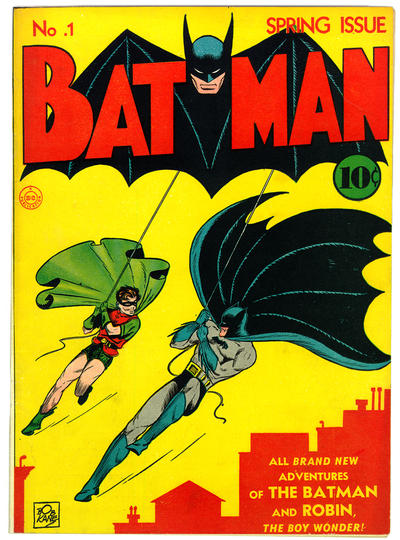
Batman's origins were different, starting in Detective Comics #27, but not getting an origin until Detective Comics #33, with the 2 page version reprinted here the slightly altered version from Batman #1 (Spring, 1940, which also saw the first appearances of Joker and the Catwoman) with words by Bill Finger, art by Bob Kane (with backgrounds by Sheldon Moldoff), with the story of how a mugger shot and killed Bruce Wayne's father and mother, Thomas and Martha, with young Bruce dedicating his life to strike fear into criminals' hearts as the Batman.A simple enough origin, and the basis for every origin that followed.
This origin was pretty much the origin readers saw in Batman #47 (June-July, 1947) by Bill Finger, Bob Kane and Charles Paris, with a few subtle alterations, like Martha dying from seeing her husband shot (and having a weak heart), young Bruce glaring at the mugger, and the mugger being given a name, Joe Chill, with Batman hunting him down, getting final vengeance (though it was Chill's own men who killed him, having heard that Chill was responsible for creating the Batman).
Both of these origins did fit under the umbrella of the Golden Age Batman, but a much longer origin for Batman (as well as his friends) did surface later, in the Untold Legend of the Batman, which added many details added to Batman's origin from the Silver Age (like his father being a Batman, as well as Bruce's stint as Robin).
Wonder Woman...The Female Sex Is Assuming Day By Day A More Dominant Role In World Affairs
Wonder Woman herself got a special condensed version of her origin, after premiering in All-Star Comics #8, then headlining starting with Sensation Comics #1.In Wonder Woman #1 (Summer, 1942, the tale reprinted here), the story of how Hippolyta carved young Diana from clay, raised her on Paradise Island, saved pilot Steve Trevor, and competed to go back with Trevor to the mainland to fight in World War II (and taking on the identity of military nurse, Diana Prince) was summarized by William Moulton Marston (under the pen name of Charles Moulton) with art by Harry G. Peter.
This would be the definite version of Wonder Woman's Golden Age origin, and the one that formed the basis for the many that followed.
That Wonder Woman origin more or less stuck, but Wonder Woman #206 (June-July, 1973) by Cary Bates, Don Heck and Vince Colletta (under a stunning Nick Cardy cover), added a current battle with Ares to the mix (as well as Diana Prince's job at the United Nations), as well as Hippolyta withholding some memories from Diana, of how Ares came and kidnapped her sister, Nubia, from Hippolyta, and was used as a pawn by him to have the two battle (and Hippolyta's revelation of his history to her daughter, with Nubia coming to stay on Paradise Island).
Sadly, this little era of Wonder Woman, fitting between her time as a powerless Wonder Woman and the twelve trials of Wonder Woman to rejoin the JLA (including one issue of Supergirl with Hippolyta and the Amazons) has not been reprinted elsewhere.
The Flash...You Can Do Almost Anything With Him...
Now, with the Flash, the distinctions between the Golden Age and Silver Age become clearer, as it was student Jay Garrick who first became the Flash in Flash Comics #1 (January, 1940) by Gardner Fox and Harry Lampert. Jay accidentally inhaled "hard water" and spent a year of college in a coma, before awakening with super speed (which he mostly kept secret, though he did show off for his girlfriend, Joan Williams).Eventually adopting the identity of the Flash, he saved Joan from the Faultless Four, eventually helping to found the Justice Society of America, and being there when it ended in the 1950s (and having many stories)....then getting revived with the help of the next young man....
Barry Allen, who first appeared in Showcase #4 (September-October, 1956), became the Flash after exposure to lightning striking a wall full of his police scientist chemicals, or at least that was the story Robert Kanigher, Carmine Infantino and Joe Kubert gave readers. Barry made his own identity as the Flash (based on a comic he read), and beating the Turtle to save Iris West in this first go around.
Sometime after this, Barry would help found the Justice League of America, and later, finding the original Flash, Jay Garrick, on an alternate Earth (which would eventually lead to Earth-1/Earth-2, with Barry on 1, Jay on 2), and later, so many other Earths, as well as a Crisis, but it all started with Barry and Jay, and the Flashes of Two Earths.
Green Lantern...No Evil Shall Escape My Sight
Alan Scott was a train engineer who nearly died in a crash, except that he was holding onto a strange green lantern as related in All-American Comics #16 (July, 1940) by Bill Finger and Martin Nodell. That green lantern related its history, bringing with it power that Alan could focus after he made a ring of its metal to wear, useful against all items but wood, with Alan taking on the identity of the Green Lantern. This Green Lantern would go on to found the Justice Society as well, having many cases with them as well as many solo cases, facing foes like the Gambler, Vandal Savage and the Icicle.Green Lantern was a part of the team when it ended the first time, and being there for its first revival.
Hal Jordan was the man to become Green Lantern in Showcase #22 (September-October, 1959) by John Broome, Gil Kane and Joe Giella. Hal was a test pilot in Coast City, who gets a Green Lantern ring from a dying Abin Sur to make him into the Green Lantern of Earth. Hal uses his ring to fight crime, giving himself the identity of Green Lantern (and adding a mask to the Green Lantern uniform), with a ring that can make anything he can think of, but needs to be recharged every 24 hours, and is useless against yellow.
Hal also helps to found the Justice League of America, finds out about the Green Lantern Corps (and that he is the protector of Sector 2814), and works for the Guardians of the Universe (who know a little bit more about the beginnings of evil, as well how the magic that formed Alan Scott's ring, than they let on).
The Green Lantern Corps are the successors of the Manhunters as well.
Hawkman...The Weirdness Seems To Be Part Of Hawkman's Appeal
Carter Hall was an archeologist researching the dagger of Khufu, when he bumped into Shiera Sanders (fleeing from an electrified railroad) in Flash Comics #1 (January, 1940) by Gardner Fox and Dennis Neville. Turns out Carter was Khufu reincarnated (as Shiera was the reincarnation of his wife, both murdered by Hath-Set....who was reincarnated at Doctor Hastor, the man behind the electrical menace). Carter uses information he had gotten on a dig to clothe himself as Hawkman, using ancient weapons and the secret Nth Metal to make wings so he could fly. Hawkman defeats Hastor, saving Shiera.Later, Shiera becomes Hawkgirl and assists Hawkman with his missions. Hawkman is also a founder of the JSA, and the only member to be involved in every JSA case in the Golden Age.
Katar Hol came to Earth as a Thanagarian policeman, with his wife and partner, Shayera Hol, pursuing the shape-changing villain, Byth, in Brave and the Bold #34 (February-March, 1961) by Gardner Fox and Joe Kubert.
Using Thanagarian science (including the Absorbascon, which allowed them access to all of Earth's knowledge), ancient weapons and an ability to speak to birds, the duo took up crimefighting as Hawkman and Hawkgirl, and Earth alter egos as Midway City Museum curators, Carter and Shiera Hall. Hawkman joined the Justice League soon after its founding, with Hawkgirl joining the JLA later. Unlike Flash, Green Lantern and Atom, the Hawks of two Earths never worked together in the Hawkman title, though the Hawkman of Earth-1 regularly worked with the Atom of Earth-1.
Hawkgirl later took on the name Hawkwoman, then, after the Crisis on Infinite Earths and Invasion!, Hawk history got confusing (as this history of Hawkgirls will show).
Green Arrow...A Streamlined Robin Hood
Though Green Arrow and Speedy first appeared in More Fun Comics #73, their origin waited until More Fun Comics #89 (March 1943) by Joe Samachson, Cliff Young and Steve Brodie. Oliver Queen was marooned on the Lost Mesa, where he met Roy Harper, a boy who had been raised by the local tribe of Indians, and the two had to work together using their archery skills against thieves who planned to plunder a local gold mine.This Green Arrow never joined the JSA, but instead joined the Seven Soldiers of Victory, and had many adventures with them, as well as only with Speedy.
Oliver Queen got a new origin in Adventure Comics #256 (January, 1959) by France Herron, Jack Kirby and Roz Kirby. Oliver Queen was a reckless millionaire who fell overboard on a yacht, ending up on Starfish Island, alone, and having to learn archery to survive. Queen even made some trick arrows to pass the time, and ended up getting off the island when he came upon pirates, and crafted a quick disguise to allow him to use his archery to stop them (and get off the island when the authorities arrived). This was one of many adventures of Green Arrow illustrated by Jack Kirby. Speedy then got a slightly newer origin as well, though not until Kirby had left Green Arrow.
Green Arrow was the first non-charter member of the Justice League of America, and later became involved with the Black Canary after getting a new costume working with Batman and losing his fortune.
Introducing The Mighty Atom
Al Pratt was a diminutive college student who started on his way to super heroics in All-American Comics #19 (October, 1940) by Bill O'Connor, Ben Flinton and Leonard Sansone. Mugged in front of his girlfriend, Mary James, Al loses the girl for a bit, but meets Joe Morgan, a homeless ex-boxer, who helps him learn the manly art of pugilism (boxing, as well other athletics). After a year, and in much better shape, Al goes to visit his ex-girlfriend, and stops her from being kidnapped (though Mary never sees him, as she is blindfolded). Al decides to take up the identity of the Atom, and fight for justice (having a costume with his next appearance).Atom is a founding member of the Justice Society of America, and, later, gets actual super-strength as well as a costume change among his many solo adventures.
Physicist Ray Palmer turns himself into the hero, the Atom, starting with Showcase #34 (September-October, 1961) by Gardner Fox, Gil Kane and Murphy Anderson. In the origin half of his tale, Ray has been experimenting with White Dwarf star material to make items shrink. Problem is, the items become unstable after a time and explode (and Ray is unable to safely enlarge them). His girlfriend, lawyer Jean Loring, takes him and a group of students on a nature hike into a large chain of caverns, which collapse while they are inside, trapping the group with little hope of rescue. Ray spots a small hole, and, having accidentally brought the White Dwarf lens with him, shrinks himself to allow him to climb the smooth walls to enlarge the hole, and, while heading back to tell Jean and the kids, accidentally walks under the lens beam again, but grows this time (as cave water had gotten on the lens, bringing along some element that allowed him to grow). Not explaining his shrinking was a success. Ray then creates a size changing uniform out of White Dwarf material, taking on the identity of the Atom.
Atom joins the Justice League after Green Arrow, and faces many foes, including Chronos. Jean and Ray even marry later on, after Ray reveals his identity to her, but they later divorce.
Shazam!...In One Thing A Sense Of Fun And The Whole Sense Of Adventure
Billy Batson was a homeless paperboy who followed a mysterious stranger into the subway in Whiz Comics #2 (February, 1940) by Bill Parker and C.C. Beck. At the end of the line, Billy met an old wizard, who said he was dying, and wanted to pass on his powers to the lad....who only had to say the wizard's name....Shazam! Billy then transformed into Captain Marvel, who had the wisdom of Solomon, the strength of Hercules, the stamina of Atlas, the power of Zeus, the courage of Achilles and the speed of Mercury. This gave Billy the ability to fight the evil Dr. Sivana, who planned on blacking out the radio stations of the day. Billy did this, and ended up getting a job with Whiz radio.Billy eventually gathered a whole Marvel Family around himself, including his sister, Mary, and their friend, Freddy Freeman, and later, Tawky Tawny and Kid Eternity. Thrown into suspended animation, they revived in the 1970s, and had more adventures on their own Earth, that of Earth-S, until the Crisis on Infinite Earths.
Plastic Man...One Of The Wildest Imaginations...
Eel O'Brian was a small time hood who got pinched in a folied robbery in Police Comics #1 (August, 1941) by Jack Cole. That ended up being the best thing that ever happened to him, as he was doused in chemicals, and, while recovering in a monestary, found he had the elastic properties of plastic. Deciding to change his life for the better to follow the monks who had helped him, Eel adopted the identity of Plastic Man, and used his crooked knowledge to find criminals, so his super self could put them in jail.Later, Plastic Man started working with Woozy Winks (a shifty indiviual himself) and the two stopped odd criminals for as long as Quality Comics lasted. Later, Plas and Woozy found themselves at home at DC Comics, with a DC Special, reprinting some of their earliest work together. The original Plastic Man later became a member of the All-Star Squadron, and, long after the Crisis On Infinite Earths, Plas joined the JLA as well (at a time when there was only one Earth).
True, there was a pretty good collection of Secret Origins in 1961, which led to even More Secret Origins, and even a seven issue run of reprints of Secret Origins (all of which included a few origins not seen here), but this 1970s tome was truly the greatest of them all!
Wednesday, February 21, 2018
Secret Origins Of Super Villains 2
Here's even more from Limited Collectors' Edition C-45 of June-July, 1976, under another wonderfully evil cover by Dick Giordano.
This time around, its the foes of Batman, Flash, Superboy/Superman and Wonder Woman that get covered....specifically Catwoman, Mirror Master, Mr. Mxyzptlk and the Cheetah!
Catwoman
Readers get to see "The Secret Life Of The Catwoman" from Batman #62 (December-January, 1950/1951) by Bill Finger, Bob Kane, Lew Schwartz and Charles Paris.Catwoman is broken out of jail by the mysterious Mr. X to help in his planned crime spree. Along the way, Catwoman encounters Batman, but saves him from a collapsing wall, with her receiving a knock on the head. Catwoman claims the 1950 calendar is ahead of time...and wonders why she is in costume, after all she is just stewardess Selina Kyle. Batman deduces she had amnesia, and works with her as she recalls a planned meeting with Mr. X. Catwoman works with the dynamic duo to capture Mr. X, and after doing so, Catwoman vows to retire from the costumed life.
Thankfully she did not....
Mirror Master
Reflecting on his past, its time for the origin of the Mirror Master from Flash #105 (February-March, 1959) by John Broome, Carmine Infantino and Joe Giella with "The Master Of Mirrors!".Ex-con Sam Scudder goes into a bank, to capture an image of one of the tellers. Appears while serving time, Scudder made a mistake making a mirror, learning how to keep a reflection in one. He continued experimenting with mirrors, making images that he could command, making himself a Mirror Master. Scudder used this ability to rob banks in Central City, coming into conflict with the Flash, who followed one of his images home, and, after a battle with some of Mirror Master's illusions, the Flash took Mirror Master to jail (so Barry Allen could make his lunch date with Iris West).
Mirror Master would return again and again to face the Flash.
Mr. Mxyzptlk
Next up, a foe of Superman's, the 5th Dimensional imp, Mr. Mxyzptlk, but a tale from his (and the Man of Steel's) boyhood, with a young Mxyzptlk facing Superboy for the first time in Superboy #78 (January, 1960) in "The Ghost of Jor-El!" by Jerry Siegel and George Papp.
Mxyzptlk started as a mischievous little boy that vexed his 5th Dimensional parents of Fuzastl and Tlndsa, so, he ran away to Earth-1, encountering Superboy in Smallville, thinking it would be fun to turn the town against the Boy of Steel. The boy prankster even enrolls in Smallville High, meeting Clark Kent, and accidentally revealing to Clark his color blindness. After a few attempts to sabotage Superboy (which Clark turns to his advantage), Superboy finally uses what he has learned to get the imp to say his name backwards and go home.
Mr. Mxyzptlk never forgave Superboy for this, and would return again and again to torment the Man of Steel.
Cheetah
Last, but not least of the featured origins, was the first battle of "Wonder Woman And The Cheetah" from Wonder Woman #6 (Fall, 1943) by William Moulton Marston and H. G. Peter.
Debutante Priscilla Rich is outshone by Wonder Woman a few times, and decides to plot revenge against the amazing amazon. Priscilla manifests an alter ego, the Cheetah, and garbs herself to look like one. stealing charity money with the intent to frame Wonder Woman for its theft. Cheetah fails in this, ending up trying to kill Wonder Woman in quicksand, then a fire, with Wonder Woman nearly figuring out her identity as it appears the flames take the Cheetah.
But, the Cheetah would return.
Added features in the treasury include a feature on 18 super villains (including Captain Boomerang, Vandal Savage, Scarecrow, Matter Master, the Shark, Bizarro No. 1, Penguin, Solomon Grundy, Giganta, Grodd, Brainiac, Two-Face, Felix Faust, Queen Bee, the Top, Pied Piper, Sonar and Kanjar Ro), another feature on the many costumes of the Catwoman, and, on the last page, "Every Hero's Enemy"...that of Dr. Light, making this and the other DC villains' treasury an indispensable guide for every villain fan of from the 1970s!


