Showing posts with label DC Super Stars. Show all posts

Wednesday, February 26, 2020

Two Face Plus Two Origins Grodd and Doctor Light

Secret origins were all the rage in comics for a time....and finding out here to now unknown facts on characters was an interesting idea.

So, when DC Super-Stars #14 (May-June, 1977) rolled around, here was a chance to explore the beginnings of two villains, Gorilla Grodd and Doctor Light, (but with different heroes helping them get their start as shown on this Jim Aparo cover), as well as the origins of the master of duality.....Two-Face!


But, there are dangers with this as well....


G -- As In Guardians, Green Lantern And Gorilla Grodd

First, a story where the Guardians of the Universe revealed unknown facts to the Green Lantern of Sector 2814 (Hal Jordan), about one of his early cases, in a story by Bob Rozakis, Rich Buckler and Bob Layton

Here, it was suggested that it was Green Lantern that, unknowingly, brought Gorilla Grodd, Solovar and the rest of Gorilla City to Earth, as an extension of one of his missions to the planet of Calor in Green Lantern #1 (July-August, 1960).

Nice idea, but impractical, as around this time, Flash was first encountering the Trickster in his own magazine, having encountered Grodd a while ago (and Flash and Green Lantern were co-founders of the JLA before this as well, with Flash encountering Grodd before the JLA formed).

A later telling of the origin in Secret Origins #40 (May,1989) by Cary Bates, Greg Weisman, Carmine Infantino and Mike DeCarlo, had the gorillas here on Earth mutated in the later 1800s by a meteor that crashed to Earth, and constructed a device to shield their city from outsiders after an encounter with some explorers (until Barry Allen stumbled upon the city later).


Double Take

The second story of the issue, by Jack C. Harris, Ed Davis and Josef Rubinstein, was an interesting exploration of the origins of Two-Face, looking at the career of District Attorney Harvey Dent, and how he worked with detective David Davis to take down Boss Moroni and the corruption of Gotham.  Dent learned that Maroni was really aiming for the detective when Dent was hit by Maroni's throw acid in the courtroom (the tragedy that led to Dent becoming Two-Face).  Oddly, his time as Two-Face served him well, as his two-sided coin deflected a bullet that would have killed him (and, as chance would have it, deflected into Maroni).

Consistent with his usual origins, but oddly lacking Batman in this tale (though slightly tied to his appearances in Teen Titans with his "daughter", the Joker's Daughter/Harlequin...a crazed bit of continuity confusion herself!).

Secret Origins Special #1 (1989) by Mark Verheiden, Pat Broderick and Dick Giordano, explored Harvey's relationship with his wife, his becoming district attorney and working with Batman, and tragic turn into Two-Face (yet that he still loved his wife, Grace - called Gilda, pre-Crisis, as he had recently saved her as Two-Face from Dalton Perry, a criminal Dent had put away in jail).


Let There Be Dr. Light

Last, but not least, is the story of Arthur Light, by Paul Kupperberg, Dick Ayers and Jack Abel, where Light invented a device that allowed him to transport to another planet, in this case, Thanagar, where he was able to steal technology that was based on light, which he used to fashion his villain identity of Dr. Light (imagination was not his strong point).  Dr. Light fought a young Thanagarian officer on his supposed first trip to Earth, Katar Hol, though he did not get the light devices back, so Dr. Light was still able to become a menace to the JLA, including Green Arrow, as well as the Teen Titans.

Problem arose with this story as well, as Katar Hol wasn't as available to be that Thanagarian police rookie (checking his extended origins in Brave and the Bold), and before the Crisis, the origin was amended to be "a Thanagarian police officer" who faced Dr. Light.

Secret Origins #37 (February, 1989) by Craig Boldman, Mike Parobeck and Ken Branch pull a Dr. Light of their own, stealing a thought from that past origin (but add to it and change it).  Arthur worked at S.T.A.R. Labs, but was a failure, until he stole the light costume from scientist Jacob Farley, who invented the costume to be a hero like the JLA, but died before he got a chance to.

The DC Super Stars issue also contained on page summaries (with earlier art) on Brainiac and the Shark...and provide an interesting look at the thoughts of creators in the 1970s, trying to link various heroes and villains (and serve as a nice example now, of some of the differences between the DC Universe, from pre-Crisis to after the Crisis On Infinite Earths!).

Saturday, February 1, 2020

Green Arrow Origins

With Arrow ending this week, figured it would be a good time to look back at the origins of the Emerald Archer....

....and over the decades, Green Arrow has had his beginnings told over and over again!

Let's take a look over a few of them, after being thankful that Green Arrow began in More Fun Comics #73 (November, 1941) by Mort Weisinger and George Papp fully formed....

The Birth Of The Battling Bowman

The first telling of Green Arrow's origin happened in More Fun Comics #89 (March, 1943) by artists Cliff Young and Steve Brodie, with millionaire Oliver Queen finding Roy Harper on a lost mesa, and the two using their archery skills to stop crooks from plundering the treasures that were found there.

This adventure ended up being the origin of the Golden Age Green Arrow (and Speedy), who were members of the Seven Soldiers of Victory.

The Green Arrow's First Case

For a telling of Green Arrow's origin, look for Adventure Comics #256 (January, 1959) by France Herron, Jack Kirby and Roz Kirby, wherein millionaire Oliver Queen fell overboard on a ship, ending up on a desert island, and using the local resources to make arrows, hunted for food, then stopped some pirates, and took on his heroic identity of Green Arrow (Speedy getting involved with his own origin told later).  The duo returned to the island as criminals had come across it, and might have found Ollie's diary of his time there and figured out he was Green Arrow.

This introduced the island to the origin of Green Arrow, but that wasn't the end of additions to Green Arrow's origin (but these two origins were reprinted in both the Secret Origins Of The Super DC Heroes of 1976 and in Green Arrow: A Celebration of 75 Years of 2016).

The Origin Of Green Arrow

Green Arrow got his origin revisited in DC Super Stars #17 (November-December, 1977) by Denny O'Neil, Mike Grell and Bruce D. Patterson.  While Oliver had been tracking down a man with proof that his fortune had been stolen, he also remembered his beginnings, very similar to the last telling, but Oliver had grown a beard on the island (and really didn't fashion clothes there as well).  Still stopping pirates (who also had thrown him overboard to begin with), he went on to become Green Arrow, joining the JLA, and losing his fortune.  It also added that he had learned archery from Howard Hill in Hollywood.

This origin is about to be reprinted in a facsimile edition of this issue, with origins of the Huntress and Legion of Super-Heroes as well!

Sometimes A Fool Notion

DC had a Crisis, and its heroes were all living on one Earth, so Ollie got an enhanced origin in Secret Origins #38 (March, 1989) by Mike Grell (who revived Green Arrow as more of an urban hunter with his Longbow Hunters mini-series and Green Arrow regular title) and for the origin, artists Hannibal King, Dick Giordano and Arne Starr.  It was a drunk Oliver Queen who fell off his own yacht who ended up on the island, but this Oliver Queen had fancied himself Robin Hood as a child, with movie stunt archer Howard Hill as a friend, and the "pirates" he stopped on the island were simple weed farmers. 


Going to a costume party soon after his return, Oliver was mulling over the idea of Robin Hood when his party was crashed by criminals, who he stopped in costume (even using an unintentional trick arrow....an arrow with a golf ball on the end) to stop them.  The main thief, Lester Norton, as being taken away, was upset about being stopped by that "green arrow guy", and the Star City papers stuck that name on Ollie's heroic identity.

Speedy's adjusted origin filled the second half of this book, and this tale has yet to be reprinted.  This Green Arrow origin showed Oliver as not much of a businessman, but more of a romantic, wanting to be a hero.

From The Beginning

This origin started similarly to the DC Super Stars one, with Green Arrow having a showdown with someone in the rain.  Green Arrow Annual #7 (1995) by Chuck Dixon, Rick Burchett, Chris Renaud, Eduardo Barreto and Gerry Fernandez introduced a pathetic playboy Oliver Queen, who had inherited his money from his parents, who fought with the crew of his yacht, and got no help when he fell overboard. to end up on an island. 

Recalling his childhood when his dad gave him a bow and arrow for Christmas (which young Ollie went outside with and accidentally killed a bunny), Ollie fashioned a bow and arrow to hunt for food, and came upon a wrecked ship on the island, and a survivor of that ship.  The pair fashioned a small raft on the island, but Ollie left his helper behind when he found out he was Nicholas Kotero (noted serial killer of women). 

Ollie ended up on another island, and found some weed farmers, and ended up back home, taking on the Green Arrow identity (and mismanaging his inherited fortune while playing hero).  It was Kotero he was confronting in the rain, as the killer also escaped the island, looking for revenge.

This origin showed Oliver being on more than one island, and that more could have happened to him in isolation.  This tale has yet to be reprinted.

The Mantle

While there were many stories in Green Arrow Secret Files & Origins #1 (December, 2002), the one by Scott McCullar, Rick Burchett and Dan Davis, where Oliver told his son, Connor, of his parents, Robert and Moira Queen.  Robert founded Queen Enterprises, had the Star City Bay Bridge build, owned the Star City Rockets (a baseball team who played at Papp Stadium).  All this, and that the Queens were descended from Sir Robert Queen the Earle of Dornee....which is what gave Robert the idea to give his son a bow and arrow one Christmas. 


Still, Ollie had no use for it after killing a rabbit, but, after a trip to Africa with his parents, guided by stunt archer Howard Hill and big game trapper Congo Bill, Robert explained to his son that he gave him the bow and arrow to help toughen the lad up...and he need to, as the party was set on by lions, killing Robert and Moira, and Ollie only survived because of his archery skills.  Congo Bill sent him home to live with an uncle, who sent Ollie to boarding school...then, Ollie was misspending his money on yachts after....until one day....

This issue also has other stories, and features on Green Arrow, Black Canary, Arsenal and more, as well as Green Arrow's trick arrows and even a chili recipe; but the issue has not been reprinted.

Green Arrow: Year One

Green Arrow: Year One is a six issue mini-series from 2007 by Andy Diggle and Mark Simpson, this time fighting with drug dealers as part of crime syndicate (introducing readers to China White, a female assassin).  Oliver was marooned on an island thanks to his bodyguard, Hackett, came to enjoy the solitude after figuring how to make a bow and arrow to get food, and found "China White"...


...who had enslaved the island's population to produce her drugs, and was working with Hackett.  Ollie fought for the people (including Taiana, a native of the island who helped nurse Ollie back to health when he was injured fighting Hackett). 

Ollie took down the operation with Howard Hill's bow (which the criminals had won in an auction), but didn't take credit for it when the authorities arrived, having a new appreciation for the people of the island.....and that he would take on a new identity, to become someone else, something else....the Green Arrow!

These six issues have been collected a few times since their original publication.

Hopefully, though a little repetitive, this should give you a little insight into the Green Arrow and how he came to be, how a spoiled rich boy became a man and a hero given the right time and circumstances....but that grew from one man, who could say that "my name is Oliver Queen....".

Wednesday, December 5, 2018

Aquaman DC Super Stars

Aquaman didn't have any 80 page or 100 page reprint collections all to himself, but one of the ones he had all to himself was DC Super Stars #7 (September, 1976), and what a fine collection it was.


All under a Jim Aparo cover, with a few great tales within, as well as a few special features, all to please even the fussiest of Aquaman fans.


Let's take a look at the tales just below the surface!


Aquaman 35

First up is Aquaman #35 (September-October, 1967) by Bob Haney and Nick Cardy, wherein Aquaman found himself "Between Two Dooms".

This was a huge issue for the Aquafamily.  First, Atlantis was attacked by Black Manta (his first appearance, though it doesn't feel so), wherein he captures Aquaman as the Sea King goes out to fight him.  While captured, Black Manta poison's Atlantis' dome, forcing Dr. Vulko (a senior advisor of Aquaman's) to pump all the water out of the city and, after Aquaman returns, initiate Project X, a plan that turns all the city dwellers into air breathers.  With only Aquaman, Aqualad, Mera and Aquababy being able to breathe water, Mera and Aquababy have to go outside the dome for a bit to breathe, where Black Manta captures the boy.  Meanwhile, Ocean Master (a previous foe of Aquaman's) was planning an attack, sees this and takes Aquababy for himself, leading to a fight between the villains, which Aquaman intercedes in...until he is injured.  Ocean Master wins, but gives Arthur Jr. to his dad, and leaves Atlantis behind.


Teen Titans 30

The second and final reprinted tale was a short from Teen Titans #30 (November-December, 1970), with Aqualad and Aquagirl (her only Teen Titans appearance before the 1980s) headed to a concert inland, where they would find "Some Call It Noise" in a story by Steve Skeates and Nick Cardy.

Garth and his Atlantean girlfriend, Tula, try to attend a concert, but have to deal with a problem first, that of an escaped mental patient enraged by an experimental hormone treatment.  While Aqualad defeats him, the patient injures Aquagirl, forcing Aqualad to take her back to the water...which he has to hurry to do because of the one hour limit Atlanteans have to be away from water.


Better still, there were a few pages on additional Aquaman villains...

...like the Fisherman, the Liquidator, the Awesome Threesome, the Human Flying Fish, and even Ocean Master, Black Manta and Mera!

Thursday, September 6, 2018

Flash DC Super Stars

Flash was one of the DC characters that did hold onto his own title even through the 1970s, so it probably wasn't a bad idea to try to tap into his rich history and give him an issue of DC Super Stars, so DC did with DC Super Stars #5 (July, 1975), which had this great cover by Dick Giordano (and the 33 of a special month where DC was saluting the Bicentennial), even though history might make you feel old, or even like you are approacing death....reflecting the 3 tales reprinted in....or, sort of.


Don't speed through the summaries, as how one of these reprints wasn't really a reprint....


Flash 157

First, we start with the reprint of the cover story from Flash #157 (December, 1965) by John Broome, Carmine Infantino and Joe Giella (and cover by Carmine Infantino and Murphy Anderson), with "The Day The Flash Aged 100 Years".

This story deal with Barry Allen dealing with the Top, one of his Rogue's Gallery solo (in between the first two appearances of the Rogue's Gallery's appearances), with the villain sending the Flash spinning by trying to steal an experimental anti-aging serum.  When the Top tries the formula on the Flash, the Flash appears to age at super speed!  This was a set up by the Flash, so the Top would leave him alone, and the Flash could follow the Top to his headquarters, but Flash couldn't find the formula there.  So, Flash tries again, this time pretending to be a hyper-evolved man with fantastic powers, gotten from a combination of the formula and one of the Top's super speed spinning gimmicks.  Top escapes the Flash, to get the vial, and gain those "powers".....but, the Flash followed him at super speed, and was able to recover the formula.


Flash 118 

Next up is a tale of young Wally West as Kid Flash, with the back up tale from Flash #118 (February, 1961) by John Broome, Carmine Infantino and Joe Giella, where Kid Flash faces "The Midnight Peril".

Wally was taking a fraternity initiation test with his pal Pete Willard, staying in a haunted house until midnight.  Pete and Wally talk about Kid Flash, with Pete telling Wally he doesn't really believe in Kid Flash.  Then, the boys are approached by "ghosts" (two men in white sheets) who chase the boys away.  Wally changes into Kid Flash (who had a smaller version of Barry's costume at this time), who uses his super speed to chase the two men (who were using the house for crime) to the police station.  Then, heading back, Kid Flash saves Pete from a rockslide, earning his respect.  Wally beats Pete back to the house and switches back to Wally, in time enough for the pair to finish their initiation into the fraternity.


All-Flash 22

Now the story of "Deal Me From The Bottom" originally appeared in All-Flash #22 (April-May, 1946) by John Broome and Martin Naydel, with Jay Garrick, the Golden Age Flash facing off against Deuces Wilde, a gambler who used a young boy who had an ability to pitch playing cards, and that was a rough deal for the Flash.


It was also a rough deal for original artist Martin Naydel, as they had the story redrawn by Rico Rival, giving the feel of a newer story, from a Golden Age one!


The issue also had a page from Strange Adventures that detailed the speed of light, as well as a text piece, that related a little history of DC's speedsters, including the Flashes -Jay, Barry and Wally - as well as the Reverse-Flash, and both Johnny Quicks (the one from Earth-2 and the other from Earth-3), but...

....you can follow the links to find info on them, and enjoy this art by Carmine Infantino of the 3 Flashes instead!

Wednesday, July 25, 2018

DC Super Stars Teen Titans

The Teen Titans had been out of print for a few years when DC Super Stars #1 (March, 1976), with its cover made of a couple of past covers of Teen Titans by Nick Cardy gave the kids their first collection of tales...


...but, this was a key issue to the development of the Teen Titans, presenting a few old tales of the team.


Let's set the wayback machine to take a look at the two classic tales reprinted here, as well as a few other surprises that E. Nelson Bridwell's reprint title had in store for readers...


Teen Titans 11

First up, the team was offered up as "Monster Bait" by Bob Haney, Irv Novick and Nick Cardy in a story reprinted from Teen Titans #11 (September-October, 1967), with cover by Cardy.

Occasional member Speedy (Green Arrow's partner, Roy Harper), came to Titans' Lair to convince the team (Robin, Kid Flash, Aqualad and Wonder Girl) to go help Willie Gregson, a young genius who was helping scientist Dr. Simon Finely, as the boy was being menaced by blackmailers using Gregson's dad's criminal past to try to have the lad steal Finely's nerve gas formula.  The five kids took the Titanscopter to the campsite near where the scientist and his team worked, and after enjoying a little time on the water in bathing suits, fought against the scuba diving criminals and their robot monster involved in this nefarious scheme.

Teen Titans 24

Next up for the team (which was down to four, as Aqualad had taken a leave of absence and Speedy joined full time), time on the slopes facing the "Skis Of Death" by Bob Haney, Gil Kane and Nick Cardy from Teen Titans #24 (November-December, 1969), with Cardy providing the original cover.

Vacationing in their alter egos (after finding out Wonder Girl's origin, name of Donna Troy and near lack of a life), the team went skiing.  Of course, there was trouble at the Medicine Mountain resort.  The Titans came to the aid of ski instructor Eddie Tallbow, to find that developer Anson Larson was trying to force the resort off the land so he could sell it to the government for a hefty profit...and he would have gotten away with it if not for these kids.

Introducing The Teen Titans

One of the most important parts of this issue was four new pages introduced by Mr. Jupiter (a senior advisor for the Teen Titans for a time), written by E. Nelson Bridwell, with art taken from previous Teen Titans issues for the members), that introduced the team for readers.


Not only Robin, Kid Flash, Aqualad, Wonder Girl and Speedy...

....but also other members such as brothers Hawk & Dove, telepath Lilith, fix-it-man Mal Duncan, and even caveboy Gnarrk and Doom Patroler Beast Boy....who, at the time of this issue, the last two had only been associates of the team.


That was due to change, thanks to the successful sales of this issue (as well as Super-Team Family #1, which also had a Teen Titans reprint), leading to the Teen Titans getting a ten issue revival in the mid-1970s, which also featured the introduction of the Titans West and added a few new heroes to the team, like Bumblebee, Joker's Daughter, Bat-Girl and Golden Eagle!

But, bigger things were coming for the Titans after the 1970s ended....

Thursday, June 28, 2018

Batman Marries Catwoman

It isn't a hoax, imaginary story or any other such phony plot device, but a real wedding for Batman and Catwoman....or, technically for Bruce Wayne and Selina Kyle.

It happened long ago, on a place called Earth-2, where the original Batman (who was a member of Justice Society of America) and the Golden Age Catwoman lived....

The Autobiography Of Bruce Wayne

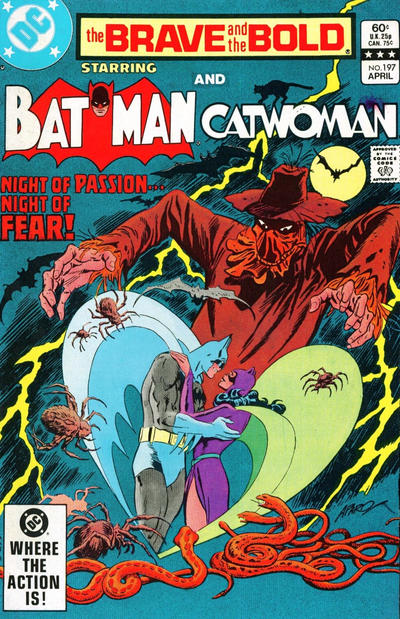
Brave and the Bold #197 (April, 1983) by Alan Brennert, Joe Staton and George Freeman (with a stunning cover by Jim Aparo), presents the story where Bruce and Selina finally admit their love for each other in 1955.

Batman worries about being alone as one of Bruce Wayne's former girlfriends gets marries, and, thanks to a recently paroled Scarecrow, that fear manifests, as Robin, Batwoman, then Alfred, Gordon, even Lois Lane and Superman disappear.  Batman goes for help from an old enemy, Catwoman, serving time as Selina Kyle after turning herself in (and claiming amnesia for most of her time as Catwoman).  During their search for Scarecrow, the two open up to each other about how much life had hurt them, and that they had both needed someone...so that they both conquered their fear of being alone by trusting each other.  The story ends with a quick summary of their wedding, as well as the events which happened in the decades following.

This story is one of the best Batman stories ever written, and has been reprinted many times, including in the Greatest Batman Stories Ever Told of 1988, Catwoman: A Celebration of 75 Years of 2015, and in Tales Of The Batman: Alan Brennert of 2016.  This tale alone almost makes any of those collections worth buying, and the other tales around it are just a bonus.


The Kill Kent Contract

Bruce and Selina get married in Superman Family #211 (October, 1981) by E. Nelson Bridwell, Kurt Schaffenberger and Dan Adkins, with guests like Dick Grayson (Robin), Alfred Beagle, Commissioner James Gordon, Harvey Kent (the former Two-Face), and Clark Kent and Lois Lane (Mr. and Mrs. Superman).

This tale starts with Clark and Lois getting an invitation of Bruce and Selina's wedding (via Batplane, no less), and the pair heading to Gotham City to attend (revealing Lois knows both parties secret identities as well as how Selina gave up, about her brother Kyle, the King of Cats).  A phone mix up allows Lois to hear that a plot to kill Kent is afoot at the wedding.  The ceremony shows Dick Grayson as Bruce's best man, Karl Kyle giving Selina away, and Bruce's butler, Alfred Beagle (the Golden Age version of Alfred Pennyworth), Com. James Gordon (with wife Barbara and son Tony).  Afterward, at the reception, Clark and Lois meet Harvey Kent, former Gotham District Attorney (and Two-Face, before cured with plastic surgery), who as the Kent who was the target.

Superman foils the criminal's plans, and later, when Lois, Clark, Bruce and Selina are alone, Lois and Clark reveal their secret to Selina, hoping the couples would be best of friends (but it was Bruce and Dick who returned for a second appearance in the Mr. and Mrs. Superman feature in Superman Family #216). 

Sadly, this tale, like most of the Mr. and Mrs. Superman tales other than Lois and Clark's wedding from Action Comics #484, has not been reprinted, but this whole run from Superman and Superman Family, along with the Action Comics issue cries out to be collected, as writer E. Nelson Bridwell really fleshed out the differences between the Earth-1 and Earth-2 versions of Superman (and Batman) with entertaining tales of a married Clark and Lois set in the 1950s.


From Each Ending....A Beginning

A quick peak at Bruce and Selina's wedding happens in DC Super-Stars #17 (November-December, 1977) by Paul Levitz, Joe Staton and Bob Layton, as well as a little look at Bruce and Selina's life after getting hitched, including how both retired their costumed identities for a while, as they raised a daughter, Helena Wayne.

The majority of this issue is about Helena, and Bruce and Selina's life at that time, but this does have that first flashback to her birth in 1957, as well as a little time of her growing up, as well as establishing many of the guests at Bruce and Selina's wedding, setting up for the later tales which help fill in the holes of the details.  The issue also introduces Silky Cernak, and the catastrophe he will introduce into the lives of Bruce, Selina and Helena Wayne in 1976, which the title of the tale suggests, leading to the introduction of the Huntress and her costume which looks like a hybrid of Batman and Catwoman's (though Huntress appeared only days earlier in All-Star Comics #69, technically her first appearance in a cameo in the JSA tale, though this story happened first).

This tale has been reprinted a few times, in Batman In The Seventies from 1999, Huntress: Darknight Daughter from 2006 (which cries for a follow up volume to finish the Huntress reprints from the 1970s/1980s from the back of Wonder Woman as her history shows, almost all her other tales have been reprinted), and in Catwoman: A Celebration of 75 Years from 2015), completing our look back at the first time Batman and Catwoman got married.