Showing posts with label More Fun Comics. Show all posts

Thursday, November 27, 2025

Happy Thanksgiving 2025

A happy Thanksgiving to all.

May you have more fun, and not face a turkey as big as this pilgrim did, in this cover to More Fun Comics #26 (November, 1937) by Vin Sullivan.


Monday, January 1, 2024

A More Fun New Year

May you have a Happy New Year, and celebrate today however you will...but don't get caught like Spike Spalding did on this cover to More Fun Comics #17 (January, 1937) by Vin Sullivan.


Spike was an ordinary kid of the time who got into extraordinary trouble, including being mistaken for the young king (Philip) of Patrania, leading to Spike being kidnapped by the evil Count Alex.


Spike appeared starting in New Fun #3 (April, 1935) up to More Fun Comics #30 (March-April, 1938), all predating the first appearance of Superman in Action Comics.

Saturday, February 1, 2020

Green Arrow Origins

With Arrow ending this week, figured it would be a good time to look back at the origins of the Emerald Archer....

....and over the decades, Green Arrow has had his beginnings told over and over again!

Let's take a look over a few of them, after being thankful that Green Arrow began in More Fun Comics #73 (November, 1941) by Mort Weisinger and George Papp fully formed....

The Birth Of The Battling Bowman

The first telling of Green Arrow's origin happened in More Fun Comics #89 (March, 1943) by artists Cliff Young and Steve Brodie, with millionaire Oliver Queen finding Roy Harper on a lost mesa, and the two using their archery skills to stop crooks from plundering the treasures that were found there.

This adventure ended up being the origin of the Golden Age Green Arrow (and Speedy), who were members of the Seven Soldiers of Victory.

The Green Arrow's First Case

For a telling of Green Arrow's origin, look for Adventure Comics #256 (January, 1959) by France Herron, Jack Kirby and Roz Kirby, wherein millionaire Oliver Queen fell overboard on a ship, ending up on a desert island, and using the local resources to make arrows, hunted for food, then stopped some pirates, and took on his heroic identity of Green Arrow (Speedy getting involved with his own origin told later).  The duo returned to the island as criminals had come across it, and might have found Ollie's diary of his time there and figured out he was Green Arrow.

This introduced the island to the origin of Green Arrow, but that wasn't the end of additions to Green Arrow's origin (but these two origins were reprinted in both the Secret Origins Of The Super DC Heroes of 1976 and in Green Arrow: A Celebration of 75 Years of 2016).

The Origin Of Green Arrow

Green Arrow got his origin revisited in DC Super Stars #17 (November-December, 1977) by Denny O'Neil, Mike Grell and Bruce D. Patterson.  While Oliver had been tracking down a man with proof that his fortune had been stolen, he also remembered his beginnings, very similar to the last telling, but Oliver had grown a beard on the island (and really didn't fashion clothes there as well).  Still stopping pirates (who also had thrown him overboard to begin with), he went on to become Green Arrow, joining the JLA, and losing his fortune.  It also added that he had learned archery from Howard Hill in Hollywood.

This origin is about to be reprinted in a facsimile edition of this issue, with origins of the Huntress and Legion of Super-Heroes as well!

Sometimes A Fool Notion

DC had a Crisis, and its heroes were all living on one Earth, so Ollie got an enhanced origin in Secret Origins #38 (March, 1989) by Mike Grell (who revived Green Arrow as more of an urban hunter with his Longbow Hunters mini-series and Green Arrow regular title) and for the origin, artists Hannibal King, Dick Giordano and Arne Starr.  It was a drunk Oliver Queen who fell off his own yacht who ended up on the island, but this Oliver Queen had fancied himself Robin Hood as a child, with movie stunt archer Howard Hill as a friend, and the "pirates" he stopped on the island were simple weed farmers. 


Going to a costume party soon after his return, Oliver was mulling over the idea of Robin Hood when his party was crashed by criminals, who he stopped in costume (even using an unintentional trick arrow....an arrow with a golf ball on the end) to stop them.  The main thief, Lester Norton, as being taken away, was upset about being stopped by that "green arrow guy", and the Star City papers stuck that name on Ollie's heroic identity.

Speedy's adjusted origin filled the second half of this book, and this tale has yet to be reprinted.  This Green Arrow origin showed Oliver as not much of a businessman, but more of a romantic, wanting to be a hero.

From The Beginning

This origin started similarly to the DC Super Stars one, with Green Arrow having a showdown with someone in the rain.  Green Arrow Annual #7 (1995) by Chuck Dixon, Rick Burchett, Chris Renaud, Eduardo Barreto and Gerry Fernandez introduced a pathetic playboy Oliver Queen, who had inherited his money from his parents, who fought with the crew of his yacht, and got no help when he fell overboard. to end up on an island. 

Recalling his childhood when his dad gave him a bow and arrow for Christmas (which young Ollie went outside with and accidentally killed a bunny), Ollie fashioned a bow and arrow to hunt for food, and came upon a wrecked ship on the island, and a survivor of that ship.  The pair fashioned a small raft on the island, but Ollie left his helper behind when he found out he was Nicholas Kotero (noted serial killer of women). 

Ollie ended up on another island, and found some weed farmers, and ended up back home, taking on the Green Arrow identity (and mismanaging his inherited fortune while playing hero).  It was Kotero he was confronting in the rain, as the killer also escaped the island, looking for revenge.

This origin showed Oliver being on more than one island, and that more could have happened to him in isolation.  This tale has yet to be reprinted.

The Mantle

While there were many stories in Green Arrow Secret Files & Origins #1 (December, 2002), the one by Scott McCullar, Rick Burchett and Dan Davis, where Oliver told his son, Connor, of his parents, Robert and Moira Queen.  Robert founded Queen Enterprises, had the Star City Bay Bridge build, owned the Star City Rockets (a baseball team who played at Papp Stadium).  All this, and that the Queens were descended from Sir Robert Queen the Earle of Dornee....which is what gave Robert the idea to give his son a bow and arrow one Christmas. 


Still, Ollie had no use for it after killing a rabbit, but, after a trip to Africa with his parents, guided by stunt archer Howard Hill and big game trapper Congo Bill, Robert explained to his son that he gave him the bow and arrow to help toughen the lad up...and he need to, as the party was set on by lions, killing Robert and Moira, and Ollie only survived because of his archery skills.  Congo Bill sent him home to live with an uncle, who sent Ollie to boarding school...then, Ollie was misspending his money on yachts after....until one day....

This issue also has other stories, and features on Green Arrow, Black Canary, Arsenal and more, as well as Green Arrow's trick arrows and even a chili recipe; but the issue has not been reprinted.

Green Arrow: Year One

Green Arrow: Year One is a six issue mini-series from 2007 by Andy Diggle and Mark Simpson, this time fighting with drug dealers as part of crime syndicate (introducing readers to China White, a female assassin).  Oliver was marooned on an island thanks to his bodyguard, Hackett, came to enjoy the solitude after figuring how to make a bow and arrow to get food, and found "China White"...


...who had enslaved the island's population to produce her drugs, and was working with Hackett.  Ollie fought for the people (including Taiana, a native of the island who helped nurse Ollie back to health when he was injured fighting Hackett). 

Ollie took down the operation with Howard Hill's bow (which the criminals had won in an auction), but didn't take credit for it when the authorities arrived, having a new appreciation for the people of the island.....and that he would take on a new identity, to become someone else, something else....the Green Arrow!

These six issues have been collected a few times since their original publication.

Hopefully, though a little repetitive, this should give you a little insight into the Green Arrow and how he came to be, how a spoiled rich boy became a man and a hero given the right time and circumstances....but that grew from one man, who could say that "my name is Oliver Queen....".

Wednesday, October 28, 2015

Guide to Golden Age Spectre Reprints

Looking back at the Golden Age must seem like looking back at people who are long gone...but one Golden Age star started out dead!  Jim Corrigan was just a cop, until a confrontation with a mobster ended up with Jim dead, until he was approached by "the Voice", and returned from the dead to punish criminals, as the Spectre, the spirit of vengeance, starting with More Fun Comics #52 (February, 1940) by Jerry Siegel and Bernard Baily.

Spectre has had quite a few of his original Golden Age tales rise from the dead as well...

Starting with More Fun Comics #52 and More Fun Comics #53 (March, 1940), both by Jerry Siegel and Bernard Baily, detailing Jim Corrigan's war against mobster Gat Benson, and how he returned to life in the first story, and saving his girlfriend, Clarice Winston, in the second, but being unable to his engagement with her, because he is now dead.  It is in the second tale that Jim fashions the costume of the Spectre.

These two stories are often reprinted together, finding their way into Secret Origins #5 (November-December, 1973) with a cover by Nick Cardy in this E. Nelson Bridwell edited series, and then in the Weird Secret Origins of 2004 (under a Jerry Ordway cover, edited by Robert Greenberger, and also containing a Dr. Fate Golden Age origin tale), and these origins were reprinted again along with other origin collections in the DC Universe: Secret Origins hardcover of 2012, and DC Universe: Secret Origins softcover of 2013.


Jim Corrigan battles another evil spirit named "Zor" in More Fun Comics #55 (May, 1940) in a tale by Jerry Siegel and Bernard Baily, battling for the life of Clarice Winston, winning with the help of "the Voice".


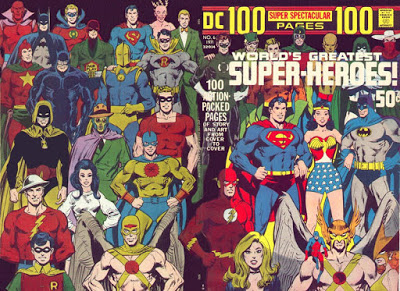
This issue was reprinted in DC 100 Page Super Spectacular #6 (1971), which, under this awesome Neal Adams cover, also had a reprint of the first JLA/JSA team-up, a Golden Age Vigilante story, and a previously unpublished Golden Age Wildcat story (as well as lists of "every" DC hero's first appearance up to that time.).  Even better, DC made a replica of the World's Great Super-Heroes Super Spectacular (yes, a reprint of a collection of reprints) in May, 2004 (though the cover was slightly altered)!

More Fun Comics #57 (July, 1940) features "The Return of Zor" by Jerry Siegel and Bernard Baily, with the Spectre having to clear Jim Corrigan's name (as Zor returns, frames Jim for murder after freeing himself from the paralysis Jim had left him under...).

Along the way, Spectre turns the real murderer into a tree, then banishes Zor into the depths of the universe (but that wouldn't stop Zor from returning eventually...).


This tale was reprinted in Superman #252 (June, 1972) under a high flying cover by Neal Adams (and a few other Golden Age stories of Dr. Fate, Starman, Hawkman and Hawkgirl and more), and later in the Greatest Golden Age Stories Ever Told hardcover of 1990, all under a Jerry Ordway cover with a few of the Spectre's fellow members of the Justice Society of America and All-Star Squadron.

Next up is More Fun Comics #65 (March, 1941) by Jerry Siegel and Bernard Baily, with the Spectre facing off against the villain called the Blue Flame (really "Dr. Mephisto", a stage magician, as Jim Corrigan discovered with a little detective work).

This tale awoke again in Detective Comics #443 (October-November, 1974) under a cover done mainly by Jim Aparo (though not the Spectre, thankfully, Jim rendered the ghostly guardian for his run in Adventure Comics from #431-440), and this issue also contained a Golden Age Green Lantern tale and in the new Batman story, the end for the revived Golden Age Manhunter by Archie Goodwin and Walt Simonson (which itself has been reprinted a few times).

More Fun Comics #66 (April, 1941), by Jerry Siegel and Bernard Baily, sees the Spectre go into "The World Within The Paintings", saving Clarice from robbers and creatures from an extra-dimensional world within paintings.


This tale found itself reprinted in the 100-Page Super-Spectacular DC-20 of September, 1973 and also includes a few other Golden Age reprints, of folks like the Black Canary, Dr. Mid-Nite, Batman's earliest fights with Two-Face and more...

...all under a cover by artist Nick Cardy, who was quite the cover sensation of the 1970s!


Spectre fought "The Vanishing Menaces" in More Fun Comics #73 (November, 1941) by Jerry Siegel and Bernard Baily, facing animals transported from Africa by Nat Rhodes, using Morton Kirk's transporting machine.


This issue was reprinted in its entirety in the Millennium Edition: More Fun Comics #73 of January, 2001, which also features the first appearance of Aquaman and Green Arrow, of Dr. Fate foe Mr. Who (with the doctor capturing the cover in his half mask that he was using at this time), as well as Johnny Quick, a ton of Golden Age goodness!

The Spectre's last Golden Age appearance was in More Fun Comics #101 (January-February, 1945) by Gardner Fox and Bernard Baily, and "The Unsafe Safe", with the Spectre helping Percival Popp (the Super-Cop) against jewel thieves, who tricked Percival into helping them.


This tale is found in the Millennium Edition: More Fun Comics #101 of November, 2000.  This issue also features Green Arrow, Aquaman, and Johnny Quick, as well as debuting a new feature...Superboy (a story of Superman, as a boy!

The Spectre didn't return until Showcase #60 (January-February, 1966) by Gardner Fox and Murphy Anderson.

But, these weren't the only Golden Age Spectre solo tales...

...the Spectre was one of many DC heroes featured in All-Star Comics #1 (Summer, 1940) in "The Tenement Fires" by Jerry Siegel and Bernard Baily, facing off against Dr. Cragg and an arsonist, and in  All-Star Comics #2 (Fall, 1940) facing off against an evil high priest of Brztal in "The Curse of Kulak" by Jerry Siegel and Bernard Baily.

The first All-Star Comics story was reprinted in the Great Comic Book Heroes of 1965, and both tales found themselves (along with stories of the Golden Age Flash, Hawkman, Johnny Thunder, Hourman and more) in the All-Star Comics Archives #0 of March, 2006.

Spectre was also a founding member of the Justice Society from All-Star Comics #3 (Winter, 1940) until All-Star Comics #23 (Winter, 1944), and all those tales are reprinted in the All-Star Comics Archives.

Spectre's earliest Golden Age tales were also collected in the Golden Age Spectre Archives #1 in 2003, featuring the stories from More Fun Comics #52 to More Fun Comics #70 (August, 1941), all by Jerry Siegel and Bernard Baily....but would it kill DC to give us a Golden Age Spectre Archives #2 with the rest of the story?

One would hope that Emmett Scanlan, who played detective Jim Corrigan on NBC's Constantine would be dying for one...as viewers were only teased with his becoming the Spectre in that show...


Thursday, October 15, 2015

Guide to Golden Age Dr. Fate Reprints

Dr. Fate premiered in More Fun Comics #55 (May, 1940) by Gardner Fox and Howard Sherman fighting Wotan to save Inza Cramer using his mystic might...and Kent Nelson kept up the battle for years in More Fun Comics, both with and without his stylish helmet of Nabu.

Let's take a look at where you can read those tales more recently!

More Fun with Dr. Fate


First up, is the tale from More Fun Comics #56 (June, 1940) by Gardner Fox and Howard Sherman, with Dr. Fate continuing "The Search For Wotan" (started in the previous issue) and his lady, Inza Cramer, where Kent Nelson's mystical alter ego has to search the underworld to find Inza, to free her from the clutches of the evil sorcerer/scientist.

This story found itself reprinted in the Immortal Doctor Fate #1 (January, 1985), with a cover by Walt Simonson, along with a retold Dr. Fate origin from DC Special Series #10 (April, 1978) by Paul Levitz and Joe Staton and the solo Dr. Fate story from First Issue Special #9 (December, 1975) by Martin Pasko and Walt Simonson (where the ankh symbol was more fully incorporated into the Doctor Fate mythos).

Next up is the next issue, More Fun Comics #57 (July, 1940) by Gardner Fox and Howard Sherman, with Dr. Fate dealing with "The Fire Murders", bodies horribly burned to death.  Dr. Fate and Inza deal with Mango the Mighty, the sorcerer who has been burning these people, and his undead legions.

This story was reprinted in Superman #252 (June, 1972) under a high-flying cover by Neal Adams, and this issue also features Golden Age Stories of Hawkman and Hawkgirl, the Spectre, Starman, Superman and more!

Dr. Fate and Inza's next single reprint was from More Fun Comics #65 (March, 1941) by Gardner Fox and Howard Sherman find the duo dealing with Nyarl-Amen and "The Fish-Men of Nyarl-Amen" to keep the U.S. Navy safe in Hawaii from these undersea invaders (all unaware of the real tragedy due to hit Pearl Harbor months later).


This tale was reprinted in Wanted, the World's Most Dangerous Villains #3 (November, 1972) under a Nick Cardy cover, and also had Golden Age Hawkman and Vigilante reprints, continuing the ties between Hawkman and Dr. Fate, as well as airing out great Golden Age stories!

Inza starts the next story, dealing with Helen, "The Leopard Girl" in More Fun Comics #66 (April, 1941) by Gardner Fox and Howard Sherman, where Helen is having troubles dealing with her leopard-like spots, and her cousin, Sarkiss, who wants her inheritance.  Inza calls in Dr. Fate for help, and along the way, Dr. Fate reveals his human side to Inza.


This story was reprinted in Detective Comics #439 (February-March, 1974) under a cover by Neal Adams and Dick Giordano, with a Golden Age Hawkman reprint as well...and quite a few good Silver Age stories reprinted, as well as a new tale of Batman, and one of Archie Goodwin and Walt Simonson's Manhunter tales.

With More Fun Comics #67 (May, 1941), readers finally get to see "The Origin Of Doctor Fate" by Gardner Fox and Howard Sherman, where we find out how young Kent Nelson was exploring an Egyptian pyramid with his archeologist father, Sven, and Kent stumbled upon the tomb of Nabu, who Kent released (as the Lord of Order, Nabu, wasn't dead, but in a gas that kept him in suspended animation).  This gas killed Kent's dad, but Nabu raised the boy and taught him magic, also giving him the helmet of Dr. Fate.  This tale happened in flashback, and also detailed the current battle of Dr. Fate and Inza against the demon, Negal.

This tale has been reprinted a few times....in Justice League of America #95 (December, 1971) under a Neal Adams cover (along with a tale of Dr. Mid-Nite), in the DC Special Blue Ribbon Digest #9 (May, 1981) under a cover by Ross Andru and Dick Giordano (and reprints of origins for the Silver Age Atom, Swamp Thing, Batgirl, Krypto and the Silver Age Green Arrow and Speedy), in the Weird Secret Origins #1 (2004) with a cover by Jerry Ordway, and also containing the origins of the Spectre, Congorilla, Animal Man, El Diablo and the Enchantress in this superbly edited throwback collection by Robert Greenberger, which itself was reprinted along with other origin collections in the DC Universe: Secret Origins hardcover of 2012, and DC Universe: Secret Origins softcover of 2013.

Dr. Fate and Inza next deal with a mad scientist and his assistant Nasha in More Fun Comics #68 (June, 1941) by Gardner Fox and Howard Sherman, with Dr. Fate wrecking the scientist's lab, showing off his mystical strength and invulnerability (and maybe a little on how less human Dr. Fate is, as opposed to Kent Nelson!).


This tale is reprinted in Detective Comics #442 (August-September, 1974) with a Jim Aparo cover, and features Golden Ages tales of Black Canary, the Newsboy Legion and Batman, as well as Silver Age Hawkman and Elongated Man tales, and a new Batman story, and the next to last original chapter of Archie Goodwin and Walt Simonson's Manhunter.

More Fun Comics #73 (November, 1941) by Gardner Fox and Howard Sherman was the next to be reprinted, and it had a lot happening in it.  It was the second appearance of Dr. Fate with his new half-helmet (reflecting Kent giving up some of his mystical power, but also not being controlled by Nabu any more, living with only his strength, invulnerability and flight powers), and the introduction of "Mr. Who", a criminal mastermind that would continue to vex the doctor with his Solution Z (which gave Mister Who superhuman powers).

This tale was reprinted twice on its own, once in Wanted, the World's Most Dangerous Villains #8 (June-July, 1973) with a Nick Cardy cover, and a Flash/Captain Cold battle, and reprinted again along with the rest of the contents of More Fun Comics #73 in the Millennium Edition: More Fun Comics #73 of January, 2001 along with the first appearances of Golden Age Green Arrow and Aquaman.

This was the end of the Doctor Fate reprints, though the Doctor Fate series continued on until More Fun Comics #98 (July-August, 1944), with Doctor Fate in his half-helmet, fighting more like a super-hero than a master of the mystic arts. 

Still, Dr. Fate had his time, also serving with the Justice Society as one of their charter members, and best of all, ALL of Dr. Fate's solo Golden Age adventures, with battles against Wotan, Ian Karkull, Mister Who, the Octopus, the Red Sage, the Clock and more from More Fun Comics #55 to #98 are available in the Golden Age Doctor Fate Archives #1 from 2007 (and his JSA tales in the All-Star Comics Archives).  So, at least the early tales of Dr. Fate aren't that tough to dig up, but be careful picking it up, you might not be able to put it down!  It would be magical if all DC's Golden Age was reprinted like this! 


Thursday, September 24, 2015

Guide to Golden Age Tarantula, Johnny Quick and Liberty Belle reprints

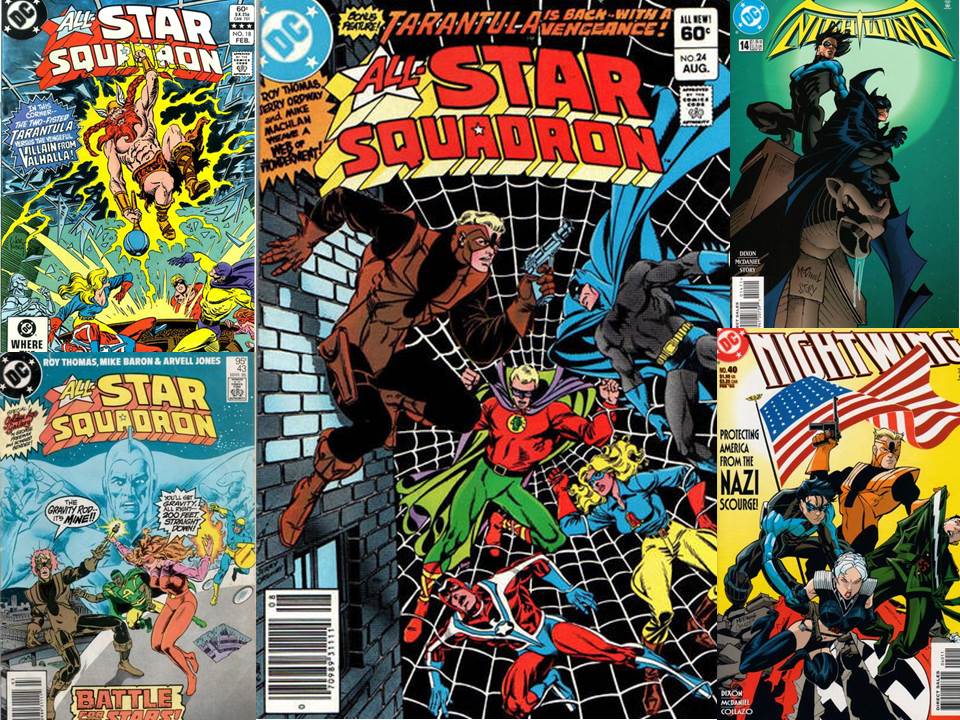
Looking back at the Golden Age of comics, taking a focus on a few characters (Tarantula, Johnny Quick and Liberty Belle) from that era that got a revival in the 1980s with the All-Star Squadron...

...and where to find reprints of their classic tales from the 1940s! 

Tarantula

John Law was a mystery writer in the 1930s, who, with the introduction of other mystery men, and inspired by his pet spider, decided to become the mystery man known as Tarantula (though a radio announcer called him "Spider-Man" in his first appearance, in Star-Spangled Comics #1 of October, 1941 by Mort Weisinger and Hal Sharp...and he had no relation to the Tarantula who was an early nemesis to the Sandman).  Armed with suction cup boots and a web-firing gun (and a loyal housekeeper named Olga), Tarantula was ready to fight crime in the Golden Age....at least until Star-Spangled Comics #19 (April, 1943).

Sadder still, only one of his Golden Age stories was reprinted...


...that of Star-Spangled Comics #11 (August, 1942) with the tale of "Galloping Gold" by writer Wade Wellman and artist Ed Smalle, Jr., where Tarantula goes west to face Bandana Bardon and other cattle rustlers.


This was reprinted in World's Finest Comics #207 (November, 1971), under a Curt Swan/Murphy Anderson cover with Superman and Batman facing some cowboy outlaws as well...along with a reprint of a sci-fi tale from Strange Adventures!


Don't feel too bad for Jonathan Law, he came back in the 1980s All-Star Squadron series by Roy Thomas, and Jerry Ordway gave him a new costume as well (via John's housekeeper, Olga)....and thanks to the time-traveling kids from Infinity, Inc., we know he had a successful novel on the Golden Age mystery men!

Jonathan even survived World War II, to show up as an elderly writer in issues of Nightwing, starting with Nightwing #14 (November, 1997), as a resident of Dick Grayson's apartment building, and showing up here and there, including issues #16, #21, #31, #40, #42, #48, #54, #55, #72, #79 and #86 (and Titans #36 of February, 2002), until problems with Blockbuster resulted in a new, female Tarantula.

Johnny Quick

Johnny Chambers was an orphan, taken in by Professor Ezra Gill, who believed one could travel at super-speed by reciting a mathematical formula, 3x2 (9YZ) 4A.  The professor passed of old age, because Johnny wasn't fast enough to save him...and eventually Johnny became a photographer for Sees All/Tells All News, along with Tubby Watts (who worked as his assistant).  Johnny and Tubby found themselves in trouble while on assignment at a circus, and this time, when Johnny said the formula, it worked, and Johnny quickly mopped up the crooks, modifying his circus outfit to work as his super-hero costume, with Tubby as his assistant not only with the paper, but as a hero.  All this happened in More Fun Comics #71 (September, 1941 by Mort Weisinger and Chad Grothkopf), which sadly has not been reprinted (though a version of it with more details, including his inspiration coming from the Flash, can be found in All-Star Squadron #65, January, 1987 by Roy & Dann Thomas and Don Heck).

It's a good thing Johnny was so quick, because quite a few of his Golden Age tales were reprinted!

Johnny's earliest reprint came from More Fun Comics #73 (November, 1941), by writer Mort Weisinger and artist Ed Moore Jr. and inker Chad Grothkopf, in the story "The Black Knight", where Johnny faced off against, well...the Black Knight, and the man behind the scenes pulling its strings....Sam Kirby.


This story was reprinted in the Millennium Edition: More Fun Comics #73 of January, 2001, which also features the first appearance of Aquaman and Green Arrow, of Dr. Fate foe Mr. Who (with the doctor capturing the cover in his half mask that he was using at this time), as well as Spectre, a ton of Golden Age goodness!

Johnny Quick's next reprinted story is from More Fun Comics #76 (February, 1942) by Mort Weisinger and Mort Meskin, entitled "The Adventure Of The Human Streak", where Johnny and Tubby faced off against Dr. Clever and his henchman, Breezy, whom the doctor gives super-speed via a ray invention of his.  Pretty clever, that doctor...but not good enough to not get boxed down by Johnny Quick!


This story was reprinted in Wanted, the World's Most Dangerous Villains #7 (March-April, 1973), with a cover by Nick Cardy, and also contained Golden Age Hawkman and Hourman reprints, in a series edited by E. Nelson Bridwell (who was responsible for so many Golden Age reprints finding new life).
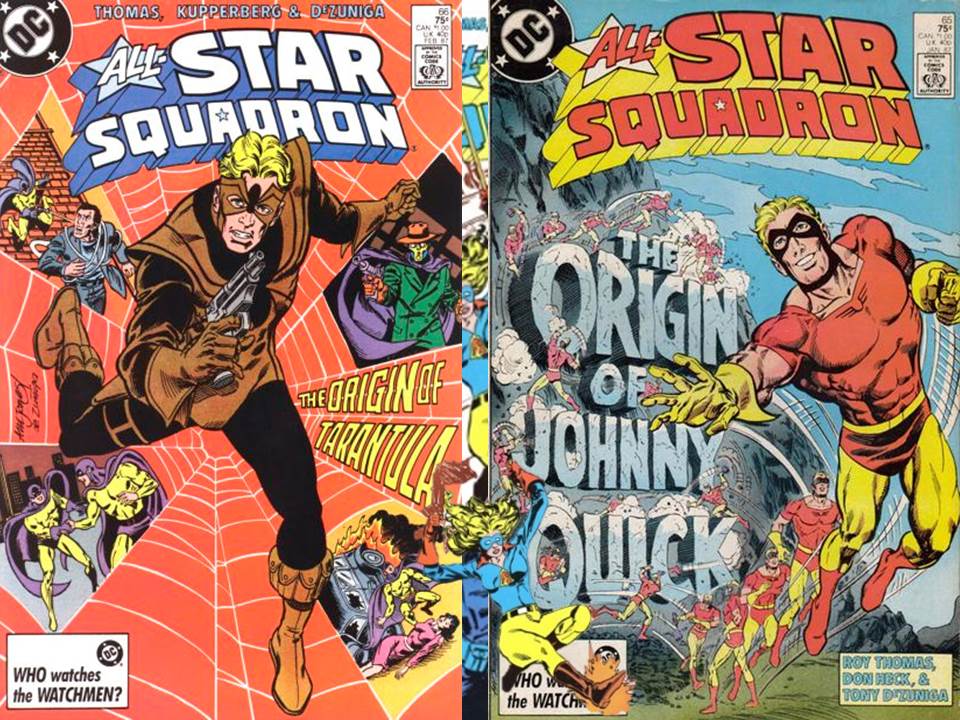

The last of Johnny's More Fun Comics appearances to be reprinted is from More Fun Comics #101 (January-February, 1945) by Don Cameron and Mort Meskin, in the story "An Investment In Happiness", where Johnny and Tubby help dying tycoon, Darius Droobe, give money back to people he swindled over the years...much to the chagrin of Droobe fortune inheritor, Ambrose.


This tale is found in the Millennium Edition: More Fun Comics #101 of November, 2000.  This issue also features Green Arrow, Aquaman, and in his last Golden Age appearance, the Spectre, as well as debuting a new feature...Superboy (a story of Superman, as a boy!  Johnny quickly left More Fun Comics after this issue (with More Fun Comics #107 of January-February, 1946), and along with Green Arrow, Aquaman and cover feature, Superboy, ended up in Adventure Comics, starting with Adventure Comics #103 (April, 1946).

Johnny's earliest Adventure Comics reprint was from Adventure Comics #117 (June, 1947) with "The Man Who Wore Ten Hats" by Bill Finger and Mort Meskin, with Johnny and Tubby helping a small town man who works too much against a crooked mayor.


This tale was reprinted in Flash #229 (September-October, 1974), under a cover by Nick Cardy, and along with Johnny Quick, features a new team-up of the Golden Age and Silver Age Flash (vs. Golden Age villains Rag Doll and the Thinker), as well as Silver Age Green Lantern, Kid Flash and Flash reprints, and a Golden Age Flash reprint as well!


Next up, reprint-wise, is the Johnny Quick story from Adventure Comics #121 (October, 1947) by Bill Finger and Mort Meskin called "The 9th Wonder Of The World"...

...wherein Johnny helps out some kids in a hospital's children's ward who were about to get a featured in an upcoming issue of his Pal the Wonder Dog comic when Mel Mitchum (the cartoonist) loses the issue in a fire.  So, Johnny quickly turns out a replacement issue for him...what comic book creator wouldn't like to have a super-speeding artist on hand?


This story ended up reprinted in Flash #232 (March-April, 1975), under an awesome Nick Cardy cover...


...within the issue is featured Barry Allen's Flash in team-ups with Kid Flash and Green Lantern, as well as a Golden Age Flash reprint.


Quick with that next reprint, as the story from Adventure Comics #123 (December, 1947) is, with the story of "The Adventure Of The Antelope Boy" by Don Cameron and Mort Meskin, with Johnny and Tubby traveling to Africa to see this "antelope boy" who can run really fast...but they end up having to save him from mobster, Mobs Bracket.


This story ended up being reprinted in Flash #160 (April, 1966, and is also known as 80 Page Giant #G-21), under a cover by Carmine Infantino and Murphy Anderson, and as Barry Allen's Flash shows you, contains quite a number of quick adventures...

...all under a DC Comics checkerboard!


Johnny faces a slow foe, that of Sleepy, in Adventure Comics #129 (June, 1948) in the story "The Slowpoke Crimes" by an unknown writer, and art by Mort Meskin...

...where Sleepy is able to use his lack of speed as an advantage for a time against Johnny Quick!


This story was reprinted in the 100-Page Super-Spectacular DC-22 of November, 1973 under a cover by Nick Cardy, and also has a Golden Age Flash reprint...


...as well as a story involving the change of Kid Flash's costume!


Next up, in Johnny Quick reprints is Adventure Comics #144 (September, 1949), with the story of "The Day That Was Five Years Long" (which might be how you feel reading about Johnny's reprints), but this was a story by Otto Binder and art by Dan Barry, wherein Johnny helps a wrongly accused man, Joe Everett, get back the five years he lost in prison, all in one day (and oddly enough, all Joe wants is a job, so Johnny helps him...but Joe finds he likes making things like clocks, and he invented one in prison!).


This story was reprinted in the Greatest Golden Age Stories Ever Told hardcover of 1990, which featured a stunning cover by Jerry Ordway, and many Golden Age stories that were, well, just great, and featured a few other JSAers like Hawkman, Wildcat, Sandman, Flash, Green Lantern, Superman, Wonder Woman, Batman, Black Canary and the Spectre as well!


The story from Adventure Comics #174 (March, 1952) focuses on "Tubby Watts, Efficiency Expert" (written by Don Cameron and art by Ralph Mayo), with Tubby trying to find better work as an efficiency expert, and Johnny Quick having to speed things up and work extra hard helping his buddy out!


This story was reprinted in World's Finest Comics #224 (July-August, 1974) under a Nick Cardy cover...


...and while it has no other Golden Age stories, it does have plenty of Superman/Batman action, and even a little Metamorpho, for fans of the Element Man!


Next up is a little adventure in pretending for Johnny Quick, as Johnny and Tubby go to cover the unveiling of a Paul Bunyon statue, and then Johnny has to perform feats to make him "The Modern Paul Bunyon" in this story by an unknown writer, with art by Paul Norris in Adventure Comics #179 (August, 1952).

This story found itself reprinted in Flash #214 (April, 1972, also known as 100 Page Super-Spectacular DC-11), under a spectacular cover by Nick Cardy, and along with the many reprints in the book, it features a Golden Age Flash story that had never been published before as well as a Golden Age tale of Quicksilver (the Quality hero who later became known as Max Mercury!).

"Joanie Swift, Queen of Speed" was the focus of the story in Adventure Comics #181 (October, 1952, with no credited writer and art by Paul Norris)...

...as Joanie was transcribing for a college professor, and said the formula that Johnny Quick uses, gaining super-speed for a time.  Johnny was more annoyed with her help, but lost it later, as Joanie couldn't remember the formula  (a good thing for Johnny as well, as he didn't need another woman in his life, but more on that soon).


This tale was reprinted in World's Finest Comics #198 (November, 1970), under a Curt Swan/Murphy Anderson cover, which featured the start of the third and deciding Superman/Flash race!


Johnny faced the problem of "Too Many Speed Kings" in the story by an unknown writer and art by Ralph Mayo from Adventure Comics #189 (June, 1953), where Professor Rollins gives Johnny Chambers a speed formula, and Johnny uses his powers to fake that it works, then has to continue to help others whom the professor gave the formula to as well!


This story is reprinted in Flash #205 (April-May, 1971) under a cover by Dick Giordano...

...along with a few Silver Age tales including the first appearance of Professor Zoom, also known as the Reverse-Flash, and a Golden Age Flash tale that had never been printed until this issue!


Adventure Comics #190 (July, 1953) is up for Johnny Quick's next reprint (with no identified writer, and art by Hy Mankin), and it features Johnny as the "Stand-In For 100 Convicts", having Johnny have to fill in for 100 convicts who were released in an experimental program, with one of them (but only one) returning to criminal ways.

This issue was reprinted in DC 100 Page Super Spectacular #6 (1971), which, under this awesome Neal Adams cover, also had a reprint of the first JLA/JSA team-up, a Golden Age Spectre story, and a previously unpublished Golden Age Wildcat story (as well as lists of "every" DC hero's first appearance up to that time.).  Even better, DC made a replica of the World's Great Super-Heroes Super Spectacular (yes, a reprint of a collection of reprints) in May, 2004 (though the cover was slightly altered)!

Last (but not least) of Johnny's reprints is Adventure Comics #202 (July, 1954) with "The Human Hot-Rodders" by Otto Binder and Ralph Mayo, having Johnny and Tubby facing off against the gang of Bull Barton, who are trying to distract police to allow Bull to escape prison and his execution.


This tale was reprinted in World's Finest Comics #186 (August, 1969) under a cover by Carmine Infantino and Neal Adams, with Superman planning to execute Batman!


Johnny's Golden Age adventures ended with Adventure Comics #207 (December, 1954), but that wasn't the end of Johnny's adventures...even in World War II, as the 1980s All-Star Squadron later proved!


Liberty Belle

Libby Lawrence first appeared in Boy Commandos #1 (Winter, 1942) with an untitled tale by Don Cameron and Chuck Winter...that told of her escape from Poland to Holland, then to France, all the while, being followed by the invading Nazis.  Libby even swims the English Channel to get to England, before the German forces start to invade their as well.  Libby goes to Philadelphia to see the Liberty Bell, and gets a tiny replica as the bell (which she wears on her belt), which gives her strength when the real Liberty Bell is wrung...thus beginning her career as Liberty Belle (all recapped in All-Star Squadron #61 of September, 1986)!

Liberty Belle appeared next in Boy Commandos #2 (Spring, 1943), along with boyfriend Rick Cannon and Liberty Bell guard Tom Revere, then the Liberty Belle feature runs from Star-Spangled Comics #20 (May, 1943) to Star-Spangled Comics #68 (May, 1947) replacing Tarantula's series...which none of which have been reprinted; in fact, if not for the cover of Adventure Comics #416 (March, 1972), readers wouldn't have seen Liberty Belle...


...until the All-Star Squadron, Roy Thomas' series focusing on World War II adventures of DC's mystery men (and women) of the time!

This series lasted for 67 issues (plus a preview in Justice League of America #193 and three Annuals), and featured World War II era versions of the Justice Society of America (including Flash, Hawkman, Dr. Mid-Nite, Wildcat and more), as well as the Seven Soldiers of Victory, the Freedom Fighters, and even individual heroes like Commander Steel, Air Wave, TNT and Dan the Dyna-Mite, and even introduced characters like Amazing Man and a new female Firebrand....

....and later in the run, Johnny and Libby got married (and later still, after the All-Stars and World War II ended), we readers found the results of that union, with their daughter, Jesse Quick (whom continues the legacy of both her parents to this day).