A blog about comic books, and enjoying the stories, characters and creators of them...and occasionally subjects that relate to comic books as well.
Showing posts with label Star-Spangled Comics. Show all posts
Wednesday, August 13, 2025
Remembering Artist Jim Mooney
Remembering artist Jim Mooney on his birthday (August 13, 1919 - March 30, 2008). Usually remembered for his work with Supergirl, Tommy Tomorrow or the Dial H For Hero series, Jim also contributed to the solo Robin stories for Star-Spangled Comics, #84 and #86 (September and November, 1948) shown here.
Thursday, August 10, 2017
Jack Kirby's Guardian And The Newsboy Legion
Back in the 1940s, kids were regularly put in danger...even by super-heroes (though, back then they were called mystery men....except for the ladies that fought crime, of course). One of the more interesting of the lot was the Guardian, a beat cop in Suicide Slum (a part of Metropolis), who worked with a group of kids, the Newsboy Legion, stopping crime and other trouble in tales mostly by Jack Kirby and Joe Simon.
The Newsboy Legion (who were the stars of the feature) and their adult sidekick continued their adventures in Star-Spangled Comics, and even worked with the Golden Age Sandman and the Boy Commandos in Boy Commandos #1 (Winter, 1942) and Detective Comics #76 (June, 1943) being a part of very few series crossovers at the time. Sadly, Jack Kirby and Joe Simon did not cover all of the Newsboy Legion's adventures, and after they were gone (having to be in the war for a time, then coming back, with their last issue appearing in Star-Spangled Comics #59 of August, 1946), the series didn't last long, ending with Star-Spangled Comics #64 (December, 1946, with art by Curt Swan and Steve Brodie), with the Guardian last appearing in the prior issue.
In Superman's Pal, Jimmy Olsen #135 (January, 1971), readers met the Golden Guardian, a clone of the original Guardian created by the original Newsboy Legion from DNA from Jim Harper, who had been killed by members of Inter-Gang, a group of organized criminals who received superior weapons from Darkseid of the Apokoliptian New Gods as a part of Kirby's Fourth World work, along with New Gods, Forever People and Mr. Miracle. The Newsboy Legion and Golden Guardian pretty much faded from Superman's mythos at the time, other than one quick exit in Superman's Pal, Jimmy Olsen #150, and a few issues of Superman Family in the #190s....
This was the location Superman went to when he needed biochemical scientific assistance (and he wasn't working with S.T.A.R. Labs). Later, when Superman was thought dead after a battle with Doomsday, Cadmus created the clone of Superman, who escaped and later became Superboy (who worked with Project: Cadmus, the Guardian and the Newsboy Legion, as well as Young Justice and the Teen Titans for a time as well), and Guardian returned later to deal with Mon-El replacing Superman for a time, and the possible death of the original Newsboy Legion members.
Best of all, all of the Golden Age Newsboy Legion/Guardian stories have been reprinted, as have the Superman's Pal, Jimmy Olsen's, with the Newsboy Legion By Joe Simon & Jack Kirby Volume 1 (February, 2010) containing reprints of Star-Spangled Comics #7 to #32 and a forward by co-creator Joe Simon, and the Newsboy Legion By Joe Simon & Jack Kirby Volume 2 (August, 2017) containing reprints of Star-Spangled Comics #33 to #64 and a forward by John Morrow, editor of the Jack Kirby Collector and founder of Two Morrows Publishing...
... and Superman's Pal, Jimmy Olsen by Jack Kirby #1 (July, 2003) containing Superman's Pal, Jimmy Olsen #133 to #139 and #141, and Superman's Pal, Jimmy Olsen by Jack Kirby #2 (October, 2004) containing Superman's Pal, Jimmy Olsen #142 to #148, and the Newsboy Legion story from Superman's Pal, Jimmy Olsen #150, so you can read all about it yourselves!
The Early Days
The first tale of the Guardian and the Newsboy Legion appeared in Star-Spangled Comics #7 (April, 1942) by Joe Simon and Jack Kirby, where readers were introduced to Officer Jim Harper, who has criminals hand him his head....so, to get back at them, he designs a costume, learns to fight, finds those criminals and turns them over to the police, taking the name of the Guardian, which proves to be apt for Harper's alter ego, as Harper finds four hooligans on the streets, but instead of having them thrown in jail, agrees to become their guardian. The boys, who then peddle papers as the Newsboy Legion, are talkative Gabby, feisty fighter Scrapper, tall and intelligent Big Words and the handsome leader of the group, Tommy (Tommy Tompkins), suspecting officer Jim Harper to be the Guardian, and helping the sometimes over his head hero out on his cases.The Newsboy Legion (who were the stars of the feature) and their adult sidekick continued their adventures in Star-Spangled Comics, and even worked with the Golden Age Sandman and the Boy Commandos in Boy Commandos #1 (Winter, 1942) and Detective Comics #76 (June, 1943) being a part of very few series crossovers at the time. Sadly, Jack Kirby and Joe Simon did not cover all of the Newsboy Legion's adventures, and after they were gone (having to be in the war for a time, then coming back, with their last issue appearing in Star-Spangled Comics #59 of August, 1946), the series didn't last long, ending with Star-Spangled Comics #64 (December, 1946, with art by Curt Swan and Steve Brodie), with the Guardian last appearing in the prior issue.
Jack's Back
Jack Kirby came back to DC Comics in the 1970s, and brought the Newsboy Legion back with him. Jack Kirby worked on Superman's Pal, Jimmy Olsen from issues #133 (October, 1970) to #148 (April, 1972), bringing the Newsboy Legion back as the sons of the original Newsboy Legion (with the same nicknames), with the adults now being scientists at the DNA Project, creating odd genetic menaces for Jimmy Olsen (who now had five sidekicks to help him, as Flippa Dipper, who was the son of another scientist at the facility and the Whiz Wagon for transport).In Superman's Pal, Jimmy Olsen #135 (January, 1971), readers met the Golden Guardian, a clone of the original Guardian created by the original Newsboy Legion from DNA from Jim Harper, who had been killed by members of Inter-Gang, a group of organized criminals who received superior weapons from Darkseid of the Apokoliptian New Gods as a part of Kirby's Fourth World work, along with New Gods, Forever People and Mr. Miracle. The Newsboy Legion and Golden Guardian pretty much faded from Superman's mythos at the time, other than one quick exit in Superman's Pal, Jimmy Olsen #150, and a few issues of Superman Family in the #190s....
Jack's Legacy
Still, the Newsboy Legion and the Guardian were now a part of Superman's back story, and, after the Crisis on Infinite Earths, were reintroduced to Superman in Superman Annual #2 (1988), with a few changes (the boys now being clones of the original Newsboy Legion who were given full real names: Gabby/John Gabrielli, Big Words/Anthony Rodriguez and Scrapper/Patrick MacGuire, and the Guardian being a cloned body of Jim Harper with Jim Harper's memories), all stemming out of Project: Cadmus.This was the location Superman went to when he needed biochemical scientific assistance (and he wasn't working with S.T.A.R. Labs). Later, when Superman was thought dead after a battle with Doomsday, Cadmus created the clone of Superman, who escaped and later became Superboy (who worked with Project: Cadmus, the Guardian and the Newsboy Legion, as well as Young Justice and the Teen Titans for a time as well), and Guardian returned later to deal with Mon-El replacing Superman for a time, and the possible death of the original Newsboy Legion members.
Best of all, all of the Golden Age Newsboy Legion/Guardian stories have been reprinted, as have the Superman's Pal, Jimmy Olsen's, with the Newsboy Legion By Joe Simon & Jack Kirby Volume 1 (February, 2010) containing reprints of Star-Spangled Comics #7 to #32 and a forward by co-creator Joe Simon, and the Newsboy Legion By Joe Simon & Jack Kirby Volume 2 (August, 2017) containing reprints of Star-Spangled Comics #33 to #64 and a forward by John Morrow, editor of the Jack Kirby Collector and founder of Two Morrows Publishing...
... and Superman's Pal, Jimmy Olsen by Jack Kirby #1 (July, 2003) containing Superman's Pal, Jimmy Olsen #133 to #139 and #141, and Superman's Pal, Jimmy Olsen by Jack Kirby #2 (October, 2004) containing Superman's Pal, Jimmy Olsen #142 to #148, and the Newsboy Legion story from Superman's Pal, Jimmy Olsen #150, so you can read all about it yourselves!
Thursday, December 8, 2016
Guide To Golden Age Robotman Reprints
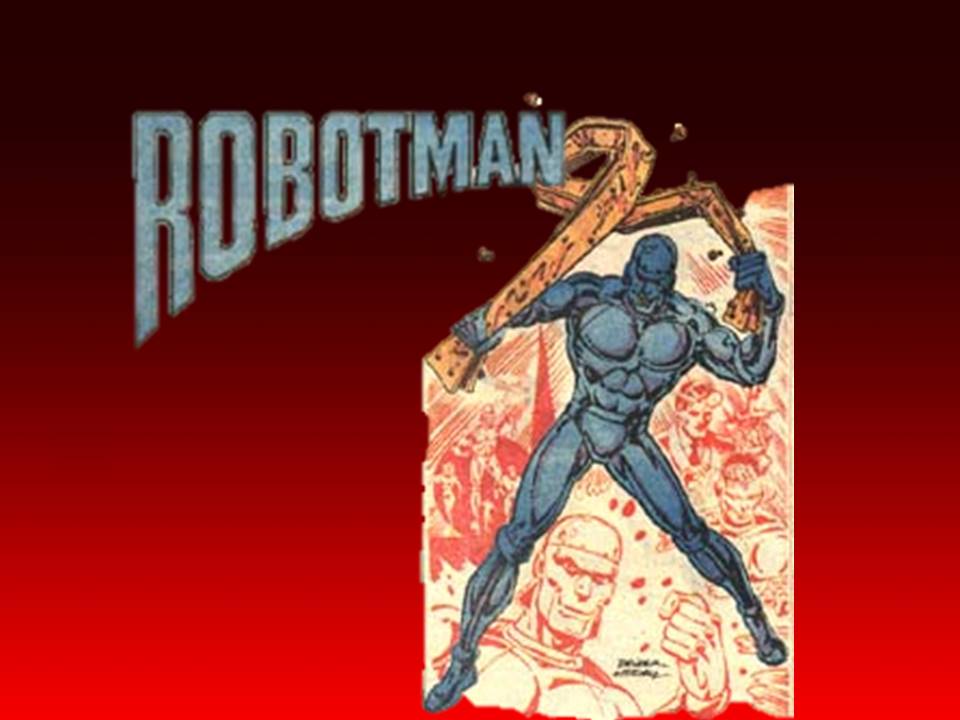
Before Cliff Steele had problems racing, Dr. Robert Crane ran afoul of some criminals trying to steal the robot body he and Chuck Grayson were building, resulting in Dr. Crane being shot by Mason, one of the thieves. Chuck Grayson transplanted Crane's brain into the stronger, faster robot body...
....creating a cyborg, the man known as Robotman!
This happened in Star-Spangled Comics #7 (April, 1942) in the story later titled "The Birth Of Robotman" by Jerry Siegel, Leo Nowak and Paul Cassidy, and Robotman did capture Mason, clearing Chuck Grayson of the murder of Robert Crane (though Crane did adopt a new human identity of Paul Dennis at the time). This story, though not reprinted, was covered in All-Star Squadron #63 (November, 1986) by Roy Thomas, Michael Bair and Mike Machlan.
Robotman had a feature that ran from Star-Spangled Comics #7 (April, 1942) until Star-Spangled Comics #82 (July, 1948), and Detective Comics #138 (August, 1948) to Detective Comics #202 (December, 1953). Let's look at the few original Robotman tales reprinted, and where to find them.
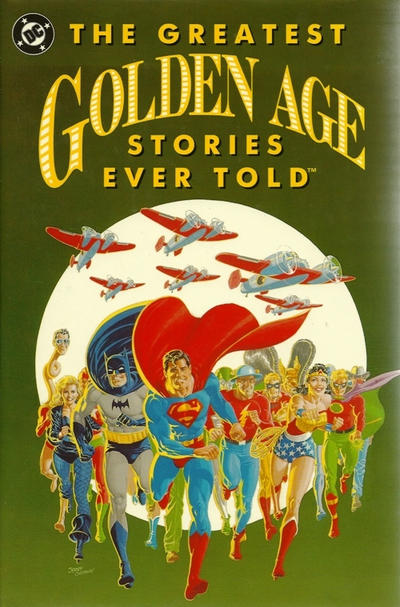
The only of his Star-Spangled Comics tales to be reprinted is from Star-Spangled Comics #77 (February, 1948) by Joe Samachson and Jimmy Thompson, with the story of "Robotman vs. Rubberman", where Robotman (and his robotic dog partner, Robbie) faced off against a man made of rubber, tracking him down through the local circus to catch the criminal.
This story was reprinted in the Greatest Golden Age Stories Ever Told of 1990, under a cover by Jerry Ordway.
Robotman's first appearance in Detective Comics, Detective Comics #138 (August, 1948) is his next reprint, with "The Inside Story of Robotman" by Otto Binder and Jimmy Thompson, along with retelling Robotman's origin, it detailed his battle with Dirk McGurk, stealing from the Dixon Gem Company, and then wrecking Robotman....until scientists found plans to rebuild Robotman in his heel, rebuilt him, and Robotman was able to bring McGurk to justice, to be able to continue to thwart evil in his hometown.
This story was reprinted as a part of the bureau of missing heroes in World's Finest Comics #208 (December, 1971), under a cover by Neal Adams, featuring Superman and Dr. Fate!
Detective Comics #176 (October, 1951) with the story "The Testing Of Robotman" by Jerry Coleman and Frank Bolle was reprinted in World's Finest Comics #168 (August, 1967).
Detective Comics #178 (December,1951) with "The Robot Ghost", and art by Frank Bolle reprinted in Adventure Comics #413 (December, 1971).
Detective Comics #194 (April,1953) saw Robotman face "The Crime Collector" by artist Joe Certa, reprinted in World's Finest Comics #226 (November-December, 1974) along with a Golden Age Sandman and Sandy reprint.
The last of Robotman's reprints, from Detective Comics #197 (July, 1953), with the story "License For A Robot" and art by Joe Certa, was reprinted in World's Finest Comics #223 (May-June, 1974), both with Nick Cardy covers on the reprints.
This wasn't the end of the original Robotman, as he made two appearances later in life, being a part of the untold origin of the JLA in Justice League of America #144 (July, 1977, by Steve Englehart, Dick Dillin and Frank McLaughlin) alongside Congorilla and more, and finding out whatever happened to him in DC Comics Presents #31 (March, 1981 by Bob Rozakis, Alex Sauvik and Vince Coletta), where his robot body had been trapped in a mine until freed, to find Chuck had died (yet willed his body to Robotman, so he could live as a human again). The now human Robotman even appeared in America vs. the Justice Society #2 (February, 1985), and even later, helping the new Star-Spangled Kid in Stars and S.T.R.I.P.E.!
Robotman had ties to the JSA thanks to his time in the All-Star Squadron, a series from the 1980s, set in the 1940s, dealing with "retroactive continuity"...adding depth to stories already printed, giving new life to old heroes like Flash, Green Lantern, Hawkman and Hawkgirl, Dr. Fate, Atom, Dr. Mid-Nite, Hourman, Liberty Belle, Johnny Quick and Tarantula (and allowing them to meet newer ones, like Commander Steel).
After all, we are all more than just machines!
....creating a cyborg, the man known as Robotman!
This happened in Star-Spangled Comics #7 (April, 1942) in the story later titled "The Birth Of Robotman" by Jerry Siegel, Leo Nowak and Paul Cassidy, and Robotman did capture Mason, clearing Chuck Grayson of the murder of Robert Crane (though Crane did adopt a new human identity of Paul Dennis at the time). This story, though not reprinted, was covered in All-Star Squadron #63 (November, 1986) by Roy Thomas, Michael Bair and Mike Machlan.
Robotman had a feature that ran from Star-Spangled Comics #7 (April, 1942) until Star-Spangled Comics #82 (July, 1948), and Detective Comics #138 (August, 1948) to Detective Comics #202 (December, 1953). Let's look at the few original Robotman tales reprinted, and where to find them.
The only of his Star-Spangled Comics tales to be reprinted is from Star-Spangled Comics #77 (February, 1948) by Joe Samachson and Jimmy Thompson, with the story of "Robotman vs. Rubberman", where Robotman (and his robotic dog partner, Robbie) faced off against a man made of rubber, tracking him down through the local circus to catch the criminal.
This story was reprinted in the Greatest Golden Age Stories Ever Told of 1990, under a cover by Jerry Ordway.
Robotman's first appearance in Detective Comics, Detective Comics #138 (August, 1948) is his next reprint, with "The Inside Story of Robotman" by Otto Binder and Jimmy Thompson, along with retelling Robotman's origin, it detailed his battle with Dirk McGurk, stealing from the Dixon Gem Company, and then wrecking Robotman....until scientists found plans to rebuild Robotman in his heel, rebuilt him, and Robotman was able to bring McGurk to justice, to be able to continue to thwart evil in his hometown.
This story was reprinted as a part of the bureau of missing heroes in World's Finest Comics #208 (December, 1971), under a cover by Neal Adams, featuring Superman and Dr. Fate!
Detective Comics #176 (October, 1951) with the story "The Testing Of Robotman" by Jerry Coleman and Frank Bolle was reprinted in World's Finest Comics #168 (August, 1967).
Detective Comics #178 (December,1951) with "The Robot Ghost", and art by Frank Bolle reprinted in Adventure Comics #413 (December, 1971).
Detective Comics #194 (April,1953) saw Robotman face "The Crime Collector" by artist Joe Certa, reprinted in World's Finest Comics #226 (November-December, 1974) along with a Golden Age Sandman and Sandy reprint.
The last of Robotman's reprints, from Detective Comics #197 (July, 1953), with the story "License For A Robot" and art by Joe Certa, was reprinted in World's Finest Comics #223 (May-June, 1974), both with Nick Cardy covers on the reprints.
This wasn't the end of the original Robotman, as he made two appearances later in life, being a part of the untold origin of the JLA in Justice League of America #144 (July, 1977, by Steve Englehart, Dick Dillin and Frank McLaughlin) alongside Congorilla and more, and finding out whatever happened to him in DC Comics Presents #31 (March, 1981 by Bob Rozakis, Alex Sauvik and Vince Coletta), where his robot body had been trapped in a mine until freed, to find Chuck had died (yet willed his body to Robotman, so he could live as a human again). The now human Robotman even appeared in America vs. the Justice Society #2 (February, 1985), and even later, helping the new Star-Spangled Kid in Stars and S.T.R.I.P.E.!
Robotman had ties to the JSA thanks to his time in the All-Star Squadron, a series from the 1980s, set in the 1940s, dealing with "retroactive continuity"...adding depth to stories already printed, giving new life to old heroes like Flash, Green Lantern, Hawkman and Hawkgirl, Dr. Fate, Atom, Dr. Mid-Nite, Hourman, Liberty Belle, Johnny Quick and Tarantula (and allowing them to meet newer ones, like Commander Steel).
After all, we are all more than just machines!
Wednesday, April 20, 2016
Guide To Golden Age Robin Reprints
Holy sidekicks, Batman! At least, that's what people think about when they think about Robin.
True, the Tim Drake version of Robin has had his own DC series, as has Dick Grayson, the original Robin (though his has been as Nightwing and as Grayson).
But, in the 1940s and 1950s, Robin did indeed branch away from the Batman for a time, with his own solo series (occasionally guest-starring Batman, especially towards the end, and even Commissioner Gordon and their butler, Alfred Beagle, as he was called in the Golden Age), in Star-Spangled Comics #65 (February, 1947) to Star-Spangled Comics #130 (July, 1952), and being on covers from the beginning of his run until Star-Spangled Comics #95 (August, 1949), with covers of Revolutionary War hero Tomahawk and then ghost-buster Dr. 13 until the title's end.
But, you don't have to be the world's greatest detective to find these stories, as where to find them in reprints is detailed below!
The first of Robin's tales to be solo reprinted in from Star-Spangled Comics #70 (July, 1947), with the "Clocks of Doom" by writer Bill Finger, penciller J. Winslow Mortimer and inker Charles Paris. This deals with Robin first facing a villain all his own, the clock, as he tries to help students filming for a school project who accidentally filmed a crime!
This story was reprinted in the Batman in the 1940s tradepaperback of 2004, along with Robin's first appearance from Detective Comics #38 (April, 1940) and many other Golden Age Batman stories featuring Joker, the original acting Clayface and even Two-Face, all guaranteed to make you smile!
Next up is a small run of Robin reprints, all collected in the same place.
The first story is Star-Spangled Comics #82, (July, 1948) and "The Boy Who Hated Robin" by artist Jim Mooney (though, as done at the time, credited to Bob Kane). This story has Robin meet Petey Downs while helping out at a camp for Gotham's underprivileged youth. The second story is Star-Spangled Comics #86 (November, 1948) with Robin facing off against 3 of "The Barton Brothers" after they shoot and injure Batman, in this tale pencilled by Jim Mooney and inked by J. Winslow Mortimer. Last of the three collected in one spot is Star-Spangled Comics #103 (April, 1950) with art by Jim Mooney and the story of "Roberta, The Girl Wonder" (who was really Mary Wills, a classmate of Dick Grayson's who became infatuated with Robin, and came up with her own costumed identity to meet the Boy Wonder, and they face off against Spider Vorn!).
These three tales were collected in the Robin The Boy Wonder A Celebration of 75 Years collection of 2015 (along with many tales of many Robins!).
Another solo Robin reprint comes from Star-Spangled Comics #111 (December, 1950) with "Dick Grayson, Detective" in a story by David V. Reed and art by Jim Mooney, with Robin's alter ego of Dick Grayson doing the crime solving at Gotham High!
Appropriately, this story is reprinted in Detective Comics #444 (December-January, 1974-1975), under a cover by Jim Aparo (which also features the beginnings of an epic Batman/Ra's Al Ghul battle as Batman kills Ra's daughter, Talia), and other reprints including Roy Raymond, Kid Eternity and Star Hawkins as well as a new story of the Elongated Man!
Served next is the story of Star-Spangled Comics #120 (September, 1951) with "The Bellboy Wonder" likely by writer John Broome and art by Jim Mooney, with Robin going undercover as a bellboy to prevent the murder of a political figure at a world conference.
This story is reprinted in World's Finest Comics #193 (May, 1970) under a cover by Curt Swan and Murphy Anderson, with Superman and Batman in trouble all on their own...
....guess the World's Finest team still needed to keep Robin on board!
There is a return in Star-Spangled Comics #123 (December, 1951), and it's when "Crazy-Quilt Comes Back", in a story by France Herron with art by Jim Mooney, where the villain comes to face Robin (Crazy-Quilt was originally a foe of the Boy Commandos, first appearing in Boy Commandos #15 in June of 1946, but he then seemed to transfer his hate over to Batman's junior partner).
This story was reprinted in Batman #255 (March-April, 1974) with a cover by Neal Adams and Nick Cardy, with a great Batman vs. werewolf new story, and a few great reprints within, including the story of how Bruce Wayne's father was "The First Batman"!
Star-Spangled Comics #124 (January, 1952) has the solo Robin story of "Operation: Escape" by artist Jim Mooney, with Robin giving a lecture to Gotham City Police cadets about how he used ordinary, average items to escape a death trap and challenges you to figure out what he did...
This story was reprinted in Batman #199 (February, 1968) under a Carmine Infantino/Murphy Anderson cover that shows Batman might need that comic instead, and it was also reprinted in the Greatest Batman Stories Ever Told Hard Cover of November, 1988 and softcover of June, 1989.
Robin faces "Murder On The Chess Board" in Star-Spangled Comics #125 (February, 1952), with story by David Vern and art by Jim Mooney, in a story which may have been checkmate for Alfred, as it is the last listed Golden Age appearance of Alfred Beagle (at least until Superman Family and the Huntress back-up in Wonder Woman deal with the Earth-2's butler of Batman!).
This tale is reprinted in World's Finest Comics #190 (December, 1969), which features one of the last times Robin worked as a part of the World's Finest team (and they needed the help)...
....all under a Curt Swan/Murphy Anderson cover.
Robin faced "Danger In The Hall Of Trophies" in Star-Spangled Comics #126 (March, 1952) in a story by David Vern with art by .Jim Mooney, with Robin and Commissioner Gordon dealing with a French criminal who is pretending to be a detective to get into the Batcave.
This story was reprinted in World's Finest Comics #192 (March, 1970), with another incredible Curt Swan and Murphy Anderson cover (and the first part to the story mentioned a little bit above....proving what lousy luck Superman and Batman have without Robin!).
Robin faces "The Game Of Death" in Star-Spangled Comics #127 (April, 1952) by writer David V. Reed and artist Jim Mooney in a story of life or death for Batman and Robin (but, when aren't they?).
This tale is reprinted in Batman #213 (July-August, 1969) in an issue focused on Robin, under a cover by artist Bill Draut and inked by Vince Coletta. This issue also reprints the first appearance of Alfred and of the villains, the Red Hood and the shape-changing Clayface, as well as including an updated origin for Robin! (For those that keep track of these things, this is the Earth-1 Robin origin, differentiating between the original Robin who was on Earth-2, and the Robin who later helped formed the Teen Titans, the one from Earth-1).
Robin's next mostly solo story is in Star-Spangled Comics #128 (May, 1952) facing "The Man Called 50-50" by writer David Vern and artist Jim Mooney (and this is as good a place as any to reveal that writer David Vern and David V. Reed are one in the same!). This had a villain called 50-50, who seemed to look like Two-Face (but wasn't....) and Robin had to take a chance to beat this foe as Batman was busy.
This is reprinted in Brave and the Bold #76 (February-March, 1968) under a cover drawn by Neal Adams, and featuring a two heroes, Batman and Plastic Man.
Last, but not least, for the Robin who would grow up and join the Justice Society, is Star-Spangled Comics #130 (July, 1952) with the "Stone-Deaf Robin" in a story by David V. Reed and art by Jim Mooney.
This tale is reprinted in World's Finest Comics #191 (February, 1970), with a cover by Curt Swan and Jack Abel, that has Superman and Batman facing off against Superman's parents of Jor-El and Lara...proving that parents can be killers!
After this issue, Robin went back to only appearing with Batman in Batman, Detective Comics and World's Finest Comics, and Star-Spangled Comics became Star-Spangled War Stories, starting with #131 in August, 1952, and focused on war stories.
Still, there are more Star-Spangled Comics Robin reprints.
Robin Archives #1 came out in August, 2005 and featured Star-Spangled Comics #65 (February, 1947) to Star-Spangled Comics #85 (October, 1948), and contains many battles with the Clock, as well as one-timers like No-Face and the Fence, and even a little time travel with Carter Nichols!
Robin Archives #2 arrived in March of 2010, and featured Star-Spangled Comics #86 (November, 1948) to Star-Spangled Comics #105 (June, 1950), with one last shot of the Clock, as well as one-time villains like George Midas, started to have more appearances of Batman, and even an appearance by Batman's girlfriend, Vicki Vale!
Let's hope DC will at least gather together the last of Robin's solo Star-Spangled Comics career in some collection.
True, the Tim Drake version of Robin has had his own DC series, as has Dick Grayson, the original Robin (though his has been as Nightwing and as Grayson).
But, in the 1940s and 1950s, Robin did indeed branch away from the Batman for a time, with his own solo series (occasionally guest-starring Batman, especially towards the end, and even Commissioner Gordon and their butler, Alfred Beagle, as he was called in the Golden Age), in Star-Spangled Comics #65 (February, 1947) to Star-Spangled Comics #130 (July, 1952), and being on covers from the beginning of his run until Star-Spangled Comics #95 (August, 1949), with covers of Revolutionary War hero Tomahawk and then ghost-buster Dr. 13 until the title's end.
But, you don't have to be the world's greatest detective to find these stories, as where to find them in reprints is detailed below!
The first of Robin's tales to be solo reprinted in from Star-Spangled Comics #70 (July, 1947), with the "Clocks of Doom" by writer Bill Finger, penciller J. Winslow Mortimer and inker Charles Paris. This deals with Robin first facing a villain all his own, the clock, as he tries to help students filming for a school project who accidentally filmed a crime!
This story was reprinted in the Batman in the 1940s tradepaperback of 2004, along with Robin's first appearance from Detective Comics #38 (April, 1940) and many other Golden Age Batman stories featuring Joker, the original acting Clayface and even Two-Face, all guaranteed to make you smile!
Next up is a small run of Robin reprints, all collected in the same place.
The first story is Star-Spangled Comics #82, (July, 1948) and "The Boy Who Hated Robin" by artist Jim Mooney (though, as done at the time, credited to Bob Kane). This story has Robin meet Petey Downs while helping out at a camp for Gotham's underprivileged youth. The second story is Star-Spangled Comics #86 (November, 1948) with Robin facing off against 3 of "The Barton Brothers" after they shoot and injure Batman, in this tale pencilled by Jim Mooney and inked by J. Winslow Mortimer. Last of the three collected in one spot is Star-Spangled Comics #103 (April, 1950) with art by Jim Mooney and the story of "Roberta, The Girl Wonder" (who was really Mary Wills, a classmate of Dick Grayson's who became infatuated with Robin, and came up with her own costumed identity to meet the Boy Wonder, and they face off against Spider Vorn!).
These three tales were collected in the Robin The Boy Wonder A Celebration of 75 Years collection of 2015 (along with many tales of many Robins!).
Another solo Robin reprint comes from Star-Spangled Comics #111 (December, 1950) with "Dick Grayson, Detective" in a story by David V. Reed and art by Jim Mooney, with Robin's alter ego of Dick Grayson doing the crime solving at Gotham High!
Appropriately, this story is reprinted in Detective Comics #444 (December-January, 1974-1975), under a cover by Jim Aparo (which also features the beginnings of an epic Batman/Ra's Al Ghul battle as Batman kills Ra's daughter, Talia), and other reprints including Roy Raymond, Kid Eternity and Star Hawkins as well as a new story of the Elongated Man!
Served next is the story of Star-Spangled Comics #120 (September, 1951) with "The Bellboy Wonder" likely by writer John Broome and art by Jim Mooney, with Robin going undercover as a bellboy to prevent the murder of a political figure at a world conference.
This story is reprinted in World's Finest Comics #193 (May, 1970) under a cover by Curt Swan and Murphy Anderson, with Superman and Batman in trouble all on their own...
....guess the World's Finest team still needed to keep Robin on board!
There is a return in Star-Spangled Comics #123 (December, 1951), and it's when "Crazy-Quilt Comes Back", in a story by France Herron with art by Jim Mooney, where the villain comes to face Robin (Crazy-Quilt was originally a foe of the Boy Commandos, first appearing in Boy Commandos #15 in June of 1946, but he then seemed to transfer his hate over to Batman's junior partner).
This story was reprinted in Batman #255 (March-April, 1974) with a cover by Neal Adams and Nick Cardy, with a great Batman vs. werewolf new story, and a few great reprints within, including the story of how Bruce Wayne's father was "The First Batman"!
Star-Spangled Comics #124 (January, 1952) has the solo Robin story of "Operation: Escape" by artist Jim Mooney, with Robin giving a lecture to Gotham City Police cadets about how he used ordinary, average items to escape a death trap and challenges you to figure out what he did...
This story was reprinted in Batman #199 (February, 1968) under a Carmine Infantino/Murphy Anderson cover that shows Batman might need that comic instead, and it was also reprinted in the Greatest Batman Stories Ever Told Hard Cover of November, 1988 and softcover of June, 1989.
Robin faces "Murder On The Chess Board" in Star-Spangled Comics #125 (February, 1952), with story by David Vern and art by Jim Mooney, in a story which may have been checkmate for Alfred, as it is the last listed Golden Age appearance of Alfred Beagle (at least until Superman Family and the Huntress back-up in Wonder Woman deal with the Earth-2's butler of Batman!).
This tale is reprinted in World's Finest Comics #190 (December, 1969), which features one of the last times Robin worked as a part of the World's Finest team (and they needed the help)...
....all under a Curt Swan/Murphy Anderson cover.
Robin faced "Danger In The Hall Of Trophies" in Star-Spangled Comics #126 (March, 1952) in a story by David Vern with art by .Jim Mooney, with Robin and Commissioner Gordon dealing with a French criminal who is pretending to be a detective to get into the Batcave.
This story was reprinted in World's Finest Comics #192 (March, 1970), with another incredible Curt Swan and Murphy Anderson cover (and the first part to the story mentioned a little bit above....proving what lousy luck Superman and Batman have without Robin!).
Robin faces "The Game Of Death" in Star-Spangled Comics #127 (April, 1952) by writer David V. Reed and artist Jim Mooney in a story of life or death for Batman and Robin (but, when aren't they?).
This tale is reprinted in Batman #213 (July-August, 1969) in an issue focused on Robin, under a cover by artist Bill Draut and inked by Vince Coletta. This issue also reprints the first appearance of Alfred and of the villains, the Red Hood and the shape-changing Clayface, as well as including an updated origin for Robin! (For those that keep track of these things, this is the Earth-1 Robin origin, differentiating between the original Robin who was on Earth-2, and the Robin who later helped formed the Teen Titans, the one from Earth-1).
Robin's next mostly solo story is in Star-Spangled Comics #128 (May, 1952) facing "The Man Called 50-50" by writer David Vern and artist Jim Mooney (and this is as good a place as any to reveal that writer David Vern and David V. Reed are one in the same!). This had a villain called 50-50, who seemed to look like Two-Face (but wasn't....) and Robin had to take a chance to beat this foe as Batman was busy.
This is reprinted in Brave and the Bold #76 (February-March, 1968) under a cover drawn by Neal Adams, and featuring a two heroes, Batman and Plastic Man.
Last, but not least, for the Robin who would grow up and join the Justice Society, is Star-Spangled Comics #130 (July, 1952) with the "Stone-Deaf Robin" in a story by David V. Reed and art by Jim Mooney.
This tale is reprinted in World's Finest Comics #191 (February, 1970), with a cover by Curt Swan and Jack Abel, that has Superman and Batman facing off against Superman's parents of Jor-El and Lara...proving that parents can be killers!
After this issue, Robin went back to only appearing with Batman in Batman, Detective Comics and World's Finest Comics, and Star-Spangled Comics became Star-Spangled War Stories, starting with #131 in August, 1952, and focused on war stories.
Still, there are more Star-Spangled Comics Robin reprints.
Robin Archives #1 came out in August, 2005 and featured Star-Spangled Comics #65 (February, 1947) to Star-Spangled Comics #85 (October, 1948), and contains many battles with the Clock, as well as one-timers like No-Face and the Fence, and even a little time travel with Carter Nichols!
Robin Archives #2 arrived in March of 2010, and featured Star-Spangled Comics #86 (November, 1948) to Star-Spangled Comics #105 (June, 1950), with one last shot of the Clock, as well as one-time villains like George Midas, started to have more appearances of Batman, and even an appearance by Batman's girlfriend, Vicki Vale!
Let's hope DC will at least gather together the last of Robin's solo Star-Spangled Comics career in some collection.
Thursday, September 24, 2015
Guide to Golden Age Tarantula, Johnny Quick and Liberty Belle reprints
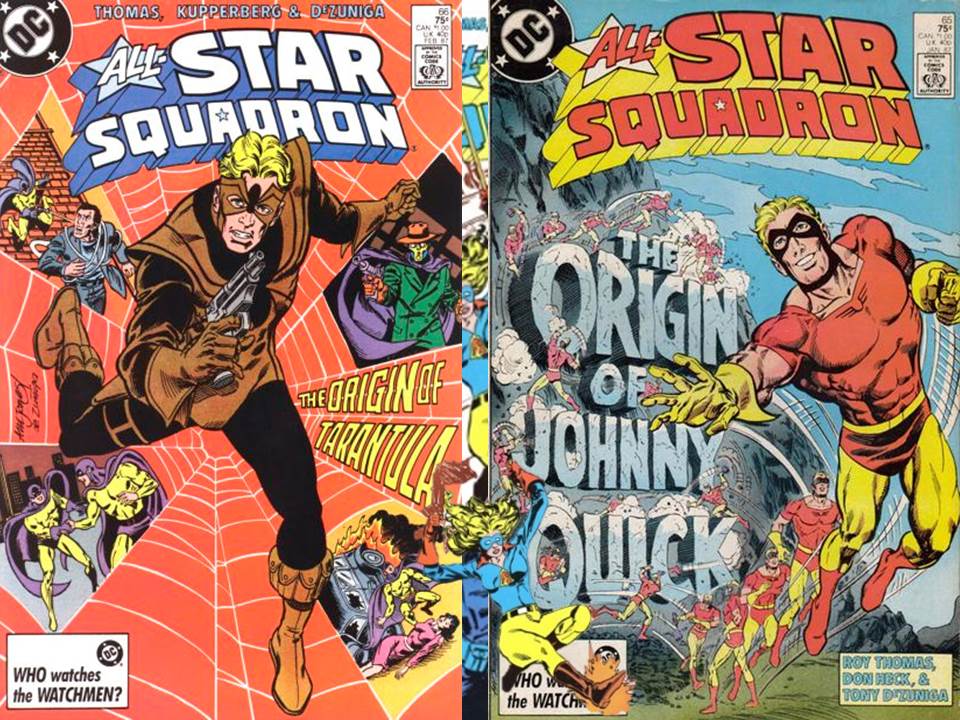
Looking back at the Golden Age of comics, taking a focus on a few characters (Tarantula, Johnny Quick and Liberty Belle) from that era that got a revival in the 1980s with the All-Star Squadron...
...and where to find reprints of their classic tales from the 1940s!
Sadder still, only one of his Golden Age stories was reprinted...
...that of Star-Spangled Comics #11 (August, 1942) with the tale of "Galloping Gold" by writer Wade Wellman and artist Ed Smalle, Jr., where Tarantula goes west to face Bandana Bardon and other cattle rustlers.
This was reprinted in World's Finest Comics #207 (November, 1971), under a Curt Swan/Murphy Anderson cover with Superman and Batman facing some cowboy outlaws as well...along with a reprint of a sci-fi tale from Strange Adventures!
Don't feel too bad for Jonathan Law, he came back in the 1980s All-Star Squadron series by Roy Thomas, and Jerry Ordway gave him a new costume as well (via John's housekeeper, Olga)....and thanks to the time-traveling kids from Infinity, Inc., we know he had a successful novel on the Golden Age mystery men!
Jonathan even survived World War II, to show up as an elderly writer in issues of Nightwing, starting with Nightwing #14 (November, 1997), as a resident of Dick Grayson's apartment building, and showing up here and there, including issues #16, #21, #31, #40, #42, #48, #54, #55, #72, #79 and #86 (and Titans #36 of February, 2002), until problems with Blockbuster resulted in a new, female Tarantula.
It's a good thing Johnny was so quick, because quite a few of his Golden Age tales were reprinted!
Johnny's earliest reprint came from More Fun Comics #73 (November, 1941), by writer Mort Weisinger and artist Ed Moore Jr. and inker Chad Grothkopf, in the story "The Black Knight", where Johnny faced off against, well...the Black Knight, and the man behind the scenes pulling its strings....Sam Kirby.
This story was reprinted in the Millennium Edition: More Fun Comics #73 of January, 2001, which also features the first appearance of Aquaman and Green Arrow, of Dr. Fate foe Mr. Who (with the doctor capturing the cover in his half mask that he was using at this time), as well as Spectre, a ton of Golden Age goodness!
Johnny Quick's next reprinted story is from More Fun Comics #76 (February, 1942) by Mort Weisinger and Mort Meskin, entitled "The Adventure Of The Human Streak", where Johnny and Tubby faced off against Dr. Clever and his henchman, Breezy, whom the doctor gives super-speed via a ray invention of his. Pretty clever, that doctor...but not good enough to not get boxed down by Johnny Quick!
This story was reprinted in Wanted, the World's Most Dangerous Villains #7 (March-April, 1973), with a cover by Nick Cardy, and also contained Golden Age Hawkman and Hourman reprints, in a series edited by E. Nelson Bridwell (who was responsible for so many Golden Age reprints finding new life).
The last of Johnny's More Fun Comics appearances to be reprinted is from More Fun Comics #101 (January-February, 1945) by Don Cameron and Mort Meskin, in the story "An Investment In Happiness", where Johnny and Tubby help dying tycoon, Darius Droobe, give money back to people he swindled over the years...much to the chagrin of Droobe fortune inheritor, Ambrose.
This tale is found in the Millennium Edition: More Fun Comics #101 of November, 2000. This issue also features Green Arrow, Aquaman, and in his last Golden Age appearance, the Spectre, as well as debuting a new feature...Superboy (a story of Superman, as a boy! Johnny quickly left More Fun Comics after this issue (with More Fun Comics #107 of January-February, 1946), and along with Green Arrow, Aquaman and cover feature, Superboy, ended up in Adventure Comics, starting with Adventure Comics #103 (April, 1946).
Johnny's earliest Adventure Comics reprint was from Adventure Comics #117 (June, 1947) with "The Man Who Wore Ten Hats" by Bill Finger and Mort Meskin, with Johnny and Tubby helping a small town man who works too much against a crooked mayor.
This tale was reprinted in Flash #229 (September-October, 1974), under a cover by Nick Cardy, and along with Johnny Quick, features a new team-up of the Golden Age and Silver Age Flash (vs. Golden Age villains Rag Doll and the Thinker), as well as Silver Age Green Lantern, Kid Flash and Flash reprints, and a Golden Age Flash reprint as well!
Next up, reprint-wise, is the Johnny Quick story from Adventure Comics #121 (October, 1947) by Bill Finger and Mort Meskin called "The 9th Wonder Of The World"...
...wherein Johnny helps out some kids in a hospital's children's ward who were about to get a featured in an upcoming issue of his Pal the Wonder Dog comic when Mel Mitchum (the cartoonist) loses the issue in a fire. So, Johnny quickly turns out a replacement issue for him...what comic book creator wouldn't like to have a super-speeding artist on hand?
This story ended up reprinted in Flash #232 (March-April, 1975), under an awesome Nick Cardy cover...
...within the issue is featured Barry Allen's Flash in team-ups with Kid Flash and Green Lantern, as well as a Golden Age Flash reprint.
Quick with that next reprint, as the story from Adventure Comics #123 (December, 1947) is, with the story of "The Adventure Of The Antelope Boy" by Don Cameron and Mort Meskin, with Johnny and Tubby traveling to Africa to see this "antelope boy" who can run really fast...but they end up having to save him from mobster, Mobs Bracket.
This story ended up being reprinted in Flash #160 (April, 1966, and is also known as 80 Page Giant #G-21), under a cover by Carmine Infantino and Murphy Anderson, and as Barry Allen's Flash shows you, contains quite a number of quick adventures...
...all under a DC Comics checkerboard!
Johnny faces a slow foe, that of Sleepy, in Adventure Comics #129 (June, 1948) in the story "The Slowpoke Crimes" by an unknown writer, and art by Mort Meskin...
...where Sleepy is able to use his lack of speed as an advantage for a time against Johnny Quick!
This story was reprinted in the 100-Page Super-Spectacular DC-22 of November, 1973 under a cover by Nick Cardy, and also has a Golden Age Flash reprint...
...as well as a story involving the change of Kid Flash's costume!
Next up, in Johnny Quick reprints is Adventure Comics #144 (September, 1949), with the story of "The Day That Was Five Years Long" (which might be how you feel reading about Johnny's reprints), but this was a story by Otto Binder and art by Dan Barry, wherein Johnny helps a wrongly accused man, Joe Everett, get back the five years he lost in prison, all in one day (and oddly enough, all Joe wants is a job, so Johnny helps him...but Joe finds he likes making things like clocks, and he invented one in prison!).
This story was reprinted in the Greatest Golden Age Stories Ever Told hardcover of 1990, which featured a stunning cover by Jerry Ordway, and many Golden Age stories that were, well, just great, and featured a few other JSAers like Hawkman, Wildcat, Sandman, Flash, Green Lantern, Superman, Wonder Woman, Batman, Black Canary and the Spectre as well!
The story from Adventure Comics #174 (March, 1952) focuses on "Tubby Watts, Efficiency Expert" (written by Don Cameron and art by Ralph Mayo), with Tubby trying to find better work as an efficiency expert, and Johnny Quick having to speed things up and work extra hard helping his buddy out!
This story was reprinted in World's Finest Comics #224 (July-August, 1974) under a Nick Cardy cover...
...and while it has no other Golden Age stories, it does have plenty of Superman/Batman action, and even a little Metamorpho, for fans of the Element Man!
Next up is a little adventure in pretending for Johnny Quick, as Johnny and Tubby go to cover the unveiling of a Paul Bunyon statue, and then Johnny has to perform feats to make him "The Modern Paul Bunyon" in this story by an unknown writer, with art by Paul Norris in Adventure Comics #179 (August, 1952).
This story found itself reprinted in Flash #214 (April, 1972, also known as 100 Page Super-Spectacular DC-11), under a spectacular cover by Nick Cardy, and along with the many reprints in the book, it features a Golden Age Flash story that had never been published before as well as a Golden Age tale of Quicksilver (the Quality hero who later became known as Max Mercury!).
"Joanie Swift, Queen of Speed" was the focus of the story in Adventure Comics #181 (October, 1952, with no credited writer and art by Paul Norris)...
...as Joanie was transcribing for a college professor, and said the formula that Johnny Quick uses, gaining super-speed for a time. Johnny was more annoyed with her help, but lost it later, as Joanie couldn't remember the formula (a good thing for Johnny as well, as he didn't need another woman in his life, but more on that soon).
This tale was reprinted in World's Finest Comics #198 (November, 1970), under a Curt Swan/Murphy Anderson cover, which featured the start of the third and deciding Superman/Flash race!
Johnny faced the problem of "Too Many Speed Kings" in the story by an unknown writer and art by Ralph Mayo from Adventure Comics #189 (June, 1953), where Professor Rollins gives Johnny Chambers a speed formula, and Johnny uses his powers to fake that it works, then has to continue to help others whom the professor gave the formula to as well!
This story is reprinted in Flash #205 (April-May, 1971) under a cover by Dick Giordano...
...along with a few Silver Age tales including the first appearance of Professor Zoom, also known as the Reverse-Flash, and a Golden Age Flash tale that had never been printed until this issue!
Adventure Comics #190 (July, 1953) is up for Johnny Quick's next reprint (with no identified writer, and art by Hy Mankin), and it features Johnny as the "Stand-In For 100 Convicts", having Johnny have to fill in for 100 convicts who were released in an experimental program, with one of them (but only one) returning to criminal ways.
This issue was reprinted in DC 100 Page Super Spectacular #6 (1971), which, under this awesome Neal Adams cover, also had a reprint of the first JLA/JSA team-up, a Golden Age Spectre story, and a previously unpublished Golden Age Wildcat story (as well as lists of "every" DC hero's first appearance up to that time.). Even better, DC made a replica of the World's Great Super-Heroes Super Spectacular (yes, a reprint of a collection of reprints) in May, 2004 (though the cover was slightly altered)!
Last (but not least) of Johnny's reprints is Adventure Comics #202 (July, 1954) with "The Human Hot-Rodders" by Otto Binder and Ralph Mayo, having Johnny and Tubby facing off against the gang of Bull Barton, who are trying to distract police to allow Bull to escape prison and his execution.
This tale was reprinted in World's Finest Comics #186 (August, 1969) under a cover by Carmine Infantino and Neal Adams, with Superman planning to execute Batman!
Johnny's Golden Age adventures ended with Adventure Comics #207 (December, 1954), but that wasn't the end of Johnny's adventures...even in World War II, as the 1980s All-Star Squadron later proved!
Liberty Belle appeared next in Boy Commandos #2 (Spring, 1943), along with boyfriend Rick Cannon and Liberty Bell guard Tom Revere, then the Liberty Belle feature runs from Star-Spangled Comics #20 (May, 1943) to Star-Spangled Comics #68 (May, 1947) replacing Tarantula's series...which none of which have been reprinted; in fact, if not for the cover of Adventure Comics #416 (March, 1972), readers wouldn't have seen Liberty Belle...
...until the All-Star Squadron, Roy Thomas' series focusing on World War II adventures of DC's mystery men (and women) of the time!
This series lasted for 67 issues (plus a preview in Justice League of America #193 and three Annuals), and featured World War II era versions of the Justice Society of America (including Flash, Hawkman, Dr. Mid-Nite, Wildcat and more), as well as the Seven Soldiers of Victory, the Freedom Fighters, and even individual heroes like Commander Steel, Air Wave, TNT and Dan the Dyna-Mite, and even introduced characters like Amazing Man and a new female Firebrand....
....and later in the run, Johnny and Libby got married (and later still, after the All-Stars and World War II ended), we readers found the results of that union, with their daughter, Jesse Quick (whom continues the legacy of both her parents to this day).
...and where to find reprints of their classic tales from the 1940s!
Tarantula
John Law was a mystery writer in the 1930s, who, with the introduction of other mystery men, and inspired by his pet spider, decided to become the mystery man known as Tarantula (though a radio announcer called him "Spider-Man" in his first appearance, in Star-Spangled Comics #1 of October, 1941 by Mort Weisinger and Hal Sharp...and he had no relation to the Tarantula who was an early nemesis to the Sandman). Armed with suction cup boots and a web-firing gun (and a loyal housekeeper named Olga), Tarantula was ready to fight crime in the Golden Age....at least until Star-Spangled Comics #19 (April, 1943).Sadder still, only one of his Golden Age stories was reprinted...
...that of Star-Spangled Comics #11 (August, 1942) with the tale of "Galloping Gold" by writer Wade Wellman and artist Ed Smalle, Jr., where Tarantula goes west to face Bandana Bardon and other cattle rustlers.
This was reprinted in World's Finest Comics #207 (November, 1971), under a Curt Swan/Murphy Anderson cover with Superman and Batman facing some cowboy outlaws as well...along with a reprint of a sci-fi tale from Strange Adventures!
Don't feel too bad for Jonathan Law, he came back in the 1980s All-Star Squadron series by Roy Thomas, and Jerry Ordway gave him a new costume as well (via John's housekeeper, Olga)....and thanks to the time-traveling kids from Infinity, Inc., we know he had a successful novel on the Golden Age mystery men!
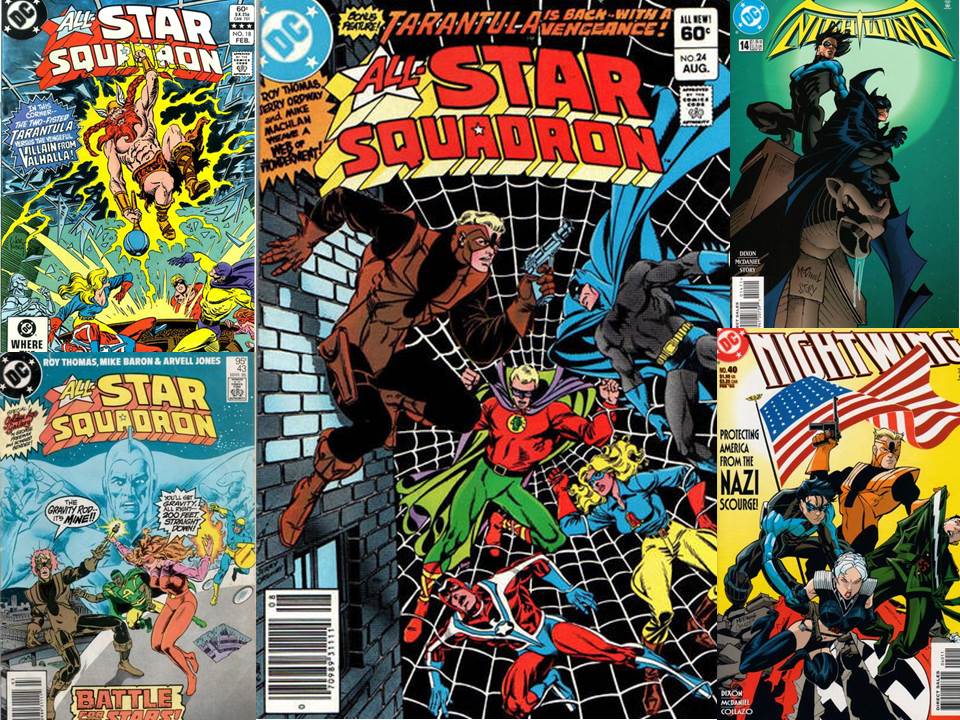
Jonathan even survived World War II, to show up as an elderly writer in issues of Nightwing, starting with Nightwing #14 (November, 1997), as a resident of Dick Grayson's apartment building, and showing up here and there, including issues #16, #21, #31, #40, #42, #48, #54, #55, #72, #79 and #86 (and Titans #36 of February, 2002), until problems with Blockbuster resulted in a new, female Tarantula.
Johnny Quick
Johnny Chambers was an orphan, taken in by Professor Ezra Gill, who believed one could travel at super-speed by reciting a mathematical formula, 3x2 (9YZ) 4A. The professor passed of old age, because Johnny wasn't fast enough to save him...and eventually Johnny became a photographer for Sees All/Tells All News, along with Tubby Watts (who worked as his assistant). Johnny and Tubby found themselves in trouble while on assignment at a circus, and this time, when Johnny said the formula, it worked, and Johnny quickly mopped up the crooks, modifying his circus outfit to work as his super-hero costume, with Tubby as his assistant not only with the paper, but as a hero. All this happened in More Fun Comics #71 (September, 1941 by Mort Weisinger and Chad Grothkopf), which sadly has not been reprinted (though a version of it with more details, including his inspiration coming from the Flash, can be found in All-Star Squadron #65, January, 1987 by Roy & Dann Thomas and Don Heck).
It's a good thing Johnny was so quick, because quite a few of his Golden Age tales were reprinted!Johnny's earliest reprint came from More Fun Comics #73 (November, 1941), by writer Mort Weisinger and artist Ed Moore Jr. and inker Chad Grothkopf, in the story "The Black Knight", where Johnny faced off against, well...the Black Knight, and the man behind the scenes pulling its strings....Sam Kirby.
This story was reprinted in the Millennium Edition: More Fun Comics #73 of January, 2001, which also features the first appearance of Aquaman and Green Arrow, of Dr. Fate foe Mr. Who (with the doctor capturing the cover in his half mask that he was using at this time), as well as Spectre, a ton of Golden Age goodness!
Johnny Quick's next reprinted story is from More Fun Comics #76 (February, 1942) by Mort Weisinger and Mort Meskin, entitled "The Adventure Of The Human Streak", where Johnny and Tubby faced off against Dr. Clever and his henchman, Breezy, whom the doctor gives super-speed via a ray invention of his. Pretty clever, that doctor...but not good enough to not get boxed down by Johnny Quick!
This story was reprinted in Wanted, the World's Most Dangerous Villains #7 (March-April, 1973), with a cover by Nick Cardy, and also contained Golden Age Hawkman and Hourman reprints, in a series edited by E. Nelson Bridwell (who was responsible for so many Golden Age reprints finding new life).
The last of Johnny's More Fun Comics appearances to be reprinted is from More Fun Comics #101 (January-February, 1945) by Don Cameron and Mort Meskin, in the story "An Investment In Happiness", where Johnny and Tubby help dying tycoon, Darius Droobe, give money back to people he swindled over the years...much to the chagrin of Droobe fortune inheritor, Ambrose.
This tale is found in the Millennium Edition: More Fun Comics #101 of November, 2000. This issue also features Green Arrow, Aquaman, and in his last Golden Age appearance, the Spectre, as well as debuting a new feature...Superboy (a story of Superman, as a boy! Johnny quickly left More Fun Comics after this issue (with More Fun Comics #107 of January-February, 1946), and along with Green Arrow, Aquaman and cover feature, Superboy, ended up in Adventure Comics, starting with Adventure Comics #103 (April, 1946).
Johnny's earliest Adventure Comics reprint was from Adventure Comics #117 (June, 1947) with "The Man Who Wore Ten Hats" by Bill Finger and Mort Meskin, with Johnny and Tubby helping a small town man who works too much against a crooked mayor.
This tale was reprinted in Flash #229 (September-October, 1974), under a cover by Nick Cardy, and along with Johnny Quick, features a new team-up of the Golden Age and Silver Age Flash (vs. Golden Age villains Rag Doll and the Thinker), as well as Silver Age Green Lantern, Kid Flash and Flash reprints, and a Golden Age Flash reprint as well!
Next up, reprint-wise, is the Johnny Quick story from Adventure Comics #121 (October, 1947) by Bill Finger and Mort Meskin called "The 9th Wonder Of The World"...
...wherein Johnny helps out some kids in a hospital's children's ward who were about to get a featured in an upcoming issue of his Pal the Wonder Dog comic when Mel Mitchum (the cartoonist) loses the issue in a fire. So, Johnny quickly turns out a replacement issue for him...what comic book creator wouldn't like to have a super-speeding artist on hand?
This story ended up reprinted in Flash #232 (March-April, 1975), under an awesome Nick Cardy cover...
...within the issue is featured Barry Allen's Flash in team-ups with Kid Flash and Green Lantern, as well as a Golden Age Flash reprint.
Quick with that next reprint, as the story from Adventure Comics #123 (December, 1947) is, with the story of "The Adventure Of The Antelope Boy" by Don Cameron and Mort Meskin, with Johnny and Tubby traveling to Africa to see this "antelope boy" who can run really fast...but they end up having to save him from mobster, Mobs Bracket.
This story ended up being reprinted in Flash #160 (April, 1966, and is also known as 80 Page Giant #G-21), under a cover by Carmine Infantino and Murphy Anderson, and as Barry Allen's Flash shows you, contains quite a number of quick adventures...
...all under a DC Comics checkerboard!
Johnny faces a slow foe, that of Sleepy, in Adventure Comics #129 (June, 1948) in the story "The Slowpoke Crimes" by an unknown writer, and art by Mort Meskin...
...where Sleepy is able to use his lack of speed as an advantage for a time against Johnny Quick!
This story was reprinted in the 100-Page Super-Spectacular DC-22 of November, 1973 under a cover by Nick Cardy, and also has a Golden Age Flash reprint...
...as well as a story involving the change of Kid Flash's costume!
Next up, in Johnny Quick reprints is Adventure Comics #144 (September, 1949), with the story of "The Day That Was Five Years Long" (which might be how you feel reading about Johnny's reprints), but this was a story by Otto Binder and art by Dan Barry, wherein Johnny helps a wrongly accused man, Joe Everett, get back the five years he lost in prison, all in one day (and oddly enough, all Joe wants is a job, so Johnny helps him...but Joe finds he likes making things like clocks, and he invented one in prison!).
This story was reprinted in the Greatest Golden Age Stories Ever Told hardcover of 1990, which featured a stunning cover by Jerry Ordway, and many Golden Age stories that were, well, just great, and featured a few other JSAers like Hawkman, Wildcat, Sandman, Flash, Green Lantern, Superman, Wonder Woman, Batman, Black Canary and the Spectre as well!
The story from Adventure Comics #174 (March, 1952) focuses on "Tubby Watts, Efficiency Expert" (written by Don Cameron and art by Ralph Mayo), with Tubby trying to find better work as an efficiency expert, and Johnny Quick having to speed things up and work extra hard helping his buddy out!
This story was reprinted in World's Finest Comics #224 (July-August, 1974) under a Nick Cardy cover...
...and while it has no other Golden Age stories, it does have plenty of Superman/Batman action, and even a little Metamorpho, for fans of the Element Man!
Next up is a little adventure in pretending for Johnny Quick, as Johnny and Tubby go to cover the unveiling of a Paul Bunyon statue, and then Johnny has to perform feats to make him "The Modern Paul Bunyon" in this story by an unknown writer, with art by Paul Norris in Adventure Comics #179 (August, 1952).
This story found itself reprinted in Flash #214 (April, 1972, also known as 100 Page Super-Spectacular DC-11), under a spectacular cover by Nick Cardy, and along with the many reprints in the book, it features a Golden Age Flash story that had never been published before as well as a Golden Age tale of Quicksilver (the Quality hero who later became known as Max Mercury!).
"Joanie Swift, Queen of Speed" was the focus of the story in Adventure Comics #181 (October, 1952, with no credited writer and art by Paul Norris)...
...as Joanie was transcribing for a college professor, and said the formula that Johnny Quick uses, gaining super-speed for a time. Johnny was more annoyed with her help, but lost it later, as Joanie couldn't remember the formula (a good thing for Johnny as well, as he didn't need another woman in his life, but more on that soon).
This tale was reprinted in World's Finest Comics #198 (November, 1970), under a Curt Swan/Murphy Anderson cover, which featured the start of the third and deciding Superman/Flash race!
Johnny faced the problem of "Too Many Speed Kings" in the story by an unknown writer and art by Ralph Mayo from Adventure Comics #189 (June, 1953), where Professor Rollins gives Johnny Chambers a speed formula, and Johnny uses his powers to fake that it works, then has to continue to help others whom the professor gave the formula to as well!
This story is reprinted in Flash #205 (April-May, 1971) under a cover by Dick Giordano...
...along with a few Silver Age tales including the first appearance of Professor Zoom, also known as the Reverse-Flash, and a Golden Age Flash tale that had never been printed until this issue!
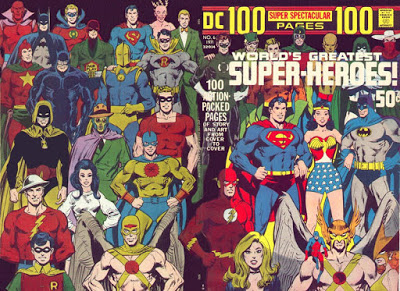
Adventure Comics #190 (July, 1953) is up for Johnny Quick's next reprint (with no identified writer, and art by Hy Mankin), and it features Johnny as the "Stand-In For 100 Convicts", having Johnny have to fill in for 100 convicts who were released in an experimental program, with one of them (but only one) returning to criminal ways.
This issue was reprinted in DC 100 Page Super Spectacular #6 (1971), which, under this awesome Neal Adams cover, also had a reprint of the first JLA/JSA team-up, a Golden Age Spectre story, and a previously unpublished Golden Age Wildcat story (as well as lists of "every" DC hero's first appearance up to that time.). Even better, DC made a replica of the World's Great Super-Heroes Super Spectacular (yes, a reprint of a collection of reprints) in May, 2004 (though the cover was slightly altered)!
Last (but not least) of Johnny's reprints is Adventure Comics #202 (July, 1954) with "The Human Hot-Rodders" by Otto Binder and Ralph Mayo, having Johnny and Tubby facing off against the gang of Bull Barton, who are trying to distract police to allow Bull to escape prison and his execution.
This tale was reprinted in World's Finest Comics #186 (August, 1969) under a cover by Carmine Infantino and Neal Adams, with Superman planning to execute Batman!
Johnny's Golden Age adventures ended with Adventure Comics #207 (December, 1954), but that wasn't the end of Johnny's adventures...even in World War II, as the 1980s All-Star Squadron later proved!
Liberty Belle
Libby Lawrence first appeared in Boy Commandos #1 (Winter, 1942) with an untitled tale by Don Cameron and Chuck Winter...that told of her escape from Poland to Holland, then to France, all the while, being followed by the invading Nazis. Libby even swims the English Channel to get to England, before the German forces start to invade their as well. Libby goes to Philadelphia to see the Liberty Bell, and gets a tiny replica as the bell (which she wears on her belt), which gives her strength when the real Liberty Bell is wrung...thus beginning her career as Liberty Belle (all recapped in All-Star Squadron #61 of September, 1986)!Liberty Belle appeared next in Boy Commandos #2 (Spring, 1943), along with boyfriend Rick Cannon and Liberty Bell guard Tom Revere, then the Liberty Belle feature runs from Star-Spangled Comics #20 (May, 1943) to Star-Spangled Comics #68 (May, 1947) replacing Tarantula's series...which none of which have been reprinted; in fact, if not for the cover of Adventure Comics #416 (March, 1972), readers wouldn't have seen Liberty Belle...
...until the All-Star Squadron, Roy Thomas' series focusing on World War II adventures of DC's mystery men (and women) of the time!
This series lasted for 67 issues (plus a preview in Justice League of America #193 and three Annuals), and featured World War II era versions of the Justice Society of America (including Flash, Hawkman, Dr. Mid-Nite, Wildcat and more), as well as the Seven Soldiers of Victory, the Freedom Fighters, and even individual heroes like Commander Steel, Air Wave, TNT and Dan the Dyna-Mite, and even introduced characters like Amazing Man and a new female Firebrand....
....and later in the run, Johnny and Libby got married (and later still, after the All-Stars and World War II ended), we readers found the results of that union, with their daughter, Jesse Quick (whom continues the legacy of both her parents to this day).
Subscribe to:
Posts (Atom)


