Looking back at the Golden Age of comics, taking a focus on a few characters (Tarantula, Johnny Quick and Liberty Belle) from that era that got a revival in the 1980s with the All-Star Squadron...
...and where to find reprints of their classic tales from the 1940s!
Tarantula
John Law was a mystery writer in the 1930s, who, with the introduction of other mystery men, and inspired by his pet spider, decided to become the mystery man known as Tarantula (though a radio announcer called him "Spider-Man" in his first appearance, in
Star-Spangled Comics #1 of October, 1941 by
Mort Weisinger and
Hal Sharp...and he had no relation to the Tarantula who was an early nemesis to the Sandman). Armed with suction cup boots and a web-firing gun (and a loyal housekeeper named Olga), Tarantula was ready to fight crime in the Golden Age....at least until
Star-Spangled Comics #19 (April, 1943).
Sadder still, only one of his Golden Age stories was reprinted...
...that of
Star-Spangled Comics #11 (August, 1942) with the tale of "Galloping Gold" by writer
Wade Wellman and artist
Ed Smalle, Jr., where Tarantula goes west to face Bandana Bardon and other cattle rustlers.
This was reprinted in
World's Finest Comics #207 (November, 1971), under a
Curt Swan/
Murphy Anderson cover with Superman and Batman facing some cowboy outlaws as well...along with a reprint of a sci-fi tale from
Strange Adventures!
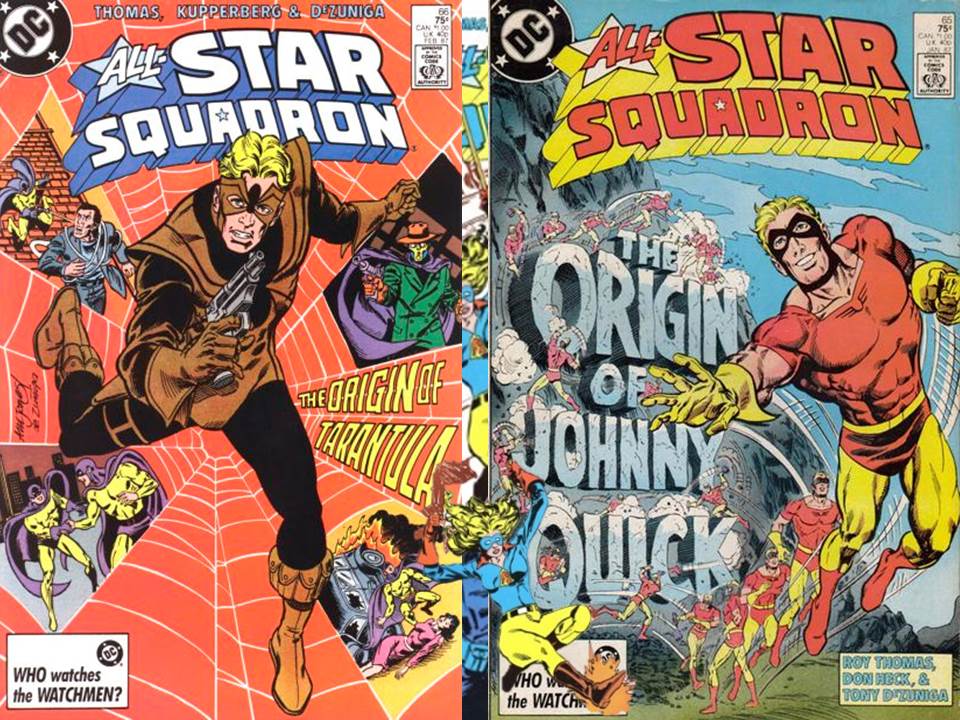
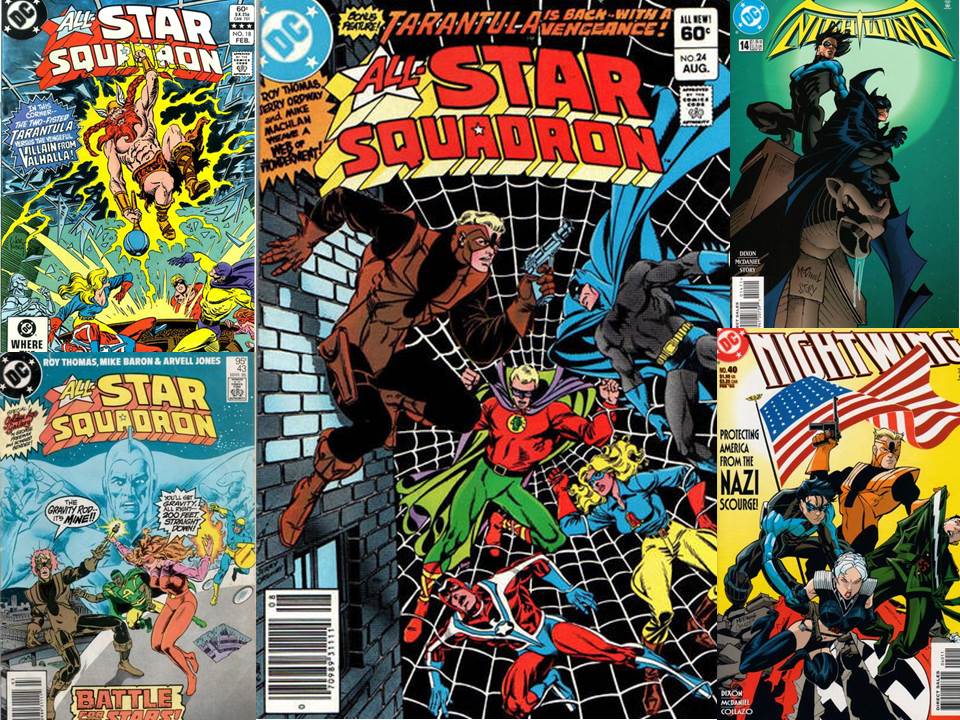
Don't feel too bad for Jonathan Law, he came back in the 1980s All-Star Squadron series by
Roy Thomas, and
Jerry Ordway gave him a new costume as well (via John's housekeeper, Olga)....and thanks to the time-traveling kids from Infinity, Inc., we know he had a successful novel on the Golden Age mystery men!
Jonathan even survived World War II, to show up as an elderly writer in issues of Nightwing, starting with
Nightwing #14 (November, 1997), as a resident of Dick Grayson's apartment building, and showing up here and there, including issues
#16,
#21,
#31,
#40,
#42,
#48,
#54,
#55,
#72,
#79 and
#86 (and
Titans #36 of February, 2002), until problems with Blockbuster resulted in a new, female Tarantula.
Johnny Quick
Johnny Chambers was an orphan, taken in by Professor Ezra Gill, who believed one could travel at super-speed by reciting a mathematical formula, 3x2 (9YZ) 4A. The professor passed of old age, because Johnny wasn't fast enough to save him...and eventually Johnny became a photographer for Sees All/Tells All News, along with Tubby Watts (who worked as his assistant). Johnny and Tubby found themselves in trouble while on assignment at a circus, and this time, when Johnny said the formula, it worked, and Johnny quickly mopped up the crooks, modifying his circus outfit to work as his super-hero costume, with Tubby as his assistant not only with the paper, but as a hero. All this happened in
More Fun Comics #71 (September, 1941 by
Mort Weisinger and
Chad Grothkopf), which sadly has not been reprinted (though a version of it with more details, including his inspiration coming from the Flash, can be found in
All-Star Squadron #65, January, 1987 by
Roy & Dann Thomas and
Don Heck).

It's a good thing Johnny was so quick, because quite a few of his Golden Age tales were reprinted!
Johnny's earliest reprint came from
More Fun Comics #73 (November, 1941), by writer
Mort Weisinger and artist
Ed Moore Jr. and inker
Chad Grothkopf, in the story "The Black Knight", where Johnny faced off against, well...the Black Knight, and the man behind the scenes pulling its strings....Sam Kirby.
This story was reprinted in the
Millennium Edition: More Fun Comics #73 of January, 2001, which also features the first appearance of Aquaman and
Green Arrow, of Dr. Fate foe
Mr. Who (with the doctor capturing the cover in his half mask that he was using at this time), as well as Spectre, a ton of Golden Age goodness!
Johnny Quick's next reprinted story is from
More Fun Comics #76 (February, 1942) by
Mort Weisinger and
Mort Meskin, entitled "The Adventure Of The Human Streak", where Johnny and Tubby faced off against Dr. Clever and his henchman, Breezy, whom the doctor gives super-speed via a ray invention of his. Pretty clever, that doctor...but not good enough to not get boxed down by Johnny Quick!
This story was reprinted in
Wanted, the World's Most Dangerous Villains #7 (March-April, 1973), with a cover by
Nick Cardy, and also contained Golden Age Hawkman and
Hourman reprints, in a series edited by
E. Nelson Bridwell (who was responsible for so many Golden Age reprints finding new life).
The last of Johnny's More Fun Comics appearances to be reprinted is from
More Fun Comics #101 (January-February, 1945) by
Don Cameron and
Mort Meskin, in the story "An Investment In Happiness", where Johnny and Tubby help dying tycoon, Darius Droobe, give money back to people he swindled over the years...much to the chagrin of Droobe fortune inheritor, Ambrose.
This tale is found in the
Millennium Edition: More Fun Comics #101 of November, 2000. This issue also features Green Arrow, Aquaman, and in his last Golden Age appearance, the Spectre, as well as debuting a new feature...Superboy (a story of Superman, as a boy! Johnny quickly left More Fun Comics after this issue (with
More Fun Comics #107 of January-February, 1946), and along with Green Arrow, Aquaman and cover feature, Superboy, ended up in Adventure Comics, starting with
Adventure Comics #103 (April, 1946).
Johnny's earliest
Adventure Comics reprint was from
Adventure Comics #117 (June, 1947) with "The Man Who Wore Ten Hats" by
Bill Finger and
Mort Meskin, with Johnny and Tubby helping a small town man who works too much against a crooked mayor.
This tale was reprinted in
Flash #229 (September-October, 1974), under a cover by
Nick Cardy, and along with Johnny Quick, features a new team-up of the Golden Age and Silver Age Flash (vs. Golden Age villains Rag Doll and
the Thinker), as well as Silver Age Green Lantern, Kid Flash and Flash reprints, and a Golden Age Flash reprint as well!
Next up, reprint-wise, is the Johnny Quick story from
Adventure Comics #121 (October, 1947) by
Bill Finger and
Mort Meskin called "The 9th Wonder Of The World"...
...wherein Johnny helps out some kids in a hospital's children's ward who were about to get a featured in an upcoming issue of his Pal the Wonder Dog comic when Mel Mitchum (the cartoonist) loses the issue in a fire. So, Johnny quickly turns out a replacement issue for him...what comic book creator wouldn't like to have a super-speeding artist on hand?
This story ended up reprinted in
Flash #232 (March-April, 1975), under an awesome
Nick Cardy cover...
...within the issue is featured Barry Allen's Flash in team-ups with Kid Flash and Green Lantern, as well as a Golden Age Flash reprint.
Quick with that next reprint, as the story from
Adventure Comics #123 (December, 1947) is, with the story of "The Adventure Of The Antelope Boy" by
Don Cameron and
Mort Meskin, with Johnny and Tubby traveling to Africa to see this "antelope boy" who can run really fast...but they end up having to save him from mobster, Mobs Bracket.
This story ended up being reprinted in
Flash #160 (April, 1966, and is also known as
80 Page Giant #G-21), under a cover by
Carmine Infantino and
Murphy Anderson, and as Barry Allen's Flash shows you, contains quite a number of quick adventures...
...all under a DC Comics checkerboard!
Johnny faces a slow foe, that of Sleepy, in
Adventure Comics #129 (June, 1948) in the story "The Slowpoke Crimes" by an unknown writer, and art by
Mort Meskin...
...where Sleepy is able to use his lack of speed as an advantage for a time against Johnny Quick!
This story was reprinted in the
100-Page Super-Spectacular DC-22 of November, 1973 under a cover by
Nick Cardy, and also has a Golden Age Flash reprint...
...as well as a story involving the change of Kid Flash's costume!
Next up, in Johnny Quick reprints is
Adventure Comics #144 (September, 1949), with the story of "The Day That Was Five Years Long" (which might be how you feel reading about Johnny's reprints), but this was a story by
Otto Binder and art by
Dan Barry, wherein Johnny helps a wrongly accused man, Joe Everett, get back the five years he lost in prison, all in one day (and oddly enough, all Joe wants is a job, so Johnny helps him...but Joe finds he likes making things like clocks, and he invented one in prison!).
This story was reprinted in the
Greatest Golden Age Stories Ever Told hardcover of 1990, which featured a stunning cover by
Jerry Ordway, and many Golden Age stories that were, well, just great, and featured a few other JSAers like Hawkman, Wildcat, Sandman, Flash,
Green Lantern, Superman, Wonder Woman, Batman,
Black Canary and the Spectre as well!
The story from
Adventure Comics #174 (March, 1952) focuses on "Tubby Watts, Efficiency Expert" (written by
Don Cameron and art by
Ralph Mayo), with Tubby trying to find better work as an efficiency expert, and Johnny Quick having to speed things up and work extra hard helping his buddy out!
This story was reprinted in
World's Finest Comics #224 (July-August, 1974) under a
Nick Cardy cover...
...and while it has no other Golden Age stories, it does have plenty of Superman/Batman action, and even a little Metamorpho, for fans of the Element Man!
Next up is a little adventure in pretending for Johnny Quick, as Johnny and Tubby go to cover the unveiling of a Paul Bunyon statue, and then Johnny has to perform feats to make him "The Modern Paul Bunyon" in this story by an unknown writer, with art by
Paul Norris in
Adventure Comics #179 (August, 1952).
This story found itself reprinted in
Flash #214 (April, 1972, also known as
100 Page Super-Spectacular DC-11), under a spectacular cover by
Nick Cardy, and along with the many reprints in the book, it features a Golden Age Flash story that had never been published before as well as a Golden Age tale of Quicksilver (the Quality hero who later became known as Max Mercury!).
"Joanie Swift, Queen of Speed" was the focus of the story in
Adventure Comics #181 (October, 1952, with no credited writer and art by
Paul Norris)...
...as Joanie was transcribing for a college professor, and said the formula that Johnny Quick uses, gaining super-speed for a time. Johnny was more annoyed with her help, but lost it later, as Joanie couldn't remember the formula (a good thing for Johnny as well, as he didn't need another woman in his life, but more on that soon).
This tale was reprinted in
World's Finest Comics #198 (November, 1970), under a
Curt Swan/Murphy Anderson cover, which featured the start of the third and deciding
Superman/Flash race!
Johnny faced the problem of "Too Many Speed Kings" in the story by an unknown writer and art by
Ralph Mayo from
Adventure Comics #189 (June, 1953), where Professor Rollins gives Johnny Chambers a speed formula, and Johnny uses his powers to fake that it works, then has to continue to help others whom the professor gave the formula to as well!
This story is reprinted in
Flash #205 (April-May, 1971) under a cover by
Dick Giordano...
...along with a few Silver Age tales including the first appearance of Professor Zoom, also known as t
he Reverse-Flash, and a Golden Age Flash tale that had never been printed until this issue!
Adventure Comics #190 (July, 1953) is up for Johnny Quick's next reprint (with no identified writer, and art by
Hy Mankin), and it features Johnny as the "Stand-In For 100 Convicts", having Johnny have to fill in for 100 convicts who were released in an experimental program, with one of them (but only one) returning to criminal ways.
This issue was reprinted in
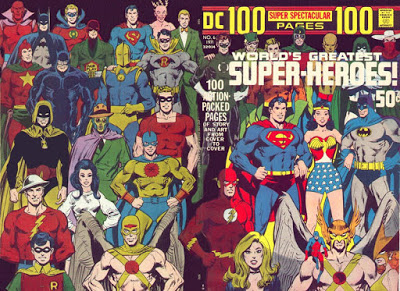
DC 100 Page Super Spectacular #6 (1971), which, under this awesome
Neal Adams cover, also had a reprint of the first JLA/JSA team-up, a Golden Age Spectre story, and a previously
unpublished Golden Age Wildcat story (as well as lists of "every" DC hero's first appearance up to that time.). Even better, DC made a replica of the World's Great Super-Heroes Super Spectacular (yes, a reprint of a collection of reprints) in May, 2004 (though the cover was slightly altered)!
Last (but not least) of Johnny's reprints is
Adventure Comics #202 (July, 1954) with "The Human Hot-Rodders" by
Otto Binder and
Ralph Mayo, having Johnny and Tubby facing off against the gang of Bull Barton, who are trying to distract police to allow Bull to escape prison and his execution.
This tale was reprinted in
World's Finest Comics #186 (August, 1969) under a cover by
Carmine Infantino and
Neal Adams, with Superman planning to execute Batman!
Johnny's Golden Age adventures ended with
Adventure Comics #207 (December, 1954), but that wasn't the end of Johnny's adventures...even in World War II, as the 1980s All-Star Squadron later proved!
Liberty Belle
Libby Lawrence first appeared in
Boy Commandos #1 (Winter, 1942) with an untitled tale by
Don Cameron and
Chuck Winter...that told of her escape from Poland to Holland, then to France, all the while, being followed by the invading Nazis. Libby even swims the English Channel to get to England, before the German forces start to invade their as well. Libby goes to Philadelphia to see the Liberty Bell, and gets a tiny replica as the bell (which she wears on her belt), which gives her strength when the real Liberty Bell is wrung...thus beginning her career as Liberty Belle (all recapped in
All-Star Squadron #61 of September, 1986)!
Liberty Belle appeared next in
Boy Commandos #2 (Spring, 1943), along with boyfriend Rick Cannon and Liberty Bell guard Tom Revere, then the Liberty Belle feature runs from
Star-Spangled Comics #20 (May, 1943) to
Star-Spangled Comics #68 (May, 1947) replacing Tarantula's series...which none of which have been reprinted; in fact, if not for the cover of
Adventure Comics #416 (March, 1972), readers wouldn't have seen Liberty Belle...
...until the All-Star Squadron,
Roy Thomas' series focusing on World War II adventures of DC's mystery men (and women) of the time!
This series lasted for 67 issues (plus a preview in
Justice League of America #193 and three Annuals), and featured World War II era versions of the Justice Society of America (including
Flash,
Hawkman,
Dr. Mid-Nite,
Wildcat and more), as well as
the Seven Soldiers of Victory,
the Freedom Fighters, and even individual heroes like
Commander Steel,
Air Wave, TNT and Dan the Dyna-Mite, and even introduced characters like Amazing Man and a new female Firebrand....
....and later in the run, Johnny and Libby got married (and later still, after the All-Stars and World War II ended), we readers found the results of that union, with their daughter,
Jesse Quick (whom continues the legacy of both her parents to this day).