Showing posts with label Golden Age. Show all posts

Friday, February 8, 2019

Secret Origins Of The Super DC Heroes

Certainly the best collection of Secret Origins, bar none, was the Crown Publishers collection of origins for the Secret Origins Of The Super DC Heroes from 1976, with cover by Neal Adams, an introduction by Carmine Infantino (who was DC's publisher at the time) and a little historical text before each hero by Denny O'Neil, all of which made this an incredible package, designed to thrill youths of all ages!

Let's dive right into the stories reprinted here!

Superman...He's The Key, The Granddaddy Of Them All

Superman was the one that started it all, in Action Comics #1 (June, 1938) by Jerry Siegel and Joe Shuster, and the one page origin they provided was reprinted here.

It had the young Superman launched from his exploding planet, to end up in an orphanage, where he exhibited extraordinary strength.  Later, he also had superb speed and incredible endurance, all of which allowed him to take up his career as Superman.

A pretty bare bones origin, to say the least, but more would be added to the legend of Superman and his history.

Carmine Infantino was said to have wanted a longer origin for Superman, so getting E. Nelson Bridwell as the writer, himself doing the layouts, with Curt Swan providing finished pencils and Murphy Anderson the inks, readers got the Superman origin presented in The Amazing World Of Superman, Metropolis Edition (1973), the 17 page origin reprinted here, lengthening that Golden Age origin, including Jor-El's fight with the Science Council to save Krypton, Jor-El and Lara's tearful farewell to young Kal-El, his landing in Smallville and being found by the Kents, being raised and taking the identity of Superboy, then watching his adopted parents pass away, leading him to Metropolis, and the Daily Planet, where, as reporter Clark Kent, he continued the neverending battle for truth, justice and the American way as Superman!

Probably the best of all Superman origins, this was expanded upon to make the story in Action Comics #500 (and even included a mention of Superboy's history with the Legion of the Super-Heroes!).

Batman...He Was Unable Not To Fight Criminals

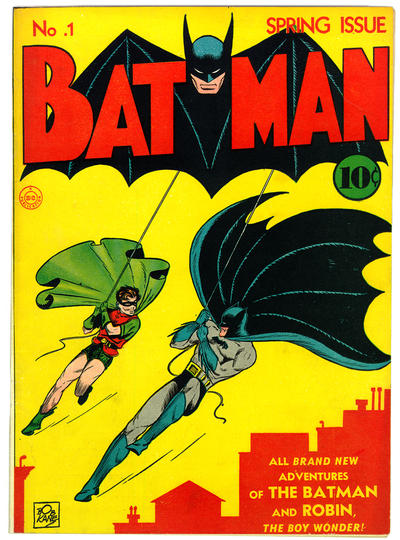
Batman's origins were different, starting in Detective Comics #27, but not getting an origin until Detective Comics #33, with the 2 page version reprinted here the slightly altered version from Batman #1 (Spring, 1940, which also saw the first appearances of Joker and the Catwoman) with words by Bill Finger, art by Bob Kane (with backgrounds by Sheldon Moldoff), with the story of how a mugger shot and killed Bruce Wayne's father and mother, Thomas and Martha, with young Bruce dedicating his life to strike fear into criminals' hearts as the Batman.

A simple enough origin, and the basis for every origin that followed.

This origin was pretty much the origin readers saw in Batman #47 (June-July, 1947) by Bill Finger, Bob Kane and Charles Paris, with a few subtle alterations, like Martha dying from seeing her husband shot (and having a weak heart), young Bruce glaring at the mugger, and the mugger being given a name, Joe Chill, with Batman hunting him down, getting final vengeance (though it was Chill's own men who killed him, having heard that Chill was responsible for creating the Batman).

Both of these origins did fit under the umbrella of the Golden Age Batman, but a much longer origin for Batman (as well as his friends) did surface later, in the Untold Legend of the Batman, which added many details added to Batman's origin from the Silver Age (like his father being a Batman, as well as Bruce's stint as Robin).


Wonder Woman...The Female Sex Is Assuming Day By Day A More Dominant Role In World Affairs

Wonder Woman herself got a special condensed version of her origin, after premiering in All-Star Comics #8, then headlining starting with Sensation Comics #1.

In Wonder Woman #1 (Summer, 1942, the tale reprinted here), the story of how Hippolyta carved young Diana from clay, raised her on Paradise Island, saved pilot Steve Trevor, and competed to go back with Trevor to the mainland to fight in World War II (and taking on the identity of military nurse, Diana Prince) was summarized by William Moulton Marston (under the pen name of Charles Moulton) with art by Harry G. Peter.

This would be the definite version of Wonder Woman's Golden Age origin, and the one that formed the basis for the many that followed.

That Wonder Woman origin more or less stuck, but Wonder Woman #206 (June-July, 1973) by Cary Bates, Don Heck and Vince Colletta (under a stunning Nick Cardy cover), added a current battle with Ares to the mix (as well as Diana Prince's job at the United Nations), as well as Hippolyta withholding some memories from Diana, of how Ares came and kidnapped her sister, Nubia, from Hippolyta, and was used as a pawn by him to have the two battle (and Hippolyta's revelation of his history to her daughter, with Nubia coming to stay on Paradise Island).

Sadly, this little era of Wonder Woman, fitting between her time as a powerless Wonder Woman and the twelve trials of Wonder Woman to rejoin the JLA (including one issue of Supergirl with Hippolyta and the Amazons) has not been reprinted elsewhere.


The Flash...You Can Do Almost Anything With Him...

Now, with the Flash, the distinctions between the Golden Age and Silver Age become clearer, as it was student Jay Garrick who first became the Flash in Flash Comics #1 (January, 1940) by Gardner Fox and Harry Lampert.  Jay accidentally inhaled "hard water" and spent a year of college in a coma, before awakening with super speed (which he mostly kept secret, though he did show off for his girlfriend, Joan Williams).

Eventually adopting the identity of the Flash, he saved Joan from the Faultless Four, eventually helping to found the Justice Society of America, and being there when it ended in the 1950s (and having many stories)....then getting revived with the help of the next young man....

Barry Allen, who first appeared in Showcase #4 (September-October, 1956), became the Flash after exposure to lightning striking a wall full of his police scientist chemicals, or at least that was the story Robert Kanigher, Carmine Infantino and Joe Kubert gave readers.  Barry made his own identity as the Flash (based on a comic he read), and beating the Turtle to save Iris West in this first go around.

Sometime after this, Barry would help found the Justice League of America, and later, finding the original Flash, Jay Garrick, on an alternate Earth (which would eventually lead to Earth-1/Earth-2, with Barry on 1, Jay on 2), and later, so many other Earths, as well as a Crisis, but it all started with Barry and Jay, and the Flashes of Two Earths.


Green Lantern...No Evil Shall Escape My Sight

Alan Scott was a train engineer who nearly died in a crash, except that he was holding onto a strange green lantern as related in All-American Comics #16 (July, 1940) by Bill Finger and Martin Nodell.  That green lantern related its history, bringing with it power that Alan could focus after he made a ring of its metal to wear, useful against all items but wood, with Alan taking on the identity of the Green Lantern.  This Green Lantern would go on to found the Justice Society as well, having many cases with them as well as many solo cases, facing foes like the Gambler, Vandal Savage and the Icicle.

Green Lantern was a part of the team when it ended the first time, and being there for its first revival.

Hal Jordan was the man to become Green Lantern in Showcase #22 (September-October, 1959) by John Broome, Gil Kane and Joe Giella.  Hal was a test pilot in Coast City, who gets a Green Lantern ring from a dying Abin Sur to make him into the Green Lantern of Earth.  Hal uses his ring to fight crime, giving himself the identity of Green Lantern (and adding a mask to the Green Lantern uniform), with a ring that can make anything he can think of, but needs to be recharged every 24 hours, and is useless against yellow.

Hal also helps to found the Justice League of America, finds out about the Green Lantern Corps (and that he is the protector of Sector 2814), and works for the Guardians of the Universe (who know a little bit more about the beginnings of evil, as well how the magic that formed Alan Scott's ring, than they let on).

The Green Lantern Corps are the successors of the Manhunters as well. 
 

Hawkman...The Weirdness Seems To Be Part Of Hawkman's Appeal

Carter Hall was an archeologist researching the dagger of Khufu, when he bumped into Shiera Sanders (fleeing from an electrified railroad) in Flash Comics #1 (January, 1940) by Gardner Fox and Dennis Neville.  Turns out Carter was Khufu reincarnated (as Shiera was the reincarnation of his wife, both murdered by Hath-Set....who was reincarnated at Doctor Hastor, the man behind the electrical menace).  Carter uses information he had gotten on a dig to clothe himself as Hawkman, using ancient weapons and the secret Nth Metal to make wings so he could fly.  Hawkman defeats Hastor, saving Shiera.

Later, Shiera becomes Hawkgirl and assists Hawkman with his missions.  Hawkman is also a founder of the JSA, and the only member to be involved in every JSA case in the Golden Age.

Katar Hol came to Earth as a Thanagarian policeman, with his wife and partner, Shayera Hol, pursuing the shape-changing villain, Byth, in Brave and the Bold #34 (February-March, 1961) by Gardner Fox and Joe Kubert.

Using Thanagarian science (including the Absorbascon, which allowed them access to all of Earth's knowledge), ancient weapons and an ability to speak to birds, the duo took up crimefighting as Hawkman and Hawkgirl, and Earth alter egos as Midway City Museum curators, Carter and Shiera Hall.  Hawkman joined the Justice League soon after its founding, with Hawkgirl joining the JLA later.  Unlike Flash, Green Lantern and Atom, the Hawks of two Earths never worked together in the Hawkman title, though the Hawkman of Earth-1 regularly worked with the Atom of Earth-1. 

Hawkgirl later took on the name Hawkwoman, then, after the Crisis on Infinite Earths and Invasion!, Hawk history got confusing (as this history of Hawkgirls will show).


Green Arrow...A Streamlined Robin Hood

Though Green Arrow and Speedy first appeared in More Fun Comics #73, their origin waited until More Fun Comics #89 (March 1943) by Joe Samachson, Cliff Young and Steve Brodie.  Oliver Queen was marooned on the Lost Mesa, where he met Roy Harper, a boy who had been raised by the local tribe of Indians, and the two had to work together using their archery skills against thieves who planned to plunder a local gold mine.

This Green Arrow never joined the JSA, but instead joined the Seven Soldiers of Victory, and had many adventures with them, as well as only with Speedy.

Oliver Queen got a new origin in Adventure Comics #256 (January, 1959) by France Herron, Jack Kirby and Roz Kirby.  Oliver Queen was a reckless millionaire who fell overboard on a yacht, ending up on Starfish Island, alone, and having to learn archery to survive.  Queen even made some trick arrows to pass the time, and ended up getting off the island when he came upon pirates, and crafted a quick disguise to allow him to use his archery to stop them (and get off the island when the authorities arrived).  This was one of many adventures of Green Arrow illustrated by Jack Kirby.  Speedy then got a slightly newer origin as well, though not until Kirby had left Green Arrow.

Green Arrow was the first non-charter member of the Justice League of America, and later became involved with the Black Canary after getting a new costume working with Batman and losing his fortune.


Introducing The Mighty Atom

Al Pratt was a diminutive college student who started on his way to super heroics in All-American Comics #19 (October, 1940) by Bill O'Connor, Ben Flinton and Leonard Sansone.  Mugged in front of his girlfriend, Mary James, Al loses the girl for a bit, but meets Joe Morgan, a homeless ex-boxer, who helps him learn the manly art of pugilism (boxing, as well other athletics).  After a year, and in much better shape, Al goes to visit his ex-girlfriend, and stops her from being kidnapped (though Mary never sees him, as she is blindfolded).  Al decides to take up the identity of the Atom, and fight for justice (having a costume with his next appearance).

Atom is a founding member of the Justice Society of America, and, later, gets actual super-strength as well as a costume change among his many solo adventures.

Physicist Ray Palmer turns himself into the hero, the Atom, starting with Showcase #34 (September-October, 1961) by Gardner Fox, Gil Kane and Murphy Anderson.  In the origin half of his tale, Ray has been experimenting with White Dwarf star material to make items shrink.  Problem is, the items become unstable after a time and explode (and Ray is unable to safely enlarge them).  His girlfriend, lawyer Jean Loring, takes him and a group of students on a nature hike into a large chain of caverns, which collapse while they are inside, trapping the group with little hope of rescue.  Ray spots a small hole, and, having accidentally brought the White Dwarf lens with him, shrinks himself to allow him to climb the smooth walls to enlarge the hole, and, while heading back to tell Jean and the kids, accidentally walks under the lens beam again, but grows this time (as cave water had gotten on the lens, bringing along some element that allowed him to grow).  Not explaining his shrinking was a success. Ray then creates a size changing uniform out of White Dwarf material, taking on the identity of the Atom.

Atom joins the Justice League after Green Arrow, and faces many foes, including ChronosJean and Ray even marry later on, after Ray reveals his identity to her, but  they later divorce. 
 

Shazam!...In One Thing A Sense Of Fun And The Whole Sense Of Adventure

Billy Batson was a homeless paperboy who followed a mysterious stranger into the subway in Whiz Comics #2 (February, 1940) by Bill Parker and C.C. Beck.  At the end of the line, Billy met an old wizard, who said he was dying, and wanted to pass on his powers to the lad....who only had to say the wizard's name....Shazam!  Billy then transformed into Captain Marvel, who had the wisdom of Solomon, the strength of Hercules, the stamina of Atlas, the power of Zeus, the courage of Achilles and the speed of Mercury.  This gave Billy the ability to fight the evil Dr. Sivana, who planned on blacking out the radio stations of the day.  Billy did this, and ended up getting a job with Whiz radio.

Billy eventually gathered a whole Marvel Family around himself, including his sister, Mary, and their friend, Freddy Freeman, and later, Tawky Tawny and Kid Eternity.  Thrown into suspended animation, they revived in the 1970s, and had more adventures on their own Earth, that of Earth-S, until the Crisis on Infinite Earths.


Plastic Man...One Of The Wildest Imaginations...

Eel O'Brian was a small time hood who got pinched in a folied robbery in Police Comics #1 (August, 1941) by Jack Cole.  That ended up being the best thing that ever happened to him, as he was doused in chemicals, and, while recovering in a monestary, found he had the elastic properties of plastic.  Deciding to change his life for the better to follow the monks who had helped him, Eel adopted the identity of Plastic Man, and used his crooked knowledge to find criminals, so his super self could put them in jail.

Later, Plastic Man started working with Woozy Winks (a shifty indiviual himself) and the two stopped odd criminals for as long as Quality Comics lasted.  Later, Plas and Woozy found themselves at home at DC Comics, with a DC Special, reprinting some of their earliest work together.  The original Plastic Man later became a member of the All-Star Squadron, and, long after the Crisis On Infinite Earths, Plas joined the JLA as well (at a time when there was only one Earth).


True, there was a pretty good collection of Secret Origins in 1961, which led to even More Secret Origins, and even a seven issue run of reprints of Secret Origins (all of which included a few origins not seen here), but this 1970s tome was truly the greatest of them all!


Thursday, June 28, 2018

Batman Marries Catwoman

It isn't a hoax, imaginary story or any other such phony plot device, but a real wedding for Batman and Catwoman....or, technically for Bruce Wayne and Selina Kyle.

It happened long ago, on a place called Earth-2, where the original Batman (who was a member of Justice Society of America) and the Golden Age Catwoman lived....

The Autobiography Of Bruce Wayne

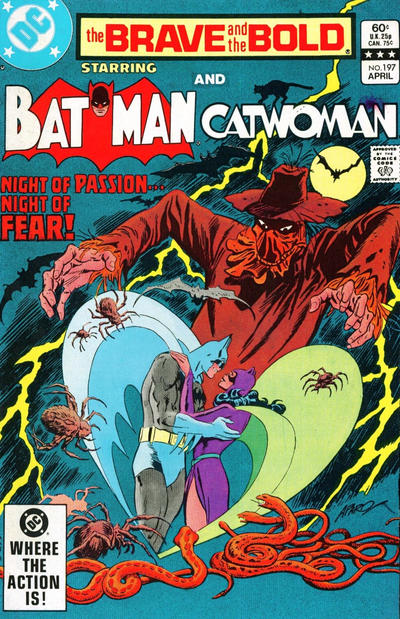
Brave and the Bold #197 (April, 1983) by Alan Brennert, Joe Staton and George Freeman (with a stunning cover by Jim Aparo), presents the story where Bruce and Selina finally admit their love for each other in 1955.

Batman worries about being alone as one of Bruce Wayne's former girlfriends gets marries, and, thanks to a recently paroled Scarecrow, that fear manifests, as Robin, Batwoman, then Alfred, Gordon, even Lois Lane and Superman disappear.  Batman goes for help from an old enemy, Catwoman, serving time as Selina Kyle after turning herself in (and claiming amnesia for most of her time as Catwoman).  During their search for Scarecrow, the two open up to each other about how much life had hurt them, and that they had both needed someone...so that they both conquered their fear of being alone by trusting each other.  The story ends with a quick summary of their wedding, as well as the events which happened in the decades following.

This story is one of the best Batman stories ever written, and has been reprinted many times, including in the Greatest Batman Stories Ever Told of 1988, Catwoman: A Celebration of 75 Years of 2015, and in Tales Of The Batman: Alan Brennert of 2016.  This tale alone almost makes any of those collections worth buying, and the other tales around it are just a bonus.


The Kill Kent Contract

Bruce and Selina get married in Superman Family #211 (October, 1981) by E. Nelson Bridwell, Kurt Schaffenberger and Dan Adkins, with guests like Dick Grayson (Robin), Alfred Beagle, Commissioner James Gordon, Harvey Kent (the former Two-Face), and Clark Kent and Lois Lane (Mr. and Mrs. Superman).

This tale starts with Clark and Lois getting an invitation of Bruce and Selina's wedding (via Batplane, no less), and the pair heading to Gotham City to attend (revealing Lois knows both parties secret identities as well as how Selina gave up, about her brother Kyle, the King of Cats).  A phone mix up allows Lois to hear that a plot to kill Kent is afoot at the wedding.  The ceremony shows Dick Grayson as Bruce's best man, Karl Kyle giving Selina away, and Bruce's butler, Alfred Beagle (the Golden Age version of Alfred Pennyworth), Com. James Gordon (with wife Barbara and son Tony).  Afterward, at the reception, Clark and Lois meet Harvey Kent, former Gotham District Attorney (and Two-Face, before cured with plastic surgery), who as the Kent who was the target.

Superman foils the criminal's plans, and later, when Lois, Clark, Bruce and Selina are alone, Lois and Clark reveal their secret to Selina, hoping the couples would be best of friends (but it was Bruce and Dick who returned for a second appearance in the Mr. and Mrs. Superman feature in Superman Family #216). 

Sadly, this tale, like most of the Mr. and Mrs. Superman tales other than Lois and Clark's wedding from Action Comics #484, has not been reprinted, but this whole run from Superman and Superman Family, along with the Action Comics issue cries out to be collected, as writer E. Nelson Bridwell really fleshed out the differences between the Earth-1 and Earth-2 versions of Superman (and Batman) with entertaining tales of a married Clark and Lois set in the 1950s.


From Each Ending....A Beginning

A quick peak at Bruce and Selina's wedding happens in DC Super-Stars #17 (November-December, 1977) by Paul Levitz, Joe Staton and Bob Layton, as well as a little look at Bruce and Selina's life after getting hitched, including how both retired their costumed identities for a while, as they raised a daughter, Helena Wayne.

The majority of this issue is about Helena, and Bruce and Selina's life at that time, but this does have that first flashback to her birth in 1957, as well as a little time of her growing up, as well as establishing many of the guests at Bruce and Selina's wedding, setting up for the later tales which help fill in the holes of the details.  The issue also introduces Silky Cernak, and the catastrophe he will introduce into the lives of Bruce, Selina and Helena Wayne in 1976, which the title of the tale suggests, leading to the introduction of the Huntress and her costume which looks like a hybrid of Batman and Catwoman's (though Huntress appeared only days earlier in All-Star Comics #69, technically her first appearance in a cameo in the JSA tale, though this story happened first).

This tale has been reprinted a few times, in Batman In The Seventies from 1999, Huntress: Darknight Daughter from 2006 (which cries for a follow up volume to finish the Huntress reprints from the 1970s/1980s from the back of Wonder Woman as her history shows, almost all her other tales have been reprinted), and in Catwoman: A Celebration of 75 Years from 2015), completing our look back at the first time Batman and Catwoman got married.

Wednesday, October 25, 2017

All-Star Comics 8 The First Wonder Woman

On October 25, 1941, All-Star Comics #8 (cover date December-January, 1941/1942), DC (in its identity as All-American Comics) was the first comic sold to be "Introducing Wonder Woman"!

The Amazon was created by William Moulton Marston and H.G. Peter, detailing Princess Diana's first meeting with U.S. Army pilot Steve Trevor as his plane crashed near Paradise Island, and, after winning a competition against her fellow Amazons, Diana left her mother, Queen Hippolyte, and her home, Paradise Island, to go fight World War II in Man's World as Wonder Woman!


But, as you might have noticed, Wonder Woman didn't make the cover.   


The main story of the issue (with a cover by Everett Hibbard) was having Starman and Dr. Mid-Nite join the Justice Society of America (and a short story about pilot Hop Harrigan)! 


Wonder Woman wouldn't get a chance to join the group until a few issues later with a major cover appearance.....


Oddly, Wonder Woman's success (getting her origin told again with Sensation Comics #1 of January, 1942, and again in Wonder Woman #1 of Summer 1942) messed up her membership to the JSA (because the comic company had a rule that active members wouldn't have their own titles, yet Wonder Woman graduated up at the time she was inducted....so, she remained as a secretary to the team....).


Both of the above Wonder Woman issues got both Famous First Editions as well as Millennium Edition reprints, but the All-Star Comics #8 was only reprinted in its entirety in All-Star Comics Archives #2 of 1993 (making the cover with the JSA) and in the Millennium Edition: All-Star Comics #8 (February, 2001), joining the DC trinity with Superman and Batman.

Wednesday, August 2, 2017

Guide To Golden Age Sandman Reprints Part 1

"There is no land beyond the law, where tyrants rule with unshakeable power!  It's but a dream from which the evil wake to face their fate...their terrifying hour!"....a message left for criminals by the crimefighter, the Sandman, putting criminals to sleep with his gas gun (which, was why he wore a gas mask along with his suit, to hide his identity as Wesley Dodds).  This Golden Age hero started in Adventure Comics, capturing a few of its covers, and worked with the Justice Society of America as well, but we start with his first published tale...and follow along with a little more after.

New York World's Fair Comics

New York World's Fair Comics #1 (April, 1939) had the first published story of the Sandman by Gardner Fox and Bert Christman, with "Sandman At The World's Fair" (though his Adventure Comics #40 story took place first, and coming out only 2 weeks after Batman's first appearance as well, so Batman isn't in this issue) where Sandman stops hoods who steal his new ray gun invention.  New York World's Fair Comics #2 (July, 1940) has the adventure of "Sandman Goes To The World's Fair" by Gardner Fox and Chad Grothkopf, with Sandman rescuing his kidnapped girlfriend, Dian Belmont. 


Both of these stories are reprinted in the DC Comics Rarities Archives #1 (December, 2004)


Adventure Comics

The first adventure of Sandman Wesley Dodds is from Adventure Comics #40 (July, 1939) by Gardner Fox and Bert Christman, with the hero dealing with when "The Tarantula Strikes", this a villain, not the later hero of the Golden Age, the Tarantula (John Law), though Sandman and the second Tarantula do have a bond, detailed later in All-Star Squadron.  This story involves Sandman rescuing kidnapped actress, Vivian Dale, and freeing her from the Tarantula's clutches.  Sandman's fashion was a little off in this issue, as in his earliest appearances, his suit was orange (before settling on green).  This tale does not feature Sandman's origin, which did not come to light until Secret Origins #7 (October, 1986), at the New York World's Fair (and involving the Crimson Avenger, another pulp styled mystery man).

This tale was reprinted in  Justice League of America #94 (November, 1971), which had this stunning cover featuring Deadman and the Justice League by Neal Adams, in an incredible story featuring the League of Assassins, as well as Starman's first appearance in Adventure Comics.

Next up is the reprint of Adventure Comics #51 (June, 1940) with the tale of "The Pawn Broker" by Gardner Fox and Creig Flessel, with Sandman tracking down escaped felon, Mad Maddon, and his murderous friend, Flip Benson.

This story was reprinted in Justice League of America #99 (June, 1972) along with a Golden Age Atom story (and a cover by Nick Cardy) and in Greatest Golden Age Stories Ever Told (1990) with a cover by Jerry Ordway.

Adventure Comics #61 (April, 1941) has Sandman facing "The Menace Of The Metal Gun" by  Gardner Fox and Creig Flessel, with Wes and Dian facing off against Ivan Borloff and his new invention, the Cylindecraft, a ray gun that destroys metal (though, ironically, has no effect on sand, which is key in allowing the Sandman to defeat the villain).

This reprint came about in Millennium Edition Adventure Comics #61 (December, 2000) which was a reprint that came from a vote by the fans...

...proving how popular Starman was (with Sandman and his fans also being one of the lucky recipients of that popularity, as this was the only place this story has been reprinted so far!).

The last of Wes' gas masked adventures reprinted is Adventure Comics #65 (August, 1941), with "The "Sandman At Sea" by artist Paul Norris.  While relaxing on a yacht with girlfriend, Dian Belmont, the Sandman gets involved in an attempted kidnapping of scientist Elbert Hudson, getting help in dealing with foreign agents from the U.S. military!


This story was reprinted in 100-Page Super Spectacular DC-17 (1973) under a cover by Nick Cardy, with three other stories...

...two featuring the Justice League and one with the Justice Society, with more facts on all of them here!


All-Star Comics

A few earlier Sandman tales, All-Star Comics #1 (Summer, 1940) with "The Twin Thieves" by Gardner Fox, Creig Flessel and Chad Grothkopf, with Sandman facing twins who are thieves while dealing with a bullet wound, and All-Star Comics #2 (Fall, 1940) with "The Glowing Globes" by Gardner Fox, Creig Flessel and Chad Grothkopf, and a scientist brother who uses the scientist's invention for evil after killing him, both reprinted  in All-Star Comics Archives #0 (2006).


Then, Sandman was a charter member of the Justice Society of America starting with All-Star Comics #3 (Winter, 1940-1941), with more of career there detailed here.


World's Finest Comics 

World's Finest Comics #3 (Fall, 1941) to #5 (Spring, 1942), have the very last of Sandman's original look, but these tales have not been reprinted at this time.

Golden Age Sandman Archives

The Golden Age Sandman Archives features a good portion of Sandman's earliest adventures with Dian Belmont, dispensing justice and helping those in need while being quite the fashionable hero, reprinting his stories from New York World's Fair Comics #1 (1939), New York World's Fair Comics #2 (1940) and Adventure Comics #40 to #59, giving readers a good taste of Sandman's career...

.....but not quite all, as it still misses the last of his suited adventures, that lasted until Adventure Comics #68, and World's Finest Comics #5


But, these issues did NOT signal the end of Sandman's Golden Age career!


Still, Sandman had some major changes, ditching the suit and gas mask for a purple and yellow costume, and getting a sidekick in Sandy the Golden Boy with Adventure Comics #69 (December, 1941), and Joe Simon and Jack Kirby as the creative force behind the comics, starting in Adventure Comics #72 (March, 1942)....but, those are tales to be told on a later date...

....with Sandman returning to his classic look with the JLA/JSA team-ups (and even later, with retroactive tales of Wes in the 1940s, with Sandman Mystery Theatre), with these tales to be looked into sometime in the future.


Wednesday, May 17, 2017

Wonder Woman Foe The Mask

Sometimes, it's the simplest things that stick in our memory....

...that might be the case with Wonder Woman foe, the Mask, as she menaces Wonder Woman on and off for decades, with little more than a domino mask and a gun!

Golden Age

Nina Close premiered in Wonder Woman #24 (July-August, 1947) with "The Challenge Of The Mask" by William Moulton Marston and H. G. Peter (being one of the last Wonder Woman villains created by Wonder Woman's creator).  Nina was a pilot, rescued by Wonder Woman, getting Wonder Woman involved in Nina's life (with her dominating husband, Brutus, who was a big game hunter).  Their marriage was not a happy one, but it got worse, with Brutus being trapped in a mask rigged with an acid drop by a villain called the Mask, and Brutus' freedom being ransomed off.  Wonder Woman tried to catch the Mask at the drop off, only to find the Mask able to steal her Invisible Plane!  Planning revenge against Wonder Woman, the Mask kidnaps Brutus, along with Etta Candy and the Holliday Girls, with Wonder Woman coming to their rescue...to find the Mask (and black wig)....hid Nina Close (who had a breakdown thanks to her husband, and came up with this scheme to get her revenge against him).  Brutus then tried to get Nina help for her actions....and that was the end of the Mask for an era.

Silver Age

The Mask returned in Justice League of America #35 (May, 1965) in the "Battle Against The Bodiless Uniforms" by Gardner Fox, Mike Sekowsky and Bernard Sachs (though it technically was the Earth-1 Mask, and even then, really only a magical duplicate brought to life by the demons Abnegazar, Rath and Ghast to battle the Justice League (along with Flash rogue Pied Piper, Batman villain Killer Moth, Aquaman menace Dagon and Green Lantern's enemy of Dr. Polaris).   The Mask didn't even make the cover!

More Modern

A more recent version of the Mask debuted in Wonder Woman #4 (February, 2007 by Allan Heinberg with Terry and Rachel Dodson) (making the cover of Wonder Woman Annual #1 of 2007 in the upper right hand corner), along with many other Wonder Woman villains re-imagined for a new age.  As Wonder Woman was struggling with her own identity, Nina Close came back as an empowered woman (in an all black outfit, but keeping the domino mask) using the fortune she got from killing her husband to fight for oppressed women everywhere (though her over-aggressive tactics brought her into conflict with the peace loving Wonder Woman, proving violence in and of itself is not the answer....but must also be tempered with kindness and wisdom).

Wednesday, May 3, 2017

Wonder Woman Golden Age Vs Silver Age

Wouldn't it be great if the original Wonder Woman met the new and improved one?

Well, that happened in DC Comics, for a few special issues of Wonder Woman (inspired by the TV Show, Wonder Woman, DC was looking to cover adventures of Wonder Woman during World War II, so they came up with an interesting idea....)

Wonder Woman #228

With Wonder Woman #228 (February, 1977), readers were treated to a "Retreat To Tomorrow" by Martin Pasko, Jose Delbo and Vince Colletta, with the then modern Wonder Woman (1977, more or less a "Silver Age" Wonder Woman, who worked with the Justice League of America on Earth-1) facing off against an aerial attack from the Red Panzer in an experimental Nazi plane over New York, and as the two battled, they fell back through the space warp to Washington DC in 1943 (where the Red Panzer was from), and into Earth-2 (an Earth where the world was protected by the Justice Society since just before the start of World War II, and Superman, Batman and Robin had started their adventures in the 1930s, with their own Wonder Woman soon after).   The two Wonder Women met (battled briefly), with the Golden Age Wonder Woman sending the Silver Age Wonder Woman back home in the Panzer Ship, and the battle between the Golden Age Wonder Woman (and Red Panzer) continued until next issue....).

Wonder Woman #243

Wonder Woman's World War II adventures continued in her own title (as well as in World's Finest Comics #244 to #250, and a few other places, as the Silver Age Wonder Woman still adventured in the Justice League of America) until Wonder Woman #243 (May, 1978) with "The Five-Sided Square" by Jack C. Harris, Jose Delbo and Frank Chiaramonte), where the two Wonder Women met again, thanks to the Earth-1 Angle Man (escaping prison, and using his time and dimension spanning weapon, the Angler, to come back to World War II).  The two Wonder Women worked together to defeat the Angle Man, with the stories in the comic following the Earth-1 version back to her own after afterwards (because, after the first season of the Wonder Woman show on ABC, the show moved to CBS for its second and third season, and was in the then modern world of the 1970s!).

More Wonder Women Facts

During the course of these two adventures, the Earth-1 Wonder Woman made the Earth-2 Wonder Woman forget about their adventures (as Earth-2 wasn't discovered by Earth-1 until the Flash of Two Worlds in Flash #123 of September, 1961, with Barry Allen and Jay Garrick).   The two Wonder Woman didn't even look different in these team-ups, but did in their first meeting (a large meeting of the JLA and JSA to free the Seven Soldiers of Victory from traps in the past, with the Golden Age Wonder Woman spotting a classic look, and the JLA's Wonder Woman in her white pantsuit "mod" look as Diana Prince for Justice League of America #100 to #102 in 1972).

A more fulfilling Wonder Woman meeting happened in Wonder Woman #300 (February, 1983), when an older, Golden Age Wonder Woman (married to Steve Trevor, with a daughter named Hippolyta, who later became Fury), met the Silver Age Wonder Woman (who had improved her breastplate from an eagle symbol to the stylized double "W"), as Earth-1's Diana was looking to make some changes in her life.

Still interested in more Wonder Woman?


Well, there was a whole Encyclopedia based on her history out a few years ago, and you can read my interview with one of its authors, John Wells, with Part 1 here and Part 2 here!


Great Hera, there's good reading in the Essential Wonder Woman Encyclopedia!