...these stories have been reprinted many times, with Neal providing even more raw emotion on the covers, but provided a wonderful window into the times they were made.
A blog about comic books, and enjoying the stories, characters and creators of them...and occasionally subjects that relate to comic books as well.
Showing posts with label Speedy. Show all posts
Saturday, June 15, 2024
Remembering Artist Neal Adams
Remembering artist Neal Adams on his birthday (June 15, 1941 - April 28, 2022) with a couple of his most famous covers from his Green Lantern run with Denny O'Neil, Green Lantern #85 and #86, (August-September and October-November, 1971), with Green Arrow being confronted with his ward's drug problem..
Friday, July 30, 2021
Teen Titans Olympics
Holy hot rings, Batman! Continuing a look back at Olympic comic book moments, here's an entry from the swinging sixites by Bob Haney and Nick Cardy, with "The Secret Olympic Heroes" from Teen Titans #4 (July-August, 1966).
This was the first appearance of Speedy in a Teen Titans title, with this flashback tale happening before the first appearance of the Teen Titans, though later events made him a charter member, so the importance of his issue cannot be overlooked!
Wednesday, July 25, 2018
DC Super Stars Teen Titans
The Teen Titans had been out of print for a few years when DC Super Stars #1 (March, 1976), with its cover made of a couple of past covers of Teen Titans by Nick Cardy gave the kids their first collection of tales...
...but, this was a key issue to the development of the Teen Titans, presenting a few old tales of the team.
Let's set the wayback machine to take a look at the two classic tales reprinted here, as well as a few other surprises that E. Nelson Bridwell's reprint title had in store for readers...
Occasional member Speedy (Green Arrow's partner, Roy Harper), came to Titans' Lair to convince the team (Robin, Kid Flash, Aqualad and Wonder Girl) to go help Willie Gregson, a young genius who was helping scientist Dr. Simon Finely, as the boy was being menaced by blackmailers using Gregson's dad's criminal past to try to have the lad steal Finely's nerve gas formula. The five kids took the Titanscopter to the campsite near where the scientist and his team worked, and after enjoying a little time on the water in bathing suits, fought against the scuba diving criminals and their robot monster involved in this nefarious scheme.
Vacationing in their alter egos (after finding out Wonder Girl's origin, name of Donna Troy and near lack of a life), the team went skiing. Of course, there was trouble at the Medicine Mountain resort. The Titans came to the aid of ski instructor Eddie Tallbow, to find that developer Anson Larson was trying to force the resort off the land so he could sell it to the government for a hefty profit...and he would have gotten away with it if not for these kids.
Not only Robin, Kid Flash, Aqualad, Wonder Girl and Speedy...
....but also other members such as brothers Hawk & Dove, telepath Lilith, fix-it-man Mal Duncan, and even caveboy Gnarrk and Doom Patroler Beast Boy....who, at the time of this issue, the last two had only been associates of the team.
That was due to change, thanks to the successful sales of this issue (as well as Super-Team Family #1, which also had a Teen Titans reprint), leading to the Teen Titans getting a ten issue revival in the mid-1970s, which also featured the introduction of the Titans West and added a few new heroes to the team, like Bumblebee, Joker's Daughter, Bat-Girl and Golden Eagle!
But, bigger things were coming for the Titans after the 1970s ended....
...but, this was a key issue to the development of the Teen Titans, presenting a few old tales of the team.
Let's set the wayback machine to take a look at the two classic tales reprinted here, as well as a few other surprises that E. Nelson Bridwell's reprint title had in store for readers...
Teen Titans 11
First up, the team was offered up as "Monster Bait" by Bob Haney, Irv Novick and Nick Cardy in a story reprinted from Teen Titans #11 (September-October, 1967), with cover by Cardy.Occasional member Speedy (Green Arrow's partner, Roy Harper), came to Titans' Lair to convince the team (Robin, Kid Flash, Aqualad and Wonder Girl) to go help Willie Gregson, a young genius who was helping scientist Dr. Simon Finely, as the boy was being menaced by blackmailers using Gregson's dad's criminal past to try to have the lad steal Finely's nerve gas formula. The five kids took the Titanscopter to the campsite near where the scientist and his team worked, and after enjoying a little time on the water in bathing suits, fought against the scuba diving criminals and their robot monster involved in this nefarious scheme.
Teen Titans 24
Next up for the team (which was down to four, as Aqualad had taken a leave of absence and Speedy joined full time), time on the slopes facing the "Skis Of Death" by Bob Haney, Gil Kane and Nick Cardy from Teen Titans #24 (November-December, 1969), with Cardy providing the original cover.Vacationing in their alter egos (after finding out Wonder Girl's origin, name of Donna Troy and near lack of a life), the team went skiing. Of course, there was trouble at the Medicine Mountain resort. The Titans came to the aid of ski instructor Eddie Tallbow, to find that developer Anson Larson was trying to force the resort off the land so he could sell it to the government for a hefty profit...and he would have gotten away with it if not for these kids.
Introducing The Teen Titans
One of the most important parts of this issue was four new pages introduced by Mr. Jupiter (a senior advisor for the Teen Titans for a time), written by E. Nelson Bridwell, with art taken from previous Teen Titans issues for the members), that introduced the team for readers.Not only Robin, Kid Flash, Aqualad, Wonder Girl and Speedy...
....but also other members such as brothers Hawk & Dove, telepath Lilith, fix-it-man Mal Duncan, and even caveboy Gnarrk and Doom Patroler Beast Boy....who, at the time of this issue, the last two had only been associates of the team.
That was due to change, thanks to the successful sales of this issue (as well as Super-Team Family #1, which also had a Teen Titans reprint), leading to the Teen Titans getting a ten issue revival in the mid-1970s, which also featured the introduction of the Titans West and added a few new heroes to the team, like Bumblebee, Joker's Daughter, Bat-Girl and Golden Eagle!
But, bigger things were coming for the Titans after the 1970s ended....
Thursday, August 18, 2016
The Secret History of the Teen Titans
Well, the original Teen Titans history won't be a secret after you read this.
The Teen Titans made their first appearance as a team in Brave and the Bold #60 (June-July, 1965), fighting the Separated Man (which also featured the premiere of Wonder Girl)....but, the teens gathered together a few times before that as well!
This involved some superior archery by Speedy, and the help of one of the young athletes, Davey Bradley, who ran a special race to save the team and look good in front of his father, Ted Bradley.
Speedy was working with the team, but this was the first time readers saw that (coming back a little later for a guest appearance in Teen Titans #11 of September-October, 1967, and permanently after Teen Titans #19 of January-February, 1969). But, no origin here, and a little extra confusion added with Speedy not being a regular member of the Teen Titans in the early days...
...so, looking forward to go back....
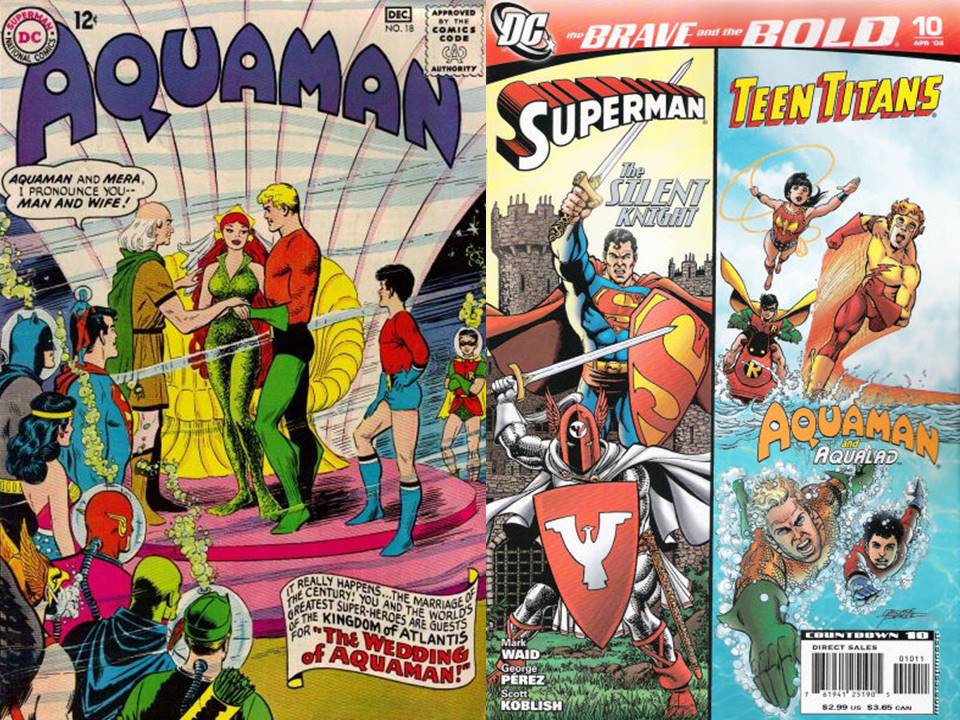
Before the Crisis on Infinite Earths, this event took place after Aquaman's wedding to Mera in Aquaman #18 of November-December, 1964, where Robin and Aqualad were guests...
...after the Crisis, it appears the fab four Teen Titans were guests at the wedding as well, as related in Brave and the Bold #10 of April, 2008.
Groovy!
But, the most of the sidekicks (Robin, Kid Flash and Aqualad) did meet one time before in Brave and the Bold #54 (June-July, 1964 by Bob Haney, Bruno Premiani and Sheldon Moldoff), when they faced Mr. Twister in the town of Hatton Corners. Mr. Twister kidnapped the youths of the town, and used the power of his magical Indian medicine staff to control the weather, which was enough to even take Kid Flash and Aqualad out of the way. Luckily, Robin was there to put an end to the trouble caused by Brom Stikk (the man who called himself Mr. Twister...
....who would later come back to menace Robin and the Teen Titans under another identity, and even later with more help as well!).
Then the Teen Titans appeared in Brave and the Bold #60 (June-July, 1965, the introduction of Wonder Girl), then in Showcase #59 (November-December, 1965), leading to Teen Titans #1 (January-February, 1966)....and from there into history, adding members like Hawk & Dove, Lilith, Mal, Gnarrk, Joker's Daughter, Golden Eagle and more!
The Teen Titans made their first appearance as a team in Brave and the Bold #60 (June-July, 1965), fighting the Separated Man (which also featured the premiere of Wonder Girl)....but, the teens gathered together a few times before that as well!
The Secret Olympic Heroes
Teen Titans #4 (July-August, 1966 by Bob Haney and Nick Cardy) told an earlier tale of the Teen Titans, where Speedy (Roy Harper, the ward of Green Arrow) worked with Robin (Dick Grayson), Aqualad (Garth), Kid Flash (Wally West), and Wonder Girl (Donna Troy) to stop the agents of DIABLO from ruining the Olympic games.This involved some superior archery by Speedy, and the help of one of the young athletes, Davey Bradley, who ran a special race to save the team and look good in front of his father, Ted Bradley.
Speedy was working with the team, but this was the first time readers saw that (coming back a little later for a guest appearance in Teen Titans #11 of September-October, 1967, and permanently after Teen Titans #19 of January-February, 1969). But, no origin here, and a little extra confusion added with Speedy not being a regular member of the Teen Titans in the early days...
...so, looking forward to go back....
In The Beginning...
The last of the original Teen Titans run, Teen Titans #53 (February, 1978 by Bob Rozakis, Juan Ortiz and John Fuller) had a special flashback tale, featuring Robin, Aqualad, Kid Flash, Speedy and the new Wonder Girl meeting for the first time as each of them had just had problems with their mentors (Batman, Aquaman, Flash, Green Arrow and Wonder Woman), as their mentors had turned to crime. The sidekicks gathered in Metropolis, thinking of going to Superman for help, but then realized he, too, might have turned bad, and thus, they resolved to team-up against the heroes gone bad, and take them down. Along the way, they also found out that the heroes were turned by an extra-dimensional being, the Antithesis, who was powered by the heroes misdeeds, and as the last of the teens defeated the last of the heroes, Antithesis disappeared back into his dimensional home, without the power to break free, and the team decided to stay together, with Wonder Girl suggesting the Titans name. Speedy didn't feel like much of a joiner, so he didn't participate in the Teen Titans earliest adventures, but was welcome to come back when he wanted to.Before the Crisis on Infinite Earths, this event took place after Aquaman's wedding to Mera in Aquaman #18 of November-December, 1964, where Robin and Aqualad were guests...
...after the Crisis, it appears the fab four Teen Titans were guests at the wedding as well, as related in Brave and the Bold #10 of April, 2008.
Groovy!
The Thousand-and-One Dooms Of Mr. Twister
But, the most of the sidekicks (Robin, Kid Flash and Aqualad) did meet one time before in Brave and the Bold #54 (June-July, 1964 by Bob Haney, Bruno Premiani and Sheldon Moldoff), when they faced Mr. Twister in the town of Hatton Corners. Mr. Twister kidnapped the youths of the town, and used the power of his magical Indian medicine staff to control the weather, which was enough to even take Kid Flash and Aqualad out of the way. Luckily, Robin was there to put an end to the trouble caused by Brom Stikk (the man who called himself Mr. Twister...
....who would later come back to menace Robin and the Teen Titans under another identity, and even later with more help as well!).
Then the Teen Titans appeared in Brave and the Bold #60 (June-July, 1965, the introduction of Wonder Girl), then in Showcase #59 (November-December, 1965), leading to Teen Titans #1 (January-February, 1966)....and from there into history, adding members like Hawk & Dove, Lilith, Mal, Gnarrk, Joker's Daughter, Golden Eagle and more!
Thursday, August 27, 2015
Individual Seven Soldiers of Victory Reprints
While there will be a few articles on the various individual Justice Society of America members, like Starman and Black Canary, sadly, it won't be as easy to do that with the Seven Soldiers of Victory.
This issue also features the first appearance of Aquaman, of Dr. Fate foe Mr. Who (with the doctor capturing the cover in his half mask that he was using at this time), as well as Spectre and Johnny Quick stories, a ton of Golden Age goodness!
That first appearance of Green Arrow and Speedy didn't have their origin, which we had to wait until More Fun Comics #89 (March, 1943) in the story "Birth of the Battling Bowman" by Joe Samachson and Cliff Young, wherein we see the first time millionaire archeologist Oliver Queen meets Indian raised Roy Harper, and how the two have to escape thugs searching for a gold mine on the Lost Mesa.
This is the Golden Age (or Earth-2 if you prefer) origin of Green Arrow, and is presented in the Secret Origins of the Super DC Heroes of 1976 (in both hardcover and soft cover), along with Golden and Silver Age origins of Superman, Batman, Wonder Woman, Flash, Green Lantern, Hawkman, Atom and more under a cover by Neal Adams.
More Fun Comics #101 (January-February, 1945) is the last of Green Arrow's More Fun Comics to be reprinted, with the "Formula For Doom" by Joe Samachson and Maurice del Bourgo wherein the battling bowmen face off against crooks disguised as cops trying to take a secret formula from chemist Cyrus Gage.
This was another story represented in a full reprint, that of the Millennium Edition: More Fun Comics #101 of November, 2000. This issue also features Aquaman, Johnny Quick and in his last Golden Age appearance, the Spectre, as well as debuting a new feature...Superboy (a story of Superman, as a boy! Superboy took over the cover quickly, preventing Green Arrow from getting covers on Adventure Comics, where his, Superboy, Johnny Quick and Aquaman's features all moved to after More Fun Comics #107 of January-February, 1946).
Sadly, few Green Arrow stories (or any stories) of Adventure Comics (starting from Adventure Comics #103 of April, 1946) were reprinted. Starting with Adventure Comics #174 (March, 1952) with "1001 Ways To Defeat Green Arrow" by Ed Herron and George Papp, which seems to spell trouble for Green Arrow and Speedy.
This tale ends up in Brave and the Bold #117 (February-March, 1975), the last of B&B's 100 page issues, and has Batman teaming up with Sgt. Rock, as well as a few great tales with the Secret Six, Viking Prince and Blackhawk!
Brave and the Bold had also become a bit of a home for Green Arrow, as he and Batman had many team-ups (though this was the Earth-1 Batman and Green Arrow)!
The only other Golden Age Green Arrow full color reprint from Adventure Comics is Adventure Comics #176 (May, 1952), wherein Green Arrow and Speedy faced the villainous Roper for the first time in "The Rogue of 1000 Ropes" with no identified writer, and art by George Papp.
The story was represented in World's Finest Comics #204 (August, 1971), which also had a new story with Superman and Wonder Woman, as well as an early Captain Comet reprint, which featured characters that were prototypes for Green Lantern's Guardians of the Universe.
Last, but not least is World's Finest Comics #71 (July-August, 1954), with the Green Arrow story of "The Invisible Death" by Ed Herron and George Papp, where Green Arrow lets TV reporters into his trophy room, and tells them of past cases (like beating villain Bull's Eye) and about his trick arrows like the Balloon Arrow, Lariat Arrow and Smoke-Bomb Arrow.
This appearance of Green Arrow and Speedy is considered Golden Age, though the Superman and Batman team-up (their first regular team-up in World's Finest Comics) are the Earth-1 (Silver Age) versions of the heroes...and the reason this issue was given a reprint in its entirety, with the Millennium Edition: World's Finest #71 in August, 2000). It even includes a story of Revolutionary War hero Tomahawk!
Green Arrow's fellow soldier, Arthurian Sir Justin, also known as the Shining Knight, might have eventually come to share Adventure Comics with the battling bowman, but Sir Justin has only had a few adventures reprinted, and not even his first appearance of Adventure Comics #66 (September, 1941).
Shining Knight reprints start with Adventure Comics #150 (March, 1950) and "The Ten-Century Lie" by Joe Samachson and Frank Frazetta, with a flashback to a time in Camelot before Sir Justin became frozen and ended up in World War II.
This story was presented in the Masterworks Series of Great Comic Book Artists #1 (Spring, 1983), focusing on the artwork of Frank Frazetta, and also includes "Sir Justin, Bronco Buster" from Adventure Comics #151 (April, 1950) and written by Joe Samachson, and Adventure Comics #153 (June, 1950) in "The Duel of the Flying Knights" written by Joe Samachson, Adventure Comics #155 (August, 1950) with "The Imitation Knight" written by Joe Samachson (with Sir Justin having to fool high society girl, Mary Mason, into NOT thinking he's the Shining Knight), and Adventure Comics #157 (October, 1950) with "Camelot, U.S.A." written by Joe Samachson, wherein Sir Justin and his flying horse Winged Victory come to Camelot, Michigan to help the town celebrate its centennial, and foil criminals.
The story in Adventure Comics #153 (June, 1950) in "The Duel of the Flying Knights" written by Joe Samachson and art by Frank Frazetta was also reprinted in World's Finest Comics #205 (September, 1971)...
...and this tale was set in the Shining Knight's time in Camelot with King Arthur and Merlin, fighting an ancient Greek warrior, Bellerophon, and his magical horse, Pegasus, with evil Sir Mordred engineering the fight between these two, and features a main story with Superman working with the Teen Titans, as well as a reprinted sci-fi tale.
Adventure Comics #159 (December, 1950) with the story of the "Knight of the Future" by Joe Samachson and art by Frank Frazetta, was reprinted in both the hardcover and softcover collections of the Greatest 1950s Stories Ever Told (hardcover from 1990 and cover by Joe Kubert, and soft cover from 1992 with a collection from the stories within).
This tale of Sir Justin (and his 20th Century squire, Sir Butch), found the duo transported to the 35th Century by a miscast spell by Merlin, and they ended up facing off against rebels trying to overthrow the government before being able to return home.
Adventure Comics #161 (February, 1951) with "The Flying Horse Swindle" by Joe Samachson and Frank Frazetta was reprinted in Adventure Comics #417 (March, 1972, with a Supergirl cover by Bob Oksner, with the issue featuring a new Supergirl story, as well as a new Vigilante story, and a reprint of he first appearance of the Enchantress, who later joined the Forgotten Villains and the Suicide Squad).
The Shining Knight story had Sir Justin facing off conman Deadpan Dixon who tried to steal Winged Victory, so Sir Justin let him to teach the crook a lesson he'd never forget!
Adventure Comics #159 (December, 1950) with the story of the "Knight of the Future" by Joe Samachson was also reprinted in the Masterworks Series of Great Comic Book Artists #2 (July, 1983), another collection of art by Frank Frazetta, along with Adventure Comics #161 (February, 1951) with "The Flying Horse Swindle" written by Joe Samachson, with its first panel providing the cover for the collection, and also containing the Shining Knight story from Adventure Comics #163 (April, 1951), written by Joe Samachson, and "The Knight In Rusty Armor", with Sir Justin facing off against a crooked sheriff in his last reprinted story, though Sir Justin had two more Golden Age stories in Adventure Comics #165 and #166 (June and July, 1951), written by Don Cameron and art by Ramona Fradon.
Detective Comics #27 (May, 1939) was the first appearance of Batman, and was reprinted in its entirety in the Millennium Edition: Detective Comics #27 (February, 2000) as well as in the Famous First Edition C-28 (1974).
This story had no title in the original book, but was given the title of "Murder On The Oceanic Line Docks" later, and was written and drawn by Jim G. Chambers, and featured the Shadow-inspired Crimson Avenger (mostly called "The Crimson" in this story) and Wing facing off against gambler Mike Moran and other hoods.
Detective Comics #38 (April, 1940) has the first appearance of Dick Grayson, also known as Robin, the Boy Wonder, and this issue was collected in its entirety in the Millennium Edition: Detective Comics #38 (April, 2000).
This story was given the title of "Phoney Jewel Robbery", and was written and drawn by Jack Lehti, and has Crimson Avenger and Wing facing jewel thieves and mobsters, with the real criminals being a bit of surprise!
Sadly, tales of the Crimson Avenger and Wing in their more super-hero style have not been reprinted, but they faired better than their fellow duo....
Star-Spangled Comics #55 (April, 1946) with the story of "The Jigsaw Murder" by artist Jon Small (with no writer identified) detailed the death of Pudge Malone, and how the Kid and his partner found the killer with the help of a puzzle.
This story was reprinted in Superboy #185 (May, 1972), with a cover by Nick Cardy, featuring Superboy and the world's greatest young heroes, including a reprint of the first Teen Titans story, as well as the first Little Boy Blue and the Blue Boys, and a Golden Age tale of Kid Eternity and a story of the Legion of Super-Heroes!
The Vigilante's first appearance in Action Comics #42 (November, 1941) later entitled "The Origin of the Vigilante", and was written by Mort Weisinger and drawn by Mort Meskin, featured the first story of the Vigilante, and a quick flashback to his origins, and his hunt to catch Killer Kelly.
This story was reprinted in Secret Origins #4 (September-October, 1973) with a cover by Nick Cardy, and the issue also featured a reprint of the first appearance of Kid Eternity, and their origins are nicely summarized on the cover.
Action Comics #69 (February, 1944) is the next of the Vigilante stories to be reprinted, with the story of "The Little Men Who Were There" by Joe Samachson and Mort Meskin, and features Vigilante and his partner, Stuff the Chinatown Kid, facing off against the Dummy, a regular foe of Vigilante's from Leading Comics, who was using a shrinking ray to steal diamonds and foiled by the cowboy and his partner.
This story was reprinted in Wanted, the World's Most Dangerous Villains #3 (November, 1972), with a cover by Nick Cardy, and also has reprints of Golden Age tales of Dr. Fate and Hawkman facing some of their foes!
Action Comics #124 (September, 1948) featured the story of "The Lonesome Kangaroo" by Joe Samachson and Jerry Robinson, and has Stuff and the Vigilante protecting the kangaroo, Katie, from hoods who want a diamond she's hidden in her pouch.
This story ended up being reprinted in Greatest Golden Age Stories Ever Told hard cover of 1990 (with the story content page mislisting the original issue as Action Comics #128), and has a cover by Jerry Ordway.
A shame no other of the Seven Soldiers made it into the book (though there was a public service ad featuring Green Arrow....and another with the introduction of Star-Spangled Comics).
Next reprint is Action Comics #146 (July, 1950), with the story "The Galleon In The Desert" by Joe Samachson and Dan Barry, featuring the Vigilante and Stuff facing off against their own version of the Fiddler (Benjamin Bowe, not the Fiddler who faced the Flash) and his henchmen of Shakes and Dictionary.
This issue was reprinted in DC 100 Page Super Spectacular #6 (1971), which, under this awesome Neal Adams cover, also had a reprint of the first JLA/JSA team-up, a Golden Age Spectre story, and a previously unpublished Golden Age Wildcat story (as well as lists of "every" DC hero's first appearance up to that time.). Even better, DC made a replica of the World's Great Super-Heroes Super Spectacular (yes, a reprint of a collection of reprints) in May, 2004 (though the cover was slightly altered)!

Vigilante's next reprinted tale comes from Action Comics #160 (September, 1951) with "The Capture of Four Aces", written by Dick Wood and drawn by Bob Brown.
This tale found itself reprinted in Super DC Giant S-15 (September-October, 1970) along with other western tales...
...including Pow-Wow Smith (a native American who became the sheriff of a small town) in two stories, and real life cowboy, Buffalo Bill, all instead of with super-heroes, all under a cover by Joe Kubert.
The Vigilante's next story, from Action Comics #161 (October, 1951) of "The Duplicate Crimes" was written by Dick Wood and art by Bob Brown as well.
This story was represented in World's Finest Comics #225 (September-October, 1974), and at least the Vigilante made a half-way decent appearance on the Nick Cardy cover, unlike Black Canary (who also had a reprint in the Superman-Batman team-up book, as did time-traveling Rip Hunter).
Nice to see DC taking advantage of all those extra pages, back in the day!
Vigilante's next story reprint comes from Action Comics #176 (January, 1953) with the story of Vig's fight against the Outlaw Benton in "The Impossible Legend" by Dick Wood and Bob Brown.
This story was reprinted in Action Comics #403 (August, 1971), along with a Superboy and Krypto reprint, and two new Superman stories all under a Carmine Infantino/Murphy Anderson cover that reminds us all of the importance of giving blood....the life you save could be Superman's!
The next wild Vigilante western story of Action Comics #188 (January, 1954) with the title of "The Reformed Owlhoot Club" by writer Dick Wood and artist Howard Sherman was quite a hoot indeed!
This tale found itself in World's Finest Comics #227 (January-February, 1975) in a cover with layouts by Carmine Infantino, and completed art by Nick Cardy, and focused more on the Superman-Batman new story (with Deadman) and a reprint of an old Superman-Batman team-up, as well as reprints of Rip Hunter and Martian Manhunter stories, and even an article on old film serials that included DC heroes, like Superman, Batman and Robin, Congo Bill, Blackhawk and...the Vigilante!
Would that Vig could find his way into the movies today!
Vigilante's next reprinted tale, of "The Red Dust Bandit" from Action Comics #192 (May, 1954) by Dick Wood and Howard Sherman, details Vig and Stuff's fight against a bandit who looks like Vig's alter ego of Greg Sanders, and causing quite a lot of trouble in 8 pages!
This tale found its way into Action Comics #405 (October, 1971), with a cover by Neal Adams and Dick Giordano, and also has a Golden Age Aquaman reprint from Adventure Comics.
Vigilante's story from Action Comics #193 (June, 1954) of "The Broadway Rose" by Dick Wood and Howard Sherman is next up, with 8 pages of cowboy heroic goodness.
This story ended up being represented World's Finest Comics #228 (March, 1975) under a Nick Cardy cover, and this issue also featured a new Superman/Batman Super-Sons story (with Robin in the mix), as well as Silver Age Aquaman, Metamorpho and Eclipso reprints!
Last, but not least, is Vig's story from Action Comics #194 (July, 1954), with "The Unlucky Horseshoe" by Dick Wood and Howard Sherman, with Vigilante dealing with thieves who took a horseshoe believed to belong to Jesse James' horse!
This tale made it into Four-Star Spectacular #5 (November-December, 1976) (this series last issue), under a cover by Ernie Chan, and with stories of Superboy, the Golden Age Wonder Woman, and the Silver Age Green Arrow (as Green Arrow was facing the Rainbow Archer, a character that would come to menace him again, when he had his second costume).
Sadly, we never got to the end of Vigilante's Golden Age trail (that of Action Comics #198 of November, 1954), but you can find all of their appearances as the Seven Soldiers of Victory in 3 Archives of Leading Comics!
Green Arrow and Speedy
Green Arrow and Speedy's very first appearance was in More Fun Comics #73 (November, 1941) in "The Case of the Namesake Murders" by Mort Weisinger and George Papp was reprinted in the Millennium Edition: More Fun Comics #73 of January, 2001.This issue also features the first appearance of Aquaman, of Dr. Fate foe Mr. Who (with the doctor capturing the cover in his half mask that he was using at this time), as well as Spectre and Johnny Quick stories, a ton of Golden Age goodness!
That first appearance of Green Arrow and Speedy didn't have their origin, which we had to wait until More Fun Comics #89 (March, 1943) in the story "Birth of the Battling Bowman" by Joe Samachson and Cliff Young, wherein we see the first time millionaire archeologist Oliver Queen meets Indian raised Roy Harper, and how the two have to escape thugs searching for a gold mine on the Lost Mesa.
This is the Golden Age (or Earth-2 if you prefer) origin of Green Arrow, and is presented in the Secret Origins of the Super DC Heroes of 1976 (in both hardcover and soft cover), along with Golden and Silver Age origins of Superman, Batman, Wonder Woman, Flash, Green Lantern, Hawkman, Atom and more under a cover by Neal Adams.
More Fun Comics #101 (January-February, 1945) is the last of Green Arrow's More Fun Comics to be reprinted, with the "Formula For Doom" by Joe Samachson and Maurice del Bourgo wherein the battling bowmen face off against crooks disguised as cops trying to take a secret formula from chemist Cyrus Gage.
This was another story represented in a full reprint, that of the Millennium Edition: More Fun Comics #101 of November, 2000. This issue also features Aquaman, Johnny Quick and in his last Golden Age appearance, the Spectre, as well as debuting a new feature...Superboy (a story of Superman, as a boy! Superboy took over the cover quickly, preventing Green Arrow from getting covers on Adventure Comics, where his, Superboy, Johnny Quick and Aquaman's features all moved to after More Fun Comics #107 of January-February, 1946).
Sadly, few Green Arrow stories (or any stories) of Adventure Comics (starting from Adventure Comics #103 of April, 1946) were reprinted. Starting with Adventure Comics #174 (March, 1952) with "1001 Ways To Defeat Green Arrow" by Ed Herron and George Papp, which seems to spell trouble for Green Arrow and Speedy.
This tale ends up in Brave and the Bold #117 (February-March, 1975), the last of B&B's 100 page issues, and has Batman teaming up with Sgt. Rock, as well as a few great tales with the Secret Six, Viking Prince and Blackhawk!
Brave and the Bold had also become a bit of a home for Green Arrow, as he and Batman had many team-ups (though this was the Earth-1 Batman and Green Arrow)!
The only other Golden Age Green Arrow full color reprint from Adventure Comics is Adventure Comics #176 (May, 1952), wherein Green Arrow and Speedy faced the villainous Roper for the first time in "The Rogue of 1000 Ropes" with no identified writer, and art by George Papp.
The story was represented in World's Finest Comics #204 (August, 1971), which also had a new story with Superman and Wonder Woman, as well as an early Captain Comet reprint, which featured characters that were prototypes for Green Lantern's Guardians of the Universe.
Last, but not least is World's Finest Comics #71 (July-August, 1954), with the Green Arrow story of "The Invisible Death" by Ed Herron and George Papp, where Green Arrow lets TV reporters into his trophy room, and tells them of past cases (like beating villain Bull's Eye) and about his trick arrows like the Balloon Arrow, Lariat Arrow and Smoke-Bomb Arrow.
This appearance of Green Arrow and Speedy is considered Golden Age, though the Superman and Batman team-up (their first regular team-up in World's Finest Comics) are the Earth-1 (Silver Age) versions of the heroes...and the reason this issue was given a reprint in its entirety, with the Millennium Edition: World's Finest #71 in August, 2000). It even includes a story of Revolutionary War hero Tomahawk!
Shining Knight
Green Arrow's fellow soldier, Arthurian Sir Justin, also known as the Shining Knight, might have eventually come to share Adventure Comics with the battling bowman, but Sir Justin has only had a few adventures reprinted, and not even his first appearance of Adventure Comics #66 (September, 1941).
Shining Knight reprints start with Adventure Comics #150 (March, 1950) and "The Ten-Century Lie" by Joe Samachson and Frank Frazetta, with a flashback to a time in Camelot before Sir Justin became frozen and ended up in World War II.
This story was presented in the Masterworks Series of Great Comic Book Artists #1 (Spring, 1983), focusing on the artwork of Frank Frazetta, and also includes "Sir Justin, Bronco Buster" from Adventure Comics #151 (April, 1950) and written by Joe Samachson, and Adventure Comics #153 (June, 1950) in "The Duel of the Flying Knights" written by Joe Samachson, Adventure Comics #155 (August, 1950) with "The Imitation Knight" written by Joe Samachson (with Sir Justin having to fool high society girl, Mary Mason, into NOT thinking he's the Shining Knight), and Adventure Comics #157 (October, 1950) with "Camelot, U.S.A." written by Joe Samachson, wherein Sir Justin and his flying horse Winged Victory come to Camelot, Michigan to help the town celebrate its centennial, and foil criminals.
The story in Adventure Comics #153 (June, 1950) in "The Duel of the Flying Knights" written by Joe Samachson and art by Frank Frazetta was also reprinted in World's Finest Comics #205 (September, 1971)...
...and this tale was set in the Shining Knight's time in Camelot with King Arthur and Merlin, fighting an ancient Greek warrior, Bellerophon, and his magical horse, Pegasus, with evil Sir Mordred engineering the fight between these two, and features a main story with Superman working with the Teen Titans, as well as a reprinted sci-fi tale.
Adventure Comics #159 (December, 1950) with the story of the "Knight of the Future" by Joe Samachson and art by Frank Frazetta, was reprinted in both the hardcover and softcover collections of the Greatest 1950s Stories Ever Told (hardcover from 1990 and cover by Joe Kubert, and soft cover from 1992 with a collection from the stories within).
This tale of Sir Justin (and his 20th Century squire, Sir Butch), found the duo transported to the 35th Century by a miscast spell by Merlin, and they ended up facing off against rebels trying to overthrow the government before being able to return home.
Adventure Comics #161 (February, 1951) with "The Flying Horse Swindle" by Joe Samachson and Frank Frazetta was reprinted in Adventure Comics #417 (March, 1972, with a Supergirl cover by Bob Oksner, with the issue featuring a new Supergirl story, as well as a new Vigilante story, and a reprint of he first appearance of the Enchantress, who later joined the Forgotten Villains and the Suicide Squad).
The Shining Knight story had Sir Justin facing off conman Deadpan Dixon who tried to steal Winged Victory, so Sir Justin let him to teach the crook a lesson he'd never forget!
Adventure Comics #159 (December, 1950) with the story of the "Knight of the Future" by Joe Samachson was also reprinted in the Masterworks Series of Great Comic Book Artists #2 (July, 1983), another collection of art by Frank Frazetta, along with Adventure Comics #161 (February, 1951) with "The Flying Horse Swindle" written by Joe Samachson, with its first panel providing the cover for the collection, and also containing the Shining Knight story from Adventure Comics #163 (April, 1951), written by Joe Samachson, and "The Knight In Rusty Armor", with Sir Justin facing off against a crooked sheriff in his last reprinted story, though Sir Justin had two more Golden Age stories in Adventure Comics #165 and #166 (June and July, 1951), written by Don Cameron and art by Ramona Fradon.
Crimson Avenger and Wing
Newspaperman Lee Travis and his driver, Wing, didn't fare that well in getting their tales reprinted (and not even their first appearance from Detective Comics #20 in October, 1938, nor their last solo Golden Age story in Detective Comics #89 of July, 1944)...with only two stories making it, featuring the early cloaked version of the Crimson Avenger that was also used in Secret Origins #5 (August, 1986) and the Crimson Avenger 4 issue mini-series of 1988....and Crimson Avenger and Wing both owe thanks to Batman!Detective Comics #27 (May, 1939) was the first appearance of Batman, and was reprinted in its entirety in the Millennium Edition: Detective Comics #27 (February, 2000) as well as in the Famous First Edition C-28 (1974).
This story had no title in the original book, but was given the title of "Murder On The Oceanic Line Docks" later, and was written and drawn by Jim G. Chambers, and featured the Shadow-inspired Crimson Avenger (mostly called "The Crimson" in this story) and Wing facing off against gambler Mike Moran and other hoods.
Detective Comics #38 (April, 1940) has the first appearance of Dick Grayson, also known as Robin, the Boy Wonder, and this issue was collected in its entirety in the Millennium Edition: Detective Comics #38 (April, 2000).
This story was given the title of "Phoney Jewel Robbery", and was written and drawn by Jack Lehti, and has Crimson Avenger and Wing facing jewel thieves and mobsters, with the real criminals being a bit of surprise!
Sadly, tales of the Crimson Avenger and Wing in their more super-hero style have not been reprinted, but they faired better than their fellow duo....
Star-Spangled Kid and Stripsey
Sylvester Pemberton and his driver, Pat Dugan, might have had a long run in Star-Spangled Comics (starting with Star-Spangled Comics #1 of October, 1941), but sadly, the Star-Spangled Kid and Stripsey only have one Golden Age reprint!Star-Spangled Comics #55 (April, 1946) with the story of "The Jigsaw Murder" by artist Jon Small (with no writer identified) detailed the death of Pudge Malone, and how the Kid and his partner found the killer with the help of a puzzle.
This story was reprinted in Superboy #185 (May, 1972), with a cover by Nick Cardy, featuring Superboy and the world's greatest young heroes, including a reprint of the first Teen Titans story, as well as the first Little Boy Blue and the Blue Boys, and a Golden Age tale of Kid Eternity and a story of the Legion of Super-Heroes!
Vigilante
The prairie troubadour of Greg Sanders did better than the Kid, but who doesn't love a cowboy?The Vigilante's first appearance in Action Comics #42 (November, 1941) later entitled "The Origin of the Vigilante", and was written by Mort Weisinger and drawn by Mort Meskin, featured the first story of the Vigilante, and a quick flashback to his origins, and his hunt to catch Killer Kelly.
This story was reprinted in Secret Origins #4 (September-October, 1973) with a cover by Nick Cardy, and the issue also featured a reprint of the first appearance of Kid Eternity, and their origins are nicely summarized on the cover.
Action Comics #69 (February, 1944) is the next of the Vigilante stories to be reprinted, with the story of "The Little Men Who Were There" by Joe Samachson and Mort Meskin, and features Vigilante and his partner, Stuff the Chinatown Kid, facing off against the Dummy, a regular foe of Vigilante's from Leading Comics, who was using a shrinking ray to steal diamonds and foiled by the cowboy and his partner.
This story was reprinted in Wanted, the World's Most Dangerous Villains #3 (November, 1972), with a cover by Nick Cardy, and also has reprints of Golden Age tales of Dr. Fate and Hawkman facing some of their foes!
Action Comics #124 (September, 1948) featured the story of "The Lonesome Kangaroo" by Joe Samachson and Jerry Robinson, and has Stuff and the Vigilante protecting the kangaroo, Katie, from hoods who want a diamond she's hidden in her pouch.
This story ended up being reprinted in Greatest Golden Age Stories Ever Told hard cover of 1990 (with the story content page mislisting the original issue as Action Comics #128), and has a cover by Jerry Ordway.
A shame no other of the Seven Soldiers made it into the book (though there was a public service ad featuring Green Arrow....and another with the introduction of Star-Spangled Comics).
Next reprint is Action Comics #146 (July, 1950), with the story "The Galleon In The Desert" by Joe Samachson and Dan Barry, featuring the Vigilante and Stuff facing off against their own version of the Fiddler (Benjamin Bowe, not the Fiddler who faced the Flash) and his henchmen of Shakes and Dictionary.
This issue was reprinted in DC 100 Page Super Spectacular #6 (1971), which, under this awesome Neal Adams cover, also had a reprint of the first JLA/JSA team-up, a Golden Age Spectre story, and a previously unpublished Golden Age Wildcat story (as well as lists of "every" DC hero's first appearance up to that time.). Even better, DC made a replica of the World's Great Super-Heroes Super Spectacular (yes, a reprint of a collection of reprints) in May, 2004 (though the cover was slightly altered)!

Vigilante's next reprinted tale comes from Action Comics #160 (September, 1951) with "The Capture of Four Aces", written by Dick Wood and drawn by Bob Brown.
This tale found itself reprinted in Super DC Giant S-15 (September-October, 1970) along with other western tales...
...including Pow-Wow Smith (a native American who became the sheriff of a small town) in two stories, and real life cowboy, Buffalo Bill, all instead of with super-heroes, all under a cover by Joe Kubert.
The Vigilante's next story, from Action Comics #161 (October, 1951) of "The Duplicate Crimes" was written by Dick Wood and art by Bob Brown as well.
This story was represented in World's Finest Comics #225 (September-October, 1974), and at least the Vigilante made a half-way decent appearance on the Nick Cardy cover, unlike Black Canary (who also had a reprint in the Superman-Batman team-up book, as did time-traveling Rip Hunter).
Nice to see DC taking advantage of all those extra pages, back in the day!
Vigilante's next story reprint comes from Action Comics #176 (January, 1953) with the story of Vig's fight against the Outlaw Benton in "The Impossible Legend" by Dick Wood and Bob Brown.
This story was reprinted in Action Comics #403 (August, 1971), along with a Superboy and Krypto reprint, and two new Superman stories all under a Carmine Infantino/Murphy Anderson cover that reminds us all of the importance of giving blood....the life you save could be Superman's!
The next wild Vigilante western story of Action Comics #188 (January, 1954) with the title of "The Reformed Owlhoot Club" by writer Dick Wood and artist Howard Sherman was quite a hoot indeed!
This tale found itself in World's Finest Comics #227 (January-February, 1975) in a cover with layouts by Carmine Infantino, and completed art by Nick Cardy, and focused more on the Superman-Batman new story (with Deadman) and a reprint of an old Superman-Batman team-up, as well as reprints of Rip Hunter and Martian Manhunter stories, and even an article on old film serials that included DC heroes, like Superman, Batman and Robin, Congo Bill, Blackhawk and...the Vigilante!
Would that Vig could find his way into the movies today!
Vigilante's next reprinted tale, of "The Red Dust Bandit" from Action Comics #192 (May, 1954) by Dick Wood and Howard Sherman, details Vig and Stuff's fight against a bandit who looks like Vig's alter ego of Greg Sanders, and causing quite a lot of trouble in 8 pages!
This tale found its way into Action Comics #405 (October, 1971), with a cover by Neal Adams and Dick Giordano, and also has a Golden Age Aquaman reprint from Adventure Comics.
Vigilante's story from Action Comics #193 (June, 1954) of "The Broadway Rose" by Dick Wood and Howard Sherman is next up, with 8 pages of cowboy heroic goodness.
This story ended up being represented World's Finest Comics #228 (March, 1975) under a Nick Cardy cover, and this issue also featured a new Superman/Batman Super-Sons story (with Robin in the mix), as well as Silver Age Aquaman, Metamorpho and Eclipso reprints!
Last, but not least, is Vig's story from Action Comics #194 (July, 1954), with "The Unlucky Horseshoe" by Dick Wood and Howard Sherman, with Vigilante dealing with thieves who took a horseshoe believed to belong to Jesse James' horse!
This tale made it into Four-Star Spectacular #5 (November-December, 1976) (this series last issue), under a cover by Ernie Chan, and with stories of Superboy, the Golden Age Wonder Woman, and the Silver Age Green Arrow (as Green Arrow was facing the Rainbow Archer, a character that would come to menace him again, when he had his second costume).
Sadly, we never got to the end of Vigilante's Golden Age trail (that of Action Comics #198 of November, 1954), but you can find all of their appearances as the Seven Soldiers of Victory in 3 Archives of Leading Comics!
Thursday, July 2, 2015
Seven Soldiers of Victory In Leading Comics
If you've followed this blog, you might remember a little about the Seven Soldiers of Victory's members, the Green Arrow, Speedy, Vigilante, The Shining Knight, the Star Spangled Kid, Stripsey, the Crimson Avenger and Wing (and yes, that was 8 members, but hey...what's one extra between friends?).
See, when they started in Leading Comics #1 (Winter, 1941-1942, overall story by Mort Weisinger and Mort Meskin, with chapters by Jerry Siegel, John Lehti, George Papp, Hal Sherman and Craig Flessel), there WERE eight members...the Law's Legionnaires included their sidekicks!
…Green Arrow’s foe, Professor Merlin from More Fun Comics #75…Star-Spangled Kid’s adversary, the Needle, who first appeared in Star-Spangled Comics #4…Red Dragon, who fought the Shining Knight in Adventure Comics #69…and a few new villains, Big Caesar to fight Crimson Avenger and the Dummy to face the Vigilante; these were to be his “fingers of crime”…
...and the team continued to fight on!
For 14 issues of Leading Comics (up until Spring, 1945), the 7 Soldiers fought many menaces, including criminal master mind Black Star in Leading Comics #2 (Spring, 1945, by writers Mort Weisinger and Bill Finger, and artists Mort Meskin, Craig Flessel, Harold Sherman, George Papp and John Lehti) who led small-time crooks False Face, Captain Bigg, Hopper, the Brain and the Rattler against the team; time traveling Dr. Wilfred Doome in Leading Comics #3 (Summer, 1942 by unknown writers, but art by Mort Meskin, Craig Flessel, Harold Sherman, George Papp and John Lehti and the story being adapted in All-Star Squadron #29); the Sixth Sense (aka Dr. Brett) in Leading Comics #4 (Fall, 1942, by Bill Finger and Ed Dobrotka and the story being adapted in All-Star Squadron #56).
Master manipulator the Skull in Leading Comics #5 (Winter, 1942, with art by Ed Dobrotka and no identified writer); the treasure hunting Copperhead (Scrivener) in Leading Comics #6 (Spring, 1943, by writer Joe Samachson and artist Maurice Del Bourgo) and a new wrinkle of the heroes working in teams in individual chapters; the Wizards of Stanovia fighting to keep a country free in Leading Comics #7 (Summer, 1943 by Joe Samachson and Pierre Rice); the Dummy returns (after facing Vigilante alone in Action Comics) to send the team through time in Leading Comics #8 (Fall, 1943, by Joe Samachson and artists Jon Small and Maurice Del Bourgo).
Mr. X bets with other villains like Red Heister, Dopo the Dip, Blackie Kraul and Lazy Dyers that he can defeat the Law's Legionaries in Leading Comics #9 (Winter, 1943, by Joe Samachson and Arthur Cazeneuve); getting shipwrecked on an island and switching partners to face Baby-Face Johnson in Leading Comics #10 (Spring, 1944 by Joe Samachson and Arthur Cazeneuve); deal with where the winds take the hat of Handsome Harry in Leading Comics #11 (Summer, 1944 by Joe Samachson and Arthur Cazeneuve); working to get money for a charity from millionaire Weldon Darrel in Leading Comics #12 (Fall, 1944 by Joe Samachson and Arthur Cazeneuve); facing crime trophy collector Barracuda who was filling his Museum of Crime in Leading Comics #13 (Winter 1944 by Joe Samachson and Arthur Cazeneuve)...

...and taking on fictional characters (like Long John Silver) freed from their books in Leading Comics #14 (Spring, 1945, by Joe Samachson and Arthur Cazeneuve, the last of the Golden Age adventures of the Seven Soldiers); getting aid from Vigilante’s partners, Billy Gunn (first in Action Comics #43, December, 1941) and Stuff the Chinatown Kid (Jimmy Leong, premiering in Action Comics #45, February, 1942) and the Shining Knight’s flying horse, Winged Victory!
Then, the team disappeared….at least, for the world to see. Crimson Avenger and Wing had lost their spot in Detective Comics, but the other members still had individual adventures (and, one last Seven Soldiers story saw print in the mid-1970s in Adventure Comics, from Adventure Comics #438-443), using a script from Joe Samachson, who wrote most of the team’s last Leading Comics stories, with art by Dick Dillin on the whole team, Howard Chaykin on Shining Knight, Lee Elias drawing Green Arrow & Speedy, Mike Grell working on Crimson Avenger & Wing, Ernie Chan doing Star-Spangled Kid & Stripsey, and Jose Luis-Garcia Lopez rendering the Vigilante, all during their magical battles with Willie Wisher…and, oddly enough, this is the only Seven Soldiers story pre-1980s that has NOT be reprinted, as DC has gathered the 14 issues of Leading Comics in three Seven Soldiers of Victory Archives.
In the real world, the team resurfaced in Justice League of America #76 (November-December 1969), but only as a drawing by Murphy Anderson, and a text page, detailing the members. Still, the characters made a return in Justice League of America #100-102 (1972, by Len Wein and Dick Dillin), where the Hand (now, the Iron Hand) had made a deal to restore the Nebula Man, who the Seven Soldiers stopped in an untold tale of the 1950s…with a loss of one of their own, and the rest being scattered in time, to be rescued by the members of the Justice League of America and Justice Society of America (this story collected in DC Special Blue Ribbon Digest #11 in 1981 and in Crisis on Multiple Earths #3 in 2004.
It was the Crisis on Infinite Earths that messed up the Law’s Legionnaires taking out Green Arrow and Speedy’s World War II tales (which we saw a little more of in All-Star Squadron) and, eventually having them replaced by the Squire, an English youth that befriended the Shining Knight in Roy Thomas‘ Young All-Stars (who would be a Knight of his own, who first appeared as the Knight in Batman #62, December, 1950)..
...the aforementioned Billy Gunn and Stuff, as well as archer Alias the Spider (Thomas Ludlow Hallaway, first in Crack Comics #1 in May 1940) in Stars & S.T.R.I.P.E. #9 (April, 2000) by Geoff Johns and Scott Kollins, and explosive heroes TNT (Thomas N. “Tex” Thomas”) and Dan the Dyna-Mite (Dan Dunbar, both first in World’s Finest Comics #5, Spring, 1942) by Len Wein & J.H. Williams in DCU: Legacies #2 (August 2010)
This was not the end of the Seven Soldiers of Victory...
...but it is the end of our coverage for now!
See, when they started in Leading Comics #1 (Winter, 1941-1942, overall story by Mort Weisinger and Mort Meskin, with chapters by Jerry Siegel, John Lehti, George Papp, Hal Sherman and Craig Flessel), there WERE eight members...the Law's Legionnaires included their sidekicks!
Leading Comics #1
This bunch of heroes gathered in Leading Comics #1's "Blueprint For Crime" to fight the Hand, a criminal who thought he was dying, and gathered the greatest villains of the time (or at least those he had access to)...…Green Arrow’s foe, Professor Merlin from More Fun Comics #75…Star-Spangled Kid’s adversary, the Needle, who first appeared in Star-Spangled Comics #4…Red Dragon, who fought the Shining Knight in Adventure Comics #69…and a few new villains, Big Caesar to fight Crimson Avenger and the Dummy to face the Vigilante; these were to be his “fingers of crime”…
...and the team continued to fight on!
Leading Comics #2 to #4
For 14 issues of Leading Comics (up until Spring, 1945), the 7 Soldiers fought many menaces, including criminal master mind Black Star in Leading Comics #2 (Spring, 1945, by writers Mort Weisinger and Bill Finger, and artists Mort Meskin, Craig Flessel, Harold Sherman, George Papp and John Lehti) who led small-time crooks False Face, Captain Bigg, Hopper, the Brain and the Rattler against the team; time traveling Dr. Wilfred Doome in Leading Comics #3 (Summer, 1942 by unknown writers, but art by Mort Meskin, Craig Flessel, Harold Sherman, George Papp and John Lehti and the story being adapted in All-Star Squadron #29); the Sixth Sense (aka Dr. Brett) in Leading Comics #4 (Fall, 1942, by Bill Finger and Ed Dobrotka and the story being adapted in All-Star Squadron #56).
Leading Comics #5 to #8
Master manipulator the Skull in Leading Comics #5 (Winter, 1942, with art by Ed Dobrotka and no identified writer); the treasure hunting Copperhead (Scrivener) in Leading Comics #6 (Spring, 1943, by writer Joe Samachson and artist Maurice Del Bourgo) and a new wrinkle of the heroes working in teams in individual chapters; the Wizards of Stanovia fighting to keep a country free in Leading Comics #7 (Summer, 1943 by Joe Samachson and Pierre Rice); the Dummy returns (after facing Vigilante alone in Action Comics) to send the team through time in Leading Comics #8 (Fall, 1943, by Joe Samachson and artists Jon Small and Maurice Del Bourgo).
Leading Comics #9 to #14

...and taking on fictional characters (like Long John Silver) freed from their books in Leading Comics #14 (Spring, 1945, by Joe Samachson and Arthur Cazeneuve, the last of the Golden Age adventures of the Seven Soldiers); getting aid from Vigilante’s partners, Billy Gunn (first in Action Comics #43, December, 1941) and Stuff the Chinatown Kid (Jimmy Leong, premiering in Action Comics #45, February, 1942) and the Shining Knight’s flying horse, Winged Victory!
No Longer Leading!
Then, the team disappeared….at least, for the world to see. Crimson Avenger and Wing had lost their spot in Detective Comics, but the other members still had individual adventures (and, one last Seven Soldiers story saw print in the mid-1970s in Adventure Comics, from Adventure Comics #438-443), using a script from Joe Samachson, who wrote most of the team’s last Leading Comics stories, with art by Dick Dillin on the whole team, Howard Chaykin on Shining Knight, Lee Elias drawing Green Arrow & Speedy, Mike Grell working on Crimson Avenger & Wing, Ernie Chan doing Star-Spangled Kid & Stripsey, and Jose Luis-Garcia Lopez rendering the Vigilante, all during their magical battles with Willie Wisher…and, oddly enough, this is the only Seven Soldiers story pre-1980s that has NOT be reprinted, as DC has gathered the 14 issues of Leading Comics in three Seven Soldiers of Victory Archives.
In the real world, the team resurfaced in Justice League of America #76 (November-December 1969), but only as a drawing by Murphy Anderson, and a text page, detailing the members. Still, the characters made a return in Justice League of America #100-102 (1972, by Len Wein and Dick Dillin), where the Hand (now, the Iron Hand) had made a deal to restore the Nebula Man, who the Seven Soldiers stopped in an untold tale of the 1950s…with a loss of one of their own, and the rest being scattered in time, to be rescued by the members of the Justice League of America and Justice Society of America (this story collected in DC Special Blue Ribbon Digest #11 in 1981 and in Crisis on Multiple Earths #3 in 2004.
It was the Crisis on Infinite Earths that messed up the Law’s Legionnaires taking out Green Arrow and Speedy’s World War II tales (which we saw a little more of in All-Star Squadron) and, eventually having them replaced by the Squire, an English youth that befriended the Shining Knight in Roy Thomas‘ Young All-Stars (who would be a Knight of his own, who first appeared as the Knight in Batman #62, December, 1950)..
...the aforementioned Billy Gunn and Stuff, as well as archer Alias the Spider (Thomas Ludlow Hallaway, first in Crack Comics #1 in May 1940) in Stars & S.T.R.I.P.E. #9 (April, 2000) by Geoff Johns and Scott Kollins, and explosive heroes TNT (Thomas N. “Tex” Thomas”) and Dan the Dyna-Mite (Dan Dunbar, both first in World’s Finest Comics #5, Spring, 1942) by Len Wein & J.H. Williams in DCU: Legacies #2 (August 2010)
This was not the end of the Seven Soldiers of Victory...
...but it is the end of our coverage for now!
Subscribe to:
Posts (Atom)