Showing posts with label Clock King. Show all posts

Wednesday, May 27, 2020

Wanted Signalman, Clock King, Puppet Master, Joker, Penguin, Trickster

E. Nelson Bridwell was a fan of comics, and an editor at DC.  He loved old comics, and had a bit of success with reprints of heroes fighting villains in two issues of DC Special.  They proved popular enough to warrant the title Wanted -- The World's Most Dangerous Villains!

The first two issues #1 (July-August, 1972, with cover by Murphy Anderson) and #2 (September-October, 1972, with cover by Nick Cardy will be covered now!

Signalman Of Crime

First up, the first story in the first issue is from Batman #112 (December, 1957) by Bill Finger, Sheldon Moldoff and Charles Paris (though this story isn't featured on the original cover by Sheldon Moldoff) which introduces the Signalman!


Phil Cobb was a small time hood who wanted to make it big leading a gang in Gotham....so, inspired by the Bat-Signal, he became....the Signalman!  Vexing Batman and Robin with crimes based on symbols, Signalman fought on land, air and sea before the Dynamic Duo put him in prison, where he joined a different gang.

Signalman would return a few times, then got a revival in the 1970s, being in the feature in an issue of Detective Comics that featured the Calculator, and being a member of the Secret Society of Super-Villains that faced the JLA/JSA.


The Crimes Of The Clock King

Next up from the first issue of Wanted is the story of the Clock King from World's Finest Comics #111 (August, 1960) by France Herron and Lee Elias (though Superman and Batman featured on the Curt Swan/Sheldon Moldoff cover of the original issue).


Clock King started his crime spree in costume all over Star City, using time and clocks as the focus of where he would strike.  Green Arrow and Speedy figured this out and where he would strike next, and, after defeating Clock King's giant hourglass trap, captured the villain!

Clock King appeared next working with the next villain and a few others in an issue of Justice League of America (reprinted in giant size) as a Green Arrow villain, and then got a name for his alter ego (William Tockman) and motivation in an issue of World's Finest, then appeared in Crisis On Infinite Earths where he made enough connections to join the Injustice League during Invasion! along with Major Disaster and Multi-Man! 


Menace Of The Giant Puppet

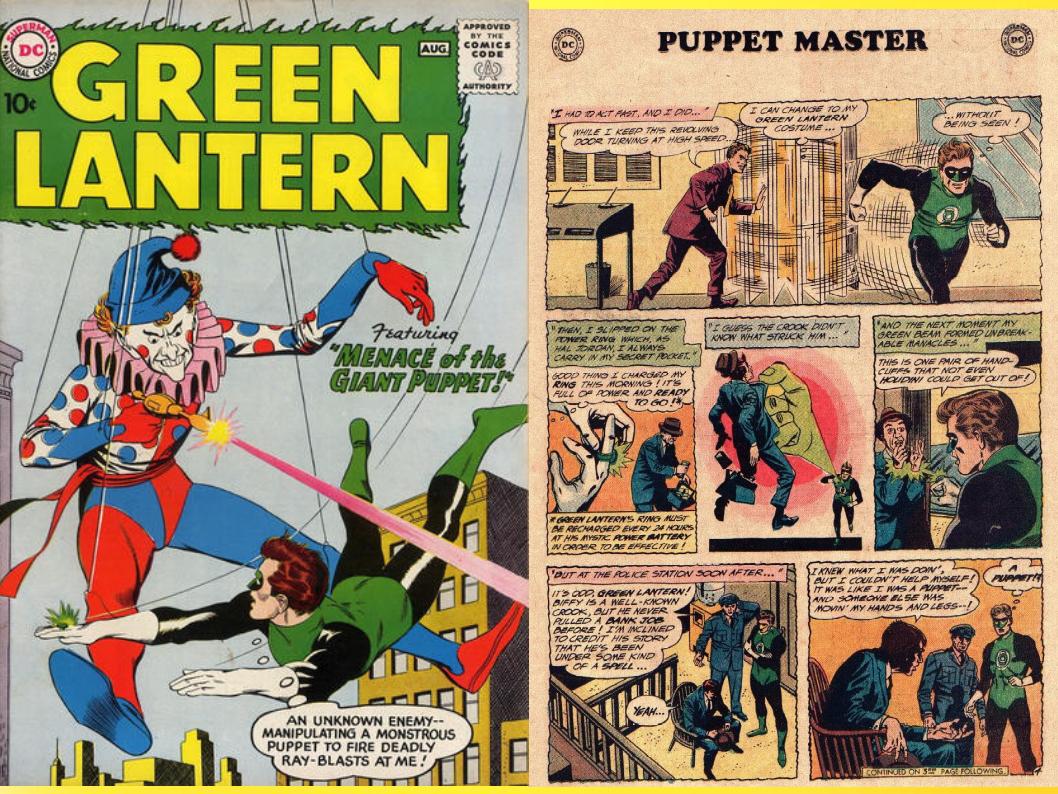
The last story reprinted in issue one is the last story of Green Lantern #1 (July-August, 1960) by John Broome, Gil Kane and Joe Giella (with a knock out of a cover by Kane/Giella), featuring the premiere of the Puppet-Master.


Oddly, the story begins with Carol Ferris, Hal Jordan's boss, who is playing puppet games of her own, thinking how she can win the heart of Green Lantern (not knowing test pilot Hal IS Green Lantern).  Then, Green Lantern deals with some odd burglaries where criminals are robbing banks, but not under their own free will, during parades (where Hal fights a giant float as well...which is like a giant puppet).  Green Lantern continues to track down the Puppet-Master, who is using a hypno-ray to get criminals to steal for him.  Carol wins a date with Green Lantern, but Puppet-Master tries his hypno-ray on Green Lantern, dragging him away.  Thanks to Hal's willpower, he beats the Puppet-Master, and takes him to jail (and faces Carol's wrath as Hal).

Puppet-Master returns with Captain Cold and others working for Doctor Destiny, then returns as the Puppeteer (a name hinted at in the original appearance) to face the Teen Titans (including Cyborg, Raven and Starfire) for H.I.V.E. (and gets an alter ego, that of Jordan Weir).

Knights Of Knavery

The first story of the second issue features a Golden Age tale from Batman #25 (October-November, 1944) by Don Cameron, Jack Burnley and Jerry Robinson (under an unrelated cover by Dick Sprang), with twice the fun...a team up of the Joker and the Penguin!


Batman and Robin put Penguin in jail, but, there, he meets the Joker, who has hatched a plan to get the two of them free, which is a sweeping success.  Free, the two villains plan to get revenge on Batman and Robin (who become aware of the villains), but also need cash, so plan to steal the Van Landorpf Emerald (and this is the competition to determine which of them will get to remain in Gotham.  Batman uses the gem to lure the villains into a trap, but, they both appear, and, though reluctantly, do work together to escape.  The villains keep the alliance going, and are successful as a duo, even capturing Batman and Robin, but that proves their downfall, as the Dynamic Duo turn the villains against each other, allowing the heroes to capture them!

Joker's origin was reprinted as well in a Limited Collectors' Edition, while it took a while to get an origin for the Penguin (a story for a later time).


The Trickster Strikes Back

The second story of the second issue was from Flash #121 (June, 1961) by John Broome, Carmine Infantino and Joe Giella, under a cover by Infantino/Giella, and is the second story that the Trickster appeared in, as he tried to disconnect the Flash's phone line!


James Jesse is able to use a children's toy to fly free from prison, and, after reviewing his file, reporter Iris West checks in with her beau, police scientist Barry Allen about a date tonight as well as the Trickster (with Barry going off as the Flash to catch him).  After speeding around Central City, Flash tracks down the Trickster (who plays a few practical jokes on the Flash first).  Trickster puts the Flash through his paces, but eventually gets caught.  All this running gives Barry Allen sore feet....which makes him unable to dance with Iris West on their date!

Trickster's first appearance was first reprinted in a Flash Giant, and the Trickster would return again and again to vex the Flash (including two Flashes in his next appearance), as well as later facing Black Lightning and Blue Devil, as well as joining the Secret Society of Super-Villains.


These weren't the only issues of Wanted -- The World's Most Dangerous Villains, and Bridwell had even teased future team-ups in the letters' page of issue number one, as well as answering letters on 100 Page Super-Spectaculars, which were full of reprints, though not necessarily with villains, like the two DC Specials that led to this issue!


Saturday, February 8, 2020

Holy Bill Finger, Batman!

Remembering the late Bill Finger on his birthday (February 8, 1914 - January 18, 1974).

Bill Finger was a writer, who provided many of the inspirational ideas to Bob Kane's outline of Batman that helped make Batman a success....like the cowl, cape, gloves, the blue/grey color scheme, and even the Bruce Wayne name!

Unfortunately, his penchant for research did not make Bill Finger a quick writer, nor did Bob Kane have him included on creator credits for Batman (only noting his contributions after Bill Finger had passed).

Still, Bill Finger did write many important Batman stories, introducing Robin, Joker, Catwoman, Riddler, Penguin and Two-Face, as well as the Batmobile, Batcave...

...and even naming Gotham City!


Much later, Bill Finger introduced readers to Ace the Bat-Hound, Bat-Mite , the first Bat-Girl, Calendar Man, the second Clayface , even Kite-Man and Zebra Man, and gave Batman his two biggest trophies:  the Tyrannosaurus Rex and giant Lincoln penny (a hallmark of Bill Finger stories was battles on oversized items).

Bill Finger also did other work for DC, writing early issues featuring the Golden Age Green Lantern, Wildcat, and creating Lana Lang in Superboy. Some of his last work on Batman was in World's Finest Comics, working with Superman (there he created Moon Man and Atom-Master, among others).

Even better, Bill Finger wrote the two episodes of the second season of the Batman 1966 TV show featuring the Clock King, giving him his first writer's credit on a Batman story....and the TV show Gotham, got his name listed as co-creator of Batman!


Wednesday, March 8, 2017

Clocking In With The Time Foes

Time, time, see what's become of me....and it was time for villains such as Chronos, Clock King, Time Commander and the Calendar Man, who used time as motif in their villainous plans to gather together, with their most ambitious plot of the seasons.

But, before going into that, a little of the history of these villains, while we tick down the seconds to their big plans!

Chronos

David Clinton started off as a thief with a fascination for time pieces in the Atom #3 (October-November, 1962) by Gardner Fox, Gil Kane and Murphy Anderson, but then joined the Crime Champions, the Injustice Gang of the World, the Secret Society of Super-Villains and the Suicide Squad, as well as fighting dinosaurs and playing baseball as he perfected his time travel devices.


While Ray Palmer took a little time off in the jungle, Chronos faced the Blue Beetle, ending up trapped in the time of the dinosaurs, returning home the long way (via suspended animation), making a ton of money via the stock market (having awakened a little before he had planned), facing off against the Atom again (during the Invasion!), then losing an arm during a battle with the Atom in the Atom Special #1 of 1993 by Tom Peyer and Steve Dillon.

Clock King

William Tockman faced Green Arrow in World's Finest Comics #111 (August, 1960) by Ed Herron and Lee Elias, robbing banks using a clock costume. Clock King was broken out of jail to face the Justice League (along with other foes of theirs like Flash's Captain Cold, Green Lantern's Puppet Master and Wonder Woman's Professor Menace) in Justice League of America #5 (June-July, 1961), before going back to jail again, finding out in World's Finest Comics #257 (June-July, 1979 by Paul Kupperberg, Jose Delbo and Frank McLaughlin) that the lab had made a mistake in his diagnosis (as he was robbing banks to get money for his invalid sister, as a doctor told him he had only six months to live, and his sister was dead while he was in jail, so he revealed to Green Arrow for the first time here, promising revenge again the Emerald Archer and the doctor).  Tockman faced Green Arrow again in World's Finest Comics #284 (October, 1982 by Mike W. Barr and Dan Spiegle) before the Crisis On Infinite Earths.

Then, Clock King joined with other villains Major Disaster, Cluemaster, Multi-Man and Big Sir to form the Injustice League, and tried to get aliens weapons during the Invasion! in Justice League International #23 (January, 1989).  Failing at that, the Injustice League returned a few times (even giving up being villains for a time, working as a Justice League satellite branch, the Justice League Antarctica as of Justice League America Annual #4 of 1990, being involved in the Justice League Breakdowns crossover, then going back to the villainous side for Justice League Europe #49 and #50 of 1993.

Calendar Man

Julian Day started off his time as a villain in Detective Comics #259 (September, 1958) by Bill Finger, Sheldon Moldoff and Charles Paris, facing off against Batman and Robin using the seasons as a motif, facing Batman five times (with the Darknight Detective having to figure out that fifth season).  It took some time for the Calendar Man to return, taking the week as inspiration for his crimes in Batman #312 (June, 1979 by Len Wein, Walter Simonson and Dick Giordano), then returning a little sooner, with the red costume most often seen in, with Batman #384 (June, 1985 by Doug Moench, Rick Hoberg and Rudy Nebres), with a superiority complex, having been recruited by the Monitor to face Batman as one of Batman's most dangerous foes (well, he's more dangerous than quite a few, but  really?), this continued into Detective Comics #551 (June, 1985), and a defeat in Batman #385 (July, 1985)...but he was able to escape and be involved in the Crisis On Infinite Earths with other villains, and escaped again in Batman #400 (October, 1986).

After a quick appearance with other lower tier villains at the Dark Side Bar in Justice League America #43 (October, 1990), Calendar Man worked with a bunch of "misfits" in Batman: Shadow Of The Bat #7 to #9 of the early 1990s by Alan Grant and Tim Sale, with Cat-Man, Killer Moth and a new villain, Chancer, who, combined, were able to prove that any villain can be deadly!


Time Commander

Last but not least is John Starr, who premiered in Brave and the Bold #59 (April-May, 1965) by Bob Haney and Ramona Fradon, facing Batman and Green Lantern as the Time Commander.  Starr at least did manipulate time a little with his hourglass, who was able to vex both heroes, by learning their secret identities and send them to other time periods as well.  The heroes teamed up to get home, and to defeat the Time Commander, who had disguised himself as Batman, by shattering his hourglass.  Time Commander returned quickly, facing Batman and Green Lantern again, in Brave and the Bold #69 (December-January, 1966/1967), this time trying to recreate Cosmo, a being of incredible power, that he also wanted to use to get revenge, but Cosmo's original creator, Dr. Carruthers, returned and Cosmo was dissolved.

Time Commander disappears for a while, with a promised battle with the Outsiders that didn't happen, but he did meet a few members of Justice League Europe (including Elongated Man, Rocket Red, Animal Man and Metamorpho) in Animal Man #16 (October, 1989 by Grant Morrison, Chas Truog and Doug Hazlewood), where Animal Man realized the Time Commander was trying to create a better world without suffering and death....at least until Metamorpho knocked Starr out, defeating "the villain".  Animal Man returned to Time Commander, hoping to use his abilities to travel in time to save his own family, but instead got involved in something weirder with the second Psycho-Pirate and help from Rip Hunter in Animal Man #22 (April, 1990).

Time Foes Gather

The time based villains began to gather in Team Titans #13 (October, 1993) by Jeff Jensen, Phil Jimenez and Will Blyberg, with Calendar Man freeing Clock King, Chronos, then Time Commander...but didn't face the time displaced teens until they cornered them in a mall trying to retrieve Time Commander's Hourglass in Team Titans #14 (November, 1993), being beaten by the kids (with the team of villains being used by the media against the heroes in Team Titans #15 of December, 1993, and the realization the foes were part of a bigger plan, being manipulated by Firestorm foes, the 2000 Committee, who were manipulated as well by others....as revealed in Team Titans #19 of April, 1994).

The Time Foes tried again to steal time travel tech, getting involved with JLA foe, the Lord of Time, in Showcase '94 #10 (September, 1994 by Mike McAvennie, Jason Armstrong and Stan Woch), but they messed up time, and the universe began to dissolve (which was a part of Zero Hour: Crisis In Time (which also wiped out the history of the Team Titans....)...

...and the Time Foes didn't make either of these covers, as their time together ran out.

Time Foes Apart

Each of the Time Foes did return later, with Chronos beginning by being recruited by Neron in Underworld Unleashed #1 (November, 1995 by Mark Waid, Howard Porter and Dan Green, and messing with the Legion of Super-Heroes while powered by Neron), Clock King forming his own team of Clockwatchers in Chase #4 (May, 1998 by D. Curtis Johnson, J.H. Williams III and Mick Gray), Calendar Man likely making his next date in Batman 80-Page Giant #3 (July, 2000 by Chuck Dixon and an army of artists including Joe Staton, Manuel Gutierrez, Mike Deodato, Graham Nolan, Louis Small Jr, Dale Eaglesham and Bill Sieinkiewicz) going weekly again and the supposedly dead Time Commander being behind the scenes in JLA #47 (November, 2000 by Mark Waid, Bryan Hitch and Paul Neary), and later in JLA #60 (January, 2002).....


...as well as being there for a death of Waverider in 52 #27 (January, 2007 by Geoff Johns, Grant Morrison, Greg Rucka, Mark Waid, Keith Giffen, Shawn Moll, Mariah Benes, Ruy Jones, Nelson, Rodney Ramos and Prentis Rollins), and finally getting his hourglass in Justice League of America 80 Page Giant #1 (November, 2009 by Rex Ogle, Mahmud Asrar and Rob Hunter) from the Lord of Time (as the two have become foes over time....).

Thursday, May 8, 2014

Targeting Green Arrow’s Villains

Everyone knows Oliver Queen was a millionaire playboy, who, after being shipwrecked on an island, and then found, went into action as the swashbucking archer…Green Arrow. But, what of the villains he faced?

Glad you asked, because here a few facts on Green Arrow’s most wanted bad guys!

Tick Tock

First up is the most timely of those foes, the Clock King.

The Clock King first appeared in World’s Finest Comics #111  (August, 1960, by Ed Herron and Lee Elias – he’s not on the cover because Green Arrow was on few covers back in the early 1960s).  William Tockman was a man out of time…he thought he was going to perish, and planned to rob a bank using his impeccable ability to schedule (and a clock costume…well, hey, it was the Silver Age!) to get money to support his sister, but he was stopped by Green Arrow and Speedy…and sent to prison.  He worked with Dr. Destiny and the first gathering of foes of the Justice League of America…and later still, found out that he wasn’t really dying at all!  The Clock King faced Green Arrow a few times in  before the Crisis on Infinite Earths (and appeared in that book as well, issue #9 with all the villains), and then joined the Injustice League with Justice League International #23 (January, 1989) with Major Disaster, Multi-Man, Cluemaster and Big Sir.  He worked with that team for a while (even when it changed to Justice League Antarctica), both helping and hindering the JLI.  He even worked with other foes who had a time fascination, like Atom’s foe – Chronos, the Batman’s Calendar Man and Batman/Green Lantern/Animal Man foe the Time Commander in a group called the “Time Foes” in Team Titans #13 and 14 (in 1993) and in Showcase ’94  for Zero Hour.

He even tried forming his own group, the Clockwatchers (with members Acidia, Sharpe, Crackle and Radiant) and fought the Teen Titans, Firehawk and Booster Gold in Chase #4 (May, 1998).  But, time finally ran out for William Tockman when he rejoined the Injustice League at the behest of the U.S. government in Suicide Squad #1 (November, 2001).  Another man took the name of the Clock King, and he seemed to have some ability to manipulate time, and he faced the Teen Titans just before Flashpoint, when time ran out for all….

Dream A Little Dream

Clock King dreamed of a better life for his sister…and maybe that’s why he was recruited by Dr. Destiny, the next foe we’ll discuss.

Making his first appearance in Justice League of America #5 (June-July, 1961, by Gardner Fox and Mike Sekowsky), John Dee was a criminal scientist who was the first foe Green Arrow faced as a member of the Justice League, having joined the issue before, and he was the first villain who recruited the foes of the members to battle the team together (in case you are wondering, those foes are Wonder Woman’s Professor Menace, Aquaman baddie –  the Electric Man, Martian Manhunter nemesis –  the Getaway Mastermind, Flash foe - Captain Cold and Green Lantern’s villain - the Puppet Master…who later took the name the Puppeteer…).  After a few more battles with the JLA, Dr. Destiny invented the Materioptikon…which allowed him to manipulate dreams into reality.  This made him much harder to defeat, and after stopping another gathering of villains (foes after the hero – Superman/Luthor, Batman/Penguin, Aquaman/Cutlass Charlie, Flash/Captain Boomerang, Green Lantern/Tattooed Man, Martian Manhunter/Dr. Light, Atom/Plant-Master and Hawkman/Mr. I.Q. in Justice League of America #61, March, 1968) where the JLAers all acted as Green Arrow, the team had Dr. Destiny hypnotized to be unable to dream.

This caused Dr. Destiny no end of problems, as shown in Justice League of America #154 (May, 1978) where he came back to try to kill the team because his inability to dream caused him to get a more skeletal appearance, and ended him up in Arkham Asylum.  Still, this didn’t stop him from returning to face the team again a few times, requiring the League to get help from the Jack Kirby‘s second Sandman (Garrett Sanford) in their first Annual, and even confronting the King of Dreams, Morpheus…aka Neil Gaiman‘s Sandman.

He even returned to face the JLA a few times after before he was only a dream….

Turn on the Light

Dr. Light was another Justice League foe who also battled the amazing archer individual after facing him in the Justice League (starting with his first appearance, in Justice League of America #12, June, 1962, by Gardner Fox  and Mike Sekowsky).

Arthur Light was kind of a failure as a scientist, and he carried that on through the rest of his life.  Arthur ended up facing the Justice League to make himself feel superior, and he’s been losing ground ever since.  Using light based weapons, he was able to isolate the individual JLA members, and dispatch them to alien planets…and, but for a bit of luck and honorary JLAer Snapper Carr, the members would still be there.

Dr. Light went on to face members individually, then even attacking the gathered sidekicks of the group in the Teen Titans (first time, in Teen Titans #44, November, 1976, with Green Arrow’s own sidekick, Speedy, in attendance).  Dr. Light even formed a group of villains to attack the teens (under the direction of the demon, Trigon), the Fearsome Five (other members included Gizmo, Mammoth, Shimmer and Psimon in New Teen Titans #3, January, 1981, by Marv Wolfman and George Perez).
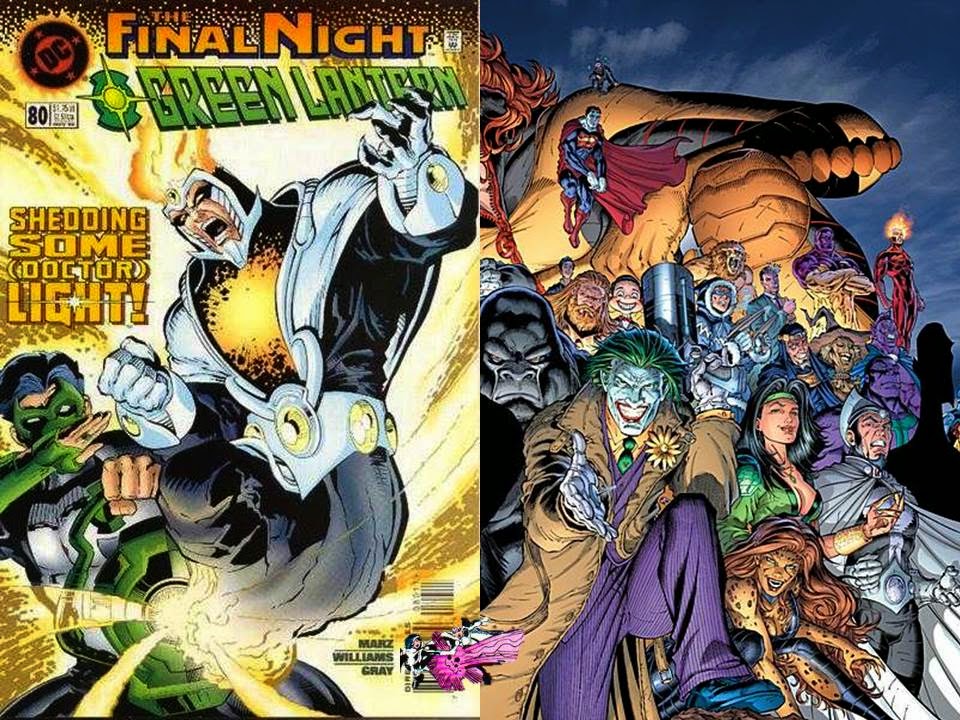
This also didn’t work out well for the doctor….he was in prison quite a bit, which didn’t turn out well for him either.  Dr. Light got recruited to the Suicide Squad…and killed on Apokolips.  Still, hell didn’t want this loser and sent him back to Earth…where he still had problems.

He got a new costume (which he later dumped), faced the new Green Lantern (Kyle Rayner), which got him recruited to play in Lex Luthor’s Injustice Gang (from JLA #10-15, as Green Lantern’s foe, with Luthor there for Superman, Joker for Batman, Ocean Master for Aquaman, Circe for Wonder Woman, Mirror Master for Flash…and a surprise for Martian Manhunter!).  Still, Arthur ended up in jail, and even partnering with the Joker didn’t keep Dr. Light safe from the toxic Joker’s Last Laugh…but that was nothing compared to the Identity Crisis he’d later have.  Seems Arthur was really villainious one day, so bad that the JLA had to wipe his mind…and that started a whole nasty chain of events, leading to tons of problems for the world’s heroes.  And, it was after all this that Arthur faced Green Arrow alone (well, not so alone….as he brought help, including Killer Frost, Mirror Master, Deathstroke the Terminator and Merlyn, all in Green Arrow #54-59 in 2005/2006!).

Archery is Black Magic

Dr. Light’s help against the emerald archer included one of his individual foes, the “magician” Merlyn.

Merlyn didn’t really use magic, but his skill with a bow was like magic.  Arthur King first came on the scene in Justice League of America #94 (November, 1971, by Mike Friedrich and Dick Dillin); he was a member of the League of Assassins, and had been an archer idolized by young Oliver Queen, and even once able to beat Green Arrow early in his career before Arthur became an assassin.  Merlyn was also a recruit in an “anti”-Justice League (composed of foes of the team, including Superman’s foe-Brainiac, Batman villain-Clayface, Aquaman’s opposite-the Ocean Master, Flash nemesis-Grodd, Green Lantern’s arch enemy-Sinestro, Atom’s foe-Chronos, Black Canary villain-the Harpy and the Queen Bee to face Elongated Man and Red Tornado) in Action Comics #443 (January, 1975) and faced Black Lightning (a future friend to Green Arrow with lightning powers) in that electric hero’s second issue.

Merlyn ended up facing other heroes for quite a time when Green Arrow went “urban hunter” in Seattle, even joining a group, the Killer Elite (with Bolt, Chiller, Deadline and Deadshot) to fight the Justice League America branch under the direction of Neron during the Underworld Unleashed, fighting Arrowette and the rest of the Young Justice kids as a member of the Zandian olympic team, and Merlyn was also involved in the Identity Crisis, mostly fighting the new female Manhunter, Kate Spencer.  Still, he couldn’t stay away from Green Arrow, and faced him again, both before and after Ollie’s wedding to Black Canary, and Black Canary as well during her 2007 mini-series, and a quick reunion with some of the League of Assassins to face the Bat-family…after, Merlyn was faced with a female psychopathic admirer of Green Arrow’s named Cupid…who made him see stars.

A Shot in the Dark

Deadshot is an odd case, and is here mostly because of his friends.

Deadshot started off as a Batman villain in Batman #59 (June, 1950, by David Vern and Lew Schwartz), and then sat out for a while, all the way until Detective Comics #474, where Steve Englehart returned the character (and the late Marshall Rogers gave him his one-eyed fully-masked assassin look).  Then, with the manipulations of Darkseid turning the world against its heroes in Legends, Deadshot joined the Suicide Squad, where he remained a member for most of its original 66 issue run (all under the talent of writer John Ostrander, fleshing out the character of Floyd Lawton, and why this rich kid went to the wrong side of the tracks, becoming a trickshot artist and assassin), even boasting a 4-issue mini-series all his own!  Even after the Squad went away for a while, Floyd stayed in groups, joining the Killer Elite, and even coming back to other versions of the Suicide Squad, where this man could use his deadly talents to help people (because, even though Deadshot is a killer, somewhere with him, he wants to be an old style gunslinger, pulling into town to keep the law…like he did the first time he met Batman).

And, all of this…and no Green Arrow?  Well…yes, that’s true.  Green Arrow and Deadshot really didn’t cross paths until around the Identity Crisis and Deadshot’s 2005 6-issue mini-series, and the Villains United series…which led to the Secret Six mini-series and regular series (wherein Floyd worked with Cat-Man, another Batman villain that crossed paths with Green Arrow).

These two incredible marksmen…just kept missing each other.  Seems something must have kept them off-balance…

Down With the Count

Keeping people off-balance is par for the course for Count Vertigo.

Werner Vertigo started off fighting Green Arrow’s ladyfriend, the sonic-empowered Black Canary, in World’s Finest Comics #251 (June-July, 1978, by Gerry Conway and Trevor von Eeden), trying to take back jewels owned by his family, as he was part of the ruling class of the small Eastern European country of Vlatava that the Russians had taken over; and his genetic inner ear disorder,  which he inherited as well, had been neutralized by mechanical means, by which he could affect the vertigo of anyone around him.  Vertigo returned in the next issue of World’s Finest to face Green Arrow (switching with the Stinger in a “tag-team” style, where the Stinger faced Black Canary…but still ending in defeat for the villains).  Green Arrow kept Vertigo as a villain for a few more battles…until Darkseid turned Earth against its heroes in Legends, and Count Vertigo faced Black Canary again.  Count Vertigo was captured by Manhunter Mark Shaw, and went to work with the Suicide Squad, starting with issue #24, where he and Deadshot had a few confrontations over time.  Still, Count Vertigo stayed with the team through issue #66, when the members left to pursue individual interests.

Count Vertigo returned home to Vlatava to help his people, but instead was there to watch as the Spectre killed them all (in Spectre #13, December, 1993, by John Ostrander and Tom Mandrake).  Count Vertigo returned to the Suicide Squad briefly, then was recruited to join Johnny Sorrow’s Injustice Society as a foe of Black Canary’s.  Still, after a chance encounter with Green Arrow (in Green Arrow #22, May, 2003 by Scott Beatty and Phil Hester) on Starfish Island (the place where Ollie learned the basic archery and survival skills and came to the realization he wanted to help people), Count Vertigo also realized the evil life wasn’t for him, and wanted to help people again (Count Vertigo was also a little bi-polar, which he also needed help with on occasion).  So, after the Infinite Crisis, he joined Checkmate (with JSAers Green Lantern Alan Scott, Mr. Terrific and JLI member Fire)…but, was still attached to the Suicide Squad (which pit him against the Justice League once again…this time, with that team being led by Black Canary, and against Manhunters Mark Shaw and Kate Spencer…leading one in a dizzying circular path…why, it’s enough to give one…vertigo!).
All of which is a way to show how interconnected Green Arrow’s foes are, both with each other, the Manhunters, and the various villainous organizations of the DC Universe.

Even so, this is just a few of the people that Green Arrow has faced over the years…and there are many more as well…and we’ll explore that further, starting with Replikon, Deathstroke and all of the other of Batman’s foes Green Arrow has faced over the years.