Everyone knows Oliver Queen was a millionaire playboy, who, after
being shipwrecked on an island, and then found, went into action as the
swashbucking archer…Green Arrow.
But, what of the villains he faced?
Glad you asked, because here a few facts on Green Arrow’s most wanted bad guys!
Tick Tock
First up is the most timely of those foes, the Clock King.
The Clock King first appeared in
World’s Finest Comics #111 (August, 1960, by
Ed Herron and
Lee Elias – he’s not on the cover because Green Arrow was on few covers back in the early 1960s
).
William Tockman was a man out of time…he thought he was going to
perish, and planned to rob a bank using his impeccable ability to
schedule (and a clock costume…well, hey, it was the Silver Age!) to get
money to support his sister, but he was stopped by Green Arrow and
Speedy…and sent to prison. He worked with Dr. Destiny and the
first gathering of foes of the Justice League of America…and later
still, found out that he wasn’t really dying at all! The Clock
King faced Green Arrow a few times in before the
Crisis on Infinite Earths (and appeared in that book as well, issue
#9 with all the villains), and then joined the Injustice League with
Justice League International #23
(January, 1989) with Major Disaster, Multi-Man, Cluemaster and Big
Sir. He worked with that team for a while (even when it changed to
Justice League Antarctica), both helping and hindering the JLI. He even
worked with other foes who had a time fascination, like Atom’s foe –
Chronos, the Batman’s Calendar Man and Batman/Green Lantern/Animal Man
foe the Time Commander in a group called the “Time Foes” in
Team Titans #13 and
14 (in 1993) and in
Showcase ’94 for Zero Hour.
He even tried forming his own group, the Clockwatchers (with members
Acidia, Sharpe, Crackle and Radiant) and fought the Teen Titans,
Firehawk and Booster Gold in
Chase #4 (May,
1998). But, time finally ran out for William Tockman when he rejoined the
Injustice League at the behest of the U.S. government in
Suicide Squad #1
(November, 2001). Another man took the name of the Clock King, and he
seemed to have some ability to manipulate time, and he faced the Teen
Titans just before
Flashpoint, when time ran out for all….
Dream A Little Dream
Clock
King dreamed of a better life for his sister…and maybe that’s why he
was recruited by Dr. Destiny, the next foe we’ll discuss.
Making his
first appearance in
Justice League of America #5 (June-July, 1961, by
Gardner Fox and
Mike Sekowsky), John Dee was a criminal scientist who was the first foe Green Arrow faced as a member of the Justice League, having joined the issue before,
and he was the first villain who recruited the foes of the members to
battle the team together (in case you are wondering, those foes are
Wonder Woman’s Professor Menace, Aquaman baddie – the Electric Man,
Martian Manhunter nemesis – the Getaway Mastermind, Flash foe - Captain
Cold and Green Lantern’s villain - the Puppet Master…who later took the
name the Puppeteer…). After a few more battles with the JLA, Dr.
Destiny invented the Materioptikon…which allowed him to manipulate
dreams into reality. This made him much harder to defeat, and after
stopping another gathering of villains (foes after the hero –
Superman/Luthor, Batman/Penguin, Aquaman/Cutlass Charlie, Flash/Captain
Boomerang, Green Lantern/Tattooed Man, Martian Manhunter/Dr. Light,
Atom/Plant-Master and Hawkman/Mr. I.Q. in
Justice League of America #61, March, 1968) where the JLAers all acted as Green Arrow, the team had Dr. Destiny hypnotized to be unable to dream.
This caused Dr. Destiny no end of problems, as shown in
Justice League of America #154
(May, 1978) where he came back to try to kill the team because his
inability to dream caused him to get a more skeletal appearance, and
ended him up in Arkham Asylum. Still, this didn’t stop him from
returning to face the team again a few times, requiring the League to
get help from the
Jack Kirby‘s second Sandman (Garrett Sanford) in their first Annual, and even confronting the King of Dreams, Morpheus…aka
Neil Gaiman‘s Sandman.
He even returned to face the JLA a few times after before he was only a dream….
Turn on the Light
Dr.
Light was another Justice League foe who also battled the amazing
archer individual after facing him in the Justice League (starting with
his first appearance, in
Justice League of America #12, June, 1962, by
Gardner Fox and
Mike Sekowsky).
Arthur Light was kind of a failure as a scientist, and he carried that
on through the rest of his life. Arthur ended up facing the Justice
League to make himself feel superior, and he’s been losing ground ever
since. Using light based weapons, he was able to isolate the individual
JLA members, and dispatch them to alien planets…and, but for a bit of
luck and honorary JLAer Snapper Carr, the members would still be there.
Dr. Light went on to face members individually, then even attacking
the gathered sidekicks of the group in the Teen Titans (first time, in
Teen Titans #44, November, 1976, with Green Arrow’s own sidekick, Speedy,
in attendance). Dr. Light even formed a group of villains to attack
the teens (under the direction of the demon, Trigon), the Fearsome Five
(other members included Gizmo, Mammoth, Shimmer and Psimon in
New Teen Titans #3, January, 1981, by
Marv Wolfman and
George Perez).
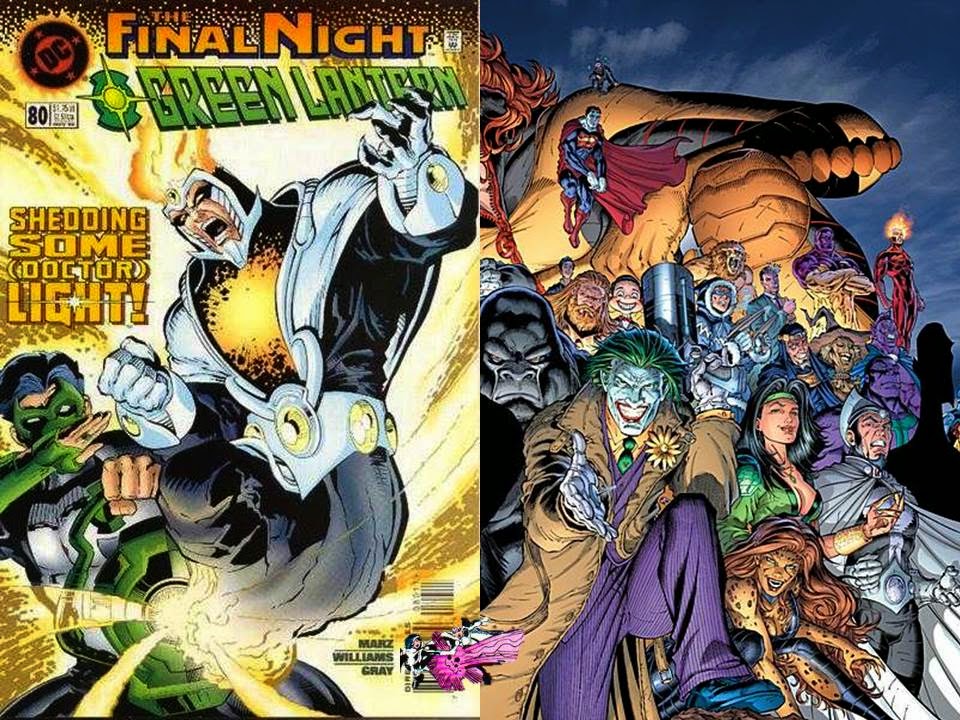
This
also didn’t work out well for the doctor….he was in prison quite a bit,
which didn’t turn out well for him either. Dr. Light got recruited to
the Suicide Squad…and killed on Apokolips. Still, hell didn’t want this loser and sent him back to Earth…where he still had problems.
He got a new costume (which he later dumped), faced the new Green
Lantern (Kyle Rayner), which got him recruited to play in Lex Luthor’s
Injustice Gang (from
JLA #10-15, as Green
Lantern’s foe, with Luthor there for Superman, Joker for Batman, Ocean
Master for Aquaman, Circe for Wonder Woman, Mirror Master for Flash…and a
surprise for Martian Manhunter!). Still, Arthur ended up in jail, and
even partnering with the Joker didn’t keep Dr. Light safe from the toxic
Joker’s Last Laugh…but that was nothing compared to the
Identity Crisis
he’d later have. Seems Arthur was really villainious one day, so bad
that the JLA had to wipe his mind…and that started a whole nasty chain
of events, leading to tons of problems for the world’s heroes. And, it
was after all this that Arthur faced Green Arrow alone (well, not so
alone….as he brought help, including Killer Frost, Mirror Master,
Deathstroke the Terminator and Merlyn, all in
Green Arrow #54-59 in 2005/2006!).
Archery is Black Magic
Dr.
Light’s help against the emerald archer included one of his individual
foes, the “magician” Merlyn.
Merlyn didn’t really use magic, but his
skill with a bow was like magic. Arthur King first came on the scene in
Justice League of America #94 (November, 1971, by
Mike Friedrich and
Dick Dillin);
he was a member of the League of Assassins, and had been an archer
idolized by young Oliver Queen, and even once able to beat Green Arrow
early in his career before Arthur became an assassin. Merlyn was also a
recruit in an “anti”-Justice League (composed of foes of the team,
including Superman’s foe-Brainiac, Batman villain-Clayface, Aquaman’s
opposite-the Ocean Master, Flash nemesis-Grodd, Green Lantern’s arch
enemy-Sinestro, Atom’s foe-Chronos, Black Canary villain-the Harpy and
the Queen Bee to face Elongated Man and Red Tornado) in
Action Comics #443
(January, 1975) and faced Black Lightning (a future friend to Green
Arrow with lightning powers) in that electric hero’s second issue.
Merlyn
ended up facing other heroes for quite a time when Green Arrow went
“urban hunter” in Seattle, even joining a group, the Killer Elite (with
Bolt, Chiller, Deadline and Deadshot) to fight the Justice League
America branch under the direction of Neron during the
Underworld Unleashed,
fighting Arrowette and the rest of the Young Justice kids as a member
of the Zandian olympic team, and Merlyn was also involved in the
Identity Crisis,
mostly fighting the new female Manhunter, Kate Spencer. Still, he
couldn’t stay away from Green Arrow, and faced him again, both before
and after Ollie’s wedding to Black Canary, and Black Canary as well
during her 2007 mini-series, and a quick reunion with some of the League
of Assassins to face the Bat-family…after, Merlyn was faced with a
female psychopathic admirer of Green Arrow’s named Cupid…who made him
see stars.
A Shot in the Dark
Deadshot is an odd case, and is here mostly because of his friends.
Deadshot started off as a Batman villain in
Batman #59 (June, 1950, by
David Vern and
Lew Schwartz), and then sat out for a while, all the way until
Detective Comics #474, where
Steve Englehart returned the character (and the late
Marshall Rogers
gave him his one-eyed fully-masked assassin look). Then, with the
manipulations of Darkseid turning the world against its heroes in
Legends,
Deadshot joined the Suicide Squad, where he remained a member for most
of its original 66 issue run (all under the talent of writer
John Ostrander,
fleshing out the character of Floyd Lawton, and why this rich kid went
to the wrong side of the tracks, becoming a trickshot artist and
assassin), even boasting a 4-issue mini-series all his own! Even after
the Squad went away for a while, Floyd stayed in groups, joining the
Killer Elite, and even coming back to other versions of the Suicide
Squad, where this man could use his deadly talents to help people
(because, even though Deadshot is a killer, somewhere with him, he wants
to be an old style gunslinger, pulling into town to keep the law…like
he did the first time he met Batman).
And, all of this…and no Green Arrow? Well…yes, that’s true. Green
Arrow and Deadshot really didn’t cross paths until around the
Identity Crisis and Deadshot’s 2005 6-issue mini-series, and the
Villains United
series…which led to the Secret Six mini-series and regular series
(wherein Floyd worked with Cat-Man, another Batman villain that crossed
paths with Green Arrow).
These two incredible marksmen…just kept missing each other. Seems something must have kept them off-balance…
Down With the Count
Keeping
people off-balance is par for the course for Count Vertigo.
Werner
Vertigo started off fighting Green Arrow’s ladyfriend,
the sonic-empowered Black Canary, in
World’s Finest Comics #251 (June-July, 1978, by
Gerry Conway and
Trevor von Eeden),
trying to take back jewels owned by his family, as he was part of the
ruling class of the small Eastern European country of Vlatava that the
Russians had taken over; and his genetic inner ear disorder, which he
inherited as well, had been neutralized by mechanical means, by which he
could affect the vertigo of anyone around him. Vertigo returned in the
next issue of World’s Finest to face Green Arrow (switching with the
Stinger in a “tag-team” style, where the Stinger faced Black Canary…but
still ending in defeat for the villains). Green Arrow kept Vertigo as a
villain for a few more battles…until Darkseid turned Earth against its
heroes in
Legends, and Count Vertigo faced
Black Canary again. Count Vertigo was captured by Manhunter Mark Shaw,
and went to work with the Suicide Squad, starting with issue
#24, where he and Deadshot had a few confrontations over time. Still, Count Vertigo stayed with the team through issue
#66, when the members left to pursue individual interests.
Count Vertigo returned home to Vlatava to help his people, but instead was there to watch as the Spectre killed them all (in
Spectre #13, December, 1993, by
John Ostrander and
Tom Mandrake).
Count Vertigo returned to the Suicide Squad briefly, then was recruited
to join Johnny Sorrow’s Injustice Society as a foe of Black Canary’s.
Still, after a chance encounter with Green Arrow (in
Green Arrow #22, May, 2003 by
Scott Beatty and
Phil Hester)
on Starfish Island (the place where Ollie learned the basic archery and
survival skills and came to the realization he wanted to help people),
Count Vertigo also realized the evil life wasn’t for him, and wanted to
help people again (Count Vertigo was also a little bi-polar, which he
also needed help with on occasion). So, after the
Infinite Crisis,
he joined Checkmate (with JSAers Green Lantern Alan Scott, Mr. Terrific
and JLI member Fire)…but, was still attached to the Suicide Squad
(which pit him against the Justice League once again…this time, with
that team being led by Black Canary, and against Manhunters Mark Shaw
and Kate Spencer…leading one in a dizzying circular path…why, it’s
enough to give one…vertigo!).
All
of which is a way to show how interconnected Green Arrow’s foes are,
both with each other, the Manhunters, and the various villainous
organizations of the DC Universe.
Even so, this is just a few of the people that Green Arrow has faced
over the years…and there are many more as well…and we’ll explore that
further, starting with Replikon, Deathstroke and all of the other of Batman’s foes
Green Arrow has faced over the years.


