Showing posts with label Captain Boomerang. Show all posts

Wednesday, December 26, 2018

Flash Facts: The Early Days of Captain Boomerang

George "Digger" Harkness was an Austrailian who happened to have a little mastery of boomerangs, as well as a penchant for thievery. 

He happened to be in the right place at the right time, becoming Captain Boomerang, which helped to fast track his way.....to jail with the help of the Flash.

Let's return to where it all began!

Here Comes Captain Boomerang!

Captain Boomerang premiered in Flash #117 (December, 1960) by John Broome, Carmine Infantino and Murphy Anderson.  "Digger" Harkness had learned how to use a boomerang evading the law in Australia, and, seeing an ad by W.W. Wiggins, the head of a toy company looking to make the boomerang an America fad, answered and became the toy's spokesman.

Problem was, "Digger" was also committing crimes, though he was able to first convince the Flash he was innocent.  Still, Captain Boomerang kept at it, causing Flash to return as well, eventually capturing Captain Boomerang (though not without "Digger" trying to launch the Flash into space on a giant boomerang!).

This story was reprinted in the 80 Page Giant #9 (April, 1965), as well as in the Flash Archives #3 and the Flash Omnibus #1.


Space-Boomerang Trap

Captain Boomerang returned in Flash #124 (November, 1961) by John Broome, Carmine Infantino and Joe Giella.

This time around, Captain Boomerang was using a new boomerang with a gimmick, that could travel through time!  This allowed him to rob while being observed not to be while being observed by the Flash.  Flash called in his friend, Ralph Dibny, the Elongated Man, for some help with this mystery, and, after working together to stop an alien invasion from another dimension, stopped Captain Boomerang as well.

This story was reprinted in Flash #160 (April, 1966), Flash Archives #3 , the Greatest Flash Stories Ever Told and in the Flash Omnibus #1.


The Day Flash Went Into Orbit

Captain Boomerang was released from prison again in Flash #148 (November, 1964) by John Broome, Carmine Infantino and Murphy Anderson, and though he tried to return to his thieving ways, kept having his take taken from him!

The real thieves were the Crooked Four, which were headed by a man named Fanning, Digger's old cellmate, who was using hypnosis while Digger slept to plant the ideas for crimes in Digge's head, then committing those crimes before Digger could get there.  In trying to get Digger caught, the Crooked Four get caught by the Flash, who then captures Captain Boomerang.

This issue has been reprinted in the sixth Flash Archive and second Flash: The Silver Age Omnibus.


The Rogues

John Broome and Carmine Infantino brought Captain Boomerang back in Flash #155 (September, 1965) and Flash #174 (November, 1967), but this time along with Captain Cold, Mirror Master, the Pied Piper, the Top and Heat Wave!  These six villains formed the foundation of the Flash's Rogue's Gallery, a specific group of Flash foes (no speedsters!).

Operation Jail The Justice League

Captain Boomerang seemed to like the idea of safety in numbers, as he returned with a group of villains including Penguin, Luthor and Dr. Light in Justice League of America #61 (March, 1968) by Gardner Fox, Mike Sekowsky and Sid Greene.

Led by Dr. Destiny, who had a grudge to settle against Green Arrow, there was a Green Arrow vs. Captain Boomerang fight (though, to be fair, it was Dr. Destiny disguised as Captain Boomerang and Flash disguised as Green Arrow, as the doctor was saving Captain Boomerang to fight the Flash later).

This issue was reprinted in the Limited Collectors' Edition #C-41, as well as in the eighth Justice League of America Archives, and the second Justice League of America Omnibus.


Beyond The Speed Of Life

Captain Boomerang returned yet again with Flash #209 (September, 1971) by Cary Bates, Irv Novick and Dick Giordano, under a cover by Dick Giordano.

Boomerang and the Trickster (who had yet to have joined the Rogues) have escaped prison together and are working together....and think they have killed the Flash!  They were actually working for a secret foe, but it is a good thing they did that, as Flash's astral self ended up helping the Sentinel in the Beyond against the Devourer (the only appearance of all these characters), before returning to his body to stop his three foes.

This issue has yet to be reprinted.


Team-Ups

Captain Boomerang liked safety in numbers, so he joined both the Secret Society of Super-Villains and the Suicide Squad (though the later was not by his choice).  With these groups, the Flash's Rogue's Gallery or on his own, Captain Boomerang can be counted on for one thing....his ability to return!


Wednesday, November 1, 2017

Flash Facts: The Early Days of The Elongated Man

Flash has had quite the collection of villains over the years....

...but equally important is the number of friends he made as well.

One of the earliest of them was the stretchable sleuth known as Elongated Man, who, in his not so secret identity of Ralph Dibny, traveled the country, using his ability to stretch, in mind and body, to solve various little mysteries that he would sniff out as they came to him.

The Mystery Of The Elongated Man

Ralph Dibny was really just an overgrown child as he first met Flash in Flash #112 (April-May, 1960) by John Broome, Carmine Infantino and Joe Giella.   Not literally, but Ralph had loved Indian Rubber Men from the circus since he was a child, and learned they all favored the soft drink, Gingold, so he made a more powerful version of this drink to really allow him to stretch, and headed out in his purple stretchable costume to solve crimes.  Problem was, Ralph looked like the best suspect in these crimes to the Flash, so the Elongated Man had to contend with Barry Allen's alter ego first, before the two teamed up to bring in the real criminal gang.

This story has been reprinted many times, including in Flash Annual #1 of 1963 (and its replica edition of 2001), DC Special Series #19 of 1979, in the second Flash Archives and Flash Chronicles, and the first Flash Omnibus and Flash: The Silver Age collections.

The Elongated Man's Secret Weapon

Ralph showed his love of the circus in Flash #115 (September, 1960) by John Broome, Carmine Infantino and Murphy Anderson, as he was working with one as a performer, and has made quite a bit of money, so takes to traveling the world.  The Elongated Man ends up in the Yucatan, following the trail of the Gingo, the plant which helps give Ralph his powers, and finds an odd red light (and a mystery), so he calls on his pal, the Flash for help.  The two heroes end up being reduced in size by  aliens, preparing to invade Earth, but the heroes stop them, returning to normal size after wrecking their shrinking machine.

This story is reprinted in second Flash Archive, third Flash Chronicle and first Flash Omnibus and Flash: The Silver Age collection.

The Elongated Man's Undersea Trap

Ralph's life changes forever in Flash #119 (March, 1961) by John Broome, Carmine Infantino and Joe Giella, as before this appearance, it is revealed that he married Sue Dearbon, and the two of them encounter trouble on their honeymoon in the Caribbean.  Ralph had been kidnapped by the alien Bredans, who had been capturing divers to sell into slavery for a while.  They capture the Flash as well, who goes along to find Ralph, who has lost his memory.  Flash helps Ralph recover his memory, and the two defeat the slave masters, free the other divers and let Ralph get back to Sue and his honeymoon, with Ralph basking in the glory (as he also does not keep a secret identity, referring to himself as the world famous Elongated Man).

This story was reprinted in Flash #209 of 1971, the third Flash Archive, the fourth Flash Chronicle, the first Flash Omnibus and the second Flash: The Silver Age Collection. 

Space-Boomerang Trap

Time for the Elongated Man to meet a super-villain (and make another cover appearance), and that happened in Flash #124 (November, 1961) by John Broome, Carmine Infantino and Joe Giella.  Captain Boomerang had been out on parole, but still using a special boomerang to commit crimes.  Flash calls in Elongated Man in for help, but the time-traveling nature of the boomerang attracts aliens, who Captain Boomerang joins with the heroes to chase off the aliens, with Boomerang then trying to use the alien tech to rid himself of the Flash, but Elongated Man stops that, and then the two work together to put Captain Boomerang back in jail.

This tale is reprinted in Flash #160 of 1966, DC Special Blue Ribbon Digest #2 of 1980, the Greatest Flash Stories Ever Told, the third Flash Archive, the fourth Flash Chronicle, the first Flash Omnibus and the second Flash: The Silver Age Collection.

Kid Flash Meets Meets The Elongated Man

Kid Flash and the Elongated Man had been alternating back-ups in the Flash for a while, so in Flash #130 (August, 1962) by John Broome, Carmine Infantino and Joe Giella, it was time for the two heroes to team-up (as Barry was to be busy, working with Green Lantern Hal Jordan).  Elongated Man called Flash for help with a case, but as Barry was going on vacation, Barry went to Kid Flash to recruit him instead.  Oakley County had been snowed in, and isolated from the world, and Kid Flash and Elongated Man figured out that it was Weather Wizard, using his control over the weather to blackmail the town.  The two heroes work together to find and disable the machine the Weather Wizard was using to blanked the town in winter weather.

This story was reprinted in Four Star Spectacular #2 of 1976, DC Special Blue Ribbon Digest #2 of 1980, the fourth Flash Archives, the first Flash Omnibus and in the second Flash: The Silver Age Collection. 

The Man Who Mastered Absolute Zero

The next Flash/Elongated Man team-up happened in Flash #134 (February, 1963) by John Broome, Carmine Infantino and Joe Giella, and pitted the pair against one of the Flash's oldest villains, Captain Cold.  Flash and Elongated Man go to help scientist Dr. Hutson with a malfunctioning computer, but are unable to find any trouble.  Flash then goes to stop Captain Cold from a prison break, but Elongated Man stops Flash.  Flash then tracks Captain Cold down again, but again, Elongated Man works to stop the Flash, so Barry knocks out Ralph, captures Captain Cold, and has to find out what's wrong with his friend.  Turns out the computer had been infected with a radiation which made it work opposite as to how it was suppose to, and somehow that Elongated Man had been infected with that radiation as well.

This story was reprinted in 100-Page Super Spectacular #DC-22 of 1973, and in the fifth Flash Archive.

The Pied Piper's Double Doom

Elongated Man's last appearance in the Flash of the 1960s happened in Flash #138 (August, 1963) by Gardner Fox, Carmine Infantino and Joe Giella, facing off against the Pied Piper.  This time, Pied Piper hypnotizes the Elongated Man into stealing for him, then forgetting what he has done.  While investigating Ralph's unintentional crime, Pied Piper uses his hypnosis on the speedster, then having him commit a crime as well, then forget it too.  Elongated Man figures out Flash was behind the second crime, and the two crimefighters figure out that they were both controlled, track down Pied Piper, and Flash, using Ralph's Gingold, surprise Pied Piper, defeating him.

This story was reprinted in DC Special Series #24 of 1981 and in the fifth Flash Archive.  Elongated Man must have felt dejected being used against the Flash, as he and Sue must have needed a change.

Nothing too terrible happened to the Elongated Man and Sue, they just moved over to Detective Comics, starting with issue #327 as a back-up feature to Batman and Robin, where Ralph's nose twitched whenever he smelled a mystery (much to Sue's chagrin).  Elongated Man even was cover featured in full length team-ups with Batman in Detective Comics #331 and #343 of the 1960s.

During his run in Detective Comics, Elongated Man faced Chronos and Riddler, changed costumes twice (once a yellow one, then a more familiar red and blue)...

...as well as teaming up with Zatanna so he could be there for the end of her quest to find her father in Justice League of America #51 in 1967.  Ralph and Sue's back-ups in Detective Comics ended with issue #383 in 1968, then took a few years for him to return in Flash #206, joining the Justice League soon after in Justice League of America #105 in 1973, where he remained almost to the end of this run of the Justice League of America (even changing to a more purple costume, all without a mask, as Ralph had decided early on not to hide his identity, loving the fame)...

....then returning to Justice League Europe after the Invasion!, even having one four issue limited series in the 1990s, as well as a Showcase Presents Elongated Man reprinting all the early Flash Elongated Man tales, as well as most of his Detective Comics tales in black and white, showcasing Ralph's deductive abilities and love of his wife, Sue.

Stretching things a bit, this is a pretty good run for anyone!

Thursday, February 23, 2017

Flash Facts: Giant Flash Foes And More

It's a "Collector's Item Special", 80 Page Giant #9 Magazine (April, 1965) featuring the first classic meeting of Flashes Barry Allen and Jay Garrick...


...as well as the fantastic first appearances of Pied Piper, Dr. Alchemy and Captain Boomerang, as well as the end of the first trilogy of Flash's epic opening battle with Gorilla Grodd!


All this Silver Age goodness under a cover by Carmine Infantino and Murphy Anderson to dig into, so let's get to it fast!


Flash #123

"Flash of Two Worlds" from Flash #123 (September, 1961) by Gardner Fox, Carmine Infantino and Joe Giella is the first tale up....and it's a doozy, as well as being the foundation of the DC Multiverse!   Barry Allen is helping at a Central City community center when he vanishes while performing a trick to impress the kids there.  Barry ends up on a parallel world, where Jay Garrick had been the Flash for years (though not since Flash Comics #104 of February, 1949....our time, at least, which Barry knows thanks to Flash Comics he has read since he was a kid).  Barry tracks down Jay in Keystone City, they swap origin stories, readers learn Jay married longtime girlfriend, Joan, before this story, and the two heroes face off against Jay's old foes of the Thinker, the Fiddler and the Shade....with Jay being convinced to permanently come out of retirement, and helps Barry get home. 

Flash #106

Next up is "The Pied Piper Of Peril" from Flash #106 (April-May, 1959) by John Broome, Carmine Infantino and Joe Giella, which introduces readers to Flash's foe for the first time. 

Robberies are happening all over Central City, and Pied Piper is responsible, using his special flute to control criminals....yet nothing is being stolen. 

Barry has to work fast to defeat the noisy villain, and, does so after a few fast tries! 

More facts on the Pied Piper are here

This issue is also important, as it reveals that reporter Iris West is Barry's fiancee for the first time...


Showcase #14

Showcase #14 (May-June, 1958) by John Broome, Carmine Infantino and Frank Giacoia, features the story of "The Man Who Changed The Earth". 

This is the first appearance of Dr. Alchemy (though not cover featured), but not the first appearance of this Flash foe.  The doctor had appeared in the previous issue of Showcase as Mr. Element, and while in jail, learned of the Philosopher's Stone, which allows its user to manipulate elements, which the newly named Dr. Alchemy uses to rob banks. 

This pulls him into a battle with the Flash, who Dr. Alchemy is able to thwart for a time using the stone, but eventually Flash is able to capture Dr. Alchemy, with Flash supposedly ending Alchemy's threat forever, by throwing the stone into space (though this does not stop both Dr. Alchemy and Mr. Element from returning!).

Flash #117

"Here Comes Captain Boomerang" is the title of the story from Flash #117 (December, 1960) by John Broome, Carmine Infantino and Murphy Anderson that introduces the Australian born villain.

W.W. Wiggins, the head of a large toy manufacturing company, decides to start marketing boomerangs in America, coming up with the idea of having a mascot to advertise boomerangs, with small time thief "Digger" Harkness answering the ad.

"Digger" uses his new identity as Captain Boomerang to disguise robberies that he performs, with Flash quickly figuring out the plan...at least until Flash meets an elderly couple that seemed to be Boomerang's parents who clear the man.  This works until Captain Boomerang tries another robbery....and to send Flash into space tied to a giant boomerang!  Flash escapes, and captures Boomerang (and his criminal cohorts who were pretending to be his parents....but, Captain Boomerang, like his namesake, continues to return, both facing the Flash and later, as a member of the Suicide Squad!).

Flash #108

Last, but not least, is the story from Flash #108 (August-September, 1959) of "The Super Gorilla's Secret Identity" by John Broome, Carmine Infantino and Joe Giella, the last issue of the trilogy of Gorilla Grodd (though DC monkeyed around, not featuring Grodd on the covers).

Grodd escapes Gorilla City again, this time using an evolution-accelerator to become a man (with a super-evolved brain), adopting the identity of Drew Drowden, who is up for the man of the year award, having made a great deal of money in the stock market.  As Drowden, Grodd built a factory to make a pill that would give him the control of mind over matter, but Flash, investigating Drowden, finds him....and Drowden reverts to Grodd to face his foe, but is defeated, and returned to Gorilla City.  Grodd would return, many times!


This was the second of two 80 Page Giants featuring the Flash, all stemming back from the first Flash Annual (which includes Mr. Element's and Grodd's first appearance) and Flash continues oversized reprints in his own title as well after the 80 Page Giants end as a separate entity...

...and you can take a look at Jay's stories in them here!

Wednesday, August 3, 2016

Legends Of The Suicide Squad

It had been a time of Crisis, when everything in the universe had changed.  Old heroes were new, groups like the Teen Titans and the Justice League of America were being torn apart, and heroes across the globe were being consumed by all their own trouble....so, who were the average person on the street suppose to turn to....the villains?

That was the idea that Amanda Waller had, using jails overflowing with super criminals.  Here is who she recruited to join the Suicide Squad during the Legends 6-issue mini-series of November, 1987 to April, 1988 by John Ostrander, Len Wein, John Byrne and Karl Kesel.


Rick Flag

Rick Rogers Flag, Jr. was part of a military family, and knew the meaning of sacrifice, which he was using ever since we first met him, as the leader of Task Force X, otherwise known as the Suicide Squad in Brave and the Bold #25 (August-September, 1959, by Robert Kanigher, Ross Andru and Mike Esposito).  Rick was a man with military talents, being able to shoot well, and he led his team on a few successful missions, until things went bad on one trip, involving a golden pyramid...which led to him working briefly with the Forgotten Heroes against Vandal Savage, and then against the Forgotten Villains, before being assigned to be the field leader of this version of the Suicide Squad.

Rick's appearances before Legends include Brave and the Bold #25, #26, #27, #37, #38, #39 (1959 to 1962, with the Suicide Squad pre-dating the JLA), Action Comics #552 and #553 (1984) and DC Comics Presents #77 and #78 (1985), with the Brave and the Bold issues and first Action Comics issue also featuring the rest of his Suicide Squad team of Karin Grace, Jess Bright and Hugh Evans; what happened to the three of them unfolds over the course of the 1980s Suicide Squad series.

Deadshot

Floyd Lawton was a man who had come from a troubled family, where he had learned to stick up for himself.  He first faced Batman in Batman #59 (June-July, 1950 by David Vern, Bob Kane, Lew Sayre Schwartz and Charles Paris) trying to be a hero in a top hat, but secretly stealing on the side.  It was his second appearance in Detective Comics #474 (December, 1977 by Steve Englehart, Marshall Rogers and Terry Austin) that gave this man his second shot at life, finally escaping prison (thanks to Penguin), and coming back to match his trick  shots against the Batman (which he could never quite shoot, maybe a throw back to looking for an authority figure in his life, or a subconscious feeling about being not worthy to live, only being a killer).

Deadshot's appearances before being caught by the Flash (Wally West) in Legends and being recruited by Amanda Waller and Rick Flag into the Suicide Squad include Batman #59, Detective Comics #474, Batman #351, Detective Comics #518, #520, Batman #354, #369, Detective Comics #536, Crisis On Infinite Earths #10 and Batman #400, and Floyd dealt with his issues during the 1980s Suicide Squad run (and even a 4 issue mini-series all his own at that time), and much later, ran across Green Arrow, another complex man with uncanny aim.

Captain Boomerang

George "Digger" Harkness was an Australian by birth, having been sent to America to get away from his step-father, taking a job with W. W. "Walt" Wiggins as of Flash #117 (December, 1960 by John Broome, Carmine Infantino and Murphy Anderson).  In America, Digger became Captain Boomerang, a mascot for Wiggins company (but used his boomerang throwing ability to commit crimes, running afoul of the Flash, who beat the Boomerang).  Captain Boomerang lived up to his moniker, continually coming back, sometimes alone, sometimes with other foes as a part of Flash's Rogue's Gallery, or even working with other foes of the JLA in the Secret Society of Super-Villains, with villains like Grodd against Captain Comet.

Captain Boomerang was among the earliest recruits to face Darkseid's forces in Legends, and had one of the longest histories of characters recruited into Task Force X (and also caused the most trouble in the group, being just not a nice guy).  Captain Boomerang appeared in Flash #117, #124, #148, #155, #174, Justice League of America #61, Flash #209, #227, #242, #243, #244, Secret Society of Super-Villains #1, #3, #4, #5, #6, Batman #322, Flash #275, #278, #283, #310, #311, #325, #337, #338, #339, #340, #341, #342, #348, #349, #350, Batman #388, Detective Comics #555, Crisis On Infinite Earths #5 and Blue Devil #30.    

Bronze Tiger

Ben Turner first appeared in Richard Dragon, Kung Fu Fighter #1 (April-May, 1975 by Jim Dennis and Leopoldo Duranona), but his life as the Bronze Tiger didn't start until Richard Dragon, Kung Fu Fighter #18 (November-December, 1977).  Ben was a kid from Central City, who killed a man attacking his parents, liked it, then tried to learn martial arts to calm his anger, ending up with the O-Sensei, where those two recruited Richard Dragon.  Richard and Ben fought the League of Assassins, including Dr. Moon, the Preying Mantis, Professor Ojo and the Axeman, who killed Ben's girlfriend, Janey Lewis, and with the help of Dragon and Lady Shiva, Ben tracked down the Axeman and killed him, though being captured by the League, brainwashed and turned into the Bronze Tiger.  While under the control of the Sensei, the Bronze Tiger fought Batman, being thought to have killed Kathy Kane (Batwoman), and eventually Richard found his friend and got him to the government, which led to Amanda Waller recruiting him, and trying to have him use his martian arts to atone for his misdeeds.

Ben Turner appeared in all but one of the 18 issues of Richard Dragon, Kung Fu Fighter of the 1970s, (missing #6), but it was the last issue that turned him into the masked Bronze Tiger.  The Bronze Tiger was in Detective Comics #485 and #489, and found by Richard Dragon in DC Comics Presents #39 (after which, the rage of tiger hit the wall....and then Ben was ready to work to save Earth's Legends, and later healing his soul during the 1980s Suicide Squad, and even finding love again with Vixen). 


Enchantress

June Moone was a freelance artist who went to a masquerade party with a friend, when the party took a strange turn and June found a secret passage leading her to the Dzamor, a demon who was willing to grant the quiet girl powers to magically fight evil, by saying the name, Enchantress, who she would turn into.   This started her career in Strange Adventures #187 (April, 1966 by Bob Haney, Howard Purcell and Sheldon Moldoff).  June only had two more adventures as a heroic Enchantress, until the use of her mystic powers pushed her over to the evil side, returning to face Supergirl, then later to lead the Forgotten Villains (with Rip Hunter's foe, Kraklow, among others) against Superman and the Forgotten Heroes (and having a new look briefly at that time).

June didn't like becoming evil, and went for help, ending up in the Suicide Squad, where Bronze Tiger was their to watch her (and also being linked to another future member of the team, Nightshade as well, but that all happened during the 1980s Suicide Squad run....and June later returned during the Day of Judgment mini-series, and again as a member of mystical group, Shadowpact).  Her appearances before the Legends mini-series were in Strange Adventures #187, #191, #200, Superman Family #204, #205, DC Comics Presents #77, #78 and Crisis On Infinite Earths #12.

Blockbuster

Mark Desmond was a smart kid, but tired of being picked on, so he developed a formula to turn himself into a hulking monster with super-strength, but it also destroyed his mind, and made him a victim of his criminal brother, Roland, who used the lad for crime and facing Batman and Robin as of Detective Comics #345 (November, 1965 by Gardner Fox, John Broome and Joe Giella).  Blockbuster was enraged by Batman, but could be calmed by Bruce Wayne (who had saved the life of young Mark earlier).  The Blockbuster was a hulking brute, usually being manipulated into fighting the Batman (often with the Justice League and Justice Society), or any of Batman's friends (including Wonder Woman), even working for the Secret Society of Super-Villains for a time, along with the Reverse-Flash and the Wizard.

Mark was hoping that the government could help him control his rages and keep others save from him before he was recruited for his short lived time with the Suicide Squad, which didn't work out so well for him (though his brother would later fight the team at the end of the run of the 1980s Suicide Squad).  Mark's appearances as Blockbuster before Legends include Detective Comics #345, #349, Justice League of America #46, #47, Batman #194, Justice League of America #135, Secret Society of Super-Villains #12, #13, #14, #15, Cancelled Comic Cavalcade #2, Justice League of America #166, #167, #168, Batman #308, #309, Detective Comics #498, #499, Wonder Woman #294, Crisis On Infinite Earths #5, #9 and #10.


Amanda Waller seems to have brought a few of these folks into Task Force X.

But, who was Amanda Waller?

Who else would be on the team?

Check back for more!


Thursday, December 10, 2015

Flash Facts Flash vs. the Rogues

One of the things the Flash was most known for in the Silver Age was his Rogue's Gallery.


You can search far and wide looking for their first appearances....


...or just get the Flash vs. The Rogues tradepaperback from 2009, under this cover by Ethan Van Scriver, with a collection of the first appearances of Flash's most important non-speedster foes.


Collected here are the first appearances of....


Captain Cold

Leonard Snart was a cheap crook who stumbled onto a gold gun in the Flash's second appearance, in Showcase #8 (May-June, 1957, by John Broome and Carmine Infantino), with "The Coldest Man On Earth". 

Captain Cold would be a driving force in Flash's life...and appeared next in Flash #114 (August, 1960, NOT in the trade, but mentioned so a cover with Captain Cold could be shown!).

Mirror Master

Sam Scudder used his knowledge of mirrors first to rob a bank, and then to become the Mirror Master, starting with Flash #105 (February-March, 1959) with "The Master of Mirrors" by John Broome and Carmine Infantino

Mirror Master was the first villain readers saw in the newly revived Flash comic....and he quickly returned in Flash #109 (October-November, 1959), also not in the trade, but a cool cover, nonetheless! 

Gorilla Grodd

Grodd was never really a rogue, but his first appearance from Flash #106 (April-May, 1959) by John Broome and Carmine Infantino in the "Menace of the Super-Gorilla" made it into this collection (though not the next two parts of the Grodd trilogy, where Flash continued to face the gorilla, meet Solovar and find Gorilla City).

Heck, Grodd didn't even make it on a cover of Flash until Flash #127 (March, 1962)....story not included here, but the cover is to get a look at the furry foe of the Flash!

Pied Piper

Hartley Rathaway hadn't been happy in live, so he took his knowledge of sound and made himself into the Pied Piper to take on the Flash in "The Pied Piper of Peril" from Flash #106 (April-May, 1959, by John Broome and Carmine Infantino), even making the cover of his first appearance!

Pied Piper even branched out in his second story (not in the trade), being recruited by Mr. Memory as the Flash foe in Justice League of America #14 (September, 1962) along with Green Lantern foe Hector Hammond, Aquaman villain Sea-Thief, Wonder Woman rogue Angle Man, Green Arrow evil-doer Dr. Davis and (behind the scenes) the Joker (to capture Batman), all while dealing with the Atom joining the JLA; though all these villains didn't make the cover!

Weather Wizard

Mark Mardon was an escaped criminal who got his weather wand when he found his brother, Clyde, (noted scientist working on weather control) dead in his lab, and used that technology to create his weather wand to give himself control of the weather...and menace the Flash starting with "The Challenge Of The Weather Wizard" in Flash #110 (December-January, 1959/1960) by John Broome and Carmine Infantino.

Weather Wizard didn't make the cover of his second appearance (Flash #130 of August, 1962, facing Kid Flash and the Elongated Man), but did finally in Flash #145 (June, 1964) in a tale not in the trade.

Trickster

Jesse James was a messed up kid, being part of a circus aerialists (but was also afraid of heights).  Jesse came up with some shoes that allowed him to walk on the air, becoming a "Danger In The Air" in Flash #113 (June-July, 1960, by John Broome and Carmine Infantino).

Trickster quickly strikes back after his heist of a plane in mid-air, quickly coming back to play new pranks on the Flash in Flash #121 (June, 1961) in a story not in the collection.

Captain Boomerang

George "Digger" Harkness came into the Flash's life with "Here Comes Captain Boomerang" in Flash #117 (December, 1960 by John Broome and Carmine Infantino), when W.W. Higgins recruited him to become his toy company's spokesman of Captain Boomerang to sell boomerang toys.  Captain Boomerang turned the tables and used the identity to rob the area.

This boomerang quickly returned, facing the Flash and the Elongated Man in Flash #124 (November, 1961), in his second appearance (which isn't in the trade).

The Top

Roscoe Dillon was a small time crook getting nowhere, until he came up with a spinning motif based on his love of tops as a child.  This led him into a spin-up with the Flash in Flash #122 (August, 1961 by John Broome and Carmine Infantino) with "Beware The Atomic Grenade" (a much larger threat than a spinning top, indeed!).

The Top spun onto his first cover on his own with Flash #141 (December, 1963), where we also met Peter Gambi, a tailor to super-villains in a stylish story (not in the collection)!


Heat Wave

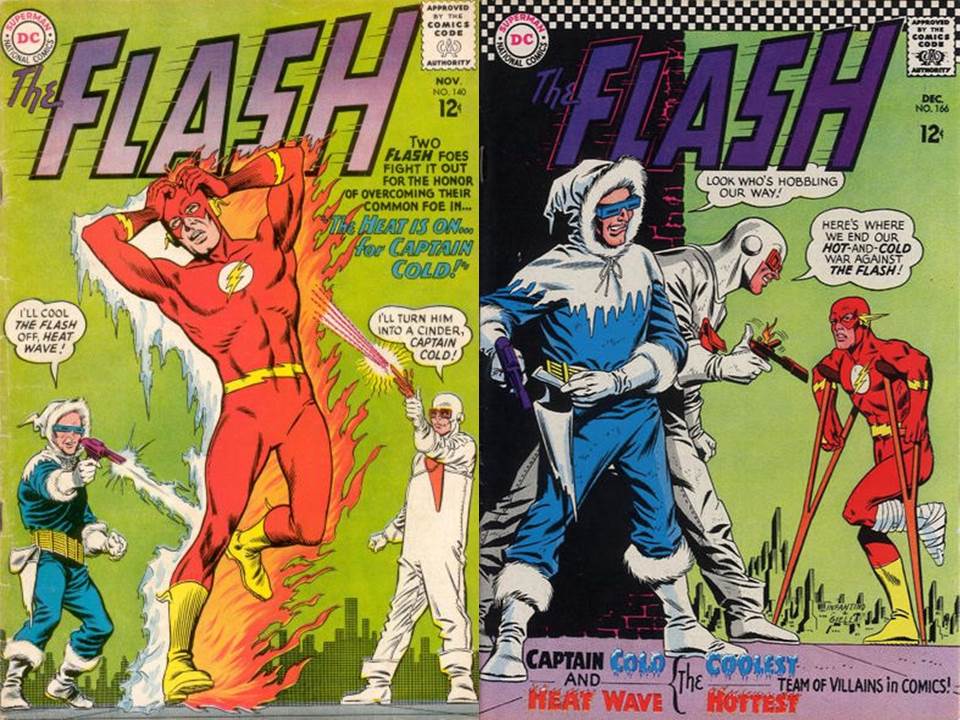
Mick Rory was a kid who liked fire.  So much so, that he ended up as the super-villain, Heat Wave, and ended up making "The Heat Is On For Captain Cold" in Flash #140 (November, 1963 by John Broome and Carmine Infantino), which started a competition between the two temperature opposite villains (starting a rivalry between them...and leading to a gathering of more Flash foes as well....).

Heat Wave's second appearance with with all the Rogues, but his appearance after that was in Flash #166 (December, 1966), still facing off against Captain Cold (but not seen in this trade), and Mick continued to be a thread to the Flash, eventually taking him on on his own!

....and the team-up of the Flash's Rogue's Gallery!  Captain Cold, Mirror Master, Pied Piper, Captain Boomerang, the Top and Heat Wave made live hard for the Flash in Flash #155 (September, 1965, by John Broome and Carmine Infantino), making Barry run "The Gauntlet of Super-Villains"...and there was a surprise villain the Rogues faced as well (who tried to make a monkey out of the villains).

The Rogues returned en masse for the second time in Flash #174 (November, 1967), making life hard for the Flash yet again in a story not in the Flash Vs. The Rogues trade, but, like all these stories, proving that sometimes things are better the second time around!