Showing posts with label Trickster. Show all posts

Friday, February 12, 2021

Blue Devil Two By Two 4

What's the first thing you have to go after you've gone away for a bit?

Well, you get to come back home.  But, in the case of stuntman supreme Dan Cassidy (the man trapped in the Blue Devil suit) and his cameraman, Norm Paxton, they weren't quite finished with their trip yet after their time down in Mexico.....as covered here.

Their trip home takes a little detour....

Night On The Town

Blue Devil #6 (November, 1984) by Gary Cohn, Dan Mishkin, Paris Cullins, Ernie Colon and Gary Martin (credited in the next issue) takes us away from the action for a bit....way away, to another galaxy, where never do well Lehni and his large pal Jorj are trying to get away from the local law enforcement, stumbling into a mircobeaming experiment, and are sent far, far away...


....all as Blue Devil and Norm Paxton are hopping through the desert headed for home (with a stop at a diner, which luckily let's the duo know they are near Las Vegas).  Norm called Marla Bloom (Dan's producer) who gathers the gang to go get them in Vegas (earning the ire of studio head, Jock Verner).  

As Norm tells Dan his theory of the "weirdness magnet" (Dan's marriage of science and sorcery in his mechanical suit married to the mystic via Nebiros), the microwave at the diner freaks out....and Jorj and Lehni appear!  

They take off, with the extraterrestrial law enforcement robots (and Blue Devil and Norm) following....towards Vegas.  Along the way, Jorg and Lehni find Bert and Smitty (remember them?).   Having ditched super villains like Metallo, they were planning a heist....in Vegas!....and now have two alien helpers.  Dan and Norm fight the robots and head to Vegas, to find Bert and Smitty, with Jorj and Lehni (who are afraid of Blue Devil because he looks like the peacekeeper robots).  

After total chaos in the casino, as the robots arrive as well, Dan sends the robots back through a microwave machine in the casino (as a temporary portal was opened on the other side), and Smitty and Bert get arrested (and are happy to, to get away from all the weirdness), but Jorj and Lehni are stuck here (no matter how much Dan tries to send them off).  Looking at the damage at the casino (also owned by Jock Verner), Blue Devil suggests they hire Jorj and Lehni to work off paying for it.  

Then, Gopher, Marla Bloom and Sharon Scott (Dan's sweetie) arrive (driven by Dan's acting rival, Wayne Tarrant) to take the crew home.  

Meanwhile, special effects man, James Jesse (also known as the Trickster, who has faced Dan before) is in trouble and facing an assassin named Bolt (and is headed for a rendezvous with Dan and crew....

Just Another Day In L.A.

While Paris Cullins still does the art for the cover of Blue Devil #7 (December, 1984), the innards of the book are by the usual writing team of Gary Cohn and Dan Mishkin, but with special guest artist, Gil Kane

The issue begins with a battle between the Trickster and the forces coming for him, including average hoods, teched out hoods and Bolt.  James escapes them....and thinks of going to Blue Devil for help.  But, Blue Devil is in a pickle of his own...trying to find a suit big enough for his new body so he can go on his first date with Sharon!  

Dan has trouble finding a large enough suit, but Marla and Wayne try to help (with counter girl Gina oddly interested in Wayne).  

Back at Marla's home, her nephew Gopher is approached by three odd men who want to talk to Dan Cassidy, and they leave there card (IHNCS).  

Eventually getting back to Marla's house after some trouble with Marla's car (as it is just too small for Dan), Dan is getting ready for Sharon to arrive (not knowing that Trickster is on his way to Marla's as well).  Sharon arrives, looking beautiful, and they leave in her large and well build old pink Cadillac, but, that is when Bolt teleports in above, as he has found the Trickster.  

At the restaurant, Dan and Sharon are enjoying a nice first date, with the three men observing from outside, and Trickster having snuck in....and surprises Dan, just as he is surprised as Bolt teleports in!  A battle ensues, with Dan eventually facing off against Bolt, who demonstrates his electrical powers on Dan (much to the dismay of his suit), but fails to take out the Trickster, so Bolt teleports out, leaving Dan wanting to find out what is going on from the Trickster!

A good enough place to stop, but more on the Bolt saga and Trickster's troubles (and the rest of the crew) will be coming soon!


Wednesday, May 27, 2020

Wanted Signalman, Clock King, Puppet Master, Joker, Penguin, Trickster

E. Nelson Bridwell was a fan of comics, and an editor at DC.  He loved old comics, and had a bit of success with reprints of heroes fighting villains in two issues of DC Special.  They proved popular enough to warrant the title Wanted -- The World's Most Dangerous Villains!

The first two issues #1 (July-August, 1972, with cover by Murphy Anderson) and #2 (September-October, 1972, with cover by Nick Cardy will be covered now!

Signalman Of Crime

First up, the first story in the first issue is from Batman #112 (December, 1957) by Bill Finger, Sheldon Moldoff and Charles Paris (though this story isn't featured on the original cover by Sheldon Moldoff) which introduces the Signalman!


Phil Cobb was a small time hood who wanted to make it big leading a gang in Gotham....so, inspired by the Bat-Signal, he became....the Signalman!  Vexing Batman and Robin with crimes based on symbols, Signalman fought on land, air and sea before the Dynamic Duo put him in prison, where he joined a different gang.

Signalman would return a few times, then got a revival in the 1970s, being in the feature in an issue of Detective Comics that featured the Calculator, and being a member of the Secret Society of Super-Villains that faced the JLA/JSA.


The Crimes Of The Clock King

Next up from the first issue of Wanted is the story of the Clock King from World's Finest Comics #111 (August, 1960) by France Herron and Lee Elias (though Superman and Batman featured on the Curt Swan/Sheldon Moldoff cover of the original issue).


Clock King started his crime spree in costume all over Star City, using time and clocks as the focus of where he would strike.  Green Arrow and Speedy figured this out and where he would strike next, and, after defeating Clock King's giant hourglass trap, captured the villain!

Clock King appeared next working with the next villain and a few others in an issue of Justice League of America (reprinted in giant size) as a Green Arrow villain, and then got a name for his alter ego (William Tockman) and motivation in an issue of World's Finest, then appeared in Crisis On Infinite Earths where he made enough connections to join the Injustice League during Invasion! along with Major Disaster and Multi-Man


Menace Of The Giant Puppet

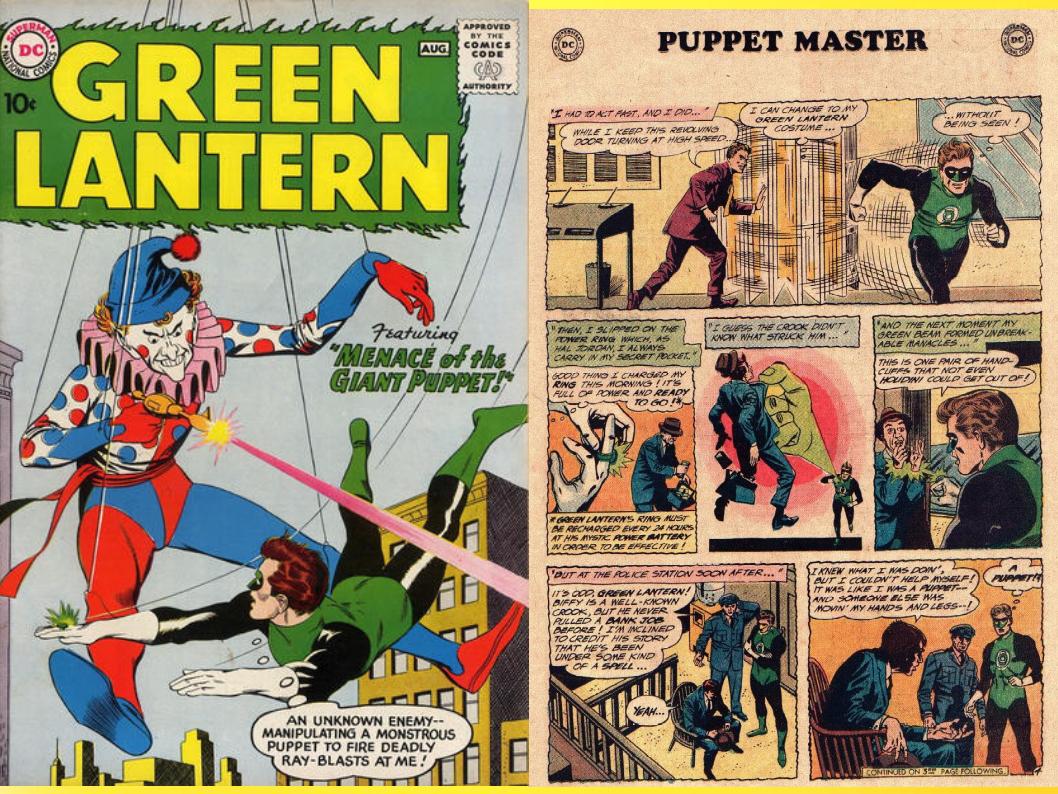
The last story reprinted in issue one is the last story of Green Lantern #1 (July-August, 1960) by John Broome, Gil Kane and Joe Giella (with a knock out of a cover by Kane/Giella), featuring the premiere of the Puppet-Master.


Oddly, the story begins with Carol Ferris, Hal Jordan's boss, who is playing puppet games of her own, thinking how she can win the heart of Green Lantern (not knowing test pilot Hal IS Green Lantern).  Then, Green Lantern deals with some odd burglaries where criminals are robbing banks, but not under their own free will, during parades (where Hal fights a giant float as well...which is like a giant puppet).  Green Lantern continues to track down the Puppet-Master, who is using a hypno-ray to get criminals to steal for him.  Carol wins a date with Green Lantern, but Puppet-Master tries his hypno-ray on Green Lantern, dragging him away.  Thanks to Hal's willpower, he beats the Puppet-Master, and takes him to jail (and faces Carol's wrath as Hal).

Puppet-Master returns with Captain Cold and others working for Doctor Destiny, then returns as the Puppeteer (a name hinted at in the original appearance) to face the Teen Titans (including Cyborg, Raven and Starfire) for H.I.V.E. (and gets an alter ego, that of Jordan Weir).

Knights Of Knavery

The first story of the second issue features a Golden Age tale from Batman #25 (October-November, 1944) by Don Cameron, Jack Burnley and Jerry Robinson (under an unrelated cover by Dick Sprang), with twice the fun...a team up of the Joker and the Penguin!


Batman and Robin put Penguin in jail, but, there, he meets the Joker, who has hatched a plan to get the two of them free, which is a sweeping success.  Free, the two villains plan to get revenge on Batman and Robin (who become aware of the villains), but also need cash, so plan to steal the Van Landorpf Emerald (and this is the competition to determine which of them will get to remain in Gotham.  Batman uses the gem to lure the villains into a trap, but, they both appear, and, though reluctantly, do work together to escape.  The villains keep the alliance going, and are successful as a duo, even capturing Batman and Robin, but that proves their downfall, as the Dynamic Duo turn the villains against each other, allowing the heroes to capture them!

Joker's origin was reprinted as well in a Limited Collectors' Edition, while it took a while to get an origin for the Penguin (a story for a later time).


The Trickster Strikes Back

The second story of the second issue was from Flash #121 (June, 1961) by John Broome, Carmine Infantino and Joe Giella, under a cover by Infantino/Giella, and is the second story that the Trickster appeared in, as he tried to disconnect the Flash's phone line!


James Jesse is able to use a children's toy to fly free from prison, and, after reviewing his file, reporter Iris West checks in with her beau, police scientist Barry Allen about a date tonight as well as the Trickster (with Barry going off as the Flash to catch him).  After speeding around Central City, Flash tracks down the Trickster (who plays a few practical jokes on the Flash first).  Trickster puts the Flash through his paces, but eventually gets caught.  All this running gives Barry Allen sore feet....which makes him unable to dance with Iris West on their date!

Trickster's first appearance was first reprinted in a Flash Giant, and the Trickster would return again and again to vex the Flash (including two Flashes in his next appearance), as well as later facing Black Lightning and Blue Devil, as well as joining the Secret Society of Super-Villains.


These weren't the only issues of Wanted -- The World's Most Dangerous Villains, and Bridwell had even teased future team-ups in the letters' page of issue number one, as well as answering letters on 100 Page Super-Spectaculars, which were full of reprints, though not necessarily with villains, like the two DC Specials that led to this issue!


Wednesday, November 28, 2018

Flash Facts: Giant Rivals?

To be fair, this issue of the Flash is a bit of a lie. 

While the cover is beautifully illustrated by Carmine Infantino and Murphy Anderson, this, the first of Flash's 80 Page Giants within his own title (numbered Giant #G-21, or just Flash #160 of April, 1966, taking place after a Flash Annual and a couple of 80 Page Giants already devoted to the Flash), it really isn't a collection of his greatest super-speed rivals (at least not entirely)....

...but, take a look through the individual stories reprinted here and see of you agree.

Flash #107

Starting with "The Amazing Race Against Time" from Flash #107 (June-July, 1959) by John Broome, Carmine Infantino and Joe Giella (with Broome and Giella providing the cover), things seem to relate to racing.

Flash encounters a man faster than he is as Barry tries to stop a runaway truck.  Problem is, the man doesn't recall who he is...so, the Flash tries to help him with his amnesia, as Iris West plans a charity race between the two (with the memory challenged fellow running backwards as he sees he is clearly faster than the Flash).  Flash brings the man to a doctor, who after exposing him to electricity, does return his memory, but at the cost of his speed.  The man is really an artificial lifeform called a Hominoid from another world, with the name of Kyri.  Kyri was trying to return to his home dimension, but cannot without his speed.  Flash helps him out, repairing his ship and providing the needed speed.

All-Flash #32

Next up is a jump back to the Golden Age, with a "Duet Of Danger" from All-Flash #32 (December-January, 1947/1948) featuring Jay Garrick, the original Flash, fighting his foe, the Fiddler, for the first time in a story by Robert Kanigher, Lee Elias and Moe Worthman (with Elias and Worthman providing the original cover!).

Isaac Bowen was a thief who got sent to prison in India, and partnered up with an Indian fakir, transferring the musical magic he learned to a fiddle instead of flute (using the fiddle to kill the fakir).  Returning home, Bowen planned to use his new skills to become a crime boss, but instead ended up facing the Flash in Keystone City.  It appeared at the end of this story that the Fiddler perished, but he would return (to face Flash individually as well as a member of the Injustice Society of the World). 

But Fiddler really isn't a super-SPEED rival....

Flash #113

And now, for something completely different, the reprint of the main story of Flash #113 (June-July, 1960) by John Broome, Carmine Infantino and Joe Giella, with the Flash facing "Danger In The Air" in the form of....the Trickster!

James Jesse premiered in this issue of the Flash, being a criminal who used gimmicks, including shoes that allowed him to walk on air, to commit robberies (all to make up for the fact that he was a failed circus acrobat...or at least had no affinity for that job; his fear of heights led him to invent the shoes that allowed him to walk on air, and his name, being the reverse of famous outlaw, Jesse James, led him to a life of crime).  Trickster still had a bit to the showman in him, facing off against Flash, at least until his theatrics helped Flash figure out his identity, leading this act...to jail!

Don't worry, the Trickster does return, again and again, same Flash-time, same Flash-channel (but, also not really a speed threat....).

Flash #114

Time for a back up, the Kid Flash back up story from Flash #114 (August, 1960), wherein young Wally West faces off against the "King Of The Beatniks" in a story by John Broome, Carmine Infantino and Joe Giella.

Wally's friend, Jimmy King, gets caught with an answer sheet to a test, and, leaves school.  The teacher, Miss Grant, realizes her mistake and recruits Wally to find him.  Jimmy went to New York to live with his cousin, Paul, the leader of a Beatnik Gang.  Kid Flash busts the Beatniks during a robbery, then, Jimmy returns to Blue Valley and school, to clear his name.

Other than Kid Flash, little speed here.

Flash #124

This time it's two heroes for the price of one, as Flash and Elongated Man have to avoid Captain Boomerang's "Space-Boomerang Trap" as originally presented in Flash #124 (November, 1961) by John Broome, Carmine Infantino and Joe Giella.

Captain Boomerang gets out of jail, and has a new scheme with a special boomerang that travels through time, allowing him to establish an alibi for his crimes.  Flash has problems solving this mystery, so calls in detective Elongated Man, and they sniff out the solution (but along the way, all three have to help stop an alien invasion, then have to contend with Captain Boomerang using a weapon gotten from those aliens against the Flash....with Elongated Man barely able to stretch to catch his friend in time!).

A great tale, but the rivals weren't all that speedy!

Adventure Comics #123

Time for an adventure....one from Johnny Quick, from Adventure Comics #123 (December, 1947), as Johnny deals with "The Adventure Of The Antelope Boy" by Don Cameron, Mort Meskin and George Roussos.

Johnny Chambers and Tubby Watts are headed to Africa to find the legendary Antelope Boy who can run so fast, but mobster Mobs Racket tries to get to the lad first.  Shame he didn't count on having to outrun Johnny Quick and his magic formula.  Johnny helps save the lad from the mobster, and is offered track scholarships to many schools in the United States!

A pretty speedy run-through of those stories, along with a Flash pin-up from Flash Annual #1 of 1963, it does lack one individual, the Reverse-Flash, who would most definitely need to be included in any collection of Flash super-speed rivals (but to be fair, at this point, Reverse-Flash only had 3 appearances!).


Thursday, September 20, 2018

Flash Facts: The Early Days of The Trickster

James Jesse was from a family of circus folk, specializing in high wire acrobatics.  Not a bad thing, except James was afraid of heights.  Still, this led him to invent a special pair of shoes that allowed him to walk on air.

Armed with those, as well as a few other gimmicky items, James Jesse took to a life of crime as the Trickster (inspired by the fact his name was the same, but reversed of a famous thief from the old West, Jesse James).  Still, would walking on air be enough to allow him to beat the Flash?

Danger In The Air

Flash #113 (June-July, 1960) premieres the Trickster, in a story by John Broome, Carmine Infantino and Joe Giella, under this incredible cover by Carmine Infantino and Joe Giella.

The Trickster performs some incredible robberies, including stealing from an airplane during a flight.  He issues a challenge to the Flash, and escapes him by running on air!

The story relates the history of James Jesse, and Flash, guessing the Trickster may have some circus blood in him, follows that hunch, checking out a local circus in town, where he happens to catch James Jesse practicing his high wire act.  Flash also finds the Trickster's outfit in Jesse's trailer, so, captures the crook, turning him over to the police.

This story made it into Flash Archives, Omnibusi, and Silver Age collections....

...as well as in Flash #160 (April, 1966), the Countdown Special: The Flash #1 (December, 2007), the Greatest Flash Stories Ever Told and the Flash Vs. the Rogues tradepaperback.


The Trickster Strikes Back

Is the Trickster Flash's father?  Not a revelation seen in Flash #121 (June, 1961) by John Broome, Carmine Infantino and Joe Giella, with a very similar cover to his first appearance, also by Infantino and Giella.

Trickster breaks out of jail, with a new plan for crimes in Central City, to steal from crooks as Flash catches them.  This works for a while, with Flash unable to catch his tricky foe, until he tracks the villain down to his warehouse hideaway.  Even then, Flash first finds a dummy made to look like the Trickster, which explodes! 

Flash outruns the explosion, doubling back in time to catch the Trickster and return him to prison.


This Trickster tale has been reprinted a few times, like in Wanted, The World's Most Dangerous Villains #2 (September-October, 1972), the third Flash Archive, the first Flash Omnibus and in Flash: The Silver Age Volume 2 tradepaperback.


Double Danger On Earth

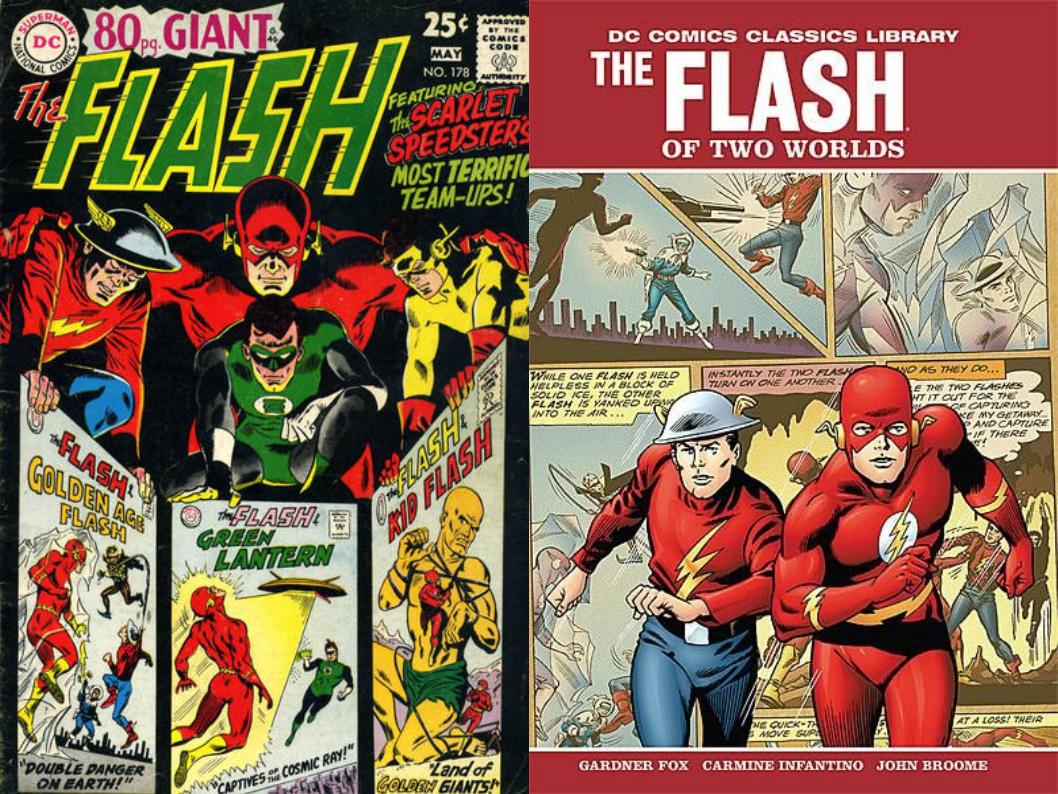
A slightly different cover by Carmine Infantino and Murphy Anderson for Flash #129 (June, 1962), with the Trickster coming back again, this time, teaming up with Captain Cold to face two Flashes in this story by Gardner Fox, Carmine Infantino and Joe Giella.

Jay Garrick, the Flash of Earth-2, comes to Earth-1 looking for a meteorite in Arizona that was causing a deadly radiation killing everyone on his home Earth, and goes looking for Earth-1's Flash (Barry Allen) for help.  Barry is at a party, that is being burgled by Captain Cold and the Trickster, who first are working alone, but then decide to team up and try to take off with the cash from the party.  The two Flashes go to find the meteorite, then stop the villainous pair, with Jay going back to his world with the meteorite cure.

This story was reprinted in Flash #178 (April-May, 1968), the first Crisis On Multiple Earths The Team Ups tradepaperback of 2006, in the Flash of Two Worlds hardcover of 2009, as well as  being one of many tales in the first Flash Omnibus.


Who Doomed The Flash?

Carmine Infantino and Muprhy Anderson give us this fatal looking cover for Flash #130 (August, 1962)  by John Broome, Carmine Infantino and Joe Giella, with the Trickster as one of many villains menacing the Flash.

To be honest, James Jesse was barely in this issue.  Flash seems to see many of his captured foes out on the loose and checks the prison near Central City, with James being one of the inmates there.  It was the Mirror Master, controlling the mind of attorney Paul Barrett that makes it seem like Flash's foes are out on the loose.   Flash, stops the plan, and Trickster's appearance here is only a slight one.  Still, this is an important issue, establishing that Flash's foes know each other, and later, when a Rogue's Gallery forms, Trickster will be represented.

This issue was reprinted in DC Special #8 (July-September, 1970), the fourth Flash Archive, DC Comics Presents: The Flash of 2011, the very heavy first Flash Omnibus, and the second volume of Flash: The Silver Age tradepaperback.


Perilous Pursuit Of The Trickster

Inker Murphy Anderson must have wanted a try at a classic Carmine Infantino Trickster cover, and got the chance with Flash #142 (February, 1964) with story by Gardner Fox, Carmine Infantino and Joe Giella.

This time around, Trickster steals from a child....a toy detective set that he then uses in his next crimes.  When Flash arrives to stop him from taking the money, the Trickster makes Flash look foolish, which so delights the Trickster, that he leaves the money behind, taking joy in embarrassing the Flash.  Flash next confronts the Trickster while the villain is stealing a diamond, but Flash was ready this time.  He had positioned a wire into the air previously, and uses it to reach the Trickster in the air, then handcuffs the Trickster using the handcuffs from the toy detective kit.

This story was reprinted in the sixth Flash Archive, as well as in the second Flash Omnibus and in the third Flash: The Silver Age tradepaperback with a wealth of other classic speedster stories of the Flash.


The Trickster's Toy Thefts


Flash #152 (May, 1965) features a Trickster story by Gardner Fox, Carmine Infantino and Murphy Anderson, with Infantino and Anderson doing yet another slight variation on the classic Trickster cover pose.

Trickster starts his crime spree by stealing a hobby horse that Iris West was giving to her niece, Inez.  Flying off on the horse, Flash chases after him as Trickster uses it to rob a dirigible, but has to let the thief go to save the passengers of the vehicle who were in danger.  Trickster has two more toys he tries to use against the Flash....a surfboard and a tricycle.  Flash again saves innocent people while Trickster uses the surfboard in a crime, but, is able to counter the tricks of the tricycle, capturing the Trickster!

Flash reprints of this tale only come in black and white in the Showcase Presents: The Flash Volume 3, and in the second Flash Omnibus (but at least that's in color).


The Swell-Headed Super-Hero

The Trickster didn't make the cover of his next appearance (as drawn by Ross Andru and Mike Esposito) in Flash #177 (March, 1968), but gave the Flash a swelled head in a story by Gardner Fox, Ross Andru and Mike Esposito.

Barry Allen uses his detective skills to solve a locked room mystery, and brags about it quite a bit.  Then, when he switches to the Flash, his head really begins to swell...all thanks to the Trickster.  The Trickster exposed Flash to weapon that causes Flash's head to expand (giving Flash headaches that slow down his use of his power), giving Trickster a chance to try to pop Flash's head.  Knocking Flash unconscious, Trickster brings him back to his headquarters, where Flash finds the bird that Trickster originally experimented on (and cured with a dose of special radiation).  Enough residual radiation remained on the bird to decrease Barry's headache, allowing him stop the Trickster, then further analyze the bird, to enable him to cure his condition.

This tale is the front cover for the fourth Showcase Presents: The Flash (which reprints the story in black and white), and in the third Flash Omnibus, which does present this tale in a color reprint for your enjoyment!


Switching Foes

Trickster appeared in a few more Flash issues, meeting villains like Captain Boomerang, Gorilla Grodd, the Top and Pied Piper, joining both the Flash's Rogue's Gallery, as well as the Secret Society of Super-Villains, then went of to fight Black Lightning and Blue Devil as well....getting to switch sides working with Blue Devil, almost become a hero over time, fighting the villain Bolt....quite the trick for the Trickster!

Thursday, December 10, 2015

Flash Facts Flash vs. the Rogues

One of the things the Flash was most known for in the Silver Age was his Rogue's Gallery.


You can search far and wide looking for their first appearances....


...or just get the Flash vs. The Rogues tradepaperback from 2009, under this cover by Ethan Van Scriver, with a collection of the first appearances of Flash's most important non-speedster foes.


Collected here are the first appearances of....


Captain Cold

Leonard Snart was a cheap crook who stumbled onto a gold gun in the Flash's second appearance, in Showcase #8 (May-June, 1957, by John Broome and Carmine Infantino), with "The Coldest Man On Earth". 

Captain Cold would be a driving force in Flash's life...and appeared next in Flash #114 (August, 1960, NOT in the trade, but mentioned so a cover with Captain Cold could be shown!).

Mirror Master

Sam Scudder used his knowledge of mirrors first to rob a bank, and then to become the Mirror Master, starting with Flash #105 (February-March, 1959) with "The Master of Mirrors" by John Broome and Carmine Infantino

Mirror Master was the first villain readers saw in the newly revived Flash comic....and he quickly returned in Flash #109 (October-November, 1959), also not in the trade, but a cool cover, nonetheless! 

Gorilla Grodd

Grodd was never really a rogue, but his first appearance from Flash #106 (April-May, 1959) by John Broome and Carmine Infantino in the "Menace of the Super-Gorilla" made it into this collection (though not the next two parts of the Grodd trilogy, where Flash continued to face the gorilla, meet Solovar and find Gorilla City).

Heck, Grodd didn't even make it on a cover of Flash until Flash #127 (March, 1962)....story not included here, but the cover is to get a look at the furry foe of the Flash!

Pied Piper

Hartley Rathaway hadn't been happy in live, so he took his knowledge of sound and made himself into the Pied Piper to take on the Flash in "The Pied Piper of Peril" from Flash #106 (April-May, 1959, by John Broome and Carmine Infantino), even making the cover of his first appearance!

Pied Piper even branched out in his second story (not in the trade), being recruited by Mr. Memory as the Flash foe in Justice League of America #14 (September, 1962) along with Green Lantern foe Hector Hammond, Aquaman villain Sea-Thief, Wonder Woman rogue Angle Man, Green Arrow evil-doer Dr. Davis and (behind the scenes) the Joker (to capture Batman), all while dealing with the Atom joining the JLA; though all these villains didn't make the cover!

Weather Wizard

Mark Mardon was an escaped criminal who got his weather wand when he found his brother, Clyde, (noted scientist working on weather control) dead in his lab, and used that technology to create his weather wand to give himself control of the weather...and menace the Flash starting with "The Challenge Of The Weather Wizard" in Flash #110 (December-January, 1959/1960) by John Broome and Carmine Infantino.

Weather Wizard didn't make the cover of his second appearance (Flash #130 of August, 1962, facing Kid Flash and the Elongated Man), but did finally in Flash #145 (June, 1964) in a tale not in the trade.

Trickster

Jesse James was a messed up kid, being part of a circus aerialists (but was also afraid of heights).  Jesse came up with some shoes that allowed him to walk on the air, becoming a "Danger In The Air" in Flash #113 (June-July, 1960, by John Broome and Carmine Infantino).

Trickster quickly strikes back after his heist of a plane in mid-air, quickly coming back to play new pranks on the Flash in Flash #121 (June, 1961) in a story not in the collection.

Captain Boomerang

George "Digger" Harkness came into the Flash's life with "Here Comes Captain Boomerang" in Flash #117 (December, 1960 by John Broome and Carmine Infantino), when W.W. Higgins recruited him to become his toy company's spokesman of Captain Boomerang to sell boomerang toys.  Captain Boomerang turned the tables and used the identity to rob the area.

This boomerang quickly returned, facing the Flash and the Elongated Man in Flash #124 (November, 1961), in his second appearance (which isn't in the trade).

The Top

Roscoe Dillon was a small time crook getting nowhere, until he came up with a spinning motif based on his love of tops as a child.  This led him into a spin-up with the Flash in Flash #122 (August, 1961 by John Broome and Carmine Infantino) with "Beware The Atomic Grenade" (a much larger threat than a spinning top, indeed!).

The Top spun onto his first cover on his own with Flash #141 (December, 1963), where we also met Peter Gambi, a tailor to super-villains in a stylish story (not in the collection)!


Heat Wave

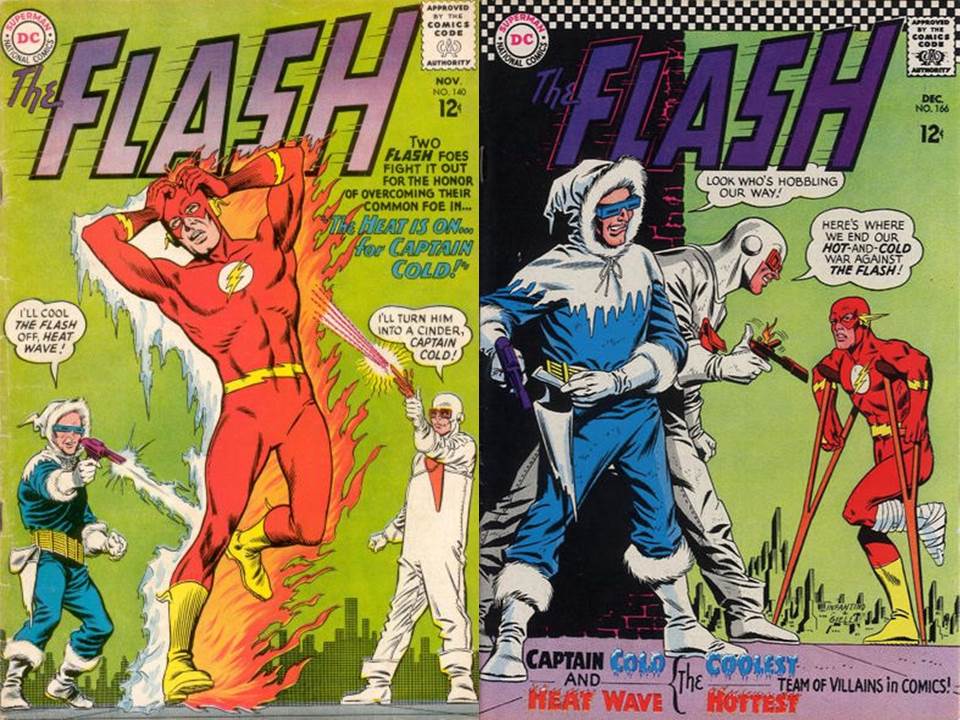
Mick Rory was a kid who liked fire.  So much so, that he ended up as the super-villain, Heat Wave, and ended up making "The Heat Is On For Captain Cold" in Flash #140 (November, 1963 by John Broome and Carmine Infantino), which started a competition between the two temperature opposite villains (starting a rivalry between them...and leading to a gathering of more Flash foes as well....).

Heat Wave's second appearance with with all the Rogues, but his appearance after that was in Flash #166 (December, 1966), still facing off against Captain Cold (but not seen in this trade), and Mick continued to be a thread to the Flash, eventually taking him on on his own!

....and the team-up of the Flash's Rogue's Gallery!  Captain Cold, Mirror Master, Pied Piper, Captain Boomerang, the Top and Heat Wave made live hard for the Flash in Flash #155 (September, 1965, by John Broome and Carmine Infantino), making Barry run "The Gauntlet of Super-Villains"...and there was a surprise villain the Rogues faced as well (who tried to make a monkey out of the villains).

The Rogues returned en masse for the second time in Flash #174 (November, 1967), making life hard for the Flash yet again in a story not in the Flash Vs. The Rogues trade, but, like all these stories, proving that sometimes things are better the second time around!