Showing posts with label Penguin. Show all posts

Sunday, July 28, 2024

Remembering Artist Dick Sprang

Remembering legendary Batman artist, Dick Sprang on his birthday (July 28, 1915 - May 10, 2000) with a couple of covers where the Dynamic Duo face the Penguin!  


Those covers being Detective Comics #99 (May, 1945) and Batman #38 (December-January, 1946/1947).


Wednesday, May 27, 2020

Wanted Signalman, Clock King, Puppet Master, Joker, Penguin, Trickster

E. Nelson Bridwell was a fan of comics, and an editor at DC.  He loved old comics, and had a bit of success with reprints of heroes fighting villains in two issues of DC Special.  They proved popular enough to warrant the title Wanted -- The World's Most Dangerous Villains!

The first two issues #1 (July-August, 1972, with cover by Murphy Anderson) and #2 (September-October, 1972, with cover by Nick Cardy will be covered now!

Signalman Of Crime

First up, the first story in the first issue is from Batman #112 (December, 1957) by Bill Finger, Sheldon Moldoff and Charles Paris (though this story isn't featured on the original cover by Sheldon Moldoff) which introduces the Signalman!


Phil Cobb was a small time hood who wanted to make it big leading a gang in Gotham....so, inspired by the Bat-Signal, he became....the Signalman!  Vexing Batman and Robin with crimes based on symbols, Signalman fought on land, air and sea before the Dynamic Duo put him in prison, where he joined a different gang.

Signalman would return a few times, then got a revival in the 1970s, being in the feature in an issue of Detective Comics that featured the Calculator, and being a member of the Secret Society of Super-Villains that faced the JLA/JSA.


The Crimes Of The Clock King

Next up from the first issue of Wanted is the story of the Clock King from World's Finest Comics #111 (August, 1960) by France Herron and Lee Elias (though Superman and Batman featured on the Curt Swan/Sheldon Moldoff cover of the original issue).


Clock King started his crime spree in costume all over Star City, using time and clocks as the focus of where he would strike.  Green Arrow and Speedy figured this out and where he would strike next, and, after defeating Clock King's giant hourglass trap, captured the villain!

Clock King appeared next working with the next villain and a few others in an issue of Justice League of America (reprinted in giant size) as a Green Arrow villain, and then got a name for his alter ego (William Tockman) and motivation in an issue of World's Finest, then appeared in Crisis On Infinite Earths where he made enough connections to join the Injustice League during Invasion! along with Major Disaster and Multi-Man


Menace Of The Giant Puppet

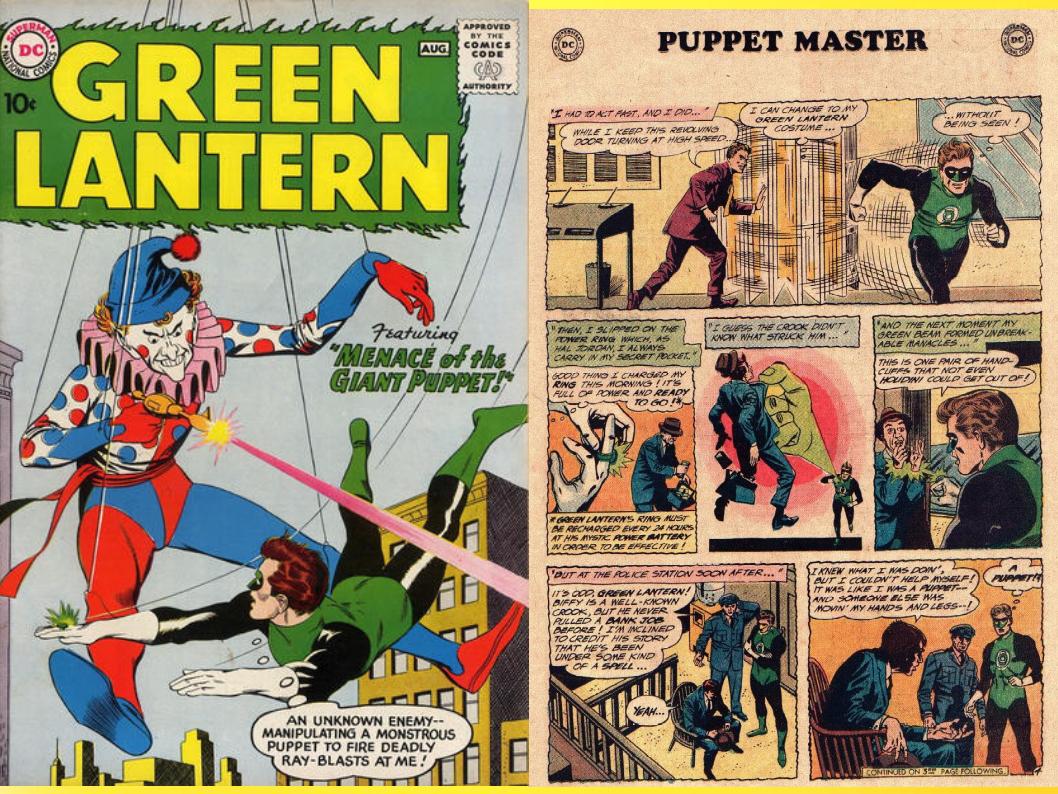
The last story reprinted in issue one is the last story of Green Lantern #1 (July-August, 1960) by John Broome, Gil Kane and Joe Giella (with a knock out of a cover by Kane/Giella), featuring the premiere of the Puppet-Master.


Oddly, the story begins with Carol Ferris, Hal Jordan's boss, who is playing puppet games of her own, thinking how she can win the heart of Green Lantern (not knowing test pilot Hal IS Green Lantern).  Then, Green Lantern deals with some odd burglaries where criminals are robbing banks, but not under their own free will, during parades (where Hal fights a giant float as well...which is like a giant puppet).  Green Lantern continues to track down the Puppet-Master, who is using a hypno-ray to get criminals to steal for him.  Carol wins a date with Green Lantern, but Puppet-Master tries his hypno-ray on Green Lantern, dragging him away.  Thanks to Hal's willpower, he beats the Puppet-Master, and takes him to jail (and faces Carol's wrath as Hal).

Puppet-Master returns with Captain Cold and others working for Doctor Destiny, then returns as the Puppeteer (a name hinted at in the original appearance) to face the Teen Titans (including Cyborg, Raven and Starfire) for H.I.V.E. (and gets an alter ego, that of Jordan Weir).

Knights Of Knavery

The first story of the second issue features a Golden Age tale from Batman #25 (October-November, 1944) by Don Cameron, Jack Burnley and Jerry Robinson (under an unrelated cover by Dick Sprang), with twice the fun...a team up of the Joker and the Penguin!


Batman and Robin put Penguin in jail, but, there, he meets the Joker, who has hatched a plan to get the two of them free, which is a sweeping success.  Free, the two villains plan to get revenge on Batman and Robin (who become aware of the villains), but also need cash, so plan to steal the Van Landorpf Emerald (and this is the competition to determine which of them will get to remain in Gotham.  Batman uses the gem to lure the villains into a trap, but, they both appear, and, though reluctantly, do work together to escape.  The villains keep the alliance going, and are successful as a duo, even capturing Batman and Robin, but that proves their downfall, as the Dynamic Duo turn the villains against each other, allowing the heroes to capture them!

Joker's origin was reprinted as well in a Limited Collectors' Edition, while it took a while to get an origin for the Penguin (a story for a later time).


The Trickster Strikes Back

The second story of the second issue was from Flash #121 (June, 1961) by John Broome, Carmine Infantino and Joe Giella, under a cover by Infantino/Giella, and is the second story that the Trickster appeared in, as he tried to disconnect the Flash's phone line!


James Jesse is able to use a children's toy to fly free from prison, and, after reviewing his file, reporter Iris West checks in with her beau, police scientist Barry Allen about a date tonight as well as the Trickster (with Barry going off as the Flash to catch him).  After speeding around Central City, Flash tracks down the Trickster (who plays a few practical jokes on the Flash first).  Trickster puts the Flash through his paces, but eventually gets caught.  All this running gives Barry Allen sore feet....which makes him unable to dance with Iris West on their date!

Trickster's first appearance was first reprinted in a Flash Giant, and the Trickster would return again and again to vex the Flash (including two Flashes in his next appearance), as well as later facing Black Lightning and Blue Devil, as well as joining the Secret Society of Super-Villains.


These weren't the only issues of Wanted -- The World's Most Dangerous Villains, and Bridwell had even teased future team-ups in the letters' page of issue number one, as well as answering letters on 100 Page Super-Spectaculars, which were full of reprints, though not necessarily with villains, like the two DC Specials that led to this issue!


Wednesday, March 18, 2020

DC Special Wanted Toyman Penguin Captain Cold Heat Wave

A second dose of Wanted -- The World's Most Dangerous Villains!


Editor E. Nelson Bridwell again went into the library of DC Comics, and pulled out a few gems, focusing on the foes of the main DC heroes of Superman, Batman and the Flash....


....and found the following tales for DC Special #14 (September-October, 1971), and put them under a cover by Murphy Anderson!


The Toyman's Castle

Superman #47 (July-August, 1947) by Don Cameron, Ira Yarbrough and Stan Kaye (originally under a Wayne Boring and Stan Kaye cover) starts off this collection, with Toyman convincing the warden in prison not to put him in solitary, but to make toys that will prevent crime.  But, the toys really detail how to commit crimes, and, then, help him escape.

On the loose, Toyman comes up with a new plan...to collect signatures from wealthy people under the guise of telling fortunes, yet really to forge their names on checks and deeds to him.  Lois Lane sniffs out his real plan, but is taken hostage, forcing Superman to rescue her from the trap he prepared for this occasion in his castle (a fiendish death trap, that Superman thwarts....with a jack-in-the-box!).  Defeated, Toyman is back in prison, breaking rocks this time.

The Heat Is On...For Captain Cold

The second story from Flash #140 (November, 1963) by John Broome, Carmine Infantino and Joe Giella (with original cover by Infantino and Anderson) pulls double duty with the villains, returning Captain Cold and introducing Heat Wave.  Flash is tasked to find a missing heiress with a unique diamond birthmark on her neck by lawyer Henry Willens, so she can get her father's fortune (with a sizeable donation for the poor of Central City).  The time to find her is running out, and Barry Allen has become fixated on a dream girl on TV (much to Iris West's dismay).  Captain Cold is interested in this dream girl too, and plans to steal her affections from the Flash by committing a spectacular crime.  Flash shows up to stop him, but is stopped by new villain, Heat Wave. 

The two villains flee with their ill-gotten booty, to find that Heat Wave, too, has designs on the dream girl!  Fighting, they find their cold and heat guns evenly matched, so go out to steal....and run across the Flash.  Working together, they stymie the fastest man alive for a bit, until he uses their powers against them....defeating them.  Still, Flash has his original task to solve, and checks directly with the dream girl....finding no neck birthmark, but that she has no memory of her early life.  She had had the mark removed, and shows him the picture, proving she is indeed the missing girl, Priscilla Varner, whom Flash speeds to the lawyer to allow her and Central City to get their inheritance (leaving Barry to mend fences with Iris!).

The Bird Sayings Crime

Last, but not least, a Batman and Robin story from World's Finest Comics #55 (December-January, 1951/1952) by William Woolfolk, Lew Schwartz and Stan Kaye (with original cover by Winslow Mortimer).  The Penguin finds his birthday a sad day, as he receives messages in his Aviary from fellow criminals, insulting his bird motif.  Penguin finds this inspiration, and plans new crimes, with clues sent to Commissioner Gordon for Batman and Robin to follow. 

Batman and Robin have no problem tracking him down and stopping his first three crimes based on "A bird in the hand is worth two in the bush", "Birds of a feather flock together" and "The early bird gets the worm" (which he escapes with help from his umbrella and birds), but it is the fourth that nearly ends the dynamic duo ("Killing two birds with one stone")....until they enlist a little help from a bird themselves, ending with capturing the Penguin, and putting him in a new nest...in jail!


While the Penguin ended this collection of Wanted The World's Most Dangerous Villains, the collections of villain based reprints would continue, in a nine issue series in the 1970s, recently collected by DC Comics (though not containing the stories from this DC Special or the previous....but it does have some NEW old tales, making it worth a look!).


Thursday, September 28, 2017

Flash Facts: Samuroids

The Samuroids were mechanical foes that first faced the Flash (Central City's protector with the alter ego of police scientist, Barry Allen)...


...but were far from the simple foes they originally appeared to be.


The Flying Samurai

The Samuroids premiered in Flash #180 (June, 1968) by Frank Robbins, Ross Andru and Mike Esposito, under a cover by Andru and Esposito.


In this issue, Barry Allen and his wife, Iris, were vacationing in Japan, where Barry was warned by his friend, police Captain Hash, that war criminal, Baron Katana (who also premieres in this issue), was coming to attack Japan, with an army of Samuroids (robot samurais).

Barry goes to investigate the gathering at nearby Castle Heron as the Flash, while Iris keeps Barry's identity a secret from his friend Hash.


The Attack of The Samuroids


In the second issue, Flash #181 (August, 1968, by Frank Robbins, Ross Andru and Mike Esposito, with Andru and Esposito on the cover), Flash's battle continues.


The Samuroids take Flash captive, with Captain Hash and his movie director friend, Hideki Toshira, coming to Castle Heron pretending to film a movie, which allows Barry the distraction he needs to make a flashy escape.  Baron Katana sends the Samuroids to attack, while holding Iris hostage.  Flash uses his super-speed to save his wife, as well as turn off the machine which powers the Samuroids, which sends Baron Katana fleeing into the ocean in defeat.

Thus ends the threat of the Samuroids....


American Samuroids

...at least until Brave and the Bold #13 (July, 2008 by Mark Waid, Jerry Ordway, Scott Koblish and Bob McLeod, under a cover by Jerry Ordway), where Batman and Jay Garrick Flash face the reactivated androids and learn a little of their history.

The Samuroids were created by T. O. Morrow (a scientific villain who first faced Barry Allen Flash and Hal Jordan Green Lantern, as well as creating the android, Red Tornado).  The Samuroids ended up in a warehouse controlled by the Riddler, who gave it to the Penguin, who called in T. O. Morrow to help reactivate the Samuroids (who used coded bacteria to aid their android parts) to cause trouble in Gotham.  Batman and Jay Garrick worked together to stop the menace.

Thursday, September 15, 2016

Gotham Guide with Penguin, Riddler and Two-Face

With the Secret Origins Special #1 (1989), under a cover by Brian Bolland (who had success with Joker in Batman: The Killing Joke), Batman tried to discourage documentary film maker Steve Jones from making a movie about Batman's villains (in the linking story of "Original Sins" by Neil Gaiman, Mike Hoffman and Kevin Nowlan)...and what follows was suppose to be 3 stories about the origins of Batman foes Penguin, Riddler and Two-Face (as well as why Batman warned off the filmmaker.....with a behind the scenes appearance of the Joker for extra emphasis, no less).


A little on the beginnings of these villains as presented in this issue (and a little more as well!).


Penguin

Oswald C. Cobblepot first appeared in Detective Comics #58 (December, 1941) by Bill Finger and Bob Kane, and was drawn in the DC Who's Who (packet 5 of the looseleaf version of 1990) by Jim Aparo.

In "The Killing Peck", Oswald was getting revenge on an old nemesis from earlier in his life, who tortured the boy who loved books and birds, making him eat fish and wear a suit, leading him down the route to becoming the Penguin in this story by Alan Grant and Sam Keith

Riddler

Edward Nigma came to be in Detective Comics #140 (October, 1948), by Bill Finger, Dick Sprang and Charles Paris, but didn't become a bigger Batman villain until the 1960s, with the DC Who's Who (packet 5 of the looseleaf version of 1990) by Kieron Dwyer and Dennis Janke).

When is an origin not an origin?  When it's "When Is A Door" by Neil Gaiman, Bernie Mireault and Matt Wagner, with the film crew following the Riddler through an old warehouse full of oversized novelties (once a feature of Batman comics in the 1950s), and the Riddler making odd commentary on it all, leaving his origins a question.

Two-Face

Harvey Dent flipped into Batman's life in Detective Comics #66 (August, 1942) by Bill Finger and Bob Kane  (though he was Harvey Kent back then), and was rendered in the the DC Who's Who (packet 11 of the looseleaf version of 1991) by Chris Sprouse and Dick Giordano.

Two-Face was almost portrayed as a hero in the untitled story in the Special, by Mark Verheiden, Pat Broderick and Dick Giordano (and he is only a coin flip away from being one, after all).  Still the district attorney who had acid thrown in his face by Boss Maroni, this story explored how Two-Face could be a hero, saving Grace (who was the one telling this Two-Face story to Steve Jones), and how he saved her from Dalton Perry (a criminal who was looking for revenge against Harvey, by kidnapping Grace).

A nice collection of tales, featuring some of Gotham's greatest criminals, which, when they first appeared in the Golden Age, only had Batman in common, but this Special started a slight link between them....something that has been built on upon the years, and continues to this day! 

Wednesday, July 8, 2015

Batman Villains First

Back in the 1970s and 1980s, there was a push on making Batman's five most dangerous foes...the Riddler, the Penguin, Two-Face, Catwoman and the Joker....

but. they all started in the 1940s!

The Riddler


Edward Nigma cheated to beat puzzles, and used that ability to take on the identity of the Riddler in Detective Comics #140 (October, 1948 by Bill Finger and Dick Sprang), wherein Batman and Robin solved the Riddler's puzzles and thought him dead, at least until Detective Comics #142 (December, 1948); these two tales being Riddler's only Golden Age appearances (both reprinted in Batman Archives #7, and the first in the Batman: Featuring Two-Face and the Riddler tradepaperback). 

If not for an appearance in Batman #171 (May, 1965) and Frank Gorshin's Riddler on the 1960s Batman TV series and 1966 Batman movie (though John Astin subbed for Gorshin for a season) and being portrayed by Jim Carrey in Batman Forever...

...the Riddler might have only been a big question mark!

The Penguin


Oswald Cobblepot began his career as an art thief, stealing painting from a gallery in Detective Comics #58 (December, 1941 by Bill Finger, Bob Kane and Jerry Robinson, with this tale bring reprinted in the Batman Archives #2, Greatest Batman Stories Ever Told tradepaperback #2, and in Batman Chronicles #5).  This bird came back to face Batman many times during the 1940s, but didn't get his first cover appearance until his fourth appearance in Detective Comics #67 (September, 1942).


This bird came to life and rose to fame played by Burgess Meredith in Batman TV show and 1966 movie...

...and helped the screen time fly by as portrayed by Danny DeVito in Batman Returns, continuing to waddle along and threaten the Caped Crusader!


Two-Face


Harvey Kent was Gotham's district attorney, pressing a case against Boss Maroni, until Moroni threw acid at Kent, scarring his half his face and turning the lawyer to crime, using Maroni's two-faced coin (with one side now scarred) to make decisions on how to proceed, starting with Detective Comics #66 (August, 1942, by Bill Finger, Bob Kane and Jerry Robinson), and the tale concluding in Detective Comics #68 (October, 1942, where he appropriately made his first cover in his second appearance) and both tales can be found in the 100-Page Super Spectacular DC-20, Batman Archives #2,  the Batman: Featuring Two-Face and the Riddler tradepaperback, Batman vs. Two-Face tradepaperback and Batman Chronicles #7.  Two-Face's alter ego's last name was switched (with no explanation) to Dent in Batman #50 (December-January, 1948-1949).

Sadly, Two-Face never made it into the Batman TV show, but did make (appropriately) a pair of movie appearances, in Batman Forever (played by Tommy Lee Jones) and in the Dark Knight (played by Aaron Eckhart)...

...for twice as much fun as any other foe!

Catwoman


Selina Kyle began her career as a jewel thief called the Cat in Batman #1 (Spring, 1940, by Bill Finger and Bob Kane), and changed to the Catwoman in Batman #2 (Summer, 1940) after helping Batman find the Joker (with both villains escaping the dynamic duo).  Surprisingly, it took until Detective Comics #122 (April, 1947) for this femme fatale to make a cover of a Batman comic book!


Catwoman was portrayed in the Batman TV series by Julie Newmar and Eartha Kitt in the Batman TV series, by Lee Meriweather in the 1966 Batman movie...

...by Michelle Pfeiffer in Batman Returns, by Halle Berry in her own Catwoman movie (though she wasn't Selina Kyle), and by Anne Hathaway in The Dark Knight Rises.

Joker


This criminal was a jack of all trades, menacing Batman and Robin twice in the very first Batman issue (Batman #1 of Spring, 1940 by Bill Finger and Bob Kane), and returned again and again to menace Batman and Robin (as well as other villains like Catwoman and Penguin, as well as the whole of Gotham).  Joker made his first Batman comic cover with Detective Comics #62 (April, 1942...quite the April's Fool joke indeed!).

Joker also is one of the most popular of Batman's live action foes..

...being portrayed by Cesar Romero in the Batman TV show and 1966 movie, getting a load of him as Jack Nicholson in the 1989 Batman movie, and very seriously by Heath Ledger in the Dark Knight.

Joker and Catwoman were both in Batman #1, and all the Batman stories of that issue were in Famous First Edition F-5, Batman: The Dark Knight Archives #1, Millenium Edition: Batman #1 and the Batman Chronicles #1

Let no one play you for a fool as to who Batman's MAIN foe is...and if you don't know, then the joke is on you!

Though Joker has been teased on two episodes of the first season of Gotham, with promises of more in its second season, the show still focuses on everyone else...Edward "Riddler" Nygma as played by Corey Michael Smith, Oswald "Penguin" Cobblepott portrayed by Robin Lord Taylor, Harvey "Two-Face" Dent played by Nicholas D'Agosto and Selina "Catwoman" Kyle played by Camren Bicondova...all helping to build the legend of Batman.


Monday, April 14, 2014

Batman Retro Action Figures Series 2

More Mego!

Batman Retro Series 2


These action figures are exact reproductions of the original ones that were produced by Mego, with cloth costumes and hair! Series two will include Bruce Wayne, Dick Grayson, The Penguin & Catwoman. Future series will include many more characters that Mego released over the years. Available in 8 inch only.