Showing posts with label DC Special. Show all posts

Thursday, April 24, 2025

The Beginnings Of The Justice Society

Tracking the Justice Society of America down through the ages...

...here are a few of their biggest beginnings from the 20th Century...

...starting from the 1940s to the 1990s, with a little history behind each appearance...


The First Meeting Of The Justice Society Of America

The team first gathered in All-Star Comics #3 (Winter, 1940), with a cover by E. E. Hibbard, and main story by Gardner Fox and E.E. Hibbard, with chapters devoted to each of the individual members of the group who were in attendance at the meeting:  The Flash (Jay Garrick), Hawkman (Carter Hall), the Spectre (Jim Corrigan), Hourman (Rex Tyler), Sandman (Wesley Dodds), Dr. Fate (Kent Nelson), Johnny Thunder (a text story, as Johnny was not yet a member), the Atom (Al Pratt) and Green Lantern (Alan Scott), as well as an interlude with the Red Tornado (and hints that Superman and Batman were too busy to come).


Though the group had met before (though readers had yet to see that), the team just related individual adventures as they interacted and got ready for the next issue, where they would work as a team for the FBI!

This set the tone for many of their adventures, with team members coming (Johnny Thunder, Dr. Mid-Nite (Charles McNider), Starman (Ted Knight), Wonder Woman, Wildcat (Ted Grant), Mr. Terrific (Terry Sloane) and Black Canary (Dinah Drake), as well as two appearances over the decades by Superman and Batman), as the teams adventures ran until All-Star Comics #57 (February-March, 1951) (with a later adventure, detailing how the team had been convinced to retire).

Vengeance Of The Immortal Villain

The team resurfaced in Flash #137 (June, 1963) by Gardner Fox, Carmine Infantino and Joe Giella (with Infantino and Murphy Anderson supplying the cover).  Here, as old (like caveman old) Flash (Jay) villain, Vandal Savage (who was one of many members of the JSA's opposite number, the Injustice Society of the World, and using a few of their gadgets), plotted to capture the retired JSA members (at least close to the final line up of the team (Hawkman, Atom, Green Lantern, Johnny Thunder, Dr. Mid-Nite and Wonder Woman...), but hadn't counted on the interference of an alternate Earth Flash (Barry Allen) who crossed over to help Jay, and the two worked together to save team and defeat Savage.

This convinced the JSA members that they needed to gather occasionally, and they would find some Crisis that had them crossing Earths to meet their counterparts in the Justice League Of America, as the JLA/JSA team-ups began (with that first one giving readers the idea that the JLA was on Earth-1, and JSA was on Earth-2), adding new members of a grown up Robin and a new robotic Red Tornado, with the original heroes (well, at least Flash, Green Lantern and the Atom) occasionally teaming up with their counterparts away from their teams.


The Untold Origin Of The Justice Society

Now, in the midst of the decades of JLA/JSA team-ups, the JSA was revived in a new All-Star Comics, adding a time-tossed Star-Spangled Kid and Power Girl, Superman's cousin to the team.  Halfway through that run, in DC Special #29 (August-September, 1977) by Paul Levitz, Joe Staton and Bob Layton (behind a Neal Adams cover), the origin of the team was revealed as the team was gathered by President Franklin D. Roosevelt as a top secret mission to stop Adolf Hitler from invading England in November, 1940.  FDR was able to get Batman, Flash and Green Lantern, and sent them, but they were not entirely successful, with Hitler planning to execute them with the Spear of Destiny (a magical item purporting to be the spear that was used against Jesus).  

Dr. Fate recruited Hourman to help him and save the trio...but that didn't quite work, with Hitler invoking some of the mystic power of the spear to summon the Valkyries (but additional heroes Dr. Fate summoned arrived...Sandman, Hawkman, Atom and the Spectre).  The Spectre especially was able to stop Hitler's sea fleet and disperse the Valkyries...and Hitler used them to guard an experimental plane he had to bomb the United States capital, and would have been successful if not for the last minute appearance of Superman.  After the Atom saved FDR from a rogue Valkyrie, the president suggested the heroes should form a team...and they did.

The Huntress joined the team during the remainder of the JSA's All-Star revival, and into their short run in Adventure Comics (the last of which had Huntress reveal to Power Girl what she knew of how the JSA retired in the 1950s....with the team's loyalty being called into question by Congress, and instead of revealing their identities, the team disappeared for a time).


This time, the team continued at least as part of JLA/JSA team-ups, as well a (sort of) revival in All-Star Squadron (which was 1980s adventures featuring the JSA, but set in the 1940s), which led to Infinity, Inc. (a group of heirs to the JSA as a team, with the JSA as supporting characters), and even another trial in America Vs. the Justice Society....all before the Crisis on Infinite Earths set in motion the events that led to the Justice Society being sentenced to limbo in Last Days Of The Justice Society Special, fighting a never-ending Ragnarok to keep the universe from ending, with only Power Girl, Dr. Fate, Star-Spangled Kid and the Spectre not being trapped in that limbo on the now (supposedly) one and only Earth.

The Gathering Of Heroes

But, you can't keep good heroes down, as in Armageddon: Inferno #4 (July, 1992) by John OstranderDick Giordano, and Frank McLaughlin (and a few other artists like Tom Mandrake, Art Adams and Walt Simonson, with Mike Netzer and Joe Rubinstein on the cover), the JSA returned.  

In the previous issue (with art by Luke McDonnell and Bruce Solotoff), Spectre related to Waverider how the JSA was out of time due to the Spear of Destiny (and Kobra's attack on the Spectre) leading to near Ragnarok, but that combining their power, they could take the JSA out of the loop, and use them to fight Abraxis (an invader from another dimension, who was summoned to Earth, and empowered his minions, getting the time travelling Waverider to recruit heroes to fight him...but all this made time fragile, leading to extraordinary measures).


Still, this returned the JSA to fight Abraxis in his home dimension, where the JSA also empowered to the locals with their Ragnarok energies to help in the fight...and the nameless residents of Abraxis' hopeless dimension found hope with their power, and, replaced the JSA in their endless time loop (after the defeat of Abraxis), resulting in the JSA (plus Hawkgirl and Sandy, partners of Hawkman and Sandman) to be returned to the modern day.

The team had a few adventures (mostly Flash and Green Lantern, with their counterparts), and a slight JSA revival, before the disruption of Zero Hour (which sidelined the team for a time, until it's revival in 1999, leading the team to one of its most successful times)...but, that's a tale for another day....and later in the 21st century....

But, if you have been lucky enough to find this, make sure to check out many other articles and podcasts on the many years of the Justice Society, as we celebrate 85 years of the JSA, and you can find out where to find them checking the #JSApril hashtag, as well as a list at fireandwaterpodcast.com/JSApril.


Friday, July 2, 2021

Wild West UFO Invasion

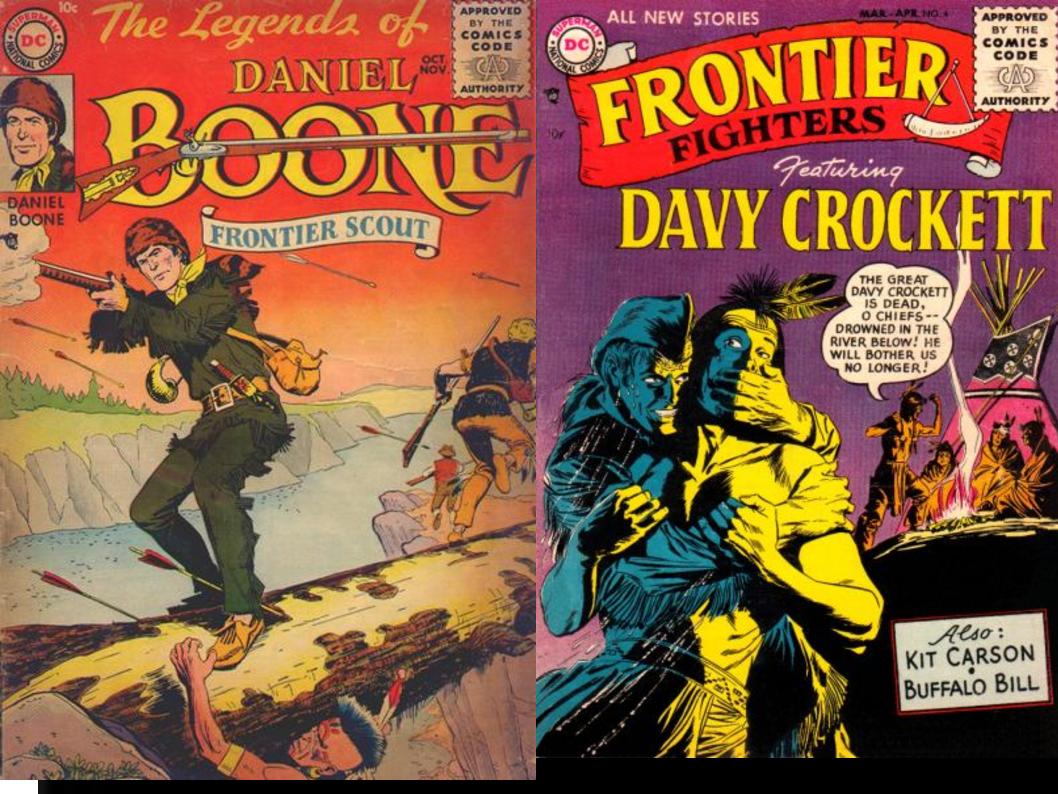
It seems an odd cover for a western, with a UFO landing, this Neal Adams cover to DC Special #6 (January-March, 1970), and it was indeed....as odd as the reprints with this issue, and, much more importantly, the new, framing story by Len Wein, Gil Kane and Vince Colletta.

The framing story, "Behold The Wild Frontier", deals with a grandpa trying to get some logging done, yet his two wild grandsons are more interested in getting in the way.  So, to calm them down, he sits them down and starts to tell him stories of men going out to tame the Western frontier.


These stories include tales of Daniel Boone (from The Legends of Daniel Boone #1 from October-November 1955), Davy Crockett and Kit Carson (both from Frontier Fighters #4 from March-April 1955), 

Buffalo Bill (from Frontier Fighters #6 from July-August 1956 - cover not pictured), 


Tomahawk (from World's Finest Comics #69 of March-April 1954) and Pow-Wow Smith (from Detective Comics #178 from December, 1951), with the last two not being featured on the covers, and a little Tomahawk history is here, as Pow-Wow Smith's is here!


As the group was heading out with their lumber, they were set upon by arrows, and found a young brave attacking their group, yet that boy's father arrived to tell him how his people were taken to the sky, and knew that the men they left behind would follow, but the logger grandfather wanted to extend his hand in peace (as readers see the slow pullback to find they were logging on an asteroid in space, extending the Wild West into the Final Frontier, with a UFO in the background!).


Monday, May 24, 2021

Remembering Artist Carmine Infantino

Remembering artist Carmine Infantino (May 24, 1925 - April 4, 2013) with something special....DC Special #1 (October-December, 1968), featuring the artist at work on some of DC most famous (and a few less so), but all characters that he had a connection to in this "All-Infantino" issue!


Carmine Infantino had a long career in comics, working on the Golden Age Flash and co-creating Black Canary, as well as others back in the day, then getting to bring back the Flash to start the Silver Age, co-creating Elongated Man, having the two Flashes meet...


...becoming DC's editorial director, then publisher...


...before moving over to Marvel to work on Spider-Woman, Nova and Star Wars (and others), before coming back to the Flash when Barry Allen got ready to face the Crisis.


Detective Comics #327

In "the Mystery Of The Menacing Mask" (May, 1964), written by John Broome and inked by Joe Giella...


....the first of the "new look" Batman (including the yellow oval), Batman and Robin faced a mystery menace with a red X on their foreheads...that allows crook Frank Fenton to paralyze them and escape.   


The Elongated Man story (also by Infantino) was reprinted elsewhere.


Flash #148

Here, in the story NOT featured on the cover, "The Doorway To The Unknown" (November, 1964), written by John Broome and inked by Joe Giella, the Flash (Barry Allen) gets involved in a slightly supernatural tale...


...where he comes home to find a Fred Dallman in his apartment....a bank vice president who tells Barry that another man will go to prison for a crime Fred committed.  Barry works to clear the man, but also discovers Fred died in a car crash....before Barry met him in his apartment!


Infantino also co-created Captain Boomerang!


Adventures Of Rex The Wonder Dog #29

Though the cover is by Gil Kane/Bernard Sachs, it is the Detective Chimp story from the issue (written by John Broome for September-October of 1956) of "The Scientific Crook Catcher"...


...where Bobo has to disguise himself as a human scientist to catch crook Larry the Lynx at a scientific convention!


Bobo, the Detective Chimp really had little involvement with the rest of the DC Universe until he showed up in Gorilla City during the Crisis On Infinite Earths (having long life as he and Rex found the fountain of youth in a DC Comics Presents back up years before).


Mystery In Space #57

An early Adam Strange adventure where Gil Kane and Joe Giella did the cover, Gardner Fox provided the story and Murphy Anderson the inks for the "Mystery Of The Giant Footprints"...


...where Adam and Alanna faced giant aliens called the Rhollians who were affected by a material called Orichalkum, that made them grow to giant size.  The aliens try to sink the island, and the island eventually does go underwater after Adam and Alanna gave them chase to let the island sink naturally.


Adam Strange and his adventures on the far away planet of Rann were still only a small part of Mystery In Space at this point, with two other stories in this issue.


Brave and the Bold #45

Last, but not least, a cover by Carmine, inked by Murphy Anderson, which is also the story by Gardner Fox and inked by Joe Giella from December-January, 1962...

...wherein a series of Strange Sports Stories ran in B&B...with the "Challenge Of The Headless Baseball Team" was the first story, where uniforms were playing the game without their players!

The DC Special also had a summary of Carmine's career up to that point!


Wednesday, March 18, 2020

DC Special Wanted Toyman Penguin Captain Cold Heat Wave

A second dose of Wanted -- The World's Most Dangerous Villains!


Editor E. Nelson Bridwell again went into the library of DC Comics, and pulled out a few gems, focusing on the foes of the main DC heroes of Superman, Batman and the Flash....


....and found the following tales for DC Special #14 (September-October, 1971), and put them under a cover by Murphy Anderson!


The Toyman's Castle

Superman #47 (July-August, 1947) by Don Cameron, Ira Yarbrough and Stan Kaye (originally under a Wayne Boring and Stan Kaye cover) starts off this collection, with Toyman convincing the warden in prison not to put him in solitary, but to make toys that will prevent crime.  But, the toys really detail how to commit crimes, and, then, help him escape.

On the loose, Toyman comes up with a new plan...to collect signatures from wealthy people under the guise of telling fortunes, yet really to forge their names on checks and deeds to him.  Lois Lane sniffs out his real plan, but is taken hostage, forcing Superman to rescue her from the trap he prepared for this occasion in his castle (a fiendish death trap, that Superman thwarts....with a jack-in-the-box!).  Defeated, Toyman is back in prison, breaking rocks this time.

The Heat Is On...For Captain Cold

The second story from Flash #140 (November, 1963) by John Broome, Carmine Infantino and Joe Giella (with original cover by Infantino and Anderson) pulls double duty with the villains, returning Captain Cold and introducing Heat Wave.  Flash is tasked to find a missing heiress with a unique diamond birthmark on her neck by lawyer Henry Willens, so she can get her father's fortune (with a sizeable donation for the poor of Central City).  The time to find her is running out, and Barry Allen has become fixated on a dream girl on TV (much to Iris West's dismay).  Captain Cold is interested in this dream girl too, and plans to steal her affections from the Flash by committing a spectacular crime.  Flash shows up to stop him, but is stopped by new villain, Heat Wave. 

The two villains flee with their ill-gotten booty, to find that Heat Wave, too, has designs on the dream girl!  Fighting, they find their cold and heat guns evenly matched, so go out to steal....and run across the Flash.  Working together, they stymie the fastest man alive for a bit, until he uses their powers against them....defeating them.  Still, Flash has his original task to solve, and checks directly with the dream girl....finding no neck birthmark, but that she has no memory of her early life.  She had had the mark removed, and shows him the picture, proving she is indeed the missing girl, Priscilla Varner, whom Flash speeds to the lawyer to allow her and Central City to get their inheritance (leaving Barry to mend fences with Iris!).

The Bird Sayings Crime

Last, but not least, a Batman and Robin story from World's Finest Comics #55 (December-January, 1951/1952) by William Woolfolk, Lew Schwartz and Stan Kaye (with original cover by Winslow Mortimer).  The Penguin finds his birthday a sad day, as he receives messages in his Aviary from fellow criminals, insulting his bird motif.  Penguin finds this inspiration, and plans new crimes, with clues sent to Commissioner Gordon for Batman and Robin to follow. 

Batman and Robin have no problem tracking him down and stopping his first three crimes based on "A bird in the hand is worth two in the bush", "Birds of a feather flock together" and "The early bird gets the worm" (which he escapes with help from his umbrella and birds), but it is the fourth that nearly ends the dynamic duo ("Killing two birds with one stone")....until they enlist a little help from a bird themselves, ending with capturing the Penguin, and putting him in a new nest...in jail!


While the Penguin ended this collection of Wanted The World's Most Dangerous Villains, the collections of villain based reprints would continue, in a nine issue series in the 1970s, recently collected by DC Comics (though not containing the stories from this DC Special or the previous....but it does have some NEW old tales, making it worth a look!).


Wednesday, October 16, 2019

DC Special Wanted Joker Luthor Sinestro And More

Wanted -- The World's Most Dangerous Villains!  

And they were!

Joker, Luthor, Mirror Master, Sinestro, Shadow-Thief....this issue of DC Special, (#8 of July-September, 1970) was a chance for editor, E. Nelson Bridwell, to put together stories of the greatest villains of the DC Universe, all under a cover by Curt Swan and Murphy Anderson.

So, as villains are quite impatient folks, let's get at them!

Joker-Luthor, Incorporated!

First up is the second team up of Luthor and Joker in World's Finest Comics #129 (November, 1962) by France Herron, Jim Mooney and Sheldon Moldoff, under a cover by Mooney and Moldoff.

Joker started to work Metropolis, bringing Superman into the mix.  Joker had some help from Luthor, with Lex using a new ray beam to turn Superman into a stream of atoms.  Batman and Robin show up, but the villains escape.  The villainous duo, inspired by success, try again, transforming Superman again, with the Dynamic Duo unable to stop the villains alone.  The third time, Superman had figured out the villains plan, capturing a disguised Luthor before he could grab the loot, allowing both villains to be captured.

Luthor and Joker would have their individual origins reprinted later in a treasury edition.


Who Doomed The Flash?

Next up is a bit of a mystery for Flash #130 (August, 1962) by John Broome, Carmine Infantino and Joe Giella, with cover by Infantino and Murphy Anderson.

Central City seemed to be plagues by many of Flash's old villains, but, when Barry checked up on each of them, they were all still in prison.  Tracing back the connections of his foes, the only name in common was attorney Paul Bennett.  Investigating him, Flash came to be knocked out.  Putting on a Flash costume, Bennett goes to break out Mirror Master, who was the mastermind behind this scheme.  Working his way freem from a trap Mirror Master put him in, Flash goes and defeats the villain and free the lawyer from Mirror Master's control.

This story sets up for the eventual team up of Flash's Rogues.


The Day 100,000 People Vanished

This story by John Broome, Gil Kane and Joe Giella from Green Lantern #7 (July-August, 1961, under an original cover by Kane and Giella), sets up major storylines for Green Lantern Hal Jordan!

After the population of Valdale vanish, Green Lantern goes to investigate (as he had business there as Hal Jordan, but was delayed).  While on his way there, Hal's astral form is summoned by the Guardians of the Universe, who tell him the tale of the renegade Green Lantern - Sinestro - who tried to take over his own space sector of 1417, until the Guardians stripped him of his ring, and banished him to the anti-matter dimension of Qward, where Sinestro came to work for the Weaponeers of Qward.  That was why the population of Valdale was taken, in an attempt to get at Hal. 

Returned to his body with memories intact for the first time, Hal gets to work to trying to attract Sinestro's attention by making the citizens of Coast City disappear.  Hal is successful, as Sinestro brings Green Lantern to Qward.  Thinking Hal helpless, Sinestro is surprised when Green Lantern uses his ring against him.  Green Lantern makes a deal with Sinestro, himself and his ring for the citizens of Valdale. 

Sinestro sends them home, with Green Lantern in a yellow bubble trap, waiting for his ring charge to deplete in 24 hours.  Green Lantern is able to use his ring to speed up the Qwardian clock, making them think his ring was decharged, and after being let out of the bubble, uses the ring to escape.


Sinestro would return, uniting with other villains over time, and even gaining a special yellow power ring of his own.


Shadow-Thief Of Midway City!

Last but not least is the last of the introductory stories of the Silver Age Hawkman from Brave and the Bold #36 (June-July, 1961) by Gardner Fox and Joe Kubert (with original cover by Kubert), introducing Hawkman's main Silver Age foe.

Katar and Shayera Hol were being recalled to Thanagar to give their report on Earth, when a shadow started to rob banks in Midway City.  Becoming Hawkman and Hawkgirl to investigate, they also were unable to beat the Shadow-Thief.  Investigating, they found that he was Carl Sands, a low level thief, fascinated by light, who found a way to another dimension, and meeting Thar Dan there, got an invention of his that would allow Sands to become a shadowy being. 

Problem was, over use of the device would plunge Earth into an ice age, but Sands was unconcerned about Thar Dan's warnings.

Hawkman and Hawkgirl do figure out that gravity still works against him, and find away to suspend him in air, so that he has to get rid of his Dimensionmeter to save his own life, which also saves the Earth from an ice age.


Shadow-Thief would also return with other villains, in both the Injustice Gang of the World and the Secret Society of Super-Villains (both with Mirror Master), to menace Hawkman and the Justice League of America over the years.


Plus, in addition to those stories, there was a page dedicated to A Gallery Of Batman's Deadliest Foes, and one to Flash's Rogue's Gallery (which had appeared before, in 80 Page Giant Magazine #4 from October, 1964).  All in all, a nice start to what would be a longer series focusing on DC's villains.


Wednesday, May 22, 2019

Green Lantern DC Specials

There was a time in the 1970s when DC was not publishing Green Lantern comics, with Hal Jordan and his alter ego only appearing in the back of Flash issues and with the Justice League of America.

Still, there was an attempt to get him back into his own series, and two issues of the reprint title, DC Special, were used to see if there was interest in the Green Lantern (both of them containing reprints, but with new covers by Mike Grell!).

Let's take a look back at those issues, and see which tales helped Green Lantern get his title back!

DC Special 17

DC Special #17 (Summer, 1975) has three great tales of Green Lantern.  First up is "The World Of The Living Phantoms" from Green Lantern #6 (May-June, 1961), a full length story by John Broome, Gil Kane and Joe Giella, wherein Hal (the Green Lantern of Sector 2814) is first contacted by Tomar-Re (the Green Lantern of Xudar, in what he claimed to be Sector 9, later referred to as Sector 2813).  Hal helps Tomar-Re against invading space monsters, as well as facing off against the Phantoms of Aku (another race of aliens who are thought projections of their own race, looking to finish off their bodies in suspended animation).  Tomar-Re appreciates the help, and tells Hal of the existence of the Guardians of the Universe, as well as of other Green Lanterns.

Next up is one of the stories from Green Lantern #2 (September-October, 1960) by John Broome, Gil Kane and Joe Giella, which features "The Secret Of The Golden Thunderbolts", introducing readers to the Weaponers of Qward (an anti-matter universe where all residents are evil, except for Telle-Teg and some of his friends, who escapes that world via a secret energy bridge which allows individuals to pass between worlds).  A Weaponer from Qward comes to attack as Hal returns to Telle-Teg as Green Lantern, with a battle ensuing between the two, with Telle-Teg falling as a fatal victim of the Weaponer's attack.  Still, Hal tracks down one of the dimensional bridges, goes through to find Telle-Teg's friends, and bring them to the Earth dimension, taking them to another world that can now colonized.  The peaceful ex-Qwardians warn Hal of the Weaponers' plans to take all the universe's power batteries.

Last, but not least for this issue is the second story from Green Lantern #26 (January, 1964) by Gardner Fox, Gil Kane and Joe Giella, where Hal Jordan finds the "World Within The Power Ring".  Here, Green Lantern is confronted by a mystical projection of Abin Sur, who attacks.  Hal defeats him, but uses his power ring to find out where the projection came from....which was inside the power ring.  Abin Sur had captured the mystical villain Myrwhydden within his power ring years ago, but slowly the villain's powers were returning and he wanted out.  Green Lantern had the ring shrink him down to Myrwhydden's world, but without the ring; so he tricks Myrwhydden into casting a spell to temporarily make magic unusable.  But, since the ring is all around him, Hal seems to have magical powers (really just using the ring) and uses that power to bind Myrwhydden's speech, as his magical powers come from his speaking his desires, then leaves Myrwhydden to his prison within the power ring.  

This issue of DC Special also has a feature on some of the planets Green Lantern has visited. 


The next two issues of DC Special also each have a Green Lantern tale within them (like #19), as well as a Superman tale and more.


DC Special 20

DC Special #20 (February-March, 1976) also features three Green Lantern tales, starting with Green Lantern #8 (September-October, 1961) where Hal faces "The Challenge From 5700 AD!" by John Broome, Gil Kane and Joe Giella.  Chairman Dasor of the high council is put in charge of finding a new Solar Director for the Star City of 5700 AD, and using his timescope, picks the 20th Century Green Lantern, Hal Jordan.  In bringing Hal to his time, (while he was fighting a monster as well), his memory is wiped, but he is given a new identity as Pol Manning, and a new love, Dasor's secretary, Iona Vane.  Hal (as Pol) learns of the menace to the city, Zegors (evolved Gila monsters) who are now attacking human settlements.  Green Lantern faces them, but one of the Zegors train its energy beam on Iona.  Hal finds that the beam shrinks its target, and follows the Zegor back to its home, where he finds the people (including Iona) that the Zegors had attacked, restores them to normal size, and destroys the machine which allows the Zegors to shrink people, allowing the humans of the time to defeat the Zegors.  Hal is then returned to his own time, with his original memories (but none of his time in the future) where he defeats the monster he was facing, but can't explain why he lost 23 of the 24 hour charge of his ring.

Next up is the "Riddle Of The Frozen Ghost Town", the second story from Green Lantern #2 (September-October, 1960) by John Broome, Gil Kane and Joe Giella.  This issue introduces Hal's airplane mechanic at Ferris Aircraft, Tom Kalmaku.  Hal learns that his mechanic has quit Ferris Aircraft, and goes to try to convince him to stay.  As he approaches Tom, Hal finds two men attacking the young man, and steps in (as Hal).  After fending them off, Tom tells the story of how his father, Kal, and another man, Jimmy Dawes, found a gold mine in Alaska, and the two men made a map to it and split it in half, each taking one; Dawes never returned from trying to get funding for the mine, so Tom inherited his dad's half, and went looking for Dawes.  Tom still had his dad's half, but these goons must have taken it. 

Hal leaves Tom, becomes Green Lantern, who comes to Tom, uses his power ring to recreate Tom's half from Tom's memories, and the two head to Alaska to start looking for the mine.  Seeing an aircraft land near a mine, they recognize two of the men as the thugs who attacked Tom and check it out.  Green Lantern fights the three men, but his ring runs out of power (as 24 hours have passed).  The villains freeze Green Lantern in ice, but he uses residual ring power to get free.  Green Lantern still has to fight them, and uses fisticuffs instead.  With the thugs defeated, Tom's people are able to take control of the mine, and Tom returns to Coast City with Green Lantern.  Tom then reveals to Hal back when they are home that he recognizes the way Hal and Green Lantern fought as being the same, but Hal doesn't erase Tom's knowledge of his identity, instead keeping the mechanic as his confidant.

The last story reprinted in this issue is from Green Lantern #30 (July, 1964) where John Broome, Gil Kane and Sid Greene reveal that "Once A Green Lantern -- Always A Green Lantern".  This story introduces Katma Tui, who had taken over being the Green Lantern of Korugar (replacing the traitor, Sinestro).  The Guardians summon Hal to go to Korugar after he charges his ring, and while on the way there tell Hal that Katma Tui plans on retiring from being a Green Lantern.  When he lands on the planet, Hal finds out Katma is female, and that she is resigning to be with her boyfriend, Imi Kann.  Hal tries to convince her to remain a Green Lantern (her record is exemplary), but she feels her decision-making would be compromised. 

Then, the trio is attacked by a giant amoeba, and Katma goes to free Hal first, and has to be directed to save Imi.  After defeating the creature, Hal tells Katma that proved she is devoted to the Corps, and she remains a Green Lantern.  On the way back home, the Guardians find out from Hal that he had created the amoeba as a test for Katma, to see where her loyalties lie.

This issue also has a feature on the three Jordan brothers (Hal and his two brothers, Jack and Jim, as well as Jim's wife, Sue), the other Green Lanterns of Earth (Golden Age Alan Scott, substitute #1 Guy Gardner and #2 John Stewart), as well as other oaths of Green Lanterns.

The Green Lantern issues (as well as the Flash back-up tales) were so popular, that they led to Green Lantern getting his own series, picking up where the numbering left off, and continuing up until the Crisis on Infinite Earths, where the title changed to the Green Lantern Corps.