Showing posts with label Hourman. Show all posts

Tuesday, June 3, 2025

Celebrating Artist Gavin Wilson

Celebrating artist Gavin Wilson on his birthday (June 3, 1965) with a selection of his covers to Sandman Mystery Theatre, featuring the Hourman.

Gavin brought his photo style to the covers of Sandman Mystery Theatre, helping to give these special stories of the early career of Wesley Dodds' alter ego an even more noir look.

Selected here, the run featuring the Hourman, as Rex Tyler was a fellow co-star of Sandman in Adventure Comics.


Sandman Mystery Theatre #29 and #30 (August and September, 1995)

.


Sandman Mystery Theatre #31 and #32 (October and November, 1995)

.

Wednesday, June 17, 2020

Wanted Dr. Clever Gentleman Ghost Dr. Glisten Captain Cold Mister Who

E. Nelson Bridwell didn't make it easy for future comic historians.  While it was great seeing stories of Johnny Quick, Hawkman, Hourman, Flash and Dr. Fate in Wanted, The World's Most Dangerous Villains, these villains he chose for the seventh and eight issue....

Doctor Clever....Gentleman Ghost (okay, not a bad choice, but he isn't on the Nick Cardy cover!)....Doctor Glisten....Captain Cold (good one there!)....and Mister Who!

Still, here there are!

The Adventure Of The Human Streak

First up for the seventh issue of Wanted from More Fun Comics #76 (February, 1942) by Mort Weisinger and Mort Meskin is the story of Johnny Quick facing a new speedy menace, thanks to his reoccurring foe, Dr. Clever (under an original cover of Dr. Fate by Howard Sherman)!


Johnny Quick's foe, Dr. Clever, fakes his own hanging in prison to get free, and continue his war with his foe. Dr. Clever has a new trick up his sleeve, a ray that gives whomever he shines it upon super-speed, and uses it on his henchman, Breezy.

After sending Breezy on a looting spree, Dr. Clever has his man confront Johnny Quick in the ring (as Johnny was using his speed formula in a boxing exposition to raise money for the USO).  Breezy beats Johnny, and Dr. Clever takes him back to his lab, where he leaves Johnny in a heated cage to perish.  Johnny gets a little extra boost from his speed formula, frees himself, and is able to defeat both Breezy and Dr. Clever.

Dr. Clever had faced Johnny before in More Fun Comics #74, and would return in More Fun Comics #78 and #89, while Johnny Quick would eventually go on to Adventure Comics (with many of these tales reprinted, and later, be a focus of the retroactive comic, the All-Star Squadron).

The Crimes That Couldn't Have Happened

Next up, is a tale of Hawkman and his invisible foe, the Gentleman Ghost (so invisible he didn't make the cover) from Flash Comics #90 (December, 1947) by Robert Kanigher and Joe Kubert (with original Flash cover by Carmine Infantino and Frank Giacoia).


Gentleman Ghost returns (his first appearance reprinted in Secret Origins #1), this time having taking the loot from a locked bank vault.  Hawkman and Hawkgirl spring into action, finding out he had taken the jewels before it was placed into the vault.

The Gentleman Ghost strikes again, taking a pharaoh's ruby from a museum, but his gives Hawkman a hint how to trap his foe.  Posing as archeologists having just returned from Africa with a precious gem, the Gentleman Ghost tries to rob the Hawks, who had a phony gem rigged with a camera to take his picture.  In battle with the Ghost, he tries a weapon on the Hawks, which explodes on him, and he disappears.  Checking the camera footage, Carter and Shiera still are unsure whether he was really a ghost.

Gentleman Ghost would return, to face not only the Golden Age Hawkman, but the Silver Age Hawkman as well, revealing that he really was the ghost of Gentleman Jim Craddock! 

Dr. Glisten

The last adventure in issue seven was from Adventure Comics #72 (March, 1942 under a Starman cover by Jack Burnley) with an Hourman (Rex Tyler, the man with power for an hour) story by Ken Fitch and Bernard Baily, featuring his foe, Dr. Glisten.


While patrolling, Hourman comes across a hit and run that was really a kidnapping, taking submarine Captain Frank Preston.  The Captain was taken by Dr. Glisten, who used his hypnotic powers to enslave himself a submarine crew, who he planned to use on his own submarine to loot the seas and blame it on enemy subs.  Hourman tracks down the villain, and puts the lights out on his nefarious scheme.

This was the only appearance of Dr. Glisten, but Hourman had many adventures in Adventure Comics with quite a few of them being reprinted.

The Big Freeze

Wanted #8 starts off with more recent villain, that of Captain Cold, and his second story from Flash #114 (August, 1960) by John Broome, Carmine Infantino and Murphy Anderson (under an original cover by Carmine Infantino and Joe Giella).


Leonard Snart was up for parole, with Iris West taking Barry Allen there so she could testify. 

Barry then appeared as Flash to testify as well, recommending Captain Cold not be let go.  The prison board agreed, but Snart was able to escape anyway with a refrigeration device he had made.  As Captain Cold, Snart approached Iris West, who informed him she wouldn't have anything to do with him even if he was the last man on Earth.  Captain Cold worked on that, with a new device that froze everyone in Central City except those two.  Barry, being outside of the city, heard of its plight, and sped home as the Flash, breaking through the ice barrier surrounding the city.  Inside, Flash faced off against Captain Cold's cold illusions and real ice threats to knock out his foe, and with Iris' help, turn off the device freezing Central City.

Captain Cold had faced Barry before during his original Showcase run (reprinted in Treasury form), and would repeatedly return to face the Flash!

Mr. Who

Last but not least for the eighth issue, is the first appearance of Mister Who from More Fun Comics #73 (November, 1941) by Gardner Fox and Howard Sherman, with Sherman also providing the original cover with Doctor Fate!


Dr. Fate shows up to stop hoods from robbing a museum, but their boss, Mr. Who, gets the painting he wanted and escapes. 

Dr. Fate finds Mr. Who's headquarters, and confronts him, but is surprised by the power of Mr. Who, enhanced by Solution Z, which gives him powers of strength, regeneration, growth and camouflage.  Capturing Dr. Fate, Mr. Who tells him the tale of how he was a sickly youth, and developed Solution Z to give himself a new lease on life.  Leaving Dr. Fate to face a giant spider, Mr. Who goes out to steal a diamond.  Dr. Fate escapes the spider, tracks down Mr. Who, and faces him on a boat, where Dr. Fate (still not use to his lesser power with his half helmet), throws Mr. Who through the boat, to the bottom of the lake.

Mr. Who would return a few more times in More Fun Comics (only reprinted in the Doctor Fate Archives), and even later, as a member of the Monster Society of Evil (facing Hawkgirl, Hourman, Dr. Fate and Sandy) introduced during the Crisis during World War II (and tying in with the next issue of Wanted).

Proceeding to the end of Wanted, having Batman, Flash and Golden Age stories (though no Golden Age Flash) with one more issue left (though the letter pages didn't foreshadow this).  Hope was still there, with possible promises of new stories, and perhaps an all female issue of Wanted, with Catwoman, Poison Ivy, Cheetah or the Huntress!


Thursday, August 8, 2019

Flash Green Lantern Dr. Fate First Multiple Crisis

While the JLA and JSA team ups usually got more attention, that tradition began with the Flashes of two worlds, Jay Garrick and Barry Allen, teaming up for a few times.

Then, they got comfortable, and brought in their friends, and those friends, like the Green Lanterns of two Earths, as well as JSAers Dr. Fate and Hourman as well as Starman and Black Canary, had team ups of their own....

Flash Of Two Worlds

This was the big one.  The first time Barry met Jay, in Flash #123 (September, 1961) by Gardner Fox, Carmine Infantino and Joe Giella (with Infantino and Murphy Anderson supplying the cover).

While helping Iris by putting on a show as the Flash at the Central City Community Center, Barry ends up on another Earth, that had subtle differences.  The big difference between Earths was that Jay Garrick had been the Flash in Keystone City, and had retired for a time.  But, with his old foes on the loose (Thinker, Fiddler and the Shade), Jay was coaxed back into action by Barry, and the two Flashes defeated the three villains, with Barry vibrating home at the end (and Jay watching, so he'd know how to do that trick.

This was the first appearance of the Flash (Jay Garrick), his wife (Joan Garrick) and the Fiddler, Thinker and the Shade since the Golden Age.

Double Danger On Earth

Next up for the two Flashes was Flash #129 (June, 1962) by Gardner Fox, Carmine Infantino and Joe Giella, under another Infantino/Anderson cover.

This time around, Jay's Earth was menaced by a mysterious radiation coming from a comet that had crashed into the sun, with a meteorite in Arizona that was absorbing the radiation...but it vanished.  Jay figured out it went to Barry's Earth, and quickly went there for help, but encountered Captain Cold and Trickster (who were both robbing the same location).  So, Jay fought the villains, and quickly got help from Barry (as the Flash).  The villains decided to team up s well, but were promptly defeated, with the Flashes taking the meteor back to Jay's Earth to coat the atmosphere to protect it from the radiation.

The JSA's last case (or at least the one readers saw), All-Star Comics #57, was referenced in this issue, as was both Jay and Barry's origins, as well as Barry's copy of All-Star Comics #37 (the first appearance of the Injustice Society of the World).

Vengeance Of The Immortal Villain

Though mostly a team-up of Barry and Jay, the JSA returns in Flash #137 (June, 1963) by Gardner Fox, Carmine Infantino and Joe Giella, under an incredible Infantino/Anderson cover.

Barry sees problems in cities that seem familiar.....the cities on his Earth that are having problems are the homes of JSA members (heroes from Jay's Earth).  A quick jump to that Earth finds trouble, as Jay suspects someone has captured the JSA.  The two start to leave Keystone City to investigate, when Jay is captured in a stasis cube.  Barry frees Jay from a stasis cube, and after being manipulated into fighting each other by Vandal Savage (the villain who captured the team), the two Flashes defeat the immortal villain, freeing the other Justice Society members,  who decide that they need to meet more regularly in the future.

This story has the first appearances of the JSA's Green Lantern, Hawkman, Atom, Dr. Mid-Nite, Johnny Thunder and Wonder Woman, as well as Vandal Savage .


Invader From A Dark Dimension

This is the first solo team up of Barry and Jay, Flash #151 (March, 1965) by Gardner Fox, Carmine Infantino and Joe Giella, under an Infantino/Anderson cover, since the JLA and JSA met.

Barry Allen faces a new menace, a black goop that Iris finds in a jewelry store (which keeps the Flash busy, and allows the store to be robbed).  Similar thefts keep happening all over Central City, while, on Earth-2, Jay finds his foe, the Shade, with plenty of money to burn.  The Shade was using his powers to rob on Earth-1, then take the loot to Earth-2, and the Shade traps Jay in darkness after Jay confronts him.  Barry covers himself in gold on Earth-1, so Shade takes him as "loot", and, inside the dark dimension Shade accesses, Barry defeats the Shade, using his cane to free Jay and return the stolen goods.

This is the first time Barry and Jay's Earths are referred to as Earth-1 and Earth-2 in a Flash comic book, after their being named in the first JLA/JSA team-up.  Jay appears here between the second and third JLA/JSA team-ups.


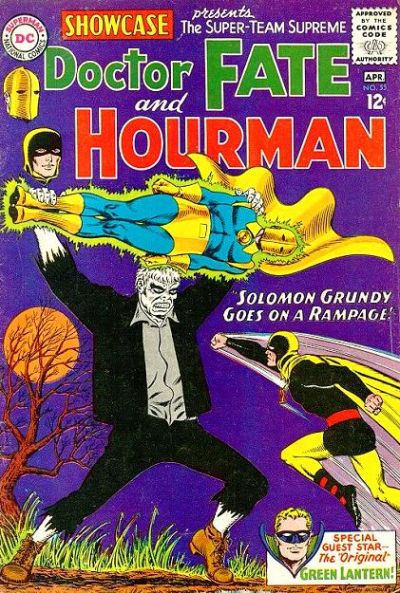
Solomon Grundy Goes On A Rampage

A team up of two JSAers happens in Showcase #55 (March-April, 1965) by Gardner Fox and Murphy Anderson (with cover by Anderson), as Dr. Fate and Hourman team-up to save the original Green Lantern from his foe, Solomon Grundy.

Solomon Grundy ends up back on Earth, after the globe Green Lantern (Alan Scott) created crashes to Earth thanks to striking a comet.  Grundy heads to home, Slaughter Swamp.  Dr. Fate has a mystic alarm go off, which puts him on Grundy's tale, as Hourman gets involved as his chemical plant is close to Slaughter Swamp.  Grundy fights the two, countering their magic and miraclo powers, escaping from them.  Grundy then faces Green Lantern, and beats him, taking the original emerald crusader back to Slaughter Swamp, changing him into a Grundy like monster.  Dr. Fate cures Green Lantern with his magic, and using their combined magical might, capture Grundy in a new sphere.

This issue recaps Solomon Grundy's origin and battle with the JSA from All-Star Comics #33 (as will as being his first appearance since the Golden Age), but how Grundy got back in that prison is recounted as part of the origin of the All-Star Squadron, and Grundy returns soon, in the fourth JLA/JSA meeting.  It is also the first appearance of Inza Nelson, Kent's wife (with their marriage being revealed first here; as she was just Inza Cramer when she worked with Dr. Fate in the Golden Age).

Perils Of The Psycho-Pirate

Next up is a story by Gardner Fox and Murphy Anderson (under a cover by Anderson) from Showcase #56 (May-June, 1965), with Dr. Fate and Hourman facing a new villain with a familiar name.

Archeologist Kent Nelson finds a set of Medusa Masks on a dig, and financier Rex Tyler finds his fiancee, Wendi Harris, fascinated by them (so much so she tries to steal them when displaying them at a party she held).  Roger Hayden manipulated her into doing that, as he planned on taking the masks to take over the identity of Psycho-Pirate.  Hayden was a cellmate of the original Psycho-Pirate (Charley Halstead), who taught him how to manipulate emotions and about the masks.  The new Psycho-Pirate sets Dr. Fate and Hourman against each other until they are able to defeat him.

This issue has the first Silver Age appearance of the original Psycho-Pirate, as well as the reporting of his death.  Dr. Fate appears here between the second and third JLA/JSA team-ups, and Hourman between the first and fifth.

Secret Origin Of The Guardians

Green Lantern #40 (October, 1965) is a big issue, revealing much of the origins of the DC Universe in this story by John Broome, Gil Kane and Sid Greene, all under a great cover by Gil Kane and Murphy Anderson.

This story stars with a reunion of Alan Scott and Doiby Dickles at Gotham Broadcasting, with Alan having to ring-sling as Green Lantern to stop a meteor, which his ring seems to have no effect on, then to save Doiby from a falling tree, which oddly works as Alan's ring usually doesn't against wood.  Alan goes to show Hal his new trick....which now doesn't work.  Alan explains, with the help of his ring, that the comet was really an ancient Oan scientist named Krona, that ended up being freed from his prison by exposure to Alan's magical based ring.

Krona was an Oan scientist, long ago, who performed experiments trying to find the origins of the universe.  He succeeded slightly, seeing a "cosmic hand" of creation (but his activities were also destructive, causing evil to be unleashed in the universe, and later, more trouble like the creation of the Multiverse, according to the Crisis on Infinite Earths).  So, the Oans banished him in comet form (and eventually became the Guardians of the Universe, who formed the Green Lantern Corps).

Krona planned on doing more experiments, and was possessing Alan Scott's body (with Alan hiding in Hal's mind).  The two battled, with Hal winning (as he had secretly switching rings with Alan, exchanging a weakness for yellow for one for wood), allowing Hal to defeat Krona, with the Guardians of the Universe returning Krona to comet form, the Green Lanterns swapping rings back, and Alan heading back to Earth-2.

This issue is the first appearance of the "Cosmic Hand", hinting at the foundation of the DC Universe (and Multiverse, all revealed during the Crisis on Infinite Earths), as well as Krona's first appearance, and the first appearance of Doiby Dickles, Alan Green Lantern's Golden Age partner.  Green Lantern Alan Scott appears here after his appearance in the third JLA/JSA team-up, and appears next in another team-up with Green Lantern Hal Jordan.

Mastermind Of Menaces

Another focus on a team-up of two JSA members, Brave and the Bold #61 (August-September, 1965) by Gardner Fox and Murphy Anderson (under a stunning Anderson cover), sees the gathering of Starman and Black Canary!

Ted Knight (Starman) is visiting Park City, and drops by the florist shop that is owned by Dinah Drake Lance, the Black Canary.  Larry Lance knows there is a rash of robberies in the town, traceable back to Dinah's flower shop.  Investigating, Starman finds that his old foe, the intangible Mist is behind it, having hypnosis, but Starman has problems working his Cosmic Rod near the Mist's men (due to frequencies given off by Mist's hypnotic flowers).  Working together, Starman and Black Canary are able to defeat the Mist and his men.

This issue sees the Mist return from the Golden Age, as well as Larry Lance (a detective who was friends with Black Canary, and is now revealed to be her husband).  Black Canary and Starman were both last in the second JLA/JSA team-up, and appear next in the next issue of B&B (which is reprinted in the second volume of this Crisis collection).

The Hour Hourman Died

The last story in this collection is from Spectre #7 (November-December, 1968) by Gardner Fox, Dick Dillin and Sid Greene, and is a back-up story featuring Hourman in a bit of a problem.

Returning to his HQ under Tyler Chemical Company from a JSA meeting, Hourman encounters Tricky Dick Arnold, a thief phasing through the door.  Taking a Miraclo pill for an hour of power, Hourman faces him, but the thief hits him with a beam from his Metalizer....which seems to kill Hourman!  Normally only working against metal (allowing Arnold to phase through items to thief), that unique radiation seem to spell doom for Hourman....except his Miraclo was keeping him alive for one last hour.  Tracking down the thief and analyzing the Metalizer, allowed Hourman to make an antidote before he faced his last hour.

Hourman appears here between the sixth and eighth JLA/JSA team ups.


All these stories are reprinted in the Crisis On Multiple Earths the Team-Ups Volume 1, with a cover by Jerry Ordway.

More JLA/JSA collections, including a second one of team-ups with team members will be forthcoming, as these meetings of members of teams from Earth-1 and Earth-2 foreshadow the Crisis On Infinite Earths.


Thursday, November 22, 2018

All-Star Comics 3 The First Meeting Of The Justice Society Of America

On November 22, 1940, in a hotel lobby, was "The First Meeting Of The Justice Society Of America" as relayed to readers in All-Star Comics #3 (Winter, 1940) under a cover by Everett Hibbard in a story by Gardner Fox.

The eight members there: Sandman, Spectre, Flash, Hawkman, Dr. Fate, Green Lantern, Hourman and the Atom formed the charter membership of the Justice Society of America, and was the first teaming of super heroes formed.

The story wasn't much of a team-up, but instead the heroes gathering to tell individual tales of their exploits (and the party was crashed by non-members, the original Red Tornado and Johnny Thunder as well).  Still, it was a good start.

With the next issue, All-Star Comics #4 (March-April, 1941), the team began to work on the same case (though they'd go off on their own).  Soon after that, old members started to leave and new members would join....but readers had to wait until DC Special #29 (August-September, 1977) to get the tale of how these heroes (as well as Superman and Batman, who were too busy to be anything but honorary members in the 1940s) originally met for the first time.

All-Star Comics #3 was reprinted a few times, first in the Famous First Edition #F-7 (June-July, 1975), then in the first volume of the All-Star Archives (a 12 volume series, which reprinted All-Star Comics #1-57, with a zero issue covering the two pre-JSA issues, and ending with volume 11, which contained All-Star Comics #50-57), and most recently in the Millennium Edition: All-Star Comics #3 (June, 2000).

All-Star Comics #3 came out on November 22, 1940, and according to America Vs. The Justice Society, that's the date of the meeting as well.  The four issue mini-series from 1985 was a great source of information on the JSA (though DC didn't reprint the inner covers in the tradepaperback, lessening the helpfulness of the TPB, as Roy Thomas put extensive notes on the inner covers of the original issues, including where to find all the Golden Age reprints of JSA and individual JSA members stories (which has been updated for most members, like Starman and Black Canary, here).  The fact Roy was also born on November 22, 1940, is just luck!

A comic that started the heroic tradition of team-ups and teams, something to be thankful for, as that tradition continues to this very day!

Wednesday, September 2, 2015

Guide To Golden Age Atom, Dr. Mid-Nite and Hourman Reprints

Next up in our look back to where to find the greats of the Golden Age, the Justice Society members....and their stories represented in the more modern ages, and all thanks to Roy Thomas and Rich Morrisey's work in this previously...

...a look at Dr. Mid-Nite, Hourman and the Atom!

Dr. Mid-Nite


Charles McNider premiered back in All-American Comics #25 (April, 1941) with the story "Dr. Mid-Nite, How He Began" (title added later; original story by writer Charles Reizenstein and artist Stan Aschmeir), with the doctor preparing to testify against racketeer Killer Maroni, and losing his sight to a bomb.  Still, Charles found he could see in the dark when an owl crashes through his window, and the doctor develops "Blackout bombs" to take away the light, infra-red goggles to see in the day, rescues the owl (and names him, Hooty), and adopts the identity of Dr. Mid-Nite!

This tale was reprinted in Justice League of America #95 (December, 1971) under a groovy cover by Neal Adams, without the doctor making the cover!  This issue also had Golden Age Dr. Fate reprint, so the doctors are in!

All-American Comics #88 (August, 1947) is the next tale of the doctor's to be reprinted, wherein "Tarantula Unmasks Dr. Mid-Nite" by John Broome and Alex Toth.  Crooks kidnap Dr. McNider thinking they'd find out if he's Dr. Mid-Nite, but the doctor proved too smart for them, beating them with hypnosis, no less.


This story was retold in 100-Page Super-Spectacular DC-20 of September, 1973, and the doctor shares the book with Golden Age tales of Batman, Black Canary, the Spectre and more!


Last, but not least is the Dr. Mid-Nite story from All-American Comics #101  (September, 1948) and the "Case of the Talking Shadows" by John Broome and Rudolph Palais.  The doctor and his assistant, Myra Mason, face off against the criminal, the Great Ludwig.


This story was reprinted in Detective Comics #445 (February-March, 1975) under a Batman cover by Jim Aparo (and a few other reprints in the book, though no JSAers)...

...and the doctor only had one more adventure, that of All-American Comics #102 (October, 1948) in the Golden Age, or at least that how it appeared back then.


But, there was an unpublished Golden Age adventure, that was published in Adventure Comics #418 (April, 1972) called "The Sight Stealers, written by John Broome, and inked in the modern day by Sal Amendola.

Oddly, this tale was recently reprinted in the Justice Society of America 100-Page Super Spectacular #1 of 2000, along with a solo Silver Age of the Golden Age Flash, a team-up of Starman and Black Canary from the Silver Age, and some team action of the JSA as well.

Sadly, the doctor only found the first five of his individual tales, those from All-American Comics #25 to All-American Comics #29 (August, 1941) in the JSA All-Stars Archives #1 of 2007 (along with the next two JSAers and more), with the rest of his Golden Age tales being with the Justice Society.


These tales were reprinted in the All-Star Comics Archives, including a solo Dr. Mid-Nite tale from All-Star Comics #6 (August-September, 1941) in All-Star Comics Archives #1 from 1992 (along with the JSA tales from All-Star Comics #3 to #6)...


...and you can read on how Dr. Mid-Nite joined the JSA here!


Hourman


Rex Tyler started popping pills to become the man of the hour with Adventure Comics #48 (March, 1940) by Ken Finch and Bernard Bailey, in the tale later titled "Presenting Tick-Tock Tyler, the Hour-Man", facing jewel thieves at the request of a friend who was worried about her husband...

...and having to do all this in an hour, as that's as long as his super-strength would last!


This story was reprinted in Justice League of America #96 (February, 1972) under a cover by Neal Adams, in an issue which also featured a Golden Age Wildcat reprint.


Hourman's next reprint done in the 20th century was in Adventure Comics #57 (December, 1940) with the story of "The Menace of Dr. Togg" by writer Gardner Fox and artist Bernard Baily (title created later), where Hourman and his Minute Men of America faced Dr. Togg and his Gombezi (genetically created creatures the doctor controlled).


This story was reprinted in 100-Page Super-Spectacular DC-18 of July, 1973, with a cover by Nick Cardy (and Dr. Togg and his creations returned later to face the robotic Hourman and his friends!).


Hourman got another reprint, thanks to the fellow who replaced him in the Justice Society, Starman. Adventure Comics #61 (April, 1941) with "The Runaway Dinosaurs" by Ken Fitch and Bernard Baily (title created later)...

...where Hourman and the Minute Men of America faced off against Mr. Whistle, who stole mechanical dinosaurs from a museum to use in other robberies.


This reprint came about in the Millennium Edition: Adventure Comics #61 (December, 2000), which was a reprint that came from a vote by the fans, and proved how popular Starman was (with Hourman and his fans also being one of the lucky recipients of that popularity!).


The last of Hourman's Adventure Comics run reprinted was Adventure Comics #72 (March, 1942) was the tale of "Dr. Glisten" by Ken Fitch and Bernard Baily (title created later), where Hourman faced glowing hypnotic foe, Dr. Glisten.

This Hourman was reprinted in Wanted, the World's Most Dangerous Villains #7 (March-April, 1973), with a cover by Nick Cardy, and also contained Golden Age Hawkman and Johnny Quick reprints, in a series edited by E. Nelson Bridwell (who was responsible for so many Golden Age reprints finding new life).

The last Golden Age Hourman story was in Adventure Comics #83 (February, 1943), but we still have a few more of his reprints to cover!

Hourman's first five tales of Adventure Comics #48 to Adventure Comics #52 (July, 1940) made it into the JSA All-Stars Archives #1 of 2007 (along with Dr. Mid-Nite, next JSA to be covered the Atom, where you'll see the cover to this book, and more).

Next up for the man of the hour is New York World's Fair Comics #2 (1940) with the story "At The World's Fair" by Ken Fitch and Bernard Baily, where Hourman fights crime at...well, you get the idea.


This, and stories with the Golden Age Sandman, Johnny Thunder, Superman, Batman and more is presented in DC Comics Rarities Archives #1 of 2005, and this volume will be referenced back to many more times to come!


Hourman also appeared in the first two issues of All-Star Comics that preceded the JSA, with solo tales in All-Star Comics #1 (Summer, 1940) with "The Forest Fire" by Ken Fitch and Bernard Baily, and in All-Star Comics #2 (Fall, 1940) with "Dr. Morte, Spiritualist" also by Ken Fitch and Bernard Baily.

 
These two tales, along with stories about Flash, Spectre, Hawkman and more soon to be JSAers were reprinted in the special All-Star Comics Archives #0 from 2006, and is also a great source of individual JSA solo tales before the JSA existed as such, even if Hourman couldn't make the covers of these books....

...and you can read of Hourman's short Golden Age JSA career here, which also details his later involvement with groups like the Freedom Fighters and the All-Star Squadron!


The Atom


Last this time around is the little man with a mighty punch, Al Pratt, also known as the Atom, who premiered in All-American Comics #19 (October, 1940) in "Introducing the Mighty Atom" by Bill O'Connor and Ben Flinton, where diminutive college student Al gets fed up with being picked on (especially when a mugger shames him in front of his girl, Mary James), secretly trains with homeless fighter Joe Morgan, and returns full of energy to fight crime as the Atom (though he doesn't get a costume until his next appearance!).

This tale is reprinted in  the Secret Origins of the Super DC Heroes of 1976 (in both hardcover and soft cover) with a cover by Neal Adams, which is one of the best sources for anyone who gets confused about the Golden and Silver Age differences between DC heroes.

Sadly, none of the Atom's appearances in All-American Comics were reprinted in color at the time of release of America vs. the Justice Society (and all too few afterwards!).

Atom did see one of his tales of this period reprinted, his story in the Big All-American Comic Book (1944) by Joe Greene and Joe Gallagher, and the entirety of that book (along with appearances by Mr. Terrific, Wildcat, Hawkman, Flash, Green Lantern, Wonder Woman and more Golden Age greats) was reprinted in the  DC Comics Rarities Archives #1 of 2005.

Atom's last appearance in All-American Comics was in All-American Comics #72 (April, 1946), then he moved over to Flash Comics #80 (February, 1947) for a regular feature, and was also in Comic Cavalcade #22, #23 and #28 in 1947 and 1948.

Atom's next reprinted story was from Flash Comics #90 (December, 1947) with "Murder On A Star", with a little murder mystery that finds the Atom falsely accused of a crime.

This story was reprinted in the 100-Page Super-Spectacular DC-18 of July, 1973 with a cover by Nick Cardy, and has Golden Age reprints of TNT, Captain Triumph and Hourman....and a few tales of some guy with a red cape as well!


Flash Comics #98 (August, 1948) features the debut of Atom's new costume (with the fin on top and atomic symbol on his chest) in the story "Terror Rides The Rails" by Robert Kanigher and Carmine Infantino, where the Atom demonstrates super-strength as well, and fights railroad saboteurs (details about the Atom's change and how it happened were later revealed as part of the retroactive continuity of Roy Thomas' tales of the All-Star Squadron, and it was quite the ride!).


This story is reprinted in Justice League of America #99 (June, 1972) under a Nick Cardy cover, and also has a Golden Age Sandman reprint.


Atom's series ran until Flash Comics #104 (February, 1949) and one last tale in Sensation Comics #86 (February, 1949), until an unpublished story surfaced, "Danger In The Totem's Eye", originally planned for Flash Comics #105, by writer Arthur Adler and artist Arthur Peddy, with Atom fighting robbers in a museum.  This story appeared in Batman #238 (January, 1972) and is also known as DC 100-Page Super-Spectacular DC-8, under a Neal Adams cover that includes almost everyone...except the Golden Age Atom!

Atom's JSA career as a charter member gets a little more coverage here.


Modern Archives weren't too kind to the little man either, the Atom's first five stories from All-American Comics #19 to #23 (February, 1941) were reprinted in the JSA All-Stars Archives #1 of 2007, along with Hourman and Dr. Mid-Nite...

 
...and Johnny Thunder, the Red Tornado, Mr. Terrific and the Wildcat, whom we will cover soon!

Wednesday, February 25, 2015

Showcase on Hourman and Dr. Fate

The Justice Society was proving quite popular at DC in the 1960s, and they were looking to expand on that premise.

Two of the JSAers who hadn't been revived before the re-introduction of the JSA in Flash #137 (and thus didn't have Silver Age counterparts) were Dr. Fate and Hourman.  Their Golden age history was notated here, but....they had a little early Silver Age spotlight of their own in two issues of Showcase!


The First Showcase


Showcase #55 (March-April, 1965) was the first of the magician and the man of the hour teaming up (and more or less without the JSA since More Fun Comics #98 (July-August, 1944) for Dr. Fate, and Adventure Comics #83 (February, 1943) for Hourman...though the Golden Age Green Lantern also guested in this tale (as well he should, as the duo faced GL's Golden Age foe, the swamp-monster Solomon Grundy, in his first Silver Age appearance).  This issue by writer Gardner Fox and artist Murphy Anderson also features Dr. Fate's long time companion, Inza Nelson (formerly Cramer, Inza must have married Kent Nelson, a.k.a. Dr. Fate between his last Golden Age appearance and this issue!).  Solomon Grundy also returned from a trap on the moon, which he had already escaped...but, this was explained in the early issues of All-Star Squadron), and the swamp man was defeated with spells and hour long strength. 

Second Showcase


Showcase #56 (May-June, 1965) did have the man of Miraclo and the helmeted magician, this time against a new menace (though, like Flash, Atom and others, inspired by an old one).  Roger Hayden, a cellmate of Charley Halstead, took over his criminal identity of the Psycho Pirate, as well as using the Medusa Mask to get the power to manipulate emotions.

Psycho Pirate shows up again, facing the Spectre in Spectre #5 (July-August, 1968), and the JSA as a whole in All-Star Comics #66-68 (1977), and returning as Hourman's representative foe in the Secret Society of Super-Villians in Justice League of America #195-197 (1981) (continuing into All-Star Squadron #26 and Annual #2 of 1983), before working for the Anti-Monitor during the Crisis on Infinite Earths...and later battling the heirs to the JSA, Infinity Inc. (including Hourman's son, the second Hourman - Rick Tyler).  Wendi Harris (the original Hourman's actress fiancee) was also a part of this issue.

First Meeting


Hourman and Dr. Fate first met in DC Special #29 (August-September, 1977 by Paul Levitz and Joe Staton), when Dr. Fate realized that Batman, Flash and Green Lantern were not having success against Hitler and his forces.

No reason was given why the magic-based Dr. Fate picked the scientific Hourman...

...but this piece of retroactive continuity (telling a story set in the past to explain later events) seemed this formed a friendship between the two that lasted over decades...


Gathering of Foes


...including All-Star Squadron #51-54 (of 1985/1986 by writer Roy Thomas and artists Mike Clark and Arvell Jones), wherein Dr. Fate, Hourman (and Sandman's partner, Sandy and Hawkman's partner, Hawkgirl) face off against the Mr. Mind's Monster Society of Evil which included Hawkman foe, priestess of the weather Nyola (from the Hawkman tale of All-Star Comics #2 of Fall, 1940), Sandman foe, plant manipulating Ramulus (formerly known as Nightshade when he first appeared in ), Dr. Fate foe, master of Solution Z Mr. Who (from More Fun Comics #73, #74 and #79 before this appearance, and after in More Fun Comics #91 and Infinite Crisis #7), and Spectre foe, Oom (from All-Star Comics #3, the Spectre tale of the first meeting of the JSA).  Since Spectre later borrowed Hourman's foe, Psycho Pirate for an issue, it only seems fair, as this tale set in 1942 has Hourman facing an old foe of Spectre's!  These four heroes were looking for the missing JSA (missing because of events of the Crisis On Infinite Earths, and how they related to it in 1942, and detailed in All-Star Squadron #50 of October, 1985, and related to the original All-Star Comics #13 Justice Society adventure cover dated October-November, 1942); and at the end, Monster Society also included the foe of the western Vigilante, the Dummy as well.  It also set things up for Mr. Mind to eventually reform the Monster Society of Evil and face the foe he was known for facing, Captain Marvel.

All this just goes to show how interrelated comic characters can get over time....it's like magic!

Just for completeness sake, here's the cover's of the premiere of the Earth-2 members of the Monster Society of Evil (though they aren't on the original covers...).

Nyola and Oom from All-Star Comics #2 and #3.  Nyola created by Gardner Fox and Sheldon Moldoff; Oom created by Jerry Siegel and Bernard Baily


Ramulus (originally known as Nightshade, but DC was getting Nightshade, a character from Charlton Comics, and his original tale of World's Finest Comics #6 was reprinted in Wanted #9), and was created by Jack Kirby


Mr. Who (his first tale of More Fun Comics #73 was reprinted in Wanted #8, and all his tales vs. Dr. Fate are in the Golden Age Dr. Fate Archives) and was created by Gardner Fox and Howard Sherman; Mister Who's Solution Z allowed him to change size, become invisible and intangible and adapt to any danger.