Showing posts with label Len Wein. Show all posts

Wednesday, November 22, 2017

A History of Crisis on Earth-X

Earth-X....the nastiest of alternate Earths, one where the Nazis had won World War II, was introduced in Justice League of America #107 (September-October, 1973) by Len Wein, Dick Dillin and Dick Giordano (under a cover by Nick Cardy) with "Crisis On Earth-X"...


...in a story which also reintroduced the 1940s Quality heroes of Uncle Sam, Doll Man, Phantom Lady, Human Bomb, Black Condor and the Ray as the Freedom Fighters...


...the last of the heroes on that world, who were still fighting the Nazi menace.

The battle continued into the next issue (Justice League of America #108 of November-December, 1973 by Wein, Dillin and Giordano, entitled "Thirteen Against The Earth")...

....where, with the help of the Justice League of America (Batman, Green Arrow, Elongated Man and Red Tornado) and Justice Society of America (the Golden Age Superman, Sandman and Dr. Fate), the Freedom Fighters were finally able to live up to their name.

The combined heroes were able to free Earth-X from the Nazi forces, and the computer that led them under the image of Adolf Hitler (all by breaking the system that allowed the evil forces to mind control most of the population into following all the Nazis lies).

Freedom Fighters

The Freedom Fighters then had their own comic series, which lasted 15 issues from March-April, 1976 to July-August, 1978.  Oddly, the heroes, instead of remaining on Earth-X, to help in rebuilding that devastated world, came to Earth-1 (the home of the Justice League of America), where they were falsely accused of being criminals by a corrupt government and cooperating media, and spent much of their time on the run.

Along the way, the Freedom Fighters met up with heroes like Wonder Woman, Batgirl and Batwoman (real heroes knowing the heroic nature of the Fighters), as well as established DC villains like Cat-Man, and even faced a few foes all their own, such as the Silver Ghost, King Samson, Skragg the super-sniper, the Crusaders (invading super-heroes Americommando and his partner Rusty, Fireball and his partner Sparky and the aquatic Barracuda), the Renegades, as well as some unnamed aliens.


Still, they couldn't escape their past, as the Nazi menace of Earth-X had been resurfacing, as the first Firebrand (Rod Reilly), who was came from Earth-X in Freedom Fighters #11 (November-December, 1977, by Bob Rozakis, Dick Ayers and Jack Abel), came to tell them, as the Silver Ghost, who was eventually revealed to be an Earth-X Nazi, was also recruiting the Secret Society of Super-Villains (who were part of a multiversal attack on heroes, at the time having a group attacking the heroes of the Justice Society on Earth-2).

Brief Interlude

At some point after the end of the Freedom Fighters and Secret Society of Super-Villains titles of the 1970s, the Freedom Fighters went back to Earth-X to stay....but Earth-X popped up twice, once in Wonder Woman #292 (June, 1982) with Phantom Lady helping Wonder Woman against the threat of the Adjucator, who menaced the multiverse, one Earth at a time, and the rest of the Freedom Fighters getting help from a resurgence of Nazism on Earth-X with the help of Earth-1's Superman in DC Comics Presents #62 (October, 1983), before the collapse of the multiverse during the Crisis On Infinite Earths (which also revisited Earth-X, among others, starting with its fifth issue).

All-Star Squadron Origins

The beginnings of the Freedom Fighters were explored in All-Star Squadron #31 to #35 (March to July, 1984 by Roy Thomas and Rick Hoberg), with Uncle Sam leading lesser known Quality heroes like Miss America, the Invisible Hood, Magno, and the Red Torpedo, along with former JSAer, Hourman, to stopping the Japanese from attacking Pearl Harbor on Earth-X, which allowed the Nazis to win World War II later, as the United States held off participating until directly attacked in 1942 (which this series was set in).

The Ray, Black Condor and Uncle Sam stayed on Earth-X to continue the fight, with the rest of the Quality heroes (including folks like the Jester, Quicksilver, Midnight, the Spider, the original Firebrand, Manhunter Dan Richards and more) to come from Earth-2 to Earth-X during the Crisis On Infinite Earths (as revealed in All-Star Squadron #50 of October, 1985).

Reintroduced

The Ray, Black Condor and Phantom Lady were reintroduced to the DC Universe in the Ray #1 (February, 1992), Black Condor #1 (June, 1992) and Action Comics Weekly #636 (January 24, 1989) as Ray Terrill (son of Happy Terrill), Ryan Kendall, and Dee Tyler (student of Sandra Knight), with these kids eventually uniting with Uncle Sam, the Human Bomb and others to form a new Freedom Fighters, which were devastated in the opening of the Infinite Crisis by a Secret Society which included Deathstroke the Terminator, the second Psycho-Pirate, Zoom and Black Adam.  This seven issue mini-series also returned the multiple Earths with new twists, followed up on in Final Crisis, Forever Evil and Multiversity....

.....including a new Earth-X, with evil Nazi equivalents of familiar heroes to fight Freedom Fighters (as opposed to the evil versions of Earth's heroes represented by the Crime Syndicate of America of Earth-3).   Still, evil is evil, and there will always be Quality heroes ready to fight for freedom..


Wednesday, September 13, 2017

Remembering Len Wein

Taking a little time to remember Len Wein, a comic book legend taken from us too soon (He was 69, born on June 12, 1948, and passed on September 10, 2017).

Len was the co-creator of Swamp Thing and the Human Target for DC and Wolverine, Storm, Colossus and Nightcrawler for Marvel, as well as launching the new team of X-Men in Giant-Size X-Men #1, and editing the early days of Alan Moore's work on the Watchmen and on Saga of the Swamp Thing, and even had a brief cameo as a Congressman in the movie X-Men: Days of Future Past in 2014.

But, now is a time to take a look back at some of his best stories.

Batman's Origins

Over the years, Batman had many origins, but they all contained the basics of young Bruce Wayne's parents being shot, and Bruce vowing to avenge their deaths, and devoting himself to the hard work of becoming Batman.  But, with the Untold Legend of Batman three issue mini-series of 1980, Len, along with artist Jim Aparo, gave the most detailed summation of how Bruce became Batman, pulling in multiple stories from over the years, as well as adding new details, and giving a little history on Robin, Batgirl, Alfred, Com. Gordon and a few villains like Joker as well, all well pushing forward and telling a compelling story of the tortured life of Bruce Wayne in the here and now (even a little on Lucius Fox, who Len created during his run on Batman....).

Batman Villains

Not every Batman villain is in the same league as the Joker, Two-Face, Riddler or Catwoman (all of which Len wrote), but quite a few of them had only one or two appearances and then were forgotten.  Len revived quite a few of Batman's odder villains, like Blockbuster, Mr. Freeze, Calendar Man, Kite-Man as well as borrowing a few foes like Crazy-Quilt (who faced Robin), Captain Boomerang (who faced Flash) and Gentleman Ghost (who was a Hawkman foe), for a run in the 300s in 1979/1980, giving these second tier villains a chance to shine (best of all, all these tales as well as the Untold Legend Of Batman were recently reprinted in Tales of the Batman: Len Wein in 2015).

Justice League Villains

Reviving villains was nothing new for Len Wein, as he did quite a bit of that in his run of Justice League of America from 100 to 114 in the early 1970s.  Len brought back JLA foes Felix Faust, Shaggy Man, T. O. Morrow, the Key, and Amazo, as well non-JLA villains like Eclipso and the Hand, and created a few new ones, like Anakronus, the Nebula Man and Libra (with Libra forming the Injustice Gang of the World, which included individual League member foes like Chronos, Poison Ivy, Mirror Master and more).

Working with the Justice League

All these new villains required new heroes, so Len added Elongated Man (who Len had written some back-up Flash stories for) and the Red Tornado to the League, as well as many guest stars, including future League members, Zatanna (who Len wrote back up Adventure Comics and Supergirl stories for) and Metamorpho, almost member, the Phantom Stranger (whom Len had a lengthy run on in the early 1970s), having back up Green Lantern John Stewart guest for an issue (his second appearance), as well as writing three JLA/JSA team-ups, creating the Freedom Fighters (made up of old Quality heroes like Uncle Sam, the Ray and the Phantom Lady), finding out what happened to Sandman's partner, Sandy the Golden Boy, and, best of all, one large group of ignored heroes as well....


Seven Soldiers of Victory

Len gave DC back the Seven Soldiers of Victory, a mostly forgotten team of heroes from the 1940s, which included Earth-2's Green Arrow and Speedy, the western Vigilante, the Shining Knight, the Star-Spangled Kid and Stripsey and the Crimson Avenger and his partner, Wing (who made 8 soldiers), plucking them out of the past in one of the largest JLA/JSA team-ups of it's time, but keeping them in the present to be available as modern heroes.  In the 1980s, Len did return to one of these heroes, writing a memorable tale that told "Whatever Happened To....the Crimson Avenger?" for DC Comics Presents #38 (October, 1981), which is both a heartbreaking and inspiring tale.    

Len's Legacy

Len would often return to characters, working on Superman, Batman (even on DC Special Series #27, teaming Batman with the Hulk), Wonder Woman, a run on Green Lantern with Hal Jordan and John Stewart, as well as many Marvel characters, then handling Blue Beetle's revival at DC after the Crisis on Infinite Earths, and even later creating Gunfire, and back for a Human Target limited series and one for Swamp Thing....

...., as well as work on a 10 issue mini-series DCU: Legacies in 2010/2011, which let Len work on the whole of the DC Universe one last time.

For all of this and so much more, comic book fans will remember the legacy of Len Wein.

Wednesday, July 20, 2016

A Few Special Star Trek Issues

Star Trek has had a few comic series over the 5 decades of its existence, but there are a few that stand out.

Here's a couple of them from DC's first run at the cast of the Enterprise....

...and why these two issues have stood the test of time (in more ways than one!).


 Chekov's Choice


It is a rare thing when television actors get a chance to write comics, especially about their own character on a beloved show, but Walter Koenig got that chance for Pavel Chekov with DC Comics' Star Trek #19 (October, 1985) and the story of "Chekov's Choice", with art by Dan Spiegle and cover by series regulars Tom Sutton and Ricardo Villagran.

This issue is important, as it focused on the era of Star Trek between the original series and the majority of original Star Trek movie era, set at a time after the original Star Trek motion picture but well before the events of Star Trek II: The Wrath of Khan.

Chekov was faced with a choice (thus, the title), and had to lead the crew of the Enterprise in a mutiny to save the ship from a collision with an asteroid.

This issue also showed that DC Comics had, wisely, gotten legal rights from Paramount to cover all eras of Star Trek at the time (unlike the previous Marvel Comic series, which only covered the era of Star Trek: The Motion Picture).

Vicious Circle


The comic took advantage of that fact with Star Trek #33 (December, 1986) and "Vicious Circle" by Len Wein, Tom Sutton and Ricardo Villagran (and cover by Jerry Bingham), when the original series crew met with the movie era crew in a special, 20th Anniversary story!

Thanks to an early time travel adventure of the Star Trek crew from the episode, "Tomorrow Is Yesterday", Kirk and crew came from the 1960s, overshooting their own time to the time and ending up in the time between Star Trek III: The Search For Spock and Star Trek IV: The Voyage Home.  This caused many time anomalies and both crews had to work together to get the original Enterprise crew to their rightful place in time.  The crew used another time travel device to help them out (which won't be spoiled here, but it was from an episode fans remember forever)...and special note, you can see the differences in the crews, because Chekov wasn't around during those early, first season episodes, yet Yeoman Janice Rand was.

This points out a problem from Star Trek II: The Wrath of Khan....in how does Khan recognize Chekov, but that's one anomaly beyond our reckoning.  The issue is also special, as writer Len Wein had written original Gold Key Star Trek issues, making him the first Star Trek comic writer to have written Star Trek comics to go from Gold Key to DC (with Mike W. Barr the first in doing duty from Marvel to DC).  Then, in 1991, Walter Koenig wrote a book, detailing his experiences on making Star Trek: The Motion Picture, entitled "Chekov's Enterprise".  Quite a vicious circle of time travel for both writers!


Thursday, November 6, 2014

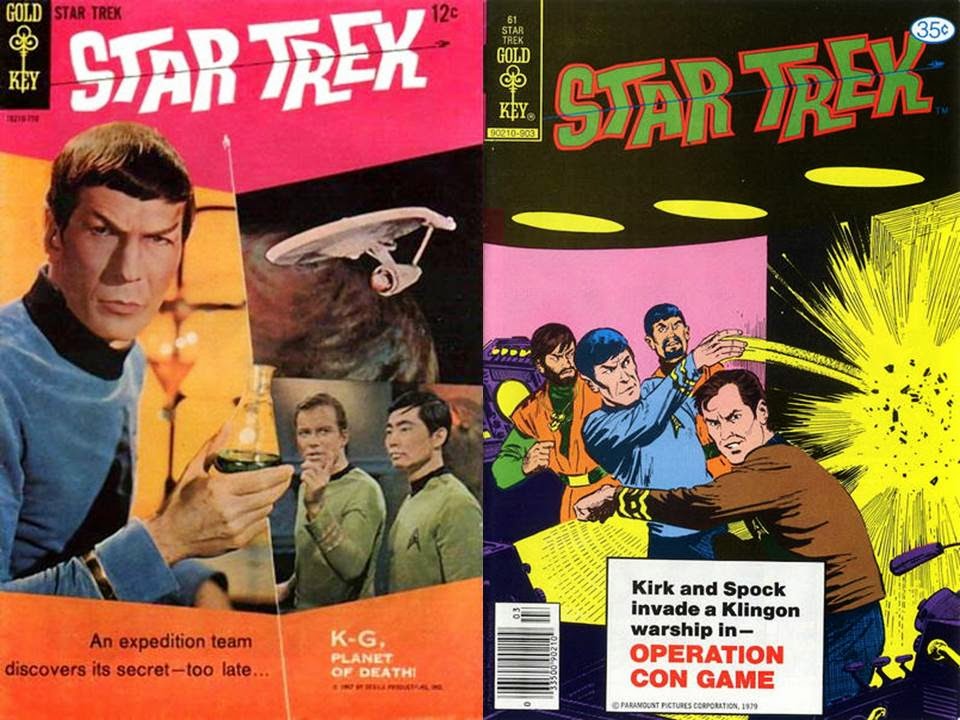
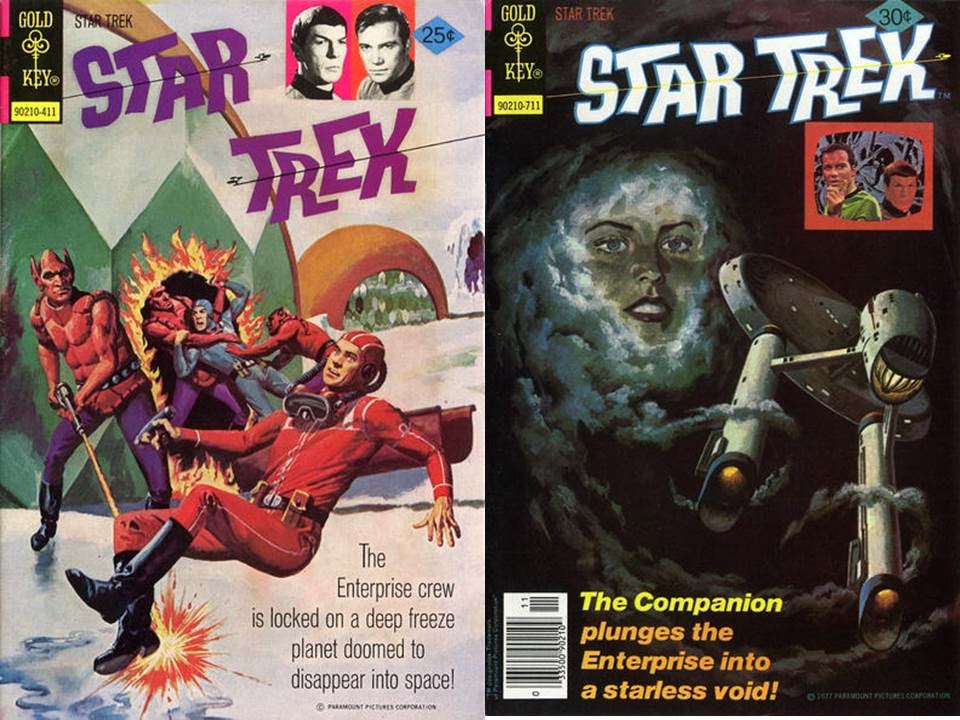
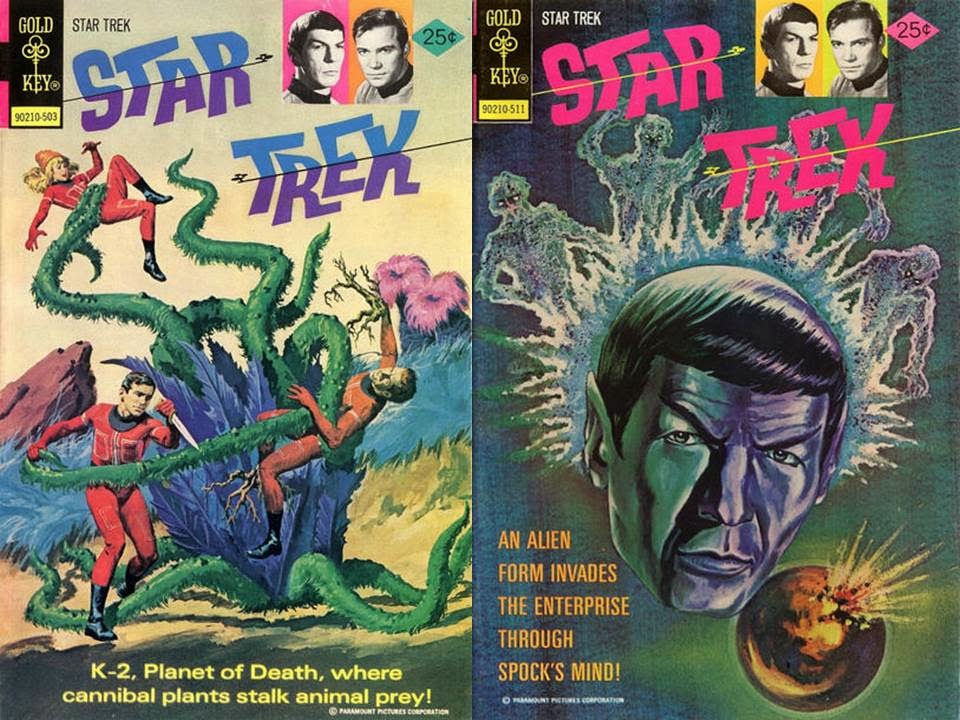
Star Trek's Gold Key

Star Trek boldly went in the 1960s, but…how to take that experience home with you in the days before VOD, DVR, DVD or even VCR?

Well, it was the comics! For 61 issues from cover dates July, 1967 to March, 1979, Kirk, Spock, McCoy, Scott, Sulu, Uhura, Chekov, Rand and Chapel were there in the funny pages for you to read, brought to you from the folks at Gold Key.

Space...the Final Frontier


The stories were simple (and usually featured things not seen in the TV show), and sometimes characters didn’t even look like their familiar versions (it wasn’t as though the comic creators could just hop on the internet to find reference….).

Even though Gold Key had access to all the characters, Uhura, Chekov, Rand and Chapel weren’t used much, and they only used Harry Mudd and Zefram Cochrane from the guest stars (once each, #49 for Cochrane, and #61 for Mudd), though they had McCoy’s daughter in a few issues (which the TV show was going to do, but never got around to), and had issues with Klingons, Romulans and the Guardian of Forever.

Though, a few comics looked like they belonged more to Irwin Allen’s Lost In Space than to Gene Rodenberry’s Star Trek

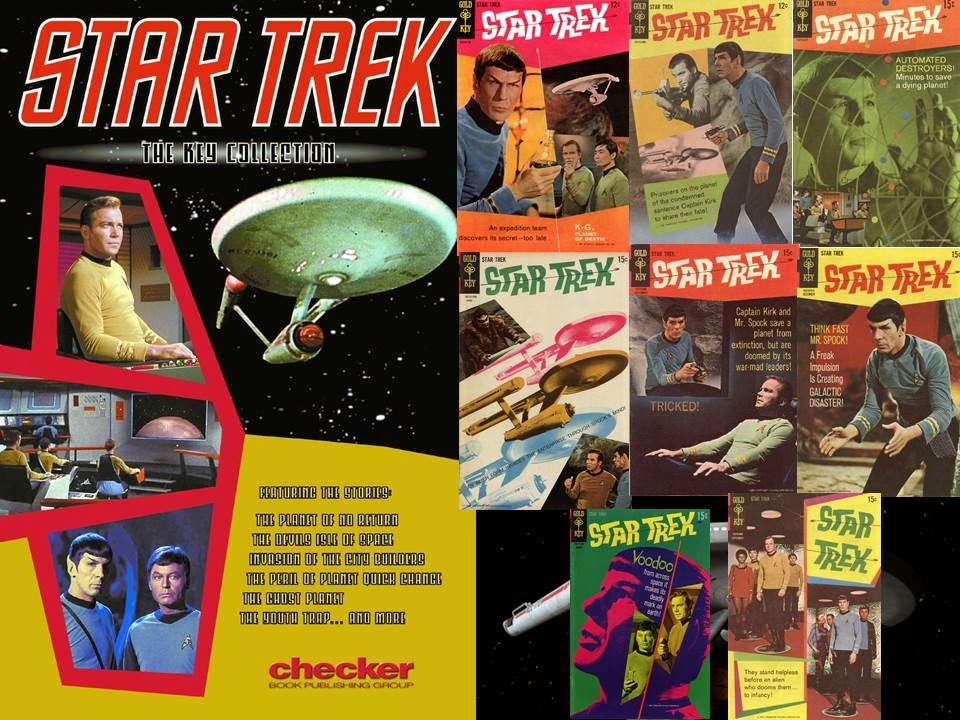
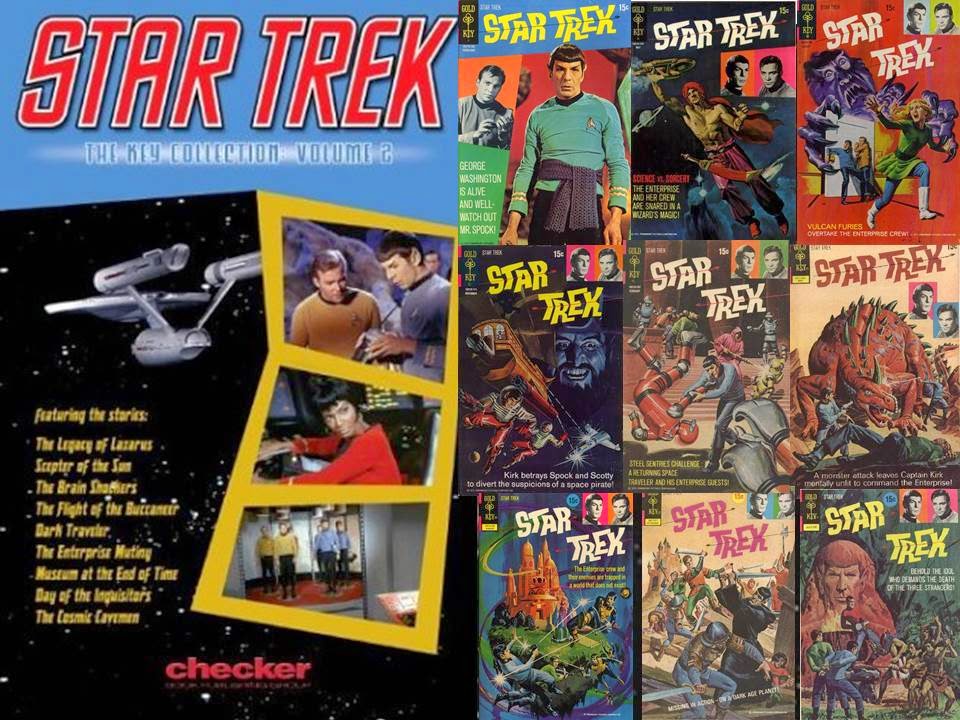
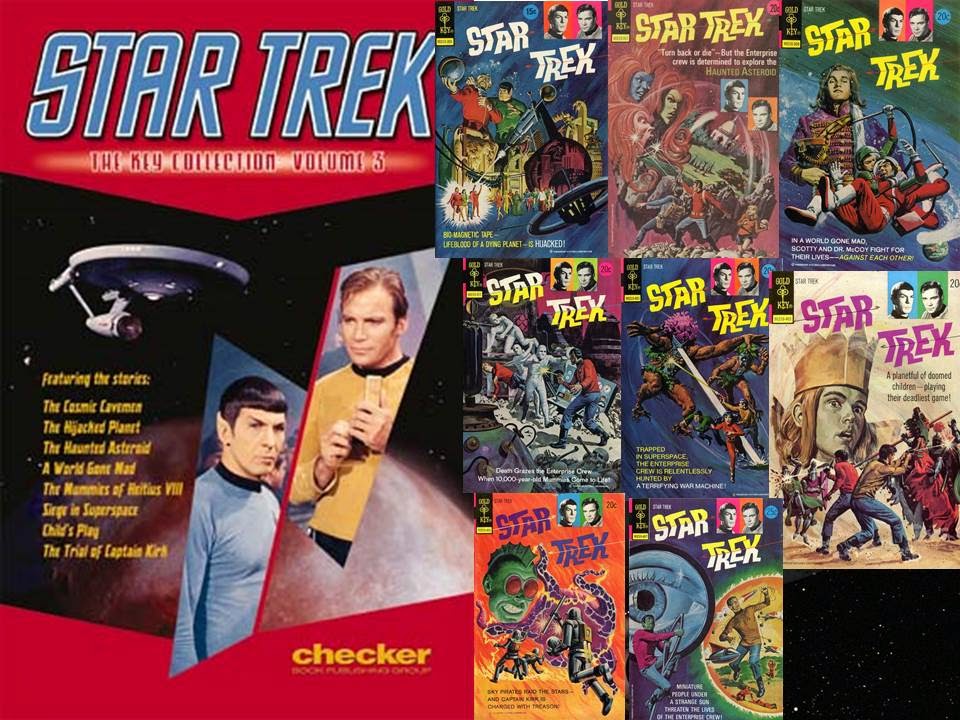
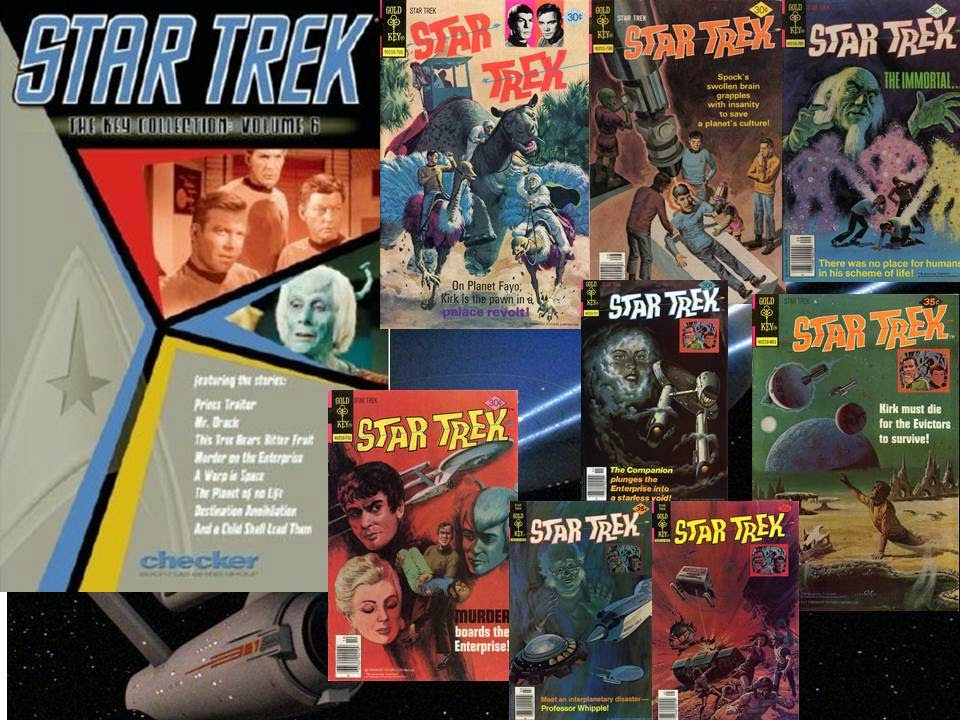
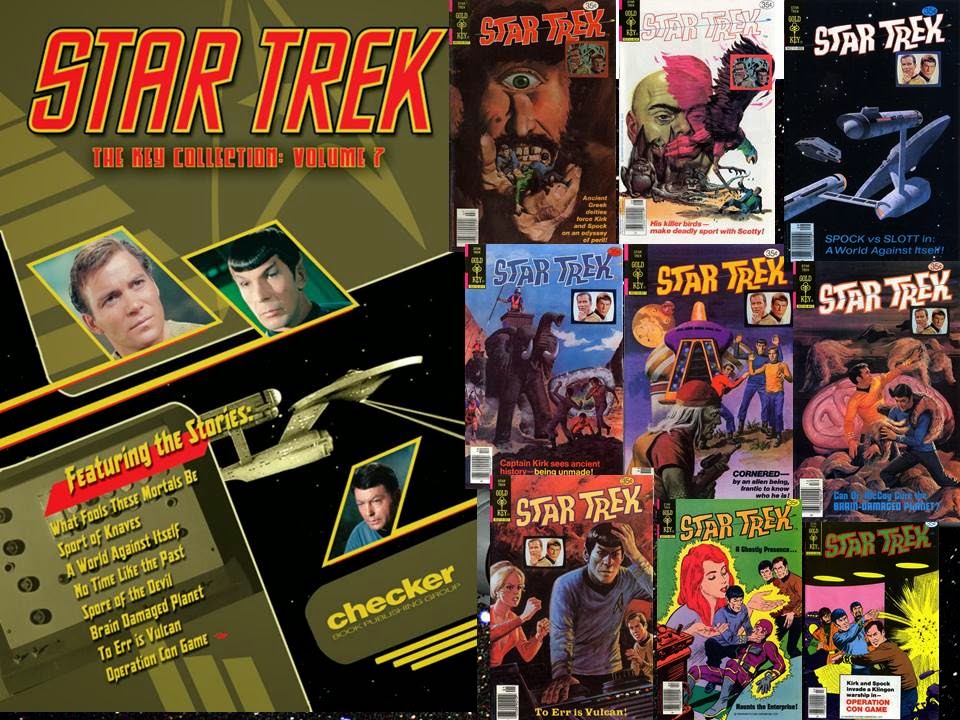
Still, some of the stories were good, and they were all preserved in the Star Trek: The Key Collection, seven volumes that reprinted the new stories from Star Trek #1-61 (#29, 35, 37 and 45 were reprints!).

Len Wein wrote issues #9-16, George Kashdan and Arnold Drake alternated issues between #17 through 61, and interior art was by Nevio Zaccara (#1 & 2), and Alberto Giolitti (#3-27 and 30-37) and Alden McWilliams (#38-61), and painted covers by George Wilson.

These issues are in interesting look at our future…from the past! Then, Star Trek went on…to Marvel Comics!

These Are The Voyages


Star Trek: the Key Collection Volume 1 – issues 1-8 by Dick Wood, Nevio Zeccara, and Alberto Giolitti from July, 1967 to September, 1970


Star Trek: the Key Collection Volume 2 – issues 9-17 by Len Wein, Arnold Drake and Alberto Giolitti from February, 1971 to February, 1973


Star Trek: the Key Collection Volume 3 – issues 18-25 by Arnold Drake, John David Warner, Gerry Boudreau and Alberto Giolitti from May, 1973 to July, 1974

Star Trek: the Key Collection Volume 4 – issues 26-33 by John David Warner, George Kashdan, Allan Moniz, Arnold Drake and Albert Giolitti from September, 1974 to September, 1975

Star Trek: the Key Collection Volume 5 – issues 34, 36, 38-43 by Arnold Drake and Albert Giolitti and Alden McWilliams from October, 1975 to February, 1977

Star Trek: the Key Collection Volume 6 – issues 44, 46-52 by Arnold Drake, George Kashdan, Doug Drexler and Alden McWilliams from May, 1977 to May, 1978

Star Trek: the Key Collection Volume 7 – issues 53-61 by George Kashdan, Arnold Drake, John Warner and Alden McWilliams from July, 1978 to March, 1979

Wednesday, September 17, 2014

Batman Origins

Over his 75 years of history, Batman's origin has been told many times.

Secret Origins #6 (September, 1986 by Roy Thomas, Marshall Rogers and Terry Austin) gave us the most complete look at the original Golden Age Batman's beginnings...and Secret Origins #2 (July, 2014 by Ray Fawkes, Dustin Nguyen and Derek Fridolfs) gave us the most recent look at Batman's past.

But, there is one real great collection of Batman's origins...and here it is, as an excerpt from the Batman 75th Anniversary fanzine (Batman...75 Years) article I wrote.

The Untold Legend of the Batman


The Untold Legend of the Batman is a three issue mini-series  from July-September, 1980 by writer Len Wein, and artist Jim Aparo (though John Byrne penciled the first issue, Jim Aparo inked it, and drew and inked issues #2 and 3).  Like most of Len Wein’s stories, he drew upon the past and added to it, giving a good look at the past while propelling you into the future…and the story looks incredible as Jim Aparo is consistently rated as one of Batman’s most recognizable and defining artists.  This story is deceptively simple, as Batman has to deal with someone trying to destroy him, and starts with him getting the tattered remains of his father’s Batman costume (prompting Batman to reflect on his beginnings, such as how he originated the Robin identity as a cover for himself, confronted his parents killer Joe Chill and the mobster Lew Moxon who ordered Thomas Wayne killed as Bruce’s dad had foiled Moxon – dressed as a Bat-Man himself for Halloween, as well as the history of Robin, Batgirl, James Gordon, Alfred Pennyworth and more), as Batman has to deduce the identity of his soon to be killer...

…probably the most comprehensive gathering of facts on Batman’s life at the time, as well as a good story in its own right, this story (along with a few others) is collected in Tales of the Batman: Len Wein due in the later part of 2014, and shows Len Wein’s belief (stated at WonderCon, 2014 and reported by Hero Complex on April 25, 2014) that Batman is “compulsive.  He’s not crazy.”.

The best part of this story is that Len Wein mixes old origins for Batman (most notably Batman #47 from June-July, 1948, Detective Comics #226 from December, 1955 and Detective Comics #235 from September, 1956, as well as more than a few additions of his own, as well as bits on Robin, Batgirl, Alfred and James Gordon) to give a full picture of this tortured boy from Gotham, as well as his friends and foes, and proves there is much more to Batman's history to explore!