Showing posts with label Gotham. Show all posts

Thursday, October 19, 2017

Gotham Guide: The Golden Age Of Solomon Grundy

Solomon Grundy....born on Monday, christened on Tuesday, married on Wednesday, took ill on Thursday, grew worse on Friday, died on Saturday and buried on Sunday.  That was the end of Solomon Grundy.  But, here, instead of talking of the old nursery rhyme, it will be a look at the creature that came out Slaughter Swamp on the outskirts of Gotham...who was named for the character in that rhyme in a classic Golden Age tale.

Fighters Never Quit

Solomon Grundy first emerged  in All-American Comics #61 (October, 1944) by Alfred Bester and Paul Reinman, coming out of Slaughter Swamp after criminal Cyrus Gold, the man who would become Grundy had been left there for dead 50 years before.

The animated corpse leaves the swamp and heads into Gotham (getting his name of Solomon Grundy from a couple of hobos), becomes their crime boss, and leads them on an attempted take over of Gotham, until Green Lantern (Alan Scott) takes him on (and has problems with Grundy, as Grundy is made of plant material, including wood, which the Golden Age GL is powerless against).  Still, Alan and his partner, Doiby Dickles defeat the creature.

This was the only solo Solomon Grundy tale reprinted, in Wanted, the World's Most Dangerous Villains #4 (December, 1972).

And, Then There Was One

Grundy returns in Comic Cavalcade #13 (Winter, 1945) by Alfred Bester and Paul Reinman for more battles with Green Lantern.


This time, Solomon Grundy is reanimated with the use of chlorophyll, by the Professor, who had killed Baron York (his own brother), in an attempt to take over Gotham's gangs.  Green Lantern (Alan Scott) is warned by his mystic Lantern, but too late, as he is overpowered by Grundy.  Solomon Grundy kills the Professor to advance his own plans and take over the gang, but has become too plant-like, allowing Green Lantern to defeat him by taking away his carbon dioxide, which Grundy needs to live, leaving Grundy petrified in a power ring bubble!


The Revenge Of Solomon Grundy

Grundy gets free from the bubble in All-Star Comics #33 (February-March, 1947) by Gardner Fox, and a host of artists, including Irwin Hasen, Joe Kubert, Stan Aschmeier, Martin Naydel, Jon Chester Koziak and Paul Reinman after a lightning bolt struck.

The JSA find their meeting room ransacked, and realize that it must have been Solomon Grundy, so they go searching for him (and the missing Green Lantern).  Each member meets Grundy (except Johnny Thunder), but it was the Golden Age Green Lantern who eventually defeats Grundy, this time, sending him to the moon!

This story was reprinted in Super-Team Family #4 (April-May, 1976) and in All-Star Comics Archives #7 of 2001.

The Case Of The Withered Flower

Solomon Grundy came back from the moon in Comic Cavalcade #24 (December-January, 1947/1948) by John Broome, Irwin Hasen and John Belfi to face Green Lantern (Alan Scott) and Doiby Dickles again.

This time, Grundy appeared to be much smarter than he was before, and could also disguise himself as Dick Cashmere (the long lost son of John Cashmere, a friend of Alan Scott's).  Grundy plans to kill John, but Green Lantern defeats him, this time imprisoning Grundy at the Earth's core.

Grundy was picked up where he was left here by Per Degaton, and put in the previous trap he had been, as revealed by Roy Thomas in the earliest issues of All-Star Squadron (to explain that this story had been forgotten about!).


Solomon Grundy's first appearance of the Silver Age was in Showcase #55 (March-April, 1965), facing off against Dr. Fate and Hourman (along with the Golden Age Green Lantern), and it took until his next appearance, in Justice League of America #46 (August, 1966) for Batman to first face Solomon Grundy (though it was more Batman foe, Blockbuster (who much later joined the Suicide Squad), doing that....for that and the second issue of the JLA/JSA team-up).

In Justice League of America #91 and #92 (1971), Solomon Grundy faced the same heroes from Earth-1 and Earth-2 (with the Golden Age Batman not around, though the Earth-1 Batman was a little, plus both Earths' Robins), and Solomon Grundy got the idea there may be an Earth-1 Solomon Grundy, an idea played out in the Superman titles, with Batman later facing an inferior outgrow of Solomon Grundy in Detective Comics #523 (February, 1983), where Batman ended the menace of the Earth-1 Solomon Grundy in fire.

Wonder if it was a Sunday?

The original Solomon Grundy continued on in Infinity, Inc., Starman, Green Arrow (and more), and as a member of the Injustice Society of the World, after getting some fame in the 1970s as a part of the Legion of Doom on the Super Friends cartoon show...

...as well as getting two live action portrayals, once in two episodes of the Legends Of The Super Heroes, played by Mickey Morton, and in the two episodes of Arrow that introduced Barry Allen, (but as Cyrus Gold) played by Graham Shields, before moving to Gotham (to be played by Drew Powell).


Thursday, April 20, 2017

Gotham's Batman Replacement Mysteryman

Batman isn't quite up to the task, with Commissioner James Gordon being ordered by the mayor to call in the dynamic duo to help against smugglers...and Batman and Robin become "The Dynamic Trio", adding Mysteryman to the group in Detective Comics #245 (July, 1957), with the story by Edmond Hamilton, Sheldon Moldoff and Charles Paris.


Reporter Vicki Vale wonders who Mysteryman is, and how he's able to order around Batman and Robin, following him around as they capture villains and thugs, first thinking he was a robot, then, believing him to be Superman....


...as for who he is, keep reading!


Mysteryman only had the one appearance, but that appearance was reprinted in Batman Annual #7 (Summer, 1964), Batman Family #2 (November-December, 1975) and in the Batman Annuals Hardcover #2 of 2010 (and the name of that man is on the reprint covers), but he also had a one page cameo in Kingdom Come #4 (August, 1996) with an unexplained appearance...

...so, go find one of these issues for the secret (if you don't want it spoiled....)

Or keep reading for the solution!

The secret of Mysteryman was discovered  by Vicki Vale....


....and the mystery hero is....

....the man known as....

...the man who did not want to disobey the mayor, but wanted to continue on the case, the Gotham Commissioner James Gordon!

Thursday, September 17, 2015

Gotham Guide: Killer Moth, Amygdala and Anarky

Looking back at old Batman villains, here's three that one would have likely never thought to be of much interest....but seems there will be some now, as they make the transition to live television!

So, let's take them out of the shadow of the bat, and focus on Killer Moth, Amygdala and Anarky!


Killer Moth

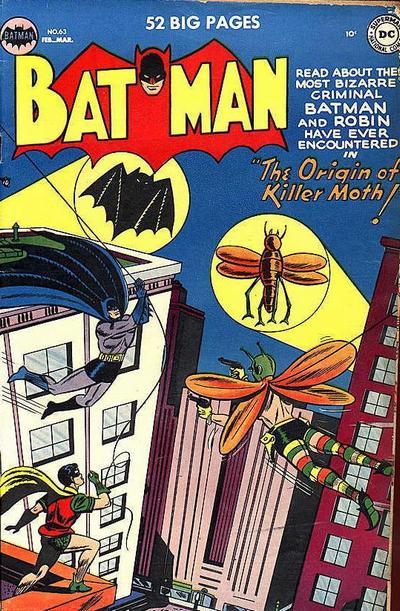
Cameron van Cleer was the first of these villains, appearing in Batman #63 (February-March, 1951 by writer Bill Finger and artist Lew Schwartz), with "The Origin of Killer Moth!".

Prisoner #234026 decides to become the "anti-Batman", setting himself up as a philanthropist friend of Bruce Wayne's...

...all the while working to help criminals with his costumed identity of the Killer Moth, complete with Moth-Cave, Mothmobile and even an infrared Moth signal to summon him!

Batman and Robin stopped the Killer Moth, but didn't catch the criminal himself.

Batman and Robin faced him again in Batman #64 (April-May, 1951), stopping an attempt to steal a moth collection, and the dynamic duo finding out his secret identity and having the Killer Moth arrested at home, and in Detective Comics #173 (July, 1951) where Killer Moth kidnapped Bruce Wayne and tried to take his identity for a time, before the original version disappeared (call him the Golden Age or Earth-2 version, who faced the Earth-2 Batman; similar versions of these stories happened to Batman and Robin on Earth-1...don't let all that multi-Earth talk confuse you, but you can read about it here).

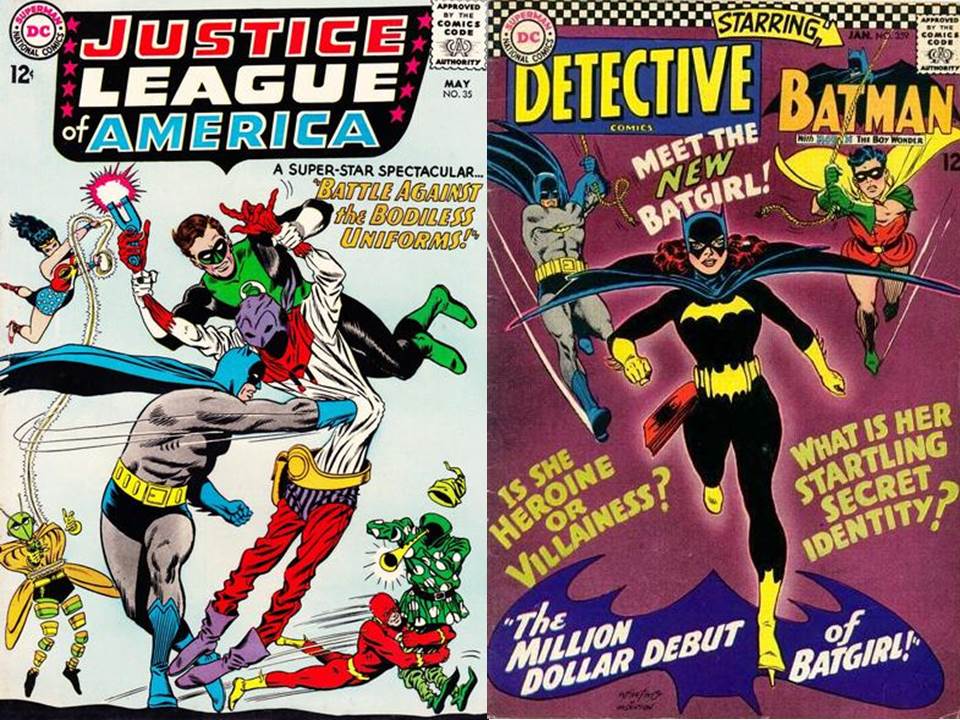
Killer Moth next appeared in Justice League of America #35 (May, 1965) along with Green Lantern foe Dr. Polaris and Flash rogue Pied Piper (and a few more JLA individual villains), but really it's only their uniforms in a plot by the Demons Three (Abnegazar, Rath and Ghast) to defeat the Justice League.  Killer Moth is more active in Detective Comics #359 (January, 1967) trying to kidnap Bruce Wayne (and leading to "The Million Dollar Debut Of Batgirl"). 

Killer Moth makes a brief appearance in Batman #200 (March, 1968), then doesn't return until Batman Family #10 (March-April, 1977) facing off against the duo of Batgirl and Batwoman (along with equally absent until this time Batman foe, the Cavalier), taking a break then to be part of the trial of Batman villains in Batman #291 to #294 (from September to December, 1977), and returning to menace the dynamite duo of Batgirl and Robin in Batman Family #15 (December-January, 1977/1978).

Had the Secret Society of Super-Villains gotten its sixteen and seventeenth issue, you would have seen Killer Moth as a member, facing off against the Freedom Fighters, (the story eventually being printed in the Cancelled Comic Cavalcade) but instead, Killer Moth was regulated to second fiddle in Batman #311 (May, 1979), facing Batgirl again in Detective Comics #486 (October-November, 1979), and just a face in the crowds of Detective Comics #526 (May, 1983), Crisis On Infinite Earths #9 (December, 1985) and Batman #400 (October, 1986).

Killer Moth returned after the Crisis On Infinite Earths, as part of "the misfits", in Batman: Shadow of the Bat #7 through #9 (December, 1992 to February, 1993), along with Cat-Man and Calendar Man (two other minor Batman foes who had seen better days before), and they kidnapped Bruce Wayne and Commissioner Gordon, putting the new Robin, Tim Drake through his paces!

Killer Moth last appeared in Underworld Unleashed #1 (November, 1995) where he made a deal with the devil (a fellow called Neron) and became a creature, Charaxes (as seen in Robin #23 and #24 of December, 1995 and January, 1996, where his real name of cheap hood Drury Walker came out) who continued to bug Batman and Robin and others, in Detective Comics #697 to #699 (1996), Batman: Arkham Asylum -Tales of Madness #1 (May, 1998), Creeper #7 and #8 (1998), Titans Secret Files #1 (March, 1999), JLA #34 (October, 1999), Joker: Last Laugh Secret Files #1 (December, 2001), Robin #107 to #110 (December, 2002 to March, 2003), and being squished in Infinite Crisis #7 (June, 2006), before a quick return as a Black Lantern in Adventure Comics #4 and #5 in 2010.

The classic Killer Moth showed up in Robin: Year One #2 (November, 2000) by writers Chuck Dixon and Scotty Beatty, and art by Javier Pulido and Robert Campanella, and in Batgirl: Year One #1 to #3, and #5 to #9 (February to October, 2003 by writers Scott Beatty and Chuck Dixon and artists Marcos Martin and Alvaro Lopez), and while Killer Moth was a second stringer behind Two-Face in Robin's first year, Killer Moth was a menace (even working with Firefly) in Batgirl's premiere year.


Amygdala

Aaron Helzinger was a man who had emotional rage problems, and to fix them, doctors removed his amygdala cluster (the bundle of nerves that control emotional associations).  This...made him into an even more homicidal manic, and a resident of Arkham Asylum (where we first met him, being manipulated by Mr. Zsasz and Jeremiah Arkham, in Batman: Shadow of the Bat #3 (August, 1992, by Alan Grant and Norm Breyfogle), and in the following issue, Batman: Shadow of the Bat #4 (September, 1992).

Amygdala appeared on his first cover with Detective Comics #659 (Early May, 1993 by Chuck Dixon and Norm Breyfogle), as a part of the Knightfall storyline, where Bane manipulated villains by freeing them from Arkham Asylum and into fighting Batman to wear the Gotham guardian out.

This issue had the Ventriloquist and Amygdala looking for the missing Scarface, and did result in Aaron being captured after a battle with Batman, and pretty much set Aaron's role in the Batman universe, incredible muscle to be used by smarter foes against Batman.

Amygdala was next in a pair of issues of Showcase (Showcase '94 #3 and #4, March and April, 1994), where the newly relocated Arkham patients (like Poison Ivy, Two-Face, Scarecrow, the Riddler, Mad Hatter, Firefly, Mr. Zsasz and more) faced off against Blackgate prisoners in a baseball game to help both sides deal with their new situations (and, yes, it went as well as you might think it would...).

Aaron seemed to be getting better...

...after a brief stay in the new Arkham Asylum in Guy Gardner: Warrior #29 (March, 1995), Underworld Unleashed: Batman - Devil's Asylum #1 (1995), New Gods #5 (February, 1996), and Batman #550 (January, 1998), Aaron was set free, with medicine that would help control his rage. 

Aaron popped up in Bludhaven, as a tenant in the building owned by Dick Grayson (Nightwing), along with writer John Law (who was secretly the Golden Age hero and All-Star Squadron member, Tarantula) in Nightwing #17 and #18 (February and March, 1998), where Aaron quietly moved in while Nightwing fought Man-Bat and Deathstroke.


Aaron remained mostly in control as Grayson's tenant, in Nightwing #21, #26, #31, #48, #50, #54-58, #64-67, #87 and #89 (March, 2004), where the Neron-improved Blockbuster blew up the building Dick owned, killing everyone inside except for Aaron...

...with Aaron being traumatized by the death of his friends in Nightwing #91 (May, 2004).

Amygdala was recruited for Luthor's Secret Society during 2006's Infinite Crisis, and drinking in the Penguin's Iceberg Lounge in Gotham Underground #5 (April, 2008).


Anarky

Lonnie Machin premiered in Detective Comics #608 (November, 1989) in a two-part story by Alan Grant and Norm Breyfogle (that concluded in Detective Comics #609, December, 1989), where Batman fought the self-styled freedom fighter, being shaken when he realized that Anarky was only a minor, fighting against injustices he felt being forced on the general populace.

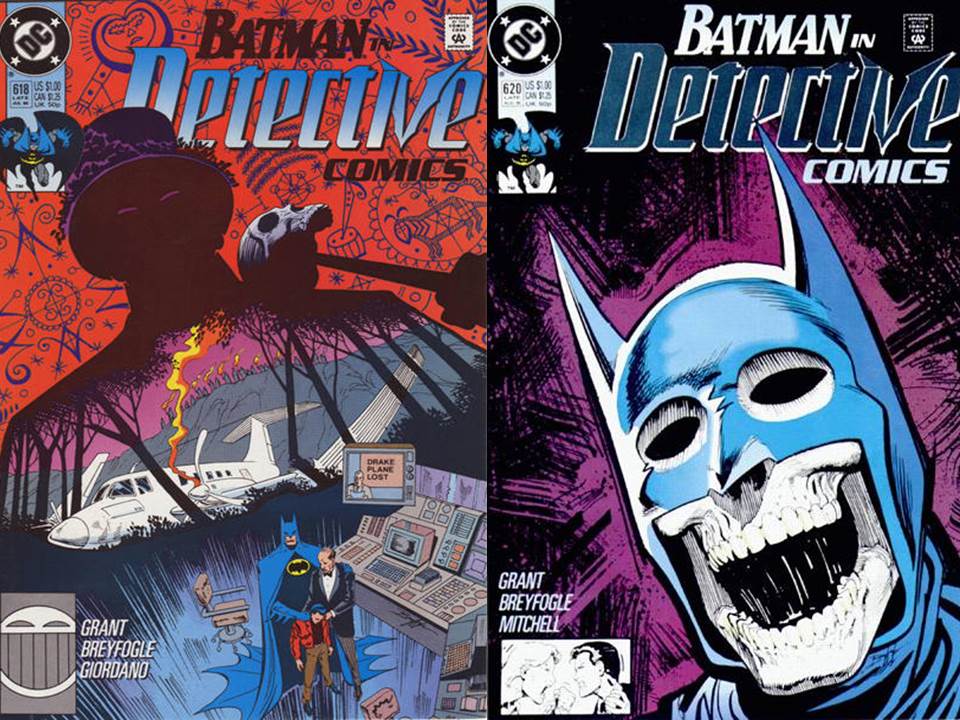
Lonnie returned briefly in Detective Comics #618 to #620 (Late July to Late August, 1990, behind the scenes in the first two of those issues)...

...showing computer skills and a continuing determination to fight for the people (this time under a new identity as Moneyspider).

Next up for Lonnie, a brief bout with an Eclipso diamond (a black diamond which gave the possessor power, feeding on the owner's internal anger, but not caring about what happens to others)...


...which gave Anarky some super power (and also started to set a course for the young lad), setting him against someone his own age....Robin (Tim Drake)...in the Robin Annual #1 (September, 1992).

This ends with the young man in custody.

Anarky escapes during the confusion of the Knightfall event, realizing that Batman is the real problem in Gotham, and works to eliminate him (and Scarecrow) in Batman: Shadow of the Bat #16-18 (Early September to Early October, 1993).  Lonnie doesn't know how right he is, as Jean-Paul Valley has taken over being Batman at this time, and is a much stricter enforcer of the law....but they do end up catching Scarecrow (with this new Batman letting Anarky know that he does not want him around...threatening to kill him if he ever sees him again). 

Anarky must have taken that threat a little to heart, as his next bit of work, closing a gun factory in Gotham, happened with the help of Green Arrow in Green Arrow #89 (August, 1994).


Ollie was at a bit of a crossroads in this point in his life, wandering across the country running into many different people...

...so meeting the anti-establishment young man helped Ollie center himself and get back on target, and Anarky kept on his path, interfering with an election in Gotham in a short solo story in Batman Chronicles #1 (Summer, 1995).

Anarky appears next in Batman: Shadow of the Bat #40 and #41 (July and August, 1995), where he finances Malochia (a crazed prophet, forecasting doom), who happens to use Anarky's funds to make Gotham end sooner (and runs afoul of Anarky, Batman and detective Joe Potato).

This ends with Lonnie's parents, Roxanne and Mike, getting an idea of what he does, and Anarky being presumed dead.

Being dead didn't stop Anarky from getting his own mini-series in 1997.  With Anarky #1 (May, 1997), Lonnie uses a demon, Blasfemy, to summon Etrigan the Demon (with less than success), and Lonnie tries his luck against the ultimate authority figure, foe of the New Gods of New Genesis and leader of Apokolips,  Darkseid, in Anarky #2 (June, 1997)....with Blasfemy paying the price.

This causes Anarky to focus on Earth in Anarky #3 (July, 1997) with freeing people from the tyranny of leadership, and to a confrontation with Batman (and his own agenda)...


...then facing the consequences of his actions (and facing Scarface and the Ventriloquist) in Anarky #4 (August, 1997).

With the Gotham earthquake, Lonnie found himself adrift, thinking his parents dead, as of Batman: Shadow of the Bat #73 (April, 1998), Anarky decided to relocate his operation (as he had founded a company that made him very rich)....deciding to tackle the corruption of Washington, DC (as briefly shown starting in DCU Heroes Secret Files #1 (February, 1999).

Anarky set up base in Washington, DC with his dog, Max, and his computer (also called Max), and found out of the Aberration, an all-powerful entity created by the flaws of the laws of reality.  In Anarky #1 (May, 1999), Lonnie tried to get the JLA to help him against the Aberration, but the Leaguer members were more interested in capturing Anarky and sending him to prison.  Anarky decided to fight the Aberration himself, stealing a Green Lantern ring, and eventually defeating Aberration (with some help from Green Lantern Kyle Rayner)....all in Anarky #2 and #3 (June and July, 1999).

Next up for Lonnie, he took on a true world threat, that of eco-terrorist Ra's Al Ghul, and how the leader of the League of Assassins was manipulating troubles in the Mideast with super powered associates, Dolmen and Buzzword, with Anarky not doing so well in Anarky #4 to #6 (August to October, 1999), then Anarky facing animated undead with the help of the old Haunted Tank crew during the Day of Judgement in Anarky #7 (November, 1999), and while checking to see if his parents might still be alive, finds out that he was adopted in Anarky #8 (December, 1999), and may be the son of the Joker, in the last issue of his regular series.
Anarky next enjoyed a little time as a grown up, in Young Justice: Sins of Youth #1 (May, 2000) and Sins of Youth: JLA Jr. #1 (May, 2000), but not for long, reverting to his normal age to deal with the supernatural problems caused by Circe in a battle with Wonder Woman that involved many of the heroes and villains of the DCU in Wonder Woman #175 (December, 2001).

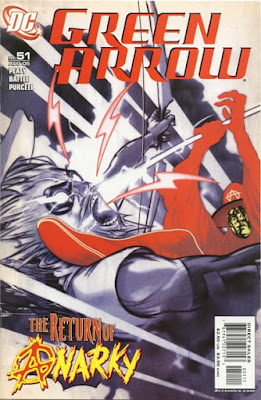
Lonnie faced Green Arrow again in Green Arrow #51 (August, 2005), where Anarky is falsely blamed for an explosion in Star City...
 
...with Anarky again leaving Ollie to contemplate his own commitment to his crusade, as Lonnie seems so much more committed than Ollie is.

Anarky returned again with Robin #181 (February, 2009) as did Lonnie in Tim's run as Red Robin (in the series, Red Robin, that ran 26 issues from August, 2009 to October, 2011), but Lonnie and Anarky weren't the same character anymore! 


More on this when we cover Robin villains at some point...

All of this proves that Anarky runs contrary to other villains like Killer Moth and Amygdala, as Drury and Aaron will appear on Fox's Gotham, and Lonnie will be appearing on the CW's Arrow!


Thursday, September 18, 2014

Superman Batman First Meetings?

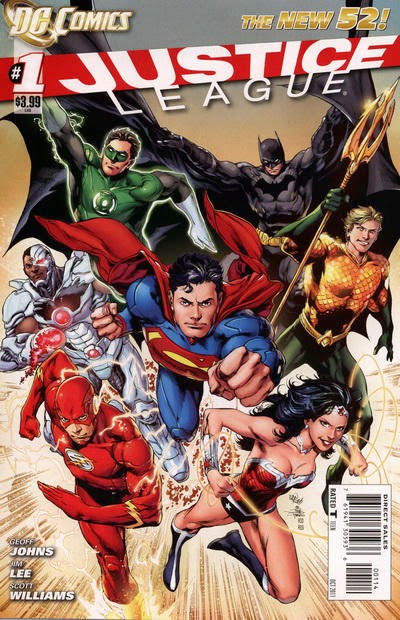
Yes, 2011's Justice League #1 teased us with a first meeting of the new DC Universe’s Superman and Batman, but, they have met before...
 

Many times, actually.

In other worlds, and other places (and of course, in other comics as well!).


So, let’s explore a few of those first meetings!


One of One


One of the longest lasting first encounters of Superman and Batman happened in Superman #76 (May-June 1952, by Edmond Hamilton and Curt Swan).  Superman and Batman (these being the Superman and Batman of Earth-1, and this story ends up being one of the earliest, definite Earth-1 stories…but it is also one of the first time Superman and Batman met in one of their own titles), travel as Clark Kent and Bruce Wayne on board a cruise ship.  The two heroes battled a diamond thief and vied for the affections of Lois Lane as well.  Within this tale, they learned each other’s identities for the first time as they changed from their normal clothes to their super-selves in a darkened cabin suddenly lit by fire…they were able to foil the criminal, but it was a third party who ended up with the damsel in distress at the end!  DC Comics had reprinted this story as one of the most influential in its history as a Millennium Edition, and it can rightfully take its place as one of the most important comics, because it was in this very issue that one character’s comic appearances were made valid in another’s individual series (as, at least at DC, characters didn’t crossover into other characters stories, except in team books, and while Fawcett Comics had a whole family of Marvels meeting each other and other Fawcett characters, Marvel Comics only existed as Timely Comics).

Adding More Earths


A more recent recovering of the first Superman/Batman meeting happened in Superman/Batman Annual #1 (December 2006, by writer Joe Kelly and a slew of artists including Ed McGuinness, Ryan Ottley, Sean Murphy and Carlo Barberi), and, for fun, threw in Alfred Pennyworth, Mr. Mxyzptlk, Deathstroke, the Terminator and the Superman/Batman of the Crime Syndicate of Amerika (Ultraman and Owlman) into the mix (as well as the Crime Syndicate’s Superwoman, and someone who couldn’t be Deadpool) along with Lois Lane (yet took the Boy Wonder out of the story, more recent histories of Batman have not had Robin as his partner in the early years, and this tale reflects that reality).  Not really sure that adding all of these other characters to the mix really improved the story, but it did make for an entertaining tale…more or less.  And it did take the first meeting of Superman and Batman back to the boat (even though it moved the meeting into the Bermuda Triangle), something that had not been followed previous changes to the tale, as the first meeting has been touched on other times as well.

Byrning History


DC’s first major reboot of the Superman mythos happened with the Man of Steel mini-series by writer/artist John Byrne, and one of the major events to have happened in Man of Steel #3 (November 1986), with that DC Universe’s first meeting of the Man of Steel and the Dark Knight.  This first meeting was inspired by a new villain, a lady by the name of Magpie, who had a fascination with shiny diamonds, and Batman having to deal with the caped Kryptonian to stop her.  This established the idea of Batman being ready for anything, as he had prepared himself for a confrontation with the Metropolis Marvel, and had outwit him at the time.  Superman and Batman did NOT learn each others identities at this time, instead having that shared secret between the two unfold over time (and, it ended up taking place in the current DC Comics of the time, which, considering, that, as co-members of the Justice League, they may have revealed their identities to each other before, but Superman’s role in the early Justice League, post-Crisis on Infinite Earths but pre-Infinite Crisis  had been reduced, and this story implied very heavily that Superman and Batman were not best of friends after this meeting…and, this event was soon followed by the gathering of the original Justice League of America in Superman: The Man of Steel Annual #4 (1995), with Superman meeting all the new young heroes of the time).

Back In Time


One tends to forget that even their heroes were young once, but (at least on Earth-1), before Superman was SuperMAN, he was SuperBOY.  Superboy and a young Bruce Wayne (taking on the identity of the Flying Fox) first met in Adventure Comics #275 (August 1960, by Jerry Coleman and George Papp).  In this story, young Bruce Wayne moves to Smallville, learns Superboy’s secret identity but does not reveal it to Lana Lang, and Superboy erases the knowledge of his identity from young Bruce’s mind…or so he thinks.

But, young Bruce Wayne met Superboy once before (as detailed in World’s Finest Comics #84, September-October 1956), but Superboy didn’t know it was Bruce Wayne who prevented crook Thad Linnis (whom young Bruce was working with) from learning Superboy was really Clark Kent!  But, Bruce does know and keeps the secret for years!


Superboy met a young Bruce Wayne a few times later in Earth-1 continuity (in Superboy #182 from February 1972, and in the Superboy Spectacular #1 of 1980), but those meetings were erased from Superboy’s memory (not as an evil plot, but by Superboy himself…

...preventing him from having too much knowledge of the future, and thus accidentally making it not happen).

Regular Meetings


World’s Finest Comics was the home of Superman/Batman team-ups from #71 to #323 (issues #2-70, while having Superman and Batman in action together on the cover, did not feature any stories with them together on the inside!).  Issue #71 (July-August 1954) simply had the duo working together, as natural as can be (and, it was really a trio, as Robin was frequently involved in these pairings as well!

Working with Superman had quite the effect on Dick Grayson, as he had taken his name for his future super-self, Nightwing, from Superman….as Superman had become Nightwing, a non-powered crimefighter, when he fought crime in the city of Kandor with Jimmy Olsen being the Kandorian Nightwing’s partner as Flamebird).

The World’s Finest stories allowed some strange team-ups as well, including regular Robin-Jimmy Olsen meetings, as well as occasional meetings of Supergirl/Batgirl, Luthor/Joker, Brainiac/Clayface, Mr. Mxyzptlk/Bat-Mite and even Penguin/Terra-Man.

Superman and Batman even faced foes that only the two of them could handle, such as the Moon Man, the Composite Superman, Dr. Zodiac, the Weapons Master, the Pantheon and Null and Void.

It is in World’s Finest Comics #94 (May-June 1958 by Edmond Hamilton and Dick Sprang) that we see “The Origin of the Superman-Batman Team!”.


To save Superman from a kryptonite trap, Batman and Robin work against the Man of Steel, yet on his side, by keeping him away from thugs who have the one substance that could kill him...

...nice to see heroes caring about each others welfare.

This ends up being a reoccurring theme in Superman/Batman meetings for many a year, and quite a lot of the history of Superman/Batman gatherings was covered in World’s Finest Comics #271 (September 1981, by Roy Thomas and Rich Buckler), where more than a few of the Earth-1 meetings were covered in one story (and the radio meeting of Superman and Batman was presented as the first meeting of the original Superman and Batman of Earth-2…but, not unlike many of the footnotes in this story – which were wrong -the radio play first meeting of the caped Kryptonian and Metropolis Marvel just was not a really good fit for the comics, but at least it was a novel attempt to explain some of the contradictions of the first meetings of DC’s two major stars).

New Meetings


The more recent Superman/Batman series (that lasted 87 issues and 5 Annuals), really didn’t deal with first meetings between Superman and Batman (other than the first annual), but a recent issue of Superman (#710, June 2011) did once have young Clark Kent and Bruce Wayne meet up and face Vandal Savage before establishing their super-identities, and an even younger Bruce Wayne saw a younger Clark Kent playing in a field in Smallville as he was driven through the town in a story in the Superman/Batman Secret Files 2003 by Jeph Loebs and Tim Sale.

In the cartoons, Superman and Batman were just partners (along with Wonder Woman, Aquaman and Robin) in the Super Friends without any first meetings ever being presented.  But, in the Superman: Animated Series, on October 4, 1997, is when those characters first met as Batman came to Metropolis to stop the Joker from selling Luthor a kryptonite statue in the episode, “World’s Finest”, written by Alan Burnett and Paul Dini

The Real First Time


But, if you want to know the first comic Superman and Batman were in together…it was All-Star Comics #7 (October-November 1941 by Gardner Fox and a team of artists including Everett Hibbard, Martin Nodell, Bernard Baily, Ben Flinton, Stanley Asch, Sheldon Moldoff and Cliff Young, both as honorary JSA members, and the first meeting of the originals – read that more as Earth-2 versions –  happened in a continuity implant in DC Special #29, from August-September 1977, with the origin of the Justice Society of America by Paul Levitz and Joe Staton).

With that, you are armed with some history on Superman and Batman’s first meetings, and all ready to take that history into Justice League #2, when Superman and Batman meet for the first time…

....again!


Bye!