Showing posts with label Solomon Grundy. Show all posts

Wednesday, July 22, 2020

Request For Injustice Society Collections

One of the most persistent foes of the Justice Society of America has been the Injustice Society of the World.  Premiered in All-Star Comics #37 (October-November, 1947) by writer Robert Kanigher and artists Irwin Hasen, Joe Kubert, Carmine Infantino, John Belfi and Alex Toth, this group of villains has unleashed havoc across the world, as well as having grown in size (here by George Perez)....

...and while the group's Golden Age appearances have been reprinted a few times, many individual members are far from having their appearances visible since their first printings.

That needs change....and, here's a way to do that in three tradepaperback volumes!


ISW Volume 1

The first volume should include:

Wizard (William Asmodeus Zard)
All-Star Comics #34 (April-May 1947):  "The Wiles Of The Wizard"

Brainwave (Henry King Sr)
All-Star Comics #15 (February-March 1943):
"The Man Who Created Images"

Gambler (Steven Sharpe)
Green Lantern #12 (Summer 1944):  "The Gambler"
Green Lantern #20 (June-July 1946):
"The Gambler Comes Back"
Green Lantern #27 (August-September 1947):
"The Gambler Bets His Life"

Per Degaton
All-Star Comics #35 (June-July 1947):  "The Day That Dropped Out Of Time"


Thinker (Clifford DeVoe)
All-Flash #12 (Fall 1943): 
"Tumble Inn To Trouble"
All-Flash #14 (Spring 1944): 
"The Man Who Unleashed The Past"


Vandal Savage
Green Lantern #10 (Winter 1943):
"The Man Who Wanted The World"

...and the team appearance from All-Star Comics #37, "The Injustice Society of The World", for a wonderful collection of 319 pages (with appropriate covers, with sadly, the Thinker not appearing on any, and the Gambler only making one of his cover), with many All-Star Comics issues, and a few Golden Age Flash and Green Lantern tales.


Still, this does collect all of Per Degaton and Vandal Savage's Golden Age appeaerances, and at least the first two appearances of every charter ISW member except for Brain Wave.


Leaves some Brain Wave, Thinker and Gambler stories uncollected, but....read on!


ISW Volume 2


The second volume should include:

Icicle (Joar Makent)
All-American Comics #90 (October 1947):
"The Icicle"
All-American Comics #92 (December 1947):
"The Icicle Goes South"

Fiddler (Isaac Bowin)
All-Flash #32 (December 1947-January 1948):  "Duet Of Danger"
Flash Comics #93 (March 1948):
"Violin Of Villainy"
Comic Cavalcade #28 (August-September 1948):
"The Flash Concerto"


Sportsmaster (Crusher Crock)
All-American Comics #85 (May 1947):
"The Rise And Fall Of Crusher Crock"
Green Lantern #28 (October-November 1947):
"The Tricks Of The Sportsmaster"
All-American Comics #98 (June 1948):
"The End Of Sports"


Huntress (Paula Brooks)
Sensation Comics #68 (August 1947):
"Wildcat -- Former Crime Fighter"
Sensation Comics #69 (September 1947):
"Follow The Leader"
Sensation Comics #71 (November 1947):
"The Count That Never Ended"
Sensation Comics #73 (January 1948):
"Murder Masquerade"
Sensation Comics #75 (March 1948):
"The Snare That Backfired"
Sensation Comics #76 (April 1948):
"The Wildcat Ride"
DC 100-Page Super-Spectacular #6 (1971):
"Crime Wore A Costume"

Harlequin (Molly Mayne)
All-American Comics #89 (September 1947):
"The Harlequin"
All-American Comics #91 (November 1947):
"The Wedding Of The Harlequin"
Green Lantern #29 (December 1947 - January 1948):
"The Challenge Of The Harlequin" and "The Harlequin Haunts Green Lantern"


All-American Comics  #93 (January 1948): 
"The Double-Crossing Decoy"
All-American Comics #94 (February 1948):
"Partners In Peril"
All-American Comics #95 (March 1948):
"The Unmasking Of The Harlequin"
Green Lantern #31 (March-April 1948):
"The Terror Of The Talismans"
Green Lantern #32 (May-June 1948): 
"The Case Of The Conscience Fund"


....and, with the Wizard's gathering of these villains from All-Star Comics #41 (June-July, 1948), this gives all the Golden Age appearances of these villains from the various Flash comics, Green Lantern comics and even Wildcat appearances (though he never made the covers of Sensation Comics).


Except for some of Harlequin's appearances, all of these characters Golden Age tales are here (about half of all of these stories hadn't been reprinted), with this being the largest volume, at 330 pages.


ISW Volume 3

The third volume should include Golden Age tales of the Bronze Age additions:

Shade (Richard Swift)
Flash Comics #33 (September 1942):
"The Man Who Commanded The Night"

Solomon Grundy (Cyrus Gold)
All-American Comics #61 (October 1944):
"Fighters Never Quit"
Comic Cavalcade #13 (Winter 1945):
"And Then There Was One"
All-Star Comics #33 (February-March 1947):
"The Revenge Of Solomon Grundy"
Comic Cavalcade #24 (December 1947-January 1948): "The Case Of The Withered Flower"


Missing stores of other ISW members from the Golden Age:
Brain Wave (Henry King Sr)
All-Star Comics #17 (June-July 1943):
"Brain Wave Goes Berserk"
All-Star Comics #30 (August-September 1946)"
"The Dreams Of Madness

Gambler (Steven Sharpe)
Green Lantern #30 (February-March 1948):
"The Fatal Chance"
Green Lantern #35 (November-December 1948):
"Perfect Crimes For Sale"
Thinker (Clifford DeVoe)
Flash Comics #65 (June-July 1945):
"Adventure Of The Thinking Cap"
All-Flash #27 (February-March 1947):
"The Thinker Cooks With Gas"
Comic Cavalcade #22 (August-September 1947):
"Beware The Ice Age"
Comic Cavalcade #23 (October-November 1947):
"The Sleeping City"
All-Flash #32 (December 1947-January 1948):
"Crime, Incorporated"
Flash #214 (April 1972):
"The Tale Of Three Tokens"

Harlequin (Molly Mayne)
Green Lantern Vol. 1 #33/3 (July-August 1948): "The Harlequin's Leap Year"
Green Lantern Vol. 1 #34 (September-October 1948): "Harlequin's Secret Revealed"

Other villains, who joined even later or were related to the ISW:

Rag Doll (Peter Merkel)
Flash Comics #36 (December 1942):
"Tale Of The Treasure Hunt"


The Mist (Kyle)
Adventure Comics #67 (October 1941):
"The Menace Of The Invisible Raiders"


The Shade joined during a JLA/JSA adventure, Solomon Grundy during the 1970s run with Star-Spangled Kid and Power Girl, Rag Doll VERY much later, in JSA All-Stars, and the Mist, because his second appearance was in the Wanted collection, and this gives more than Flash and Green Lantern (and JSA stories) with a Starman story, giving 328 pages (and hope that a collection with Hawkman's Gentleman Ghost and Monocle and a few others can materialize somewhere).


A fanciful wish from someone who knows the Flash, Green Lantern, Wildcat, Hawkman and Starman stories reprinted from the Golden Age, and would like to see more, with Wizard, Brain Wave, Per Degaton, Vandal Savage, Gambler, Thinker, Icicle, Sportsmaster, Huntress, Fiddler, Harlequinn and the rest serving as a nice conduit to a forgotten era!


Wednesday, June 3, 2020

Wanted Dummy Nyarl-Amen Human Fly Bandits Solomon Grundy Master Man

More E. Nelson Bridwell goodness from the past, as shown on these Nick Cardy covers for Wanted: The World's Most Dangerous Villains #3 (November, 1972) and #4 (December, 1972).

This time, it is foes of Vigilante, Doctor Fate, Hawkman, Green Lantern and Kid Eternity....all from the Golden Age, with villains of the Dummy, Nyarl-Amen, the Human Fly Bandits, Solomon Grundy and Master Man.


The Little Men Who Were There

First up, the first story reprinted in Wanted #3 is Action Comics #69 (February, 1944) by Joe Samachson, Mort Meskin and Joe Kubert, featuring the western Vigilante and his foe....the Dummy (though the original cover by Wayne Boring and Stan Kaye featured Superman fighting the Prankster!).

The Dummy was a small man, with a big evil intellect, who after finishing a train robbery, sent a message to Vigilante about his next robbery....he was going to heist a flying plane! 

Vigilante (Greg Sanders) and Stuff the Chinatown Kid got aboard that plane to keep it safe, but the Dummy and his men used a shrinking ray at their blacksmith headquarters.  The Dummy and his men were hidden in a crate on the plane, and enlarged to go after the diamonds on the plane, and escaped via parachute.  Vigilante and Stuff followed them back to their HQ, but that was the Dummy's plan....so he could use the shrink ray on them!  After a fight with a chicken (!!!), Vigilante and Stuff turned the tables on the villains and shrunk them, defeating them easily.  Then, they presented the villains to the police...in a parakeet cage!

The Dummy was the only villain from the third issue who appeared outside the tale reprinted, featuring in issues of Leading Comics with the Seven Soldiers of Victory, as well as facing Vigilante in other issues of Action Comics (sadly no other Vigilante/Dummy stories were reprinted).

The Fish-Men Of Nyarl-Amen


Next up is the Doctor Fate reprint from More Fun Comics #65 (March, 1941) by Gardner Fox and Howard Sherman (though Bernard Baily's Spectre was on the cover). 

Here, the Doctor faced the ancient foe of Nyarl-Amen!


Nyarl-Amen were fishmen from the sea who ruled over 50,000 years ago, and Dr. Fate saw them attacking a Hawaiian naval base in the here and now!  The fish-men attacked the soldiers with ancient mystic weapons, but Doctor Fate drove them off.  Doctor Fate followed them to their undersea home, where he found that Nyarl-Amen was gathering information on the worlds' armies to plan an attack against mankind.  Using his ancient sorcery, he fought Nyarl-Amen, who perished falling on his own sword, with Dr. Fate destroying the city of the fish-men to end their ancient evil.

The Human Fly Bandits

Last but not least of the first issue of reprints, is a Hawkman/Hawkgirl tale from Flash Comics #100 (October, 1948) by John Broome and Joe Kubert (with a Kubert Hawkman cover no less!). 


The flying duo faced The Human Fly Bandits!


John Rotor was the villain of the story, and he was kidnapping Professor Garvey (an inventor friend of Carter Hall and Shiera Sanders) when the alter egos of Hawkman and Hawkgirl came upon the crime, and stopped Rotor from kidnapping Garvey in their heroic alter egos (though they had to chase a car up a building to do it!).  The professor had invented a way to deny gravity via gyroscope and the Human Fly Gang wanted it.  Rotor and his men were tracked by Hawkman and Hawkgirl, but the gang overpowered them using their new walking on walls gimmick.  Captured, Hawkgirl was placed in a giant thermometer, with Hawkman fighting to get a chemical before being thrown in with her.  The plan was to use a heating plate, and have the mercury suffocate them as it rose from the heat.  But, Hawkman got a chemical that would explode in contact with the mercury, which it did, allowing the Hawks to escape, then capture the villains (though they destroyed the professor's gyroscopic car in the process).

Fighters Never Quit

First up for the fourth issue of Wanted is All-American Comics #61 (October, 1944) by Alfred Bester and Paul Reimman (who also drew the cover), it must have been Monday, featuring the debut of Solomon Grundy and his first battle against Green Lantern Alan Scott!


Cyrus Gold was an old thief who died in Slaughter Swamp 50 years before this story.  Escaping hoods wandering the depths of Slaughter Swamp outside of Gotham found a reanimating corpse...who could articulate enough to say he was born on Monday (which gave them the idea to name him Solomon Grundy). 

Getting non-prison attire on Tuesday, the new gang went to rob a jewelry story on Wednesday, facing Alan Scott (at least until the gang pulled out guns, at which point Alan left to become Green Lantern).  Solomon Grundy proved invulnerable to Green Lantern's mystic ring (which was only vulnerable to wood), and with his tremendous strength beat Green Lantern.  Going over the battle with his pal, Doiby Dickles, Alan found out that Solomon Grundy dropped the silver ring of Cyrus Gold in a robbery (Gold having died 50 years ago, escaping police in Slaughter Swamp...his body was the basis of Solomon Grundy).  After Solomon Grundy had a looting spree on Thursday, Green Lantern confronted him again, where the giant nearly killed Green Lantern!  Dazed, Doiby tried to confront Solomon Grundy on his own on Friday (with Alan eventually recovering and going to help on Saturday....but he forgot his Power Ring!).  Fighting Grundy in a trainyard, Green Lantern was able to trick Grundy in front of a train, perhaps spelling an end to Solomon Grundy as the sun rose on a Sunday.....

Only this and Grundy's JSA appearance from the Golden Age have been reprinted, but his Silver Age appearances (against Dr. Fate and Hourman, and two battles against the JLA and JSA have been).  Grundy would soon become very popular, facing Superman in his title and becoming a member of the Legion of Doom on the Super Friends cartoon.

Master Man

The last story of the fourth issue is from Kid Eternity #15 (May, 1949) by William Woolfolk and Al Bryant (with an original cover by Al Bryant)...

....featuring the debut of Master Man, evil foe of Kid Eternity and his helper, Mr. Keeper!


As Kid Eternity could summon dead heroes to help him by saying "Eternity", Master Man was empowered by the devil to bring up dead villains for more dastardly deeds by saying "Stygia". 

Outside a prison, Master Man first summoned evil Russian Rasputin to break into a prison (where Kid Eternity and Mr. Keeper brought up coach Knute Rockne for help).  Foiling Master Man's plans, the devil bid him to kidnap Kid Eternity, and use the Spanish Inquisition's main torturer, Torquemada, against the kid.  Fighting free after being found by Mr. Keeper, Kid Eternity summoned Will Rogers for help....then Master Man summoned Mongol Batu Khan, whom Kid Eternity had face European Charles Martel...with Kid Eternity eventually beating Master Man...who was dragged to hell via a fissure because of his failure.

Master Man would later return with other Satanically influenced villains to face the Marvel Family and Kid Eternity in two digest issues of Adventure Comics (the Marvel Family's last solo tales before the Crisis On Infinite Earths).

E. Nelson Bridwell seemed to be picking favorites here, as both Vigilante and Kid Eternity would have their Secret Origins featured in a soon to debut new reprint title that he edited, and the Hawkman and Dr. Fate stories were more for the heroes (though Green Lantern was a big thing).  The letters' pages promised if there was enough demand, new stories would be possible, but later issues didn't prove that out (but, unlike the first two issues, these were all Golden Age stories!).


Thursday, October 31, 2019

Happy Halloween Super Friends

Happy Halloween!

Ramona Fradon and Robert Allen Smith gave us the cover of Super Friends #28 (January, 1980) which teased a confrontation among DC's top heroes and most villainous monsters (but they were only magically transformed guests).

Here, a look at when these monsters first appeared, and when they met who they faced!

Bizarro

The first adult Bizarro version of Superman appeared in Action Comics #254 (July, 1959) by Otto Binder and Al Plastino as an imperfect duplicate of Superman created by Luthor, but, Superboy had faced an earlier Bizarro back in Superboy #68 (October, 1958), though that version was destroyed.


Swamp Thing

The Alec Holland version of Swamp Thing first appeared in Swamp Thing #1 (October-November, 1972) by Len Wein and Bernie Wrightson, a scientist burned in an accident and healed by the swamp.  He first met Batman in Swamp Thing #7 (November-December, 1973).


Demon

Etrigan the Demon first appeared in The Demon #1 (August-September, 1972) by Jack Kirby and Mike Royer, as an agent of Merlin, bonded to human Jason Blood during the fall of Camelot to fight evil.  He first met Wonder Woman in Wonder Woman #280 (June, 1981).


Man-Bat

Kirk Langstrom created a formula that turned him into a half-man, half-bat creature, called Man-Bat in Detective Comics #400 (June, 1970) by Frank Robbins, Neal Adams and Dick Giordano.  While Batman and Man-Bat faced off in that issue, Robin didn't meet Man-Bat until Power Records 30 in 1976 in the aptly titled "Robin Meets Man-Bat".

Solomon Grundy

Now, Solomon Grundy first appeared in All-American Comics #61 (October, 1944) by Alfred Bester and Paul Reinman fighting the Golden Age Green Lantern as the animated corpse of Cyrus Gold, but, even with multiple encounters with the JLA...never really ran into Aquaman before the Crisis On Infinite Earths.

Though, well after, Aquaman and Solomon Grundy were in JLA: Year One #2 (February, 1998) in a retroactive retelling of the JLA's first year (which, itself, was a story of how five heroes became...super friends!).

How's that for a tricky treat?


Thursday, August 8, 2019

Flash Green Lantern Dr. Fate First Multiple Crisis

While the JLA and JSA team ups usually got more attention, that tradition began with the Flashes of two worlds, Jay Garrick and Barry Allen, teaming up for a few times.

Then, they got comfortable, and brought in their friends, and those friends, like the Green Lanterns of two Earths, as well as JSAers Dr. Fate and Hourman as well as Starman and Black Canary, had team ups of their own....

Flash Of Two Worlds

This was the big one.  The first time Barry met Jay, in Flash #123 (September, 1961) by Gardner Fox, Carmine Infantino and Joe Giella (with Infantino and Murphy Anderson supplying the cover).

While helping Iris by putting on a show as the Flash at the Central City Community Center, Barry ends up on another Earth, that had subtle differences.  The big difference between Earths was that Jay Garrick had been the Flash in Keystone City, and had retired for a time.  But, with his old foes on the loose (Thinker, Fiddler and the Shade), Jay was coaxed back into action by Barry, and the two Flashes defeated the three villains, with Barry vibrating home at the end (and Jay watching, so he'd know how to do that trick.

This was the first appearance of the Flash (Jay Garrick), his wife (Joan Garrick) and the Fiddler, Thinker and the Shade since the Golden Age.

Double Danger On Earth

Next up for the two Flashes was Flash #129 (June, 1962) by Gardner Fox, Carmine Infantino and Joe Giella, under another Infantino/Anderson cover.

This time around, Jay's Earth was menaced by a mysterious radiation coming from a comet that had crashed into the sun, with a meteorite in Arizona that was absorbing the radiation...but it vanished.  Jay figured out it went to Barry's Earth, and quickly went there for help, but encountered Captain Cold and Trickster (who were both robbing the same location).  So, Jay fought the villains, and quickly got help from Barry (as the Flash).  The villains decided to team up s well, but were promptly defeated, with the Flashes taking the meteor back to Jay's Earth to coat the atmosphere to protect it from the radiation.

The JSA's last case (or at least the one readers saw), All-Star Comics #57, was referenced in this issue, as was both Jay and Barry's origins, as well as Barry's copy of All-Star Comics #37 (the first appearance of the Injustice Society of the World).

Vengeance Of The Immortal Villain

Though mostly a team-up of Barry and Jay, the JSA returns in Flash #137 (June, 1963) by Gardner Fox, Carmine Infantino and Joe Giella, under an incredible Infantino/Anderson cover.

Barry sees problems in cities that seem familiar.....the cities on his Earth that are having problems are the homes of JSA members (heroes from Jay's Earth).  A quick jump to that Earth finds trouble, as Jay suspects someone has captured the JSA.  The two start to leave Keystone City to investigate, when Jay is captured in a stasis cube.  Barry frees Jay from a stasis cube, and after being manipulated into fighting each other by Vandal Savage (the villain who captured the team), the two Flashes defeat the immortal villain, freeing the other Justice Society members,  who decide that they need to meet more regularly in the future.

This story has the first appearances of the JSA's Green Lantern, Hawkman, Atom, Dr. Mid-Nite, Johnny Thunder and Wonder Woman, as well as Vandal Savage .


Invader From A Dark Dimension

This is the first solo team up of Barry and Jay, Flash #151 (March, 1965) by Gardner Fox, Carmine Infantino and Joe Giella, under an Infantino/Anderson cover, since the JLA and JSA met.

Barry Allen faces a new menace, a black goop that Iris finds in a jewelry store (which keeps the Flash busy, and allows the store to be robbed).  Similar thefts keep happening all over Central City, while, on Earth-2, Jay finds his foe, the Shade, with plenty of money to burn.  The Shade was using his powers to rob on Earth-1, then take the loot to Earth-2, and the Shade traps Jay in darkness after Jay confronts him.  Barry covers himself in gold on Earth-1, so Shade takes him as "loot", and, inside the dark dimension Shade accesses, Barry defeats the Shade, using his cane to free Jay and return the stolen goods.

This is the first time Barry and Jay's Earths are referred to as Earth-1 and Earth-2 in a Flash comic book, after their being named in the first JLA/JSA team-up.  Jay appears here between the second and third JLA/JSA team-ups.


Solomon Grundy Goes On A Rampage

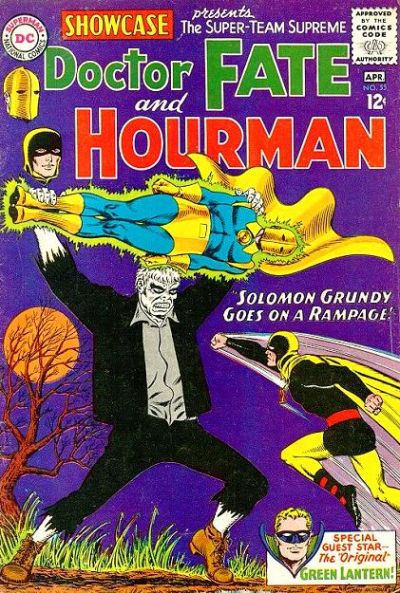
A team up of two JSAers happens in Showcase #55 (March-April, 1965) by Gardner Fox and Murphy Anderson (with cover by Anderson), as Dr. Fate and Hourman team-up to save the original Green Lantern from his foe, Solomon Grundy.

Solomon Grundy ends up back on Earth, after the globe Green Lantern (Alan Scott) created crashes to Earth thanks to striking a comet.  Grundy heads to home, Slaughter Swamp.  Dr. Fate has a mystic alarm go off, which puts him on Grundy's tale, as Hourman gets involved as his chemical plant is close to Slaughter Swamp.  Grundy fights the two, countering their magic and miraclo powers, escaping from them.  Grundy then faces Green Lantern, and beats him, taking the original emerald crusader back to Slaughter Swamp, changing him into a Grundy like monster.  Dr. Fate cures Green Lantern with his magic, and using their combined magical might, capture Grundy in a new sphere.

This issue recaps Solomon Grundy's origin and battle with the JSA from All-Star Comics #33 (as will as being his first appearance since the Golden Age), but how Grundy got back in that prison is recounted as part of the origin of the All-Star Squadron, and Grundy returns soon, in the fourth JLA/JSA meeting.  It is also the first appearance of Inza Nelson, Kent's wife (with their marriage being revealed first here; as she was just Inza Cramer when she worked with Dr. Fate in the Golden Age).

Perils Of The Psycho-Pirate

Next up is a story by Gardner Fox and Murphy Anderson (under a cover by Anderson) from Showcase #56 (May-June, 1965), with Dr. Fate and Hourman facing a new villain with a familiar name.

Archeologist Kent Nelson finds a set of Medusa Masks on a dig, and financier Rex Tyler finds his fiancee, Wendi Harris, fascinated by them (so much so she tries to steal them when displaying them at a party she held).  Roger Hayden manipulated her into doing that, as he planned on taking the masks to take over the identity of Psycho-Pirate.  Hayden was a cellmate of the original Psycho-Pirate (Charley Halstead), who taught him how to manipulate emotions and about the masks.  The new Psycho-Pirate sets Dr. Fate and Hourman against each other until they are able to defeat him.

This issue has the first Silver Age appearance of the original Psycho-Pirate, as well as the reporting of his death.  Dr. Fate appears here between the second and third JLA/JSA team-ups, and Hourman between the first and fifth.

Secret Origin Of The Guardians

Green Lantern #40 (October, 1965) is a big issue, revealing much of the origins of the DC Universe in this story by John Broome, Gil Kane and Sid Greene, all under a great cover by Gil Kane and Murphy Anderson.

This story stars with a reunion of Alan Scott and Doiby Dickles at Gotham Broadcasting, with Alan having to ring-sling as Green Lantern to stop a meteor, which his ring seems to have no effect on, then to save Doiby from a falling tree, which oddly works as Alan's ring usually doesn't against wood.  Alan goes to show Hal his new trick....which now doesn't work.  Alan explains, with the help of his ring, that the comet was really an ancient Oan scientist named Krona, that ended up being freed from his prison by exposure to Alan's magical based ring.

Krona was an Oan scientist, long ago, who performed experiments trying to find the origins of the universe.  He succeeded slightly, seeing a "cosmic hand" of creation (but his activities were also destructive, causing evil to be unleashed in the universe, and later, more trouble like the creation of the Multiverse, according to the Crisis on Infinite Earths).  So, the Oans banished him in comet form (and eventually became the Guardians of the Universe, who formed the Green Lantern Corps).

Krona planned on doing more experiments, and was possessing Alan Scott's body (with Alan hiding in Hal's mind).  The two battled, with Hal winning (as he had secretly switching rings with Alan, exchanging a weakness for yellow for one for wood), allowing Hal to defeat Krona, with the Guardians of the Universe returning Krona to comet form, the Green Lanterns swapping rings back, and Alan heading back to Earth-2.

This issue is the first appearance of the "Cosmic Hand", hinting at the foundation of the DC Universe (and Multiverse, all revealed during the Crisis on Infinite Earths), as well as Krona's first appearance, and the first appearance of Doiby Dickles, Alan Green Lantern's Golden Age partner.  Green Lantern Alan Scott appears here after his appearance in the third JLA/JSA team-up, and appears next in another team-up with Green Lantern Hal Jordan.

Mastermind Of Menaces

Another focus on a team-up of two JSA members, Brave and the Bold #61 (August-September, 1965) by Gardner Fox and Murphy Anderson (under a stunning Anderson cover), sees the gathering of Starman and Black Canary!

Ted Knight (Starman) is visiting Park City, and drops by the florist shop that is owned by Dinah Drake Lance, the Black Canary.  Larry Lance knows there is a rash of robberies in the town, traceable back to Dinah's flower shop.  Investigating, Starman finds that his old foe, the intangible Mist is behind it, having hypnosis, but Starman has problems working his Cosmic Rod near the Mist's men (due to frequencies given off by Mist's hypnotic flowers).  Working together, Starman and Black Canary are able to defeat the Mist and his men.

This issue sees the Mist return from the Golden Age, as well as Larry Lance (a detective who was friends with Black Canary, and is now revealed to be her husband).  Black Canary and Starman were both last in the second JLA/JSA team-up, and appear next in the next issue of B&B (which is reprinted in the second volume of this Crisis collection).

The Hour Hourman Died

The last story in this collection is from Spectre #7 (November-December, 1968) by Gardner Fox, Dick Dillin and Sid Greene, and is a back-up story featuring Hourman in a bit of a problem.

Returning to his HQ under Tyler Chemical Company from a JSA meeting, Hourman encounters Tricky Dick Arnold, a thief phasing through the door.  Taking a Miraclo pill for an hour of power, Hourman faces him, but the thief hits him with a beam from his Metalizer....which seems to kill Hourman!  Normally only working against metal (allowing Arnold to phase through items to thief), that unique radiation seem to spell doom for Hourman....except his Miraclo was keeping him alive for one last hour.  Tracking down the thief and analyzing the Metalizer, allowed Hourman to make an antidote before he faced his last hour.

Hourman appears here between the sixth and eighth JLA/JSA team ups.


All these stories are reprinted in the Crisis On Multiple Earths the Team-Ups Volume 1, with a cover by Jerry Ordway.

More JLA/JSA collections, including a second one of team-ups with team members will be forthcoming, as these meetings of members of teams from Earth-1 and Earth-2 foreshadow the Crisis On Infinite Earths.


Wednesday, August 7, 2019

JSA vs. Solomon Grundy Hot

Wally Wood worked on the Justice Society of America title of All-Star Comics for a time in the 1970s (including the Star-Spangled Kid and Power Girl), and got a chance to put the team to work in the heat of Egypt.....

....with a battle against Solomon Grundy from the 1977 Super DC Calendar for August!

Thursday, November 23, 2017

Happy Thanksgiving Batman

Happy Thanksgiving, Batman, as Solomon Grundy is waiting for you and he's brought his appetite.


Here's the cover of Batman: The Long Halloween #2 (January, 1997), of a 13 issue mini-series by Jeph Loeb and Tim Sale, with Batman searching for a new villain, the Holiday Killer.

Thursday, October 19, 2017

Gotham Guide: The Golden Age Of Solomon Grundy

Solomon Grundy....born on Monday, christened on Tuesday, married on Wednesday, took ill on Thursday, grew worse on Friday, died on Saturday and buried on Sunday.  That was the end of Solomon Grundy.  But, here, instead of talking of the old nursery rhyme, it will be a look at the creature that came out Slaughter Swamp on the outskirts of Gotham...who was named for the character in that rhyme in a classic Golden Age tale.

Fighters Never Quit

Solomon Grundy first emerged  in All-American Comics #61 (October, 1944) by Alfred Bester and Paul Reinman, coming out of Slaughter Swamp after criminal Cyrus Gold, the man who would become Grundy had been left there for dead 50 years before.

The animated corpse leaves the swamp and heads into Gotham (getting his name of Solomon Grundy from a couple of hobos), becomes their crime boss, and leads them on an attempted take over of Gotham, until Green Lantern (Alan Scott) takes him on (and has problems with Grundy, as Grundy is made of plant material, including wood, which the Golden Age GL is powerless against).  Still, Alan and his partner, Doiby Dickles defeat the creature.

This was the only solo Solomon Grundy tale reprinted, in Wanted, the World's Most Dangerous Villains #4 (December, 1972).

And, Then There Was One

Grundy returns in Comic Cavalcade #13 (Winter, 1945) by Alfred Bester and Paul Reinman for more battles with Green Lantern.


This time, Solomon Grundy is reanimated with the use of chlorophyll, by the Professor, who had killed Baron York (his own brother), in an attempt to take over Gotham's gangs.  Green Lantern (Alan Scott) is warned by his mystic Lantern, but too late, as he is overpowered by Grundy.  Solomon Grundy kills the Professor to advance his own plans and take over the gang, but has become too plant-like, allowing Green Lantern to defeat him by taking away his carbon dioxide, which Grundy needs to live, leaving Grundy petrified in a power ring bubble!


The Revenge Of Solomon Grundy

Grundy gets free from the bubble in All-Star Comics #33 (February-March, 1947) by Gardner Fox, and a host of artists, including Irwin Hasen, Joe Kubert, Stan Aschmeier, Martin Naydel, Jon Chester Koziak and Paul Reinman after a lightning bolt struck.

The JSA find their meeting room ransacked, and realize that it must have been Solomon Grundy, so they go searching for him (and the missing Green Lantern).  Each member meets Grundy (except Johnny Thunder), but it was the Golden Age Green Lantern who eventually defeats Grundy, this time, sending him to the moon!

This story was reprinted in Super-Team Family #4 (April-May, 1976) and in All-Star Comics Archives #7 of 2001.

The Case Of The Withered Flower

Solomon Grundy came back from the moon in Comic Cavalcade #24 (December-January, 1947/1948) by John Broome, Irwin Hasen and John Belfi to face Green Lantern (Alan Scott) and Doiby Dickles again.

This time, Grundy appeared to be much smarter than he was before, and could also disguise himself as Dick Cashmere (the long lost son of John Cashmere, a friend of Alan Scott's).  Grundy plans to kill John, but Green Lantern defeats him, this time imprisoning Grundy at the Earth's core.

Grundy was picked up where he was left here by Per Degaton, and put in the previous trap he had been, as revealed by Roy Thomas in the earliest issues of All-Star Squadron (to explain that this story had been forgotten about!).


Solomon Grundy's first appearance of the Silver Age was in Showcase #55 (March-April, 1965), facing off against Dr. Fate and Hourman (along with the Golden Age Green Lantern), and it took until his next appearance, in Justice League of America #46 (August, 1966) for Batman to first face Solomon Grundy (though it was more Batman foe, Blockbuster (who much later joined the Suicide Squad), doing that....for that and the second issue of the JLA/JSA team-up).

In Justice League of America #91 and #92 (1971), Solomon Grundy faced the same heroes from Earth-1 and Earth-2 (with the Golden Age Batman not around, though the Earth-1 Batman was a little, plus both Earths' Robins), and Solomon Grundy got the idea there may be an Earth-1 Solomon Grundy, an idea played out in the Superman titles, with Batman later facing an inferior outgrow of Solomon Grundy in Detective Comics #523 (February, 1983), where Batman ended the menace of the Earth-1 Solomon Grundy in fire.

Wonder if it was a Sunday?

The original Solomon Grundy continued on in Infinity, Inc., Starman, Green Arrow (and more), and as a member of the Injustice Society of the World, after getting some fame in the 1970s as a part of the Legion of Doom on the Super Friends cartoon show...

...as well as getting two live action portrayals, once in two episodes of the Legends Of The Super Heroes, played by Mickey Morton, and in the two episodes of Arrow that introduced Barry Allen, (but as Cyrus Gold) played by Graham Shields, before moving to Gotham (to be played by Drew Powell).