Showing posts with label Wizard. Show all posts

Wednesday, July 22, 2020

Request For Injustice Society Collections

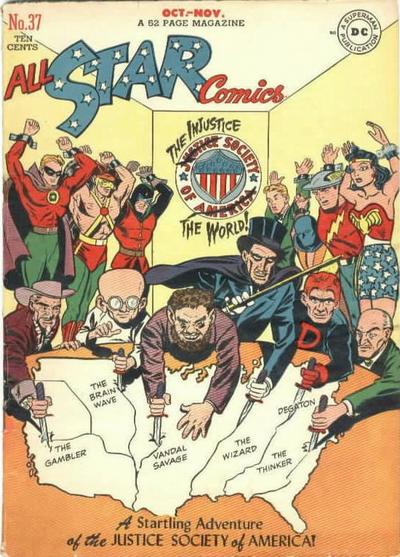
One of the most persistent foes of the Justice Society of America has been the Injustice Society of the World.  Premiered in All-Star Comics #37 (October-November, 1947) by writer Robert Kanigher and artists Irwin Hasen, Joe Kubert, Carmine Infantino, John Belfi and Alex Toth, this group of villains has unleashed havoc across the world, as well as having grown in size (here by George Perez)....

...and while the group's Golden Age appearances have been reprinted a few times, many individual members are far from having their appearances visible since their first printings.

That needs change....and, here's a way to do that in three tradepaperback volumes!


ISW Volume 1

The first volume should include:

Wizard (William Asmodeus Zard)
All-Star Comics #34 (April-May 1947):  "The Wiles Of The Wizard"

Brainwave (Henry King Sr)
All-Star Comics #15 (February-March 1943):
"The Man Who Created Images"

Gambler (Steven Sharpe)
Green Lantern #12 (Summer 1944):  "The Gambler"
Green Lantern #20 (June-July 1946):
"The Gambler Comes Back"
Green Lantern #27 (August-September 1947):
"The Gambler Bets His Life"

Per Degaton
All-Star Comics #35 (June-July 1947):  "The Day That Dropped Out Of Time"


Thinker (Clifford DeVoe)
All-Flash #12 (Fall 1943): 
"Tumble Inn To Trouble"
All-Flash #14 (Spring 1944): 
"The Man Who Unleashed The Past"


Vandal Savage
Green Lantern #10 (Winter 1943):
"The Man Who Wanted The World"

...and the team appearance from All-Star Comics #37, "The Injustice Society of The World", for a wonderful collection of 319 pages (with appropriate covers, with sadly, the Thinker not appearing on any, and the Gambler only making one of his cover), with many All-Star Comics issues, and a few Golden Age Flash and Green Lantern tales.


Still, this does collect all of Per Degaton and Vandal Savage's Golden Age appeaerances, and at least the first two appearances of every charter ISW member except for Brain Wave.


Leaves some Brain Wave, Thinker and Gambler stories uncollected, but....read on!


ISW Volume 2


The second volume should include:

Icicle (Joar Makent)
All-American Comics #90 (October 1947):
"The Icicle"
All-American Comics #92 (December 1947):
"The Icicle Goes South"

Fiddler (Isaac Bowin)
All-Flash #32 (December 1947-January 1948):  "Duet Of Danger"
Flash Comics #93 (March 1948):
"Violin Of Villainy"
Comic Cavalcade #28 (August-September 1948):
"The Flash Concerto"


Sportsmaster (Crusher Crock)
All-American Comics #85 (May 1947):
"The Rise And Fall Of Crusher Crock"
Green Lantern #28 (October-November 1947):
"The Tricks Of The Sportsmaster"
All-American Comics #98 (June 1948):
"The End Of Sports"


Huntress (Paula Brooks)
Sensation Comics #68 (August 1947):
"Wildcat -- Former Crime Fighter"
Sensation Comics #69 (September 1947):
"Follow The Leader"
Sensation Comics #71 (November 1947):
"The Count That Never Ended"
Sensation Comics #73 (January 1948):
"Murder Masquerade"
Sensation Comics #75 (March 1948):
"The Snare That Backfired"
Sensation Comics #76 (April 1948):
"The Wildcat Ride"
DC 100-Page Super-Spectacular #6 (1971):
"Crime Wore A Costume"

Harlequin (Molly Mayne)
All-American Comics #89 (September 1947):
"The Harlequin"
All-American Comics #91 (November 1947):
"The Wedding Of The Harlequin"
Green Lantern #29 (December 1947 - January 1948):
"The Challenge Of The Harlequin" and "The Harlequin Haunts Green Lantern"


All-American Comics  #93 (January 1948): 
"The Double-Crossing Decoy"
All-American Comics #94 (February 1948):
"Partners In Peril"
All-American Comics #95 (March 1948):
"The Unmasking Of The Harlequin"
Green Lantern #31 (March-April 1948):
"The Terror Of The Talismans"
Green Lantern #32 (May-June 1948): 
"The Case Of The Conscience Fund"


....and, with the Wizard's gathering of these villains from All-Star Comics #41 (June-July, 1948), this gives all the Golden Age appearances of these villains from the various Flash comics, Green Lantern comics and even Wildcat appearances (though he never made the covers of Sensation Comics).


Except for some of Harlequin's appearances, all of these characters Golden Age tales are here (about half of all of these stories hadn't been reprinted), with this being the largest volume, at 330 pages.


ISW Volume 3

The third volume should include Golden Age tales of the Bronze Age additions:

Shade (Richard Swift)
Flash Comics #33 (September 1942):
"The Man Who Commanded The Night"

Solomon Grundy (Cyrus Gold)
All-American Comics #61 (October 1944):
"Fighters Never Quit"
Comic Cavalcade #13 (Winter 1945):
"And Then There Was One"
All-Star Comics #33 (February-March 1947):
"The Revenge Of Solomon Grundy"
Comic Cavalcade #24 (December 1947-January 1948): "The Case Of The Withered Flower"


Missing stores of other ISW members from the Golden Age:
Brain Wave (Henry King Sr)
All-Star Comics #17 (June-July 1943):
"Brain Wave Goes Berserk"
All-Star Comics #30 (August-September 1946)"
"The Dreams Of Madness

Gambler (Steven Sharpe)
Green Lantern #30 (February-March 1948):
"The Fatal Chance"
Green Lantern #35 (November-December 1948):
"Perfect Crimes For Sale"
Thinker (Clifford DeVoe)
Flash Comics #65 (June-July 1945):
"Adventure Of The Thinking Cap"
All-Flash #27 (February-March 1947):
"The Thinker Cooks With Gas"
Comic Cavalcade #22 (August-September 1947):
"Beware The Ice Age"
Comic Cavalcade #23 (October-November 1947):
"The Sleeping City"
All-Flash #32 (December 1947-January 1948):
"Crime, Incorporated"
Flash #214 (April 1972):
"The Tale Of Three Tokens"

Harlequin (Molly Mayne)
Green Lantern Vol. 1 #33/3 (July-August 1948): "The Harlequin's Leap Year"
Green Lantern Vol. 1 #34 (September-October 1948): "Harlequin's Secret Revealed"

Other villains, who joined even later or were related to the ISW:

Rag Doll (Peter Merkel)
Flash Comics #36 (December 1942):
"Tale Of The Treasure Hunt"


The Mist (Kyle)
Adventure Comics #67 (October 1941):
"The Menace Of The Invisible Raiders"


The Shade joined during a JLA/JSA adventure, Solomon Grundy during the 1970s run with Star-Spangled Kid and Power Girl, Rag Doll VERY much later, in JSA All-Stars, and the Mist, because his second appearance was in the Wanted collection, and this gives more than Flash and Green Lantern (and JSA stories) with a Starman story, giving 328 pages (and hope that a collection with Hawkman's Gentleman Ghost and Monocle and a few others can materialize somewhere).


A fanciful wish from someone who knows the Flash, Green Lantern, Wildcat, Hawkman and Starman stories reprinted from the Golden Age, and would like to see more, with Wizard, Brain Wave, Per Degaton, Vandal Savage, Gambler, Thinker, Icicle, Sportsmaster, Huntress, Fiddler, Harlequinn and the rest serving as a nice conduit to a forgotten era!


Thursday, September 1, 2016

JSA Foes Crime Champions 2

The villains known as the Crime Champions had beginnings on two Earths, and finished their first team up in Justice League of America #22 (September, 1963) with the "Crisis On Earth-Two" by Gardner Fox, Mike Sekowsky and Bernard Sachs.

The foes of the Justice Society of America....Fiddler, Icicle and the Wizard, the villains from Earth-2 (where the Justice Society of America lived) where the ones who initiated the team-up, crossing over from their Earth (Earth-2) to Earth-1 (and they captured the two Flashes, who had a few team-ups before....).

Fiddler

The Fiddler first appeared in All-Flash #32 (December-January, 1947/1948 by Robert Kanigher, Lee Elias and Moe Worthman), the last of the All-Flash comics of the Golden Age, using his magical musical talents against Jay Garrick, the Golden Age Flash, in "Duet Of Danger".  The Fiddler, also known as Isaac Bowen, would return for a couple of solo battles against the Flash in the Golden Age, as well as being a part of the Wizard's second Injustice Society of the World, before being one of three villains (the Thinker and the Shade) to face both Flashes (Jay and Barry Allen) in the Flash #123 (September, 1961), just before joining the Crime Champions.  After the first battle with the JLA and JSA, Fiddler returned first for a solo battle with Jay Garrick in Flash #201 (November, 1970), then was a part of the Injustice Society of the World (and its update, Injustice, Unlimited, to face Infinity, Inc.) for most of his returns after (though he did stop by to face the Teen Titans once), at least until meeting his final fate with the Secret Six.

Icicle

Joar Mahkent first appeared facing the Golden Age Green Lantern in All-American Comics #90 (October, 1947 by Robert Kanigher, Irwin Hasen and John Belfi) as "The Icicle".  The Icicle returned twice in the Golden Age (the second time in the Injustice Society of the World in All-Star Comics #41 of June-July, 1948, working with the Fiddler, the Wizard and the Sportsmaster and the Huntress as well), before throwing his cold gun in to help out the Crime Champions.  The Icicle was a loyal member of the ISW, making all his appearances after the meeting with the Crime Champions as a member of the ISW (starting with Justice League of America #123 of October, 1975, except when he worked with the Crime Champions again, or faced his end during the Crisis On Infinite Earths).  But, the Icicle legacy lived on with his son taking over the name (and he had ice powers of his own!).

Wizard

The Wizard premiered battling the entire Justice Society of America in All-Star Comics #34 (April-May, 1947 by Gardner Fox and the hosts of artists including Irwin Hasen, Joe Kubert, Frank Harry, Lee Elias, Harry Lampert and Paul Reinman), having the JSA face "The Wiles Of The Wizard", posing as W. I. Zard, to trick the JSA, offering them money to capture villains.  The Wizard returned twice during the Golden Age, working with the Injustice Society of the World in All-Star Comics #37 (and Vandal Savage and Per Degaton, among others), and #41, before joining the Crime Champions (though later historical inserts add the Wizard as the man who helped the Golden Age Superman marry Lois Lane, and who cursed the young Dinah Laurel Lance, giving her what became the "Canary Cry" when she became the second Black Canary).  After using his magical powers to work with the Crime Champions, Wizard also returned as a member of the Injustice Society of the World to face the JLA and JSA in Justice League of America #123 of October, 1975), but the Wizard had bigger aspirations, also working with the Secret Society of Super-Villains and later, Injustice, Unlimited, to continue to menace all generations of heroes.

The Crime Champions never quite took hold (likely having too many bosses, as Chronos also led groups of villains over time), and only returned one more time, in Justice League of America #219 and #220 (October and November, 1983) where they worked with the evil Earth-1 version of Johnny Thunder (and learned of the history of the two Black Canaries), though it was with the second version of Dr. Alchemy.  Still, the Crime Champions were a building block of villainy, allowing for larger groups of villains to form in the future.

Thursday, August 6, 2015

Strange Tales of the Frightful Four

The Frightful Four were a collection of villains that first faced the Fantastic Four on Reed and Sue's engagement in Fantastic Four #36 (March, 1965, by Stan Lee and Jack Kirby).  

But, most of these villains had appeared before in Strange Tales, which featured the Human Torch in solo tales (and later, partnered with the Thing)!

Wizard


The first of these foes to appear (in Strange Tales #102, November, 1962 in "The Prisoner of the Wizard" by writers Stan Lee and Larry Lieber and artist Jack Kirby) was the super-genius Wizard, who gained fame as a chess champion and escape artist (abandoning his real name of Bentley Wittman to make "the Wizard" his legal name.  Worried that the Fantastic Four would steal his fame, the Wizard tries to ruin the Torch's name by impersonating Johnny and committing crimes in his name...and Johnny is saved with a little help from his sister Sue (the Invisible Girl).

The Wizard returns in Strange Tales #105 (February, 1963 in "The Return of the Wizard" by Stan Lee, Larry Lieber and Jack Kirby), again with Strange Tales #110 (July, 1963 in "The Human Torch vs. the Wizard and Paste-Pot Pete!" by Stan Lee, H. E. Huntley and Dick Ayers), a quick cameo in Strange Tales #112 (September, 1963 in "The Threat of the Living Bomb" by Stan Lee, Jerry Siegel (as Joe Carter) and Dick Ayers) though the villain of the issue was the Eel, and in Strange Tales #118 (March, 1964, in "The Man Who Became the Torch" by Stan Lee and Dick Ayers), with the Wizard using anti-gravity discs against the Human Torch...a device he didn't quite control, and thus floated away from the Human Torch (not quite under his own control...)

Trapster


Trapster was originally called Paste-Pot Pete, and was a villain who first menaced the Human Torch in Strange Tales #104 (January, 1963 in "The Human Torch Meets Paste-Pot Pete" by Stan Lee, Larry Lieber and Jack Kirby).  Peter Petruski tried to use his paste-gun to rob banks, and ran afoul of the Human Torch...and Paste-Pot Pete then tried to move up in the criminal world, taking a U.S. Army missile to sell to the Soviets, but that backfired, with Paste-Pot Pete sticking himself to an airplane wing and escaping to sea.

Paste-Pot Pete returned in Strange Tales #110 (July, 1963 in "The Human Torch vs. the Wizard and Paste-Pot Pete!" by Stan Lee, H. E. Huntley and Dick Ayers), wherein the two villains paired up to face off against the Human Torch, but Pete didn't like being bossed by the Wizard, and the two were captured and sent to jail.  Pete then quickly helped the Avengers in Avengers #6 (July, 1964), providing the Avengers with a solvent to dissolve Baron Zemo's Adhesive-X during a battle with the Masters of Evil, which must have been enough to get Pete out of prison.  Pete didn't learn his lesson, returning with new weapons to face the Human Torch and the Thing in Strange Tales #124 (September, 1964 in "Paste-Pot Pete" by Stan Lee and Dick Ayers), where Pete causes trouble for the Thing and the Human Torch....

Sandman


Sandman started off as a Spider-Man foe in Amazing Spider-Man #4 (September, 1963 in "Nothing Can Stop the Sandman" by Stan Lee and Steve Ditko), with Flint Marko breaking out of prison, and being exposed to radiation which turned him into the man of living sand, the Sandman (though being defeated by Spider-Man...and a vacuum cleaner!).

Sandman soon broke free, and faced the Human Torch in Strange Tales #115 (December, 1963, in "The Sandman Strikes" by Stan Lee and Dick Ayers), where the Human Torch defeats the Sandman with a sprinkler system while Spider-Man waits!


Sandman then teams up with five other Spider-Man foes like Kraven, the Vulture and Electro to form the Sinister Six in Amazing Spider-Man Annual #1 (October, 1964 in "The Sinister Six" by Stan Lee and Steve Ditko, proving that the Sandman was willing to be a team player...).


Sandman returned again in Amazing Spider-Man #18 and #19 (November and December, 1964 in "The End of Spider-Man" and "Spidey Strikes Back" both by Stan Lee and Steve Ditko), wherein Spider-Man eventually defeats Sandman (with the Human Torch watching in the last issue).     

Medusa


Medusa first appeared in Fantastic Four #36, never making an appearance in Strange Tales, but had a bit of history before that...mostly with her somewhat strange family, the Inhumans!

Medusa was there when Maximus made Black Bolt unleash the power of his voice (which was quite destructive) in Thor #149 (February, 1968 in the flashback tale "Silence Or Death" by Stan Lee and Jack Kirby), when the Inhumans moved their city in What If? #30 (December, 1981 in "Moving Day" by Peter Gillis and Ron Wilson), and then in the Inhumans Special #1 (April, 1990 in "Remembrances of Revolutions Past" by Lou Mougin and Richard Howell) wherein Maximus caused Medusa's amnesia, and she ended up in Europe as a thief, and met the Frightful Four.

The Frightful Four continued on to menace the Fantastic Four in Fantastic Four #38 (May, 1965, with Paste-Pot Pete changing his name to the Trapster), a brief detour in Journey Into Mystery #116 (May, 1965), and a final battle royal where the Frightful Four turn the Thing against his own teammates in Fantastic Four #41-43 (August to October, 1965), and the Trapster and Sandman being abandoned by Medusa in favor of the Inhumans in Fantastic Four #45 (December, 1965).

Medusa confronted the Frightful Four one last time in Marvel Super-Heroes #15 (July, 1968) and Fantastic Four #94 (January, 1970) (though both the Wizard and the Sandman made individual runs at the Fantastic Four before this point. both with new and improved uniforms)...

...at which point, the Frightful Four realized that they'd need a new fourth member...

After a brief battle with Spider-Man and the Human Torch in Marvel Team-Up #2 (May, 1972), they then reunited and tried to add super-strong Thundra in Fantastic Four #129 (December, 1972)...

...then began a long search for a fourth member, which included characters like the Brute, Electro and the Klaw among others, and the tales of the Frightful Four get stranger!


Wednesday, June 24, 2015

JSA Opposite: Injustice Society of the World Part 2

Just had too much villainy for one article, so, continuing with the charter members of the Injustice Society of the World...the most vile villains of the Justice Society of America that premiered in All-Star Comics #37 (October-November, 1947 by Robert Kanigher and Irwin Hasen).  Already covered are Vandal Savage, the Gambler and the Thinker...here are the rest!


Brain Wave


Henry King was just a kid when he discovered he could create images with just his mind...and kept working at developing his brain over the years, becoming a psychologist, setting up a practice in New York and deciding to influence others to commit crimes for him as Brain Wave.

Influencing the villain Professor Elba and setting up the illusions of war for All-Star Comics #8 and #11, Brain Wave first attacked the JSA as "The Man Who Created Images" in All-Star Comics #15 (February-March 1943, by Gardner Fox and a team of artists including Joe Gallagher, Sheldon Moldoff, Stan Aschmeier, Jack Kirby, Ed Dobrotka, Bernard Baily and Howard Sherman), wherein they are saved by their girlfriends and Wonder Woman!  Brain Wave returns in All-Star Comics #17 (June-July, 1943), with "Brain Wave Goes Berserk", using a device to shrink the JSA, and as they almost captured him, getting away in an explosion.  Henry King returned one last time alone in the Golden Age, with All-Star Comics #30 (August-September, 1948) by getting them to have their minds tested, and subjecting the team to "The Dreams of Madness"!

After working with the ISW, Brain Wave didn't return until Power Girl joined the JSA, with All-Star Comics #58 and #59 (in 1976, and showed off a new illusionary form), and was part of the group attack on the JSA in All-Star Comics #66 (May-June, 1977), and a plot against Flash and Green Lantern foiled by Power Girl in Showcase #97 to #99 (February to April, 1978).  Brain Wave joined up with Ultra-Humanite's Secret Society of Super-Villains for Justice League of America #195 to #197 (October to December, 1981), trying to wipe Earth-2's heroes out of existence (and failing), but Brain Wave, along with the Mist, Rag Doll, the Monocle and Psycho Pirate went back in time to the 1940s to work with an earlier Ultra-Humanite (and his crew which included Deathbolt and Cyclotron), which helped form Infinity Inc. (all in All-Star Squadron #26 and Annual #2 of 1983, as some of Brain Wave's earlier 1940s actions came to light in All-Star Squadron #17, #19 and #20 published in 1983).

Brain Wave met his end facing off against the Ultra-Humanite in Infinity Inc. #9 and #10 (December 1984 and January, 1985), but not before passing on more of his power to his son, Brainwave Jr., who was also instrumental in forming Infinity, Inc. and wanted to be a hero (though likely his increased power made Henry King Jr. a little crazy, as he formed a Legion of Doom to fight Captain Atom and his Justice League in Extreme Justice #14 to #18)!

Per Degaton


Per Degaton was just a lowly lab assistant, working with the Time Trust, cleaning test tubes, and had been doing menial tasks for years...until 1947, when Professor Malachi Zee invented a time machine and Degaton tried to use it to take over the world, until he was stopped by the JSA (all in All-Star Comics #35 (June-July, 1947, by John Broome and the art team of Irwin Hasen, Lee Elias, Paul Reinman, Joe Kubert and Frank Harry).  The trick here was that the JSA reversed time, so Degaton was back to washing test tubes in "The Day That Dropped Out Of Time!".  Inexplicably, Degaton was back to menace the JSA as a member of the ISW soon after, but there was more to his story....

Per Degaton had been working for the Time Trust since the days of All-Star Comics #10 (April-May, 1942), getting nowhere....but still having occasional flashes of ideas in 1947, where he tried time travel again, gathering then current (1947) JSA foes like Sky Pirate, Solomon Grundy, the Monster, Professor Zodiac and Wotan, to stop the Justice Society on December 7th, 1941 (which is what prevented these heroes from stopping the tragedy at Pearl Harbor).  Instead, Degaton unknowningly inspired President Franklin D. Roosevelt to have all United States heroes band together as the All-Star Squadron (all revealed in Justice League of America #193 of August, 1981 and All-Star Squadron #1 to #4 of September to December, 1981)..but again, at the end of this adventure, Degaton didn't remember the full details and went back to washing test tubes...

...and another adventure, involving the current Justice Society of America, the Justice League, and the 1940s All-Star Squadron as well as the Crime Syndicate of America...all in All-Star Squadron #14 and Justice League of America #207 of October, 1982, All-Star Squadron #15 and Justice League of America #208 of November, 1982 and Justice League of America #209 of December, 1982 (with the Crisis in these issues being undone, and Degaton back to the test tubes again!).

Eventually, Degaton grew tired of the test tubes, murdered Prof. Zee...but Zee ended up in taking the time machine with him!  Somehow, Degaton convinced the ISW to let him in, and then Degaton ended up destitute, being found by Brain Wave in All-Star Comics #59 (March-April, 1976), and mostly waiting in jail for his final attempt against the JSA in America vs. the Justice Society #1 to #4 in January to April, 1985...wherein the original Batman's diary was found, accusing the JSA of being Nazi collaborators!  This was not true, and the story ended with Per Degaton's death (but, this was around the time of the Crisis on Infinite Earths, and Degaton showed up their as well...and as history was being rewritten, Degaton's was as well....with Degaton being alive and well as of Infinity, Inc. Annual #2 of 1988, led up to from Young All-Stars #12 to #14 and Young All-Stars Annual #1 of 1988 and even another 1940s pre-time travel appearance in Young All-Stars #28 of August, 1989). 

JSA #59 revealed Per Degaton's "out of time" status, and his continued desire for revenge against the JSA....which he tried in JSA #65 to #72 (November, 2004 to June, 2005), with the early 1950s JSA teaming with the 2005 JSA!  Degaton has also been seen with the likes of the Ultra-Humanite, Black Beetle and Despero (who have odd timelines), with the "Time Stealers" who have appeared in Justice League of America #9 (July, 2007) and Booster Gold #5 and #7 to #10 of 2008.


The Wizard


The Wizard premiered in All-Star Comics #34 (April-May, 1947 by writer Gardner Fox and the art team of Irwin Hasen, Joe Kubert, Frank Harry, Lee Elias, Harry Lampert and Paul Reinman) in "The Wiles Of The Wizard", posing as Mr. W. I. Zard and offering the JSA money to capture villains (which they wouldn't accept as it would be too tempting to the new villain, the Wizard!), and the Wizard has cast quite a spell of villainy for decades on, returning as a founder of the Injustice Society of the World in All-Star Comics #37 (October-November, 1947) and being their only return member in All-Star Comics #41 (June-July, 1948)!

The Wizard even menaced the JSA members individually, casting a spell on Superman to remove his powers (which ended up allowing Clark Kent to marry Lois Lane), and kidnapping Larry Lance and Black Canary's daughter (who ended up becoming the second Black Canary).

The Wizard was also a founder of the Crime Champions to be involved in the first JLA/JSA Crisis of Justice League of America #21 and #22 (August and September of 1963), with the Fiddler and Icicle (and later additions to the ISW) of Earth-2, and Chronos, Dr. Alchemy and Felix Faust as JLA/Earth-1 villains.  Wizard returned to the ISW with Justice League of America #123 and #124 (October and November, 1975), and likely soon around that time, the Injustice Society of the World likely realized that they needed new villainous blood to help them defeat the JSA.

While the Injustice Society menaced the JSA in All-Star Comics #63 to #66 (1970s), the Wizard was on Earth-1, working with and then leading the Secret Society of Super-Villains (Secret Society of Super-Villains #1 through #15, except #2, from May-June, 1976 to June-July, 1978), with the Wizard getting extra power (as his magical might was waning on Earth-1) from the Sorcerer's Treasures (originally found in World's Finest Comics #103 of August, 1959), and along the way, Wizard worked with villains like Captain Cold, Gorilla Grodd, a new Star Sapphire, Matter Master, Felix Faust, Lex Luthor, Blockbuster, Reverse-Flash and the Floronic Man, and even running afoul of villains like Darkseid and the Crime Syndicate of America while fighting Captain Comet.

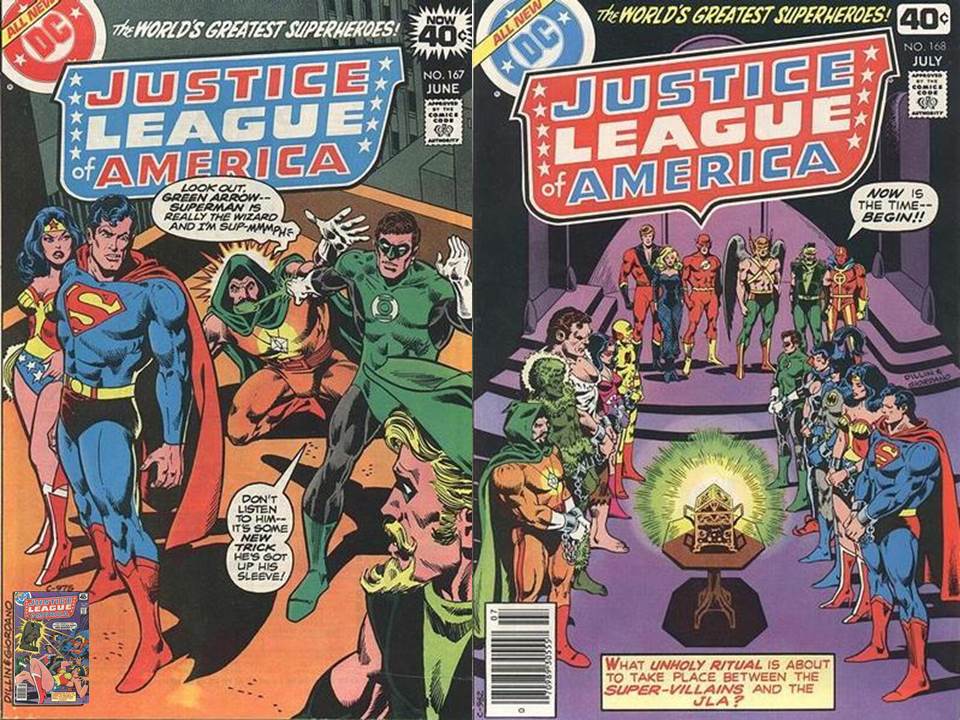
Sadly, it wasn't the heroes that brought this plot to an end, but the DC Implosion of 1978...though it was later revealed that the Secret Society had been thwarted by the JSA, and the Secret Society ended up in limbo (getting out involved body switching with the JLA...and was detailed in Justice League of America #166 to #168 of May to July, 1979, though the unfinished sixteenth and seventeen issues of Secret Society of Super-Villains were published in Cancelled Comic Cavalcade #2 in Fall of 1978, reprinted in the second Secret Society of Super-Villains hardcover of 2012.

The Wizard dumped the Invisibility Cloak, Energy Prism and Power Gloves when he returned with the Crime Champions to work with the Earth-1 Johnny Thunder in Justice League of America #219 and #220 in October and November, 1983...

...then continued to work without them, testifying against the JSA in the third issue of America Vs. The Justice Society (March, 1985)..

...and he could have used them, as William Asmodeus Zard was easily defeated by Dr. Fate!  Wizard was also one of the sorcerer's recruited to help save the Earth in Crisis on Infinite Earths #12 (March, 1986), but working with heroes was sort lived.

Wizard helped form Injustice, Unlimited (a next generation of the Injustice Society of the World), to face off against Infinity, Inc. (the inheritors of the JSA), starting with Infinity, Inc. #34 to #37 (January to April, 1987) as well as with the Lorelei in Infinity, Inc. #49 and #50 (April and May, 1988).

The Wizard then laid low for a time, as his magical power would flucuate...

...popping up in Books of Magic #2 (1990) and Day of Judgment Secret Files #1 (November, 1999), but not having much success, returning again with the Secret Society of Super-Villains in JLA #115 to #119 (August to November, 2005) dealing with fallout from Identity Crisis of 2004 and leading to the break up of the JLA right before the Infinite Crisis of 2006.

Wizard continues to reform villain teams, forming the Injustice Society of the World again in JSA: Classified #5 to #7 of January to March, 2006, working against the JSA in JSA: Classified #14 to #16 (September and October, 2006) and against another generation of JSAers in JSA: All-Stars #2 to #5 (March to June, 2010).

All of which shows there are more members of the Injustice Society of the World to be covered...and check back as we'll get around to them at some point!