Thursday, July 2, 2015

Seven Soldiers of Victory In Leading Comics

If you've followed this blog, you might remember a little about the Seven Soldiers of Victory's members, the Green Arrow, Speedy, Vigilante, The Shining Knight, the Star Spangled Kid, Stripsey, the Crimson Avenger and Wing (and yes, that was 8 members, but hey...what's one extra between friends?).

See, when they started in Leading Comics #1 (Winter, 1941-1942, overall story by Mort Weisinger and Mort Meskin, with chapters by Jerry Siegel, John Lehti, George Papp, Hal Sherman and Craig Flessel), there WERE eight members...the Law's Legionnaires included their sidekicks!

Leading Comics #1 

This bunch of heroes gathered in Leading Comics #1's "Blueprint For Crime" to fight the Hand, a criminal who thought he was dying, and gathered the greatest villains of the time (or at least those he had access to)...


…Green Arrow’s foe, Professor Merlin from More Fun Comics #75…Star-Spangled Kid’s adversary, the Needle, who first appeared in Star-Spangled Comics #4…Red Dragon, who fought the Shining Knight in Adventure Comics #69…and a few new villains, Big Caesar to fight Crimson Avenger and the Dummy to face the Vigilante; these were to be his “fingers of crime”…

...and the team continued to fight on!

Leading Comics #2 to #4


For 14 issues of Leading Comics (up until Spring, 1945), the 7 Soldiers fought many menaces, including criminal master mind Black Star in Leading Comics #2 (Spring, 1945, by writers Mort Weisinger and Bill Finger, and artists Mort Meskin, Craig Flessel, Harold Sherman, George Papp and John Lehti) who led small-time crooks False Face, Captain Bigg, Hopper, the Brain and the Rattler against the team; time traveling Dr. Wilfred Doome in Leading Comics #3 (Summer, 1942 by unknown writers, but art by Mort Meskin, Craig Flessel, Harold Sherman, George Papp and John Lehti and the story being adapted in All-Star Squadron #29); the Sixth Sense (aka Dr. Brett) in Leading Comics #4 (Fall, 1942, by Bill Finger and Ed Dobrotka and the story being adapted in All-Star Squadron #56).

Leading Comics #5 to #8


Master manipulator the Skull in Leading Comics #5 (Winter, 1942, with art by Ed Dobrotka and no identified writer); the treasure hunting Copperhead (Scrivener) in Leading Comics #6 (Spring, 1943, by writer Joe Samachson and artist Maurice Del Bourgo) and a new wrinkle of the heroes working in teams in individual chapters; the Wizards of Stanovia fighting to keep a country free in Leading Comics #7 (Summer, 1943 by Joe Samachson and Pierre Rice); the Dummy returns (after facing Vigilante alone in Action Comics) to send the team through time in Leading Comics #8 (Fall, 1943, by Joe Samachson and artists Jon Small and Maurice Del Bourgo).


Leading Comics #9 to #14

Mr. X bets with other villains like Red Heister, Dopo the Dip, Blackie Kraul and Lazy Dyers that he can defeat the Law's Legionaries in Leading Comics #9 (Winter, 1943, by Joe Samachson and Arthur Cazeneuve); getting shipwrecked on an island and switching partners to face Baby-Face Johnson in Leading Comics #10 (Spring, 1944 by Joe Samachson and Arthur Cazeneuve); deal with where the winds take the hat of Handsome Harry in Leading Comics #11 (Summer, 1944 by Joe Samachson and Arthur Cazeneuve); working to get money for a charity from millionaire Weldon Darrel in Leading Comics #12 (Fall, 1944 by Joe Samachson and Arthur Cazeneuve); facing crime trophy collector Barracuda who was filling his Museum of Crime in Leading Comics #13 (Winter 1944 by Joe Samachson and Arthur Cazeneuve)...


...and taking on fictional characters (like Long John Silver) freed from their books in Leading Comics #14 (Spring, 1945, by Joe Samachson and Arthur Cazeneuve, the last of the Golden Age adventures of the Seven Soldiers); getting aid from Vigilante’s partners, Billy Gunn (first in Action Comics #43, December, 1941) and Stuff the Chinatown Kid (Jimmy Leong, premiering in Action Comics #45, February, 1942) and the Shining Knight’s flying horse, Winged Victory!


No Longer Leading!


Then, the team disappeared….at least, for the world to see. Crimson Avenger and Wing had lost their spot in Detective Comics, but the other members still had individual adventures (and, one last Seven Soldiers story saw print in the mid-1970s in Adventure Comics, from Adventure Comics #438-443), using a script from Joe Samachson, who wrote most of the team’s last Leading Comics stories, with art by Dick Dillin on the whole team, Howard Chaykin on Shining Knight, Lee Elias drawing Green Arrow & Speedy, Mike Grell working on Crimson Avenger & Wing, Ernie Chan doing Star-Spangled Kid & Stripsey, and Jose Luis-Garcia Lopez rendering the Vigilante, all during their magical battles with Willie Wisher…and, oddly enough, this is the only Seven Soldiers story pre-1980s that has NOT be reprinted, as DC has gathered the 14 issues of Leading Comics in three Seven Soldiers of Victory Archives.


In the real world, the team resurfaced in Justice League of America #76 (November-December 1969), but only as a drawing by Murphy Anderson, and a text page, detailing the members. Still, the characters made a return in Justice League of America #100-102 (1972, by Len Wein and Dick Dillin), where the Hand (now, the Iron Hand) had made a deal to restore the Nebula Man, who the Seven Soldiers stopped in an untold tale of the 1950s…with a loss of one of their own, and the rest being scattered in time, to be rescued by the members of the Justice League of America and Justice Society of America (this story collected in DC Special Blue Ribbon Digest #11 in 1981 and in Crisis on Multiple Earths #3 in 2004.


It was the Crisis on Infinite Earths that messed up the Law’s Legionnaires taking out Green Arrow and Speedy’s World War II tales (which we saw a little more of in All-Star Squadron) and, eventually having them replaced by the Squire, an English youth that befriended the Shining Knight in Roy Thomas‘ Young All-Stars (who would be a Knight of his own, who first appeared as the Knight in Batman #62, December, 1950)..

...the aforementioned Billy Gunn and Stuff, as well as archer Alias the Spider (Thomas Ludlow Hallaway, first in Crack Comics #1 in May 1940) in Stars & S.T.R.I.P.E. #9 (April, 2000) by Geoff Johns and Scott Kollins, and explosive heroes TNT (Thomas N. “Tex” Thomas”) and Dan the Dyna-Mite (Dan Dunbar, both first in World’s Finest Comics #5, Spring, 1942) by Len Wein & J.H. Williams in DCU: Legacies #2 (August 2010)

This was not the end of the Seven Soldiers of Victory...


...but it is the end of our coverage for now!


Wednesday, July 1, 2015

Harvey Comics' Spirit

You may know of Denny Colt, the man who was the Spirit...creation of Will Eisner that first appeared June 2nd, 1940 in a syndicated Sunday supplement by the Register and Tribune Syndicate that continued until October 5th, 1952, wherein Denny Colt faced menaces such as the crimelord the Octopus, P'Gell the femme fatale, childhood crush Sand Saref, mad scientist Dr. Cobra, adventurer Silk Satin all for Commissioner Dolan, often with help from the chief's daughter (and Spirit's girlfriend), Ellen Dolan and sidekick Ebony White all in a stylish blue suit,  white shirt, red tie and domino mask armed pretty much only with his wit and determination.

These stories also ended up being published in Police Comics #11 (September, 1942) by Quality Comics through Police Comics #102 (October, 1950) along with Plastic Man, Modern Comics #102 (October, 1950) with Blackhawk and 22 issues of the Spirit by Quality Comics from 1944 until August of 1950.

This could have been the end of the Spirit, but Will Eisner was a smart businessman as well, and owned the rights to his character....and ended up having 2 comics of the Spirit in the 1960s at Harvey Comics (known more for characters like Richie Rich, Little Lotta, Little Dot and Casper the Friendly Ghost).

Harvey Comics Spirit #1


Harvey Comics' Spirit #1 came out in October, 1966, with 8 stories including a new origin for the Spirit written and pencilled by Will Eisner (with an inking assist by Chuck Kramer) to lead off the book (it was the third version of his origin, but still just Denny Colt going off to fight crime and thinking he died, becoming the Spirit....)...


...with 7 other stories from 1948 and 1949 newspapers, and an "interview with the Spirit" by Marilyn Mercer, as well as a 2 page featurette by Will Eisner called the "Spirit Lab Invincible Devices".

Not bad for 25 cents (a large amount to spent on a comic in those days....it was a "Giant Size Harvey Thriller" after all!).

Harvey Comics Spirit #2


Harvey Comics Spirit #2 came out in March, 1967, and was also a larger issue, with a new story by Will Eisner and to lead it off...this time featuring the Octopus, who was given an alter ego, Zitzbath Zark, for the first time, as well as an origin tale here.

There was a two page text feature by Marilyn Mercer wherein the Spirit answers your mail...as well as a 2 page story likely inspired by the Man from U.N.C.L.E. by Will Eisner in the "Spirit Lab, The Man from MSD" as well as 7 different reprints of newspaper features from 1948 through 1950.


These two comics showed the Spirit (and Will Eisner) was able to adapt to the times, and find a home no matter the odds, dealing with everything including the kitchen sink (ironic, as Kitchen Sink Press was the next home of the Spirit in the 1970s!).


Thursday, June 25, 2015

Charlton's Emergency Comics

Emergency was a TV series that focused on the new at the time profession of emergency medical response teams created by Jack Webb, Robert A. Cinader and Harold Jack Bloom as a spin off of Webb's Adam-12 police series.  The focus of the show was on Fire Station 51 personnel John Gage (played by Randolph Mantooth) and Roy DeSoto (played by Kevin Tighe), as they provided emergency on-location medical support for the emergency room of Rampart General Hospital, who's staff included Dr. Kelly Brackett (played by Robert Fuller), nurse Dixie McCall (played by Julie London) and neurosurgeon Dr. Joe Early (played by Bobby Troup).   

The show lasted for six seasons, starting on January 15, 1972 and going until March 26, 1977, with six made for TV movies in 1978 and 1979 focusing on the lives of those who saves lives in the Los Angeles area.

The Emergency Comic Book


Charlton made 4 issues of a color comic book based on the Emergency TV show, running from June, 1976 to December, 1976 following the adventures of John and Roy as they did their business of helping those in danger!


The stories were written by Joe Gill, and cover art was by Joe Staton for issue #1 and #2, and by Jack Sparling for issue #3 and #4, with interior art in issue #1 by a young John Byrne, and the later 3 issues by Demetrio Sanchez Gomez.


The Emergency Magazine


Charlton also put out 4 magazine editions of Emergency, being in black and white except for the cover, from July, 1976 to January, 1977.

These magazines featured multiple stories per issue, with Emergency #1 having stories by Joe Gill, Nicola Cuti and Mike Pellowski and art by Continuity Associates (a group organized by cover artist, Neal Adams).  Emergency #2 also had stories by Nicola Cuti, Mike Pellowski and Joe Gill, and art by Continuity Associates and cover by Neal Adams.

Emergency #3 had stories by Nicola Cuti, Mike Pellowski and Joe Gill, interior art by Continuity Associates, and a painted cover by Earl Norem.  Earl also painted the cover for Emergency #4, and interior stories were written by Nicola Cuti, Joe Gill and Mike Pellowski, and art by Win Mortimer for the first two, and by Jack Sparling for the third.


These books, along with the TV show, stand as a tribute to those whose job it is to run towards the danger....the real heroes!


Wednesday, June 24, 2015

JSA Opposite: Injustice Society of the World Part 2

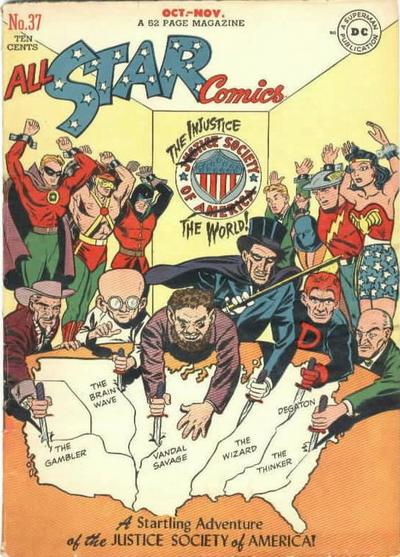
Just had too much villainy for one article, so, continuing with the charter members of the Injustice Society of the World...the most vile villains of the Justice Society of America that premiered in All-Star Comics #37 (October-November, 1947 by Robert Kanigher and Irwin Hasen).  Already covered are Vandal Savage, the Gambler and the Thinker...here are the rest!


Brain Wave


Henry King was just a kid when he discovered he could create images with just his mind...and kept working at developing his brain over the years, becoming a psychologist, setting up a practice in New York and deciding to influence others to commit crimes for him as Brain Wave.

Influencing the villain Professor Elba and setting up the illusions of war for All-Star Comics #8 and #11, Brain Wave first attacked the JSA as "The Man Who Created Images" in All-Star Comics #15 (February-March 1943, by Gardner Fox and a team of artists including Joe Gallagher, Sheldon Moldoff, Stan Aschmeier, Jack Kirby, Ed Dobrotka, Bernard Baily and Howard Sherman), wherein they are saved by their girlfriends and Wonder Woman!  Brain Wave returns in All-Star Comics #17 (June-July, 1943), with "Brain Wave Goes Berserk", using a device to shrink the JSA, and as they almost captured him, getting away in an explosion.  Henry King returned one last time alone in the Golden Age, with All-Star Comics #30 (August-September, 1948) by getting them to have their minds tested, and subjecting the team to "The Dreams of Madness"!

After working with the ISW, Brain Wave didn't return until Power Girl joined the JSA, with All-Star Comics #58 and #59 (in 1976, and showed off a new illusionary form), and was part of the group attack on the JSA in All-Star Comics #66 (May-June, 1977), and a plot against Flash and Green Lantern foiled by Power Girl in Showcase #97 to #99 (February to April, 1978).  Brain Wave joined up with Ultra-Humanite's Secret Society of Super-Villains for Justice League of America #195 to #197 (October to December, 1981), trying to wipe Earth-2's heroes out of existence (and failing), but Brain Wave, along with the Mist, Rag Doll, the Monocle and Psycho Pirate went back in time to the 1940s to work with an earlier Ultra-Humanite (and his crew which included Deathbolt and Cyclotron), which helped form Infinity Inc. (all in All-Star Squadron #26 and Annual #2 of 1983, as some of Brain Wave's earlier 1940s actions came to light in All-Star Squadron #17, #19 and #20 published in 1983).

Brain Wave met his end facing off against the Ultra-Humanite in Infinity Inc. #9 and #10 (December 1984 and January, 1985), but not before passing on more of his power to his son, Brainwave Jr., who was also instrumental in forming Infinity, Inc. and wanted to be a hero (though likely his increased power made Henry King Jr. a little crazy, as he formed a Legion of Doom to fight Captain Atom and his Justice League in Extreme Justice #14 to #18)!

Per Degaton


Per Degaton was just a lowly lab assistant, working with the Time Trust, cleaning test tubes, and had been doing menial tasks for years...until 1947, when Professor Malachi Zee invented a time machine and Degaton tried to use it to take over the world, until he was stopped by the JSA (all in All-Star Comics #35 (June-July, 1947, by John Broome and the art team of Irwin Hasen, Lee Elias, Paul Reinman, Joe Kubert and Frank Harry).  The trick here was that the JSA reversed time, so Degaton was back to washing test tubes in "The Day That Dropped Out Of Time!".  Inexplicably, Degaton was back to menace the JSA as a member of the ISW soon after, but there was more to his story....

Per Degaton had been working for the Time Trust since the days of All-Star Comics #10 (April-May, 1942), getting nowhere....but still having occasional flashes of ideas in 1947, where he tried time travel again, gathering then current (1947) JSA foes like Sky Pirate, Solomon Grundy, the Monster, Professor Zodiac and Wotan, to stop the Justice Society on December 7th, 1941 (which is what prevented these heroes from stopping the tragedy at Pearl Harbor).  Instead, Degaton unknowningly inspired President Franklin D. Roosevelt to have all United States heroes band together as the All-Star Squadron (all revealed in Justice League of America #193 of August, 1981 and All-Star Squadron #1 to #4 of September to December, 1981)..but again, at the end of this adventure, Degaton didn't remember the full details and went back to washing test tubes...

...and another adventure, involving the current Justice Society of America, the Justice League, and the 1940s All-Star Squadron as well as the Crime Syndicate of America...all in All-Star Squadron #14 and Justice League of America #207 of October, 1982, All-Star Squadron #15 and Justice League of America #208 of November, 1982 and Justice League of America #209 of December, 1982 (with the Crisis in these issues being undone, and Degaton back to the test tubes again!).

Eventually, Degaton grew tired of the test tubes, murdered Prof. Zee...but Zee ended up in taking the time machine with him!  Somehow, Degaton convinced the ISW to let him in, and then Degaton ended up destitute, being found by Brain Wave in All-Star Comics #59 (March-April, 1976), and mostly waiting in jail for his final attempt against the JSA in America vs. the Justice Society #1 to #4 in January to April, 1985...wherein the original Batman's diary was found, accusing the JSA of being Nazi collaborators!  This was not true, and the story ended with Per Degaton's death (but, this was around the time of the Crisis on Infinite Earths, and Degaton showed up their as well...and as history was being rewritten, Degaton's was as well....with Degaton being alive and well as of Infinity, Inc. Annual #2 of 1988, led up to from Young All-Stars #12 to #14 and Young All-Stars Annual #1 of 1988 and even another 1940s pre-time travel appearance in Young All-Stars #28 of August, 1989). 

JSA #59 revealed Per Degaton's "out of time" status, and his continued desire for revenge against the JSA....which he tried in JSA #65 to #72 (November, 2004 to June, 2005), with the early 1950s JSA teaming with the 2005 JSA!  Degaton has also been seen with the likes of the Ultra-Humanite, Black Beetle and Despero (who have odd timelines), with the "Time Stealers" who have appeared in Justice League of America #9 (July, 2007) and Booster Gold #5 and #7 to #10 of 2008.


The Wizard


The Wizard premiered in All-Star Comics #34 (April-May, 1947 by writer Gardner Fox and the art team of Irwin Hasen, Joe Kubert, Frank Harry, Lee Elias, Harry Lampert and Paul Reinman) in "The Wiles Of The Wizard", posing as Mr. W. I. Zard and offering the JSA money to capture villains (which they wouldn't accept as it would be too tempting to the new villain, the Wizard!), and the Wizard has cast quite a spell of villainy for decades on, returning as a founder of the Injustice Society of the World in All-Star Comics #37 (October-November, 1947) and being their only return member in All-Star Comics #41 (June-July, 1948)!

The Wizard even menaced the JSA members individually, casting a spell on Superman to remove his powers (which ended up allowing Clark Kent to marry Lois Lane), and kidnapping Larry Lance and Black Canary's daughter (who ended up becoming the second Black Canary).

The Wizard was also a founder of the Crime Champions to be involved in the first JLA/JSA Crisis of Justice League of America #21 and #22 (August and September of 1963), with the Fiddler and Icicle (and later additions to the ISW) of Earth-2, and Chronos, Dr. Alchemy and Felix Faust as JLA/Earth-1 villains.  Wizard returned to the ISW with Justice League of America #123 and #124 (October and November, 1975), and likely soon around that time, the Injustice Society of the World likely realized that they needed new villainous blood to help them defeat the JSA.

While the Injustice Society menaced the JSA in All-Star Comics #63 to #66 (1970s), the Wizard was on Earth-1, working with and then leading the Secret Society of Super-Villains (Secret Society of Super-Villains #1 through #15, except #2, from May-June, 1976 to June-July, 1978), with the Wizard getting extra power (as his magical might was waning on Earth-1) from the Sorcerer's Treasures (originally found in World's Finest Comics #103 of August, 1959), and along the way, Wizard worked with villains like Captain Cold, Gorilla Grodd, a new Star Sapphire, Matter Master, Felix Faust, Lex Luthor, Blockbuster, Reverse-Flash and the Floronic Man, and even running afoul of villains like Darkseid and the Crime Syndicate of America while fighting Captain Comet.

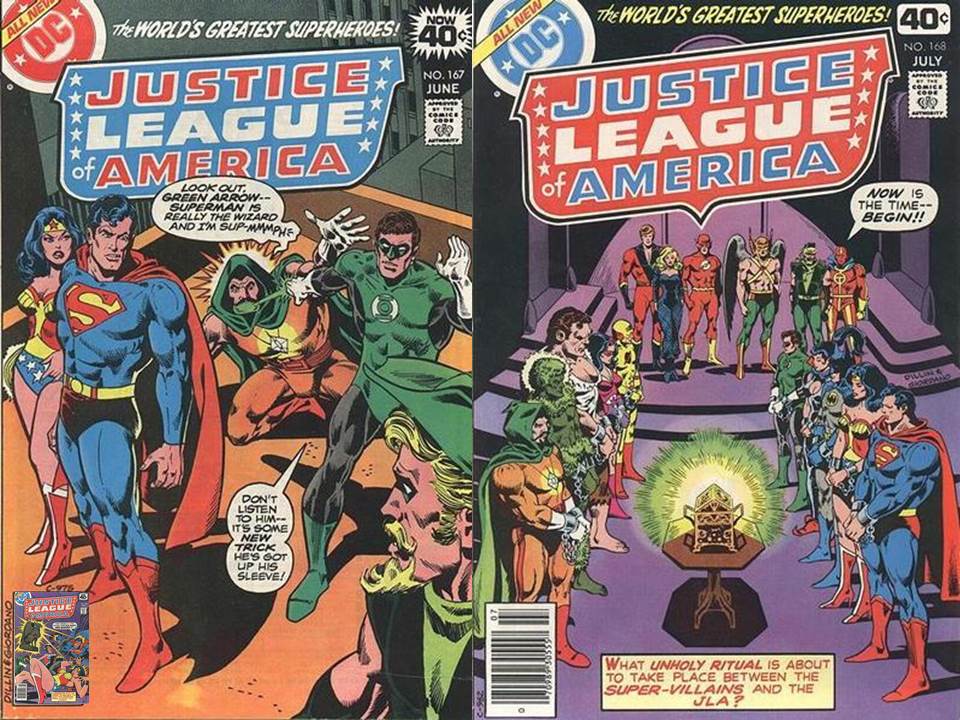
Sadly, it wasn't the heroes that brought this plot to an end, but the DC Implosion of 1978...though it was later revealed that the Secret Society had been thwarted by the JSA, and the Secret Society ended up in limbo (getting out involved body switching with the JLA...and was detailed in Justice League of America #166 to #168 of May to July, 1979, though the unfinished sixteenth and seventeen issues of Secret Society of Super-Villains were published in Cancelled Comic Cavalcade #2 in Fall of 1978, reprinted in the second Secret Society of Super-Villains hardcover of 2012.

The Wizard dumped the Invisibility Cloak, Energy Prism and Power Gloves when he returned with the Crime Champions to work with the Earth-1 Johnny Thunder in Justice League of America #219 and #220 in October and November, 1983...

...then continued to work without them, testifying against the JSA in the third issue of America Vs. The Justice Society (March, 1985)..

...and he could have used them, as William Asmodeus Zard was easily defeated by Dr. Fate!  Wizard was also one of the sorcerer's recruited to help save the Earth in Crisis on Infinite Earths #12 (March, 1986), but working with heroes was sort lived.

Wizard helped form Injustice, Unlimited (a next generation of the Injustice Society of the World), to face off against Infinity, Inc. (the inheritors of the JSA), starting with Infinity, Inc. #34 to #37 (January to April, 1987) as well as with the Lorelei in Infinity, Inc. #49 and #50 (April and May, 1988).

The Wizard then laid low for a time, as his magical power would flucuate...

...popping up in Books of Magic #2 (1990) and Day of Judgment Secret Files #1 (November, 1999), but not having much success, returning again with the Secret Society of Super-Villains in JLA #115 to #119 (August to November, 2005) dealing with fallout from Identity Crisis of 2004 and leading to the break up of the JLA right before the Infinite Crisis of 2006.

Wizard continues to reform villain teams, forming the Injustice Society of the World again in JSA: Classified #5 to #7 of January to March, 2006, working against the JSA in JSA: Classified #14 to #16 (September and October, 2006) and against another generation of JSAers in JSA: All-Stars #2 to #5 (March to June, 2010).

All of which shows there are more members of the Injustice Society of the World to be covered...and check back as we'll get around to them at some point!


Sunday, June 21, 2015

World's Finest Father's Day

Taking a moment to remember the fathers of the World's Finest super-heroes, Superman and Batman....Jor-El and Thomas Wayne.


Though no longer with them, their dads helped to make them into the heroes they became and continued to effect their lives after they were gone, as shown on these covers, with Jor-El on Superboy #121 (June, 1965 by Curt Swan), and Thomas Wayne on Detective Comics #235 (September, 1956 by Sheldon Moldoff).

Friday, June 19, 2015

Happy 100th Julie Schwartz!

Happy 100th Julie Schwartz!

If former DC editor Julie Schwartz were still with us, he would be 100 today.


The gang at DC interrupted a continuing story of Superman vs. Lex Luthor to give Julie this present of Superman #411 (September, 1985) back in the day....


Julie Schwartz gave us so much back in the day...coming up with the idea to have a "new" Flash with a scientific background, police scientist Barry Allen in Showcase #4 (September-October, 1956 with writer Robert Kanigher - who would have been 100 yesterday - and artist Carmine Infantino)...and that led to Showcase issue updates for Green Lantern and Atom, and Brave and the Bold issue updates for Hawkman and the Justice League of America!

Julie even stepped in to help his beloved comic characters one in a while....as in Flash #179 (May, 1968 by Cary Bates and Ross Andru), wherein Barry Allen ended up at the DC offices on what would later be known as "Earth-Prime" where Barry was only thought of as a comic book character...and enlisted the help of Julie to get home in "The Flash - Fact or Fiction?".


There are so many more facts on Julius "Julie" Schwartz than what can fit here, so I leave you with a quote of his which inspires why I write...

"Take something you love, tell people about it, bring together people who share your love, and help make it better. Ultimately, you'll have more of whatever you love for yourself and the world."


Thursday, June 18, 2015

Superman Says Happy Birthday Clark Kent!

Odd that Superman could wish Clark Kent a happy birthday...especially since they are suppose to be the same person!

To help conceal his identity, Superman (who has a birthday on February 29th), doesn't share a birthday with Clark Kent (who was born on June 18th!)!

You can see, that DC has done a few tricks over the years to put Superman at odds with Clark Kent...

One of the biggest tricks they pulled was having Superman and Clark Kent team up, and they did that twice in Superman's team-up book of DC Comics Presents!


Superman meets Clark Kent


In DC Comics Presents #50 (October, 1982) in the story "When You Wish Upon A Planetoid" by writers Dan Mishkin and Gary Cohn, and artists Curt Swan and Kurt Schaffenberger, thanks to a chance encounter with the Miracle Machine (technically, its first appearance, as every other time Superman encountered this device of the Controllers, it was in the future, when Superboy, Superman's adventurous younger self, traveled to the 30th Century to work with the Legion of Super-Heroes) while saving a planet, Superman's subconscious wish of having a life separate from Clark Kent came true, and the two existed as individual beings for a time, working to thwart the Atomic Skull and his attack on S.T.A.R. Labs.

Eventually, Superman and Clark worked together and returned to being one man.


Clark Kent Meets Superman


At least until DC Comics Presents #79 (March, 1985) in the story "Superman -- Meet Clark Kent" by writer Paul Kupperberg and artists Curt Swan with Al Williamson, Superman and Clark were split by intergalactic gamblers Rokk and Sorban (and dealt with the villainous Erg-Master at this time), and the two alter egos had to work together...and become one being as well.

It might seem strange to devote time to Superman and Clark Kent working together, but they need to, and sometimes we all need to make parts of ourselves work together...the showy larger than life side full of action and heroics (one might say the Superman side) and the quieter, thoughtful, more emotional reporting side (the reporter, Clark Kent) to make us all be one functioning person!

But, you might ask, why June 18th as Clark Kent's birthday?  Well, that's the day that Kal-El arrived on Earth from Krypton and was found by the Kents...

...and, oddly enough, in 1908, it was when Bud Collyer was born (he who would voice Superman on radio and in the cartoons of the 1940s, shifting his voice an octave when he switched identities).