True, some people have their Christmas lights up before Thanksgiving, but some wait until December to do that ritual...and Hal Jordan seems to be one who waits.
While enjoying Christmas with his brothers, Jim and Jack, and their family, Green Lantern has to face the Justice League villain, Dr. Light.
That puts a little "bah, humbug" into Hal's holiday, in this story from Green Lantern #36 (February, 1993) titled "The Ghost Of Christmas Light" by Gerard Jones, Gene Ha and Romeo Tanghal.
A blog about comic books, and enjoying the stories, characters and creators of them...and occasionally subjects that relate to comic books as well.
Friday, December 1, 2017
Thursday, November 30, 2017
Happy Holidays From Sabrina The Teenage Witch
Whether Halloween, Thanksgiving, Christmas or New Year's...
...Sabrina the Teenage Witch is there to wish you a happy one with this cover from 1994!
Sabrina's Holiday Spectacular #2 has a cover by Rex W. Lindsay, and is from Archie Comics., and let's all slow down a bit and try to celebrate each holiday for what it is!
...Sabrina the Teenage Witch is there to wish you a happy one with this cover from 1994!
Sabrina's Holiday Spectacular #2 has a cover by Rex W. Lindsay, and is from Archie Comics., and let's all slow down a bit and try to celebrate each holiday for what it is!
Wednesday, November 29, 2017
Flash Facts: The Tornado Twins
Jumping a head a little bit...to the 30th Century, the home of the Legion of Super-Heroes, a group of young interplanetary heroes who uses their alien powers to protect the universe (with the help of Superboy, Superman when he was a boy)...in Adventure Comics #373 (October, 1968) they met "The Tornado Twins" in a story by Jim Shooter and Win Mortimer, with a cover by Neal Adams.
The twins were Don and Dawn, who used their powers to beat up on the Legion members, and their abilities seemed oddly familiar.
Spoilers, here...
....so beware.
So, the twins were Don and Dawn Allen, the descendants of Barry Allen (the Flash), using a special formula to duplicate Barry's powers for a day to celebrate the Flash.
Now, they appeared rarely after this, showing up for Bouncing Boy/Duo Damsel's wedding in Superboy #200 (January-February, 1974) and Legion of Super-Heroes Annual #1 (October, 1985), but....
...it was the son of Don (Bart Allen, who became Impulse, then Kid Flash and even Flash for a bit, who first appeared in Flash #91 of June, 1994 and joined the Titans and Young Justice) and daughter of Dawn (Jenni Ognats, who became XS, who first appeared in Legionnaires #0 of October, 1994, who joined the Legion of Super-Heroes), after the Crisis On Infinite Earths, soon after which, it was revealed Don and Dawn were Barry and Iris Allen's kids.
So, all these heroes were born on a fast track!
The twins were Don and Dawn, who used their powers to beat up on the Legion members, and their abilities seemed oddly familiar.
Spoilers, here...
....so beware.
So, the twins were Don and Dawn Allen, the descendants of Barry Allen (the Flash), using a special formula to duplicate Barry's powers for a day to celebrate the Flash.
Now, they appeared rarely after this, showing up for Bouncing Boy/Duo Damsel's wedding in Superboy #200 (January-February, 1974) and Legion of Super-Heroes Annual #1 (October, 1985), but....
...it was the son of Don (Bart Allen, who became Impulse, then Kid Flash and even Flash for a bit, who first appeared in Flash #91 of June, 1994 and joined the Titans and Young Justice) and daughter of Dawn (Jenni Ognats, who became XS, who first appeared in Legionnaires #0 of October, 1994, who joined the Legion of Super-Heroes), after the Crisis On Infinite Earths, soon after which, it was revealed Don and Dawn were Barry and Iris Allen's kids.
So, all these heroes were born on a fast track!
Thursday, November 23, 2017
Happy Thanksgiving Batman
Happy Thanksgiving, Batman, as Solomon Grundy is waiting for you and he's brought his appetite.
Here's the cover of Batman: The Long Halloween #2 (January, 1997), of a 13 issue mini-series by Jeph Loeb and Tim Sale, with Batman searching for a new villain, the Holiday Killer.
Wednesday, November 22, 2017
A History of Crisis on Earth-X
Earth-X....the nastiest of alternate Earths, one where the Nazis had won World War II, was introduced in Justice League of America #107 (September-October, 1973) by Len Wein, Dick Dillin and Dick Giordano (under a cover by Nick Cardy) with "Crisis On Earth-X"...
...in a story which also reintroduced the 1940s Quality heroes of Uncle Sam, Doll Man, Phantom Lady, Human Bomb, Black Condor and the Ray as the Freedom Fighters...
...the last of the heroes on that world, who were still fighting the Nazi menace.
The battle continued into the next issue (Justice League of America #108 of November-December, 1973 by Wein, Dillin and Giordano, entitled "Thirteen Against The Earth")...
....where, with the help of the Justice League of America (Batman, Green Arrow, Elongated Man and Red Tornado) and Justice Society of America (the Golden Age Superman, Sandman and Dr. Fate), the Freedom Fighters were finally able to live up to their name.
The combined heroes were able to free Earth-X from the Nazi forces, and the computer that led them under the image of Adolf Hitler (all by breaking the system that allowed the evil forces to mind control most of the population into following all the Nazis lies).
Along the way, the Freedom Fighters met up with heroes like Wonder Woman, Batgirl and Batwoman (real heroes knowing the heroic nature of the Fighters), as well as established DC villains like Cat-Man, and even faced a few foes all their own, such as the Silver Ghost, King Samson, Skragg the super-sniper, the Crusaders (invading super-heroes Americommando and his partner Rusty, Fireball and his partner Sparky and the aquatic Barracuda), the Renegades, as well as some unnamed aliens.
Still, they couldn't escape their past, as the Nazi menace of Earth-X had been resurfacing, as the first Firebrand (Rod Reilly), who was came from Earth-X in Freedom Fighters #11 (November-December, 1977, by Bob Rozakis, Dick Ayers and Jack Abel), came to tell them, as the Silver Ghost, who was eventually revealed to be an Earth-X Nazi, was also recruiting the Secret Society of Super-Villains (who were part of a multiversal attack on heroes, at the time having a group attacking the heroes of the Justice Society on Earth-2).
The Ray, Black Condor and Uncle Sam stayed on Earth-X to continue the fight, with the rest of the Quality heroes (including folks like the Jester, Quicksilver, Midnight, the Spider, the original Firebrand, Manhunter Dan Richards and more) to come from Earth-2 to Earth-X during the Crisis On Infinite Earths (as revealed in All-Star Squadron #50 of October, 1985).
.....including a new Earth-X, with evil Nazi equivalents of familiar heroes to fight Freedom Fighters (as opposed to the evil versions of Earth's heroes represented by the Crime Syndicate of America of Earth-3). Still, evil is evil, and there will always be Quality heroes ready to fight for freedom..
...in a story which also reintroduced the 1940s Quality heroes of Uncle Sam, Doll Man, Phantom Lady, Human Bomb, Black Condor and the Ray as the Freedom Fighters...
...the last of the heroes on that world, who were still fighting the Nazi menace.
The battle continued into the next issue (Justice League of America #108 of November-December, 1973 by Wein, Dillin and Giordano, entitled "Thirteen Against The Earth")...
....where, with the help of the Justice League of America (Batman, Green Arrow, Elongated Man and Red Tornado) and Justice Society of America (the Golden Age Superman, Sandman and Dr. Fate), the Freedom Fighters were finally able to live up to their name.
The combined heroes were able to free Earth-X from the Nazi forces, and the computer that led them under the image of Adolf Hitler (all by breaking the system that allowed the evil forces to mind control most of the population into following all the Nazis lies).
Freedom Fighters
The Freedom Fighters then had their own comic series, which lasted 15 issues from March-April, 1976 to July-August, 1978. Oddly, the heroes, instead of remaining on Earth-X, to help in rebuilding that devastated world, came to Earth-1 (the home of the Justice League of America), where they were falsely accused of being criminals by a corrupt government and cooperating media, and spent much of their time on the run.Along the way, the Freedom Fighters met up with heroes like Wonder Woman, Batgirl and Batwoman (real heroes knowing the heroic nature of the Fighters), as well as established DC villains like Cat-Man, and even faced a few foes all their own, such as the Silver Ghost, King Samson, Skragg the super-sniper, the Crusaders (invading super-heroes Americommando and his partner Rusty, Fireball and his partner Sparky and the aquatic Barracuda), the Renegades, as well as some unnamed aliens.
Still, they couldn't escape their past, as the Nazi menace of Earth-X had been resurfacing, as the first Firebrand (Rod Reilly), who was came from Earth-X in Freedom Fighters #11 (November-December, 1977, by Bob Rozakis, Dick Ayers and Jack Abel), came to tell them, as the Silver Ghost, who was eventually revealed to be an Earth-X Nazi, was also recruiting the Secret Society of Super-Villains (who were part of a multiversal attack on heroes, at the time having a group attacking the heroes of the Justice Society on Earth-2).
Brief Interlude
At some point after the end of the Freedom Fighters and Secret Society of Super-Villains titles of the 1970s, the Freedom Fighters went back to Earth-X to stay....but Earth-X popped up twice, once in Wonder Woman #292 (June, 1982) with Phantom Lady helping Wonder Woman against the threat of the Adjucator, who menaced the multiverse, one Earth at a time, and the rest of the Freedom Fighters getting help from a resurgence of Nazism on Earth-X with the help of Earth-1's Superman in DC Comics Presents #62 (October, 1983), before the collapse of the multiverse during the Crisis On Infinite Earths (which also revisited Earth-X, among others, starting with its fifth issue).All-Star Squadron Origins
The beginnings of the Freedom Fighters were explored in All-Star Squadron #31 to #35 (March to July, 1984 by Roy Thomas and Rick Hoberg), with Uncle Sam leading lesser known Quality heroes like Miss America, the Invisible Hood, Magno, and the Red Torpedo, along with former JSAer, Hourman, to stopping the Japanese from attacking Pearl Harbor on Earth-X, which allowed the Nazis to win World War II later, as the United States held off participating until directly attacked in 1942 (which this series was set in).The Ray, Black Condor and Uncle Sam stayed on Earth-X to continue the fight, with the rest of the Quality heroes (including folks like the Jester, Quicksilver, Midnight, the Spider, the original Firebrand, Manhunter Dan Richards and more) to come from Earth-2 to Earth-X during the Crisis On Infinite Earths (as revealed in All-Star Squadron #50 of October, 1985).
Reintroduced
The Ray, Black Condor and Phantom Lady were reintroduced to the DC Universe in the Ray #1 (February, 1992), Black Condor #1 (June, 1992) and Action Comics Weekly #636 (January 24, 1989) as Ray Terrill (son of Happy Terrill), Ryan Kendall, and Dee Tyler (student of Sandra Knight), with these kids eventually uniting with Uncle Sam, the Human Bomb and others to form a new Freedom Fighters, which were devastated in the opening of the Infinite Crisis by a Secret Society which included Deathstroke the Terminator, the second Psycho-Pirate, Zoom and Black Adam. This seven issue mini-series also returned the multiple Earths with new twists, followed up on in Final Crisis, Forever Evil and Multiversity.........including a new Earth-X, with evil Nazi equivalents of familiar heroes to fight Freedom Fighters (as opposed to the evil versions of Earth's heroes represented by the Crime Syndicate of America of Earth-3). Still, evil is evil, and there will always be Quality heroes ready to fight for freedom..
Thursday, November 16, 2017
Superman As The Justice League
One wonders why Superman would need the Justice League of America, with all of his powers, he certainly outshines them all.
Why, Superman could take over for any member of the League...
...and, back in Action Comics #314 (July, 1964) he did, in a story by Edmond Hamilton and Al Plastino (under a cover by Curt Swan and Sheldon Moldoff), wherein readers saw "The Day Superman Became The Flash".
But, as always, there is more to the story than a flashy cover, this story featured Superman...
...becoming Atom, Aquaman, Green Arrow, Batman and the Flash, as shown in simulations by Superman's father, Jor-El, in a rocketship found by Aquaman in the ocean. Jor-El did this to see how his son, Kal-El, might live if Jor-El sent him to various worlds, but each of these lives ended with Superman being alone, miserable or his life ending too soon.
Thus, Jor-El decided to send Kal-El to Earth, where he would grow up to be Superman (and eventually help found the Justice League). Perhaps Jor-El was wiser than he knew, because he knew why Superman needed the JLA, not so much for their powers or abilities, but so that his son could have friends to count on.
This story, along with other overlooked gems, was reprinted in the Best of DC #8 (November-December, 1980), under a cover by Ross Andru and Dick Giordano.
Why, Superman could take over for any member of the League...
...and, back in Action Comics #314 (July, 1964) he did, in a story by Edmond Hamilton and Al Plastino (under a cover by Curt Swan and Sheldon Moldoff), wherein readers saw "The Day Superman Became The Flash".
But, as always, there is more to the story than a flashy cover, this story featured Superman...
...becoming Atom, Aquaman, Green Arrow, Batman and the Flash, as shown in simulations by Superman's father, Jor-El, in a rocketship found by Aquaman in the ocean. Jor-El did this to see how his son, Kal-El, might live if Jor-El sent him to various worlds, but each of these lives ended with Superman being alone, miserable or his life ending too soon.
Thus, Jor-El decided to send Kal-El to Earth, where he would grow up to be Superman (and eventually help found the Justice League). Perhaps Jor-El was wiser than he knew, because he knew why Superman needed the JLA, not so much for their powers or abilities, but so that his son could have friends to count on.
This story, along with other overlooked gems, was reprinted in the Best of DC #8 (November-December, 1980), under a cover by Ross Andru and Dick Giordano.
Wednesday, November 15, 2017
Justice League Lore: Early Days of Steppenwolf
Steppenwolf was the leader of the Dog Cavalry on Apokolips, home of the evil side of the New Gods.
He also played an important part in the battle between the forces of Apokolips and New Genesis...but fell victim to his (and others) lust for power.
Steppenwolf was dead, but that proved to only be a minor inconvenience for him....
...so, Darkseid used his "Omega Effect" and additional machines to revive Kalibak, Desaad, Steppenwolf and Mantis to fight for him, though their mental capacities were not quite up to snuff to start, requiring "reeducation" to be almost as useful as they had been.
This series reflected how Darkseid had been removed from power in the DC Graphic Novel, The Hunger Dogs, but had not quite reflected the current times of the DC Universe, missing effects from the Crisis On Infinite Earths, as well as the current run of the Justice League of America..
....plus Steppenwolf, Mantis and the Parademons looked very different than they had before (but, then again, this series was more to sell Kenner's action figures for their Super Powers line than following continuity...
...still, it survives as a small look at what Jack Kirby might have done had he been allowed to do more with his Fourth World and the rest of the DC Universe).
...and new, post-death appearances in Damage #8 of December, 1994, Green Lantern #61 of April, 1995, Outsiders #21 and #22 of 1995, Underworld Unleashed: Apokolips - Dark Uprising #1 of November #1995, New Gods #6 of March, 1996, Mr. Miracle #2 to #4 of 1996, Genesis #3 and Superboy and the Ravers #14 of October, 1997, Action Comics #814 of June, 2004 and Flash: The Fastest Man Alive #9 (April, 2007)....with inconsistent looks in these appearances.
....sporting the look he has in the Justice League movie.
He also played an important part in the battle between the forces of Apokolips and New Genesis...but fell victim to his (and others) lust for power.
The Pact
Steppenwolf premiered in New Gods #7 (February-March, 1972) by Jack Kirby and Mike Royer, where he was revealed to be Darkseid's uncle, and a foe of Izaya the Inheritor, whom Darkseid maneuvered into killing Avia (Izaya's wife), starting a bloody war between the forces of New Genesis and Apokolips, resulting in the death of Steppenwolf (and the need for "The Pact" to stop the war, as well as Izaya taking on the role of Highfather for the forces of New Genesis and Darkseid taking over on Apokolips....more info on all of that here).Steppenwolf was dead, but that proved to only be a minor inconvenience for him....
Even Gods Must Die
Steppenwolf returned New Gods #6 (November, 1984) by Jack Kirby and D. Bruce Berry, wherein Darkseid found himself in need of more allies (as he had been either killing them or dispatching them to their deaths recently, and Orion, the mad god of New Genesis was on his way to battle.......so, Darkseid used his "Omega Effect" and additional machines to revive Kalibak, Desaad, Steppenwolf and Mantis to fight for him, though their mental capacities were not quite up to snuff to start, requiring "reeducation" to be almost as useful as they had been.
Super Powers
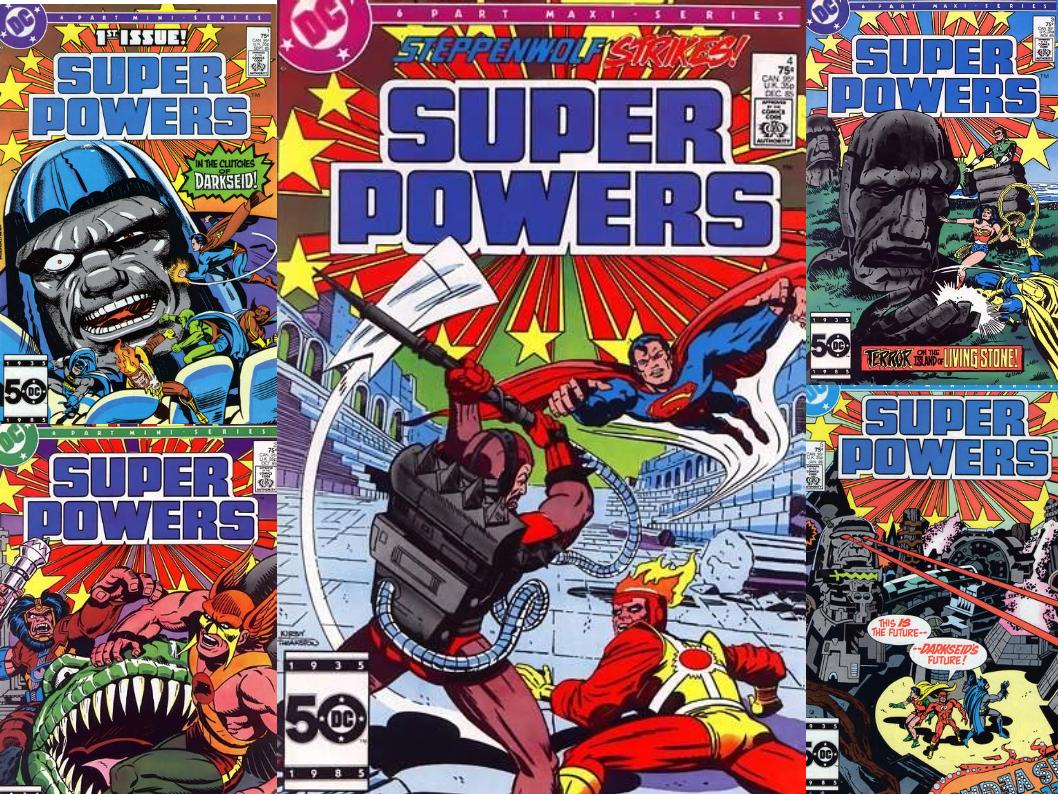
In the second Super Powers mini-series (the six issue series, running from September 1985 to February 1986, by Paul Kupperberg, Jack Kirby and Greg Theakston), Darkseid and his most loyal forces waged a war with the Justice League (and a few of their friends, like Robin and Dr. Fate), and Steppenwolf, sporting a new look was there was well, but still having his battleaxe.This series reflected how Darkseid had been removed from power in the DC Graphic Novel, The Hunger Dogs, but had not quite reflected the current times of the DC Universe, missing effects from the Crisis On Infinite Earths, as well as the current run of the Justice League of America..
....plus Steppenwolf, Mantis and the Parademons looked very different than they had before (but, then again, this series was more to sell Kenner's action figures for their Super Powers line than following continuity...
...still, it survives as a small look at what Jack Kirby might have done had he been allowed to do more with his Fourth World and the rest of the DC Universe).
Revivals
Still, Steppenwolf had many more appearances, whether they be flashback appearances.. ..some, like New Gods #22 of January, 1991 with a hybrid appearance of his looks, Doomsday Annual #1 of 1995 with his new look, or Jack Kirby's Fourth World #3 and 15 of 1997 and 1998, with his original look.......and new, post-death appearances in Damage #8 of December, 1994, Green Lantern #61 of April, 1995, Outsiders #21 and #22 of 1995, Underworld Unleashed: Apokolips - Dark Uprising #1 of November #1995, New Gods #6 of March, 1996, Mr. Miracle #2 to #4 of 1996, Genesis #3 and Superboy and the Ravers #14 of October, 1997, Action Comics #814 of June, 2004 and Flash: The Fastest Man Alive #9 (April, 2007)....with inconsistent looks in these appearances.
New 52
It was with the New 52, that Steppenwolf was more of a menace to the Justice Society and the Justice League.......sporting the look he has in the Justice League movie.
Subscribe to:
Posts (Atom)