Showing posts with label Firebrand. Show all posts

Wednesday, December 18, 2019

Crisis Out Of Time

One of the main pieces of the Crisis On Infinite Earths, was that heroes from different times and places were able to meet up and work together.

Only a few of the crossovers took advantage of that revolutionary idea by using heroes from history, and here are the two of them, as they teamed up with some fiery super heroines of the 1980s!

The Crisis Comes To 1942

There was a little pre-crossover set up in All-Star Squadron #54 (February, 1986) by Roy Thomas, Danette Thomas, Mike Clark, Alfredo Alcala, Arvell Jones and Vince Colletta, all under a cover by Mike Clark, with the honorary members of the JSA (in 1942, including Flash, Batman, Green Lantern and Hourman) all coming back to put the final touches on Mr. Mind's early Monster Society of Evil, including Oom, who you can see attacking the Perisphere, the headquarters of the All-Star Squadron.

All that so that Firebrand (Danette Reilly, the second Firebrand, a heroine who was related to the original Firebrand who later joined the Freedom Fighters, but she also had flame powers which she had gotten during the formation of the All-Star Squadron) could go on a mission to Cape Canaveral.

Speaking with Nuklon and the 1985 version of the Golden Age Atom, Firebrand got assigned to check out Cape Canaveral, home of the Space Shuttle program at the time (as well as Terri Rothstein, who was Nuklon's mom and Firebrand's goddaughter).

So, Firebrand ended up leading a team composed of heroes from history including Don Caballero (a man from Spain who welded his blade, El Captain), the Roving Ranger (Jeff Graham, a Texas Ranger), the Trigger Twins (Walt and Wayne, two men who pretended to be one sheriff - this batch all premiered in All-Star Western #58 of April-May, 1951); the Silent Knight (Brian Kent, apprentice knight who fought villainy in secret), the Golden Gladiator (Marcus, a former Roman shepherd and slave who became a warrior after winning a bout and getting a golden helmet) and the Viking Prince (Jon, a Scandinavian hero of the 10th Century, these three all premiering in Brave and the Bold #1 of August-September, 1955); the Black Pirate (Jon Valor of 16th Century Europe, who premiered in Action Comics #23 of April 1940, and his son, Justin Valor), Miss Liberty (Bess Lynn who nursed soldiers during the Revolutionary War, and first appeared in Tomahawk #81 of July-August, 1962), and Valda (the iron maiden of Frankland in the 8th Century, who premiered in Arak Son Of Thunder #3 in November, 1981).


This group approached Cape Canaveral in Florida in 1985, to find it besieged by American Indians of old...including Super-Chief (Flying Stag, also known as Saganowhana, leader of the Wolf Clan who gets super powers from a meteor in All-Star Western #117 of February-March 1961 and used them for the next two issues as well, to be later pulled out for massive team-ups, more on which in later columns....).   For now, to the next issue and more guests!


Crisis At Canaveral

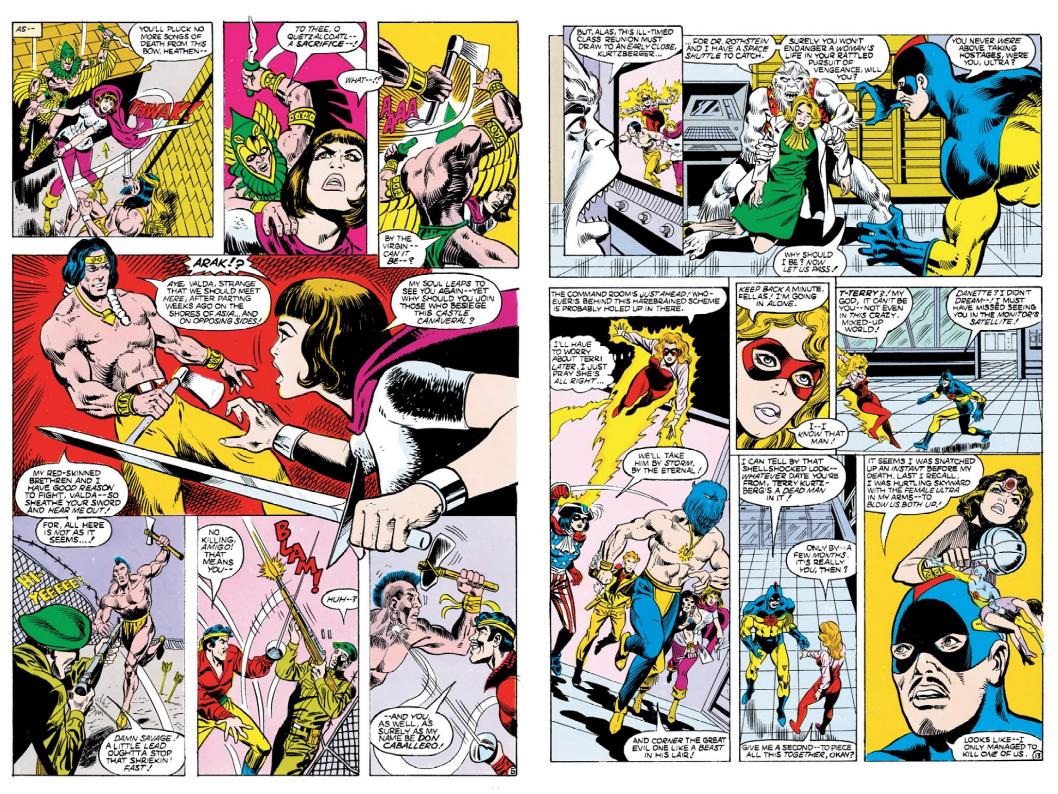
All that set up for All-Star Squadron #55 (March, 1986) by Roy Thomas, Danette Thomas, Arvell Jones, Vince Colletta and Tim Burgard (with cover by Arvell Jones and Tony DeZuniga)!

Firebrand and history's heroes battle the displaces native Americans (including a few more comic related ones, including Strong Bow of the Misty Mountains from an America before Columbus had landed who had premiered in All-Star Western #58 of April-May, 1951 - the issue that took over the numbering from the Golden Age JSA home of All-Star Comics) and Arak Red-Hand (shaman of the Quontauka tribe of the 8th Century who premiered in Warlord #48 in August, 1981, and had 50 issues of his own written by Roy Thomas).

All these time tossed characters (including Cyclotron, who was Terri Rothstein's now deceased father) had been gathered to fight the Ultra-Humanite (a foe of the Golden Age Superman... ....now in the body of a giant mutated white ape).

The heroes were eventually successful stopping the Ultra-Humanite, left wondering how the greater Crisis would go (all the while the Golden Age Sandman had his adventure on an alternate Uranus).


A Long Night's Journey Into Day

A much simpler adventure happened in Fury Of Firestorm #42 (December, 1985) by Gerry Conway, Rafael Kayanan, Ian Akin and Brian Garvey (with a cover by Rafael Kayanan and Dick Giordano, featuring the stars of the issue, Firehawk/Lorraine Reilly and Wonder Girl/Donna Troy, as Firestorm was busy during the Crisis).

A little later in the Crisis On Infinite Earths (if time has any meaning), New York found itself split into multiple time zones, in which were lost Terry Long (Wonder Girl's husband) and former Senator Walter Reilly (Firehawk's dad).

Lorraine Reilly was a young woman who was helping her father, when she was taken by the 2000 Committee, and subjected to tests that turned her into an approximation of Firestorm (without an attached other person) in Fury of Firestorm #17 (October, 1983).


Still new to the hero game, and giving herself a new costume in Crisis On Infinite Earths #9 (December, 1985), she and Wonder Girl went off to check on their relatives in Manhattan, to find it a time tossed city.

Wonder Girl got injured fighting an octopus and being hit by a cannonball (it really wasn't Donna's day), so Lorraine had taken her to the locals to get aid, finding themselves in the Revolutionary War, and getting help from Tomahawk (frontiersman who worked with General Washington...

....Tom Hawk had his adventures from Star-Spangled Comics #69 of June, 1947 to Star-Spangled Comics #130 of July, 1952, and some issues of World's Finest Comics, as well as 130 issues of Tomahawk from 1950 to 1970, before the title became his sons for 10 issues, but he was there as his older self).

The ladies helped Tomahawk and his assistant, Dan Hunter, fight the British forces, but had no luck finding the men they were looking for.

These three 1980s tales (and more) were reprinted in the Crisis On Infinite Earths Companion Deluxe Edition Volume 1 of 2018, and serve as a nice introduction of past heroes (some of whom had been seen before in JLA/JSA crossovers as well, tales which had occurred in the past, but will be covered in the future!).


Thursday, December 12, 2019

Crisis Recruits

The Crisis On Infinite Earths started in Crisis On Infinite Earths #1 (April, 1985 by Marv Wolfman and George Perez), with the Monitor transforming his assistant, Lyla, into the Harbinger, and sending her off to recruit various heroes (and villains)  to help save the Multiverse.

While that first issue showed some of the recruitment meetings, others were handled in the individual titles of characters.

Here is where Harbinger reached out past the Crisis title.....

Firebrand

In "Crisis Point" for All-Star Squadron #50 (October, 1985) by Roy Thomas, Mike Clark, Vince Colletta, Arvell Jones and Tony DeZuniga (with cover by Jerry Ordway), Harbinger echoed her retrieval of the second Firebrand (Danette Reilly) from a War Bonds rally on Earth-2, April 1, 1942....

...but so much more happened as well.


The current JSA was "Shanghaied Into Space" in an adventure based on their appearance in All-Star Comics #13 (October-November, 1942 - but, instead of going to the eight other planets of their own solar system, they were sent through hyper-space to other dimensional versions of Sol's planets, that were inhabited).

The rest of the Quality heroes (including Plastic Man and Phantom Lady) followed Uncle Sam to Earth-X (an unfortunate world where, at the time, the Nazis were winning World War II).

Commander Steel, behind enemy lines, defeated his enemy, but was thrown into another Earth (Earth-1) that had no super heroes during World War II, and there he remained (having a grandson, who would be Steel in the JLA).

Johnny Chambers and Libby Lawrence (Johnny Quick and Liberty Belle) got married, and headed to their honeymoon, except for the red skies, which had Green Lantern (Alan Scott) come for their help, and then ended them up on Earth-S for a time.

The All-Star Squadron as a whole was a part of the Crisis from All-Star Squadron #50 to #60, and these issues were reprinted in the Crisis On Infinite Earths Companion Deluxe Edition Volume 1 of 2018.


Obsidian

In "Helix Goes To Hollywood" from Infinity, Inc. #18 (September, 1985) by Roy and Danette Thomas, Todd McFarlane and Pablo Marcos, the members of Infinity, Inc. were facing their foes, the super villain team Helix, when Harbinger arrived to take Obsidian (Todd Rice) away.

The rest of the team soldiered on, getting involved in the Crisis up to Infinity, Inc. #25, as well as their first annual and being part of the last JLA/JSA team up in Justice League of America #244 (with these issues all being reprinted in the Crisis On Infinite Earths Companion Deluxe Edition Volume 2 of 2019.

Firestorm

Ronnie Raymond and Martin Stein were trying to settle into their new life at college in Pittsburgh in "Storm Warning" from Fury Of Firestorm #41 (November, 1985) by Gerry Conway, Rafael Kayanan and Ian Akin (cover by Rafael Kayanan and Dick Giordano).

Harbinger, bring along Psycho-Pirate, came to retrieve Firestorm (and Psycho-Pirate's emotion manipulation powers caused a little bit of a problem first, as he induced fright in Martin Stein, the "thinking" half of Firestorm).

This issue and the next of Fury of Firestorm were this titles Crisis crossovers, and were reprinted in the Crisis On Infinite Earths Companion Deluxe Edition Volume 1 of 2018.

Cyborg

Cyborg (Victor Stone) was Harbinger's recruit from New Teen Titans #13 (October, 1985) by Marv Wolfman, Eduardo Barreto and Romeo Tanghal, in "Crisis".

This issue showed that some time had passed between Harbinger taking Cyborg to the Monitor's satellite and the effects of Crisis hitting Earth...

...as shown when the Titans, Outsiders and Superman dealt with some Crisis problems (mirroring issue #3 of the main Crisis series), as well as the Titans involvement in Crisis #4-#9, and Wonder Girl getting help from Firehawk in Fury of Firestorm #42, while Nightwing, Starfire and Jericho go back to Starfire's homeworld of Tamaran (which unfolds over the next few issues of New Teen Titans, also involving the Omega Men).

New Teen Titans #13 and #14 are reprinted in the Crisis On Infinite Earths Companion Deluxe Edition Volume 2 of 2019.


Green Lantern

The last individual recruited was Green Lantern in Green Lantern #194 (November, 1985) by Steve Englehart, Joe Staton and Bruce D. Patterson in "5".  Green Lanterns Katma Tui and John Stewart were coming back from a space mission, when they see the red skies on Earth, and check in with Green Arrow and Black Canary in Star City to find out what is going on.

That is when Harbinger shows up to recruit John, but first a battle happens between Green Arrow, Black Canary and Katma against Harbinger.

Explaining her need, she takes John along (as soon as he "fixes" his costume).  Meanwhile, former Green Lanterns Hal Jordan and Guy Gardner are taking steps to get their hands on a Power Ring, with the Guardians of the Universe providing an unexpected answer.

John Stewart goes through the same scenes he did in Crisis #1 and #2, fighting Shadow Demons and learning about the threat the worlds face.  This story, and the rest of the Green Lantern Crisis issues are reprinted in the Crisis On Infinite Earths Companion Deluxe Edition Volume 1 of 2018.


The other original recruits of the Monitor were King Solovar of Gorilla City, Dawnstar of the 30th Century Legion of Super-Heroes, Blue Beetle of Hub City, Psycho-Pirate (JSA foe), Arion (lord of ancient Atlantis), Psimon (of the Fearsome Five), Geo-Force (of the Outsiders), the Golden Age Superman, Green Lantern foe Dr. Polaris, and Firestorm foe Killer Frost (the second version of his original foe).

This group faced a breach of Monitor's satellite by the Anti-Monitor's Shadow Demons, and then were dispatched through time and space to protect the Monitor's towering tuning forks in an attempt to stave off the Crisis.....

Wednesday, November 22, 2017

A History of Crisis on Earth-X

Earth-X....the nastiest of alternate Earths, one where the Nazis had won World War II, was introduced in Justice League of America #107 (September-October, 1973) by Len Wein, Dick Dillin and Dick Giordano (under a cover by Nick Cardy) with "Crisis On Earth-X"...


...in a story which also reintroduced the 1940s Quality heroes of Uncle Sam, Doll Man, Phantom Lady, Human Bomb, Black Condor and the Ray as the Freedom Fighters...


...the last of the heroes on that world, who were still fighting the Nazi menace.

The battle continued into the next issue (Justice League of America #108 of November-December, 1973 by Wein, Dillin and Giordano, entitled "Thirteen Against The Earth")...

....where, with the help of the Justice League of America (Batman, Green Arrow, Elongated Man and Red Tornado) and Justice Society of America (the Golden Age Superman, Sandman and Dr. Fate), the Freedom Fighters were finally able to live up to their name.

The combined heroes were able to free Earth-X from the Nazi forces, and the computer that led them under the image of Adolf Hitler (all by breaking the system that allowed the evil forces to mind control most of the population into following all the Nazis lies).

Freedom Fighters

The Freedom Fighters then had their own comic series, which lasted 15 issues from March-April, 1976 to July-August, 1978.  Oddly, the heroes, instead of remaining on Earth-X, to help in rebuilding that devastated world, came to Earth-1 (the home of the Justice League of America), where they were falsely accused of being criminals by a corrupt government and cooperating media, and spent much of their time on the run.

Along the way, the Freedom Fighters met up with heroes like Wonder Woman, Batgirl and Batwoman (real heroes knowing the heroic nature of the Fighters), as well as established DC villains like Cat-Man, and even faced a few foes all their own, such as the Silver Ghost, King Samson, Skragg the super-sniper, the Crusaders (invading super-heroes Americommando and his partner Rusty, Fireball and his partner Sparky and the aquatic Barracuda), the Renegades, as well as some unnamed aliens.


Still, they couldn't escape their past, as the Nazi menace of Earth-X had been resurfacing, as the first Firebrand (Rod Reilly), who was came from Earth-X in Freedom Fighters #11 (November-December, 1977, by Bob Rozakis, Dick Ayers and Jack Abel), came to tell them, as the Silver Ghost, who was eventually revealed to be an Earth-X Nazi, was also recruiting the Secret Society of Super-Villains (who were part of a multiversal attack on heroes, at the time having a group attacking the heroes of the Justice Society on Earth-2).

Brief Interlude

At some point after the end of the Freedom Fighters and Secret Society of Super-Villains titles of the 1970s, the Freedom Fighters went back to Earth-X to stay....but Earth-X popped up twice, once in Wonder Woman #292 (June, 1982) with Phantom Lady helping Wonder Woman against the threat of the Adjucator, who menaced the multiverse, one Earth at a time, and the rest of the Freedom Fighters getting help from a resurgence of Nazism on Earth-X with the help of Earth-1's Superman in DC Comics Presents #62 (October, 1983), before the collapse of the multiverse during the Crisis On Infinite Earths (which also revisited Earth-X, among others, starting with its fifth issue).

All-Star Squadron Origins

The beginnings of the Freedom Fighters were explored in All-Star Squadron #31 to #35 (March to July, 1984 by Roy Thomas and Rick Hoberg), with Uncle Sam leading lesser known Quality heroes like Miss America, the Invisible Hood, Magno, and the Red Torpedo, along with former JSAer, Hourman, to stopping the Japanese from attacking Pearl Harbor on Earth-X, which allowed the Nazis to win World War II later, as the United States held off participating until directly attacked in 1942 (which this series was set in).

The Ray, Black Condor and Uncle Sam stayed on Earth-X to continue the fight, with the rest of the Quality heroes (including folks like the Jester, Quicksilver, Midnight, the Spider, the original Firebrand, Manhunter Dan Richards and more) to come from Earth-2 to Earth-X during the Crisis On Infinite Earths (as revealed in All-Star Squadron #50 of October, 1985).

Reintroduced

The Ray, Black Condor and Phantom Lady were reintroduced to the DC Universe in the Ray #1 (February, 1992), Black Condor #1 (June, 1992) and Action Comics Weekly #636 (January 24, 1989) as Ray Terrill (son of Happy Terrill), Ryan Kendall, and Dee Tyler (student of Sandra Knight), with these kids eventually uniting with Uncle Sam, the Human Bomb and others to form a new Freedom Fighters, which were devastated in the opening of the Infinite Crisis by a Secret Society which included Deathstroke the Terminator, the second Psycho-Pirate, Zoom and Black Adam.  This seven issue mini-series also returned the multiple Earths with new twists, followed up on in Final Crisis, Forever Evil and Multiversity....

.....including a new Earth-X, with evil Nazi equivalents of familiar heroes to fight Freedom Fighters (as opposed to the evil versions of Earth's heroes represented by the Crime Syndicate of America of Earth-3).   Still, evil is evil, and there will always be Quality heroes ready to fight for freedom..


Wednesday, May 27, 2015

Freedom Fighters Quality

True, the team of the Freedom Fighters got their start in Justice League of America #107 and #108 (September-October and November-December, 1973) by Len Wein and Dick Dillin, and then a fifteen issue series that ran from March-April, 1976 to July-August, 1978...but the team started decades before that, in Quality Comics, and here's a quick look at those earlier appearances!

Doll Man


Darrell Dane was a scientist who developed a formula that allowed him to shrink in size...

...and he used this ability to save his girlfriend, Martha Roberts, taking on the identity of Doll Man, starting with Feature Comics #27 (December, 1939, by Samuel Maxwell Iger and Will Eisner).

Doll Man had many adventures over the years, remaining a feature in Feature Comics until Feature Comics #139 (October, 1939), as well as gaining his own book...

...first Doll Man Quarterly for its first four issues (Fall, 1941; Spring, 1942; Summer, 1942; and Winter, 1942)...

...before just becoming Doll Man with issue #5 (Spring, 1943), which lasted all the way to Doll Man #47 (October, 1953).

Among many foes, the biggest thing to happen to Doll Man was when Martha Roberts became Doll Girl in Doll Man #37 (December, 1951) during a battle with the Skull...

...where she replaced Elmo the Wonder Dog (who Doll Man first partnered up with in Doll Man #31, December, 1950),  as a regular helper in Doll Man. 

Black Condor


Richard Grey, Jr. was thrown into his heroics at birth, when his father and mother were killed soon after in Outer Mongolia and raised by the condors (where he learned to fly), eventually being taken in by missionary, Father Pierre, who is then also killed by raiders.  The young man uses his abilities to stop them, becoming the Black Condor, all in Crack Comics #1 (May, 1940, by Will Eisner and Lou Fine).  The Black Condor comes up with a paralyzing ray gun in his next appearance (in Crack Comics #2, June, 1940), and later, adopted the identity of Senator Thomas Wright (who died, and just happened to look exactly like the Black Condor) in order to vote in an important appropriations bill (in Crack Comics #11, March, 1941).

Even with the odd plots and turns, the Black Condor series lasted all the way to Crack Comics #31 (October, 1943), and along the way, he faced foes like Ali Kan, Ras Gyn, Sinh Fang, De Graf, the Sapphire King, the Master, Karlo Klug and his Kite-Men, the Great Yaho, Lung Woe and the Spinning Deaths, Monks Gallagher, the Sophisticated Lady, Senator Jasper Crow, Carl Stark, General Korn, Miranda, the Ghost-Gun Killer, the Hand, Mysto, Karle Kurt, Skull-Face, Draku and the Black Dragon Society, Senator Dan Bird and Fury the Eagle and Senator Joe Logan (and with all these Senators as foes, you'd think Black Condor was in Congress today!). 


The Ray 


"Happy" Terrill was a reporter who joined Professor Styne on a balloon experiment that took them to the upper stratosphere, during which "Happy" was thrown from the blimp into a "cosmic storm", turning him into a being of light energy who can fly and project energy, leading "Happy" to become the Ray to save the Professor from spies in Smash Comics #14 (September, 1940, by Will Eisner and Lou Fine).

The Ray continues his adventures through Smash Comics #40 (February, 1943), facing foes along the way like Anton Rox, Cadava the Crumbler, Bela Jat, Stradivous, Miss White and her 7 dwarfs, Slash Scraponi, Jud Marshwood and Slyme, Captain Blue, Lupo, the Beetle and Long Woo, the  Great Ivan, Dr. Kompf, Zimmerman, El Lobo, Von Ribboncounter, Monsieur Le Rat, Baron Hoff, the Khan, Hammer Hand, the Headsman, and Oscar Slott.

Human Bomb


Roy Lincoln was the son of a scientist, and that chemist is the reason Roy became the Human Bomb, after Axis spies broke into the professor's lab, trying to take the explosive formula 27-ORX, which Roy swallowed, gaining the power of explosive fists (as well as a degree of invulnerability to things like bullets) all in Police Comics #1 (August, 1941, by Paul Gustavson).

The Human Bomb never really was a cover feature on Police Comics, as Plastic Man hogged most of the covers (except for Firebrand, who later became a Freedom Fighter), even though the Human Bomb feature went on to Police Comics #58 (September, 1946).  Along the way, the Human Bomb fought lots of Nazis, the Black Vanguards, a phony Human Bomb, Hoiman Schtrugmeyer, Mr. Chameleon, the Three Mosquitos, Patch-Eye, Swami Kazombo, femme fatale Nola, vampiric Miss Walpurga, Mustapho, the Robber Baron, the Butcher Boys, the Shrimp, and Yarboe, as well as his loyal companion, Hustace Throckmorton, who gets an emergency blood transfusion from the Human Bomb, and develops explosive powers (in his feet) in Police Comics #15 (January, 1943) and the Bombardiers (Montague T. "Curley" McGurk, Swordo and Miss Red Rogers) who aid the Human Bomb in Police Comics #21 (August, 1943) and Police Comics #22 (September, 1943).

Phantom Lady


Sandra Knight was the daughter of Senator Henry Knight, and worked with Professor Abraham Davis to develop a black light ray projector in Police Comics #1 (August, 1941, by Arthur Peddy).  Sandra lost contact with the Professor when he was kidnapped, and saw the same men try to take her father, and sprung into action, stopping the thugs, who never got a good look at her, telling police they were stopped by a "phantom lady"...a name she kept.  Later stories had Sandra being related to the original Starman, who encouraged her to continue as Phantom Lady, and she perfected the black light ray projector, which then also allowed her to become invisible and the special glasses she wore which allowed her to see in the dark.

The Phantom Lady's run lasted until Police Comics #23 (October, 1943), and also included a crossover in Feature Comics #69, #70 and #71 (July, August and September, 1943) with the Spider Widow (Dianne Grayton) and the Raven (Tony Grey) who never became Freedom Fighters!  Villains she faced in her run included Tikoy, Captain Ortega, a phony Phantom Lady, the Bunny Man, and the Boss (the foe the three heroes faced).  Phantom Lady also never had covers during her original run, but did as she developed on her own (but, in stories outside her regular continuity, stories past Police Comics #23 weren't produced by Quality (and resulted in a color change in costume for Phantom Lady as well....) when the Phantom Lady returned to comics under Fox with Phantom Lady #13 (August, 1947) by Matt Baker.   

Uncle Sam


A national hero taking form in the comics with National Comics #1 (July, 1940, by Will Eisner and Dave Berg), and the man that eventually formed the Freedom Fighters, Uncle Sam!

Sam was a patriot, loyal to the United States during the Revolutionary War, and as he was dying to complete a mission for General George Washington, he had a vision of the "spirit of America", who joined with him, creating the hero known as Uncle Sam.

Uncle Sam carried a feature all the way through National Comics #45 (December, 1945), and even had his own Uncle Sam Quarterly that lasted 8 issues (from Fall, 1941 to Autumn, 1943), facing foes like the Black Legion (later the Black Guard), Scar, the Purple Shirts, Mias, Yiffendi, Yoritomo Rawlins, Heinrich Brun, Scalini, King Killer, Dr. Link and Dr. Blink, the Steel Helmets, Cadaver, the Witch Queen, Malvolo, the Jinx, Jeremiah Korntooth, Blackout, Dr. Dirge, Hamid the Astrologer, Boss Spring, Professor Bump, Count Torza, Zando and of course, plenty of Nazis, all with his little buddy...Buddy Smith!


Uncle Sam even had the first major hint of a Quality hero crossover, with a prose story in Uncle Sam Quarterly #2 (Winter, 1941), with Uncle Sam convincing Quality's villains they have to go back to work to face Hercules, Neon, Quicksilver, the Ray and Black Condor, or they'd all be out of business!

Uncle Sam was the backbone of the Freedom Fighters and we salute you!

The founding of the Freedom Fighters didn't get covered until DC Comics took over the characters, and it was in All-Star Squadron #31-35 (March-July, 1984, by Roy Thomas and Rick Hoberg), and told how these (and other) Quality heroes (like Miss America, Magno and Neon the Unknown as well as DC hero and JSA founder, Hourman) had originally started on Earth-2, and left to help Earth-X, and unintentionally allowed the Nazis to win World War II!

The team began in the two issues of Justice League of America (#107 and #108), and then had its own series for 15 issues that ran from March-April, 1976 to July-August, 1978...

...with stories by Gerry Conway, Martin Pasko, and Bob Rozakis and interior art by Ric Estrada, Mike Royer, Pablo Marcos, Ramona Fradon and Dick Ayers!


These issues had the team leaving their Earth-X, coming to Earth-1 and being thought of as villains, thanks to the Silver Ghost, and facing foes like King Samson, Skragg the Super Sniper, the Crusaders, Cat-Man, and the Renegades, as well as heroes like Wonder Woman, Batgirl and Batwoman, and having old Quality hero Firebrand (Rod Reilly, who appeared in the first 13 issues of Police Comics, even taking most of the covers from Plastic Man) join the team in Freedom Fighters #12 (January-February, 1978).

Firebrand


Rod Reilly premiered in  in Police Comics #1 (August, 1941, by Samuel Maxwell Iger and Reed Crandell), and he was the son of a wealthy steel tycoon, but wanted more from his life, working with ex-boxer Slugger Dunn to become the crime fighter known as Firebrand!

Firebrand fought criminals and spies like Baron Von Hanson, General Alfredo Muerte, Boss Slaine, Dr. Kruger and the White Gardenias, before ending his short run in Police Comics with issue #13 (November, 1942), all happening before Pearl Harbor (as explained in the early issues of All-Star Squadron).

But back to the Freedom Fighters!

After the 15 issues of the Freedom Fighters, and a few other appearances like DC Comics Presents #62 (October, 1983) and Wonder Woman #292 (June, 1982), the original Freedom Fighters fought their last battle with the Crisis on Infinite Earths, with later revivals focusing on new versions of the Quality characters.

But, with DC's Convergence, and the 2015 2 issues of Convergence: Freedom Fighters, Simon Oliver and John McCrea have brought new adventures of the old Quality Freedom Fighters (added Plastic Man to the team!).