Thursday, March 30, 2017

Detective Comics 27 The First Batman

On March 30, 1939, Detective Comics #27 (cover date May, 1939....cover dates were usually a little later than actual on sale dates) came out...premiering the Batman (actually "the Bat-Man" in that first appearance) by scripter Bill Finger and pencils and inks by Bob Kane, with the 6 page story "The Case Of The Chemical Syndicate".  

The story was also the first appearance of Commissioner James Gordon, and the issue also featured tales of Speed Saunders Ace Investigator, Buck Marshall Range Detective, Spy (Bart Regan), the Crimson Avenger, Bruce Nelson, the mysterious Fu Manchu, Flatfoot Flannigan, Cosmo the Phantom of Disguise, Plain Clothes Pete and Slam Bradley (with Spy and Slam Bradley being by Jerry Siegel and Joe Shuster, who had earlier created Superman for Action Comics #1).

While Batman's first tale from the Golden Age has been reprinted in Archives, Chronicles, and more, only the oversized Famous First Edition #C-28 (1974) and the Millennium Edition: Detective Comics #27 (February, 2000), have reprinted the whole issue, giving fans the chance to relive the total experience as those who first opened this historic issue back on this day in 1939!


Wednesday, March 29, 2017

Flash Facts: The Early Days of Abra Kadabra

Abra Kadabra was a man from the 64th Century, using that time period's super-science for theatrical purposes....

....making "magic", as a true showman.   But, the Flash stole his headlines, leading to battles of science vs. speed, as Abra Kadabra would come back in time to face the Flash, again and again.

Here are the stories of the earlier of their confrontations!

The Case Of The Real-Gone Flash

Abra Kadabra took his first bow in Flash #128 (May, 1962) by John Broome, Carmine Infantino and Joe Giella...and it was quite a performance!


Coming back in time from 6363, the man called Abra Kadabra couldn't get anyone to pay any attention to him, finding folks distracted about crimes in the newspaper....so, Abra decided to start stealing items to get attention, attracting the Flash.  After failing to capture him once, Barry went after Kadabra when the magician tried to perform in Central City, with Abra making Flash disappear out of his uniform, sending Barry into space (where the police scientist used science to get out of predicament, and imprisoning the pseudo-sorceror by using his own hypno-ray against him).


This tale has magical reappeared in a few places...

...including Flash #187 (April-May, 1969), DC Super-Stars #11 (January, 1977), DC Blue Ribbon Digest #15 (November, 1981), the Flash Archives #4 of 2006, and the Flash Omnibus #1 of 2014.


The Plight Of The Puppet Flash

Abra Kadabra took a second curtain call in Flash #133 (December, 1962) by John Broome, Carmine Infantino and Joe Giella, and one of the most beloved covers of the Silver Age by Infantino and Murphy Anderson (begging the question of just how did Flash know how turning into a puppet feel like?).
 

Abra Kadabra gets out of jail by performing a little slight of hand (actually hypnotism) on the governor, starting a series of stage shows using puppets (and making fun of the Flash).  To protect his reputation, Flash wages an all out war against crime, stealing publicity from Abra's shows...forcing Abra to turn Flash into a puppet (and use him in his shows).  Barry figures out how to reverse the advanced science-spell, and recaptures Kadabra.


Like magic...


...this tale reappeared in Flash #169 (April-May, 1967), in the Flash Archives #5 of 2009 and the Flash Omnibus #2 of 2017 (but none of these ever do reveal what it feels like to be turned into a puppet!).


Robberies By Magic

Continuing to look for the spotlight, Abra returns in Flash #149 (December, 1962) by John Broome, Carmine Infantino and Murphy Anderson.

This time around, Abra cast a "spell" on Central City, hitting Flash as he returned from out of town, being imbued with Abra's "magic".  This causes Flash to fail as he tries to stop crime, leading him to confront Kadabra, who tries to extort Flash's speed from him in return for removing the "spell".  Flash uses a little super-speed slight of hand to beat the magician.

This tale was reprinted in the DC Special Blue Ribbon Digest #2 (May-June, 1980) in the Flash Archives #6 of 2012 and the Flash Omnibus #2 of 2017.


The Day Magic Exposed Flash's Secret Identity

Abra Kadabra works on a disappearing act in Flash #163 (August, 1966) by John Broome, Carmine Infantino and Joe Giella (with this shocking cover by Infantino and Giella!).

This time around, Kadabra escapes his 20th Century prison by switching minds with a 64th Century Police Officer.  Flash follows his foe to a magician's convention, where Abra planned a trick to remove Flash's powers and costume, exposing his foe's secret identity...but Barry proved too fast for that to work, and ended up defeating his foe, this time returning Abra to the 64th Century for imprisonment.

This tale has only been reprinted in black and white, in Showcase Presents: The Flash #4 of 2012.


The See-Nothing Spells Of Abra Kadabra

Even the 64th Century couldn't hold Abra Kadabra, who returned with Flash #170 (May, 1967) by Gardner Fox, Carmine Infantino and Sid Greene.


More slight of hand from the crafty Kadabra....this time disguising himself as actor John Cardine, and giving the Flash a disk after he prevents a robbery.  This disk prevents the Flash from seeing crime, causing trouble in Central City.  Abra discovers Flash's identity as Barry Allen as well, and this "spell" echoes through the multiverse, causing trouble on Earth-2, prompting a house call from Golden Age heroes Doctors Fate and Mid-Nite, as well as Flash Jay Garrick.  The 3 Justice Society members work with Barry, and Barry comes up with a trick (helped by the hidden JSAers) to get Abra to remove the spell from Barry.


This story was reprinted in...

....DC Special Series #24 (February, 1981), Crisis On Multiple Earths: Team-Ups #2 of 2007 and in the Flash Of Two Worlds book from the DC Comics Classics Library from 2009.


The Race To The End Of The Universe

Flash #175 (December, 1967) by E. Nelson Bridwell, Ross Andru, and Mike Esposito is a quick comic....having Superman and the JLA as guest stars, as Superman and Flash have their second race (and Abra Kadabra gets involved as well).

Abra and another secret villain (this guy, click here only if you want it spoiled), arrange the second race between the Man of Steel and the Fastest Man Alive....with results similar to the first race.

Head here if you want to read about the Superman/Flash races, and realize that this tale has been reprinted in the Limited Collector's Edition C-48 (October-November, 1976) and in the Superman Vs. The Flash tradepaperback of 2005.
 

The Thief Who Stole All The Money In Central City

Abra Kadabra reappeared in Flash #182 (September, 1968) by John Broome, Ross Andru and Mike Esposito, pulling out his usual tricks.

This time around, Abra wants to attend a magician's convention, but the men in charge throw him out due to his criminal past.  Kadabra pulls a trick on them, hypnotizing the lot to go out and commit crimes, which attracts the attention of the Flash.  Abra then entrances all of Central City to bring him money (which includes the Flash, whom Abra then tries to humiliate while under his spell...which allows Flash to break the spell, capture Kadabra and return the money).

This tale has only been reprinted in black and white, in Showcase Presents: The Flash #4 of 2012.


The Flash In Cartoon-Land

Cary Bates, Irv Novick and Dick Giordano get a crack at Kadabra in Flash #212 (February, 1972).


This time around, Abra Kadabra sends the Flash into television....but not on his own show, but instead into an odd cartoonland, where the characters are out to get the Flash, where Barry is forced to use his speed, wits and a boy he was babysitting (Dustin Barton) as Barry Allen to get out of the trap that Kadabra has pulled him into!


This little jaunt into TV Land for the Fastest Man Alive has yet to been rerun....err, reprinted!


Future Flash Problems

Flash is framed for killing Abra Kadabra in Flash #246 (January, 1977) by Cary Bates, Irv Novick and Frank McLaughlin (with a cover by Neal Adams), in "Kill Me, Flash -- Faster....Faster", leading Flash to be imprisoned in the 64th Century, with Jay Garrick helping Barry against Abra in Flash #247 (March, 1977) by Cary Bates, Irv Novick and Frank McLaughlin (under a cover by Rich Buckler and Frank Springer) in "The Mad, Mad Earth Of Abra Kadabra".

Neither of these stories have yet to be reprinted.

Outside The Flash 

Abra Kadabra next appeared behind the curtain in Justice League of America #158 (September, 1978) by Gerry Conway, Dick Dillin and Frank McLaughlin demonstrating "The Super-Power Of Negative Thinking" as the JLA faced their foes, the Injustice Gang Of The World, then reappeared in  Adventure Comics #464 (July-August, 1979) by Cary Bates, Don Heck and Joe Giella facing the Flash "The Day Up Was Down".

Neither of these stories have been reprinted, but here's where our Abra Kadabra coverage disappears for now, so as not to over extend our act, and to give you more to look for in the future!


.

Sunday, March 26, 2017

Happy Birthday Jose Luis Garcia-Lopez

Happy birthday to artist Jose Luis Garcia-Lopez, an artist who has primarily worked for DC Comics over the years, at times on covers and inside of comics...and even on the style guides for DC.


Jose gave us this beautiful cover for Batman #321 (March, 1980), with the Joker celebrating his own birthday by torturing Batman, Robin, Alfred Pennyworth and James Gordon!

Thursday, March 23, 2017

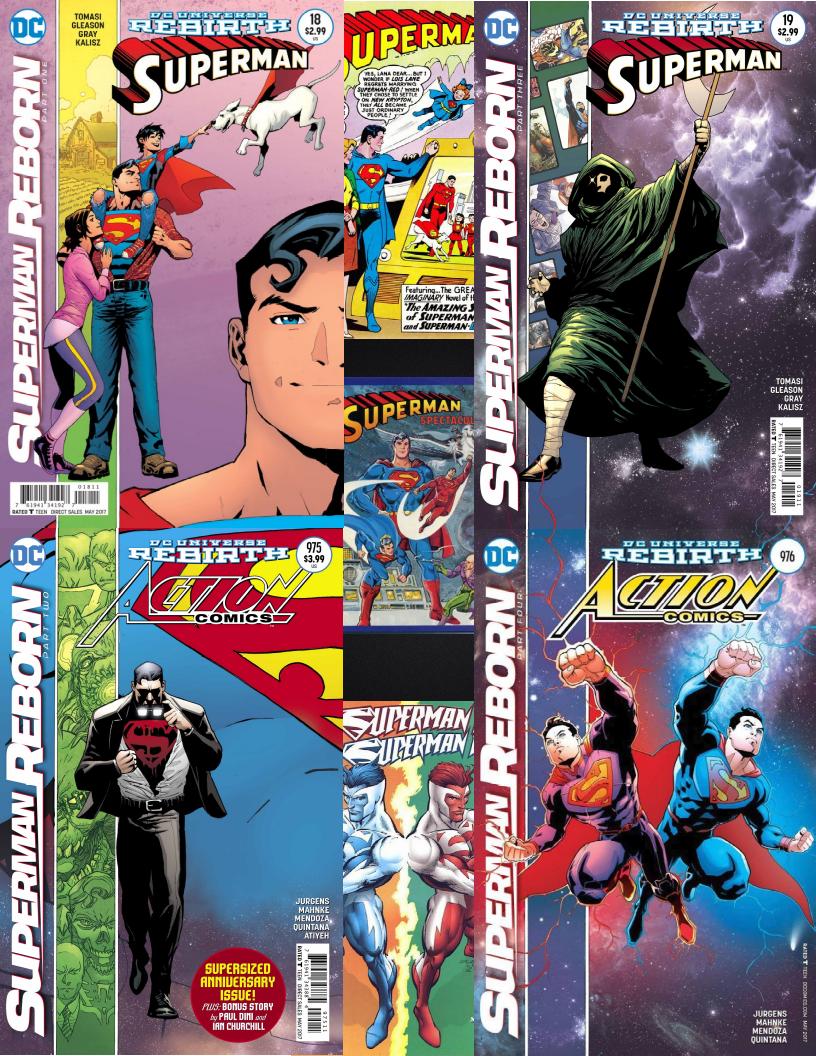
The Amazing Story of Superman-Red and Superman-Blue

"The Amazing Story of Superman-Red and Superman-Blue" first appeared in Superman #162 (July, 1963), by Leo Dorfman, Curt Swan and George Klein (and cover by Kurt Schaffenberger)....and it was a doozy!  Superman decides he has too much to do, so makes a machine that will increase his intelligence (powered by the many colors of Kryptonite), and does increase his intelligence (but also permanently splits Superman into two equal beings, one Superman-Blue, the other, Superman-Red).  With two Supermen, he is able to cure all the world's ails, reform the villains, even marry Lois and Lana (and start a family and retire).

Pretty good for an imaginary story, right?


But, this wasn't the end of the story....

Reprints

It's worth noting that this story was indeed a very good story, as shown by the number of times it has been reprinted.  First in the 100-Page Super-Spectacular DC-18 (July, 1973, with a cover by Nick Cardy), in the Best of DC #19 (December, 1981, with a cover by Ross Andru and Dick Giordano)...


...in the Greatest Superman Stories Ever Told from 1987 (both hardcover and softcover versions), and in DC's Greatest Imaginary Stories #1 under a Brian Bolland cover from 2005 (and soon after, the "imaginary story" was classified to Earth-168, putting it as a part of DC Continuity, though removed a bit....with a brief appearance in the Kingdom #2 and in Infinite Crisis #5)

Return

Superman-Red and Superman-Blue returned as a part of the usual DC Universe in an unnumbered Superman Spectacular in 1982, with "The Startling Saga Of Superman-Red And Superman-Blue" by Bob Rozakis, Paul Kupperberg, Adrian Gonzales and Vince Colletta (with Gonzales providing the cover).  Superman foe, the space cowboy on the flying horse, Terra-Man, finds some Red Kryptonite, and working with Lex Luthor, expose Superman to it (causing the Man of Steel to split into Superman-Red and Superman-Blue), with the duo capturing Terra-Man, but not Luthor, who then learns magic to threaten Lois Lane, while the two Supermen re-merge, then beat Luthor and save Lois.

Electric

For a time, Superman's powers changed from the Kryptonian powerhouse that he was to a more electric based hero, starting with Superman #123 (May, 1997) by Dan Jurgens, Ron Frenz and Joe Rubenstein.  This lasted for a while (from "Superman Triangle Numbers" #19 of 1997 to #21 of 1998, including a Superman Red/Superman Blue special, with the dueling electrical Supermen in February of 1998, with triangle #6 of 1998, where the Superman Red premiered in), and the two had re-merged into a "classic" Superman in Superman Forever #1 (June, 1998) after defeating the Millennium Giants. 

Rebirth

With the death of the New 52 Superman, an earlier Superman returned to be the "new" Man of Steel, and very recently, Superman #18, Action Comics #975, Superman #19 (revealing the older Superman to have a "blue" energy, and the newer, deceased one to have released his "red" energy" and Action Comics #976 (all 2017, Superman #18 and #19 by Peter J. Tomasi, Patrick Gleason and Mick Grey, the Action Comics by Dan Jurgens, Doug Mahnke and Jaime Mendoza)...

...give the saga of Superman Red/Superman Blue new life for the new Millennium, seeing Superman Reborn!

Wednesday, March 22, 2017

Covering Star Trek's Captain Kirk

Captain James T. Kirk had a long history.....and quite a bit of it was covered in comic books!

Here's a look back at the various looks (and comic book incarnations) of James T. Kirk over the decades, celebrating the long life of William Shatner...


....one of the best covers is the cover for Star Trek Annual #2 (1991) by Jerome K. Moore, for an issue that focused on Kirk's time at Starfleet Academy (but also showed his evolution over the decades).


Let's cover a few more....


Gold Key

Gold Key had the license from the time of the original series, and it lasted for 61 issues, from October, 1967 to March, 1979, with a couple of Captain Kirk covers like #33 (September, 1975) by George Wilson, and #38 (July, 1976) also painted by George Wilson.


Marvel 1

Marvel was next to have the Star Trek series, based on Star Trek: The Motion Picture, and since it only lasted for 18 issues from April, 1980 to February, 1982, it didn't have as much time to cover then Admiral James T. Kirk, with covers here from #4 (July, 1980) by Dave Cockrum and Klaus Janson and #14 (June, 1981) by Ed Hannigan and James Sherman.

DC 1

DC Comics got the Enterprise crew next, with their first series running for 56 issues from February, 1984 to November, 1988; it had many covers with Admiral Kirk, including #6 (July, 1984) by Tom Sutton and Sal Amendola, and #54 (September, 1988) by Jerome K. Moore and Keith Wilson.


DC 2

DC ran a second series based on the original Star Trek characters, running from October, 1989 to February, 1996, with stories of Kirk from all over his career, including #10 (July, 1980) by Mark Bright and Keith Wilson, and #73 (July, 1995) by Jason Palmer, for what ended up being Star Trek's longest running series, lasting 80 issues from October, 1989 to February, 1996, by which time the original Star Trek cast had moved on from Star Trek, leaving the movies and television shows to new generations....


Marvel 2

That didn't stop addition adventures with the original crew from happening....Marvel had multiple Star Trek series during the 1990s under the Paramount Comics imprint, and Kirk was featured in more than a few of the issues, such as Star Trek: Early Voyages #14 (March, 1998) and Star Trek Unlimited #8 (March, 1998), but sadly, neither issue credits their cover artists. 


IDW

The Star Trek characters have ended up at IDW Publishing, with Captain Kirk being the feature of many covers and stories, including Star Trek: Year Four Enterprise Experiment #3 (June, 2008) cover by the Sharp Brothers...


....and even Star Trek #59 and #60 (covers by Tony Shasteen in 2016), where William Shatner's Kirk met Chris Pine's....


....proving Captain Kirk will indeed live long and prosper (more of Captain Kirk's individual history is in Who's Who In Star Trek #1 from 1987; and a story co-written by William Shatner in 1995 called Star Trek: the Ashes Of Eden with cover by Nicholas Jainschigg) and for more Star Trek covers, for one's featuring Spock, and more here for Star Trek's 50th Anniversary).

Friday, March 17, 2017

Happy St. Patrick's Day from Wonder Woman

Happy St. Patrick's Day!

Wonder Woman celebrated the holiday back in Wonder Woman #14 (Fall, 1945) by being "Captured By Leprechauns" in a story by William Moulton Marston and H. G. Peter, with this story being reprinted in the Wonder Woman Archives #6 of 2010.

Etta Candy finds leprechauns while chasing after a squirrel that stole her last piece of candy, which leads Wonder Woman into a battle with the leprechauns, which results in Wonder Woman losing her memory for a time, as well as confronting a killer who tries to steal the jewels of Princess Elaine of Shamrock Land...

...with leprechauns Shaggy, Hoppy and Woggle returning in Sensation Comics #75 (March, 1948), along with Queen Moonbeam and her fairies (whom Wonder Woman encounters along the way).

Thursday, March 16, 2017

Giant Jerry Lewis

Here we are with another collection of reprints, and a little extra...

 ...this time looking back at the lighter side of comics, with a couple of issues of The Adventures of Jerry Lewis in Super DC Giant S-19 (October-November, 1970)....


...all under a cover by Bob Oksner and Neal Adams!


Reprints

The stories in this issue come from Adventures of Jerry Lewis #83 (July-August, 1964) with "Scared Silly" by Arnold Drake and Bob Oksner, featuring Jerry dealing with an old age home of retired horror actors (Boris Killoff/Krankenstein, Bela Le Ghouli/Count Drinkula and Peter Leery/Dog-Boy,  and from Adventures of Jerry Lewis #95 (July-August, 1966 also by Drake/Oksner) with "The Killer Counselor Of Camp Wack-A-Boy", dealing with Jerry returning to summer camp (run by Uncle Hal), with separate camps for the boys and the girls (Jerry brings along his nephew, Renfrew, Witch Kraft and her niece, Zanyia).

Beginnings

The series originally began as the Adventures of Dean Martin and Jerry Lewis (July-August, 1952), with work by Howie Post, and featured stories closer to what the duo did in movies, antics and misunderstandings with them and others around them, and this lasted until the Adventures of Dean Martin and Jerry Lewis #40 (October, 1957), by which time Bob Oksner had signed on as artist....with the team of Martin and Lewis having split in real life....

On His Own

Jerry's comic counterpart soldiered on, as he took sole possession of the title with Adventures of Jerry Lewis #41 (November, 1957), with Jerry monkeying around, working his way through life, and through many adventures (including some that bordered on the supernatural), with the title ending with the Adventures Of Jerry Lewis #124 (May-June, 1971).

Super Friends

Of course, along the way Jerry did meet a few of DC's super heroes...
 
...including Batman and Robin (with the Joker) in Adventures of Jerry Lewis #97 (November-December, 1966), Superman (and Lex Luthor) in the Adventures of Jerry Lewis #105 (March-April, 1968)...


...Flash, Captain Cold and Abra Kadabra in the Adventures of Jerry Lewis #112 (May-June, 1969), Wonder Woman (in her non-powered guise as Diana Prince) and Queen Hippolyta in the Adventures of Jerry Lewis #117 (March-April, 1970)...


....and even tries his own hand at being a super-hero (the fearless Tarantula) in the Adventures of Jerry Lewis #84 (September-October, 1964), as well as Jerry being the first actor to greet Batman and Robin in the 1966 Batman TV show, as a citizen leaning out a window in the Batman episode "The Bookworm Turns" from April 20, 1966.

Holy "hey, lady", Batman!