Showing posts with label Johnny Thunder. Show all posts

Wednesday, July 1, 2026

All-Star Western Madame .44

As sales of Western titles at DC started to fade, DC started to punch up the titles...

...and, with the Johnny Thunder feature in All-Star Western, added a femme fatale for him to face...

...Madame .44!


Six-Gun Showdown With Madame .44

Introduced in All-Star Western #117 (February-March, 1961) by Gardner Fox, Gil Kane and Joe Giella, Madame .44 rode into Mesa City looking for trouble, and found Johnny Thunder.  John Tane (the teacher alter ego of Johnny Thunder) learned a little about her, and set out after her.  He caught up with her in a small, empty town set upon by Arapho Indians, where she explained she only went after Hardin as he had stolen from others, like how her father lost his mine to his partner (and died brokenhearted because of it).  They allied and stopped the problems, but Johnny vowed to find her true identity.


The Eyes Of Johnny Thunder

Next up is All-Star Western #118 (April-May, 1961) by Gardner Fox, Gil Kane and Joe Giella. where John Tane goes into action as Johnny Thunder due to gunfire in Mesa City, but it was only women competing in a shooting contest to win a date with Johnny Thunder.  There, he gets a hint of her whereabouts, and goes off in pursuit.  Meanwhile, Madame .44 is tracking down Joe Hendricks, but is betrayed and shot.  Johnny Thunder shows up in time to rescue her, but is blinded in the effort.  Working together the two fend off the villains, and make it to Mesa City.  Johnny Thunder's blindness was temporary, and as John Tane settles back to normal life, meets a new photographer for the city, Jeanne Walker.

Ghost-Town Gun Fight!

Last, but not least, All-Star Western #119 (June-July, 1961) by Gardner Fox, Gil Kane and Joe Giella features the last of the original Madame .44 trilogy, where John Tane is acting on his suspicions about Jeanne Walker, at least until she leaves town with a Cheyenne woman.  Suiting up as Johnny Thunder, he finds a trail of Madame .44, as she robs a man (AB Jones), and they meet up in the ghost town of Blackwater Gulch.  There, the two are set upon by Jones and the Green Hat Gang.  Jones is the Indian agent of the Cheyenne reservation, but he steals the government money for them, and gives them bad goods in exchange.  


He also runs the Green Hat Gang, whom Johnny and the local sheriff have been chasing.  The two capture AB Jones, and Johnny tries to bring him to justice, but the local judge won't prosecute.  

Dejected, John Tane wonders what to do next, as does Jeanne...and the two set off after the gang, bringing them to justice (and giving each other clues to the other's identity).   How will this fare in the next issue?


Well, there was no next issue, but the story does get resolved in DC Comics Presents #28 (December, 1980), with John and Jeanne telling the story to their children (Becky and Charles) of how they found each others identities fighting Silk Black (and Johnny Thunder and Madame .44 go into action with a time displaced Super-Chief, among others, fighting to save Swamp Thing in Swamp Thing #85 from April, 1989).

Wednesday, July 9, 2025

Johnny Thunder All-Star Western

As the adventures of Johnny Thunder in the west started to wind down (and Johnny got a change from brown western duds to brighter red and blue), readers got an origin for Johnny Thunder (teacher John Tane, who was the son of a sheriff and a school teacher, whose mother made him promise never to use guns).  So, John came up with the alter ego Johnny Thunder, which allowed him to defend Mesa City, Arizona from all sorts of nefarious menaces, including Madame .44 (Jeanne Walker) who took her own secret identity to take from the rich and give to the needy (and, as later established, the two found out each others secrets, and married), all with art by Gil Kane, who sometimes inked himself, or was inked by Joe Giella or Russ Heath! The stories started being by Robert Kanigher, then were by Gardner Fox.


All-Star Western #108 and #109 (August-September and October-November, 1959)

.


All-Star Western #110 and #111 (December-January 1959/1960 and February-March 1960)

.

All-Star Western #112 and #113 (April-May and June-July, 1960)

.

All-Star Western #114 and #115 (August-September and October-November, 1960)

.

All-Star Western #116 and #117 (December-January, 1960/1961 and February-March, 1961)

.

All-Star Western #118 and #119 (April-May and June-July, 1961)

.


Wednesday, July 31, 2024

Johnny Thunder All-American Comics

Just a quick look at the earliest Johnny Thunder (the western hero) and his debut covers for All-American Comics.  They were all drawn by Alex Toth, and he did these 3 covers as Johnny took over the comic from Green Lantern (who was regulated to just a feature of these issues, before the comic became All-American Western with #103 (November, 1948), but Toth still supplied a cover....


All-American Comics #100 and #101 (August and September, 1948)

.


All-American Comics #102 and All-American Western #103 (October and November, 1948)


Saturday, July 2, 2022

Johnny Thunder Reprints

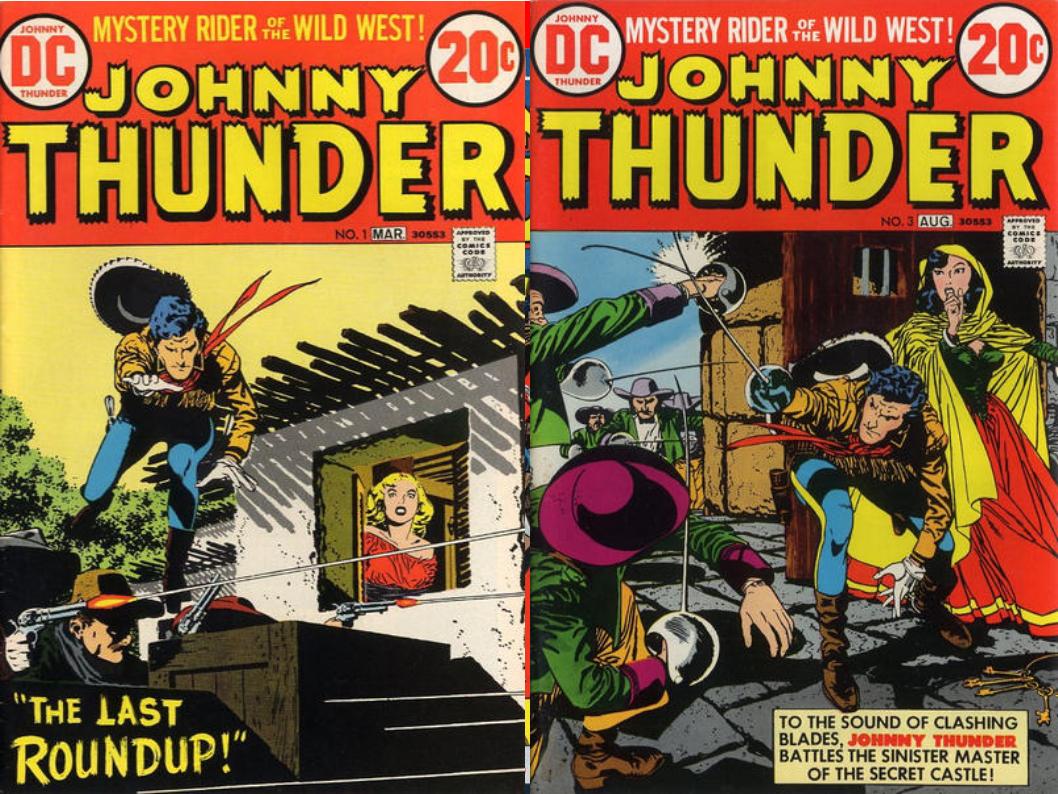
Did you know the classic Western version of Johnny Thunder (with secret identity of John Tane) had his own title in the 1970s?

True, it only featured reprints of his stories (as well as some from Nighthawk/Hannibal Hawkes, the Trigger Twins/Walt and Wayne Trigger) with cover art by Alex Toth....but they did exist!


Johnny Thunder #1 (February-March, 1973)

Johnny Thunder reprints from All-American Western #103 (November, 1948) with The City Without Guns and #125 (April-May, 1952) with Johnny Thunder's Last Roundup and Nighthawk reprint from Western Comics #42 (November-December, 1953) with The Gun-Fighting Statue.


All this and a little on the history of Johnny Thunder by editor E. Nelson Bridwell.


Johnny Thunder #2 (April-May, 1973)

Johnny Thunder reprints from All-Star Western #73 and #74 (October-November, 1953 and December-January 1953/1954) with Battle Of The War Bonnet and Decoy At Canyon Pass, Trigger Twins reprint from All-Star Western #96 (August-September, 1957) with Ambush At Arrow Hill and Nighthawk reprint from Western Comics #71 (September-October, 1958) with The Amazing Quest For Nighthawk's Identity.


Johnny Thunder #3 (July-August, 1973)


Johnny Thunder reprints from All-American Western #122 (October-November, 1951) and All-Star Western #71 (June-July, 1953) with The Real Johnny Thunder and Battle For Mesa City, and Nighthawk reprint from Western Comics #75 (May-June, 1959) with Secret Of The Outlaw Timepiece.


Say, you need a little history of all the people named Johnny Thunder....read more here!


Thursday, July 16, 2020

Wanted Prankster Nightshade Catwoman Black Canary Mars

Here it is, the end of the run for E. Nelson Bridwell's Wanted: The World's Most Dangerous Villains, with villains for Superman, Sandman (these two under a Nick Cardy cover), Batman, Johnny Thunder and Wonder Woman in Prankster, Nightshade, Catwoman, Black Canary and Mars.

The series that ended in the 1970s because no one wanted Wanted (a line attributed to publisher Carmine Infantino at the time)  The last issue of #9, and the tenth issue....

...wait, what?

Well, read on!

Crime's Comedy King

First up for the last issue of Wanted, is a Superman reprint from Action Comics #57 (February, 1943) by Jerry Siegel and John Sikela (with original cover by Sikela), featuring the return of the Prankster...

...who had debuted all of 6 issues ago!


The Prankster returns by punking crime boss King Ruggles on his birthday, tormenting him with bad puns and even worse gimmick gags, but getting the King to give him $100,000 for the promise of over a million in a month.  The Prankster goes to withdraw $50,000 and promptly goes to the police station, and gives himself and the money up!  This gets a call in to Clark Kent and Lois Lane, with Clark changing to Superman to confront King Ruggles, then returning to police HQ to see Prankster leaving....where he stops the villain.

But, Prankster had been released, as he was donating the money to the preservation of ostriches, gaining favor with their supporters, who bailed him out (and turned on Clark Kent....and Superman!).  King Ruggles pulled the bailed Prankster in again, planning to rough him up, but gave him another $25,000.  Clark's editor assigned him to cover Prankster's new endeavor, Appreciation, Inc., that would show people gratitude that had made large donations to charity.  Prankster then got to meet and go to the homes of these wealthy individuals.  Oddly, these people then all saw major thefts.

Prankster reported back to King Ruggles with his million (his scheme fulfilled, as he got to be around the rich, he found ways to rob them).  Of course, Prankster only showed Ruggles the money, as he planned on taking it from him as well.  Superman shows up to stop all of them, but, a quick maneuver takes out Superman (!!!).  The King then plans to dispose of Superman and the Prankster, but Superman wakes up, saves himself, and captures Ruggles (but, the Prankster gets away....).

Prankster would return, with many more gimmicks to make fun of the Man of Steel!


The Adventure Of The Magic Forest

The last story reprinted in Wanted is from World's Finest Comics #6 (Summer, 1942) by Jack Kirby and Joe Simon, featuring Sandman and Sandy (though the issue has a Fred Ray Superman/Batman/Robin cover), featuring the debut of a new villain, Nightshade!


A married couple called the Tuckers and an unlucky explorer have problems in a forest, all observed by a lonely mobster.  This mobster goes back to the home of the Nightshade, who, now that someone knows his value, readies his plan to make criminals wealthy.  Meanwhile, back at young Toby Tucker's birthday party, the lad misses his parents who were suppose to be coming home, and tells his friend, Sandy Hawkins (ward to Wes Dodds, the Sandman).  Sandman and Sandy go off in search of the Tuckers, finding Nightshade's deadly forest, and are attacked by the plants there.  They also find some natural illusions, that lead people (like the Tuckers) to drive off the road.  Thankfully, the Tuckers survived, and the heroes have the police take them home.

Sandman and Sandy go further into the jungle, facing more menaces, as well as mobsters, who were bringing Nightshade money (as he offered his home as a sanctuary to criminals, as the police wouldn't follow them in).  Sandman and Sandy fight the thugs in Nightshade's home, barely escaping with their lives....then the house blows up!  Nightshade planned to kill the thugs for their cash, and now plans to kill the heroes....until his forest seems to turn on him and kill him!  The heroes return to the Tucker party in their alter egos as the forest burns down.

Oddly, Nightshade survived, and returning during World War II during the Crisis, in a few issues of All-Star Squadron (though he got a name change when he joined the Monster Society of Evil to face Dr. Fate and Hourman and more!  Even worked with a fellow Wanted alumni in Mr. Who!).


Thus ended the original run of Wanted, the World's Most Dangerous Villains....but previous issues had promised stories with Catwoman and Wonder Woman....so, as DC collected the original issues, they included a few "newer" reprints as well, including a mock-up cover as well (sadly, Nick Cardy is no longer with us, as he drew Black Canary, Wonder Woman and Catwoman all too rarely....).


The Sleeping Beauties Of Gotham City

First up is a Catwoman story from Batman #84 (June, 1954) by David V. Reed, Sheldon Moldoff and Stan Kaye (under an original cover by Win Mortimer)...

...as Selina Kyle returns to face the dynamic duo of Gotham City.


In Gotham, it just rains cats....as Catwoman lets Batman and Robin know she has a new crime scheme.  Batman reviews Catwoman's career with the police (thinking that she has abandoned her good life as Selina Kyle).  But, Bruce and Dick find Selina entered into a five woman beauty pageant sponsored by the W. Ross Cosmetic Company.  Finding Selina's address their, Batman and Robin go to confront her, to find Selina ready for them (planning to sue for false arrest, as the duo have no proof she is Catwoman).

Catwoman tries a violin heist that night, and thwarts Batman and Robin's attempt to capture her working through the giant instruments.  Then, the duo discover Selina Kyle is now a "modern sleeping beauty",  having gotten a virus, that leaves her comatose (with the cosmetic company putting her in a glass case to use the suffering woman as a marketing ploy).  Catwoman goes to rob two more contestants (who then also fall to the sleeping sickness), all the while with Selina Kyle on full view (and faces Batman one more time), then only Selina remains for the beauty pageant....as she awakens. 

As Batman smells the perfume she is to get as a prize, he realizes her plan....that she had European agents place valuables in the exotic perfume (which got past customs) so she could get her prize (and her ill-gotten booty).  She created a film duplicate of herself to fool the guards watching her sleeping body (having only dosed herself with a bit of the sleeping sickness)

Catwoman would return to face Batman again and again (and she even faced the next villain a few times as well....)

The Black Canary

Next up, a Johnny Thunder tale from Flash Comics #86 (August, 1947) by Robert Kanigher, Carmine Infantino and Joe Giella (under an original Flash cover by Lee Elias and Joe Kubert) that introduced the villainess (yes, that's right) Black Canary!


Say, you wouldn't think Johnny Thunder would be dumb enough to climb a ladder and rob a thug's apartment for a pretty lady, wouldn't you?  (You'd be wrong).  Johnny does, getting a special mask for the pretty lady (who steals the ladder as Johnny throws her the mask).  Johnny calls his Thunderbolt, but is pulled inside by the thugs whose mask he took.  Black Canary needed the mask to get into a special party thrown by Socks Slade (where special masks are the identification for admission).  There, she takes a jewel Socks stole, as Johnny and the T-Bolt wipe up the gangsters.  Black Canary escapes in the confusion (having also stolen Johnny's heart.....).


Black Canary would return, team up with Johnny, eventually replacing his thunderbolt, then Johnny himself in these comic pages, as well as taking his membership in the JSA!

The Girl Who Saved Paradise Island

Last, but certainly not least, a story featuring Mars, the god of war, from Wonder Woman #36 (July-August, 1949) by Robert Kanigher and H. G. Peter (with original cover by Irwin Hasen and Bernard Sachs), adding to Wonder Woman's mythology.


Wonder Woman starts this tale with her mother and tales from ancient Sparta, where soldiers would leave baby girls to be eaten by wolves...yet Diana's mother, Hippolyte, and her amazons were there to rescue the girls, including Astra (who, even as a baby could defend herself).  The Queen took the babies to Infanta, the child planet, where the girls could grow up (a little, retaining eternal youth, yet also having powers as well, with Astra becoming Infanta's child Queen). 

Mars, tired of the amazons, took the young boys of Sparta as his troops on the planet Duxo, and with the help of Lord Conquest, training them to hate the amazons.  Mars then launched his forces from Duxo, which Steve Trevor detected, seeing an invasion fleet coming to Earth (and notifying Wonder Woman), but that their target was harmless...in the middle of the ocean (but Wonder Woman knew that to be the home of Paradise Island, so she went to defend it).  Mars' boys were able to defeat Hippolyte and her amazons, but Wonder Woman, Queen Astra and her girls were able to turn the tables on the boys of Duxo....freeing them from Mars, and taking them to learn the ways of peace on Infanta.

Astra, Conquest and Mars would return (in fact, all of them did in Sensation Comics #92!).

While the collection did not include the two DC Specials which led to the Wanted series, DC's Wanted the World's Most Dangerous Super-Villains recent collection did include the nine issues of that series (including the Trickster, Solomon Grundy, Dr. Light and Captain Cold (and more).

A wonderful tribute to lasting villainy.....and the love of comics had by E. Nelson Bridwell.


Thursday, July 7, 2016

Happy Birthday Johnny Thunder

Say, you know today, July 7th, is the birthday of Johnny Thunder?

Who is Johnny Thunder you might ask?

Johnny is a Golden Age superhero (or, as they were called back then, mystery man), who premiered in Flash Comics #1 (January, 1940) by John B. Wentworth and Stan Aschmeier.  Johnny was born in the Bronx, on the seventh day of the seventh month on a year that ended with seven (1917), but kidnapped by the High Priest of Aissor to be taken to the country of Badhnisia.

There, he was given power over the Thunderbolt called Yz with the phrase Cei-U (which, sounds like "say, you"), and Johnny could control when he uttered the T-Bolt's control phrase and command to do whatever Johnny could think of (but Johnny wasn't exactly a deep thinker).  Johnny joined both the Justice Society of America and wartime All-Star Squadron, and worked tirelessly for the good, surviving many a Crisis....and even appearing recently in DC Universe: Rebirth #1 (July, 2016), though you might not have recognized the old man without his Thunderbolt.

Johnny wasn't the only one to weld a Thunderbolt!  Here's a look at a few others....

Jonni Thunder, Detective

Jonni Thunder first appeared in Jonni Thunder #1 (February, 1985), the first of four issues by writers Roy and Dann Thomas, and drawn by Dick Giordano.

Jonni was a west coast detective who lived an ordinary life with her '57 Thunderbird...at least until a laser blast hit an old statue of her dad's....and Jonni was able to manifest as an energy being similar to lightning, with all its properties, while her body was unconscious.

Still had to solve crimes, though her new ability with the Thunderbolt helped, and at least for the mini-series, lived without other super-heroes, though Jonni make it to the Monitor's satellite (and cover of Crisis On Infinite Earths #5, next to the Golden Age Flash and above Psycho-Pirate) and did participate at a detective's convention in Crisis On Infinite Earths along with Harvey Bullock and Christopher Chance (the Human Target), in a case involving Angle Man's Angler (and helping the Star-Spangled Kid fight original Green Lantern foe, Knodar, the last criminal, in Infinity, Inc. #24 from March, 1986, placing Jonni on Earth-2....for as long as Earth-2 lasted after Crisis). 

Jonni was attacked by her Thunderbolt in Infinity, Inc. #31 (October, 1986), and drew closer to Sylvester.  Jonni stuck around Infinity, Inc., as she and Sylvester Pemberton (the former Star-Spangled Kid turned Skyman), and found out the plan of the Thunderbolt in Infinity, Inc. #40 and #41 (July and August, 1987), as the Thunderbolt got a name (that of Mzzttexxal, and a male Thunderbolt named Zzlrrrzzzm possessed Skyman to become Skybolt), and Jonni pretty much disappearing after the disbanding of Infinity, Inc. in Infinity, Inc. #53 (August, 1988). 

JJ Thunder, JSA

Jakeem Thunder or J.J. Thunder ended up being the alias for Jakeem Johnny Williams, who first appeared (though not named) in Flash #134 (February, 1998), as the Golden Age Flash was looking for the Thinker's Thinking Cap, and Johnny Thunder had turned it into a flower pot at the old age home he lived in.  Johnny also had his Thunderbolt in a pen, which J.J. took, which led to JLA #28 to #31 (April to July, 1999) by Grant Morrison and Howard Porter, where Jakeem helped against an invasion from the 5th dimension, that occupied the JLA and remainders of the JSA (Flash, Wildcat, Green Lantern, Wonder Woman/Hippolyta and the Spectre-force without Jim Corrigan), as well as Captain Marvel face Thunderbolt Lkz, with J.J. releasing Yz, eventually merging Lkz with Yz, giving Jakeem the ability to control the combined Thunderbolt with the phrase, "So Cool", and this Crisis Times Five also led into the reformation of the JSA during the Day of Judgment and the JSA's battle with Mordru.

Jakeem's most important storyline ran from JSA #32 to #37 (March to August, 2002), where Earth was threatened by the Ultra-Humanite (secretly in control of Johnny Thunder's body), who uses the T-Bolt to change the world into one of his liking!  During the course of the battle to regain the world, Johnny Thunder suffers fatal wounds, yet merges with the Thunderbolt to become "Johnny Thunderbolt"....with J.J. Thunder now in charge of the combined Johnny and Yz!  Soon after this experience, Jakeem joins the JSA.

Jakeem eventually had a solo story as well, in JSA: Classified #28 (September, 2007). 


Johnny Thunder, Lawman

John Tane was the son of a sheriff and teacher, and wanted to honor them both, but his mother didn't want him participating in the violence western law required.  So, John came up with the identity of Johnny Thunder to fight evil, and did so with his horse, Black Lightning, starting with All-American Comics #100 (August, 1948) by Robert Kanigher and Alex Toth.  Johnny stayed with the title, even when it changed to All-American Western with #103 (November, 1948, losing super-heroes like the Golden Age Green Lantern), staying there until All-American Western #126 (June-July, 1952), where the title changed after to All-American Men of War, and Johnny's feature continued in All-Star Western with #67 (October-November, 1952), though the Trigger Twins (another western feature) kept most of the covers though, with Johnny getting a few, and all towards the end, with All-Star Western #119 (June-July, 1961), with adventures from the 1850s and 1860s.

Johnny updated from his brown western duds to a red and blue outfit in All-Star Western #108 (August-September, 1959), met Madame .44 (Jeanne Walker) in All-Star Western #117 (February-March, 1961, coincidentally the same issue that the Super-Chief first appeared in a separate story, set in the 1490s).  Madame .44 fought with Johnny for his last three appearances, but ended up marrying him, and having kids, as revealed in DC Comics Presents #28 (December, 1980), and even appeared in the Crisis on Infinite Earths of 1985 (though it was 1885 from Johnny's point of view), where he worked with Jonah Hex, Scalphunter, Bat Lash and Nighthawk.  Johnny and Madame .44 also teamed up with Super-Chief, the western El Diablo and Jonah Hex, as well as Firehair and Hawk (son of Tomahawk)....the last two at the end of their careers, all to deal with Swamp Thing (at a time set between the flashback and main story of DC Comics Presents #28) in Swamp Thing #85 (April, 1989).  All of which shows that a western focused article should come on soon...

Evil Earth-1 Johnny

Johnny Thunder had an alternate Earth duplicate (being evil on Earth-1, while the original Johnny was good on Earth-2), who first appeared in Justice League of America #37 (August, 1965) by Gardner Fox and Mike Sekowsky, but this Johnny Thunder was evil, putting criminals into the origins of the JLA members, and only being stopped by the JSA in Justice League of America #38 (September, 1965).  This Johnny Thunder returned in Justice League of America #219 and #220 (October and November, 1983), working with the Crime Champions (villains of two Earths, like the Wizard and Chronos), and again manipulating the Thunderbolt for his own ends.

Johnny also had Bahdnesian Kiku Thunder, who was in the 10 issue Justice Society of America series of the early 1990s (with Jesse Quick), and Willpower (William Twotrees) who was revealed to be Johnny's son in issues of Primal Force, but these characters never really broke out of those series, so will likely get more coverage when those series are covered.


Say, you want to find out more about the original Johnny Thunder?  Read a little of his Justice Society history here, and where to find reprints of his individual Golden Age stories here!


Wednesday, September 9, 2015

Guide to Golden Age Mr. Terrific, Wildcat and More Reprints

Continuing our look back at how to find the earliest reprints of various JSAers, and we'll look at a few team members that didn't fare so well...folks like Mr. Terrific, Wildcat, Johnny Thunder and the Red Tornado, members who were valuable parts of the JSA, but just haven't been able to get their solo Golden Age adventures out there.

Mr. Terrific


Terry Sloane was the master of fair play, and being smarter than everyone, graduating college at twelve!  He became bored and planned to end it all....but instead helped a young woman and her brother, and became the hero, Mr. Terrific!

All this happened in his first appearance, "Who Is Mr. Terrific?" in Sensation Comics #1 (January, 1942) by Charles Reizenstein and Harold W. Sharp.

This story was reprinted in the Famous First Edition C-30 of 1974 and in the Millennium Edition: Sensation Comics #1 (October, 2000), but more as this was the start of Wonder Woman's first regular series.

Mr. Terrific found a second story of his reprinted, this from the Big All-American Comic Book of 1944, entitled "Models For Crime", with no identified writer, and art by Stan Aschmeier, where Terry faces the criminal, "Money" Lowy.

This story was reprinted in the DC Comics Rarities Archives #1 of 2005, and also features Wildcat, Johnny Thunder, Ma Hunkel and a few other Golden Age characters as well like Hawkman, Green Lantern, Wonder Woman and the Flash!

Sadly, only the first five of Mr. Terrific's Golden Age tales from Sensation Comics #1 to Sensation Comics #5 (May, 1942, all by Charles Reizenstein and Hal Sharp) were reprinted in the JSA All-Stars Archives #1 of 2007, but he was in good company (but they still had many stories to reprint, as Mr. Terrific had a series until Sensation Comics #63 of March, 1947).

Mr. Terrific's one and only other Golden Age appearance was in All-Star Comics #24 (Spring, 1945), which was reprinted in All-Star Comics Archives #6 of 2000, and you can read more about him joining the JSA here!

Wildcat


Ted Grant was a boxer framed for a murder, but he refused to give up the fight, becoming Wildcat to clear his name (and continuing the fight even after, as Ted just refused to stop fighting for us all!).  This happened in Sensation Comics #1 (January, 1942) by Bill Finger and Irwin Hasen, in "This Is The Story Of Wildcat".

This story was reprinted in the Famous First Edition C-30 of 1974 and in the Millennium Edition: Sensation Comics #1 (October, 2000) all along with Mr. Terrific's tale, as well as in Secret Origins #3 (July-August, 1973) with a cover by Nick Cardy and in the Greatest Golden Age Stories Ever Told hardcover of 1990 with a Jerry Ordway cover.

Wildcat found another story reprinted from Sensation Comics #4 (April, 1942) with "Stretch Skinner, Dee-teca-tif" by Bill Finger and Irwin Hasen.  Stretch (whose first name was Hiram), made his first appearance here, and continued to help Wildcat during his career as a detective (and sometimes as Ted Grant's manager).

This story was reprinted in 100-Page Super-Spectacular DC-14 of February, 1973 and includes Golden Age reprints of Batman, Wonder Woman, Blackhawk and Doll Man all under a wraparound cover by Nick Cardy!

Wildcat and Stretch later found two more appearances reprinted, stories from Comic Cavalcade #1 (Winter, 1942) of "Crime Takes A Count" by Bill Finger and Irwin Hasen, and Comic Cavalcade #2 (Spring, 1943) of "The Story Behind The Bellyache" also by Finger and Hasen, with the two taking a swing at criminals, putting them down for the count!


Both these stories were reprinted in Comic Cavalcade Archives #1 of 2005, along with the rest of the contents of those issues (and Comic Cavalcade #3 of Summer, 1943, which didn't include Wildcat), including Golden Age stories of Green Lantern, Wonder Woman and Flash, and even the Black Pirate, Hop Harrigan and Scribbly.


Wildcat was also in the Big All-American Comic Book of 1944, where "Wildcat Met The Kidder", with no identified writer, and art by Joe Gallagher; along with Mr. Terrific and more, and it was still reprinted in the DC Comics Rarities Archives #1 of 2005.

Wildcat faced trouble in "The Wasp's Nest" with no identified writer, but art by Joe Kubert in Sensation Comics #66 (June, 1947), where he and Stretch Skinner faced the Yellow Wasp (who had appeared before, in the Wildcat stories in Sensation Comics #20 and #25, both not reprinted).


This story was reprinted in Wanted: The World's Most Dangerous Villains #6 (February, 1973), with a cover by Nick Cardy (and the villain being called the Golden Wasp, which led to some confusion over the years).  The issue also featured Starman and Sargon!

Wildcat's next reprinted appearance was from Sensation Comics #71 (November, 1947) with "The Count That Never Ended" by Robert Kanigher and Gil Kane, where Wildcat faced his foe, the original Huntress (who appeared in Sensation Comics #68 and #69, both not reprinted).  This was the original Huntress, not Helena Wayne, daughter of Batman (though she faced her as well).


This story was reprinted in 100-Page Super-Spectacular DC-20 of September, 1973 along with a Black Canary tale (and a few other Golden Age stories), and Black Canary and Starman faced off against the original Huntress as well in Brave and the Bold #62 (October-November, 1965), and Black Canary was there when Huntress was part of the Injustice Society of the World returned to fight the JSA in All-Star Comics #41 (June-July, 1948).


Sensation Comics #84 (December, 1948) with "The Monkey's Circle" has the last of Wildcat's original run to be reprinted, with no identified writer and art by Bernie Krigstein, and has Wildcat and Stretch facing off against an evil organ grinder and his pet monkeys!


This tale found its way into Justice League of America #96 (February, 1972), along with a Golden Age Hourman reprint and under a cover drawn by Neal Adams; Wildcat still was featured in Sensation Comics all the way up until Sensation Comics #90 (June, 1949).


But, there was one more Golden Age Wildcat story to be told!


This unpublished Golden Age tale of Wildcat, "Crime Wore A Costume" by Robert Kanigher and Jon C. Kozlak found its way into DC 100 Page Super Spectacular #6 (1971) with a stunning Neal Adams cover that included Wildcat facing the Huntress, as well as a few other reprints including Johnny Quick and Vigilante (and the issue had Golden Age reprints of theirs as well).

This reprint also found itself reprinted, as the DC 100 Page Super Spectacular #6 Replica Edition in May, 2004.

Wildcat's Golden Age JSA adventures including how he joined the team are recapped here!

Wildcat, like many other JSAers, found his first five stories (from Sensation Comics #1 to Sensation Comics #5 of May, 1942) reprinted in the JSA All-Stars Archives #1 of 2007.


Johnny Thunder

Say, you'd think we'd be happy to see Johnny Thunder, and his magic Thunderbolt (called Cei-U, pronounced "say, you") and his first appearance in Flash Comics #1 (January, 1940) from the story "The Kidnapping of Johnny Thunder" by John B. Wentworth and Stan Aschmeier?

Well, we are, and this story has his origins.

This story has been reprinted a few times, in Famous First Edition F-8 (August-September, 1975) and in the Millennium Edition: Flash Comics #1 (September, 2000), but likely more because the book is also the first appearance of the Golden Age Hawkman and Flash....but, hey, Johnny was there too!

Unfortunately, most of Johnny's reprints came because he was in a book where others had stories reprinted.  Johnny was in the New York World's Fair Comics #2 (1940) with the story "At The World's Fair" by John B. Wentworth and Stan Aschmeier, where Johnny tries to impress his girlfriend, Daisy Darling, but ends up getting his wallet stolen (and later found by the Thunderbolt).  Johnny was also in the the Big All-American Comic Book (1944) in a story by Julius Schwartz and Stan Aschmeier, where Johnny and his adopted daughter, "Peachy Pet Met the Big Bad Wolf".  Both of these tales were reprinted in the DC Comics Rarities Archives #1 of 2005 along with many other Golden Age tales, including stories from Wildcat, Mr. Terrific, Hourman and the Atom.

Johnny also had a solo tale in in All-Star Comics #2 (Fall, 1940) with "The Darling Apartment" by John B. Wentworth and Stan Aschmeier, with Johnny, Daisy and her dad dealing with a crooked political boss.

This story was reprinted in All-Star Comics Archives #0 from 2006, and Johnny was popular enough to stay as a regular guest of the Justice Society in their earliest appearances, and even had solo tales in All-Star Comics #4 (March-April, 1941) and in All-Star Comics #5 (June-July, 1941), although Johnny didn't become a member until All-Star Comics #6 (August-September, 1941) (and All-Star Comics #3 to #6 are reprinted in All-Star Comics Archives #1 from 1992, where you can read more about Johnny, and you can read how he joined the JSA here).

Johnny's first five stories from Flash Comics (Flash Comics #1 to Flash Comics #5 of May, 1940) were reprinted in the JSA All-Stars Archives #1 of 2007, and oddly (and thankfully), his last six Golden Age solo appearances were also collected...


...as in Flash Comics #86 (August, 1947), Black Canary premiered in Johnny's strip, and his tales from Flash Comics #86 to Flash Comics #91 (January, 1948) were reprinted in The Black Canary Archives #1 along with the rest of her Golden Age tales and more!


So, Johnny was helped out by his friends!


Red Tornado


Last, but never least is the stories of Ma Hunkel, who first appeared in All-American Comics #3 (June, 1939), as a neighbor of Scribbly (a boy cartoonist, based on Sheldon Mayer, who wrote and drew the Scribbly feature).


With All-American Comics #20 (November, 1940) by Sheldon Mayer, Ma realized she needed to adopt a super-heroic identity to help her kids, and put on longjohns and a pot, and became...the Red Tornado!

Ma's first five tales as the Red Tornado were reprinted (along with Golden Age Superman, Batman and Plastic Man tales) in "A Smithsonian Book of Comic Book Comics" in 1981.

Ma's first five tales as the Red Tornado, from All-American Comics #20 to All-American Comics #24 (March, 1941) were also reprinted in the JSA All-Stars Archives #1 of 2007 along with those of Dr. Mid-Nite, Hourman, the Atom, Mr. Terrific, Wildcat and Johnny Thunder.

Would that there be more Archives of these delightful tales!