Showing posts with label Flash Comics. Show all posts

Wednesday, February 14, 2018

Love Giant Lois Lane

True, it was still the title of Superman's Girl Friend, but even though Superman and Lois Lane loved each other, it was shown on a few occasions that Lois might love someone else, or that Superman might have someone else in his life...

....or that Lois would have to move on from Superman, as you can see on the cover of Superman's Girl Friend, Lois Lane #113 (September-October, 1971) by Dick Giordano (which was also Giant #G-87, but not quite the 80-Page Giants of the past, as this one only had 68 pages.....).


Still, it brought back quite a few tales of love...


Superman's Girl Friend, Lois Lane #49

First up was "The Unknown Superman" from Superman's Girl Friend, Lois Lane #49 (May, 1964) by an unknown writer and artist Kurt Schaffenberger.

Lois tests out a device by a Dr. Drolc, which allows her to trace talents, which she proves works.  So, she finds Strong Bear, an Indian man with super powers, and the two fall in love, then plan to marry.  Looking at the ring his tribe gives her, she realizes that Strong Bear really was Dr. Drolc, and others whom she had found during her testing.  Lois breaks the ring, and Strong Bear becomes a small blue alien man, the last survivor of the nuclear war which devastated his planet, who had been using the ring to take human form, allowing him to survive on Earth.  He did love Lois, but, without the ring, he was unable to survive on Earth and dies....

Superman's Girl Friend, Lois Lane #54

Superman's Girl Friend, Lois Lane #54 (January, 1965) is the next tale up, with "The Monster Who Loved Lois Lane" by Edmond Hamilton and Kurt Schaffenberger.

This time around, it was the inter-dimensional alien of Herko that falls for Lois, having been brought to Lois' dimension by Dr. Elder, and the super-strong and invulnerable alien immediately falls in love with Lois.  Lois leads Herko away from populated areas, giving Dr. Elder time to repair his machine.  Herko even proves a match for Superman for a bit, and, after the doctor finishes his repairs, Lois leads the love struck alien back to a portal to his own dimension, where he is heartbroken, having to live there without Lois Lane.

Superman's Girl Friend, Lois Lane #57

Next up is "The Return Of Lois' Monster Sweetheart" from Superman's Girl Friend, Lois Lane #57 (May, 1965, by Edmond Hamilton and Kurt Schaffenberger, though that feature didn't make the cover...).

Feeling a little guilty about what she did to Herko, Lois goes to check up on him with help from Jimmy Olsen, but the two accidentally get trapped in Herko's dimension.  While there, Herko tries to renew his relationship with Lois, but Lois finds Zagga (a female member of Herko's race, who happens to love Herko).  Lois convinces Jimmy to try to woo Zagga, hoping to make Herko jealous and pursue Zagga, but this plan backfires, nearly resulting in a double wedding of Earthers and aliens.  Thankfully, Lois' makeup makes Herko sick, and he falls for Zagga as she helps him recover, while Dr. Elder fixes his machine to bring Lois and Jimmy home.

Superman's Girl Friend, Lois Lane #43

With Superman's Girl Friend, Lois Lane #43 (August, 1963), Lois became "The Girl Who Mourned For Superman", in a story by Leo Dorfman and Kurt Schaffenberger (with another story not featured on the original cover of the issue).

This time around, an electrical experiment with the Jimmy Olsen Fan Club transports Lois to an alternate Earth (but this one was so similar, she wasn't aware she was on an alternate planet).   Here, Lex Luthor traps her, and is able to kill Superman (but dies in the process).  Lois lives there long enough to see a robot replace Superman, then a Kandorian....before she meets an ambassador from Atlantis (which had not sunk in this world).  Lois visits her doppleganger without revealing herself, and ends up back home after getting another unintentional electric shock.

Superman's Girl Friend, Lois Lane #41


The last Lois Lane story of this giant was from Superman's Girl Friend, Lois Lane #41 (May, 1963), with "Superman's Romance With Lana Lane" by Jerry Siegel, Curt Swan and George Klein.

Wait a minute...Lana Lane?  Yes, a few years before this story, Lana and Lois were merged into one girl by an alien pendant, and Superman, realizing he is getting the best of both worlds, proposes to the merged woman (believing this change would be permanent).  Unfortunately, it was not, and Superman realized they would both die.  Superman came up with a way to save one with a magic statue, but thankfully radiation from a strange meteor safely separated the two, and Superman, confronted by the pair, refuses to admit which of them he would have saved.


Unpublished Flash/Rose And Thorn Story

There is part of one more story in this issue, an unpublished Flash Comics Rose And Thorn Story from the tail end of the Golden Age by Robert Kanigher and Joe Kubert.

At least, it is two pages of this story, with the Golden Age Flash, Jay Garrick, saving Joan Williams from the evil Thorn, who turns back to her good side of Rose, with Flash giving Rose to Green Lantern to take to Wonder Woman's island, to make sure she is reformed. 

More on this Rose and Thorn, and her more modern version who was a heroic back-up in Lois Lane, is available here, and, if you loved this, more Giant Lois Lane fun can be found here, with the eventual results of that union of Green Lantern and Thorn pop up here, as Roy Thomas used this untold tale during his run on Infinity, Inc.  


Thursday, October 8, 2015

Guide to Golden Age Hawkman and Hawkgirl Reprints

Continuing our look back at the Golden Age, and where to find them now, we go all the way back to ancient Egypt....or the early days of World War II, with the high-flying Hawkman, and his partner, Hawkgirl.

Carter Hall was an archeologist and weapons collector, who came into possession of a knife which high priest Hath-Set killed Prince Khufu of ancient Egypt...and when Carter touched it, he saw Khufu's death and realized he was Khufu reborn!  Soon after, Carter met Shiera Sanders (the reincarnation of Khufu's eternal love, Chay-Ara) and ended up donning wings of the anti-gravity Nth metal and using ancient weapons to battle Dr. Anton Hastor, the reincarnation of Hath-Set, with Hawkman winning this time!

All this from Flash Comics #1 (January, 1940) with "The Origin of Hawkman" by Gardner Fox and Dennis Neville.

This story was reprinted many times, in the Famous First Edition F-8 of August-September, 1975, in the Secret Origins of the Super DC Heroes of 1976 (in both hardcover and soft cover, with cover by Neal Adams, and also had the Silver Age Hawkman origin), and in the Millennium Edition: Flash Comics #1 of September, 2000.

Hawkman fought the "Thought Terror" in Flash Comics #4 (April, 1940) by Gardner Fox and Sheldon Moldoff, where Carter faced a hypnotist called the Thought Terror with Shiera's help (though she had yet to don any winged identity....).


This story was found again in the Greatest Golden Age Stories Ever Told hardcover of 1990, which featured a stunning cover by Jerry Ordway, and many Golden Age stories that were, well, just great, and featured a few other JSAers like Flash, Wildcat, Sandman, Green Lantern, Superman, Wonder Woman, Batman, Black Canary and the Spectre as well!


Hawkman's next reprinted story was from Flash Comics #5 (May, 1940) by Gardner Fox and Sheldon Moldoff, later titled "The Kidnapping Of Ione Craig", a female secret agent, that Carter had to save from Hassan Ibn Sadah and his assassins (and no Shiera to be found in this story!).


This story was dug up by the comic archeologist of Jules Feiffer and reprinted in The Great Comic Book Heroes of 1965...

...along with other Golden Age tales of Superman, Batman, Flash, Green Lantern, Spectre, Wonder Woman and more.

Hawkman took on a crooked doctor in Flash Comics #12 (December, 1940) in "The Heart Patient" by Gardner Fox and Sheldon Moldoff, where Carter was helping his friend, Tommy Rogers, who had been convinced he had a bad heart by his girlfriend, Betty Tremont.  Even back in the 1940s there were problems with healthcare fraud!


This story was reprinted in Hawkman #25 (April-May, 1968) in an issue featuring a cover by Dick Dillin, and a new story about the Silver Age Hawkman (who was the feature of the book).  Sadly, the Golden Age and Silver Age Hawkmen never teamed up in the Hawkman book, like the Flashes, Green Lanterns and Atoms did (in their own respective Silver Age titles).

Next up for Hawkman is an important comic for Shiera Sanders, Flash Comics #24 (December, 1941) later entitled "Meet Hawkwoman", though it was technically the first appearance of Hawkgirl!  Shiera was given a hawk costume for a costume party, and she ended up going into action at the event, when birds mistook her for Hawkman.  This wasn't Shiera's first time in a hawk costume, as she went into action in All-Star Comics #5 (June-July, 1941), but she kept at it after this.

This story was reprinted in Superman #252 (June, 1972) under a high-flying cover by Neal Adams, and this issue also features Golden Age Stories of Dr. Fate, the Spectre, Starman, Superman and more!

The Hawkman story from Flash Comics #71 (May, 1946) by Gardner Fox and Joe Kubert involved "The Land Of The Bird People" (later known better as Feithera) and had Hawkman find this land in the arctic, including Trata (the villain of the piece), and Worla (the leader of the bird people).
 
This city's existence is kept a secret, but later on, Norda (known as Northwind) from Infinity, Inc. is revealed to be Worla's grandson (and son of Osroro and friend of Carter's, archeologist Fred Cantrell).  This story was represented in Infinity, Inc. #4 (July, 1984) under a shocking Jerry Ordway cover, and "The Land Of The Bird People" was partially redrawn by Al Dellinges (who did a wonderful job, but does make it a question of whether this was a true reprint).

It is first appearance time with the story of "The Ghost" from Flash Comics #88 (October, 1947) by Robert Kanigher and Joe Kubert, though the character's name was technically the Gentleman Ghost (a ghost by the name of Jim Craddock).  Gentleman Ghost would go on to menace Hawkman and Hawkgirl again, and even cross Earths to menace the Silver Age Hawkman and the Atom!


This tale can be rediscovered in Secret Origins #1 (February-March, 1973) along with the origins of Superman, Flash (Barry Allen) and Batman, all under a cover by Nick Cardy, and series edited by E. Nelson Bridwell (who helped dig up so many of these glorious Golden Age tales).

The Gentleman Ghost came back in Flash Comics #90 (December, 1947) in "The Crimes That Couldn't Have Happened" facing off against Hawkman and Hawkgirl again, this time in Africa, in a story by Robert Kanigher and Joe Kubert.


This story was reprinted in Wanted, the World's Most Dangerous Villains #7 (March-April, 1973) under a Nick Cardy cover (that featured Hourman and Johnny Quick's Golden Age stories), in this other E. Nelson Bridwell edited 9 issue series that focused on reprints of stories featuring DC's bad guys, mostly with stories from the Golden Age.


The Gentleman Ghost was back again in Flash Comics #92 (February, 1948) with the "Riddle Of The Clown" by Robert Kanigher and Joe Kubert, with Hawkman and Hawkgirl facing off with their persistent foe in Paris, and again avoiding capture by apparently dying (as Hawkman had doubts whether gentleman Jim was really a ghost...).


This story was unearthed again in Detective Comics #439 (February-March, 1973) along with Golden Age Dr. Fate and Kid Eternity reprints (and Silver Age reprints of Batman, Elongated Man and the Atom, as well as new Batman stories and a new Manhunter story by Archie Goodwin and Walter Simonson, putting a new spin on a Golden Age character), all under a cover by Neal Adams and Dick Giordano.

The last of Hawkman's reprinted solo tales not in a larger collection is Flash Comics #100 (October, 1948) with "The Human Fly Bandits" by John Broome and Joe Kubert, with Hawkman and Hawkgirl facing John Rotor and his henchmen (and having to fight their way out of a giant thermometer in a Batman related twist, as it was Batman and Robin who were usually trapped in giant death-traps!).


This tale was reprinted in Wanted, the World's Most Dangerous Villains #3 (November, 1972) under a Nick Cardy cover, and also had Golden Age Dr. Fate and Vigilante reprints.  Hawkman and Hawkgirl continued on with solo stories until Flash Comics #104 (February, 1949), but had a few other Golden Age appearances as well.


The biggest of which was in the Big All-American Comic Book of 1944 (a collection of many tales) with "A Hot Time In The Old Town" by Gardner Fox and Joe Kubert, with Hawkman and Hawkgirl facing off against Hot Shot, a foe who liked to set fires and needed heat to survive.

This story was reprinted in the DC Comics Rarities Archive #1 of 2005, along with plenty of different Golden Age characters stories, including fellow JSAers Green Lantern, Flash, Superman, Batman, Sandman, Wildcat, Mr. Terrific, Johnny Thunder, Atom, Hourman and even characters like Slam Bradly, Zatara and the Ghost Patrol!

More importantly, Hawkman has solo stories in All-Star Comics #1 and #2 in 1940, with All-Star Comics #1 (Summer, 1940) featuring Hawkman fighting the sorcerer Trygg and his army of zombies in a story by Gardner Fox and Sheldon Moldoff, and in All-Star Comics #2 (Fall, 1940) with Hawkman facing the Aztec priestess of Nyola, sacrificing people to her god, Yum-Chac.

These stories were reprinted in the the All-Star Comics Archives #0 of 2006, and Hawkman was there for the formation of the JSA with All-Star Comics #3 (Winter, 1940-1941) and the only one there for all 57 Golden Age issues of All-Star Comics (which themselves were reprinted in 12 total All-Star Comics Archives, making the JSA tales complete)!

Sadly, Hawkman's Golden Age tales aren't complete and need to be unearthed, as Hawkman only got one Golden Age Hawkman Archives in 2006, featuring Hawkman's solo tales from Flash Comics #1 to Flash Comics #22 (October, 1941)...


...getting more Golden Age reprints would sure be a reason to bring back DC's Archives, if only to see some of Hawkgirl's earliest tales, as well as villains like the Coin, the Hummingbird, Simple Simon, and the Monocle and friends like Neptune Perkins!


Thursday, October 1, 2015

Guide to Golden Age Flash Reprints

Jay Garrick first picked up the hat of the Flash in Flash Comics #1 (January, 1940) by Gardner Fox and Harry Lampert...and that series lasted 104 issues, as well as spinning off into All-Flash comics (starting with All-Flash Quarterly #1 in Summer of 1941, which lasted 32 issues), as well as appearing in All-Star Comics with the Justice Society of America (and in Comic Cavalcade with Green Lantern and Wonder Woman), all in the Golden Age...

...so, how do you find those Golden Age tales now?

Flash Comics

Jay first appeared in Flash Comics, so that's where we'll start running...with Flash Comics #1 (January, 1940) with "The Origin of the Flash" by Gardner Fox and Harry Lampert, this is where college student Jay Garrick accidentally inhales some "hard water" and wakes up out of a coma with the ability to move and think at super-speed!  Later, Jay moves to New York, being an assistant professor, and taking up the mantle of the Flash to save the life of the father of his girlfriend, Joan Williams, from Sieur Satan and his Faultless Four!

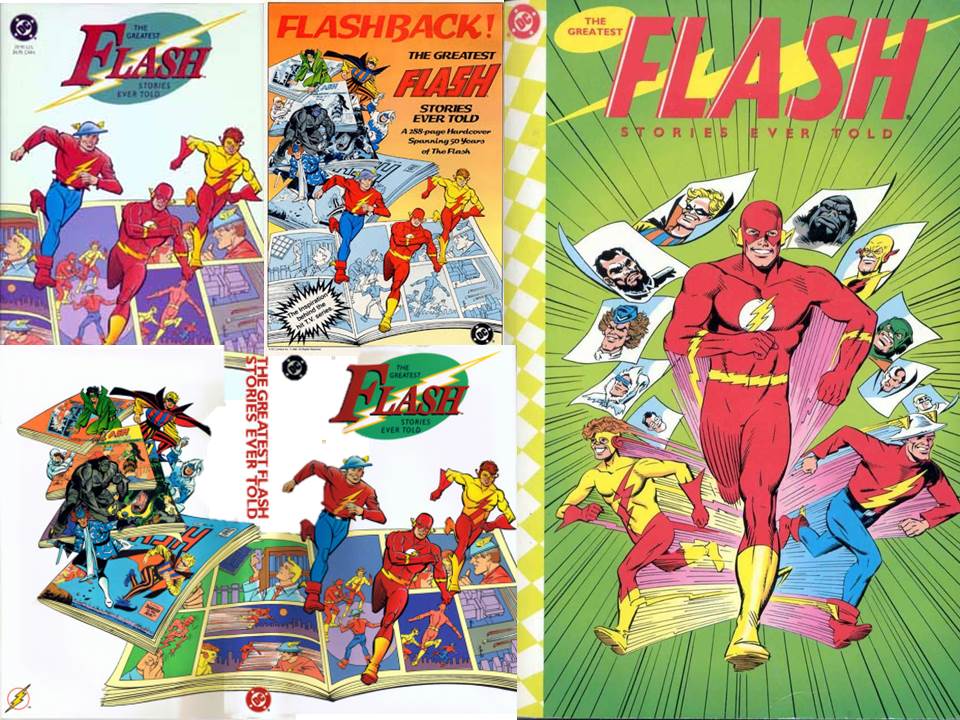
This tale has been reprinted many times, first in The Great Comic Book Heroes of 1965, then in the Famous First Edition F-8 of August-September, 1975, in the Secret Origins of the Super DC Heroes of 1976 (in both hardcover and soft cover), in the Greatest Flash Stories Ever Told (hardcover in 1991 and softcover in 1992), in the Millennium Edition: Flash Comics #1 of September, 2000, and in the Flash: A Celebration of 75 Years of 2015.

Flash's next solo reprint from Flash Comics is from Flash Comics #66 (August-September, 1945), with "The Flash and the Black Widow" by Robert Bloch and Everett Hibbard, with Jay, Joan and the Three Dimwits (Winky, Blinky and Noddy) facing off against Princess Helene and her transforming formula.

This tale is reprinted in the Greatest Flash Stories Ever Told hardcover of 1991, and in the Greatest Flash Stories Ever Told soft cover of 1992, both having covers by Carmine Infantino (who would be better known for his art with Barry Allen Flash!).

These two Greatest Flash Stories Ever Told collections also have the next Flash Comics story, that of Flash Comics #86 (August, 1947) with Jay and Joan facing dinosaurs in the "Stone Age Menace" by Robert Kanigher, Lee Elias and Joe Kubert.


This story was also reprinted in the Flash: Greatest Stories Ever Told tradepaperback of 2007, with an Alex Ross cover (though, again, the focus is on Barry Allen Flash, there are a couple of Jay stories in there!).


Flash Comics #90 (December, 1947) is the next Flash Comics issue to be reprinted, with the story of "Nine Empty Uniforms" by Robert Kanigher and Carmine Infantino, where the Flash helps a baseball team, the Bobtails, who are on a losing steak, and defeat a gambler who was betting against them (though this wasn't THE Gambler, a Green Lantern foe...).


This tale was reprinted in the 80-Page Giant #4 (October, 1964), under a cover by Carmine Infantino and Murphy Anderson, with a collection of odd Barry Allen Flash stories!

Dig the expressions on Barry Allen's face!


Flash Comics #94 (April, 1948) is the next treat reprinted, featuring the tale of Dr. Maria Flura, who ended up waking up on death's row....with no idea how she got there, being convicted of the murder of Professor Lexon!  All this in the tale "The Images of Doom", by Robert Kanigher and Carmine Infantino, in a follow up to her appearance in All-Flash Comics #31.


This tale found itself reprinted in Flash #232 (March-April, 1974) under a Nick Cardy cover (who drew a lot of covers that reprinted Golden Age DC tales)...

...and along with a couple of Barry Allen team-up stories, featured a Golden Age Johnny Quick story!


The last of the Flash Comics stories to be found alone is the last published solo Golden Age Flash story, Flash Comics #104 (February, 1949) with "The Rival Flash" by Robert Kanigher and Carmine Infantino, with Flash facing a foe who was his rival...and had super-speed equal to the Flash's own!  Nothing worse than a villainous speedster...

This tale has been reprinted many times, starting with Flash #211 (December, 1971) under a cover by Irv Novick and Dick Giordano, in the Flash Archives #1 of 1996 (which then reprints Barry Allen's earliest appearances including all 4 of his Showcase appearances), in the Flash: The Greatest Stories Ever Told tradepaperback of 2007 and in the Flash Omnibus #1 of 2014.   


All-Flash

Flash's solo title ended up producing a few reprints.... starting with All-Flash #13 (Winter, 1943) by Gardner Fox and Everett Hibbard and the "Campaign Against The Flash", with Jay, Joan the Three Dimwits dealing with Flash being labeled a criminal, and a new hero rising, called Muscleman...all while having to deal with the mobster, Dapper Don Dolan.

This story was reprinted in the 100-Page Super-Spectacular DC-22 of November, 1973 under a cover by Nick Cardy, and also has a Golden Age Johnny Quick reprint...


...as well as a story involving the change of Kid Flash's costume and another with Captain Cold and the Elongated Man!


Next up is a great Jay Flash reprint from All-Flash #14 (Spring, 1944) with "The Rise and Fall of the Norman Empire" by Gardner Fox and Everett Hibbard.  Norman Empire is a card shark, that forces Deuces Wilde (a friend of the Flash) to play for a lady's life!  

This story was reprinted in the Greatest Golden Age Stories Ever Told hardcover of 1990, which featured a stunning cover by Jerry Ordway, and many Golden Age stories that were, well, just great, and featured a few other JSAers like Hawkman, Wildcat, Sandman, Green Lantern, Superman, Wonder Woman, Batman, Black Canary and the Spectre as well!

Sadly, only this Flash tale has been reprinted from this issue (the other features Flash foe, the Thinker, and hasn't been reprinted).

All-Flash #22 (April-May, 1946) had two stories redone, one "Deal Me From The Bottom" by Gardner Fox and Martin Naydel, with Jay dealing with Deuces Wilde and his exploiting a boy who could pitch playing cards, and the story of "The City of Shifting Sand" by John Broome and Martin Naydel, with Flash dealing with a liar's club and telling a tall tale....

....the Deuces Wild story ended up in DC Super-Stars #5 (July, 1976, under a cover by Dick Giordano), redrawn by Rico Rival, and that sand story was kind of reprinted in Four-Star Spectacular #1 (March-April, 1976, under a cover by Ernie Chan)...as while the story was the same, it was redrawn by artist Edgar Bercasio from Broome's script.


So, do above qualify as a reprints?


No confusion with the next story, as All-Flash #30 (August-September, 1947) has one of its three stories reprinted, that of "Anything Can Happen" by John Broome and Lee Elias...

...with the Flash finding a murdered man dumped off a bridge, and this continuing to happen repeatedly with Jay arrested!


This tale found itself in Flash #216 (June, 1972) under a cover by Nick Cardy, where Barry Allen Flash faces his foe, Mr. Element!


The story of "The Secret City" by Robert Kanigher and Carmine Infantino from All-Flash #31 (October-November, 1947) is up next and has Jay facing off (as the Flash) against the soldiers of the Secret City for the life of Dr. Maria Flura, who went searching for a reporter friend of hers lost in the jungle and how Jay dealt with all of that (and this sets up Dr. Flura's appearance in the Flash Comics story mentioned above!).

This tale was reprinted in Flash #229 (September-October, 1974), under a cover by Nick Cardy, and along with the old Golden Age Flash story, features a new team-up of the Golden Age and Silver Age Flash (vs. Golden Age villains Rag Doll and the Thinker), as well as Silver Age Green Lantern, Kid Flash and Flash reprints, and a Golden Age Johnny Quick Flash reprint as well!


"The Planet Of Sport" from All-Flash #31 (October-November, 1947) by Robert Kanigher and Everett Hibbard is also reprinted, and features Jay and Joan competing in an alien Olympic games after being taken off Earth to the alien world of Strobos along with two other athletes, which they had to compete in to return home, of course, keeping their wars there a secret, as that's what super-heroes do, even when they face a marvel such as alien competition!


This tale was reprinted in the Flash: A Celebration of 75 Years of 2015, along with Jay, Barry and Wally West's first appearances, with a few other interesting tales as well, including Jay and Barry's first meeting, and the first Superman-Flash race!    

The last issue of All-Flash was All-Flash #32 (December-January, 1947/1948), and it has two tales reprinted...first, "The Amazing Star Sapphire" by Robert Kanigher and Lee Elias, with Jay and Dr. Flura being found dead....and having to fight the alien empress, the Star Sapphire in their dreams to save Earth from alien invasion!

This tale was reprinted in the first Flash Annual from Summer, 1963, with a cover by Carmine Infantino, and it also reprints the first appearances of Katmos, Mr. Element, Elongated Man, Gorilla Grodd and Kid Flash....and is so incredible, that DC reprinted the reprint in the Flash Annual Replica Edition in 2001!

The second story from All-Flash #32 (December-January, 1947/1948) to be reprinted is the first appearance of Flash foe, the Fiddler, entitled "Duet Of Danger", wherein Flash battles his musical foe for the first time (but the Fiddler will return again and again, including during the first meeting of Jay and Barry).


The Fiddler story is reprinted in Flash #160 (April, 1966) under a cover by Carmine Infantino and Murphy Anderson, and is also known as 80 Page Giant #G-21, with a few other quick reprints as well.  Sadly, the third All-Flash #32 story, featuring the Thinker, has not been reprinted as of yet.


Comic Cavalcade

Flash had one story from Comic Cavalcade reprinted separately, that of Comic Cavalcade #24 (December-January, 1947-1948), with "The Slow-Motion Crimes" by Robert Kanigher and Carmine Infantino, and has Jay facing his foe, the Turtle, again, and gets help from Joan and a junior JSA member!

This tale is reprinted in the Greatest Flash Stories Ever Told hardcover of 1991, and in the Greatest Flash Stories Ever Told soft cover of 1992, both having covers by Carmine Infantino (who would be better known for his art with Barry Allen Flash...

...and this turtle isn't really related to the Turtle Barry Allen faced in his first appearance!).


Flash also found his first 3 Comic Cavalcade stories reprinted in the Comic Cavalcade Archives #1 of 2005, which also Golden Age stories of Wonder Woman, Green Lantern, Wildcat, Sargon and more!  Flash also found his solo tales from All-Star Comics #1 and #2 reprinted in the All-Star Archives #0 of 2006, and his story from the Big All-American Comic Book reprinted in the DC Comics Rarities Archive #1 of 2005.  Would that we could get more Archives from DC!

Flash Archives

With this talk of Archives, Flash did have two volumes all to himself!

The first Golden Age Flash Archive from 1999 featured the first 17 Flash Comics stories, covering Jay's first appearance until Flash Comics #17 (May, 1941), and the second Golden Age Flash Archive from 2006 covered Flash's stories from Flash Comics #18 to #24 from 1941, and All-Flash Quarterly #1 and #2 (Fall, 1941)!


Unpublished Golden Age Flash Tales

Flash had three tales from the Golden Age that went unpublished....

The first is called "Journey Into Danger" by Robert Kanigher and Carmine Infantino, and was printed in Flash #205 (April-May, 1971, under a Dick Giordano cover) where Flash deals with other things that were suddenly sped up, and the man who wanted to take advantage of that!


There's also some Barry Allen, Wally West and Johnny Quick reprints in the issue as well...but the oldest story in the book was also the only one previous unseen!


The second is titled "A Tale of Three Tokens" and is also by Robert Kanigher and Carmine Infantino, and deals with a battle between the Flash and the Thinker, and the Thinker's plot to take a time machine, and this story ended up in Flash #214 (April, 1972) under a Nick Cardy wrap-around cover featuring many members of Flash' family, foes and a few extra!

The third is an even odder case, as it features Rose and the Thorn (the original version, who faced Jay in multiple issues...and would have again, had this story been printed).  The splash page and first two pages can be found in Alter Ego #4 (with a Joe Kubert cover), and the last two pages of this 10 page story were published by DC Comics in Superman's Girlfriend, Lois Lane #113 (September-October, 1971, under a Dick Giordano cover), (with Flash handing over the defeated Thorn to Green Lantern (Alan Scott) to be taken to Transformation Island (the place where Wonder Woman reformed her criminals).  This story was later expanded upon by Roy Thomas during his Infinity, Inc. series, especially in the first Infinity, Inc. Annual (and it also involved another Robert Kanigher creation, that of the original Harlequin, with more on those women here!).

So, it might take the skills of a police scientist...

...but you can go back and find Golden Age Flash adventures! 


Wednesday, September 9, 2015

Guide to Golden Age Mr. Terrific, Wildcat and More Reprints

Continuing our look back at how to find the earliest reprints of various JSAers, and we'll look at a few team members that didn't fare so well...folks like Mr. Terrific, Wildcat, Johnny Thunder and the Red Tornado, members who were valuable parts of the JSA, but just haven't been able to get their solo Golden Age adventures out there.

Mr. Terrific


Terry Sloane was the master of fair play, and being smarter than everyone, graduating college at twelve!  He became bored and planned to end it all....but instead helped a young woman and her brother, and became the hero, Mr. Terrific!

All this happened in his first appearance, "Who Is Mr. Terrific?" in Sensation Comics #1 (January, 1942) by Charles Reizenstein and Harold W. Sharp.

This story was reprinted in the Famous First Edition C-30 of 1974 and in the Millennium Edition: Sensation Comics #1 (October, 2000), but more as this was the start of Wonder Woman's first regular series.

Mr. Terrific found a second story of his reprinted, this from the Big All-American Comic Book of 1944, entitled "Models For Crime", with no identified writer, and art by Stan Aschmeier, where Terry faces the criminal, "Money" Lowy.

This story was reprinted in the DC Comics Rarities Archives #1 of 2005, and also features Wildcat, Johnny Thunder, Ma Hunkel and a few other Golden Age characters as well like Hawkman, Green Lantern, Wonder Woman and the Flash!

Sadly, only the first five of Mr. Terrific's Golden Age tales from Sensation Comics #1 to Sensation Comics #5 (May, 1942, all by Charles Reizenstein and Hal Sharp) were reprinted in the JSA All-Stars Archives #1 of 2007, but he was in good company (but they still had many stories to reprint, as Mr. Terrific had a series until Sensation Comics #63 of March, 1947).

Mr. Terrific's one and only other Golden Age appearance was in All-Star Comics #24 (Spring, 1945), which was reprinted in All-Star Comics Archives #6 of 2000, and you can read more about him joining the JSA here!

Wildcat


Ted Grant was a boxer framed for a murder, but he refused to give up the fight, becoming Wildcat to clear his name (and continuing the fight even after, as Ted just refused to stop fighting for us all!).  This happened in Sensation Comics #1 (January, 1942) by Bill Finger and Irwin Hasen, in "This Is The Story Of Wildcat".

This story was reprinted in the Famous First Edition C-30 of 1974 and in the Millennium Edition: Sensation Comics #1 (October, 2000) all along with Mr. Terrific's tale, as well as in Secret Origins #3 (July-August, 1973) with a cover by Nick Cardy and in the Greatest Golden Age Stories Ever Told hardcover of 1990 with a Jerry Ordway cover.

Wildcat found another story reprinted from Sensation Comics #4 (April, 1942) with "Stretch Skinner, Dee-teca-tif" by Bill Finger and Irwin Hasen.  Stretch (whose first name was Hiram), made his first appearance here, and continued to help Wildcat during his career as a detective (and sometimes as Ted Grant's manager).

This story was reprinted in 100-Page Super-Spectacular DC-14 of February, 1973 and includes Golden Age reprints of Batman, Wonder Woman, Blackhawk and Doll Man all under a wraparound cover by Nick Cardy!

Wildcat and Stretch later found two more appearances reprinted, stories from Comic Cavalcade #1 (Winter, 1942) of "Crime Takes A Count" by Bill Finger and Irwin Hasen, and Comic Cavalcade #2 (Spring, 1943) of "The Story Behind The Bellyache" also by Finger and Hasen, with the two taking a swing at criminals, putting them down for the count!


Both these stories were reprinted in Comic Cavalcade Archives #1 of 2005, along with the rest of the contents of those issues (and Comic Cavalcade #3 of Summer, 1943, which didn't include Wildcat), including Golden Age stories of Green Lantern, Wonder Woman and Flash, and even the Black Pirate, Hop Harrigan and Scribbly.


Wildcat was also in the Big All-American Comic Book of 1944, where "Wildcat Met The Kidder", with no identified writer, and art by Joe Gallagher; along with Mr. Terrific and more, and it was still reprinted in the DC Comics Rarities Archives #1 of 2005.

Wildcat faced trouble in "The Wasp's Nest" with no identified writer, but art by Joe Kubert in Sensation Comics #66 (June, 1947), where he and Stretch Skinner faced the Yellow Wasp (who had appeared before, in the Wildcat stories in Sensation Comics #20 and #25, both not reprinted).


This story was reprinted in Wanted: The World's Most Dangerous Villains #6 (February, 1973), with a cover by Nick Cardy (and the villain being called the Golden Wasp, which led to some confusion over the years).  The issue also featured Starman and Sargon!

Wildcat's next reprinted appearance was from Sensation Comics #71 (November, 1947) with "The Count That Never Ended" by Robert Kanigher and Gil Kane, where Wildcat faced his foe, the original Huntress (who appeared in Sensation Comics #68 and #69, both not reprinted).  This was the original Huntress, not Helena Wayne, daughter of Batman (though she faced her as well).


This story was reprinted in 100-Page Super-Spectacular DC-20 of September, 1973 along with a Black Canary tale (and a few other Golden Age stories), and Black Canary and Starman faced off against the original Huntress as well in Brave and the Bold #62 (October-November, 1965), and Black Canary was there when Huntress was part of the Injustice Society of the World returned to fight the JSA in All-Star Comics #41 (June-July, 1948).


Sensation Comics #84 (December, 1948) with "The Monkey's Circle" has the last of Wildcat's original run to be reprinted, with no identified writer and art by Bernie Krigstein, and has Wildcat and Stretch facing off against an evil organ grinder and his pet monkeys!


This tale found its way into Justice League of America #96 (February, 1972), along with a Golden Age Hourman reprint and under a cover drawn by Neal Adams; Wildcat still was featured in Sensation Comics all the way up until Sensation Comics #90 (June, 1949).


But, there was one more Golden Age Wildcat story to be told!


This unpublished Golden Age tale of Wildcat, "Crime Wore A Costume" by Robert Kanigher and Jon C. Kozlak found its way into DC 100 Page Super Spectacular #6 (1971) with a stunning Neal Adams cover that included Wildcat facing the Huntress, as well as a few other reprints including Johnny Quick and Vigilante (and the issue had Golden Age reprints of theirs as well).

This reprint also found itself reprinted, as the DC 100 Page Super Spectacular #6 Replica Edition in May, 2004.

Wildcat's Golden Age JSA adventures including how he joined the team are recapped here!

Wildcat, like many other JSAers, found his first five stories (from Sensation Comics #1 to Sensation Comics #5 of May, 1942) reprinted in the JSA All-Stars Archives #1 of 2007.


Johnny Thunder

Say, you'd think we'd be happy to see Johnny Thunder, and his magic Thunderbolt (called Cei-U, pronounced "say, you") and his first appearance in Flash Comics #1 (January, 1940) from the story "The Kidnapping of Johnny Thunder" by John B. Wentworth and Stan Aschmeier?

Well, we are, and this story has his origins.

This story has been reprinted a few times, in Famous First Edition F-8 (August-September, 1975) and in the Millennium Edition: Flash Comics #1 (September, 2000), but likely more because the book is also the first appearance of the Golden Age Hawkman and Flash....but, hey, Johnny was there too!

Unfortunately, most of Johnny's reprints came because he was in a book where others had stories reprinted.  Johnny was in the New York World's Fair Comics #2 (1940) with the story "At The World's Fair" by John B. Wentworth and Stan Aschmeier, where Johnny tries to impress his girlfriend, Daisy Darling, but ends up getting his wallet stolen (and later found by the Thunderbolt).  Johnny was also in the the Big All-American Comic Book (1944) in a story by Julius Schwartz and Stan Aschmeier, where Johnny and his adopted daughter, "Peachy Pet Met the Big Bad Wolf".  Both of these tales were reprinted in the DC Comics Rarities Archives #1 of 2005 along with many other Golden Age tales, including stories from Wildcat, Mr. Terrific, Hourman and the Atom.

Johnny also had a solo tale in in All-Star Comics #2 (Fall, 1940) with "The Darling Apartment" by John B. Wentworth and Stan Aschmeier, with Johnny, Daisy and her dad dealing with a crooked political boss.

This story was reprinted in All-Star Comics Archives #0 from 2006, and Johnny was popular enough to stay as a regular guest of the Justice Society in their earliest appearances, and even had solo tales in All-Star Comics #4 (March-April, 1941) and in All-Star Comics #5 (June-July, 1941), although Johnny didn't become a member until All-Star Comics #6 (August-September, 1941) (and All-Star Comics #3 to #6 are reprinted in All-Star Comics Archives #1 from 1992, where you can read more about Johnny, and you can read how he joined the JSA here).

Johnny's first five stories from Flash Comics (Flash Comics #1 to Flash Comics #5 of May, 1940) were reprinted in the JSA All-Stars Archives #1 of 2007, and oddly (and thankfully), his last six Golden Age solo appearances were also collected...


...as in Flash Comics #86 (August, 1947), Black Canary premiered in Johnny's strip, and his tales from Flash Comics #86 to Flash Comics #91 (January, 1948) were reprinted in The Black Canary Archives #1 along with the rest of her Golden Age tales and more!


So, Johnny was helped out by his friends!


Red Tornado


Last, but never least is the stories of Ma Hunkel, who first appeared in All-American Comics #3 (June, 1939), as a neighbor of Scribbly (a boy cartoonist, based on Sheldon Mayer, who wrote and drew the Scribbly feature).


With All-American Comics #20 (November, 1940) by Sheldon Mayer, Ma realized she needed to adopt a super-heroic identity to help her kids, and put on longjohns and a pot, and became...the Red Tornado!

Ma's first five tales as the Red Tornado were reprinted (along with Golden Age Superman, Batman and Plastic Man tales) in "A Smithsonian Book of Comic Book Comics" in 1981.

Ma's first five tales as the Red Tornado, from All-American Comics #20 to All-American Comics #24 (March, 1941) were also reprinted in the JSA All-Stars Archives #1 of 2007 along with those of Dr. Mid-Nite, Hourman, the Atom, Mr. Terrific, Wildcat and Johnny Thunder.

Would that there be more Archives of these delightful tales!