Wednesday, June 17, 2015

JSA Opposite: Injustice Society of the World Part 1

Every hero needs a villain....and even groups have their opposite number.


For the premiere super-team of the Justice Society of America, their evil counterpart came with All-Star Comics #37 (October-November, 1947, by Robert Kanigher and Irwin Hasen) with "The Injustice Society of the World"...a team made up of foes of the JSA!


This team was made of these members the first time around...


Vandal Savage


Starting with the oldest member of the team...the caveman, Vandar Adg was a caveman who killed his father to take over his tribe (and was exposed to the energy of a meteor, granting him an exceptionally long life, wherein he battled to control the world) and he first faced the original Green Lantern in Green Lantern Quarterly #10 (Winter, 1943 by Alfred Bester and Martin Nodell) with "The Man Who Wanted The World" (in his only Golden Age appearance besides the team adventure).

Vandal Savage was responsible for the return of the Justice Society, fighting the two Flashes in Flash #137 (June, 1963), and returned again and again, not only to face the JSA, but also the Flashes (Jay Garrick and Barry Allen in Flash #215 and #235 in the 1970s  and Wally West in Flash #1, #2, #13 to #16 and more in the 1980s and Flash #48 to #50 in the 1990s), Superman (Action Comics #515 #516, #542, #543 and #556 in the 1980s), Rip Hunter with the Forgotten Heroes (Action Comics #552 and #553 in February and March, 1984) and Time Masters (Time Masters 8 issue mini-series in 1990), the Martian Manhunter and his Justice League Task Force (including Gypsy in Justice League Task Force #17-#21, #25, #27, #28 and #37 and the Ray in Ray #14-#21 and #28), Hawkman (Hawkman #29 and #30 in February and March, 1996), Arsenal (in the four issue Arsenal mini-series of 1998) and the Titans (fronting their gathering of foes, Tartarus in Titans #5 to #12 in 1999), Resurrection Man (Resurrection Man #24 to #27 of 1999), and even his own daughter, Scandal Savage and her group, the Secret Six (Villains United #5 and #6 of November and December 2005, and Secret Six #3 to #6 of September to December, 2006), as well as being the driving force in getting the Justice Legion A to come back to the current time in DC One Million...

Someone worth more of a look in the future, especially as more tales from his past come to light as well, as it seems this villain has been fighting the JSA even before they became the JSA (in JSA #42 to #44 of January to March, 2003), and was instrumental in helping them end as well (mentioned in Justice Society of America #1 to #8 of 1991, and JLA: Year One #2 and #3 of February and March, 1998)...


...not bad for an old man around almost as long as the dinosaurs, eh?


The Gambler


Next up is another foe of the original Green Lantern, Steven Sharpe III premiered in Green Lantern Quarterly #12 (Summer, 1943 by Henry Kuttner and Martin Nodell) in "The Gambler".  Steven tried to marry his high school sweetheart right after graduation, but the girl, Helen, ran off with another local boy who won the lottery.  Then, Steven encountered an armored car that lost a bag of money, and he could see the writing on the wall...it was better to take a chance and hope for luck, and he became a Gambler, like his grandfather.

The Gambler picked up skills like mastering disguise, throwing knives and guns (his gimmicked to fire ammonia or blackout gas), and ran across Green Lantern (Alan Scott) next to his own wanted poster in Gotham City!  Gotham seemed to have a problem keeping criminals in jail, or maybe it was just luck...the Gambler returned again and again in the Golden Age, with Green Lantern #20 (June-July, 1946), Green Lantern #27 (August-September, 1947), joining the ISW, and coming back to face Green Lantern twice more, in Green Lantern #30 (February-March, 1948) and Green Lantern #35 (November-December, 1948), though as luck would have it, he didn't make it onto any of those covers.

The Gambler returned once more with the Injustice Society, facing off against the combined JLA and JSA in Justice League of America #123 and #124 (October and November, 1975) and surviving the Crisis on Infinite Earths #9 (December, 1985), before being cheated of his ill-gotten gains, and shooting himself in the head with his own derringer.  Still, his legacy continued with his granddaughter, Rebecca, who joined Injustice, Unlimited to face Infinity, Inc. with her own luck power (starting in Infinity, Inc. #34 of January, 1987), and his grandson, Steven Sharpe V, who became the new Gambler, to join with the Royal Flush Gang and face the New Teen Titans (in New Titans #68 and #69 of July and September, 1990).

The Thinker 


Clifford DeVoe first faced the original Flash in All-Flash #12 (Fall, 1943, by Gardner Fox and Everett Hibbard) in the "Tumble Inn to Trouble".  Clifford was a lawyer, who just couldn't make any money, failing in prosecuting mobster Hunk Norvock, and realized that criminals, who had the skills to make money, but not the smarts, just needed someone to lead them, to be their "Thinker", to find success.  The Thinker came to face the Flash, more than occasionally using the latest scientific devices, but failed again and again, in All-Flash #14 (Spring, 1944), All-Flash #27 (February-March, 1947), Comic Cavalcade #22 (August-September, 1947), Comic Cavalcade #23 (October-November, 1947), the team appearance, All-Flash #32 (December-January, 1947/1948) and one unpublished Golden Age adventure presented in Flash #214 (April, 1972).

The Thinker, along with the Fiddler and the Shade, kept Keystone City under their personal control, until defeated by the combined efforts of Flashes Barry Allen and Jay Garrick (Flash #123 of September, 1961), with Clifford now using the Thinking Cap of Dr. Hartford Jackson (from Flash Comics #65 of June, 1945), which gave the mob organizer amplified brain power, including projecting mental force.  Soon after being defeated by the two Flashes, the Thinker moved up to full super-villain mode, getting a costume and improving the helmet, facing off against the two Atoms in Atom #29 (February-March, 1967), then working with old Flash foe, the Rag Doll, in Flash #229 (September-October, 1974), rejoining the ISW in All-Star Comics #66 (May-June, 1977), and facing off against the Huntress and Power Girl in Wonder Woman #274 to #276 (December to February, 1980/1981)...all the while pretty much avoiding being on a comic cover!

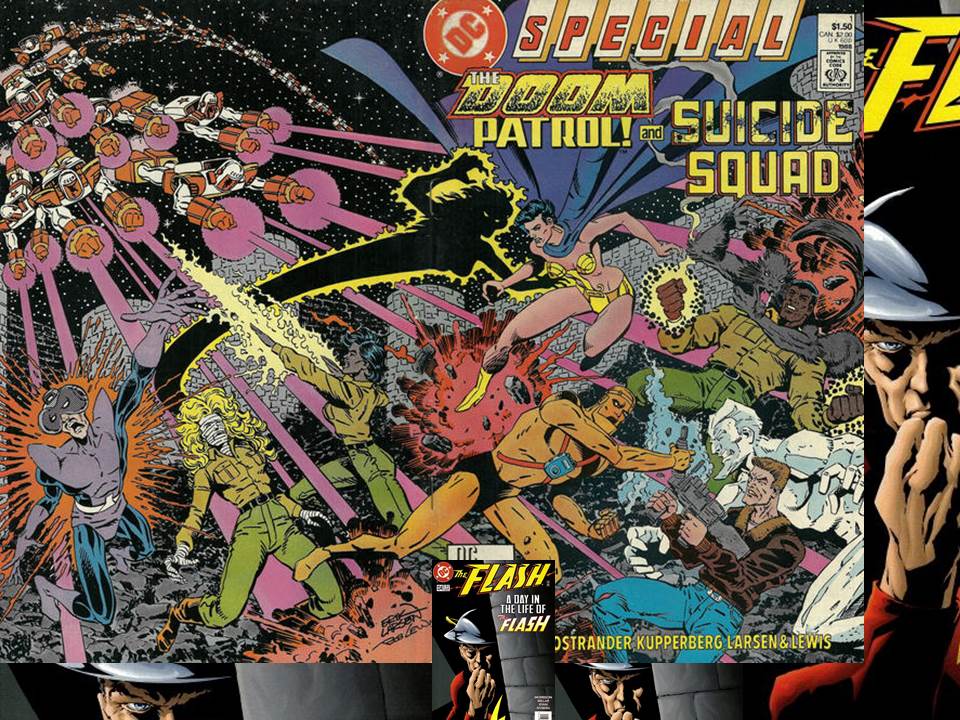
The Thinker died when recruited for a mission for the Suicide Squad in Doom Patrol and Suicide Squad #1 (1988), but really thought his way out of this fighting mess, instead dying quietly from brain cancer in Flash #134 (February, 1998) even when Jay Garrick tried to revive him by finding his original thinking cap; Clifford still wanted to die as it was his time.

The Thinker continued, with Ronnie Raymond's high school nemesis, Cliff Carmichael, getting the Thinking Cap DeVoe left behind from Amanda Waller, and being the new Thinker for a time (starting in Firestorm #99, July, 1990)...and another version of the Thinker in an Artificial Intelligence that was part of a new Injustice Society of the World (starting in JSA #16, November, 2000) (that eventually went to work for Amanda Waller in Checkmate, no less).


Check back soon for the other 3 original members, Brain Wave, Per Degaton and The Wizard!

Thursday, June 11, 2015

Batman vs Dinosaurs

Holy Jurassic World, Batman!

If you think having the Gotham guardian of Batman facing off against dinosaurs is an odd idea....

...think again!

First Fight


Back in the earliest days of Batman (Batman #35, June-July, 1946 by Bill Finger and Bob Kane), Batman and Robin went to "Dinosaur Island" at the request of Murray Wilson Hart to try out his new exhibit which included robot dinosaurs.  Batman and Robin volunteered to be the prey on a mock hunt, not knowing that criminal Stephen Chase took over the controls, and made it much more deadly!

This case proved to make a lasting impression on Batman, as one of the dinosaur robots ended up as trophy in the Batcave!  This story was also reprinted a few times, and can be read if you find a copy of Batman #256 (May-June, 1974) or in the Secrets of the Batcave tradepaperback, which came out in 2007.


The Kids Get In The Act


Not to be outdone, but Batgirl and Robin went to the "Isle of A Thousand Thrills" in Batman Family #3 (January-February, 1976, by Elliot S. Maggin and Jose-Luis Garcia Lopez), where the dynamite duo faced off against not only dinosaurs, but future soldiers and even the Spanish Inquisition while there!  Holy Monty Python, Batman (because no one expects the Spanish Inquisition)!  This story is also important, as this is when Batgirl and Robin learned each others' alter egos of Barbara Gordon and Dick Grayson!

Twice Told Tale


In light of a few decades of publishing history, Batman's history changed a few times, so the story of how the robot dinosaur changed a little over the years.  Batman Chronicles #8 (Spring, 1997) gave us the updated (that is, post Frank Miller's Batman: Year One) version of how Batman got that dinosaur trophy (without Robin), still with Murray Hart (but dead this time) and Stephen Chase as the villain in this well told tale by writer and artist Graham Nolan (who gave thanks to Chuck Dixon, as well as Bill Finger and Dick Sprang) for the inspiration, and we can all thank Graham Nolan for doing this!

Bill Finger and Dick Sprang added so much to Bob Kane's Batman, that we all should be thankful for what they've done!  Take a look at this wonderful work by Dick Sprang lithograph done for DC in 1995....


...just be happy we've been invited along for the ride!  Graham Nolan had Alfred summed up the best reason for keeping the incredibly large dinosaur trophy (and this is one of the great secrets of the Batcave, one not even gotten in Batman #203)..."Master Bruce wondered if what he does make a difference.  It does.  And now he will be able to see it".


Wednesday, June 10, 2015

A World of Topps' Jurassic Park Comics

Topps, usually known for baseball cards, expanded into the new world (at least to them) of comic books from 1993 to 1998.

One of its biggest properties besides X-Files, Mars Attacks, Dracula, Xena and Zorro was the licensed adaptations of Jurassic Park (and it's sequel, The Lost World: Jurassic Park) and a few original series based on this world of Michael Crichton's!

Jurassic Park


The first series of Jurassic Park comics with 4 issues that came out in June, 1993 to August, 1993, and was an adaptation of the movie written by Walt Simonson and drawn by Gil Kane and George Perez, and covers for the first two issues by Kane and Perez (and a variant on issue #2), and the last two covers were by Dave Cockrum.

Topps also provided "collector's editions"...


....that came polybagged, and had 3 collector's cards with them (hey, it was Topps after all, cards were how they made their living for decades)...


...and they even polybagged a tradepaperback collection of these 4 issues (with a zero issue, and more cards as well!).

Well, it was the 1990s, and bagging and selling comics as collectibles was the rage!


Jurassic Park: Raptor


First up in their original comics were two issues of Jurassic Park: Raptor as the "Official Continuation of the Hit Movie" by Steve Englehart and Armando Gil (with covers by Michael Golden) in November and December, 1993 (just the two issues)...

...and of course, bagged with 3 William Stout trading cards!

Jurassic Park: Raptors Attack


The next original series up was Jurassic Park: Raptors Attack from March to June, 1994 with stories by Steve Englehart, and art by Chaz Truog, and covers by Michael Golden for 4 issues as "the biggest Blockbuster ever continues!".


Still more adventures of Dr. Alan Grant and Dr. Ellie Sattler facing off against dinosaurs!

Really neat, and reprinted in Topps' Jurassic Park Adventures #3-6, while Jurassic Park Adventures #1 and #2 had Jurassic Park: Raptor #1 and #2.

Jurassic Park: Raptors Hijack


After the dinosaurs attacked, then they'd hijack, and that was the following mini-series of 4 issues by Steve Englehart and Neil Vokes...Jurassic Park: Raptors Hijack #1 to #4 from July to November, 1994.

Hmm...it does seem like they are just cloning these books as they go along (but, go with it, as cloning dinosaurs was the theme of the movie....), and these tales were reprinted in Jurassic Park Adventures #6 to #10.

Jurassic Park Annual


Jurassic Park had it's one and only annual (with Jurassic Park Annual #1) in May of 1995, with 2 all-new stories and art by Bob Almond, Neil Garrett Jr., Michael Golden, Ed Murr, Andrew Pepoy, Claude St. Aubin and Renee Witterstaetter...


...and, at this time, the writing was beginning to show up on the cave walls....


...but, never count a Velociraptor or a Tyrannosaurus Rex out at any time, as they return more than Jason did in Friday the 13th (also a property used by Topps Comics!).


Return To Jurassic Park


A slightly new title was made to the new series of Return To Jurassic Park that started in April of 1995 and ran nine issues until February of 1996.


Issues #1 to #4 of Return to Jurassic Park were done by Steve Englehart and Joe Staton, Return to Jurassic Park #5 through #8 were by Tom & Mary Bierbaum and Armando Gil with the storyline of "Heirs To Thunder"...


...then Return to Jurassic Park #9, the final issue of this run of the series, which came out in February, 1996, was a "Jurassic Jam" issue, featuring work by writers Keith Giffen, Renee Witterstaetter and Dwight Zimmerman and a dinosaur-sized set of talented artists including Aaron Lopresti, Adam Hughes, Brian Stelfreeze, Cully Hammer, George Perez, Jason Pearson, Jeff Butler, John Byrne, June Brigman, Kelly Freas, Kerry Gammill, Kevin Maguire, Mike Docherty, Mike Zeck, Mitch O'Connell, Pat Broderick, Paul Chadwick, Paul Gulacy, Rafael Kayanan, Ron Lim, and Walter Simonson and a cover by John Bolton!

The Lost World: Jurassic Park


Jurassic Park had a sequel in 1997 called The Lost World: Jurassic Park, set four years after the original movie, and it dealt with more dinosaurs (as well as the return of Ian Malcolm) to deal with the mistakes made when John Hammond unleashed these cloned dinosaurs on the world as the Bowman family dealt with new threats off the coast of Central America (and Peter Ludlow, the nephew of John Hammond), tried to take over InGen (the parent company that started this mess) and the dinosaurs.

This time around, for the comic series of The Lost World: Jurassic Park (May to August, 1997), Walt Simonson provided the covers, Don McGregor did the comic writing, and the art was provided by Jeff Butler for The Lost World: Jurassic Park #1 and #2, and by Claude St. Aubin for The Lost World: Jurassic Park #3 and #4.

Also added this time around were photo cover variants for the issues....but, soon after this, Topps Comics was as dead as the dinosaurs.

IDW To The Rescue


Still, IDW Publishing got the rights to Jurassic Park, and it made tradepaperback collecting these series...Classic Jurassic Park #1 has Jurassic Park #1 to #4,  Classic Jurassic Park #2: Raptors Revenge has Jurassic Park #0, Jurassic Park; Raptor #1 and #2, and Jurassic Park: Raptors Attack #1 to #4, Classic Jurassic Park #3: Amazon Adventure! has Jurassic Park Annual #1, and Jurassic Park: Raptors Hijack #1 to #4, Classic Jurassic Park #4: Return to Jurassic Park Part 1 has Return to Jurassic Park #1 to #4, and Classic Jurassic Park #5: Return to Jurassic Park Part 2 has Return to Jurassic Park #5 to #9.

IDW has even made its own adaptations as well, continuing on the work started by Topps, and continuing the hard work to resurrect dinosaurs, with its own 5 issue Jurassic Park series from June to October, 2010 (by Bob Schrek and Nate Van Dyke), 5 issues of Jurassic Park: Dangerous Games from September, 2011 to January, 2012 (by Erik Bear and Jorge Jimenez), and 4 issues of Jurassic Park: The Devils In The Desert from January to April, 2011 (by John Byrne) ....when will they ever learn not to clone things from left behind DNA?


Thursday, June 4, 2015

Bat-Mite History

Bat-Mite is all set to have a six-issue mini-series in the here and now at DC Comics thanks to writer Dan Jurgens and artist Corin Howell....

...and it seems odd to have an extra-dimensional imp in the world of Batman.

But, Bat-Mite has been around for decades!

A Long Time Ago


Bat-Mite came to be in Detective Comics #267 (May, 1959 by Bill Finger and Sheldon Moldoff, and a beautiful cover by Curt Swan) in the story "Batman Meets Bat-Mite".

(Something to be said about truth in advertising....).

A fan of Batman's from another dimension, Bat-Mite showed up in the Batcave to help make Batman's adventures more fun..

...and, after finding a way to help a little, Bat-Mite heads back to his home (much to the joy of Batman and Robin!).

This little gem of a story has also been reprinted a few times, in Batman Annual #7, Batman in the Fifties, Batman: the Black Casebook and in DC Comics Classics Library: the Batman Annuals #2, so it shouldn't take too much magic to find and read it yourself!

He's Back


Bat-Mite soon returns in Detective Comics #276 (February, 1960, also by Bill Finger and Shelly Moldoff, under a cover drawn by Moldoff), in a story entitled "The Return of Bat-Mite"!

(Well, you can't say early comics weren't honest....).

This time, along with annoying the Dynamic Duo, Bat-Mite also meets and works with Batwoman (another Gotham City crimefighter, secretly Kathy Kane), who also really wants little to do with Bat-Mite, but they all put up with the pest, and solve crimes as well.

(Sadly, this story hasn't been reprinted as of yet).


Life Is Better With Friends

Bat-Mite was obviously taken by Kathy, as he became "Batwoman's Publicity Agent" in Batman #133 (August, 1960 by Bill Finger and Shelly Moldoff), and enlisted the aid of Ace the Bat-Hound as well...and Bat-Mite also met Superman (and his imp foe, Mr. Mxyzptlk) in World's Finest Comics #113 (November, 1960 by Jerry Coleman and Dick Sprang).

Batman #133 was reprinted in Batman Annual #7 and in DC Comics Classics Library: the Batman Annuals #2, and World's Finest Comics #113 can be found in Batman from the 30s to the 70s and in World's Finest Comics Archives #3.

More Mischief


Bat-Mite created menaces for Batman and Robin in Batman #136 (December, 1960) in a rare non-cover appearance for the imp with "The Case of the Crazy Crimes" by Finger and Moldoff, and actually helped criminals in his next appearance in Detective Comics #289 (March, 1961) with Finger and Moldoff's "The Bat-Mite Bandits".

Sadly, neither of these appearances have been collected as of yet.


The Imp Gets Around


The imp met yet another Batman family member with Batman #144 (December, 1961 by Finger and Moldoff) with "Bat-Mite Meets Bat-Girl".  Bat-Girl was Betty Kane, the niece of Batwoman, and Bat-Mite offered to help her woo Robin.  Bat-Mite continued along after, appearing in World's Finest Comics #123 (February, 1962), Batman #146 (March, 1962), Detective Comics #310 (December, 1962) and Batman #158 (September, 1963), all not collected in reprints except for Batman #144 (in Batman from the 30s to the 70s and Batman in the Sixties).

One Last Time


Bat-Mite's last hurrah was in Batman #161 (February, 1964 by Dave Wood and Sheldon Moldoff), wherein Bat-Mite became disillusioned with Batman, and tries creating his own heroes in "The Bat-Mite Hero"...

....with little success.

This must have caused Bat-Mite some level of upset, as he didn't appear to bother Batman in his own titles for a while..

....(or, maybe Bat-Mite was annoyed that this tale hasn't been reprinted either!).


Hiding In Plain Sight

Bat-Mite did come back a couple of times, in World's Finest Comics #152 (September, 1965 by Edmond Hamilton and Curt Swan) and in World's Finest Comics #169 (September, 1967 by Cary Bates and Curt Swan) along with Mr. Mxyzptlk...

...but both times he was disguised as someone else (no spoilers, but the covers should give you a clue)!

Look for Showcase Presents: World's Finest Volume #3 for these two tales (though they are only in black and white).

Be Careful What You Ask For


Bat-Mite does finally get a solo feature in Detective Comics #482 (February-March, 1979) with "Bat-Mite's New York Adventure", wherein Bat-Mite decides he wants a feature in Detective Comics, and conjures up writer Bob Rozakis, penciller Michael Golden, inker Bob Smith, letterer Milton Snapinn, colorist Anthony Tollin, and production Todd Klein for editor Al Milgrom and Jack Harris...and they gave him this story.

Quite a bit of fun, and can also be found in the Greatest Batman Stories Ever Told (1988 Hardcover and 1989 Softcover).

Bat-Mite's last hurrah pre-Crisis on Infinite Earths came to us in Brave and the Bold #200 (July, 1983) (where Batman was working with the original Batman, and the Outsiders were being introduced, continuing tales of a more serious Batman, and sadly a world where Bat-Mite just didn't fit...).


Stephen DeStefano gave us this 1 pager, wherein "Bat-Mite Speaks His Mind"...and says it well enough for himself!

Post Crisis Bat-Mite


Bat-Mite returned a few times after this...once as a drug-induced hallucination of Bob Overdog in Batman: Legends of the Dark Knight #38 (October, 1992) with the "Legend of the Dark Mite" by Alan Grant and Kevin O'Neill (and, thankfully that dark vision of Bat-Mite was amended, making him again a friend of Mr. Mxyzptlk with Batman and Superman: World's Finest #6 of September, 1999 by Karl Kesel and Peter Doherty) after Bob's death in Batman: Mitefall #1 of 1995 by Alan Grant and Kevin O'Neill.

Bat-Mite also vexed Ambush Bug, and quite a few Elseworlds and other alternate Batmen (including the 1 Million version), until Superman and Batman: World's Funniest #1 (2000 by writer Evan Dorkin and a Who's Who of artists including Brian Bolland, Dave Gibbons, Mike Allred, Sheldon Moldoff, Stuart Immonen, Frank Cho, Jaime Hernandez, Scott Shaw!, Stephen DeStefano, Jim Woodring, Frank Miller, Joe Giella, Bruce Timm, Phil Jimenez, Ty Templeton and Alex Ross) which truly established Bat-Mite as he and Mr. Mxyzptlk messed around many of the worlds of the DC Universe!

An Inspiration


Bat-Mite was there for the end of a major storyline in Superman/Batman #25 (May, 2006 by Jeph Loeb and Ed McGunness) along with Batzarro and Mr. Mxyzptlk for a reality bending adventure with Superman and Batman, and as an inspiring hallucination (or was he real?), encouraging Batman to go on during 2008's Batman R.I.P. storyline by writer Grant Morrison and Tony Daniel (which also brought back other 1950s Batman elements like the Batmen of Many Nations and Zur En Arrh, and those tales are in Batman: The Black Glove and Batman: R.I.P. the Deluxe Edition, and the 1950s tales that inspired Grant Morrison are in Batman: the Black Casebook).

Bat-Mite sneaks around the corners of the DC Universe...

...showing us all its okay to have heroes, and to inspire us all to keep going!


Wednesday, June 3, 2015

Flashback Pre-Crisis For Flashes

With the Flash CW TV series, there's been a little bit of talk about a "Crisis", and that would be a problem for the Flash.

So, where did this Crisis begin?

Flash of Two Worlds

In Flash #123 (September, 1961), Barry Allen met the Flash.  Jay Garrick, that is, the original Flash, who premiered in Flash Comics #1 (and Barry had been reading his adventures in comic books for years, check in Barry's first appearance, and the time he became the Flash in Showcase #4).

This story by Gardner Fox and Carmine Infantino introduced the idea that the previous Flash (who had his own series for 104 issues) existed in a parallel world from the current comic Flash, and expanded the idea of what the DC Universe really was.

While helping Iris West at a fundraiser in Central City, Barry-Flash suddenly finds himself elsewhere....in Keystone City, the home of Jay-Flash.  Barry goes in search of Jay, finding him (now slightly older than the comics Barry use to read, which were written by Gardner Fox, and married to Joan Williams, Jay's girlfriend in the comics Barry read).  Barry convinces Jay to come out of retirement and the pair of Flashes face off against some of Jay's old foes (the Fiddler, the Shade and the Thinker - more on these villains coming in later articles on the Injustice Society of the World), defeating them, and then eventually returning Barry to his home world.

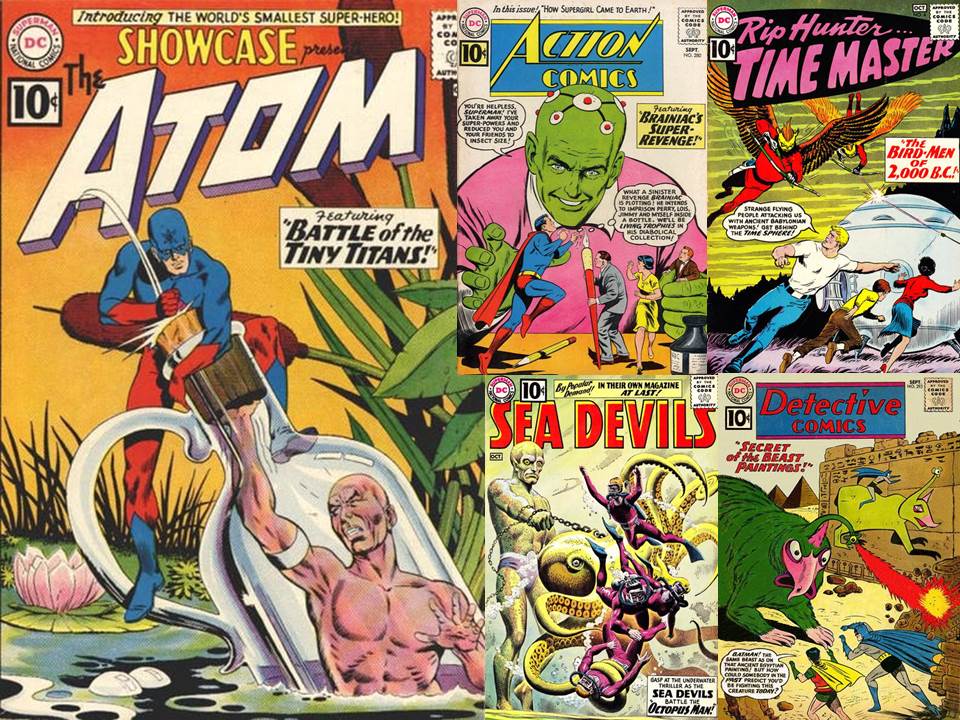
Barry's world had a lot going on at that time, the Atom (Ray Palmer) was premiering in Showcase #34, Superman was facing off against Brainiac with the help of Congorilla in Action Comics #280, Rip Hunter was continuing to travel in time with his fourth issue, the Sea Devils (a group of divers led by Dane Dorrance) were getting their first issue after a three-issue run in Showcase, and even Batman was busy fighting alien menaces like in Detective Comics #295.

Flash #123 was also reprinted on its own quite a few times...

...most notably in 80 Page Giant #9 in April, 1965 (along with a few other Flash tales), and in the Greatest Team-Up Stories Ever Told (presented in both hard cover and tradepaperback forms in 1990...the year of CBS' Flash TV show!).

Double Danger On Earth


Jay Garrick returned in Flash #129 (June, 1962), ending up on Barry's world, and fighting a few of his foes (Captain Cold and the Trickster) as Jay was there to get a meteorite to save his world from a deadly radiation.

Barry proved a good host to his new friend, helping Jay get the meteor (and Jay helped Barry defeat the two villains as well) in this story by Gardner Fox and Carmine Infantino.

The two Earths still had not been named at this point, but an important difference between the Flashes was introduced...Barry was a member of the Justice League of America, and Jay had been a member of the Justice Society of America (and a reference to their last published case of All-Star Comics #57 of February-March, 1951) was made getting the current comic reading world a possible glimpse into more events in Jay's world.

Back in Barry's world, Barry was teaming up with Green Lantern (Hal Jordan) in Green Lantern's own title (Green Lantern #13), as well as in Justice League of America #12 (facing Dr. Light, and also dealing with the JLA's newest member, Green Arrow), Atom was just moving up to his first issue and facing Jason Woodrue the Plant-Master, Batman was having troubles with the Joker in Batman #148, and Superman, well, he had his hands full with many cases (including the one in Action Comics #289).

Flash #129 was reprinted a few times....

...Flash #178 (April-May, 1968) contains the story (or most of it, two pages didn't make it), along with a Flash/Kid Flash story and the second Flash-Green Lantern individual team-up, and, Showcase Presents: The Flash #2, has this story (as well as Flash #123 and the next story), but in black and white.


Vengeance of The Immortal Villain


Flash #137 (June, 1963) starts with Barry seeing lights over six cities on his Earth, and, being a comic fan, puts together the fact that these lights correspond to the home cities of six members of the Justice Society of America, and thus travels to Jay's Earth and Keystone City.

In Keystone City, Jay-Flash finds a light there, and is captured in a stasis cube (which Barry helps free him from in this story by Gardner Fox and Carmine Infantino).  The pair of Flashes then fought Vandal Savage (an immortal cave man who had been fighting the original Green Lantern and the Justice Society of America, who last appeared in All-Star Comics #37 of October, 1947, as member of the Injustice Society of the World, and that issue is shown owned by Barry in this issue no less), defeating him, and freeing the JSA's Atom (Al Pratt), Dr. Mid-Nite, Green Lantern (Alan Scott), Hawkman (Carter Hall), Johnny Thunder and Wonder Woman, all of whom (along with Jay) decided that maybe they need to get back into the hero business, reforming the Justice Society (which happens with Justice League of America #21 of August, 1963, which is the story which finally names Earth-1 as Barry's Earth, and Earth-2 as Jay's Earth in "Crisis on Earth-One"!). 

By this point, Atom had joined the Justice League, and was meeting with the Thanagarian Hawkman (Katar Hol) in Atom #7, the Justice League was facing bigger menaces like Spaceman X in Justice League of America #20, the Faceless Creature returned to menace the United Nations in Strange Adventures #153, the group of misfits that were the Doom Patrol had their first case as a team with My Greatest Adventure #80, and Superman, Batman and Robin were facing the Band of Super-Villains in World's Finest Comics #134 (that were forgotten after this) showing that the Earth really needed more heroes!

Flash #137 was reprinted a few times as well...

...in Flash #213 (March, 1972), with a cover by Neal Adams, and in the Justice Society of America 100-Page Super-Spectacular (which also had a reprint of All-Star Comics #57!).

The Coming Crisis


These three issues of Flash set the stage for the first Justice League of America and Justice Society of America team-up in Justice League of America #21 (August, 1963), which became an annual event, and introduced many Earths (like the Crime Syndicate's evil Earth-3 and the Freedom Fighters' Nazi controlled Earth-X) and reintroduced many characters (like the Seven Soldiers of Victory and Sandman's junior partner, Sandy)...and all of that and more became threatened with the Crisis On Infinite Earths!

This all just gets you to the start of the Crisis, but it's a good start, and over time, check back to see more details filled in....or, explore on your own, with two collections that contain all 3 Barry-Jay team-ups, and fill in some more holes with the Flash of Two Worlds Hardcover of 2009, that has all three Flash stories above, as well as 3 later Flash team-ups, facing the Shade in one from Flash #151, facing Abra Kadabra (with help from Dr. Fate and Dr. Mid-Nite) in the second from Flash #170, and the Golden Man with the help of Kid Flash in the third from Flash #173...or in the Crisis on Multiple Earths the Team-Ups #1 of 2006, which also has the three stories from above, as well as Flash #151 with Barry and Jay vs. the Shade, the two Dr. Fate and Hourman team-up (including the introduction of the Psycho-Pirate from Showcase #56), the origin of the Guardians of the Universe and the first appearance of the "cosmic hand" and hints of the beginning of the universe with a team-up of Green Lanterns Hal Jordan and Alan Scott from Green Lantern #40, the first Starman/Black Canary team-up from Brave and the Bold #61 (with the return of the Mist) and a solo Hourman story (from Spectre #7).  But, read a little of what's presented here, and you'll be ready for a Crisis!