Showing posts with label Star-Spangled Kid. Show all posts

Wednesday, October 7, 2015

Charter Members of Infinity, Inc. Part 2

Infinity, Inc. was the next generation of super-heroes (at least on Earth-2, a world where folks like Superman, Batman, Wonder Woman, Flash Jay Garrick, Green Lantern Alan Scott and Hawkman Carter Hall were heroes in the Justice Society for decades....).


It seemed like these new heroes were to replace the JSA...


...but, they were also related to the Justice Society.


Northwind

Norda Cantrell was the winged godson of the original Hawkman, half-human and half-Feitheran.  Hawkman first encountered the Feitherans in Flash Comics #71 (May, 1946), and in the early issues of Infinity, Inc., it was revealed that Hawkman went back their with Fred Cantrell, who became accepted by the inhabitants of the city.  Fred married Osoro (the daughter of Feithera's leader, Worla), and they produced Norda.  Norda was a favorite of the original Hawkman and Hawkgirl, putting a wedge between the two and their own son, Hector, who couldn't fly.  Norda went to track down Hector around Christmas, bursting in on Hector, Lyta and Al Rothstein as they were making plans to storm the JSA HQ and join the team.  Norda ended up flying along as Northwind, and became a charter member of Infinity, Inc. during the course of the Generations Saga.

Northwind's flight and agility was an asset to Infinity, Inc., as was his Feitheran technology (such as the "Globglass Gun" he had, which disabled opponents by messing with their equilibrium), and he served with the team regularly until soon after the Crisis On Infinite Earths, when he returned home to his people, getting in touch with his mystical and religious side there (and learning of a prophecy about Hector Hall and the Silver Scarab), missing out on the end of Infinity, Inc..  Norda later returned, further mutated into bird form, as a member of Black Adam's Injustice Society of the World (along with former Infinity, Inc. members Atom-Smasher/Al Rothstein and Brainwave Jr/Henry King, Jr., and a new version of Eclipso). 

Jade

Jennifer-Lynn Hayden started as a lady of mystery...but her glowing green skin and power pulse that allowed her to manipulate energy marked her as a relative of Alan Scott, the Golden Age Green Lantern (though that was in doubt for the earliest issues of Infinity, Inc.).

Jennie-Lynn Hayden had found her brother, as both she and Todd had been adopted, ending up with Julian and Myrna Hayden, with a quite suburban life...until she started turning green here and there, which can be a problem!  Jennie-Lynn used this ability to find her brother, and the two showed up at JSA HQ when the other four future Infinity, Inc. members did.

Jade remained a member of Infinity, Inc. for its entire run, even befriending Solomon Grundy (a foe of the Golden Age Green Lantern), then moved away from her brother, working with the Blood Pack (a group of heroes who got their powers from their bloodlines being mixed with alien DNA), losing her powers for a time and becoming the girlfriend of Green Lantern Kyle Rayner (and becoming a Green Lantern herself), then getting the powers back, joining the Outsiders, dying during Infinite Crisis, but coming back during the Blackest Night to join the Justice League of America along with Jesse Quick (being sort of a female Flash/Green Lantern team). 

Obsidian

Todd Rice was Jennie-Lynn's brother, and his ability to become a shadow didn't particularly tie him to any JSAer, but he was also the son of the original Green Lantern.  Todd didn't live the good life of his sister, being adopted by James Rice, who abused the boy, and Todd developed mental problems because of the abuse, suffering a deep depression (not helped by his powers of darkness, to turn into a shadow and bring out people's darkest fears).  Still, he found his sister and the two were there for the beginning of Infinity, Inc.  (though it took a while for the siblings to find out who their mother was....hint, it was one of the Golden Age ladies here!).

Todd hung in to the end of Infinity, Inc. as well, and continued on with his sister, until she left him too....and Obsidian joined the Justice League America with Nuklon (and Fire, Ice Maiden, Blue Devil, Flash Wally West, a merged Hawkman and more, and among others, fought with the Killer Elite, which included Deadshot and Merlyn as members), then worked with Manhunter Kate Spencer for a bit, as well as fighting his darker nature (which at times made Todd a villain, usually due to the influence of Eclipso).


Brainwave, Jr.

Henry King, Jr. is a bit of an odd case in more ways than one.  He premiered one issue before the other members of Infinity, Inc. (in All-Star Squadron #24 of August, 1983, by Roy Thomas and Jerry Ordway) and set the stage for the other members to appear.  Henry is also the member that didn't have a relation to a JSAer, but instead was the son of one of their most persistent villains, the Brain Wave.  Odder still, his mother was revealed to be Merry, the Girl of 1000 Gimmicks (Merry Pemberton, the cousin of the Star-Spangled Kid), but the details of this union were never revealed.

Brainwave, Jr. crashed the party when the other future Infinitors crashed JSA HQ, and he ended up tagging along when Ultra-Humanite sent the other six back to the 1940s (to fight the All-Star Squadron), and it was Brain Wave, Jr., who, along with Tarantula who helped save the day (and more importantly, saving Albert Rothstein's mom....so Nuklon could eventually be born!).

Henry was attracted to Jennie-Lynn, which upset Todd to no end, especially with Henry's mind powers (which expanded after he absorbed his father at the end of the Generations Saga).  Sticking with Infinity, Inc. to the end, Henry later went over to the dark side, forming the Legion of Doom out of JLA foes like the second Killer Frost, Major Force, the Madmen and other foes of the members of Extreme Justice, and being part of Black Adam's Injustice Society.

Star-Spangled Kid

Sylvester Pemberton started out all the way back in Star-Spangled Comics #1 (October, 1941) by Jerry Siegel and Howard Sherman.  The kid was a member of the Seven Soldiers of Victory, the All-Star Squadron, and after some time-hopping of his own, even joined the Justice Society of America.  But Sylvester wasn't happy as a JSAer, feeling the need to leave the team and wanting to establish a name and direction for himself.

That he felt that much more after the death of the Crimson Avenger, and Sylvester was planning on telling the JSA he was going to leave the team, until these kids all bust in JSA HQ.  The Star-Spangled Kid had the Pemberton fortune, including owning an old movie studio in California, which Syl then turned into the base for Infinity, Inc., helping against new foes, like the team Helix, and even became friends with the female detective, Jonni Thunder.  The Star-Spangled Kid was one of the few JSAers not to be stuck in limbo after the Crisis On Infinite Earths, but he decided to adopt a new identity at that time, becoming Skyman.  Skyman only had the powers of flight thanks to his suit, which used what survived of his Cosmic Converter Belt, and faced off against Injustice, Unlimited (the inheritors of the mantle of the Injustice Society of the World).  Sadly, Skyman didn't survive to the end of Infinity, Inc. with his death being a major part of the end of the team.

Power Girl and Huntress

Karen Starr (aka Kara Zor-L) and Helena Wayne were both characters that came from the run of All-Star Comics in the 1970s.  They both briefly worked with the Infinitors, but neither stuck around for long.  Power Girl survived the Crisis On Infinite Earths, and Huntress....well, not so much.

Still, they were Earth-2's next generation of Superman and Batman, and though they weren't in Infinity, Inc. much, they were still charter members.

Infinity, Inc. began with the Generations Saga, and left quite a legacy, adding more members as well (female versions of Wildcat and a correctly spelled Dr. Midnight, as well as the son of Hourman, and even worked with Mr. Bones of Helix), all before the series ended after 53 issues and two Annuals (as well as team-ups with the Justice League of America, New Teen Titans and Outsiders).

Thursday, August 27, 2015

Individual Seven Soldiers of Victory Reprints

While there will be a few articles on the various individual Justice Society of America members, like Starman and Black Canary, sadly, it won't be as easy to do that with the Seven Soldiers of Victory.


Green Arrow and Speedy

Green Arrow and Speedy's very first appearance was in More Fun Comics #73 (November, 1941) in "The Case of the Namesake Murders" by Mort Weisinger and George Papp was reprinted in the Millennium Edition: More Fun Comics #73 of January, 2001.


This issue also features the first appearance of Aquaman, of Dr. Fate foe Mr. Who (with the doctor capturing the cover in his half mask that he was using at this time), as well as Spectre and Johnny Quick stories, a ton of Golden Age goodness!


That first appearance of Green Arrow and Speedy didn't have their origin, which we had to wait until More Fun Comics #89 (March, 1943) in the story "Birth of the Battling Bowman" by Joe Samachson and Cliff Young, wherein we see the first time millionaire archeologist Oliver Queen meets Indian raised Roy Harper, and how the two have to escape thugs searching for a gold mine on the Lost Mesa. 

This is the Golden Age (or Earth-2 if you prefer) origin of Green Arrow, and is presented in the Secret Origins of the Super DC Heroes of 1976 (in both hardcover and soft cover), along with Golden and Silver Age origins of Superman, Batman, Wonder Woman, Flash, Green Lantern, Hawkman, Atom and more under a cover by Neal Adams. 

More Fun Comics #101 (January-February, 1945) is the last of Green Arrow's More Fun Comics to be reprinted, with the "Formula For Doom" by Joe Samachson and Maurice del Bourgo wherein the battling bowmen face off against crooks disguised as cops trying to take a secret formula from chemist Cyrus Gage.

This was another story represented in a full reprint, that of the Millennium Edition: More Fun Comics #101 of November, 2000.  This issue also features Aquaman, Johnny Quick and in his last Golden Age appearance, the Spectre, as well as debuting a new feature...Superboy (a story of Superman, as a boy!  Superboy took over the cover quickly, preventing Green Arrow from getting covers on Adventure Comics, where his, Superboy, Johnny Quick and Aquaman's features all moved to after More Fun Comics #107 of January-February, 1946).

Sadly, few Green Arrow stories (or any stories) of Adventure Comics (starting from Adventure Comics #103 of April, 1946) were reprinted.  Starting with Adventure Comics #174 (March, 1952) with "1001 Ways To Defeat Green Arrow" by Ed Herron and George Papp, which seems to spell trouble for Green Arrow and Speedy.


This tale ends up in Brave and the Bold #117 (February-March, 1975), the last of B&B's 100 page issues, and has Batman teaming up with Sgt. Rock, as well as a few great tales with the Secret Six, Viking Prince and Blackhawk!

Brave and the Bold had also become a bit of a home for Green Arrow, as he and Batman had many team-ups (though this was the Earth-1 Batman and Green Arrow)!

The only other Golden Age Green Arrow full color reprint from Adventure Comics is Adventure Comics #176 (May, 1952), wherein Green Arrow and Speedy faced the villainous Roper for the first time in "The Rogue of 1000 Ropes" with no identified writer, and art by George Papp.

The story was represented in World's Finest Comics #204 (August, 1971), which also had a new story with Superman and Wonder Woman, as well as an early Captain Comet reprint, which featured characters that were prototypes for Green Lantern's Guardians of the Universe.

Last, but not least is World's Finest Comics #71 (July-August, 1954), with the Green Arrow story of "The Invisible Death" by Ed Herron and George Papp, where Green Arrow lets TV reporters into his trophy room, and tells them of past cases (like beating villain Bull's Eye) and about his trick arrows like the Balloon Arrow, Lariat Arrow and Smoke-Bomb Arrow.

This appearance of Green Arrow and Speedy is considered Golden Age, though the Superman and Batman team-up (their first regular team-up in World's Finest Comics) are the Earth-1 (Silver Age) versions of the heroes...and the reason this issue was given a reprint in its entirety, with the Millennium Edition: World's Finest #71 in August, 2000).  It even includes a story of Revolutionary War hero Tomahawk!


Shining Knight


Green Arrow's fellow soldier, Arthurian Sir Justin, also known as the Shining Knight, might have eventually come to share Adventure Comics with the battling bowman, but Sir Justin has only had a few adventures reprinted, and not even his first appearance of Adventure Comics #66 (September, 1941).

Shining Knight reprints start with Adventure Comics #150 (March, 1950) and "The Ten-Century Lie" by Joe Samachson and Frank Frazetta, with a flashback to a time in Camelot before Sir Justin became frozen and ended up in World War II.

This story was presented in the Masterworks Series of Great Comic Book Artists #1 (Spring, 1983), focusing on the artwork of Frank Frazetta, and also includes "Sir Justin, Bronco Buster" from Adventure Comics #151 (April, 1950) and written by Joe Samachson, and Adventure Comics #153 (June, 1950) in "The Duel of the Flying Knights" written by Joe Samachson, Adventure Comics #155 (August, 1950) with "The Imitation Knight" written by Joe Samachson (with Sir Justin having to fool high society girl, Mary Mason, into NOT thinking he's the Shining Knight), and Adventure Comics #157 (October, 1950) with "Camelot, U.S.A." written by Joe Samachson, wherein Sir Justin and his flying horse Winged Victory come to Camelot, Michigan to help the town celebrate its centennial, and foil criminals.

The story in Adventure Comics #153 (June, 1950) in "The Duel of the Flying Knights" written by Joe Samachson and art by Frank Frazetta was also reprinted in World's Finest Comics #205 (September, 1971)...


...and this tale was set in the Shining Knight's time in Camelot with King Arthur and Merlin, fighting an ancient Greek warrior, Bellerophon, and his magical horse, Pegasus, with evil Sir Mordred engineering the fight between these two, and features a main story with Superman working with the Teen Titans, as well as a reprinted sci-fi tale.


Adventure Comics #159 (December, 1950) with the story of the "Knight of the Future" by Joe Samachson and art by Frank Frazetta, was reprinted in both the hardcover and softcover collections of the Greatest 1950s Stories Ever Told (hardcover from 1990 and cover by Joe Kubert, and soft cover from 1992 with a collection from the stories within).

This tale of Sir Justin (and his 20th Century squire, Sir Butch), found the duo transported to the 35th Century by a miscast spell by Merlin, and they ended up facing off against rebels trying to overthrow the government before being able to return home.

Adventure Comics #161 (February, 1951) with "The Flying Horse Swindle" by Joe Samachson and Frank Frazetta was reprinted in Adventure Comics #417 (March, 1972, with a Supergirl cover by Bob Oksner, with the issue featuring a new Supergirl story, as well as a new Vigilante story, and a reprint of he first appearance of the Enchantress, who later joined the Forgotten Villains and the Suicide Squad).

The Shining Knight story had Sir Justin facing off conman Deadpan Dixon who tried to steal Winged Victory, so Sir Justin let him to teach the crook a lesson he'd never forget!


Adventure Comics #159 (December, 1950) with the story of the "Knight of the Future" by Joe Samachson was also reprinted in the Masterworks Series of Great Comic Book Artists #2 (July, 1983), another collection of art by Frank Frazetta, along with Adventure Comics #161 (February, 1951) with "The Flying Horse Swindle" written by Joe Samachson, with its first panel providing the cover for the collection, and also containing the Shining Knight story from Adventure Comics #163 (April, 1951), written by Joe Samachson, and "The Knight In Rusty Armor", with Sir Justin facing off against a crooked sheriff in his last reprinted story, though Sir Justin had two more Golden Age stories in Adventure Comics #165 and #166 (June and July, 1951), written by Don Cameron and art by Ramona Fradon. 

Crimson Avenger and Wing

Newspaperman Lee Travis and his driver, Wing, didn't fare that well in getting their tales reprinted (and not even their first appearance from Detective Comics #20 in October, 1938, nor their last solo Golden Age story in Detective Comics #89 of July, 1944)...with only two stories making it, featuring the early cloaked version of the Crimson Avenger that was also used in Secret Origins #5 (August, 1986) and the Crimson Avenger 4 issue mini-series of 1988....and Crimson Avenger and Wing both owe thanks to Batman!


Detective Comics #27 (May, 1939) was the first appearance of Batman, and was reprinted in its entirety in the Millennium Edition: Detective Comics #27 (February, 2000) as well as in the Famous First Edition C-28 (1974).

This story had no title in the original book, but was given the title of "Murder On The Oceanic Line Docks" later, and was written and drawn by Jim G. Chambers, and featured the Shadow-inspired Crimson Avenger (mostly called "The Crimson" in this story) and Wing facing off against gambler Mike Moran and other hoods.

Detective Comics #38 (April, 1940) has the first appearance of Dick Grayson, also known as Robin, the Boy Wonder, and this issue was collected in its entirety in the Millennium Edition: Detective Comics #38 (April, 2000).


This story was given the title of "Phoney Jewel Robbery", and was written and drawn by Jack Lehti, and has Crimson Avenger and Wing facing jewel thieves and mobsters, with the real criminals being a bit of surprise!


Sadly, tales of the Crimson Avenger and Wing in their more super-hero style have not been reprinted, but they faired better than their fellow duo....


Star-Spangled Kid and Stripsey

Sylvester Pemberton and his driver, Pat Dugan, might have had a long run in Star-Spangled Comics (starting with Star-Spangled Comics #1 of October, 1941), but sadly, the Star-Spangled Kid and Stripsey only have one Golden Age reprint!

Star-Spangled Comics #55 (April, 1946) with the story of "The Jigsaw Murder" by artist Jon Small (with no writer identified) detailed the death of Pudge Malone, and how the Kid and his partner found the killer with the help of a puzzle.

This story was reprinted in Superboy #185 (May, 1972), with a cover by Nick Cardy, featuring Superboy and the world's greatest young heroes, including a reprint of the first Teen Titans story, as well as the first Little Boy Blue and the Blue Boys, and a Golden Age tale of Kid Eternity and a story of the Legion of Super-Heroes!

Vigilante

The prairie troubadour of Greg Sanders did better than the Kid, but who doesn't love a cowboy?


The Vigilante's first appearance in Action Comics #42 (November, 1941) later entitled "The Origin of the Vigilante", and was written by Mort Weisinger and drawn by Mort Meskin, featured the first story of the Vigilante, and a quick flashback to his origins, and his hunt to catch Killer Kelly.


This story was reprinted in Secret Origins #4 (September-October, 1973) with a cover by Nick Cardy, and the issue also featured a reprint of the first appearance of Kid Eternity, and their origins are nicely summarized on the cover.


Action Comics #69 (February, 1944) is the next of the Vigilante stories to be reprinted, with the story of "The Little Men Who Were There" by Joe Samachson and Mort Meskin, and features Vigilante and his partner, Stuff the Chinatown Kid, facing off against the Dummy, a regular foe of Vigilante's from Leading Comics, who was using a shrinking ray to steal diamonds and foiled by the cowboy and his partner.


This story was reprinted in Wanted, the World's Most Dangerous Villains #3 (November, 1972), with a cover by Nick Cardy, and also has reprints of Golden Age tales of Dr. Fate and Hawkman facing some of their foes!


Action Comics #124 (September, 1948) featured the story of "The Lonesome Kangaroo" by Joe Samachson and Jerry Robinson, and has Stuff and the Vigilante protecting the kangaroo, Katie, from hoods who want a diamond she's hidden in her pouch.


This story ended up being reprinted in Greatest Golden Age Stories Ever Told hard cover of 1990 (with the story content page mislisting the original issue as Action Comics #128), and has a cover by Jerry Ordway.

A shame no other of the Seven Soldiers made it into the book (though there was a public service ad featuring Green Arrow....and another with the introduction of Star-Spangled Comics).


Next reprint is Action Comics #146 (July, 1950), with the story "The Galleon In The Desert" by Joe Samachson and Dan Barry, featuring the Vigilante and Stuff facing off against their own version of the Fiddler (Benjamin Bowe, not the Fiddler who faced the Flash) and his henchmen of Shakes and Dictionary.

This issue was reprinted in DC 100 Page Super Spectacular #6 (1971), which, under this awesome Neal Adams cover, also had a reprint of the first JLA/JSA team-up, a Golden Age Spectre story, and a previously unpublished Golden Age Wildcat story (as well as lists of "every" DC hero's first appearance up to that time.).  Even better, DC made a replica of the World's Great Super-Heroes Super Spectacular (yes, a reprint of a collection of reprints) in May, 2004 (though the cover was slightly altered)!

Vigilante's next reprinted tale comes from Action Comics #160 (September, 1951) with "The Capture of Four Aces", written by Dick Wood and drawn by Bob Brown.


This tale found itself reprinted in Super DC Giant S-15 (September-October, 1970) along with other western tales...


...including Pow-Wow Smith (a native American who became the sheriff of a small town) in two stories, and real life cowboy, Buffalo Bill, all instead of with super-heroes, all under a cover by Joe Kubert.


The Vigilante's next story, from Action Comics #161 (October, 1951) of "The Duplicate Crimes" was written by Dick Wood and art by Bob Brown as well.


This story was represented in World's Finest Comics #225 (September-October, 1974), and at least the Vigilante made a half-way decent appearance on the Nick Cardy cover, unlike Black Canary (who also had a reprint in the Superman-Batman team-up book, as did time-traveling Rip Hunter).


Nice to see DC taking advantage of all those extra pages, back in the day!


Vigilante's next story reprint comes from Action Comics #176 (January, 1953) with the story of Vig's fight against the Outlaw Benton in "The Impossible Legend" by Dick Wood and Bob Brown.


This story was reprinted in Action Comics #403 (August, 1971), along with a Superboy and Krypto reprint, and two new Superman stories all under a Carmine Infantino/Murphy Anderson cover that reminds us all of the importance of giving blood....the life you save could be Superman's!


The next wild Vigilante western story of Action Comics #188 (January, 1954) with the title of "The Reformed Owlhoot Club" by writer Dick Wood and artist Howard Sherman was quite a hoot indeed!

This tale found itself in World's Finest Comics #227 (January-February, 1975) in a cover with layouts by Carmine Infantino, and completed art by Nick Cardy, and focused more on the Superman-Batman new story (with Deadman) and a reprint of an old Superman-Batman team-up, as well as reprints of Rip Hunter and Martian Manhunter stories, and even an article on old film serials that included DC heroes, like Superman, Batman and Robin, Congo Bill, Blackhawk and...the Vigilante!

Would that Vig could find his way into the movies today!

Vigilante's next reprinted tale, of "The Red Dust Bandit" from Action Comics #192 (May, 1954) by Dick Wood and Howard Sherman, details Vig and Stuff's fight against a bandit who looks like Vig's alter ego of Greg Sanders, and causing quite a lot of trouble in 8 pages!


This tale found its way into Action Comics #405 (October, 1971), with a cover by Neal Adams and Dick Giordano, and also has a Golden Age Aquaman reprint from Adventure Comics.


Vigilante's story from Action Comics #193 (June, 1954) of "The Broadway Rose" by Dick Wood and Howard Sherman is next up, with 8 pages of cowboy heroic goodness.


This story ended up being represented World's Finest Comics #228 (March, 1975) under a Nick Cardy cover, and this issue also featured a new Superman/Batman Super-Sons story (with Robin in the mix), as well as Silver Age Aquaman, Metamorpho and Eclipso reprints!


Last, but not least, is Vig's story from Action Comics #194 (July, 1954), with "The Unlucky Horseshoe" by Dick Wood and Howard Sherman, with Vigilante dealing with thieves who took a horseshoe believed to belong to Jesse James' horse!

This tale made it into  Four-Star Spectacular #5 (November-December, 1976) (this series last issue), under a cover by Ernie Chan, and with stories of Superboy, the Golden Age Wonder Woman, and the Silver Age Green Arrow (as Green Arrow was facing the Rainbow Archer, a character that would come to menace him again, when he had his second costume).

Sadly, we never got to the end of Vigilante's Golden Age trail (that of Action Comics #198 of November, 1954), but you can find all of their appearances as the Seven Soldiers of Victory in 3 Archives of Leading Comics!


Wednesday, August 19, 2015

Justice Society's Super-Squad

All-Star Comics had a historic run back in the day, running 57 issues from the Summer of 1940 to February-March, 1951, and it was home to the Justice Society of America before turning into All-Star Western with #58 in 1951....

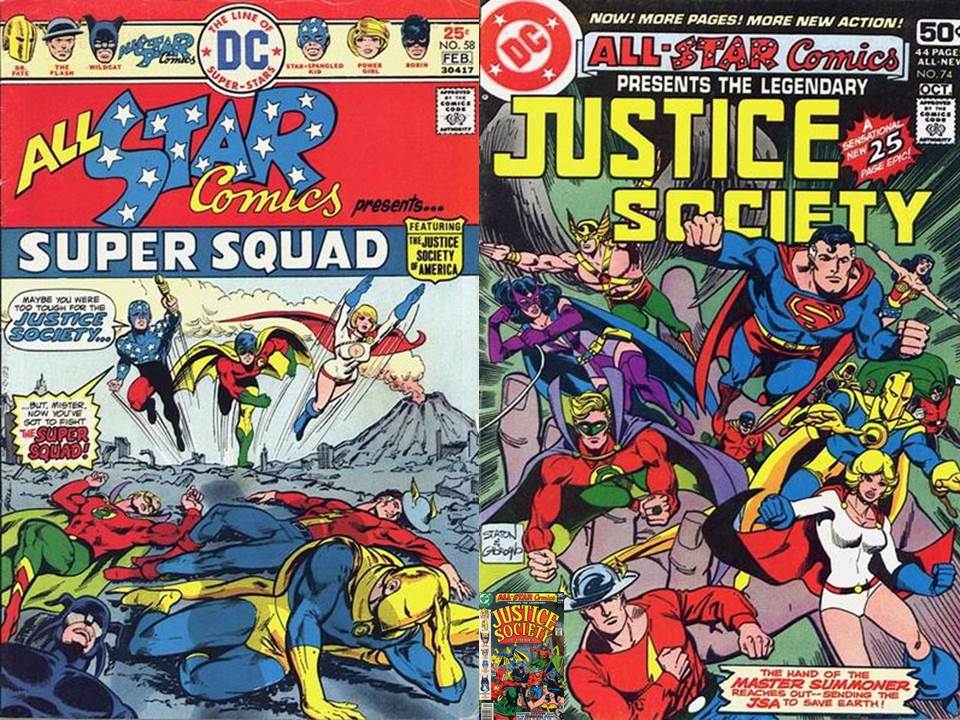
...but, All-Star Comics came back in the 1970s, with All-Star Comics #58 (January-February, 1976), and it brought the Justice Society back with them, including new members, who started out first as the Super-Squad!

Cosmic Crusader


Star-Spangled Kid (Sylvester Pemberton) had been around (since in Star-Spangled Comics #1, October, 1941 by Jerry Siegel and Howard Sherman), working with his driver, Stripsey, and a member of the Seven Soldiers of Victory (and later revealed, the All-Star Squadron) all during World War II...and, thanks to a little time travel (and a JLA/JSA team-up), ended up coming out of the 1950s, to the current day.

Starting with the revived All-Star Comics, Star-Spangled Kid was using Starman's Cosmic Rod (on loan, as Starman had broken his leg), and got involved with helping the JSA save the world (along with the ex-Boy Wonder, Robin) and another new heroine, introduced at the time.  The three formed a loose "super-squad", but then joined the JSA with All-Star Comics #64 (January-February, 1977), mostly to show off his new Cosmic Converter Belt, which was an improvement over the original, not only allowing Sylvester to fly, project beams and influence gravity, but also to change molecular structure (making things like Hawkman's wings, a spacesuit for Superman and other costume changes).   Sylvester was also doing all this to impress his new teammate (with little success) and to help fellow Seven Soldier, the Shining Knight who happened by for a time.

The troubles for the Star-Spangled Kid continued, as the JSA faced a new menace..that of the Strike Force, and Sylvester found that menace to be a part of his past, so took a leave of absence from the team to deal with that (though regularly checked back).  Then, the Star-Spangled Kid formed Infinity, Inc. to have a home for the next generation of super-heroes, and that's where he focused his energy (though his Cosmic Converter Belt had pretty much shorted out during the Crisis on Infinite Earths), and after most of the JSA was confined to limbo, Sylvester changed to a new costume identity (for a new look, and maybe to impress new friend, Jonni Thunder), that of Skyman (taking on in Secret Origins #9), which he held from Infinity, Inc. #31 until his end in Infinity, Inc. #51.    

Sylvester even had a legacy, young Courtney Whitmore, who took up the identity of the Star-Spangled Kid with Stars and S.T.R.I.P.E. #0 (July, 1999), after finding some of Sylvester's old stuff in her step-father's storage (he being Pat Dugan, Syl's partner in fighting crime, Stripsey....who then also debuted a suit of armor at this time, and started calling himself S.T.R.I.P.E.).  Courtney later joined the JSA, and even took up the name Stargirl!

Mighty Maid of Steel


Rocketing from the planet Krypton, Power Girl's ship was a little slower than Superman's, so she got here a little later than Kal-L (who had already married Lois Lane), so it took a little longer for Kara Zor-L to make her debut (that in All-Star Comics #58, January-February, 1976, by Gerry Conway, Ric Estrada and Wally Wood).  Not quite as powerful as Superman, Power Girl was still leaping buildings in a single bound during her earlier appearances, but proved to be quite a help to the JSA as a part of the "Super Squad" with Robin and the Star-Spangled Kid, helping against Per Degaton and Brainwave, Vulcan and Zanadu before joining the JSA in All-Star Comics #64 (January-February, 1977, which also lured her cousin out of semi-retirement to help fight Vandal Savage).

Power Girl did quite well as a liberated new JSAer, working against the Injustice Society of the World, fighting the Underlord and his minions, and even helping the JSA against the Psycho-Pirate (who was turning JSAers against each other).

After a brief trip to Earth-1 to meet the JLA (and the Legion of Super-Heroes, in Justice League of America #147 and #148), Power Girl continued her work with the JSA, meeting a new friend who would change her life, getting help from the original Wonder Woman to get an education in computer science (and getting the new identity of Karen Starr, and three issues of Showcase from #97 to #99 in 1978 by Paul Levitz and Joe Staton, reprinted in the first Power Girl TPB in 2006).

Power Girl continued to distinguish herself with the JSA, and even briefly joined Infinity, Inc. during its early days, before returning to the Justice Society, and meeting her Earth-1 cousin in DC Comics Presents #56 (April, 1983),  and ended up escaping the fate of the JSA (being sentenced to limbo) after the Crisis on Infinite Earths.

Now, left without a history, Power Girl wandered the Earth somewhat aimlessly (though it was found out she had a different past, having been the granddaughter of Arion, Lord of Atlantis, at least as Secret Origins #11 told us), and she continued to battle evil, on her own (first in Skartaris with the Warlord, a brief return to Infinity, Inc., her own 4 issue mini-series, finding that she had taken Supergirl's place in history with the Doom Patrol), then, after an alien Invasion!, with the Justice League Europe, for a time (getting a new, tighter costume, then another...and a cat!), and then found herself working with the JSA again...

...and even finding out that Arion had lied about her past, and that she was indeed the original Superman's cousin during the Infinite Crisis...

...(all of which says there is so much more to Power Girl, including her own regular series, so we'll look into more of her history later, as the various Crises and Justice Leagues come up!).  

Darknight Daughter 


Odd that a girl from an exploded planet would find a friend on Earth, but she did in the daughter of Batman, Helena Wayne, the new Huntress of Earth-2.  The Huntress premiered in DC Super-Stars #17 (November-December, 1977 by Paul Levitz, Joe Staton and Bob Layton), where Helena had to face the death of her mother (Selina Wayne, formerly Selena Kyle, the Catwoman), and donned a costume that looked like a hybrid of Batman and Catwoman's to hunt down Silky Cernak, Selina's killer.

On sale at the same time, All-Star Comics #69 (November-December, 1977), had Helena watching over the JSA, as they were being torn apart by Gotham Commissioner Bruce Wayne...and the Huntress worked with Wildcat and the Star-Spangled Kid to help Sylvester deal with his family soon after, leading to the Huntress joining the JSA in All-Star Comics #72 (May-June, 1978), and facing the Thorn (and soon after, her villainous namesake as well, fighting to earn the right to the Huntress name in All-Star Comics #73...and being their for the last case of the JSA versus the Master Summoner in All-Star Comics #74).

Huntress also went to meet her Earth-1 "uncle", the Batman of the Justice League of America at this time (in Batman Family #17), and soon started a series of her own, first in Batman Family (#18-20), then as a back up in Wonder Woman (starting in Wonder Woman #271).  Huntress started to be a regular in JLA/JSA team-ups, and was there for the JSA's brief move to Adventure Comics from Adventure Comics #461 to #466 (the last of which had new details about the end of the JSA in the Golden Age).

Most of Huntress' time was spend as a back-up in Wonder Woman at this time, facing off against Solomon Grundy (Wonder Woman #271-273), the Thinker (with help from Power Girl, in Wonder Woman #274-276), Lionmane, a foe of her mother, Catwoman (in Wonder Woman #277-280)...

...then continuing by facing the original Joker, a foe of her father, Batman (in Wonder Woman #281 to #284), dealing with her life in Wonder Woman #285, fighting a foe of her own with Karnage in Wonder Woman #286 to #287), a brief visit with "uncle Bruce" in Brave and the Bold #184, Crimelord from Wonder Woman #289 to #290, saving Alfred in Wonder Woman #294 and #295, fighting alongside possible Batman replacement, Blackwing against the Boa in Wonder Woman #296 to #299, fighting the Undertaker and the Mechanic over the course of Wonder Woman #301, villainous Pat Pending in Wonder Woman #302, and Dr. Tarr and Professor Fether through Wonder Woman #306, finding her own identity in Wonder Woman #307 and #308, meeting new villain Earthworm in Wonder Woman #309 to #313, more self-exploration in Wonder Woman #314 and #315, fighting the Sea Lion in Wonder Woman #316, the Nightingale in Wonder Woman #317 to #319, and finally finding herself in Wonder Woman #320 and #321.

Towards the end of Huntress' Wonder Woman back-up run, she (along with Power Girl) worked with Infinity, Inc. and were even briefly members of that team, up until Infinity, Inc. #12, then worked as lawyer Helena Wayne to prove the innocence of the JSA in America vs. the Justice Society #1-4, before the Crisis on Infinite Earths ended the career of the Huntress (at least as Batman's daughter for a time), as well as putting the JSA in limbo for a time (all except Dr. Fate, the Spectre, Power Girl and the Star-Spangled Kid, and including non-members Hawkgirl and Sandy, partners of Hawkman and Sandman), starting with the Last Days of the Justice Society Special of 1986; this put the JSA on hold for a time, but you can't keep good heroes down!