Wednesday, August 19, 2015

Justice Society's Super-Squad

All-Star Comics had a historic run back in the day, running 57 issues from the Summer of 1940 to February-March, 1951, and it was home to the Justice Society of America before turning into All-Star Western with #58 in 1951....

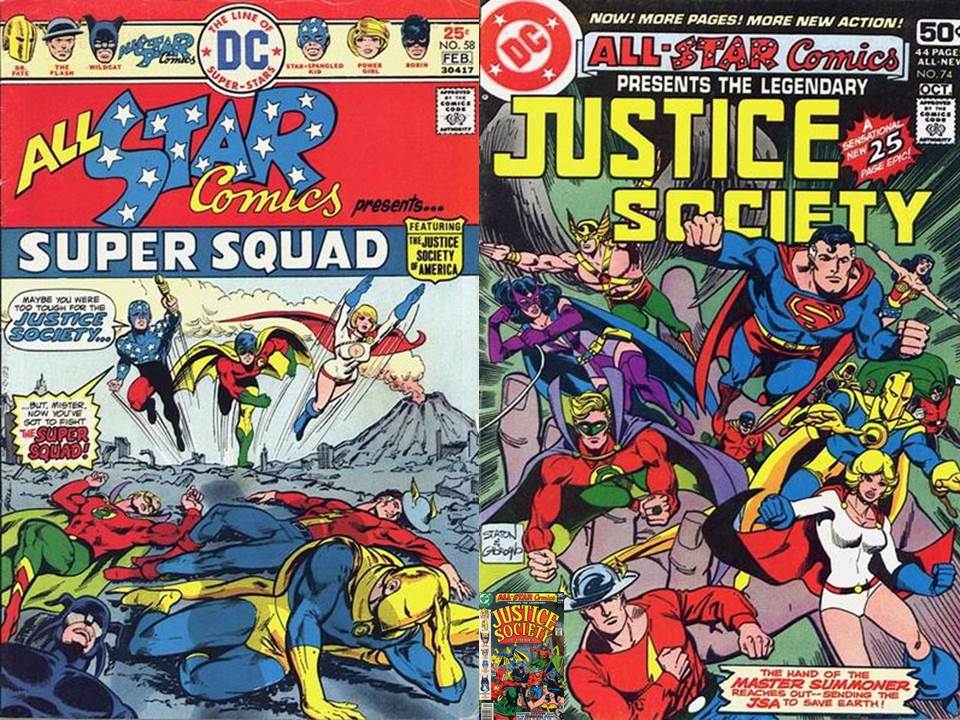
...but, All-Star Comics came back in the 1970s, with All-Star Comics #58 (January-February, 1976), and it brought the Justice Society back with them, including new members, who started out first as the Super-Squad!

Cosmic Crusader


Star-Spangled Kid (Sylvester Pemberton) had been around (since in Star-Spangled Comics #1, October, 1941 by Jerry Siegel and Howard Sherman), working with his driver, Stripsey, and a member of the Seven Soldiers of Victory (and later revealed, the All-Star Squadron) all during World War II...and, thanks to a little time travel (and a JLA/JSA team-up), ended up coming out of the 1950s, to the current day.

Starting with the revived All-Star Comics, Star-Spangled Kid was using Starman's Cosmic Rod (on loan, as Starman had broken his leg), and got involved with helping the JSA save the world (along with the ex-Boy Wonder, Robin) and another new heroine, introduced at the time.  The three formed a loose "super-squad", but then joined the JSA with All-Star Comics #64 (January-February, 1977), mostly to show off his new Cosmic Converter Belt, which was an improvement over the original, not only allowing Sylvester to fly, project beams and influence gravity, but also to change molecular structure (making things like Hawkman's wings, a spacesuit for Superman and other costume changes).   Sylvester was also doing all this to impress his new teammate (with little success) and to help fellow Seven Soldier, the Shining Knight who happened by for a time.

The troubles for the Star-Spangled Kid continued, as the JSA faced a new menace..that of the Strike Force, and Sylvester found that menace to be a part of his past, so took a leave of absence from the team to deal with that (though regularly checked back).  Then, the Star-Spangled Kid formed Infinity, Inc. to have a home for the next generation of super-heroes, and that's where he focused his energy (though his Cosmic Converter Belt had pretty much shorted out during the Crisis on Infinite Earths), and after most of the JSA was confined to limbo, Sylvester changed to a new costume identity (for a new look, and maybe to impress new friend, Jonni Thunder), that of Skyman (taking on in Secret Origins #9), which he held from Infinity, Inc. #31 until his end in Infinity, Inc. #51.    

Sylvester even had a legacy, young Courtney Whitmore, who took up the identity of the Star-Spangled Kid with Stars and S.T.R.I.P.E. #0 (July, 1999), after finding some of Sylvester's old stuff in her step-father's storage (he being Pat Dugan, Syl's partner in fighting crime, Stripsey....who then also debuted a suit of armor at this time, and started calling himself S.T.R.I.P.E.).  Courtney later joined the JSA, and even took up the name Stargirl!

Mighty Maid of Steel


Rocketing from the planet Krypton, Power Girl's ship was a little slower than Superman's, so she got here a little later than Kal-L (who had already married Lois Lane), so it took a little longer for Kara Zor-L to make her debut (that in All-Star Comics #58, January-February, 1976, by Gerry Conway, Ric Estrada and Wally Wood).  Not quite as powerful as Superman, Power Girl was still leaping buildings in a single bound during her earlier appearances, but proved to be quite a help to the JSA as a part of the "Super Squad" with Robin and the Star-Spangled Kid, helping against Per Degaton and Brainwave, Vulcan and Zanadu before joining the JSA in All-Star Comics #64 (January-February, 1977, which also lured her cousin out of semi-retirement to help fight Vandal Savage).

Power Girl did quite well as a liberated new JSAer, working against the Injustice Society of the World, fighting the Underlord and his minions, and even helping the JSA against the Psycho-Pirate (who was turning JSAers against each other).

After a brief trip to Earth-1 to meet the JLA (and the Legion of Super-Heroes, in Justice League of America #147 and #148), Power Girl continued her work with the JSA, meeting a new friend who would change her life, getting help from the original Wonder Woman to get an education in computer science (and getting the new identity of Karen Starr, and three issues of Showcase from #97 to #99 in 1978 by Paul Levitz and Joe Staton, reprinted in the first Power Girl TPB in 2006).

Power Girl continued to distinguish herself with the JSA, and even briefly joined Infinity, Inc. during its early days, before returning to the Justice Society, and meeting her Earth-1 cousin in DC Comics Presents #56 (April, 1983),  and ended up escaping the fate of the JSA (being sentenced to limbo) after the Crisis on Infinite Earths.

Now, left without a history, Power Girl wandered the Earth somewhat aimlessly (though it was found out she had a different past, having been the granddaughter of Arion, Lord of Atlantis, at least as Secret Origins #11 told us), and she continued to battle evil, on her own (first in Skartaris with the Warlord, a brief return to Infinity, Inc., her own 4 issue mini-series, finding that she had taken Supergirl's place in history with the Doom Patrol), then, after an alien Invasion!, with the Justice League Europe, for a time (getting a new, tighter costume, then another...and a cat!), and then found herself working with the JSA again...

...and even finding out that Arion had lied about her past, and that she was indeed the original Superman's cousin during the Infinite Crisis...

...(all of which says there is so much more to Power Girl, including her own regular series, so we'll look into more of her history later, as the various Crises and Justice Leagues come up!).  

Darknight Daughter 


Odd that a girl from an exploded planet would find a friend on Earth, but she did in the daughter of Batman, Helena Wayne, the new Huntress of Earth-2.  The Huntress premiered in DC Super-Stars #17 (November-December, 1977 by Paul Levitz, Joe Staton and Bob Layton), where Helena had to face the death of her mother (Selina Wayne, formerly Selena Kyle, the Catwoman), and donned a costume that looked like a hybrid of Batman and Catwoman's to hunt down Silky Cernak, Selina's killer.

On sale at the same time, All-Star Comics #69 (November-December, 1977), had Helena watching over the JSA, as they were being torn apart by Gotham Commissioner Bruce Wayne...and the Huntress worked with Wildcat and the Star-Spangled Kid to help Sylvester deal with his family soon after, leading to the Huntress joining the JSA in All-Star Comics #72 (May-June, 1978), and facing the Thorn (and soon after, her villainous namesake as well, fighting to earn the right to the Huntress name in All-Star Comics #73...and being their for the last case of the JSA versus the Master Summoner in All-Star Comics #74).

Huntress also went to meet her Earth-1 "uncle", the Batman of the Justice League of America at this time (in Batman Family #17), and soon started a series of her own, first in Batman Family (#18-20), then as a back up in Wonder Woman (starting in Wonder Woman #271).  Huntress started to be a regular in JLA/JSA team-ups, and was there for the JSA's brief move to Adventure Comics from Adventure Comics #461 to #466 (the last of which had new details about the end of the JSA in the Golden Age).

Most of Huntress' time was spend as a back-up in Wonder Woman at this time, facing off against Solomon Grundy (Wonder Woman #271-273), the Thinker (with help from Power Girl, in Wonder Woman #274-276), Lionmane, a foe of her mother, Catwoman (in Wonder Woman #277-280)...

...then continuing by facing the original Joker, a foe of her father, Batman (in Wonder Woman #281 to #284), dealing with her life in Wonder Woman #285, fighting a foe of her own with Karnage in Wonder Woman #286 to #287), a brief visit with "uncle Bruce" in Brave and the Bold #184, Crimelord from Wonder Woman #289 to #290, saving Alfred in Wonder Woman #294 and #295, fighting alongside possible Batman replacement, Blackwing against the Boa in Wonder Woman #296 to #299, fighting the Undertaker and the Mechanic over the course of Wonder Woman #301, villainous Pat Pending in Wonder Woman #302, and Dr. Tarr and Professor Fether through Wonder Woman #306, finding her own identity in Wonder Woman #307 and #308, meeting new villain Earthworm in Wonder Woman #309 to #313, more self-exploration in Wonder Woman #314 and #315, fighting the Sea Lion in Wonder Woman #316, the Nightingale in Wonder Woman #317 to #319, and finally finding herself in Wonder Woman #320 and #321.

Towards the end of Huntress' Wonder Woman back-up run, she (along with Power Girl) worked with Infinity, Inc. and were even briefly members of that team, up until Infinity, Inc. #12, then worked as lawyer Helena Wayne to prove the innocence of the JSA in America vs. the Justice Society #1-4, before the Crisis on Infinite Earths ended the career of the Huntress (at least as Batman's daughter for a time), as well as putting the JSA in limbo for a time (all except Dr. Fate, the Spectre, Power Girl and the Star-Spangled Kid, and including non-members Hawkgirl and Sandy, partners of Hawkman and Sandman), starting with the Last Days of the Justice Society Special of 1986; this put the JSA on hold for a time, but you can't keep good heroes down! 

Thursday, August 13, 2015

Green Arrow's Arrowcar

You likely know about Batman and his Batmobile, but did you know that Green Arrow had a car of his own, called the Arrowcar? It was true, ever since his earliest days in More Fun Comics! Face it, having a good car is more fun! It’s also quite an Adventure, and if you’re lucky, you get one of the World’s Finest vehicles (and Green Arrow appeared in strips in the back of Adventure Comics and World’s Finest Comics for years…).


Ollie Queen patrolled for crime in comfort in his early days with Speedy, driving around town in his bright yellow Arrowcar! One does have to wonder…why such a bright yellow car? Maybe just what he could get his hands on as a wealthy playboy in those days.


Sadly, the Arrowcar met it’s end back in Green Arrow #33 (February 2004, by Scott Beatty and Shawn Martinbrough) when Green Arrow had to face of against people who had purchased the vehicle at an auction (including Superboy foe, the Scavenger).


See, Green Arrow (after getting his snazzy new Neal Adams designed costume, then lost his fortune...


…and in losing his money, couldn’t afford all those neat toys that he had once used to fight crime, so the Arrowcar became a part of his past, but at least Ollie gained Black Canary at the time!).


Of course, this wasn’t the first time that Green Arrow faced off against his vehicle, as he also did so in World’s Finest Comics #254 (December-January 1979, by Gerry Conway and Trevor von Eeden), with a similar outcome for the vehicle.


Hey, Green Arrow is just like any other guy…he loves a great car, and all the fun you can have with it. Of course, the fun he had was fighting criminals, so that is likely a little different than most car enthusiasts…


A little inconsistent that he was able to have two confrontations? Well, Ollie was rich enough to afford a mansion, and a ward (Roy Harper, aka Speedy), so it was likely he could afford more than one Arrowcar...

...(hey, he also had an Arrowplane and an Arrowboat; true, he lost the Arrowplane during his backups in Flash #217-219 in 1972 by Denny O’Neil and Neal Adams, which were reprinted in Green Lantern/Green Arrow #7, due to wanting to check out for a while, but that boat could still be around)…again, Green Arrow had all the best toys!

Speaking of toys, Green Arrow himself was a Mego action figure, and Green Arrow also got one of the few vehicles made for those figures, the “Green Arrow Car”! Now, true, the Mego figure was made of the Green Arrow version Neal Adams had designed…which had also appeared on the Super Friends cartoon (likely the inspiration for the figure, and enough to think he could support extras like a vehicle), but the vehicle Mego made didn’t really look like the classic car…it wasn’t even yellow. Think the Mego people got confused by Green Hornet and his Black Beauty? (Likely not…as it doesn’t really look like that either….).


Still, the CW has the Arrow series starring DC’s favorite archer (as well as his lady love, the Black Canary and companion series, the Flash). Do you think he should have an Arrowcar in it?


If he was to have one, may I suggest an already existing vehicle…the 2002 Thunderbird? Along with Torch Red, Evening Black, Whisper White and Thunderbird Blue, this classic roadster came in Inspiration Yellow!

What a great inspiration it would be for an archer who is down on his luck, to drive in one of these great, under appreciated roadsters?

Green Arrow would look quite styling in this convertible as well while he is fighting crime!

Wednesday, August 12, 2015

It's Supermobile

Sure, Wonder Woman had her invisible jet, and Batman had all those wonderful toys (including the Batmobile), but when you are faster than a speeding bullet and more powerful than a locomotive, why would Superman need a vehicle of his own?

Well, he did and it was the Supermobile!

Premiere of the Supermobile


The story started in Action Comics #480 (February, 1978, by Cary Bates and Curt Swan, with a cover by Jose Luis Garcia-Lopez and Dick Giordano),  wherein red sun radiation hitting Earth weakens Superman and revives Amazo (an android that duplicates the powers of the JLA).  Amazo wants to go back to sleep, and looks for his creator, Professor Anthony Ivo (all the while, trapping most of the Justice League in their satellite, and putting it in another dimension).  Superman needs help to fight Amazo, and gets it in Action Comics #481 (March, 1978, also by Bates and Swan, with cover by Garcia-Lopez), when he goes to his Fortress of Solitude, and brings out the Supermobile in a story called "It's a bird...It's a plane...It's Supermobile!".

The Supermobile was an extension of Superman, made of Supermanium, allowing him to keep his powers under a red sun and use his powers through the vehicle, with vents for his super-breath, a scope to use his microscopic, telescopic, heat and x-ray vision, monitors that work with his super hearing, and telescopic robotic arms that Superman can use his super-strength with (along with the vehicle's invulnerability and flight abilities). 

The citizens of Metropolis need the Supermobile as Amazo plots against Superman, threatening the staff of the Daily Planet, so Superman picks Lois up in the Supermobile and heads five days into the future (all in Action Comics #482, April, 1978, by Bates and Swan, with a Garcia-Lopez cover) in the story "This is a job for Supermobile!".  Then, in Action Comics #483 (May, 1978, by Bates and Swan, with a cover by Rich Buckler and Dick Giordano), Superman defeats Amazo and returns the JLA and its satellite home.

Superman rarely used the Supermobile, taking it out to clean up Kryptonite after an encounter with the Atomic Skull and Titano in Superman #324 (June, 1978)...and it mostly being regulated to limbo, other than an appearance in the future in All-New Atom #8 (April, 2007), being up for sale in Funky Flashman's used car lot in the Dr. 13 part of Tales of the Unexpected #5 (April, 2007)...


Super Friends Supermobile


The Supermobile even made it into animated Superman...with his Super Friends!

The Supermobile appeared with the Phantom Zone Villains in "Terror from the Phantom Zone" in October, 28, 1978, "Lex Luthor Strikes Back" from September 29, 1979, and "The Krypton Syndrome" from September, 24, 1983.


Toys of the Supermobile


The Supermobile did make it as a Corgi toy, to go along with the Daily Planet helicopter, Metropolis police car, Superman van, and Daily Planet delivery truck....

...and as a part of Kenner's line of vehicles, to go along with their Super Powers figures (though this Supermobile found itself altered a bit, lacking the arms and instead having a "Krypton Action Ram").

It was this version of the Supermobile that popped up in the corner of Action Comics Annual #10 (March, 2007) in the Secrets of the Fortress of Solitude 2-pager (lower right corner), so maybe we'll see the Supermobile again!


Thursday, August 6, 2015

Strange Tales of the Frightful Four

The Frightful Four were a collection of villains that first faced the Fantastic Four on Reed and Sue's engagement in Fantastic Four #36 (March, 1965, by Stan Lee and Jack Kirby).  

But, most of these villains had appeared before in Strange Tales, which featured the Human Torch in solo tales (and later, partnered with the Thing)!

Wizard


The first of these foes to appear (in Strange Tales #102, November, 1962 in "The Prisoner of the Wizard" by writers Stan Lee and Larry Lieber and artist Jack Kirby) was the super-genius Wizard, who gained fame as a chess champion and escape artist (abandoning his real name of Bentley Wittman to make "the Wizard" his legal name.  Worried that the Fantastic Four would steal his fame, the Wizard tries to ruin the Torch's name by impersonating Johnny and committing crimes in his name...and Johnny is saved with a little help from his sister Sue (the Invisible Girl).

The Wizard returns in Strange Tales #105 (February, 1963 in "The Return of the Wizard" by Stan Lee, Larry Lieber and Jack Kirby), again with Strange Tales #110 (July, 1963 in "The Human Torch vs. the Wizard and Paste-Pot Pete!" by Stan Lee, H. E. Huntley and Dick Ayers), a quick cameo in Strange Tales #112 (September, 1963 in "The Threat of the Living Bomb" by Stan Lee, Jerry Siegel (as Joe Carter) and Dick Ayers) though the villain of the issue was the Eel, and in Strange Tales #118 (March, 1964, in "The Man Who Became the Torch" by Stan Lee and Dick Ayers), with the Wizard using anti-gravity discs against the Human Torch...a device he didn't quite control, and thus floated away from the Human Torch (not quite under his own control...)

Trapster


Trapster was originally called Paste-Pot Pete, and was a villain who first menaced the Human Torch in Strange Tales #104 (January, 1963 in "The Human Torch Meets Paste-Pot Pete" by Stan Lee, Larry Lieber and Jack Kirby).  Peter Petruski tried to use his paste-gun to rob banks, and ran afoul of the Human Torch...and Paste-Pot Pete then tried to move up in the criminal world, taking a U.S. Army missile to sell to the Soviets, but that backfired, with Paste-Pot Pete sticking himself to an airplane wing and escaping to sea.

Paste-Pot Pete returned in Strange Tales #110 (July, 1963 in "The Human Torch vs. the Wizard and Paste-Pot Pete!" by Stan Lee, H. E. Huntley and Dick Ayers), wherein the two villains paired up to face off against the Human Torch, but Pete didn't like being bossed by the Wizard, and the two were captured and sent to jail.  Pete then quickly helped the Avengers in Avengers #6 (July, 1964), providing the Avengers with a solvent to dissolve Baron Zemo's Adhesive-X during a battle with the Masters of Evil, which must have been enough to get Pete out of prison.  Pete didn't learn his lesson, returning with new weapons to face the Human Torch and the Thing in Strange Tales #124 (September, 1964 in "Paste-Pot Pete" by Stan Lee and Dick Ayers), where Pete causes trouble for the Thing and the Human Torch....

Sandman


Sandman started off as a Spider-Man foe in Amazing Spider-Man #4 (September, 1963 in "Nothing Can Stop the Sandman" by Stan Lee and Steve Ditko), with Flint Marko breaking out of prison, and being exposed to radiation which turned him into the man of living sand, the Sandman (though being defeated by Spider-Man...and a vacuum cleaner!).

Sandman soon broke free, and faced the Human Torch in Strange Tales #115 (December, 1963, in "The Sandman Strikes" by Stan Lee and Dick Ayers), where the Human Torch defeats the Sandman with a sprinkler system while Spider-Man waits!


Sandman then teams up with five other Spider-Man foes like Kraven, the Vulture and Electro to form the Sinister Six in Amazing Spider-Man Annual #1 (October, 1964 in "The Sinister Six" by Stan Lee and Steve Ditko, proving that the Sandman was willing to be a team player...).


Sandman returned again in Amazing Spider-Man #18 and #19 (November and December, 1964 in "The End of Spider-Man" and "Spidey Strikes Back" both by Stan Lee and Steve Ditko), wherein Spider-Man eventually defeats Sandman (with the Human Torch watching in the last issue).     

Medusa


Medusa first appeared in Fantastic Four #36, never making an appearance in Strange Tales, but had a bit of history before that...mostly with her somewhat strange family, the Inhumans!

Medusa was there when Maximus made Black Bolt unleash the power of his voice (which was quite destructive) in Thor #149 (February, 1968 in the flashback tale "Silence Or Death" by Stan Lee and Jack Kirby), when the Inhumans moved their city in What If? #30 (December, 1981 in "Moving Day" by Peter Gillis and Ron Wilson), and then in the Inhumans Special #1 (April, 1990 in "Remembrances of Revolutions Past" by Lou Mougin and Richard Howell) wherein Maximus caused Medusa's amnesia, and she ended up in Europe as a thief, and met the Frightful Four.

The Frightful Four continued on to menace the Fantastic Four in Fantastic Four #38 (May, 1965, with Paste-Pot Pete changing his name to the Trapster), a brief detour in Journey Into Mystery #116 (May, 1965), and a final battle royal where the Frightful Four turn the Thing against his own teammates in Fantastic Four #41-43 (August to October, 1965), and the Trapster and Sandman being abandoned by Medusa in favor of the Inhumans in Fantastic Four #45 (December, 1965).

Medusa confronted the Frightful Four one last time in Marvel Super-Heroes #15 (July, 1968) and Fantastic Four #94 (January, 1970) (though both the Wizard and the Sandman made individual runs at the Fantastic Four before this point. both with new and improved uniforms)...

...at which point, the Frightful Four realized that they'd need a new fourth member...

After a brief battle with Spider-Man and the Human Torch in Marvel Team-Up #2 (May, 1972), they then reunited and tried to add super-strong Thundra in Fantastic Four #129 (December, 1972)...

...then began a long search for a fourth member, which included characters like the Brute, Electro and the Klaw among others, and the tales of the Frightful Four get stranger!


Wednesday, August 5, 2015

Why Marvel Needs the Fantastic Four

The Fantastic Four...

...the super-strong monster Thing (Benjamin J. Grimm), leader and elastic in mind and body Mr. Fantastic (Reed Richards), the fiery Human Torch (Johnny Storm) and the hard to see Invisible Girl (Sue Storm, later Sue Richards).  Four friends who premiered in Fantastic Four #1 (November, 1961 by Stan Lee and Jack Kirby).

At one point, this was considered to be the start of the Marvel Universe...

....the original X-Men were created "in the sensational Fantastic Four style" and the Avengers formed when Rick Jones' call for help with the Hulk to the FF was redirected to Iron Man, Ant-Man, Wasp and Thor!

The Fantastic Four had met the Hulk and Ant-Man before the Avengers even formed, and when Spider-Man was looking for money, he went to try to join the Fantastic Four!

Friends of the Fantastic Four


The Inhumans slowly worked their way into the life of the Fantastic Four...starting with Medusa (as a member of the Frightful Four, along with the Wizard, Paste-Pot Pete and the Sandman, in Fantastic Four #36 in March, 1965 by Stan Lee and Jack Kirby), then followed by Gorgon in Fantastic Four #44 (November, 1965, also by Stan and Jack), and the whole royal family of Inhumans (including leader Black Bolt, Karnak, Triton and Crystal) in Fantastic Four #45 (December, 1965 also by Lee and Kirby).

The Inhumans were a race of humans modified by exposure to the Terrigen Mists to have powers and abilities far beyond those of normal humans, and they lived apart from humanity in their city of Attilan.  The Inhumans saga slowly evolved over issues of the Fantastic Four, with the lovely Crystal being the object of affection of the Human Torch...(and Crystal becoming a member of the Fantastic Four for a time, when Sue had to take maternity leave after the birth of her and Reed's son, Franklin...starting in Fantastic Four #81 of December, 1968).

But, the Inhumans couldn't be contained to one book...having their history explored in Thor and elsewhere, and graduating to a few series of their own, like a 10 issue run in Amazing Adventures #1 to #10 from August, 1970 to January, 1972, to their first self-titled series with the Inhumans #1 to #12 from October, 1975, to August, 1977 and oh so many more!

The Inhumans worked with Black Panther as well, another friend of the FF, who premiered in Fantastic Four #52 (July, 1966 by Lee and Kirby again).  T'Challa was a prince of the African nation of Wakanda, the home of the unique metal of vibranium...and he wished to prove his meddle against the Fantastic Four, and did!  Black Panther became a quick ally of the team when Klaw killed T'Challa's father, T'Chaka (Fantastic Four #53, August, 1966).

Black Panther worked with the FF against a few foes quickly, ending with Psycho Man in Fantastic Four Annual #5 (November, 1967)...before moving on, meeting Captain America and soon joining the Avengers!

Black Panther worked with the Avengers for a time, but graduated to his own series as well, first in Jungle Action from issues #5 to #24 (July, 1973 to November, 1976), and then in the first of his own series, Black Panther, starting with issue #1 in January, 1977, lasting until issue #15, in May, 1979...

...oddly, with both those series ending elsewhere...and the Black Panther getting more series as well...

Foes of the Fantastic Four


An early foe of the Fantastic Four was the Sub-Mariner...and Namor was a foe of the whole human race!  Starting with Fantastic Four #4 (May, 1962), when Johnny Storm found a derelict in a homeless shelter...and cleaned him up to realize he was Namor, the Sub-Mariner!  Namor thought he lost his city of Atlantis, and vowed to take revenge on the human race (though being a threat to the family of the Fantastic Four as well, as he had intentions toward the Invisible Girl as well...much to the annoyance of her beau, Mr. Fantastic!).  Namor used his aquatic powers in a few early battles with the FF, culminating in Fantastic Four Annual #1 (September, 1963), when Namor found out that his people were still alive! 

But, that wasn't the end of Namor's tale...or the trouble he would cause the Fantastic Four, in more ways than one.  While battling the FF (and soon after, the Avengers, with the Hulk, no less), the Sub-Mariner also freed Captain America from his prison in ice (allowing Cap to join the Avengers!).

With Cap and Namor now active, it was realized that the Fantastic Four weren't the start of the Marvel Universe (and there was a whole history of Marvel characters from before, with Timely Comics, where Sub-Mariner and Captain America had comics, along with a different android Human Torch!).

All this didn't stop Namor from going on, taking the shared spot with the Hulk away from Giant-Man in Tales to Astonish (from issues #70, August, 1965 to #101, March, 1968, though Namor's last cover was Tales To Astonish #100 of February, 1968) and getting the first of his post meeting with the Fantastic Four starting with Sub-Mariner #1 in May, 1968, lasting until Sub-Mariner #72 September, 1974...

...with Namor's creator, Bill Everett coming back to do work on more than a few issues of Tales to Astonish (#85-91, #94-96) and Sub-Mariner (#50-55, and parts of #58-60), ending his association with Sub-Mariner #61 (May, 1973), which he died before completing more than 3 pages (with the rest of issue being finished by writer Steve Gerber, artist Win Mortiner and inker Jim Mooney).

But, Namor wasn't without a title for long, ending up in one with fellow Fantastic Four foe, Dr. Doom (that of Super-Villain Team-Up).

But, Dr. Doom existed before that series started...facing off against the Fantastic Four in Fantastic Four #5 (July, 1962, by Stan Lee and Jack Kirby), and had been a thorn in the lives of the Fantastic Four even before they went on their voyage to space and received their powers.

Victor von Doom was a college classmate of Reed Richards and Ben Grimm, who was annoyed by Reed's being a better scientist than Doom.  After an accident in the lab where he was working (which Reed tried to warn him about), Doom left the university, to head to Tibet, making his armor and then going to home to Latveria to take that country over (all from Fantastic Four Annual #2, September, 1964).

Dr. Doom also made the rounds, working with other villains like the Sub-Mariner (in Fantastic Four #6 in September, 1962), and even facing other members of the Marvel Universe, like Spider-Man (in Amazing Spider-Man #5 in October, 1963) and the Avengers (starting with Avengers #24-25, January-February, 1966 or earlier, as later reports came in)!

Dr. Doom's first solo tale came with Marvel Super-Heroes #20 (May, 1969), with Doom having to take on fellow Fantastic Four foe, El Diablo, who had tried to influence Doom by taking Valeria (the love of Doom's life)...

...but you can read more on this here, with the title becoming mostly reprints after his appearance, Dr. Doom DID defeat the Marvel super-heroes!

Still, Dr. Doom continued on, getting his own series (with Ka-Zar), which lasted for 8 issues in Astonishing Tales (#1 to #8, August, 1970 to October, 1971), where Doom faced Prince Rudolfo, the Doomsman,  the Faceless One (Astonishing Tales #1 to #3), Red Skull (Astonishing Tales #4 and #5), Black Panther (Astonishing Tales #6 and #7, trying to get at Wakanda's vibranium), and even "Satan" in Astonishing Tales #8 (where Doom tries to save the soul of his mother, Cynthia)!  

Doom tried another series as well, with Namor, the Sub-Mariner, starting with 2 issues of Giant-Size Super-Villain Team-Up (in  March and  June, 1975), and then continuing for 14 new issues with Super-Villain Team-Up starting in August, 1975 (though Namor took off with Super-Villain Team-Up #13, and X-Men foe Magneto and odd super-group the Champions were the guest of Super-Villain Team-Up #14 in October, 1977, and a reprint of the two Astonishing Tales battles with the Red Skull filled Super-Villain Team-Up #15 in November, 1978).

All this villainy, where can heroes turn?

Family


Everyone is a part of the Fantastic Four family, from Inhumans like Crystal and Medusa, to Heroes for Hire like Luke Cage, She-Hulk and Ant-Man...that was the charm of the Fantastic Four....it was a party, and everyone was invited!  

The family was the core of what made the Fantastic Four such an important part of the readers lives...and, by extension, made the whole of the Marvel Universe part of our family as well.