Thursday, June 4, 2015

Bat-Mite History

Bat-Mite is all set to have a six-issue mini-series in the here and now at DC Comics thanks to writer Dan Jurgens and artist Corin Howell....

...and it seems odd to have an extra-dimensional imp in the world of Batman.

But, Bat-Mite has been around for decades!

A Long Time Ago


Bat-Mite came to be in Detective Comics #267 (May, 1959 by Bill Finger and Sheldon Moldoff, and a beautiful cover by Curt Swan) in the story "Batman Meets Bat-Mite".

(Something to be said about truth in advertising....).

A fan of Batman's from another dimension, Bat-Mite showed up in the Batcave to help make Batman's adventures more fun..

...and, after finding a way to help a little, Bat-Mite heads back to his home (much to the joy of Batman and Robin!).

This little gem of a story has also been reprinted a few times, in Batman Annual #7, Batman in the Fifties, Batman: the Black Casebook and in DC Comics Classics Library: the Batman Annuals #2, so it shouldn't take too much magic to find and read it yourself!

He's Back


Bat-Mite soon returns in Detective Comics #276 (February, 1960, also by Bill Finger and Shelly Moldoff, under a cover drawn by Moldoff), in a story entitled "The Return of Bat-Mite"!

(Well, you can't say early comics weren't honest....).

This time, along with annoying the Dynamic Duo, Bat-Mite also meets and works with Batwoman (another Gotham City crimefighter, secretly Kathy Kane), who also really wants little to do with Bat-Mite, but they all put up with the pest, and solve crimes as well.

(Sadly, this story hasn't been reprinted as of yet).


Life Is Better With Friends

Bat-Mite was obviously taken by Kathy, as he became "Batwoman's Publicity Agent" in Batman #133 (August, 1960 by Bill Finger and Shelly Moldoff), and enlisted the aid of Ace the Bat-Hound as well...and Bat-Mite also met Superman (and his imp foe, Mr. Mxyzptlk) in World's Finest Comics #113 (November, 1960 by Jerry Coleman and Dick Sprang).

Batman #133 was reprinted in Batman Annual #7 and in DC Comics Classics Library: the Batman Annuals #2, and World's Finest Comics #113 can be found in Batman from the 30s to the 70s and in World's Finest Comics Archives #3.

More Mischief


Bat-Mite created menaces for Batman and Robin in Batman #136 (December, 1960) in a rare non-cover appearance for the imp with "The Case of the Crazy Crimes" by Finger and Moldoff, and actually helped criminals in his next appearance in Detective Comics #289 (March, 1961) with Finger and Moldoff's "The Bat-Mite Bandits".

Sadly, neither of these appearances have been collected as of yet.


The Imp Gets Around


The imp met yet another Batman family member with Batman #144 (December, 1961 by Finger and Moldoff) with "Bat-Mite Meets Bat-Girl".  Bat-Girl was Betty Kane, the niece of Batwoman, and Bat-Mite offered to help her woo Robin.  Bat-Mite continued along after, appearing in World's Finest Comics #123 (February, 1962), Batman #146 (March, 1962), Detective Comics #310 (December, 1962) and Batman #158 (September, 1963), all not collected in reprints except for Batman #144 (in Batman from the 30s to the 70s and Batman in the Sixties).

One Last Time


Bat-Mite's last hurrah was in Batman #161 (February, 1964 by Dave Wood and Sheldon Moldoff), wherein Bat-Mite became disillusioned with Batman, and tries creating his own heroes in "The Bat-Mite Hero"...

....with little success.

This must have caused Bat-Mite some level of upset, as he didn't appear to bother Batman in his own titles for a while..

....(or, maybe Bat-Mite was annoyed that this tale hasn't been reprinted either!).


Hiding In Plain Sight

Bat-Mite did come back a couple of times, in World's Finest Comics #152 (September, 1965 by Edmond Hamilton and Curt Swan) and in World's Finest Comics #169 (September, 1967 by Cary Bates and Curt Swan) along with Mr. Mxyzptlk...

...but both times he was disguised as someone else (no spoilers, but the covers should give you a clue)!

Look for Showcase Presents: World's Finest Volume #3 for these two tales (though they are only in black and white).

Be Careful What You Ask For


Bat-Mite does finally get a solo feature in Detective Comics #482 (February-March, 1979) with "Bat-Mite's New York Adventure", wherein Bat-Mite decides he wants a feature in Detective Comics, and conjures up writer Bob Rozakis, penciller Michael Golden, inker Bob Smith, letterer Milton Snapinn, colorist Anthony Tollin, and production Todd Klein for editor Al Milgrom and Jack Harris...and they gave him this story.

Quite a bit of fun, and can also be found in the Greatest Batman Stories Ever Told (1988 Hardcover and 1989 Softcover).

Bat-Mite's last hurrah pre-Crisis on Infinite Earths came to us in Brave and the Bold #200 (July, 1983) (where Batman was working with the original Batman, and the Outsiders were being introduced, continuing tales of a more serious Batman, and sadly a world where Bat-Mite just didn't fit...).


Stephen DeStefano gave us this 1 pager, wherein "Bat-Mite Speaks His Mind"...and says it well enough for himself!

Post Crisis Bat-Mite


Bat-Mite returned a few times after this...once as a drug-induced hallucination of Bob Overdog in Batman: Legends of the Dark Knight #38 (October, 1992) with the "Legend of the Dark Mite" by Alan Grant and Kevin O'Neill (and, thankfully that dark vision of Bat-Mite was amended, making him again a friend of Mr. Mxyzptlk with Batman and Superman: World's Finest #6 of September, 1999 by Karl Kesel and Peter Doherty) after Bob's death in Batman: Mitefall #1 of 1995 by Alan Grant and Kevin O'Neill.

Bat-Mite also vexed Ambush Bug, and quite a few Elseworlds and other alternate Batmen (including the 1 Million version), until Superman and Batman: World's Funniest #1 (2000 by writer Evan Dorkin and a Who's Who of artists including Brian Bolland, Dave Gibbons, Mike Allred, Sheldon Moldoff, Stuart Immonen, Frank Cho, Jaime Hernandez, Scott Shaw!, Stephen DeStefano, Jim Woodring, Frank Miller, Joe Giella, Bruce Timm, Phil Jimenez, Ty Templeton and Alex Ross) which truly established Bat-Mite as he and Mr. Mxyzptlk messed around many of the worlds of the DC Universe!

An Inspiration


Bat-Mite was there for the end of a major storyline in Superman/Batman #25 (May, 2006 by Jeph Loeb and Ed McGunness) along with Batzarro and Mr. Mxyzptlk for a reality bending adventure with Superman and Batman, and as an inspiring hallucination (or was he real?), encouraging Batman to go on during 2008's Batman R.I.P. storyline by writer Grant Morrison and Tony Daniel (which also brought back other 1950s Batman elements like the Batmen of Many Nations and Zur En Arrh, and those tales are in Batman: The Black Glove and Batman: R.I.P. the Deluxe Edition, and the 1950s tales that inspired Grant Morrison are in Batman: the Black Casebook).

Bat-Mite sneaks around the corners of the DC Universe...

...showing us all its okay to have heroes, and to inspire us all to keep going!


Wednesday, June 3, 2015

Flashback Pre-Crisis For Flashes

With the Flash CW TV series, there's been a little bit of talk about a "Crisis", and that would be a problem for the Flash.

So, where did this Crisis begin?

Flash of Two Worlds

In Flash #123 (September, 1961), Barry Allen met the Flash.  Jay Garrick, that is, the original Flash, who premiered in Flash Comics #1 (and Barry had been reading his adventures in comic books for years, check in Barry's first appearance, and the time he became the Flash in Showcase #4).

This story by Gardner Fox and Carmine Infantino introduced the idea that the previous Flash (who had his own series for 104 issues) existed in a parallel world from the current comic Flash, and expanded the idea of what the DC Universe really was.

While helping Iris West at a fundraiser in Central City, Barry-Flash suddenly finds himself elsewhere....in Keystone City, the home of Jay-Flash.  Barry goes in search of Jay, finding him (now slightly older than the comics Barry use to read, which were written by Gardner Fox, and married to Joan Williams, Jay's girlfriend in the comics Barry read).  Barry convinces Jay to come out of retirement and the pair of Flashes face off against some of Jay's old foes (the Fiddler, the Shade and the Thinker - more on these villains coming in later articles on the Injustice Society of the World), defeating them, and then eventually returning Barry to his home world.

Barry's world had a lot going on at that time, the Atom (Ray Palmer) was premiering in Showcase #34, Superman was facing off against Brainiac with the help of Congorilla in Action Comics #280, Rip Hunter was continuing to travel in time with his fourth issue, the Sea Devils (a group of divers led by Dane Dorrance) were getting their first issue after a three-issue run in Showcase, and even Batman was busy fighting alien menaces like in Detective Comics #295.

Flash #123 was also reprinted on its own quite a few times...

...most notably in 80 Page Giant #9 in April, 1965 (along with a few other Flash tales), and in the Greatest Team-Up Stories Ever Told (presented in both hard cover and tradepaperback forms in 1990...the year of CBS' Flash TV show!).

Double Danger On Earth


Jay Garrick returned in Flash #129 (June, 1962), ending up on Barry's world, and fighting a few of his foes (Captain Cold and the Trickster) as Jay was there to get a meteorite to save his world from a deadly radiation.

Barry proved a good host to his new friend, helping Jay get the meteor (and Jay helped Barry defeat the two villains as well) in this story by Gardner Fox and Carmine Infantino.

The two Earths still had not been named at this point, but an important difference between the Flashes was introduced...Barry was a member of the Justice League of America, and Jay had been a member of the Justice Society of America (and a reference to their last published case of All-Star Comics #57 of February-March, 1951) was made getting the current comic reading world a possible glimpse into more events in Jay's world.

Back in Barry's world, Barry was teaming up with Green Lantern (Hal Jordan) in Green Lantern's own title (Green Lantern #13), as well as in Justice League of America #12 (facing Dr. Light, and also dealing with the JLA's newest member, Green Arrow), Atom was just moving up to his first issue and facing Jason Woodrue the Plant-Master, Batman was having troubles with the Joker in Batman #148, and Superman, well, he had his hands full with many cases (including the one in Action Comics #289).

Flash #129 was reprinted a few times....

...Flash #178 (April-May, 1968) contains the story (or most of it, two pages didn't make it), along with a Flash/Kid Flash story and the second Flash-Green Lantern individual team-up, and, Showcase Presents: The Flash #2, has this story (as well as Flash #123 and the next story), but in black and white.


Vengeance of The Immortal Villain


Flash #137 (June, 1963) starts with Barry seeing lights over six cities on his Earth, and, being a comic fan, puts together the fact that these lights correspond to the home cities of six members of the Justice Society of America, and thus travels to Jay's Earth and Keystone City.

In Keystone City, Jay-Flash finds a light there, and is captured in a stasis cube (which Barry helps free him from in this story by Gardner Fox and Carmine Infantino).  The pair of Flashes then fought Vandal Savage (an immortal cave man who had been fighting the original Green Lantern and the Justice Society of America, who last appeared in All-Star Comics #37 of October, 1947, as member of the Injustice Society of the World, and that issue is shown owned by Barry in this issue no less), defeating him, and freeing the JSA's Atom (Al Pratt), Dr. Mid-Nite, Green Lantern (Alan Scott), Hawkman (Carter Hall), Johnny Thunder and Wonder Woman, all of whom (along with Jay) decided that maybe they need to get back into the hero business, reforming the Justice Society (which happens with Justice League of America #21 of August, 1963, which is the story which finally names Earth-1 as Barry's Earth, and Earth-2 as Jay's Earth in "Crisis on Earth-One"!). 

By this point, Atom had joined the Justice League, and was meeting with the Thanagarian Hawkman (Katar Hol) in Atom #7, the Justice League was facing bigger menaces like Spaceman X in Justice League of America #20, the Faceless Creature returned to menace the United Nations in Strange Adventures #153, the group of misfits that were the Doom Patrol had their first case as a team with My Greatest Adventure #80, and Superman, Batman and Robin were facing the Band of Super-Villains in World's Finest Comics #134 (that were forgotten after this) showing that the Earth really needed more heroes!

Flash #137 was reprinted a few times as well...

...in Flash #213 (March, 1972), with a cover by Neal Adams, and in the Justice Society of America 100-Page Super-Spectacular (which also had a reprint of All-Star Comics #57!).

The Coming Crisis


These three issues of Flash set the stage for the first Justice League of America and Justice Society of America team-up in Justice League of America #21 (August, 1963), which became an annual event, and introduced many Earths (like the Crime Syndicate's evil Earth-3 and the Freedom Fighters' Nazi controlled Earth-X) and reintroduced many characters (like the Seven Soldiers of Victory and Sandman's junior partner, Sandy)...and all of that and more became threatened with the Crisis On Infinite Earths!

This all just gets you to the start of the Crisis, but it's a good start, and over time, check back to see more details filled in....or, explore on your own, with two collections that contain all 3 Barry-Jay team-ups, and fill in some more holes with the Flash of Two Worlds Hardcover of 2009, that has all three Flash stories above, as well as 3 later Flash team-ups, facing the Shade in one from Flash #151, facing Abra Kadabra (with help from Dr. Fate and Dr. Mid-Nite) in the second from Flash #170, and the Golden Man with the help of Kid Flash in the third from Flash #173...or in the Crisis on Multiple Earths the Team-Ups #1 of 2006, which also has the three stories from above, as well as Flash #151 with Barry and Jay vs. the Shade, the two Dr. Fate and Hourman team-up (including the introduction of the Psycho-Pirate from Showcase #56), the origin of the Guardians of the Universe and the first appearance of the "cosmic hand" and hints of the beginning of the universe with a team-up of Green Lanterns Hal Jordan and Alan Scott from Green Lantern #40, the first Starman/Black Canary team-up from Brave and the Bold #61 (with the return of the Mist) and a solo Hourman story (from Spectre #7).  But, read a little of what's presented here, and you'll be ready for a Crisis!


Thursday, May 28, 2015

Original Seven Soldiers of Victory

It wasn't that far from Robin Hood and his merry men.  A group of ordinary men gathered together to stop crime, including an archer, a man with a gun, someone with a star, and a sword...except it wasn't any ordinary crime, and these weren't quite ordinary men.  They were soldiers in the war against crime, leading us to victory...but, they also didn't know how to count, these Law's Legionnaires...otherwise known as the Seven Soldiers of Victory.

Leading with Seven Soldiers

See, when they started in Leading Comics #1 (Winter 1941-1942...


...overall story by Mort Weisinger and Mort Meskin, with chapters by Jerry Siegel, John Lehti, George Papp, Hal Sherman and Creig Flessel)...


...there were eight members!


Let's count them off and get to know the men that made this great super-team of the 1940s...


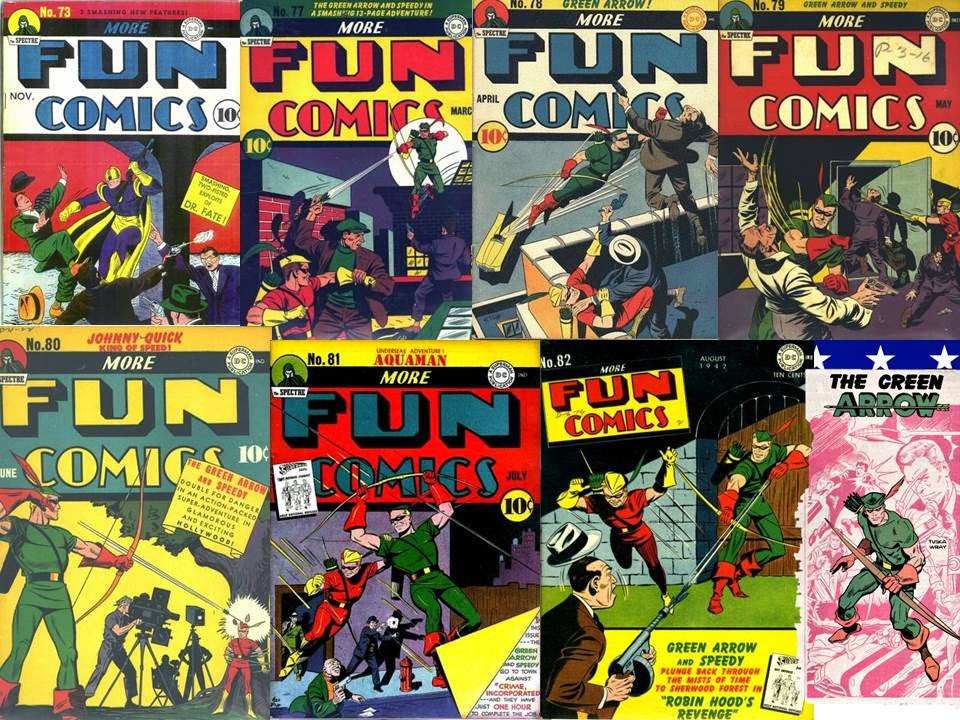
Green Arrow and Speedy 

Green Arrow (Oliver Queen), the battling bowman and his partner Speedy (Roy Harper), who first appeared in More Fun Comics #73, November, 1941 by Mort Weisinger and George Papp.
These two probably were the most visible of the Seven Soldiers during the Golden Age, appearing on early covers of More Fun Comics (though not his first one), as well as one World's Finest Comics...
 
...but even then, it wasn't for all of their appearances in More Fun Comics (they went from #73 to More Fun Comics #107 in January-February, 1946, where they then moved over to Adventure Comics starting with Adventure Comics #103, which was headlined by Superboy, as well as a feature in World's Finest Comics starting with issue World's Finest Comics #7 in Fall, 1942.
The end of the runs of Green Arrow and Speedy get a little odd, as though the feature was continuous, the universe changed around the character, adding a slight bit of confusion as to when the Earth-1 (Justice League of America) version of Green Arrow started....and when the Earth-2 (Seven Soldiers of Victory) ended....

...which could be Adventure Comics #217 (October, 1955) or Adventure Comics #245 (February, 1958) and World's Finest Comics #78 (September-October, 1955) or World's Finest Comics #93 (March-April, 1958), but they weren't on any Adventure Comics covers until the later days of the JLA's Green Arrow....


The Vigilante

The Vigilante (Greg Saunders), the law of the old west, from Action Comics #42, November, 1941 by Mort Weisinger and Mort Meskin.  The prairie troubadour was an old style hero in modern times.  During the course of his run in Action Comics from issue #42 to Action Comics #198 (November, 1954), as well as the first four issues of Western Comics, working with two partners over the years, old western cowboy Billy Gunn (who started with the Vigilante in Action Comics #43, December, 1941), and then Stuff the Chinatown Kid (who appeared first in Action Comics #45, February, 1942), and facing foes like the Shade and the Fiddler (same name but no known relation to two Flash foes of the time), the Dummy, the Head, and the Rainbow Man.

Sadly, this cowboy masked man didn't get too many cover appearances during the Golden Age besides Leading Comics...

...only landing Action Comics #52 (September, 1952) along with the Americommando, Zatara, Congo Bill, and action super-star, Superman!


The Shining Knight

The Shining Knight (Sir Justin), came from Camelot to fight the forces of evil in the 1940s starting with Adventure Comics #66, September, 1941 by Henry Perkins and Craig Flessel.  With his trusty steed, Winged Victory, Sir Justin was freed from the ice by Dr. Moresby and battled evil in any era!  The Shining Knight did well with his magic sword and armor, and even picked up a squire in the modern age, Butch Boyle, whom he called Sir Butch, and the two even travelled back in time to Camelot to aid Merlin and King Arthur.  Shining Knight also faced foes like the giant Blunderbore, the Red Dragon, crimelord Savarr, the Black Baron, the Black Queen, and evil mage Archimago.

The Shining Knight's adventures in Adventure Comics continued until Adventure Comics #166 (July, 1951), but other than Leading Comics, Sir Justin didn't make it onto any covers in the Golden Age (as the covers were filled with Starman and Sandman, whom Justin worked with in the All-Star Squadron, as well as Superboy), only making Masterworks Series of Great Comic Book Artists #1 and #2 (reprinting Frank Frazetta drawn tales of the Shining Knight) in 1983!


The Star Spangled Kid and Stripsey

The Star-Spangled Kid (Sylvester Pemberton), patriotic youth, working with Stripsey (Pat Dugan), his equally patriotic butler independently deciding to fight crime...and then team-up, starting in Star-Spangled Comics #1, October, 1941 by Jerry Siegel and Howard Sherman.  Their origin was finally given in Star-Spangled Comics #18 (March, 1943), and the two patriotic heroes fought the good fight (even though they were confused often about who was the hero and who was the sidekick...both claimed to be the hero!), both in the feature in Star-Spangled Comics, and in World's Finest Comics #6 through #18, even making one cover of World's Finest Comics with Superman, Batman, Green Arrow and the Boy Commandos!

The duo fought menaces like Dr. Weerd, the Needle, Mr. Ghool, Moonglow, King Midas, the Eel, Mr. Gadget, High-Brow Herby, and Pin-Ball, until Sylvester's dad adopted Merry, (who started to vex the Star-Spangled Kid with Star-Spangled Comics #82 of June, 1948, and joined Sylvester as his new partner to fight the Rope after Stripsey broke his leg in Star-Spangled Comics #83 of August, 1948, which was also Stripsey's last Golden Age appearance).  The Star-Spangled Kid left the feature with Star-Spangled Comics #84 of September, 1948 (with Merry the Gimmick Girl continuing on until Star-Spangled Comics #90 of March, 1949). 

The Crimson Avenger and Wing

The Crimson Avenger (Lee Travis), who was the earliest of super-heroes, wearing a dark suit, hat and mask in Detective Comics #20, October, 1938 (by Jim G. Chalmers), and...his partner, Wing (Wing How, who was credited as the unofficial "eighth" soldier....thus allowing them to be seven; the Crimson Avenger got a more regular super-hero costume in Detective Comics #44...with a cape!  The cape was gone by Detective Comics #54, and Wing got into his own costume by Detective Comics #59).

The Crimson Avenger and Wing even predated Batman, who quickly took over the covers of Detective Comics after he premiered, thus regulating Crimson Avenger and Wing to background status (and, other than Leading Comics, his new look never made it onto a cover!).  The pair were more pulp heroes to start (not unlike Green Hornet and Kato), and didn't quite make the transfer over to super-heroics...with the Crimson Avenger appearing World's Best Comics #1 (Spring, 1941), World's Finest Comics #2 through #5 (to be replaced by the Star-Spangled Kid!), and not even keeping his own feature running while the Seven Soldiers were active...with the last solo Crimson Avenger story happening in Detective Comics #89 (July, 1944), and the Seven Soldiers bowing out with Leading Comics #14 (Spring, 1945).

The Seven Soldiers did return, coming straight out of the 1950s into a JLA/JSA Crisis with Justice League of America #100 to #102, and the team appeared a little in Infinity, Inc. (which had the Star-Spangled Kid as it's leader, just before he turned himself into Skyman) before the Crisis on Infinite Earths....

...this caused a lot of confusion, as Green Arrow and Speedy couldn't be considered members, so it became quite a mystery for a time as to who the 7th (and 8th) Soldier were for a time (and come back as we'll go into that at a later date)....

...but that original team is back for Convergence: World's Finest #1 and #2 (June and July, 2015) by Paul Levitz and Jim Fern....and we all couldn't be happier to see this team again, especially since they brought Scribbly and the original Red Tornado with them, and proving that old heroes can still fight new menaces!


Wednesday, May 27, 2015

Freedom Fighters Quality

True, the team of the Freedom Fighters got their start in Justice League of America #107 and #108 (September-October and November-December, 1973) by Len Wein and Dick Dillin, and then a fifteen issue series that ran from March-April, 1976 to July-August, 1978...but the team started decades before that, in Quality Comics, and here's a quick look at those earlier appearances!

Doll Man


Darrell Dane was a scientist who developed a formula that allowed him to shrink in size...

...and he used this ability to save his girlfriend, Martha Roberts, taking on the identity of Doll Man, starting with Feature Comics #27 (December, 1939, by Samuel Maxwell Iger and Will Eisner).

Doll Man had many adventures over the years, remaining a feature in Feature Comics until Feature Comics #139 (October, 1939), as well as gaining his own book...

...first Doll Man Quarterly for its first four issues (Fall, 1941; Spring, 1942; Summer, 1942; and Winter, 1942)...

...before just becoming Doll Man with issue #5 (Spring, 1943), which lasted all the way to Doll Man #47 (October, 1953).

Among many foes, the biggest thing to happen to Doll Man was when Martha Roberts became Doll Girl in Doll Man #37 (December, 1951) during a battle with the Skull...

...where she replaced Elmo the Wonder Dog (who Doll Man first partnered up with in Doll Man #31, December, 1950),  as a regular helper in Doll Man. 

Black Condor


Richard Grey, Jr. was thrown into his heroics at birth, when his father and mother were killed soon after in Outer Mongolia and raised by the condors (where he learned to fly), eventually being taken in by missionary, Father Pierre, who is then also killed by raiders.  The young man uses his abilities to stop them, becoming the Black Condor, all in Crack Comics #1 (May, 1940, by Will Eisner and Lou Fine).  The Black Condor comes up with a paralyzing ray gun in his next appearance (in Crack Comics #2, June, 1940), and later, adopted the identity of Senator Thomas Wright (who died, and just happened to look exactly like the Black Condor) in order to vote in an important appropriations bill (in Crack Comics #11, March, 1941).

Even with the odd plots and turns, the Black Condor series lasted all the way to Crack Comics #31 (October, 1943), and along the way, he faced foes like Ali Kan, Ras Gyn, Sinh Fang, De Graf, the Sapphire King, the Master, Karlo Klug and his Kite-Men, the Great Yaho, Lung Woe and the Spinning Deaths, Monks Gallagher, the Sophisticated Lady, Senator Jasper Crow, Carl Stark, General Korn, Miranda, the Ghost-Gun Killer, the Hand, Mysto, Karle Kurt, Skull-Face, Draku and the Black Dragon Society, Senator Dan Bird and Fury the Eagle and Senator Joe Logan (and with all these Senators as foes, you'd think Black Condor was in Congress today!). 


The Ray 


"Happy" Terrill was a reporter who joined Professor Styne on a balloon experiment that took them to the upper stratosphere, during which "Happy" was thrown from the blimp into a "cosmic storm", turning him into a being of light energy who can fly and project energy, leading "Happy" to become the Ray to save the Professor from spies in Smash Comics #14 (September, 1940, by Will Eisner and Lou Fine).

The Ray continues his adventures through Smash Comics #40 (February, 1943), facing foes along the way like Anton Rox, Cadava the Crumbler, Bela Jat, Stradivous, Miss White and her 7 dwarfs, Slash Scraponi, Jud Marshwood and Slyme, Captain Blue, Lupo, the Beetle and Long Woo, the  Great Ivan, Dr. Kompf, Zimmerman, El Lobo, Von Ribboncounter, Monsieur Le Rat, Baron Hoff, the Khan, Hammer Hand, the Headsman, and Oscar Slott.

Human Bomb


Roy Lincoln was the son of a scientist, and that chemist is the reason Roy became the Human Bomb, after Axis spies broke into the professor's lab, trying to take the explosive formula 27-ORX, which Roy swallowed, gaining the power of explosive fists (as well as a degree of invulnerability to things like bullets) all in Police Comics #1 (August, 1941, by Paul Gustavson).

The Human Bomb never really was a cover feature on Police Comics, as Plastic Man hogged most of the covers (except for Firebrand, who later became a Freedom Fighter), even though the Human Bomb feature went on to Police Comics #58 (September, 1946).  Along the way, the Human Bomb fought lots of Nazis, the Black Vanguards, a phony Human Bomb, Hoiman Schtrugmeyer, Mr. Chameleon, the Three Mosquitos, Patch-Eye, Swami Kazombo, femme fatale Nola, vampiric Miss Walpurga, Mustapho, the Robber Baron, the Butcher Boys, the Shrimp, and Yarboe, as well as his loyal companion, Hustace Throckmorton, who gets an emergency blood transfusion from the Human Bomb, and develops explosive powers (in his feet) in Police Comics #15 (January, 1943) and the Bombardiers (Montague T. "Curley" McGurk, Swordo and Miss Red Rogers) who aid the Human Bomb in Police Comics #21 (August, 1943) and Police Comics #22 (September, 1943).

Phantom Lady


Sandra Knight was the daughter of Senator Henry Knight, and worked with Professor Abraham Davis to develop a black light ray projector in Police Comics #1 (August, 1941, by Arthur Peddy).  Sandra lost contact with the Professor when he was kidnapped, and saw the same men try to take her father, and sprung into action, stopping the thugs, who never got a good look at her, telling police they were stopped by a "phantom lady"...a name she kept.  Later stories had Sandra being related to the original Starman, who encouraged her to continue as Phantom Lady, and she perfected the black light ray projector, which then also allowed her to become invisible and the special glasses she wore which allowed her to see in the dark.

The Phantom Lady's run lasted until Police Comics #23 (October, 1943), and also included a crossover in Feature Comics #69, #70 and #71 (July, August and September, 1943) with the Spider Widow (Dianne Grayton) and the Raven (Tony Grey) who never became Freedom Fighters!  Villains she faced in her run included Tikoy, Captain Ortega, a phony Phantom Lady, the Bunny Man, and the Boss (the foe the three heroes faced).  Phantom Lady also never had covers during her original run, but did as she developed on her own (but, in stories outside her regular continuity, stories past Police Comics #23 weren't produced by Quality (and resulted in a color change in costume for Phantom Lady as well....) when the Phantom Lady returned to comics under Fox with Phantom Lady #13 (August, 1947) by Matt Baker.   

Uncle Sam


A national hero taking form in the comics with National Comics #1 (July, 1940, by Will Eisner and Dave Berg), and the man that eventually formed the Freedom Fighters, Uncle Sam!

Sam was a patriot, loyal to the United States during the Revolutionary War, and as he was dying to complete a mission for General George Washington, he had a vision of the "spirit of America", who joined with him, creating the hero known as Uncle Sam.

Uncle Sam carried a feature all the way through National Comics #45 (December, 1945), and even had his own Uncle Sam Quarterly that lasted 8 issues (from Fall, 1941 to Autumn, 1943), facing foes like the Black Legion (later the Black Guard), Scar, the Purple Shirts, Mias, Yiffendi, Yoritomo Rawlins, Heinrich Brun, Scalini, King Killer, Dr. Link and Dr. Blink, the Steel Helmets, Cadaver, the Witch Queen, Malvolo, the Jinx, Jeremiah Korntooth, Blackout, Dr. Dirge, Hamid the Astrologer, Boss Spring, Professor Bump, Count Torza, Zando and of course, plenty of Nazis, all with his little buddy...Buddy Smith!


Uncle Sam even had the first major hint of a Quality hero crossover, with a prose story in Uncle Sam Quarterly #2 (Winter, 1941), with Uncle Sam convincing Quality's villains they have to go back to work to face Hercules, Neon, Quicksilver, the Ray and Black Condor, or they'd all be out of business!

Uncle Sam was the backbone of the Freedom Fighters and we salute you!

The founding of the Freedom Fighters didn't get covered until DC Comics took over the characters, and it was in All-Star Squadron #31-35 (March-July, 1984, by Roy Thomas and Rick Hoberg), and told how these (and other) Quality heroes (like Miss America, Magno and Neon the Unknown as well as DC hero and JSA founder, Hourman) had originally started on Earth-2, and left to help Earth-X, and unintentionally allowed the Nazis to win World War II!

The team began in the two issues of Justice League of America (#107 and #108), and then had its own series for 15 issues that ran from March-April, 1976 to July-August, 1978...

...with stories by Gerry Conway, Martin Pasko, and Bob Rozakis and interior art by Ric Estrada, Mike Royer, Pablo Marcos, Ramona Fradon and Dick Ayers!


These issues had the team leaving their Earth-X, coming to Earth-1 and being thought of as villains, thanks to the Silver Ghost, and facing foes like King Samson, Skragg the Super Sniper, the Crusaders, Cat-Man, and the Renegades, as well as heroes like Wonder Woman, Batgirl and Batwoman, and having old Quality hero Firebrand (Rod Reilly, who appeared in the first 13 issues of Police Comics, even taking most of the covers from Plastic Man) join the team in Freedom Fighters #12 (January-February, 1978).

Firebrand


Rod Reilly premiered in  in Police Comics #1 (August, 1941, by Samuel Maxwell Iger and Reed Crandell), and he was the son of a wealthy steel tycoon, but wanted more from his life, working with ex-boxer Slugger Dunn to become the crime fighter known as Firebrand!

Firebrand fought criminals and spies like Baron Von Hanson, General Alfredo Muerte, Boss Slaine, Dr. Kruger and the White Gardenias, before ending his short run in Police Comics with issue #13 (November, 1942), all happening before Pearl Harbor (as explained in the early issues of All-Star Squadron).

But back to the Freedom Fighters!

After the 15 issues of the Freedom Fighters, and a few other appearances like DC Comics Presents #62 (October, 1983) and Wonder Woman #292 (June, 1982), the original Freedom Fighters fought their last battle with the Crisis on Infinite Earths, with later revivals focusing on new versions of the Quality characters.

But, with DC's Convergence, and the 2015 2 issues of Convergence: Freedom Fighters, Simon Oliver and John McCrea have brought new adventures of the old Quality Freedom Fighters (added Plastic Man to the team!).