Thursday, February 2, 2017

Two-Face 100 Page Super Spectacular

For the second of February, it seems appropriate to shine the light at the Batman foe, Two-Face....


....with a collection of his earliest appearances (as well as a couple of extras) from 100-Page Super Spectacular #DC-20 from September, 1973, all under a cover by Nick Cardy.


Detective Comics #66

Detective Comics #66 (August, 1942) by Bill Finger, Bob Kane and Jerry Robinson, is the origin of Two-Face, where the dynamic duo first meet up with Harvey Kent (that was his original last name) when they face "The Crimes Of Two-Face".  

This is when we see District Attorney Harvey Kent take acid to the face as he was prosecuting Boss Maroni, scarring half his face, making Kent use Maroni's two-headed coin (with one side now scarred as well) to make decisions, with the clean side representing good, and the scarred, evil.  Batman feels it is his responsibility to catch and rehabilitate Two-Face, but Two-Face is undecided, with his coin landing on its edge when he was deciding whether to be a hero or villain.  


Detective Comics #68

In "The Man Who Led A Double Life" from Detective Comics #68 (October, 1942) by Finger, Kane and Robinson, we get a follow up to the original tale, with Batman following up on his promise, as well as Harvey making a decision.

Putting the coin in his pocket, it is the coin that saves Two-Face when a cop shoots him in an attempt to stop the ex-attorney, making Two-Face lean to evil.  Two-Face begins crimes focused on the number two, and tries unsuccessfully to reconcile with his fiancee, Gilda, hiding half his face with help from a make-up artist (which eventually fails, leading Two-Face into a vendetta with the artist, and the artist's son to want revenge on Two-Face).  Batman stops this series of events.

All-American Comics #88

JSAer, Dr. Mid-Nite faces a villain called the Tarantula in this reprint from All-American Comics #88 (August, 1947) by John Broome and Alex Toth, with the Tarantula thinking he has figured out Dr. Mid-Nite's secret identity of Dr. Charles McNider.


Thankfully, Dr. Mid-Nite was able to blackout Tarantula's suspicions....


Flash Comics #95

Dinah Drake gets an order at her flower shop...from the Black Canary (her alter ego) in Flash Comics #95 (May, 1948) by Robert Kanigher, Carmine Infantino and Joe Giella in "An Orchid For The Deceased.

Investigating as Black Canary, she ends up at the home of Andrew Masters, who has been murdered...and Black Canary has been framed!  Turns out Masters' niece committed the crime and the frame, because Masters changed his will to leave his money to Black Canary.

Adventure Comics #66 

Starman is next up, with his tale of "The Case Of The Camera Curse" from Adventure Comics #66 (September, 1941) by Gardner Fox and Jack Burnley.


Starman (Ted Knight) faces off against Cuthbert Cain, who uses a special camera powered by voodoo magic to steal men's souls, who takes a picture of FBI agent, Woodley Allen, to keep him from interfering with Cain's plans.


Starman turns the tables on Cain using his own Gravity Rod, using Cain's camera on him, making Cain disappear and breaking Cain's hold on Allen....


Blackhawk #13

Blackhawk and his fellow aviators face off against femme fatale Fear for the second time in Blackhawk #13 (Winter, 1946) with art by Bill Ward.


The lady Fear gets help from Starra, who has managed to control a small European country by marrying it's prince, Ghor, to face off against Blackhawk and his men, but it doesn't end well for Starra, being killed by Fear as Starra was not able to manipulate Fear as well as she did her husband. 


Fear also realizes how strong her feeling are for Blackhawk...


More Fun Comics #66

Spectre is called on to fight evil once more in More Fun Comics #66 (April, 1941) by Jerry Siegel and Bernard Baily.


This time, Spectre has to stop giant creatures who are menacing his home of Cliffland, but he is surprisingly weakened by their green eyes.  Spectre follows the creatures to a museum, where he learns their secret...that they live within the paintings!


After destroying the painting that housed the monsters, the Spectre saves his girlfriend, Clarice Winston, from criminals who were menacing her.


Sensation Comics #71

Fighter Wildcat (Ted Grant) shows up next, with "The Count That Never Ended from Sensation Comics #71 (November, 1947) by Robert Kanigher and Gil Kane.

This story features a battle between Wildcat and his foe, the Huntress, as she tries to hurt Ted by kidnapping Wildcat's assistant, Stretch Skinner, so that Ted will have to miss a championship fight.

Wildcat is able to free Stretch from the Huntress, then take out the imposter Huntress had replacing Ted Grant in the ring.


Detective Comics #80

Finally returning to Batman with Detective Comics #80 (October, 1943) featuring "The End Of Two-Face" by Bill Finger, Bob Kane and Jerry Robinson.

Harvey escapes prison to go on a criminal rampage, but accidentally shoots his fiancee, Gilda, during his spree.

This causes Harvey to want to reform, helping Batman defeat his gang, and Batman gets a doctor to perform plastic surgery on Two-Face, theoretically ending the menace of Two-Face forever (or at least until Batman #50 of 1948, but that's another tale...).

Wednesday, February 1, 2017

Starro JLA First Foe

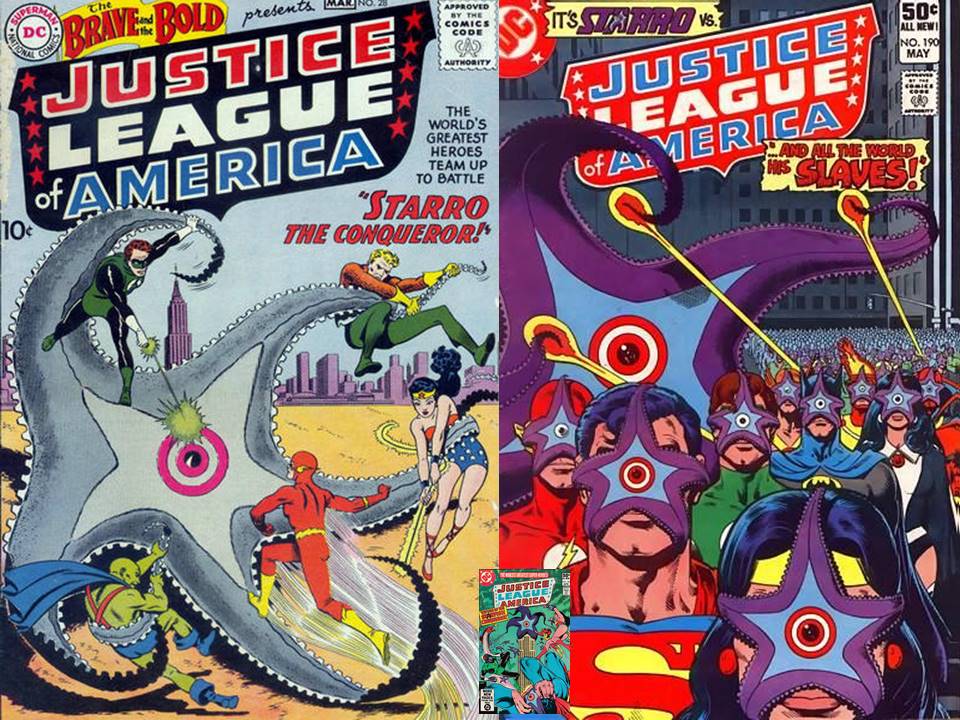
Starro was the first foe that readers saw the Justice League of America face, in their premiere in Brave and the Bold #28 (February-March, 1960) by Gardner Fox, Mike Sekowsky, Bernard Sachs, Joe Giella and Murphy Anderson.


So, this is our chance to have Starro in our face....but, the safe way, not the way it was in the comics!


Starro The Conqueror

Brave and the Bold #28 (February-March, 1960) by Gardner Fox, Mike Sekowsky, Bernard Sachs, Joe Giella and Murphy Anderson premiered the alien invader Starro, as he faced off against the Justice League of America (though this wasn't their origin, that would be explained later).  Aquaman gets warned of the menace of the invading starfish, Starro, by his own finny friends, and he sends out the call to the JLA, with Flash as chairman, sending out the team to take on the 3 duplicates of Starro, with Green Lantern facing one, Wonder Woman and Martian Manhunter taking on the second, while Flash goes to Happy Harbor and meets the oddly immune Snapper Carr (whose help on this case leads him to become the Justice League biographer and honorary member), while Aquaman finds the original  (who the team defeats with lime, thanks to Snapper).


T.O. Morrow Kills The Justice League -- Today

Starro's next appearance is just a small one, in Justice League of America #65 (September, 1968) by Gardner Fox, Dick Dillin and Sid Greene, where Starro, along with past JLA foes Amazo, Super-Duper, the Crystal Creature from Appellax, and Dr. Light face the team at the behest of T. O. Morrow...


...who had hatched a plan to kill the Justice Society of America the issue previous, creating the android Red Tornado (but Reddy was a good guy and a little more than just an android, so he helps undo Morrow's plan, and saves the JLA as well), in the last story of the Justice League of America written by Gardner Fox.


The Secret Of The Sinister Abyss

Aquaman faces Starro alone in Adventure Comics #451 (May-June, 1977) by David Michelinie, Jim Aparo and Liz Berube.  The secret is out, as Starro appears on the cover, but that doesn't stop the alien starfish from being a menace to Aquaman right at the worst time, while he was looking for his octopus friend, Topo, who had taken his son, Aquababy.  This Starro regenerated from a piece of the original Starro, growing strong in the polluted part of the ocean he was in, giving Aquaman the opportunity to summon fish to bring fresh water to the area, which stunned Starro, allowing Aquaman to defeat the creature (and have Green Lantern take the alien away)...

...so Arthur could continue his quest for his son in the next issue without alien interference.


The Return Of The Starfish Conqueror

When Starro returned in Justice League of America #189 (April, 1981 cover by Brian Bolland) by Len Wein, Gerry Conway, Rich Buckler and Frank McLaughlin, he was much more in your face (literally!).  Having been found by young Terry Watson following his encounter by Aquaman, the boy was possessed by the alien starfish, who then took his family as well, having them move him to a Central Park lake.  There, Starro accidentally encounters Wonder Woman and Red Tornado, who summon JLAers Black Canary, Firestorm, Green Lantern and Superman to face the alien.  Starro has a new trick this time, creating duplicates of himself which attach to the face of his foes, and dominate their minds.  By the end of this issue, Starro has conquered the JLA, and the island of Manhattan....


...with the other JLAers finding out that "Our Friends, Our Enemies" in Justice League of America #190 (May, 1981) under a cover by Brian Bolland, with story by Len Wein, Gerry Conway, Rich Buckler, Bob Smith and Larry Mahlstedt.  The rest of the Justice League (including Batman, Flash, Aquaman, Hawkman, Elongated Man, Hawkgirl and Zatanna) are called in to deal with the problem, staying safe from Starro by using repellor-discs Hawkman supplied.

Still, Starro could have won if not for the robotic Red Tornado and young Terry Watson (who got free in a freezer), which Hawkman and Hawkgirl discovered, allowing the JLA to use extreme cold to defeat the alien starfish.


The Pluto Syndrome

A menace to Earth-C (a new Earth Superman found while people on Earth-1 were starting to act like apes a special insert in New Teen Titans #16 of February, 1982 by Roy Thomas, Gerry Conway, Scott Shaw, Ross Andru and Bob Smith), leading to the creation of Captain Carrot (and other super powered "funny animals" that would be called the Zoo Crew.  This led into Captain Carrot and His Amazing Zoo Crew #1 (March, 1982), where Superman and his new animal allies found out that Starro was the menace behind this all!


War Zone

Starro was one of many villains to take part in the attack on the heroes in Crisis On Infinite Earths #9 (December, 1985) by Marv Wolfman, George Perez and Jerry Ordway, but Starro was just one of many villains gathered by Brainiac on his satellite, with the Conqueror not even using his abilities to take over people...and gets a punch in the eye by Superman for all his trouble...


...though Starro seems to have gotten over his cold allergy, as he seems to have no problem with the villains plan to freeze Earth-S, the home of the Marvel Family,  in this issue (or perhaps it was the cold that weakened the giant Starfish so Superman could defeat him alone).


And Beyond

A few of the highlights of Starro after the Crisis on Infinite Earths include a run in Justice League Europe starting with Justice League Europe #24 (March, 1991) (though Starro didn't appear until Justice League Europe #25, and his plan unfolded in Justice League Europe #26 to #28....all by Keith Giffen, Gerard Jones, Bart Sears and Randy Elliott), with Starro approaching the JLE to help him go home or he'll die (but ends up possessing Elongated Man, Flash/Wally West, Power Girl, Bluejay and Silver Sorceress to fight Captain Atom, Rocket Red and Metamorpho...

A slightly different version of Starro faces the Justice League (of Superman, Batman, Aquaman, Martian Manhunter, Flash/Wally West, Green Lantern/Kyle Rayner, Zauriel, Wonder Woman/Hippolyta in JLA #22 (September, 1998) and JLA #23 (October, 1998) by Grant Morrison, Howard Porter and John Dell, which was only defeated by the lord of dreams, Daniel, who was helping a boy named Michael Haney (though this Starro was called "It", "it" was a conqueror, and "it"s coming was foretold in JLA Secret Files #1 (September, 1997).

Starro returns in Teen Titans #51 (November, 2007)  to Teen Titans #54 (February, 2008) by Sean McKeever, Ale Garza, Jamal Igle, Eddy Burrows, Derek Fridolfs, Jesse Delperdang, Rob Hunter, Marlo Alquiza, Julio Ferreira, Olcair Albert and Joe Prado, where a version of the Titans who had become the JLA come back in time, and Starro starts taking over minds to make things worse....

A more classic Starro returns for the 3 issue Captain Carrot and the Final Ark (December, 2007 to February, 2008 by Bill Morrison, Scott Shaw, Al Gordon, Phil Winslade and Scott Koblish), where the Zoo Crew defeat Starro but at a dire cost to them....

Starro ends up on time traveller Rip Hunter in Booster Gold #13 (December, 2008) by Rick Remender, Pat Olliffe and Jerry Ordway, where after a fight with Booster Gold and his sister, Goldstar, ends up on Chronos and Lady Chronos, with Booster ending up in a vat of Starros.  Escaping in Booster Gold #14 (January, 2009) by Remender, Olliffe and Ordway, Booster frees Lady Chronos, and the pair go to stop Rip from being infected, and find Chronos having stopped it even earlier, stopping Starro, but causing timestream anomolies...

Starro underwent his biggest transformation starting in R.E.B.E.L.S. #5 (August, 2009) by Tony Bedard, Claude St. Aubin and Scott Hanna, confronting Vril Dox and his outer space police force (who add Captain Comet, Adam Strange and Kanjar Ro for help), with forces of his own, the High Vanguard, through R.E.B.E.L.S. #9 (December, 2009), with the Conqueror's full origin in R.E.B.E.L.S. Annual #1 of 2009.

Dox finds himself at odds with the L.E.G.I.O.N. facing Starro and his forces, getting help from the Omega Men, Despero and the Dominators as well, defeating Starro for a time in R.E.B.E.L.S. #15 (June, 2010), but Starro returns for a final battle using an army of Lobos in R.E.B.E.L.S. #23 to #28 (February to July, 2011).

All in all, that's a lot of face time with Starro!


Thursday, January 26, 2017

A Little Archie In Riverdale

Archie Andrews and the town of Riverdale were introduced back in Pep Comics #22 (December, 1941, by Vic Bloom and Bob Montana), along with his pal, Jughead Jones, as Archie tries to impress the new girl who moved into town, Betty Cooper as kids.  Starting in the next issue, Archie and his friends were tracked a little further in their lives, as teenagers.  Betty's rival, rich girl, Veronica Lodge, appears soon after, in Pep Comics #26 (April, 1942), with Archie's nemesis, Reggie Mantle and Mr. Weatherbee being introduced in Jackpot Comics #5 (Spring, 1942)....all continuing to grow the cast and expand upon the high school activities of Archie and his friends, until they could stop sharing a magazine with heroes like the Shield, Black Hood, Steel Sterling and the Hangman, and Archie Comics was born (starting in Winter, 1942).

But, what about the kids younger lives?  Well, here a little history of Little Archie...

Little Archie

Little Archie #1 premiered in 1956, when the company publishing Archie had changed from MLJ to Archie Comics, with the adventures of Archie, Betty, Veronica, Jughead, Reggie and even Moose Mason as kids, written and drawn by Bob Bolling, with inks by Bob White (at least for the first issue, Bob Bolling having more to do on the later issues).

These were cute little tales of the kids of Riverdale, working things out as they played war, pretended marriage, played doctor and nurse, pretended to go to court and other activities kids did as they figured out their world (though not quite matching up with regular Archie Comics, as Betty didn't move to Riverdale until she was a little older....).

The Little Archie run lasted until issue #4, in the Fall of 1957....

Little Archie Giant Comics


...to become Little Archie Giant Comics, starting with issue #5 in Winter 1957-1958, and continuing under that title, with more of the same hijinks, with the title actually becoming giant-sized starting with issue #13 of Winter, 1959/1960...


...through issue #18 of Spring, 1961 (where Archie headed out to Mars in "Little Archie On Mars")...


....establishing a more fantasy/science fiction feel for the Little Archie series, which would continue on as the series continued on....


The Adventures Of Little Archie


...being retitled as The Adventures Of Little Archie with #19 (Summer, 1961), continuing the fantasy elements in the issues, as well as adding new ones....


....like a reoccurring villain, the Mad Doctor Doom (no relation to Fantastic Four's Doctor Doom)...


....adding a young version of Archie's super-hero identity of Pureheart the Powerful with Little Pureheart the Powerful...


....even creating a mod band for the kids as the Little Archies, as Dexter Taylor came on board to handle some of the Little Archie tales as well along with Bob Bolling, all the way through issue #53 of May, 1969....


Little Archie


....with the title reverting back to Little Archie with #54 (July, 1969), which remained as the title of the book until its end with issue #180 in February, 1983.

During this run, a Little Sabrina (a younger version of Sabrina, the Teenage Witch) was added to the mix as well, with the title remaining a giant sized through issue #84, and the stories were more fantastic than ever.


A little fun in Riverdale, separate from all the other Archie Comics, before comic books and the world got so serious!


Wednesday, January 25, 2017

Flash Facts: Flash Annual of 1963

Flash was the envy of all the other DC heroes except for Superman, Batman and Lois Lane, as the fastest man alive got his first annual in the Summer of 1963.


This book featured reprints of the first appearances of important characters to the Flash mythos....


....and we'll take a look at these stories below!


Katmos

The first reprinted story is from Flash #105 (February-March, 1959) by John Broome, Carmine Infantino and Joe Giella, with Barry Allen facing off against the "Conqueror From 8 Million B.C."....that being the menace of Katmos (though the cover of the original issue features the Mirror Master, who was in the other story of that book).


After a brief recap of the Flash's origin, Barry faces off against the ancient threat of Katmos, freed by archeologist John Haines (as the metallic monarch used his mind control ray on the man).  Katmos then encountered the Flash, even taking control of him for a time, but Barry Allen proved to be too fast for this  menace, beating his plans....and still being able to go to dinner with Iris West!


Mr. Element

Next up is the first appearance of another enemy of the Flash, from Showcase #13 (March-April, 1958) by John Broome, Carmine Infantino and Frank Giacoia, that of the "Master Of The Elements", Mr. Element (though this also was not the feature of the issue to make the cover).


Barry faces Mr. Element and his gang (Argon, Krypton, Xenon and Radon, named after the inert elements of the periodic table), with the tricky Mr. Element using pre-prepared tricks with elements to halt the fastest man alive.  Mr. Element evades capture, and even calls out the Flash while Barry is on a dinner date with Iris...the villain ruins Barry's night, but the Flash proved he could think fast enough to dash the hopes of his enemy.  Mr. Element returns later, in a new identity, that of Dr. Alchemy!


Elongated Man

Flash really needed a friend, and he found one in the Flash #112 (April-May, 1960) by John Broome, Carmine Infantino and Joe Giella, at least he would as soon as he solved "The Mystery Of The Elongated Man".


Flash is being out-heroed by newcomer to Central City, the Elongated Man.  Elongated Man was really Ralph Dibny, who was fascinated by circus rubber men since he was a kid, found they all drank a soft drink, Gingold, and took an extract from that which allowed him his elastic powers.  Flash suspected Elongated Man of recent robberies in his city, and set a trap for the Gingold guardian....but he found EM to have captured the real thieves instead.  Flash and Elongated Man tied for the Man of the Year award given by Picture News, and became fast friends after this (with Elongated Man later joining the JLA!).


Star Sapphire

The next story of the issue featured the Flash from the Golden Age, Jay Garrick.  "The Amazing Star Sapphire" was the one of the menaces of All-Flash #32 (December-January, 1947/1948) by Robert Kanigher, Lee Elias and Moe Worthman (thought Flash foe, the Fiddler, got the cover).
 
The Flash and Dr. Flura were found comatose, and brought to a laboratory to be revived.  While in the lab, the villainous Star Sapphire appeared, with a plan to have her world destroy the Earth (and lured Flash and the lady doctor to it, via a space-time machine).  Flash stopped Star Sapphire's evil plan, rescued Dr. Flura as well, returning to Earth.   This Star Sapphire later proved to be similar to the Star Sapphire who was the foe of Barry's friend, Green Lantern Hal Jordan (but that connection took a few decades to reveal....).


Grodd

Flash faced the "Menace Of The Super-Gorilla" in Flash #106 (April-May, 1959) by John Broome, Carmine Infantino and Joe Giella, though this story wasn't featured on the cover...it was the first appearance of Gorilla Grodd and King Solovar of Gorilla City.

Grodd secretly comes to Central City, while Barry's friend, actor Fred Pearson, thinks he's losing his mind (as he performs in an act disguised as a gorilla, but can't remember his last performance, which people say was his best).  Really, it was Grodd, hiding for a time, as he searched for Solovar (the king of Gorilla City, who had been captured and was in a circus, hiding his own telepathic abilities).  Grodd found Solovar, took the secret of Force of Mind (mind control) from him, and Solovar broke free to find Flash.  Solovar explained this to the Flash, who then had to stop Grodd from taking over Gorilla City...which he quickly did (and also promised to keep the existence of telepathic gorillas and their home from the world).  Grodd would return many times to face the Flash....


Kid Flash

Flash got a little bit of help in his life as he would "Meet Kid Flash" in Flash #110 (December-January, 1959/1960) by John Broome, Carmine Infantino and Joe Giella (in the non-cover featured story of this issue).  

Iris' nephew, Wally West, was a big fan of the Flash.  Iris asked Barry to escort Wally around town, and hoped to meet the Flash.  Barry brought Wally back to his lab, and super-speed around to meet Wally as the Flash.  While explaining his origin, a lightning bolt struck, hitting the chemicals and dousing Wally, giving him the same super-speed Barry has.  The Flash gives Wally a smaller version of his own suit, allowing the boy to be a super-hero as Kid Flash, as long as he keeps his abilities a secret from everyone.   Later, Barry tells the boy his own secret, and Wally even joins with other sidekicks of other heroes to form the Teen Titans.


There were also special features in this issue, like how artist Carmine Infantino drew the Flash, as well as an index of the Barry Allen Flash issues of the time, and a few special Flash firsts covers.  While it took a long time for Flash to get another annual, Flash did have a couple of 80 Page Giants (#4 of October 1964 and #9 of April 1965) devoted to his earlier adventures (which you can use the index in the annual to guess which ones they are).  Better still, you can get a replica edition of the Flash Annual (which came out in 2001).

Friday, January 20, 2017

Superman As President?

Faster than a speeding congressman, more powerful than a filibuster, able to leap tall monuments in a single bound...


....it is Superman as President of the United States!


Taking advantage of the alternate futures that Waverider was able to project when touching your favorite DC heroes in the 1991 Armageddon 2001 Annuals, readers get to see what a Superman presidency would be like in Action Comics Annual #3 (1991) by Roger Stern, Tom Grummett, Phil Rodier, Carlos Garzon, Doug Hazlewood and Brad Vancata under a cover by Dave Gibbons.


After a brief battle with Kalibak of the New Gods and a conversation with Metron, Superman goes to have a date night with Lois (as Clark Kent), when Waverider arrives to see Superman's future.

In this future, Pa Kent dies in a horrible accident on the farm, prompting Ma Kent to move to Metropolis, Clark and Lois to get married, and Pete Ross to run for President.  After a nearly successful attempt on Pete's life by Intergang, foiled only by Clark Kent (who exposes his duel identity in public to save his friend), Pete convinces Clark to run for President in his place.  After having the Supreme Court rule Superman is an American (as his birthing chamber was also his rocket, meaning Superman was born in the USA), Superman runs for and wins the Presidency.  Clark settles the national debt with help from Aquaman (finding old sea treasure), has Luthor arrested for plotting to kill him, and unites the world's heroes to help all mankind.

Not the bleak future where Monarch ruled that he was looking for, Waverider leaves Superman (who prevents this future by being slightly distracted, and going to save Pa Kent from being crushed by a tractor). 

Thursday, January 19, 2017

Captain America as President?

Captain America as President?  That was the basis of the story of What If? #26 (April, 1981), with Captain America running for and successfully becoming the President of the United States in a story by Mike W. Barr, with Roger McKenzie, Don Perlin, Roger Stern and John Byrne all contributing, and art by Herb Trimpe and Mike Esposito....all under a cover by Marie Severin (with Captain America co-creator Jack Kirby swearing in Steve Rogers, with Jimmy Carter and Ronald Reagan in attendance). 
 
Of course, if Captain America takes over the United States, wouldn't that force the Red Skull to get his own country?

The issue also contained a story about an alternate reality Man-Thing, and some history on the Eternals and the Kree (the last two alien races that Jack Kirby had a hand in creating....).


This story was an alternate world version of the Captain America story from Captain America #250 (October, 1980, by Roger Stern, John Byrne and Joe Rubenstein, with plot ideas by Don Perlin and Roger McKenzie), wherein Captain America was approached about running for President as the people's choice.  Cap decided for the good of the country, that his being president would not be good for America.....which the What If? story played out. 


How can you judge a President? 


How about by what he does while he is President?

Wednesday, January 18, 2017

Patriot Captain America of the late 1940s and early 1950s

Steve Rogers was the first Captain America, but he wasn't the only one.   Another man to be Cap was Jeff Mace.


Reporter.       Hero.


American.     Patriot.

Here's a little of the history of the man who was the Patriot, and gave up that identity to become Captain America!

Golden Age

Jeff Mace began life as the Patriot in Human Torch #4 (Spring, 1941 by Ray Gill and George Mandel, though the issue was #3 on the cover), appearing in the next issue (Human Torch #4/5), then moving over to Marvel Mystery Comics starting with #21 (July, 1941), where he was a regular feature until Marvel Mystery Comics #74 (July, 1946), using his athletic ability and reporter's skills to fight menaces.

Along the way, he even gained a partner, Miss Patriot (Jeff's friend, Mary Morgan), who gained powers of above normal hearing and super-vision in Marvel Mystery Comics #50 (December, 1943), getting him a little extra help on his cases.


All these appearances, and the Patriot never made a cover in the Golden Age, so settle for a few of his splash pages to show his original costume!


This was also the costume Rick Jones manifested him during the Kree-Skrull War (but that wasn't really Jeff Mace....).


1970s Revival

With the success of the Invaders in the 1970s (a team composed of the original Captain America, the original Human Torch and Sub-Mariner formed in an issue of the Avengers during a time travel adventure), more classic Timely characters were given new life, detailing their adventures during World War II, this time as the homefront heroes, the Liberty Legion, including the Whizzer, Miss America, the Thin Man, Jack Frost, Blue Diamond, Red Raven and the Patriot...

...starting in Invaders #5 (March, 1976 by Roy Thomas, Rich Buckler, Dick Ayers and Jim Mooney), continuing into Marvel Premiere #29 (April, 1976 by Roy Thomas, Don Heck and Vince Colletta), Invaders #6 (May, 1976 by Roy Thomas, Frank Robbins and Vince Colletta) and Marvel Premiere #30 (June, 1976 by Thomas, Heck and Colletta), with all the heroes gathering to battle the Red Skull (under Jack Kirby covers, no less!).  The Liberty Legion returned in Invaders #35 to #38 (December, 1978 to March, 1979), as well as alternate Earth versions of the team meeting the Thing in Marvel Two-In-One Annual #1 (1976) and Marvel Two-In-One #20 (October, 1976).

The big change for the Patriot happened in What If? #4 (August, 1977 by Roy Thomas and Frank Robbins), where he helped the former Invaders and their new Captain America and Bucky against the android, Adam II, who killed the second Captain America....resulting in Jeff Mace making the decision to take up the spirit of liberty, and become the newest Captain America, where he remained until he couldn't any more (with this history recognized in Captain America #215 in November, 1977), retiring to go back to reporting, and another man was assigned by the government to become the fourth Captain America.

End Of The Line

Jeff Mace got a little help from the Contemplator in Captain America Annual #6 (1982 by J. M. DeMatteis, Ron Wilson and Vince Colletta) to become Captain America once more, saving an alternate Earth from an alternate Adam II with help from Steve Rogers!  This was important to Jeff Mace, who needed a good last shot at being a hero, as he was dying of cancer, eventually passing away in Captain America #285 (September, 1983 by J. M. DeMatteis, Sal Buscema and Kim DeMulder).

Life Of The Legend

Patriot got some of his history filled in with later looks back at Timely's Golden Age...
 
...with the longest look back coming in Captain America: Patriot mini-series, with four issues from November 2010 to February, 2011, really getting into the mind of Jeffrey Mace and his added history! 
 

Karl Kesel and Mitch Breitweisser gave the Patriot a fuller origin, having reporter Jeffrey Solomon Mace be influenced by Captain America to become a hero, detailing how he took over as the third Captain America, working with the All-Winners Squad, FBI liaison Betsy Ross (who would become Golden Girl), Miss Patriot, the shooting of his Bucky, and how the FBI didn't want him as Captain America as the threat of Communism loomed over America, making Jeff lack trust in the USA, and retire from being Captain America.

Captain America History

Though the comics treated Captain America and Bucky as the originals, Jeff Mace and Fred Davis' versions of Captain America and Bucky had their Golden Age adventures, starting with Captain America Comics #59 (November, 1946), continuing into All-Winners Comics #21 (Winter, 1946-1947, facing Future Man and Madame Death with the All-Winners Squad), then from Captain America Comics #60 (January, 1947) to Captain America Comics #73 (July, 1949), and even titles like Blonde Phantom #16 (Winter, 1947-1948), Sub-Mariner #31 (April, 1949) and Captain America's Weird Tales #74 (October, 1949), and even to his home, Marvel Mystery Comics, for issues #80 to #84, #86 to #88, #91 and #92 in the 1940s (but this time as Captain America).
 

Captain America faced many new foes at this time, like the Human Fly, the Black Baron, Mr. Polly, King Lear, the Acrobat, the Chief, and even Lavender....who shot Bucky and was the villain that Betsy Ross first faced, in her new super-hero identity as the Golden Girl (in Captain America Comics #66 in April, 1948 by Bill Woolfolk and Syd Shores). 

Bucky (Fred Davis) stayed on the sidelines from this point onward (returning briefly to face the Trickster in Captain America Comics #71 of March, 1949), and Golden Girl gave up her costumed identity after Captain America Comics #73 (July, 1949). 

Jeff Mace's Captain America even faced his own Red Skull....

...facing off against the dead villain in the odd Captain America's Weird Tales #74 (October, 1949), as the Red Skull got the lord of the underworld to bring Cap to hell for one last battle....(and the rest of the tales of this and the next issue were supernatural ones, not relating to Captain America).  Through all this, Captain America triumphed....a Patriot (this time, represented by Jeff Mace).