Thursday, February 4, 2016

Mongul Before The Crisis

Mongul was introduced as a space villain, facing off against Superman and the Martian Manhunter, and continued to face off against DC heroes not from Earth...


...heroes like Supergirl, one of the alien versions of Starman, and the Legion of Super-Heroes, before his final defeat facing Superman, Batman, Wonder Woman and Robin.


Let's take a look at the history of Mongul...


The Key That Unlocked Chaos

Mongul premiered in DC Comics Presents #27 (November, 1980) in a story by writer Len Wein, penciller Jim Starlin and inkers Dick Giordano and Frank McLaughlin, where Mongul forces Superman and the Martian Manhunter (who had been living with his people on his new home of Mars II and been away from the Justice League at this time) over a crystal key (which the alien race, the Largas, gave J'onn J'onnz to watch over).

This would give the alien conqueror Mongul control of the Warworld, a highly destructive planet created by the Warzoons, constructed to move across the cosmos and cause chaos! 

Mongul was able to get control, and the Martian Manhunter blamed Superman for new weapon, and how he would now be a thread to the universe.


Warworld

DC Comics Presents #28 (December, 1980)  by Len Wein, Jim Starlin and Romeo Tanghal picks up where the last issue left off, with Superman (who has enlisted the help of his cousin, Supergirl), in pursuit of Mongul, who now controls the Warworld and plans to use it against the citizens of the universe.


The heroes find that the weapons of Warworld are strong enough to hurt Kryptonians, and come up with a desperate plan to have Mongul use all the bases' weapons against them....which does work, stopping Mongul and destroying his control over Warworld, but sending Supergirl hurtling across the universe, reaching speeds she had never before.

(Superman resolves this problem in the next issue with the help of the ghostly guardian known as the Spectre, but that issue didn't feature Mongul).


Whatever Happened To Starman?

Mongul returns in DC Comics Presents #36 (August, 1981)  by Paul Levitz and Jim Starlin, with a new plan.


This time, Mongul is even more ruthless, killing the sister of Prince Gavyn (the Starman of Throneworld, no relation to the original Starman of the JSA at this time), and marrying the Lady Merria to take over this world.


Superman arrives and meets this Starman for the first time, and the two work together to defeat their foe...

...and Starman learns more of his power and place in the universe.


In Final Battle

Mongul comes to Earth in DC Comics Presents #43 (March, 1982) by Paul Levitz, Curt Swan and Dave Hunt, with a plan to destroy the current home of Superman using a Sun-Eater (which Superman had faced before, when he was the young Superboy, but in the future, working with the Legion of Super-Heroes).

A small contingent of Justice League members, including Green Lantern, Red Tornado and Black Canary, along with Supergirl, were unable to defeat Mongul, so Superman took the battle upon himself.  The Legion of Super-Heroes came back to the present from their 30th Century future (not concerned with damage to be done to the timeline, since the Earth hadn't had its sun eaten by the Sun-Eater), with Legionnaires Cosmic Boy, Brainiac 5, Sun Boy, Element Lad, Shadow Lass and Wildfire facing off against the 20th Century Sun-Eater (and being able to stop it, without losing a teammate like they did last time).  

For The Man Who Has Everything

Mongul returned one last time Superman Annual #11 (November, 1980) in a superb story by writer Alan Moore and artist Dave Gibbons.

This time, Mongul attacked Superman on his birthday, in his Fortress of Solitude....by giving the Man of Steel a gift, a plant called the Black Mercy, which parasitically attaches itself to a person, gives its host visions of an ideal life, as it slowly kills the person its attached to. 

That's how Wonder Woman, Batman and new at the time Jason Todd version of Robin find Superman, and while Wonder Woman fights Mongul, Batman and Robin try to find a way to get the Black Mercy off of Superman, which they did and defeated Mongul, all in time to celebrate Superman's birthday.


Best of all, you can gift yourself and read all these stories in a tradepaperback collection of Superman vs. Mongul of December, 2013!


Mongul even reappeared in the new DC Universe, running Warworld, fighting a Superman in exile from Earth, and even menacing the Green Lantern Corps.


Wednesday, February 3, 2016

The Superman Family of Bizarros

You'd think it would be easy to track the many Bizarros of Superman's life, as Luthor used a duplicate of an imperfect duplicator machine to make Bizarro No. 1 in Action Comics #254 (July, 1959 by Otto Binder and Al Plastino), with Lois Lane making a Bizarro Lois Lane in Action Comics #255 (August, 1959, also by Binder and Plastino), to stop Bizarro from fighting Superman....but, you'd be wrong.

Here's a few of the most notable other Bizarro creations!

Bizarro Supergirl

Supergirl had her first Bizarro version created in Superman #140 (October, 1960 by Otto Binder and Wayne Boring), along with "The Son of Bizarro"!  Bizarro No. 1 and Bizarro Lois Lane have a child, who originally doesn't look like a Bizarro, and he ends up on Earth, at the Midvale Orphanage that raised Supergirl, no less!  This baby accidentally creates the Bizarro Supergirl (and Superman creates blue Kryptonite by using the duplicator machine on green Kryptonite, to stop an army of Bizarros from invading Earth to get the baby back).  Sadly, the Bizarro Supergirl dies being near some blue Kryptonite.  This tale is also reprinted in Action Comics #347, with Bizarro Supergirl's only Silver Age cover appearance on this giant Supergirl reprint!

Bizarro Superboy

Superboy also got the Bizarro treatment, as he faced the first Bizarro back in Superboy #68 (October, 1958, by Otto Binder and George Papp) with "The Boy Of Steel Versus The Thing of Steel".  Professor Dalton created the original duplicator machine that he used on Superboy, creating the original Bizarro, an imperfect duplicate of Superboy.  This Bizarro was just a little slow, and tried to be helpful, but people were scared by his bizarre appearance.  His only friend came with a blind girl, Melissa, whom he sacrificed his life to restore her site.  Bizarro No. 1 likely has the memories of this Bizarro, as he has the memories of Superman (who was Superboy grown into a man), and this story found its way into Superman Annual #2 of January, 1961 and The Greatest Superman Stories Ever Told of 1987.

Bizarro Krypto

Superboy faced the menace of a Bizarro again, but this time it was a duplicate of his best friend, his super-dog, Krypto in Superboy #82 (July, 1960 by Jerry Siegel and John Sikela), created by two new villains, the Brain and the General in their "War Against Superboy!" with Bizarro Krypto created by the Brain to distract Krypto, and his robots lured away, Superboy had no help against these fiendish foes..

...but got lucky and was able to beat them anyway, and this Bizarro Krypto was destroyed, but there would be more versions in the future.


This story was also reprinted in Superboy #138 (May-June, 1967).  


Bizarro Legion of Super-Heroes

Speaking of the future, there were Bizarros there as well.  Superboy traveled through time to join a group of 30th Century kids called the Legion of the Super-Heroes, who all had powers of their own and counted him as an inspiration.  A new Bizarro Superboy showed up at one of their meetings, trying to join, but the Legionnaires wouldn't accept him.


This Bizarro Superboy created his own Legion of Stupor-Bizarros, making imperfect duplicates of Brainiac 5, Lightning Lad, Saturn Girl, Chameleon Boy and Invisible Kid...

...and then added versions of Cosmic Boy, Mon-El and Ultra Boy, all doing the opposite of the Legion of Super-Heroes, creating menaces instead of solving problems.


Thankfully, this team only appeared once, in Adventure Comics #329 (February, 1965 by Jerry Siegel and Jim Mooney) in "The Bizarro Legion", though the story was reprinted in Best of DC #57 of February, 1985 and in the Legion of Super-Heroes Archive #4 of 1994.

It's only fair that the Legion featured Bizarros in an issue, as they took over the spot Bizarros held there from Adventure Comics #285 of June, 1961 to Adventure Comics #299 of August, 1962. 


Bizarro Enemies

A few of Superman's friends introduced with Bizarro versions were introduced during the Bizarro Adventure Comics run of the early 1960s, including a modern Bizarro Krypto in Adventure Comics #285 (June, 1961 by Jerry Siegel and Wayne Boring, who also appeared in #287, #288, #289, #290, #291, #293, #294, #295, #296, Superman #150 and Superman's Pal Jimmy Olsen #80).

Jimmy Olsen got his own Bizarro, starting with Adventure Comics #287 (August, 1961 by Jerry Siegel and John Forte), along with Perry White.  Bizarro Jimmy Olsen also appeared in Adventure Comics #288, #290, #295, #296, #298, Superman's Pal Jimmy Olsen #80 and #87 and DC Comics Presents #97 and Bizarro Perry White also appeared in Adventure Comics #288, #290, #295, #296, Superman's Pal Jimmy Olsen #80 and #87 and DC Comics Presents #97.

Even Superman's ex and Jimmy's girlfriend had duplicates, with Bizarro Lana Lang appearing in Adventure Comics #292, #294, #295, #296 and Superman's Pal Jimmy Olsen #80  Bizarro Lucy Lane appearing in Adventure Comics #292 and Superman's Pal Jimmy Olsen #80 and Bizarro Morgan Edge making a solo shot in Superman #333.

Best of all, the Bizarro Adventures series can be found in Superman: Tales of Bizarro World tradepaperback of 2000, with the Bizarro story from Superman's Pal Jimmy Olsen #80 being in the Superman: The Amazing Transformation of Jimmy Olsen tradepaperback of 2007.

Bizarro Friends

But, Krypto, Jimmy, Perry were Superman's friends (thus, by Bizarro logic, they'd be Bizarro's enemies).  So, what of Superman's enemies (who, would be Bizarro's friends?).


Well, Mr. Mxyzptlk got the treatment, with Bizarro Kltpzyxm, who first appeared in Adventure Comics #286 (July, 1961 by Jerry Siegel and John Forte), who would say his name forward to go away (since he does the opposite of his doppleganger, and wants to go away, by saying his name forwards instead of backwards).  He also appeared in Adventure Comics #287, #288, #292 and #294

Titano got the Bizarro treatment, with Adventure Comics #295 (April, 1962 by Jerry Siegel and John Forte) in the story of "The Kookie Super-Ape", where Bizarro No. 1 created Bizarro Titano to wrestle with Bizarro Lois Lane so she could be defeated and not become wrestling champion (and thus, by winning, be exiled from Bizarro World....).


Bizarro Titano won the match by running away!


Ah, the wonderful Bizarro logic....in Bizarro Titano's only appearance.

Luthor, who started Superman's Bizarro menace also got a Bizarro version of himself, with "The Good Deeds of Bizarro-Luthor" in Adventure Comics #293 (February, 1962 by Jerry Siegel and John Forte), with Bizarro Luthor going good deeds on Earth (or what he thinks are good, but aren't as much), and returns home to Bizarro World and gives the Bizarro Supermen reverse "S" symbols to make up for his crimes of doing good.  Bizarro Luthor returns in Adventure Comics #294, Superman's Pal Jimmy Olsen #80, and in Superman #379.


Bizarro Justice League of America

Superman's fellow super-heroes even got the Bizarro treatment, with the Bizarro Justice League, who appeared in Superman #379 (January, 1983 by Cary Bates, Curt Swan and Dave Hunt) and DC Comics Presents #71 (July, 1984).  Superman #379's "The Bizarrobuster Is Loose" introduced the world to the Bizarro Justice League and members Bizarro Yellow Lantern (the Green Lantern duplicate, whose weakness is also green, and can't charge from his green battery), Bizarro Aquaman and Bizarro Hawkman, as well as members Bizarro Batman and Bizarro Flash. 

DC Comics Presents #71's story of "The Mark of Bizarro" by E. Nelson Bridwell, Curt Swan and Dave Hunt also introduces a Bizarro Wonder Woman to the BJL (and reveals that Bizarro Batman left the team to join the Insiders, the Bizarro Outsiders), as well as Bizarro versions of the Joker (the only sad, sane person on an insane world), another Bizarro Supergirl, a Bizarro Shaggy Man (who only sits and thinks), and a Bizarro Amazo (who gives people super-powers instead of taking them).

But, Bizarro Batman and Bizarro Flash have a bit of history before this, with their first appearances being in World's Finest Comics #156 of March, 1966 and in Superman's Girlfriend. Lois Lane #74 of May, 1967.  But, in true Bizarro logic, if you want to know about them, go backwards and read here


Thursday, January 28, 2016

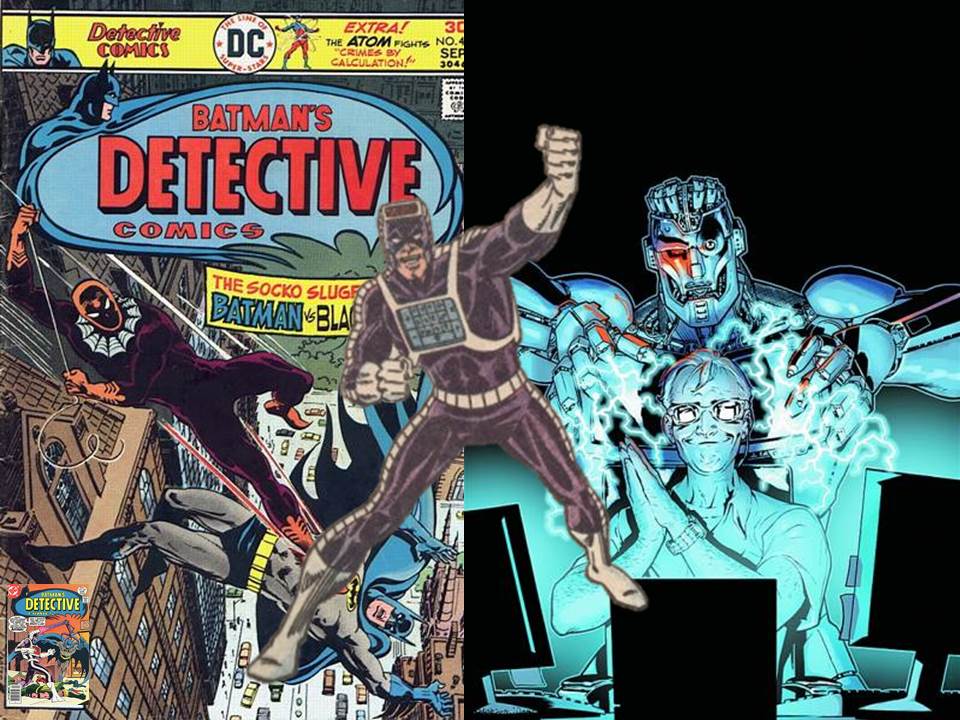
Crimes Of The Calculator

A long time ago, a villain came to be, to strike fear into the hearts of the heroic community....that man was....the Calculator!

Well, not so much.  True, the Calculator might have been a villain to contend with, but he hardly struck fear into the heroes who faced him.

Let's take a look at the facts of his early cases, and see how things add up!

Crimes By Calculation

Detective Comics #463 (September, 1976 by writer Bob Rozakis, penciller Mike Grell and inker Terry Austin) saw the premiere of the Calculator, and he started off small, by facing the Atom!

The Calculator was trying to steal a "quake-breaker" from scientist Richard Bagley at Ivy University, and he was quickly defeated by the Atom (but, the Calculator seemed happy about this as he pressed a button at his defeat....).

A Hot Time In Star City Tonight

The Atom told his friend and fellow Justice League member, the Black Canary about his case in Detective Comics #464 (October, 1976 by Bob Rozakis, penciller Mike Grell and inker Terry Austin), or at least he tried, as Black Canary wanted to get home to Star City for it's Tricentennial!

After a mishap in getting home, the Black Canary faced off against the Calculator and an untimely heat wave in Star City (that the Calculator was causing by amplifying Black Canary's Canary Cry!).  Luckily, she figured out a way to beat him, and did (though, again, the Calculator seemed happy as he pressed a button on his uniform in defeat).

The Elongated Plague

Next up for the Calculator is Detective Comics #465 (November, 1976 by Bob Rozakis, penciller Ernie Chan and inker Terry Austin), where the villain really decided to stretch his muscles, and face off against the Elongated Man!

This time, Elongated Man and his wife, Sue Dibny, were guests of honor at the Star City Comic Con, where they faced off against an outbreak of elongated attendees....the people at the show all developed elongated powers they couldn't control (thanks to the Calculator).  Still, Ralph Dibny was able to defeat the Calculator (who again, pushed a button, and seemed very happy in prison....). 


Take Me Out Of The Ballgame

Detective Comics #466 (December, 1976 by Bob Rozakis, penciller Marshall Rogers and inker Terry Austin) saw hints of the Calculator's plan, as he attacks a baseball game in Star City.

Green Arrow was scheduled to throw out the first pitch, but he just couldn't get the ball across the plate (and it was the fault of the Calculator).  Elongated Man was a spectator at the game, and found himself unable to move to help Green Arrow, as the battling bowman used the Elongated Man as a bowstring to take out the Calculator (accidentally hitting the Calculator's special button himself).

The Man Who Skyjacked Hawkman

By Detective Comics #467 (January-February, 1977 by Bob Rozakis, penciller Marshall Rogers and inkers Terry Austin and Neal Adams), even Hawkman knew something bigger was happening, and he told Batman so.

After Batman related his most recent case to the Thanagarian policeman, Hawkman told Batman of his battle with the Calculator, where he faced his foe at Midway City Airport, as Hawkman was taking a scientist off a plane to stop an atomic plant from melting down, but found his cargo to instead be the Calculator!  Hawkman still defeated the villain, and saved the atomic plant (with the Calculator again pressing his button), but Hawkman came to Gotham to warn Batman that he might be the next victim of the Calculator!

Battle Of The Thinking Machines

Detective Comics #468 (March-April, 1977 by Bob Rozakis, penciller Marshall Rogers and inker Terry Austin) sees Batman face the Calculator as the villain tries to steal a time capsule being buried in Gotham, and Batman defeats him, with, yet again, the Calculator pressing his special button.

Batman, after dealing with Metropolis WGBS head, Morgan Edge, goes to the Justice League Satellite, where the members talk about the Calculator escaping...AGAIN...and the heroes who faced him before have Aquaman (who was on monitor duty), beam them down to the Calculator's new target in Central City (where the Flash, the city's hero, is unavailable due to having time travelled into the future at this time).  The Calculator....easily defeats the JLA!

Somehow, the Calculator's device would calculate all the tricks the heroes could use against him after one battle, and they would never be able to defeat him again!   Batman doesn't believe this, so goes after the Calculator again when he strikes at S.T.A.R. Labs in Central City, and turns the tables on the Calculator, having the villain defeat himself!  A truly fun series of tales, as writer Bob Rozakis finally answers the question he set up in all the previous Calculator stories (which, as DC's Answer Man, you knew he would!).

The Calculator Continues

Bob Rozakis brought the Calculator back a few times, first to face the Atom and Air Wave in Action Comics #522 to #524 (August to October, 1981, with penciller Alex Sauvik and inker Vince Colletta), then writer Len Wein, penciller Paris Cullins and inker Dell Barris have Blue Beetle deal with the Calculator in Blue Beetle #8 (January, 1987), and Bob Rozakis has the Calculator learn the value of being behind the scenes, as he faces off against the heroes of Hero Hotline in Hero Hotline #6 (September, 1989, with art by Stephen DeStefano and Karl Kesel). 

The Calculator is just another face in the crowd in Justice League America #43, JSA #30, Flash #183 and Young Justice #51, before taking inspiration from the Oracle (the lady who led the Birds of Prey), and became a source for criminal information behind the scenes, helping villains during the Identity Crisis (and finally getting an alter ego, that of Noah Kutler), helping the villains against the Secret Six during Villains United and the Infinite Crisis, and being a thorn in the side of Oracle and Black Canary in Birds of Prey.

The Calculator proved that big things can add up from the smallest beginnings!    

Wednesday, January 27, 2016

Flash Facts: The Early Days of Reverse-Flash

Reverse-Flash was one of Barry Allen's deadliest enemies, having all the same speed powers that the Flash did, but none of his morals or character, time-traveling back from the 25th Century to make things rough for the Flash.


A little different than the character that has appeared on the CW's Flash, so let's take a quick look at the comic history of the Reverse-Flash!


Menace Of The Reverse-Flash

In Flash #139 (September, 1963, by John Broome, Carmine Infantino, and Joe Giella), we first meet Eobard Thawne, a resident of the 25th Century who finds Dr. Walter Drake's time capsule with a Flash uniform, and uses future science to give himself super-speed.  Flash arrives in the 25th Century (to save the future from a potential problem in the capsule), and defeats the criminal referred to as the Professor, then Professor Zoom, because Thawne only got the speed of the Flash, and not the aura that protected Barry from his speed, which the Reverse-Flash duplicated with chemicals.  Flash solved the problem, and destroys Professor Zoom's costume.

This tale has been reprinted a few times, like in Flash #205 (April-May, 1971), the Flash Archives #5 of 2009, and DC Comics Presents: The Flash of 2011.

Our Enemy, The Flash

With Flash #147 (September, 1964 by John Broome, Carmine Infantino, and Joe Giella), the Reverse-Flash returns, and turns reformed criminal Al Desmond back into his element changing identity of Mr. Element (a previous foe of the Flash, who also worked as Dr. Alchemy from Flash's earliest days in Showcase), to stabilize his own Element Z, and get his Reverse-Flash speed back.  This leads to another battle with the Flash, which Barry wins over Eobard, as well as being able to prove the innocence of Al Desmond as Al was only a pawn in Professor Zoom's hands.


This tale has been reprinted in Flash Archives #6 of 2012. 


The Mightiest Punch Of All Time

Flash #153 (June, 1965 by John Broome, Carmine Infantino, and Joe Giella) delivers another tale of the Reverse-Flash, with Thawne being released from prison in the 25th Century by cheating on a psychological exam.  Then, the Reverse-Flash tries again enlists the help of Mr. Element, but Al calls on the Flash for help.  Reverse-Flash makes his own cosmic treadmill to come back to the 20th Century, and gains the power of mental manipulation, which he uses to turn Central City against the Flash.  Flash eventually takes on Professor Zoom directly, finishing him off with quite a punch, as well as getting poor Al Desmond help for his criminal tendencies.

This tale was reprinted in Flash #196 (April-May, 1970).

One Bridegroom Too Many

With Flash #165 (November, 1966 by John Broome, Carmine Infantino, and Joe Giella), Professor Zoom develops the habits he uses a lot more in the future.  The day before Barry marries Iris West, Thawne brings Barry to the 25th Century, and Reverse-Flash comes back, disguised as Barry to wed Iris!

Coming back in time to make Barry miserable and taking Barry's place are themes Thawne will revisit again and again.


This tale was reprinted in Flash #328 (December, 1983) and in Flash: The Greatest Stories Ever Told Tradepaperback of 2007.


The Race To The End Of The Universe

In Flash #175 (December, 1967 by E. Nelson Bridwell, Ross Andru, and Mike Esposito), the Reverse-Flash works with another time travelling villain of the Flash, 64th Century Abra Kadabra, to manipulate the second Superman/Flash race, and cause problems for Barry Allen.  The two villains get defeated by Superman and the Flash, but still no winner in the race is decided...

..and won't be for a while.


More history on the Superman/Flash races is here, and you can find this tale reprinted in the Limited Collector's Edition C-48 of 1976 and in the Superman Vs. Flash Tradepaperback of 2005.


Time Times Three Equals -- ?

Flash #186 (March, 1969 by Mike Friedrich, Ross Andru and Mike Esposito) sees the revival of a Golden Age hero, Sargon the Sorcerer, whose Ruby of Life allows him to manipulate matter, but he comes back as a bad guy.  Sargon breaks the Reverse-Flash out of his 25th Century prison, planning to get Professor Zoom to teach him more time travel tricks, but Thawne only wants revenge on the Flash.  Professor Zoom battles Sargon, using his own magic against him and trapping the sorcerer in a nether dimension (which he tricks the Flash into freeing him from).  After their return, Flash battles the Reverse-Flash again, using the Ruby of Life to defeat him, but Sargon gets away.


This tale has yet to be reprinted, though this cover provides an eerie look into the future of the Flash.

Green Lantern Master Criminal of the 25th Century

Flash #225 (January-February, 1974 by Cary Bates, Irv Novick and Dick Giordano) sees an odd event...

...with Flash teaming up with the Reverse-Flash against Flash's friend, Green Lantern?  This happens because Professor Zoom created a "syntho-steed" menace that he sent back to the 20th Century, and the two heroes had to go to 25th Century to get Professor Zoom's help in defeating it.


This tale has yet to be reprinted, but wouldn't it make a great addition to a collection of Flash/Green Lantern team-ups?


The Deadly Secret Of The Flash

Flash #233 (May, 1975 by Cary Bates, Irv Novick and Dick Giordano) sees a bit of the ability to plan and think fast on his feet for the Reverse-Flash, who comes back in time to take Iris Allen as his, and ruin Barry Allen's life.  Thawne's original plan doesn't seem to be successful, but in this case he had a back-up plan, and it took a little time for it to manifest...

...but, as a time traveller, Professor Zoom would be okay with that!


This tale was collected in The Flash: A Celebration of 75 Years in 2015, as it well defines the character of the Reverse-Flash!


The 1,000-Year Separation

What Professor Zoom set up in his last appearance comes home in Flash #237 (November, 1975 by Cary Bates, Irv Novick and Frank McLaughlin).  Flash had spent the previous two issues looking for Iris Allen (who had disappeared in a battle with Vandal Savage), and the Golden Age Flash and Dr. Fate had been keeping Barry away from Iris, this all due to energy that the Reverse-Flash had put into Iris that would destroy the world if Barry saw Iris again, which Thawne would only remove if Iris wed him.  Iris was at her original birth time of the 30th Century (a long story, but Iris was also from the future), and Flash fought the Reverse-Flash there to save Iris, and bring her home.


This story has not been reprinted.


Super-Villain Team-Up

When next the Reverse-Flash appeared, it was as a part of the Secret Society of Super-Villains, working with villains like the Wizard, Blockbuster, the Floronic Man and Star Sapphire, all after the Wizard got rid of Grodd!  More on that team after introducing more of it's members, and you can also read more of Reverse-Flash's legacy here


Thursday, January 21, 2016

The Many Lives of Hawkgirl

Hawkgirl is one of DC's first heroines, pre-dating Wonder Woman, and she's still relevant today.


But, Hawkgirl has undergone many changes over the decades as well, so, here's a quick little summary of the many lives of Hawkgirl!


Golden Age Hawkgirl

Shiera Sanders had a long history, even before she became Hawkgirl.  Premiering in Flash Comics #1 (January, 1940 by writer Gardner Fox and artist Dennis Neville), Shiera was the reincarnated version of Egyptian priestess, Chay-Ara, who met her eternal love, Prince Khufu in his reincarnated version as Carter Hall.  Shiera ended up being kidnapped by Dr. Anton Hastor, the modern version of the foe of the ancient prince and princess, Hath-Set, which led to Carter becoming Hawkman, using an anti-gravity Nth Metal and ancient weapons to save the girl, and (temporarily) vanquish their foe.

Shiera continued with Carter, eventually donning a costume and wings herself in the Justice Society story of All-Star Comics #5 (June-July, 1941) in a story written by Gardner Fox (but it was more to make villains think she was Hawkman), but Shiera officially became Hawkgirl in Flash Comics #24 (December, 1941 by writer Gardner Fox and artist Sheldon Moldoff)...though, just to add a bit of confusion to this tale, she called herself Hawkwoman in this tale (and this one only).

Shiera continued on working with Hawkman in Flash Comics, and occasionally in All-Star Comics (but not being a member of the JSA team in the original run, unlike Carter, who was), though Hawkgirl did join the World War II team of the All-Star Squadron.  Shiera was mostly retired when the JSA returned at the coaxing of the two Flashes (having married Carter Hall and had their son, Hector, sometime between the end of the JSA and their first revival), but Hawkgirl did go into limbo with the JSA (unlike the newest members of Power Girl and the Star-Spangled Kid) soon after the Crisis on Infinite Earths (and was officially a JSA member when she and the rest of the team came back for a brief time in the 1990s).  Sadly, she and her husband, Carter, didn't make it out of Zero Hour....but did, it's complicated....and that tale requires you to meet the rest of the Hawkgirls and Hawkwomen....   

Silver Age Hawkgirl/Hawkwoman

Shayera Hol was introduced to the world in Brave and the Bold #34 (February-March, 1961 by Gardner Fox and Joe Kubert) along with Hawkman as married police officers from the planet Thanagar, looking for fugitive shape-changer Byth, and stayed to learn Earth crime fighting techniques while using her flight, resistance to outer space, technological advances and ancient weapons to fight the new menaces they encountered!


This Hawkgirl also worked with Hawkman exclusively, and even supported his work when he joined the Justice League of America, though it took until Justice League of America #146 (September, 1977) for her to be inducted into the JLA.  Soon after, Hawkman and Hawkgirl got involved in the Rann-Thanagar War (in Showcase #101-103 from June to August, 1978), and that conflict which had the Hawks exiled from their homeworld caused friction between the couple, which also led to Shayera to change her identity from Hawkgirl to Hawkwoman in World's Finest Comics #272 in October, 1981 by Bob Rozakis and Alex Saviuk, though the couple patched things up soon after halting the Rann-Thanagar War (for a time).

The Thanagarians were more blood thirsty after their war, but raged their war as a more silent, shadow war, which kept the Hawks busy during their 17 issue series in the mid-1980s, and up until they faced two other alien threats to Earth, with the Millennium and Invasion! (along with joining the newest version of the Justice League, the Justice League International, after which they pretty much completely disappeared (this, due to an editorial decision at DC, which led to the newest Hawkwoman, and years of confusion for Hawkman fans!).

Hawkworld Hawkwoman

Shayera Thal owes her existence to an accident, and not just the one that killed the original Shayera Thal in Tim Truman's 1989 Hawkworld mini-series (though that wasn't the Silver Age Hawkgirl or  Hawkwoman).  When Hawkworld #1 (June, 1990 by John Ostrander and Graham Nolan) appeared, it was the first appearance of the new Hawkwoman, Shayera Thal (though she was in the mini-series as a civilian, and revealed to be the illegitimate daughter of Chief Wingman Andar Pul), who was a Thanagarian police officer, coming to Earth for the first time, with her single partner, Katar Hol, soon after the events of the Hawkworld mini-series (and yet, after Invasion!), looking for the escaped shape-changer, Byth (who also was coming to Earth for the first time), and using their advanced Thanagarian tech to fight crime (which included flying and blasters).

Being new to Earth, Hawkwoman (and Hawkman) had problems with the local heroes (who had just fought Thanagarian Hawkmen in Invasion!), as well as Earth losing its pair of Hawkmen and a Hawkgirl and Hawkwoman (explained as the original Hawkman and Hawkgirl taking the place of the Silver Age pair up to the Crisis on Infinite Earths, then a Thanagarian double agent taking Hawkman's place, recruiting Earth girl, Sharon, as his Hawkwoman, and his wife....see Hawkworld Annual #1 of 1990 and Hawkworld #23 of May, 1992 for the confusing details, including how the Golden Age Hawkman and Hawkgirl seemed to have access to Thanagarian technology).

Be that as it may, Shayera Thal was getting use to life on Earth, and being a hero (and slowly getting to like Katar), and even using crossovers like the War of the Gods to make new friends (like Wonder Woman), though some people, like Eclipso, got in her head (during Eclipso: The Darkness Within).  Hawkman and Hawkwoman even got exiled from their Thanagar, coming to stay on Earth as heroes on their own, getting updated costumes....and were fine on Earth, until Zero Hour: Crisis on Time of 1994, where this new Hawkman, the original Hawkman, and the original Hawkgirl all merged (and all of the original Hawkman's past lives got a lot louder in Hawkman's head).  This also made Hawkman the only possessor of the Thanagarian Nth-metal (which allowed the Hawks to fly), so Shayera was left without her wings (and sadly, mostly abandoned by Hawkman).  Hawkman did finally join the Justice League America, eventually disappearing himself soon after Underworld Unleashed and an encounter with Vandal Savage (who took credit for killing many of the original Hawkman's reincarnated selves).

Hawkwoman did return, after the original Hawkman returned, and Shayera also worked with the new Hawkgirl, at least until a new Rann-Thanagarian War, which spelled the end of Shayera Thal Hawkwoman....

....but, more details of that to follow, as we meet the more current Hawkgirl!

JSA Hawkgirl

Kendra Saunders was a troubled young girl, so much so that she tried to kill herself, and she was almost successful, but then came back as Hawkgirl!  Premiering in JSA Secret Files #1 (August, 1999, by James Robinson, David Goyer and Scott Benefiel), we learn that Kendra was the granddaughter of Speed Saunders (an adventurer who premiered in Detective Comics #1 of March, 1937)...

...and that he saved Kendra (though she did die for a time, and that allowed the soul of Shiera Hall into her body), with Speed realizing what had happened after Kendra awoke in the hospital.  Speed gave her a set of Sheira's old wings, inspiring the young girl to be Hawkgirl.  She soon joined the reforming JSA (which included as members the second Black Canary, Nuklon as Atom-Smasher and the original Flash and Wildcat) as they faced the wizard, Mordru, and continued to distinguish herself as a member of the team, including during the Day of Judgment.

Hawkgirl ended up being taken to Thanagar to face Onimar Synn, who proclaimed himself an eater of souls, who was using the Thanagarian Nth metal to control the population of the planet.  With the help of the current JSA, Hawkgirl frees the people of Thanagar, and helps in the return of the original Hawkman, Carter Hall (who still possesses echos of his previous lives, but not Shiera Hall, nor the Hawkworld Katar Hol, with Carter's return being chronicled in JSA #23 to #25 of 2001 by David Goyer, Geoff Johns, Stephen Sadowski and Michael Bair).  Carter tells Kendra of his and Shiera's eternal love, and keeps trying to convince her they belong together, but Kendra isn't sure, feeling their relationship is more complicated.

The pair move to St. Roch, Louisiana, following a lead on the death of Kendra's parents, and the Hawks settle there for a time (along the way, discovering more about their past lives and each other, like how old West incarnations Nighthawk and Cinnamon, had met in St. Roch, and we learn that Nighthawk was the one who originally killed Jim Craddock, the Gentleman Ghost.....), joining the Justice League of America at this time (in JLA #71 of early October, 2002, with Green Arrow, Atom, Firestorm, Nightwing and others), as well as fighting Helene Astar (who had killed Silver Scarab a.k.a. Hector Hall son of the original Hawkman and Hawkgirl in Infinity, Inc. #42 to #44, and was thought to be the modern reincarnation of Hath-Set, who faced Silver Scarab, and later, the Hawkworld Hawkman in Hawkman #21 and Hawkman Annual #2), and finding Kendra's parents' killer.


Hawkgirl even met the Hawkworld Hawkwoman in Hawkman #14 thru #17 (June to September, 2003), where Shayera learned that the Katar she loved was dead, with Carter, Kendra, Shayera and Animal Man capturing shape-changer Byth who was loose on Earth again, and then Kendra encountered Shayera again during he Rann-Thanagar War 6 issue mini-series of 2005, where Hawkwoman sadly lost her life, just before the Infinite Crisis, with Kendra and Carter, for a time accepting one another.

After the Infinite Crisis, Kendra does what no Hawkgirl before her ever did, getting her own title!  Running from Hawkgirl #50 (May, 2006, taking over the numbering of the Hawkman series), and lasting until Hawkgirl #66 (September, 2007), with Hawkgirl finally dealing with Hath-Set, and settling if it was Shiera Hall or Kendra Saunders in charge, letting Kendra be in control of her own life going forward.


Kendra continued onward as Hawkgirl..

....at least until the Blackest Night event, where she perished in Blackest Night #1 (September, 2009)...

...but continued to menace the world as an undead Black Lantern through the rest of that eight issue series.


The Original Hawkgirl Returns

All of this history led to the return of the original Hawkgirl, Shiera Sanders-Hall, in Brightest Day #1 (Early July 2010), finally reunited with her Hawkman, Carter Hall, where they continued to fight for us all, facing off with Hath-Set one last time, as well as Chay-Ara's mother (Queen of Thanagar Khea Taramka, also known as Queen Shrike) and learned how Thanagar had been an influence in the original ancient Egyptian life of Khufu and Chay-Ara, until the DC Universe got a reset with Flashpoint, and we eventually got a new Hawkgirl and Hawkwoman in the New 52.

Hawkgirl is a great example of reincarnation and karma..

...truly showing what goes around, comes around, and how true love can be eternal!