"When Heroes Gather!" should have been the title!
Starting with
Brave and the Bold #28 (February-March, 1960), and facing off against "
Starro the Conqueror"...so came together the Justice League of America by writer
Gardner Fox and artist
Mike Sekowsky. The team continued along with two more tryout issues (
Brave and the Bold #29, facing Xotar the Weapons-Master and
Brave and the Bold #30, fighting Professor Ivo and his adapting android, Amazo), before getting a
Justice League of America #1 (October-November, 1960), in a title that ran 261 issues (and 3 annuals), ending its original run with the cover date of April, 1987.
Not going to attempt to cover all that history right now (or their ancestor team, the Justice SOCIETY of America...but sometime later...).
Here's a little on the original seven founding members of the Justice League of America and where they came from and who they were before they joined the Justice League!
Who to start with? How about....
The Man of Steel
Superman...Clark Kent of the Daily Planet, Kal-El from Krypton, and considered the first of the DC Comics heroes with flight, speed, vision powers and the strength to fight for truth, justice and the American way! Superman being a part of any gathering of heroes was almost a given...Superman's historical first appearance was in
Action Comics #1 (June, 1938, by
Jerry Siegel and
Joe Shuster), but that's the original Superman (and the one who joined the Justice Society of America before World War II).
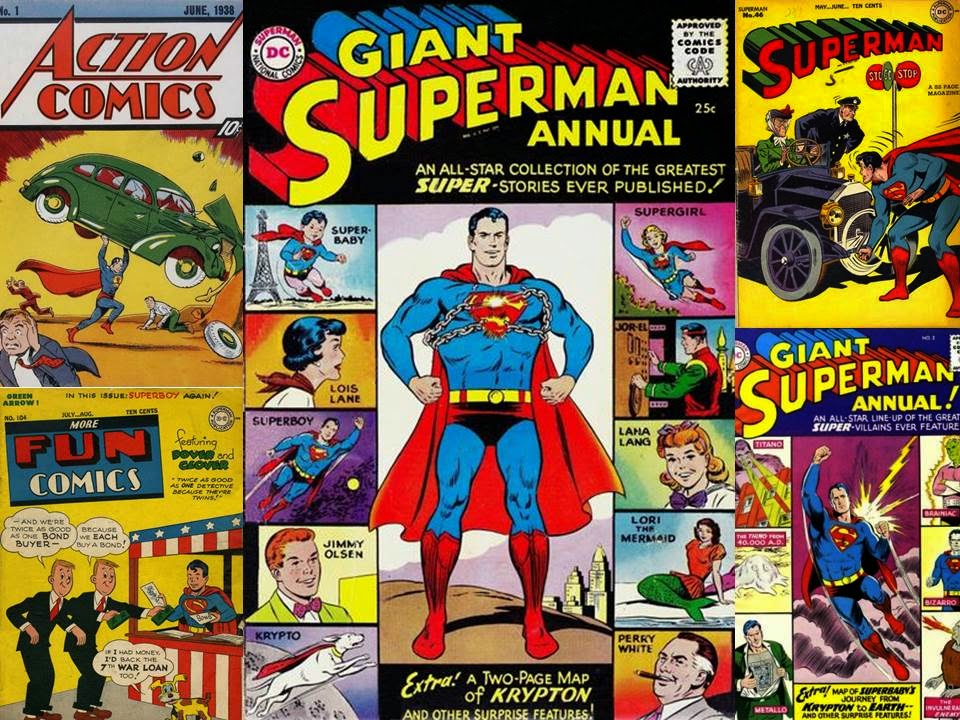
The Superman who was in the Justice League also had a career as Superboy (which the original Superman, Kal-L, didn't have), so technically
More Fun Comics #101 (January-February, 1945, also by
Siegel and
Shuster, and no cover appearance until
#104) could be considered his first Earth-1 appearance...and Superboy's first mention in a Superman comic was in
Superman #46 (May-June, 1947), so that could be considered Superman's first Earth-1 story!
In any case, Superman wasn't around much in the early Justice League stories (as he was also in
Superman,
Action Comics,
Superman's Girl Friend Lois Lane,
Superman's Pal Jimmy Olsen, as well as in
Adventure Comics and
Superboy as his younger self and sharing a spot with a fellow charter member in
World's Finest Comics), so editorial decree kept the Kryptonian Crusader sidelined (and also kept Superman's supporting cast out of the JLA for quite some time other than brief appearances, and, sadly, most of his villains except for
Luthor and Brainiac out over the entire original JLA run), but he became much more important to the team as time went along...
The Darknight Detective
Batman...Bruce Wayne, the criminal crimefighter of Gotham City, putting all his mental resources to stop the villains who killed his parents. Starting with
Detective Comics #27 (May, 1939 by
Bob Kane and
Bill Finger),
Batman began his unrelenting war against crime...though that wasn't the Batman that joined the Justice League (nothing nefarious, just a change in...well, the universe).
Batman had a "
first meeting" with Superman in
Superman #76 (May-June, 1952), and oddly enough...that ends up being Batman's first Silver Age (or Earth-1) appearance (due to the fact that Superman and Batman met in
All-Star Comics #7, both as honorary members of the Justice Society!). Batman himself hadn't changed as much from his Golden Age to the Silver Age, but boy did the world around him change!
Villains like the Joker, Two-Face, Scarecrow, and Penguin got more complex, Robin was still the Boy Wonder (at least for a time), and with
Detective Comics #327, Batman added the yellow circle around his chest emblem (though he had no emblem in
Justice League of America #1-27, he started sporting it with
Justice League of America #28).
Later Batman villains like Poison Ivy, Blockbuster, Signalman and more also came to be (and they joined JLA villain groups like the
Injustice Gang of the World and the Secret Society of Super-Villains). Batman even became friendlier, along with being in
Batman and
Detective Comics, Batman worked with Superman as a team in
World's Finest Comics (since
#71, July-August, 1954), and then teamed up with many DC heroes for a time (continuously since issue
#74) in
Brave & the Bold (until the title changed to
Batman & the Outsiders, after
Brave & the Bold #200), and Batman left the JLA for a time.
Amazing Amazon
Wonder Woman....Princess Diana of Paradise Island, who took the identity of Diana Prince when she came to "Man's World" to save us from ourselves. Wonder Woman burst onto the scene as a back up to the Justice Society of America in
All-Star Comics #8 (December-January, 1941/1942) in a story by
William Marston (pen name
Charles Moulton) and art by
Harry G. Peter.
That Diana headlined
Sensation Comics starting with its first issue (as well as joining the Justice Society), but the Wonder Woman who was the Silver Age amazon started in
Wonder Woman #98 (May, 1958), which presented a new origin for Wonder Woman, different from her World War II one (as the JLA Wonder Woman didn't really start during World War II), as well as having the first
Ross Andru art on Wonder Woman (and this issue also first established Wonder Woman's mother, Hippolyta, as a blonde, as she had been a brunette from the early days; writer
Robert Kanigher was making a visible effort to make a new Wonder Woman), though
Wonder Woman #78 (November, 1955) was once considered the Silver Age start, as it shared a release date with
Detective Comics #225.
Real differences between the Wonder Women weren't really established until the later 1970s and 1980s...even when her villains appeared in the Justice League (like the Mask, Angle Man or Minister Blizzard), they were usually from the Golden Age, though a modern Cheetah did show up later! Still, differences existed, and were expanded upon (most notably the marriage of the original Wonder Woman to Steve Trevor, and Silver Age Wonder Woman having saved young Donna Troy who would grow up to be
Wonder Girl in the Teen Titans...though originally, Wonder Girl was Wonder Woman as a girl!).
Wonder Woman was often confused and searching for her own identity, and even lost her powers for a time (leaving the JLA for a while from
Justice League of America #69 to
129) but she got them back, rejoined (after twelve trials), upgraded her costume in
DC Comics Presents #41 (which then showed up in
Wonder Woman #288) and stuck around until the JLA changed and moved to Detroit...before her own untimely end during the
Crisis on Infinite Earths and being reborn in a new Wonder Woman series with art by
George Perez.
Sea King
Aquaman...Arthur Curry, king of the Seven Seas and the undersea kingdom of Atlantis, with the power to breathe underwater and command sea life. Aquaman first appeared in
More Fun Comics #73 (November, 1941) along with Green Arrow (though neither made the cover...mystic hero Dr. Fate was given that honor) in a story by writer
Mort Weisinger and artist
Paul Norris.
Like Superman, Batman and Wonder Woman, this was an earlier version of Aquaman (though this wasn't revealed until the days of the All-Star Squadron, as Aquaman was usually one of the heroes used as an "Earth-1" only, not unlike how Dr. Fate was used for "Earth-2". A definite change in Aquaman which could be the JLA version of Aquaman started with
Adventure Comics #229 (October, 1956) with the first appearance of Topo, Aquaman's pet octopus (and one thing that the original Aquaman didn't have..like supporting characters until this point...or even cover appearances, as Superboy dominated
Adventure Comics covers!
Adventure Comics #215 of August, 1955 has also been listed as an early first Silver Age appearance, and DC's
Showcase Presents: Aquaman starts with the story in
Adventure Comics #260, and Aquaman's more modern origin of a father who was a lighthouse keeper, and his Atlantean mother).
Aquaman really only started appearing on covers with his joining the of JLA (the same month Aquaman first met Aqualad, no less, in
Adventure Comics #269), then his
Showcase tryout issues, and then finally getting his own title with
Aquaman #1 (January-February, 1962). His major foes (Ocean Master and Black Manta) were introduced in that Aquaman series, as was his wife, Mera, and later, their son, Arthur Jr. (though, of all the Aqua-family and foes, only Mera made it into Justice League appearances, though Electric Man did, and he had only appeared in
Adventure Comics #254, but most of the Aquaman foes we saw in the original JLA run were made up for JLA, like Sea-Thief and Cutlass Charlie...after Aquaman and Mera were nice enough to have the JLA and the Teen Titans at their wedding). Aquaman proved quite loyal to the League (it being his only home for a time, though he kept going back to being a feature in
Adventure Comics and
World's Finest Comics, and even briefly in
Action Comics), reforming it after a Martian invasion, and helping the team settle into Detroit, before leaving the team to be with Mera!
Manhunter from Mars
Martian Manhunter...J'onn J'onzz, was just a police man on Mars, until he was taken from his home by Dr. Erdel's teleport device and ended up on Earth, becoming Detective John Jones, first using his powers in secret, and looking for a way home. The Martian Manhunter first appeared in
Detective Comics #225 (November, 1955) by
Joe Samachson and
Joe Certa, and stayed hidden as a back-up feature behind Batman for many years (having only the slight crossover with Batman, though, at the time, Batman was facing many alien menaces, so he could have used J'onn's help!).
It was appropriate for the Martian Manhunter to stay hidden, as in his early days, J'onn hid in his identity of an Earth detective, mostly using his telepathy and invisibility as he secretly fought alien menaces and other problems like Monty Moran-the Getaway Mastermind and the Human Flame (uniquely built to take advantage of the Martian's weakness to fire), borrows Prof. Arnold Hugo (who started as a one-time Batman foe). J'onn would also avoid the questions of fellow police officer Diane Meade and his Captain, Harding, and even picked up a sidekick called Zook as he became a more active super-hero.
Joining the JLA was good for the Martian Manhunter, as soon after the JLA met the JSA, J'onn also ended up in the first
Brave and the Bold team-up (with Green Arrow) in
B&B #50, and then moved from
Detective Comics (with his last issue there being
#326, with Elongated Man taking J'onn's place in
Detective at the same time Batman got his new look) to
House of Mystery (starting with
#143 in June, 1964) where J'onn was the headliner (but while still a detective, was a little more like a green-skinned Superman, especially in the Justice League), and faced foes like the Idol-Head of Diabolu, Faceless and the agents of Vulture. That ended (as did the super-hero format of
House of Mystery) with issue
#173 (March-April, 1968) leaving J'onn with only the JLA as his home (and leaving his co-star, Dial H for Hero, homeless!).
The Martian Manhunter even lost his spot in the Justice League of America with issue
#71 (May, 1969). But, between
World's Finest Comics,
Adventure Comics,
DC Comics Presents and even the
Justice League of America, J'onn kept busy...and returned to the Justice League full time as Aquaman reformed the team and moved them to Detroit.
This also cemented J'onn's relationship with the Justice League, and he's been a mainstay there for decades.
Scarlet Speedster
Flash started his run in
Showcase #4 (September-October, 1956) when police scientist Barry Allen was hit by lightning in "The Mystery of the Human Thunderbolt!" by writer
Robert Kanigher and artist
Carmine Infantino! Just like that lightning bolt, Flash's premiere kicked off the Silver Age as a unique hero, but still one with a
legacy (Barry was reading a comic of the earlier Flash's exploits! Barry was the beginning of revamped heroes, with more scientific origins, and the start of a whole new frontier of super-heroics).
Flash had his own world of foes to contend with, including
the Rogues (Captain Cold,
Mirror Master, Pied Piper, Weather Wizard and Captain Boomerang popped up in JLA), as well as villains like the always changing
Dr. Alchemy (who was also Mr. Element), the future magician, Abra Kadabra, and the villainous speedster, the
Reverse-Flash! Barry also met that other Flash as he traversed worlds, and started a tradition, wherein the Justice League met with the Justice Society, and the two teams dealt with whatever
Crisis would come up...and try to defeat it together!
During his run, Barry also
raced against Superman, had a sidekick in Kid Flash (aka
Wally West), made friends with the Elongated Man (also a future JLAer), married his fiancé, Iris West, discovered a city of talking apes in Africa (and faced
Grodd, a gorilla with mind powers, to help the leader of Gorilla City, Solovar), and even got to meet his maker, editor
Julie Schwartz! Due to some personal hardships, Barry did have to take a leave from the Justice League towards the end of its run....but Barry was always there for the JLA, and they for him. All this coming from a man who just wanted to good for everyone around him...and did it very fast, thanks to a bath in chemicals electrified from a lightning bolt!
Emerald Crusader
Green Lantern was a name known throughout the cosmos, and test pilot Hal Jordan joined their ranks in
Showcase #22 (September-October, 1959) with "SOS Green Lantern" by writer
John Broome and artist
Gil Kane (continuing the tradition started by editor
Julie Schwartz, with the Flash, of reviving Golden Age characters with more modern, scientific origins). What a start this was, as Green Lantern ended up as the last of the charter JLAers (even before he got his own book!).
Green Lantern and his "magical" ring (not so magical, really a scientific device which focused green energy from a lantern, which was given to Hal by Abin Sur, a member of the Green Lantern Corps, which watched over everyone, and led by the Guardians of the Universe, and that ring could make anything he thought of, with the only weakness it had was the color yellow, and the limits of Hal's willpower) were a mainstay and central focus of the earliest of the JLA adventures (though Hal was only in their pre-origin focus as a test pilot as the pre-team faced Ben Blanx, a foe of the Martian Manhunter....).
Still, Hal was not always happy with the directions the Guardians gave him as Green Lantern of Sector 2814, and after a
hard time travelling the country with Green Arrow, Hal came to find himself again (but he did so as a back-up feature in his buddy's, the Flash, title, as his title had been cancelled for a time), and Green Lantern foes like the immortal mind reader Hector Hammond, the sound weapon using Sonar, master of living body art the Tattooed Man, magnetic manipulator Dr. Polaris and even the hyper-evolved
Shark all ended up facing the JLA for a time (while yellow ring-slinger Sinestro only menaced Hal with the Secret Society of Super-Villains, along with a new girl in the guise of Star Sapphire).
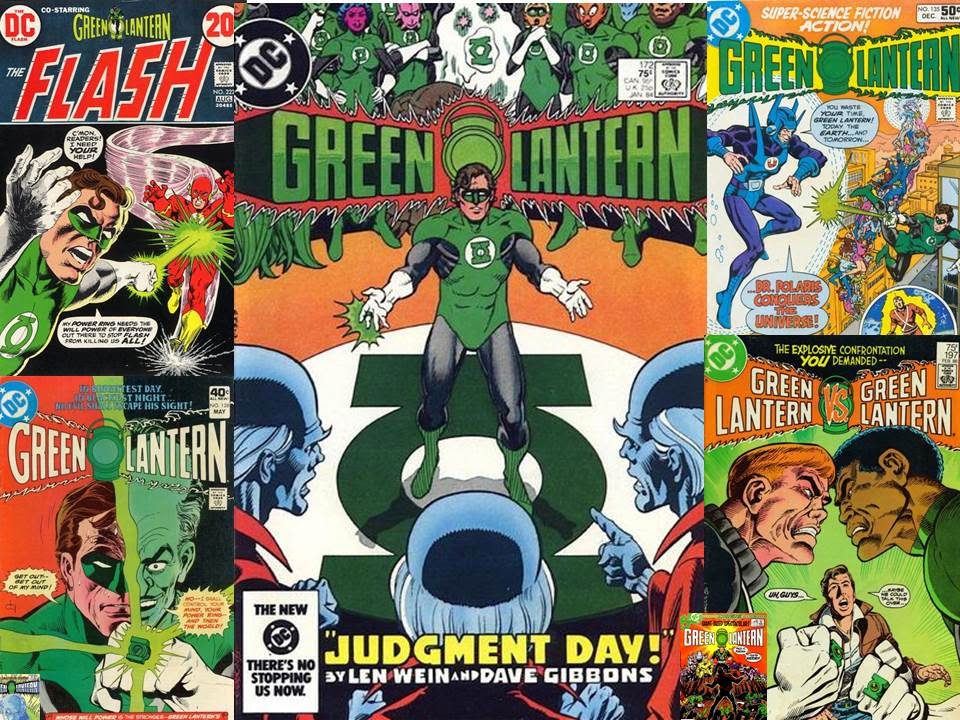
Hal even had a few back-up Green Lanterns, with John Stewart ending up working with the JLA briefly during its original run (and Guy Gardner being a mainstay after the Justice League's rebirth). Hal did get his own title back, and with his title recharged still hung around with the JLA (as well as going back to work for Carol Ferris at Ferris Air)...at least until Aquaman reorganized the JLA after the "Martian" invasion, and took the team to Detroit.
These seven heroes were where the Justice League started...and their ranks soon grew to add more members, like
Green Arrow, the Atom, Hawkman,
Black Canary,
the Elongated Man, the Red Tornado, Hawkgirl, Zatanna and more..
...but that is a story for another day!