Monday, August 11, 2014

Swing With the Spidermobile?

Yes, Spidey swung around Manhattan with the greatest of ease…but, I guess there were some days he needed a car.

So, here’s the spectacular Spider-Mobile!

Introduced to the world in Amazing Spider-Man #130 (March, 1974, by Gerry Conway and Ross Andru…one issue AFTER the 1st appearance of the Punisher, by the way), media moguls Carter and Lombardo (working to advertise Corona Motors; they had approached Spidey a few issues earlier), set up a deal with Spidey, where he accepted a check to have the Spider-Mobile…except he had to build it himself! With the help of his hot rod friend, the Human Torch (honest, Johnny Storm was into cars, check out early Strange Tales!), the Spider-Mobile came into being! The car had web-shooters, a spider-signal spotlight, and even an ejector seat (how very James Bond), and, with a push of a button, could disguise itself as a 1950s Chevy fleetline. Spidey even used it to capture some of Hammerhead’s hoods (but not the main villain himself…as Spidey could barely drive! All those spectacular things Peter Parker could do…didn’t include driving; yes, Spidey had never taken driving lessons!).

Spidermobile quick drives!


The Spider-Mobile next appeared in Spider-Man/Human Torch #3 by Dan Slott and Ty Templeton in May, 2005 (though it was a flashback tale), then a few more times…in Amazing Spider-Man #141, where Spidey looks for Jackal in the Spider-Mobile, and sinks the car in the Hudson River when an alley becomes a pier! (This tells you Spider-Man’s foe, the illusion-welding Mysterio is back in town…or does it?).

Then, in Amazing Spider-Man #142, Spidey checks out the wreckage of the Spider-Mobile and Mysterio jumps him!

It took until Amazing Spider-Man #157 (this time written by Len Wein instead of Gerry Conway), where Spidey finds the Mobile’s mirror, and in Amazing Spider-Man #159 where we see someone rebuilding the Spider-Mobile!

The Spidermobile wheels back in


The Spider-Mobile returned in Amazing Spider-Man #160 (September, 1976, by Len Wein and Ross Andru), but this time under control of the Tinkerer (himself a Spidey foe all the way back from Amazing Spider-Man #2…where he worked with the original Mysterio before he was Mysterio!). And, like all car guys, the Tinkerer couldn’t resist tinkering with the Spider-Mobile, having added a remote control (to allow him to attack Spidey with the car), drive up walls (allowing the car to live up to its name), and launch gas bombs that nullified Spidey’s spider-powers! Still, Spidey was able to defeat the car…and returned it to Carter and Lombardo (albeit not in cherry condition!).

Likely, the Spider-Mobile was made to tie into the merchandise that was hitting store shelves in the 1970s…

Toy car?


Spider-Man had himself a Mego action figure, and that was followed up by…the Spider-Car?
Well, it kind of looked like the Spider-Mobile (and likely might have been a reason for it to be put into the comics), but, sadly, this cool little Spider-accessory wasn’t quite in line with the comics, but it sure looked fun! (Isn’t that what having a car you modify all about?).


The Spider-Mobile has even returned a few more times in recent years….with a brief stop in a flashback in Marvel Knights: Spider-Man #7, but more would follow…

The Spidermobile Returns


Popping up as a museum piece (fully restored) in Amazing Spider-Man #600 (in one of the stories in that September 2009 book by Zeb Wells and Derec Donovan; but the car was not quite fully respected by the museum patrons….).


In Amazing Spider-Man #647 (December, 2010, by Fred Van Lente and Max Fiumara; this time, the villain Overdrive, who has the power to make machines with his mind, turns an unsuspecting limousine into…the Spider-Mobile!).

It even made an alternate future, where it had been upgraded even more…and was driven by Hawkeye (so he could help Old Man Logan in a run of Wolverine, easier to look for the “Old Man Logan” tradepaperback, though it is issues #66-72 in 2008 by Mark Millar and Steve McNiven!).

The Spider-Mobile might not be as famous as Batman's Batmobile, or even Green Arrow's Arrowcar, but it’s still….amazing!

Thursday, August 7, 2014

Superman’s Phantom Zone Facts

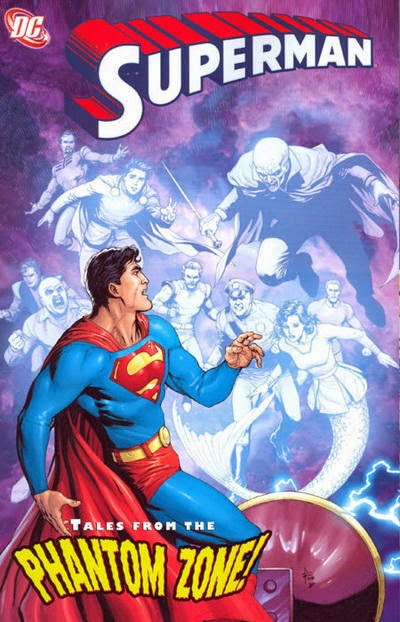
The Phantom Zone was home to Krypton’s greatest criminals, and, oddly, they survived Krypton’s destruction by being sent there.  They also broke free on occasion, and ended up menacing Superboy, Supergirl, Superman, and all of Earth!

Origin of the Phantom Zone


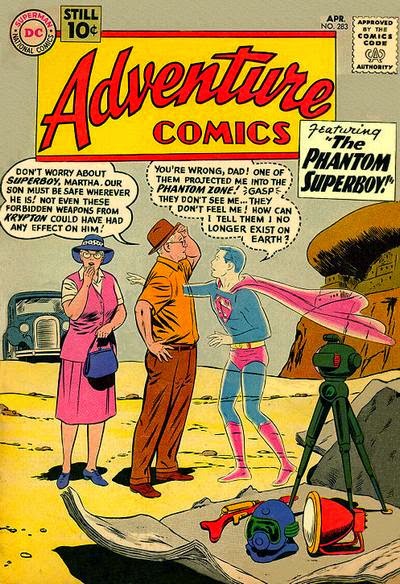
The Phantom Zone first appeared in Adventure Comics #283 (April, 1961 by writer Robert Bernstein and artist George Papp),  when Superboy found a cache of Kryptonian weapons on Earth, and with them, the Phantom Zone projector, which he accidentally triggered and trapped himself in the zone, able to see all, but touch or talk to no one (except the prisoners, via telepathy).  Luckily, young Kal-El was able to get a message to his Earth father, Jonathan Kent, and got free from the zone.
But, this opened a Pandora’s Box of problems, as the criminals were now aware of Earth, Superboy and would work tirelessly to get themselves free and subjugate the Earth, and the son of Jor-El, the scientist who found the zone, and put most of them there.

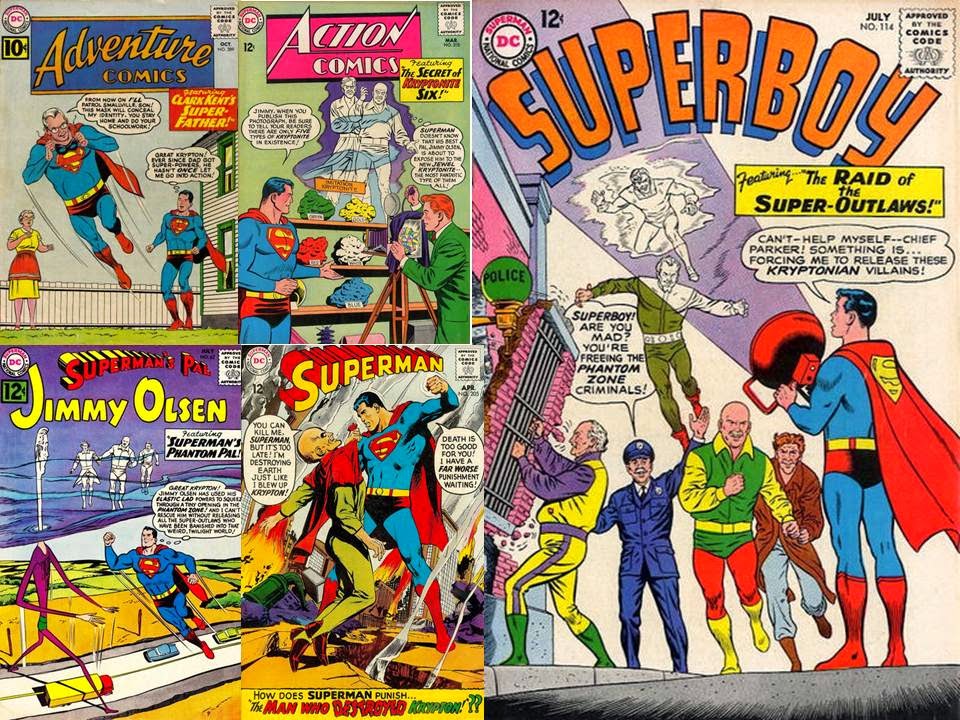
A few of those prisoners Superboy saw in that first appearance were Dr. Xadu (a scientist sent to the Zone for conducting forbidden experiments in suspended animation which resulted in the deaths of his patients, and his wife, Erndine Ze-Da, was later sent there as well, and the pair menaces Superboy and Superman at different times), but the most important prisoner was General Zod.

Zod In the Zone


Dru-Zod was a general in the Kryptonian army, and after the explosion of Wegthor (a moon of Krypton) ending Krypton’s space program, Zod attempted a coup of Kryptonian Council, using an army of imperfect duplicates of himself.  Zod was stopped, the duplicates destroyed, and that crime got him sentenced to the Phantom Zone.  While in the Phantom Zone, Zod learned of Earth, and of the son of his jailer(Kal-El, aka Superboy, the son of Jor-El), and plotted to get free of the zone (and torment all of the house of El), starting with Superboy, then Supergirl, and finally Superman.  Zod even led the Phantom Zone criminals against Green Lantern Hal Jordan, who had stumbled into the Phantom Zone trying to free Guy Gardner…which led Zod to have a knowledge of the Green Lantern power battery (and the trouble that would cause….).

Jax-Ur Gets Free


Another prisoner was the worst of the bunch, scientist Jax-Ur, who premiered in Adventure Comics #289 (October, 1961, by writer Otto Binder and artist George Papp).  Jax-Ur worked with Jor-El on Krypton, pushing the Kryptonian space program forward, and made a nuclear missile which he planned to use to destroy a huge meteor…but instead, the missile missed, and took out the Kryptonian moon of Wegthor, ending Krypton’s rocket test, and resulting in Jax-Ur being the first criminal to be sentenced to the Phantom Zone…for eternity (and he was still there in the 30th Century, at least as far as Adventure Comics #305 would attest…though Phantom Girl of the Legion found the Mighty Gazor their as the last inhabitant of the Phantom Zone in Adventure Comics #323.  The Legion kept track of the Phantom Zone…for reasons to be revealed later….).  Jax-Ur plotted against Superman’s family of Lois Lane and Jimmy Olsen, but he even worked with Superman in Superman #205 when the two confronted Black Zero, an alien villain who claimed responsibility of the destruction of Krypton (and Superman and Jax-Ur work together to stop him).

The Female Is Deadly


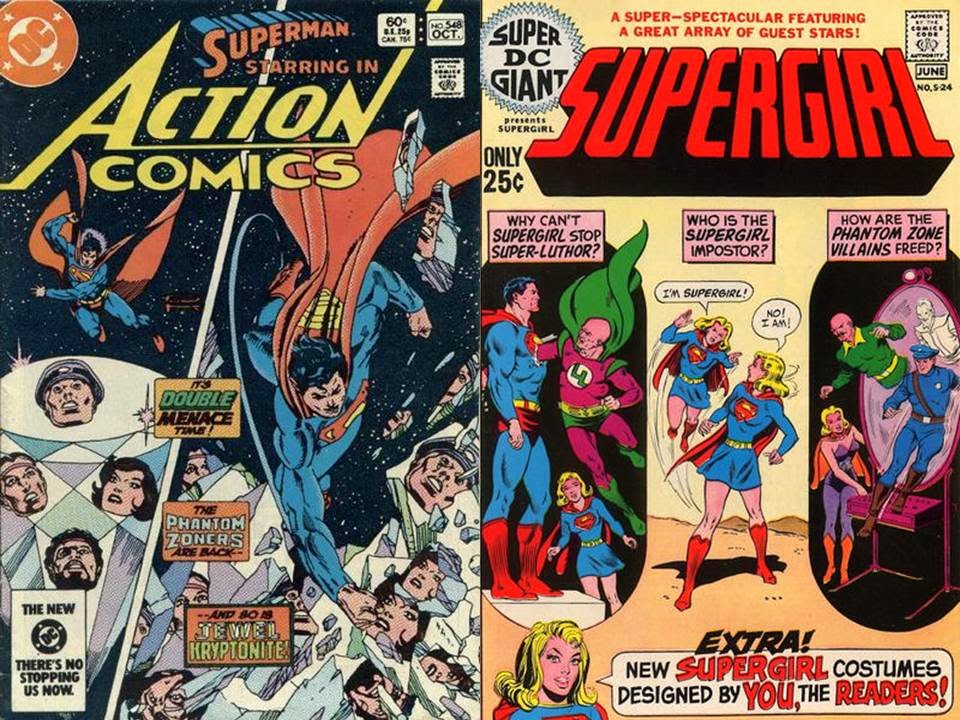
Mostly, the Phantom Zone was filled with crazed scientists (like Professor Vakox, who first appeared in Action Comics #284), Kru-El (cousin to Jor-El, and creator of a cache of Kryptonian weapons, who first appeared in Action Comics #297, and freed by Supergirl’s foe, Lesla-Lar), but one of the most evil was Faora Hu-Ul, who first appeared in Action Comics #471 (May, 1977, by Cary Bates and Curt Swan).  Faora was a stone cold serial killer of men, and had killed over twenty men before being sentenced to over 300 years in the zone (the second longest sentencing, after Jax-Ur).  From Action Comics #471-473, she manipulated a neighbor of Clark Kent’s to help her by pretending to be the ghost of the man’s dead wife…and this resulted in a mass break out of the Phantom Zone.  Still, one worse break out was to come….

Hero In The Zone


But first, a little on a hero in the Phantom Zone, Mon-El.  Mon-El was put in the zone in his first appearance, in Superboy #89 (June, 1961, by Robert Bernstein and George Papp).  Superboy found an amnesiac boy in a spaceship, and with his Kryptonian-like powers and a map from Jor-El, figured he must be his older brother!  Calling him Mon (after Monday, the day he found him) and the Kryptonian surname of El, he took in the lad, and even crafted an alter ego for him, of travelling salesman, Bob Cobb.  Except…(spoiler here), Mon-El was really from Daxam (a planet similar to Krypton), and the lad (really named Lar Gand), was not vulnerable to Kryptonite, but instead was sickened by lead, and got a fatal exposure to it thanks to Superboy.  To save his life, Superboy sent Mon-El into the Phantom Zone.  Mon-El helped Superboy (and later, Superman) for years to come…and had to wait a thousand years for a cure (found by Brainiac 5, a descendant of Superman’s foe, Brainiac) in Adventure Comics #305.

The Zone Is the Star


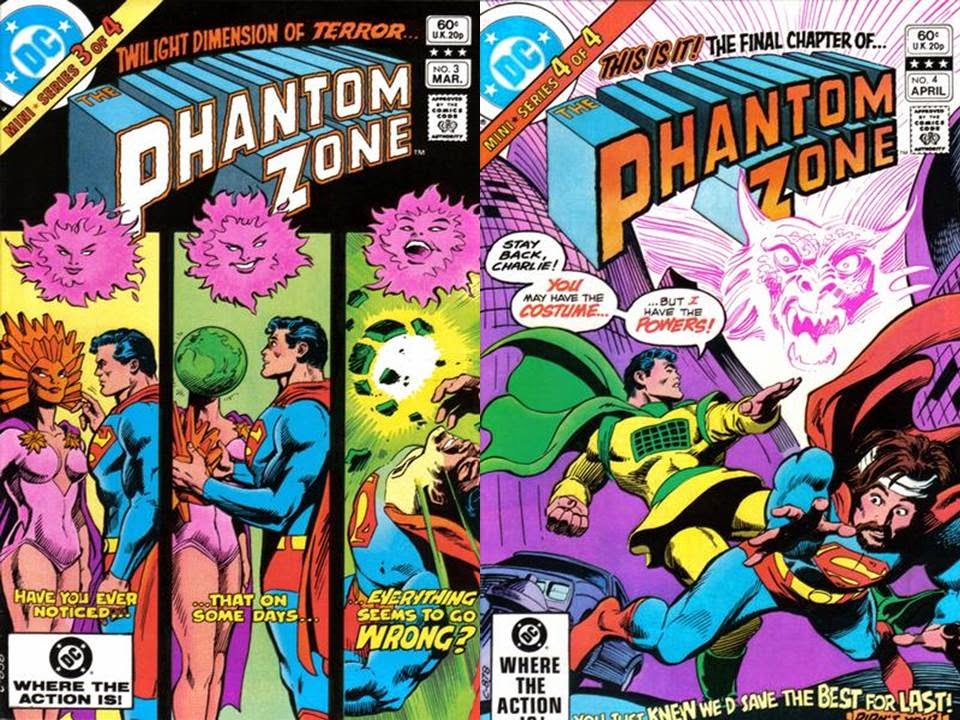
Some of these Kryptonians had to have sentences that elapsed between the time of Krypton’s destruction and Superman’s life span…and that was the case for Quex-Ul in Superman #157 (November, 1962 by Edmond Hamilton and Curt Swan).  In this story, Superman freed Quex-Ul, who was then plotting revenge on Superman as the son of his jailer, and Superman even ended up proving the Zoner was originally innocent (having been hypnotised into believing he was guilty).  After being informed of his innocence by Supergirl, Quex-Ul trips his own gold kryptonite trap on himself to save Superman (thus losing his powers forever)…and Quex-Ul even loses his memory in the process, but Superman helps him, by setting up a life for the Kryptonian as Charlie Kweskill, an employee of the Daily Planet.

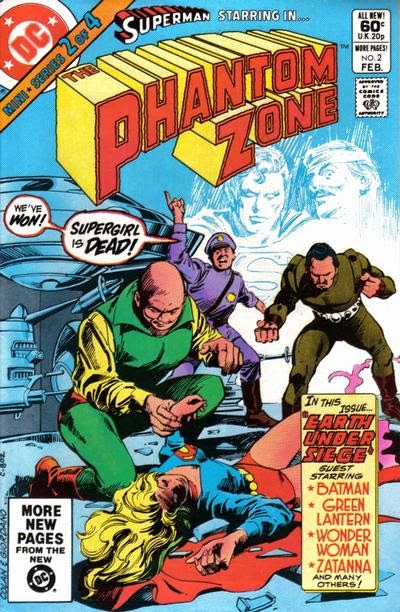
Charlie remains working at the Daily Planet until the Phantom Zone limited series (#1-4, from January to April, 1982, by Steve Gerber and Gene Colan).  This was a mass breakout from the Phantom Zone, and introduced us to Nadira Va-Dim and Az-Rel, who were Kryptonian criminals with super-powers beyond the normal, and brought back a few other Zoners like Nam-Ek (a Kryptonian scientist who made himself immortal, and later attacked Superman, and was sent to the zone by him, first appeared in Superman #282), Jer-Em (a mad Kryptonian cleric who knew the truth of the survival of Argo City, the home of Supergirl’s parents, and first appeared in Action Comics #309).  The Phantom Zone prisoners focused all their thoughts on Charlie Kweskill, and had him build a Phantom Zone projector to free them…Superman finds out about their plan, and tries to stop them, ending up in the Zone with Charlie, while a group of the criminals get free.


Superman and Charlie go further into the Phantom Zone to try to escape, while Supergirl recruits Batman for help, and the Zoners attack Green Lantern to get his power batter, and send the Justice League satellite out of orbit (taking most of the JLA except for Wonder Woman out of the fight).  Zod planned on using the Green Lantern power battery to power a super-projector to send all of Earth into the Phantom Zone.  Meanwhile, Superman and Charlie go further into the Zone to attempt to escape…and find out about Krypton’s secret magical history from Thul-Kar, and that the zone is a living entity called Aethyr.  Charlie and Superman do manage to escape, but not without cost, and the heroes do send the Zoners back to the Phantom Zone (with Green Lantern getting his power battery back, and going to rescue the JLA…).  Pretty involved for something Jor-El simply thought he stumbled across on Krypton!


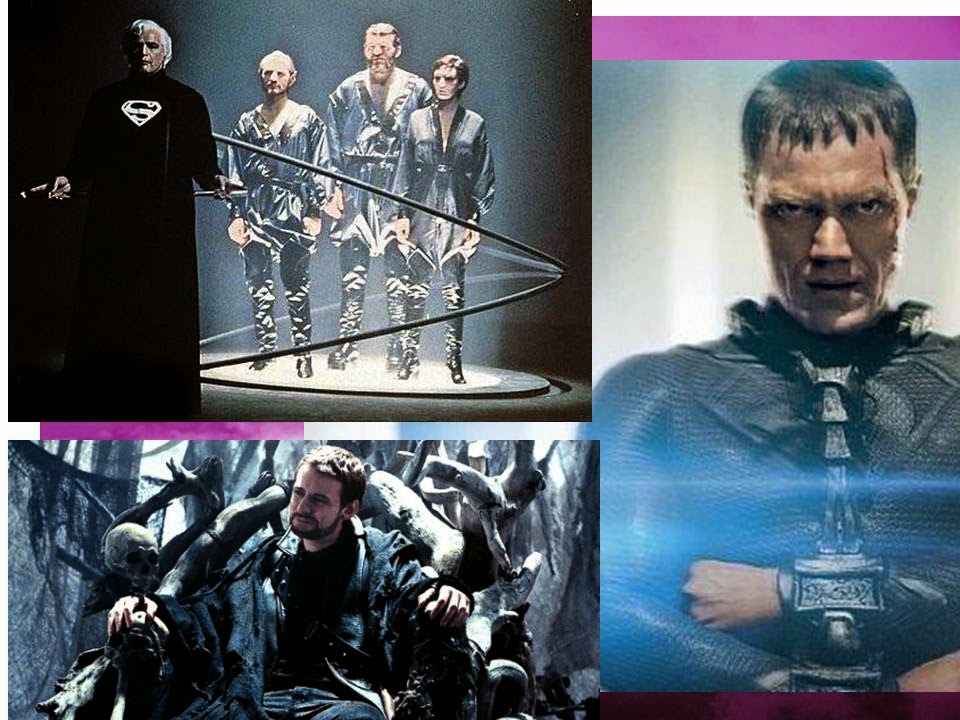
The Phantom Zoners came back a few times after the mini-series…but never quite with as much force.  Sadly, this batch was wiped out of existence by the Crisis on Infinite Earths, closing the door on the Silver Age of the Phantom Zone.  But, thanks to the Superman movies (with Terrance Stamp as Zod), the General kept coming back in the comics (even being a major foe for Clark Kent in Smallville, and being portrayed by Callum Blue), and Zod (and a few others) return with the latest Superman movie, the Man of Steel, as played by Michael Shannon.  Quite a few of the early tales of the Phantom Zone were recently collected (though not the mini-series, sadly….)

Appears the General (as well as the rest of the Zoners) were able to survive the destruction of their world, and their universe and go beyond…where everyone shall “kneel before Zod!”.

Wednesday, August 6, 2014

Agents of S.H.I.E.L.D. comic

In December, 2014, Marvel plans on putting out a comic book on the Agents of S.H.I.E.L.D. TV series.

It's a comic based on the TV show, and plans to have Agent Coulson and his team working in the current comic universe, introducing Melinda May, Leo Fitz and Jemma Simmons into the Marvel Universe (as opposed to the Marvel Cinematic Universe) in a series of stories by Mark Waid (and first issue containing art by Carlos Pacheco and later issues by Chris Sprouse and Alan Davis).  CBR interviewed Mark Waid, and he discussed his plans for Phil Coulson and crew here.

But, what of other, comic book agents of S.H.I.E.L.D.?

Super-Agents of S.H.I.E.L.D.


For that, look no further than Captain America #217-218 (January-February, 1978) in stories by writers Roy Thomas, Don Glut, and artists John and Sal Buscema, wherein we are introduced to the new Super-Agents of S.H.I.E.L.D....the Falcon, the Texas Twister, Blue Streak, the Vamp and Marvel Boy!

Like S.H.I.E.L.D. (whose history is touched on here along with their villainous counterpart, Hydra), these characters have connections all over the Marvel Universe (the Falcon, Cap's frequent partner, to get more coverage under the Avengers).

Texas Twister


Drew Daniels first appeared as the Texas Twister in Fantastic Four #177 (December, 1976) in a story by Roy Thomas and George Perez, wherein he tried to join the Frightful Four (villainous counterpart to the Fantastic Four) who, at the time were short a member.  Not really a villain by nature (and needing to be paid), Drew then ended up using his tornado powers to disrupt a race the Human Torch was in, and then did join the new Super-Agents of S.H.I.E.L.D....planning on using his powers for good.  A later run of Captain America issues saw the end of the Super-Agents...and Texas Twister became a founder of the Rangers (along with the western Ghost Rider aka Night Rider aka Phantom Rider, Red Wolf, Firebird and Shooting Star) in Incredible Hulk #265 (November, 1981), and continued with them over the years, being a part of the Contest of Champions, working with the West Coast Avengers, being a part of the Civil War and even working with the Scarlet Spider!  Not bad for a cowpoke who got his powers being too close to a nuclear power plant and a tornado!

The Vamp and the Blue Streak


Both the Vamp (Denise Baranger) and the Blue Streak (Don Thomas) first appeared in Captain America #217 (January, 1978, by Roy Thomas, Don Glut and John Buscema).  The Vamp had limited telepathy, was trained in judo and had an Absorbo-Belt which allowed her to duplicate the strength of others (and, she had a secret as well).  Blue Streak was a talented skater, with rocket powered roller skates and later added lasers to his forearms in a weapons upgrade.  Their end as Super-Agents were chronicled in Captain America #228-231 (1979), Incredible Hulk #232-234 (1979) and in Quasar #2 (November, 1989)...and Blue Streak came back with upgraded armor in Captain America #318 (June, 1986) and then as a victim of the Punisher in Punisher #5, 6 and 9 (2009), with the Vamp coming back in Captain America #319-320 (1986), and Deadpool #0 and 6 (1997).

Marvel Boy


Wendell Elvis Vaughn was a guard at a Stark International facility testing the Quantum Bands of the Crusader (Thelius, who pretended to be the original Marvel Boy), and, in an invasion by A.I.M. (Advanced Idea Mechanics), put them on to stop the villainous group...and himself became Marvel Boy (later Marvel Man) and ended up in the S.H.I.E.L.D. Super-Agent program.  Between Captain America #218 and #228, he and Falcon participated in the "Defenders for a Day" event, wherein many heroes (and even villains) joined the Defenders for a time (Defenders #62-64, 1978), although they weren't considered real Defenders like Hulk, Nighthawk, Valkyrie and Hellcat.  With the end of the S.H.I.E.L.D. Super-Agents, Marvel Man stuck around the Hulk until Incredible Hulk #234 (April, 1979, by Roger Stern and Sal Buscema), wherein Wendell took the name of Quasar, and headed to his next assignment...


...working at Project: Pegasus as and becoming their head of security.  Project: Pegasus (Potential Energy Group/Alternate Sources/United States) was a base in the Adirondack Mountains of New York that studies alien and super weapons (like the Cosmic Cube) and people (like Nuklo), serving as a prison for some villains too dangerous to be near other people.  The Thing ended up there, checking on Wundarr (an alien from another world here to spread hope who became Aquarian), and ended up involved with Giant-Man (the former Black Goliath/Bill Foster), Thundra (a reformed member of the Frightful Four, a super-strong amazon from a future society) and Deathlok (a futuristic cyborg from another timeline...well, more or less...and someone familiar to Agents of S.H.I.E.L.D. viewers) in a plot by the Nth Man (a foe of the Thing's from previous issues of Marvel Two-In-One) in the Project: Pegasus saga (in Marvel Two-In-One #53-58, 1979, collected in the Thing: Project Pegasus in 2010) by Mark Gruenwald, Ralph Macchio, John Byrne, Joe Sinnott, George Perez and Gene Day.

Quasar then guested across the Marvel Universe for a time, participating in the Contest of Champions, and being there for the pardon of the Hulk, as well as working with Spider-Man, Dazzler and the Thing....then becoming an Avenger and getting his own title that lasted 60 issues and explored the secrets of the Marvel Universe (actually, the Marvel Multiverse, as it went beyond the galaxy and even explored other dimensions, and cleared up a lot of little continuity oddities along the way).

Mark Gruenwald and Paul Ryan gave us the story of how Wendell got the Quantum-Bands in Quasar #1 (October, 1989), and had Eon make Quasar the Protector of the Universe in Quasar #2 (November, 1989). 

From there, using his powers of flight, strength and energy manipulation granted by the bands, Quasar kept going until Quasar #60 (July, 1994), with Mark Gruenwald writing almost all the issues, and having Quasar meet with or fight a vast array of the Marvel Universe...

...including Deathurge, the Human Torch, Quantum, Aquarian, Absorbing Man, Living Laser, Red Ghost, the Watcher, Terminus, the cosmic Spider-Man, MODAM, the Kree Dr. Minerva and Captain Atlas, Halflife, the Excalibur team including Phoenix, the Eternals, Moondragon, the Squadron Supreme, Over-Mind, the Stranger, Rocket Raccoon, Runner, Captain Marvel (Monica Rambeau), the Jack of Hearts, Maelstrom, Woodgod, Dr. Strange, Thanos, Her, Adam Warlock, Nova, Drax the Destroyer, Gamora, the Imperial Guard, Binary (the former Ms. Marvel/Carol Danvers), Eternity, the Punisher, the Antibody, Blue Shield, Blue Marvel, Thunderstrike, Black Bolt, the Presence and Darkstar, and participate in the Acts of Vengeance, the Infinity Gauntlet, Galactic Storm, the Infinity War and Starblast, and even work with D.P. 7 and get the Star Brand from the New Universe, and even getting a few new costumes along the way. 

Later on, he works with Silver Surfer and Beta Ray Bill in Star Masters, Thor, Photon (former Captain Marvel Monica Rambeau), Tigra, Starfox, Moondragon, and Jack of Hearts in Avengers: Infinity, and even Nova, Captain America, Gladiator, Wolverine, Ronan and the Guardians of the Galaxy in Realm of Kings!  Don't worry if you don't know all those names....as you haven't seen most of them in any Marvel movies as of yet, but all of this shows how big and cosmic things can get, even dealing with the Earthbound Agents of S.H.I.E.L.D.! 


Thursday, July 31, 2014

Guardians of the Galaxy Movie Review

"I'm hooked on a feeling....I'm high on believing..."


These lines from a Blue Swede song is likely where you first heard of the Guardians of the Galaxy in the overpowering marketing blitz by Marvel and Disney for the movie release of their sci-fi epic with Chris Pratt, Zoe Saldana, Dave Bautista, Vin Diesel, Bradley Cooper, Michael Rooker and Karen Gillan....


...but, what do you know about the history of this super-group and the Guardians of the Galaxy movie?

Early Comics


The earliest bits of the Guardians of the Galaxy came in the 1960s...with Tales To Astonish #13 (November, 1960) in a story by Stan Lee and Jack Kirby, about an alien invader Groot who was going to take over the Earth, but his plant form was bested by termites....and in Marvel Super-Heroes #18 (January, 1969) by Arnold Drake and Gene Colan, that dealt with astronaut Major Vance Astro from the 20th Century ending up traveling to Alpha Centauri in suspended animation, and gathering together misfits chrystalline Martinex from Pluto, massive Charlie-27 from Jupiter, and archer Yondu from Alpha Centauri to make a prison break and fight the alien Badoon.

The team then returned in Marvel Two-In-One #4 and 5 (July-September, 1974 by Steve Gerber and Sal Buscema), getting help from the Thing and Captain America against the Badoon in the 31st Century, and returned again in a run of the Defenders (#26-29 in 1975, also by Gerber and Buscema), adding cosmic mystery Starhawk and his wife Aleta to their ranks, and even getting a short run in Marvel Presents (where Mercurian Nikki joined the group...).  After this run, the team popped up again in Thor Annual #6, Avengers #167-177, #181, Ms. Marvel #23, Marvel Team-Up #86 (with Spider-Man) and back to Marvel Two-In-One #61-63, #69, and later, even had their own title for a time (62 issues and 4 annuals in the early 1990s).

But What About Now?


It all started with Annihilation, a 2006 crossover, featuring Galactus herald Silver Surfer, Fantastic Four mimic Super-Skrull, human guardian of Xandar Nova, alien villainess Nebula, alien assassin Gamora and Kree Ronan the Accuser (as well as Drax the Destroyer and Thanos)....all cosmic heroes and villains with odd pasts from various parts of the modern Marvel Universe versus Annihilus, all under the writing of Keith Giffen and Dan Abnett and Andy Lanning, the later two who gathered interstellar heroes again, including Quasar, Star-Lord, the Wraith, Moondragon, Mantis and Rocket Raccoon in Annihilation Conquest, which let to Star-Lord founding the 21st century Guardians of the Galaxy!

For those keeping track, the main movie characters first appearances were in:

Drax the Destroyer and Thanos - Iron Man #55 (February, 1973, created by Jim Starlin)
Star-Lord - Marvel Preview #4 (January, 1976, created by Steve Englehart and Steve Gan)
Rocket Raccoon - Marvel Preview #7 (Summer, 1976, created by Bill Mantlo and Keith Giffen)
Gamora - Strange Tales #180 (June, 1975, created by Jim Starlin)
Nebula - Avengers #257 (July, 1985, created by Roger Stern and John Buscema)
Ronan the Accuser - Fantastic Four #65 (August, 1967, created by Stan Lee and Jack Kirby)

Note that most of the characters didn't appear on their premiere covers!

It's all connected...


Well, the Guardians of the Galaxy movie is a story about a group of misfits and outcasts who gather together and find the better parts of themselves when confronted with the ultimate evil...and end up saving the day (and, well...the galaxy).  This is a constant theme in movies and TV (from the Magnificent Seven and Star Wars to Firefly and Farscape...even Footloose and Raiders of the Lost Ark)  and oh so many more!

It is also the story of comic creation (as you can see by all the people who gathered together over the decades to create the comics....which lead to the movie)...and, a basic plot common to many stories (especially those of Guardians of the Galaxy co-creator, Arnold Drake), that everyone has something to contribute, and we can all be heroes, if given the chance, and have a darn good time doing it...as will you if you go to see the movie! 


More on Marvel’s Showcase on Super-Heroes

Spinning out of the 11 issue reprint book Fantasy Masterpieces was Marvel Super-Heroes.  Already covered was Marvel Super-Heroes #12-16, but here we go onward!  But first, what reprints were in those issues?  Mostly, it was old sci-fi stories, golden age Captain America stories, golden age Human Torch stories, golden age Sub-Mariner stories…and even stories from the 1950s…that of the medieval Black Knight!

That leads us back to the new stories in Marvel Super-Heroes, and the next issue in line…

A Knight In Time

Marvel Super-Heroes #17 (November, 1968 by Roy Thomas and Howard Purcell) features Dane Whitman, the nephew of Nathan Garrett (a foe of Giant-Man’s and member of the original Masters of Evil), but Nathan died, passing along the mantle of Black Knight to Dane (and Dane first became the Black Knight in Avengers #48).  In MSH #17, Dane meets the spirit of Sir Percy (the original Black Knight) and gets the Ebony Blade and defeats Le Sabre (Paul Richarde) who was chosen to oppose the Black Knight.  The Black Knight was an on-again, off-again Avenger for many years, but it took until 1990 for him to have a four issue limited series (by Roy and Dann Thomas and Tony DeZuniga).  Marvel Super-Heroes #17 was reprinted in Marvel Masterworks Volume 84: Avengers #7 (along with Avengers #59-68, Black Knight’s earlier appearances were in the previous 2 Avengers Marvel Masterworks) and all 5 issues of Sir Percy’s Black Knight were reprinted in Marvel Masterworks Volume 123 : Atlas Era Black Knight/Yellow Claw.

Defenders of the Future

Marvel Super-Heroes #18 (January, 1969) has writer Arnold Drake and artist Gene Colan taking the reader to the future of the Marvel Universe… 3007, to be exact.  That’s when astronaut Major Vance Astro arrived at Alpha Centauri from Earth (of 1988, at the time…the future!) after over 1000 in suspended animation and forced to wear that suit or he’d age away!  While there, he met Charlie-27, an extra dense soldier from Jupiter; Martinex (a crystalline being from Pluto); and Yondu, an archer who was native to the fourth world of Alpha Centauri.  These men united to fight the Badoon…to free Earth!  The team didn’t appear again until Marvel Two-In-One #4-5 (July-September 1974) and then in Giant-Size Defenders #2 and Defenders #26-29 (in 1975) fighting along side modern heroes like the Thing, Captain America and the Defenders.  The team added Starhawk to their membership while fighting alongside the Defenders, then were featured in Marvel Presents #3-12 (where they added Mercurian female Nikki to the line up) in the 1970s…and encountered the Avengers during their war with Korvac and met Spider-Man in Marvel Team-Up, as well as Ms. Marvel in the last issue of her book (and Vance Astro met his Marvel world counterpart, Vance Astrovik, who would later be known as Justice of the New Warriors when working with the Thing in Marvel Two-In-One).  While not having a Masterwork, Marvel Super-Heroes #18 is reprinted in Guardians of the Galaxy: Earth Shall Overcome and in Guardians of the Galaxy: Tomorrow’s Avengers (along with their earliest appearances in other books).

Welcome to the Jungle

Ka-Zar, Marvel’s jungle hero,  swings into Marvel Super-Heroes #19 (March, 1969) in a story by Arnold Drake and Steve Parkhouse with art by George Tuska (and a cover by Barry Smith, before he became Barry Windsor-Smith).  The lord of the Savage Land and his pet sabretooth tiger Zabu faced off against Kevin’s brother, the Plunderer in this series that pulled together the history of a character (Ka-Zar/Kevin Plunder first appeared in X-Men #10 in March, 1965 by Stan Lee and Jack Kirby, and Lord Parnival Plunder/the Plunderer was first in Daredevil #12, in January, 1966 by Stan Lee, Jack Kirby and John Romita) who bounced around the Marvel Universe…and led to his own title (which oddly reprinted earlier Ka-Zar appearances in Daredevil and Amazing Spider-Man, yet had new stories of Hercules and the Angel), but had new stories in Astonishing Tales (which he shared with someone….well, for the first 8 issues anyway).  Ka-Zar spent his time in the 20 issues of Astonishing Tales fighting A.I.M., Spider-Man foe Kraven the Hunter, the Man-Thing, member of the Zodiac Gemini, the Plunderer and Victorius (a scientist trying to re-invent Captain America’s super-soldier serum) as well as working with S.H.I.E.L.D. agent, Bobbi Morse (who eventually became Mockingbird)!  Marvel Super-Heroes #19, along with the first 16 issues of Astonishing Tales were presented in Marvel Masterworks Volume 190: Ka-Zar #1.

He Shall Be Your Doom

Marvel Super-Heroes #20 (May, 1969, in an issue written by Larry Lieber and Roy Thomas and drawn by Larry Lieber and Frank Giacoia) was the last issue to feature new stories in the 1960s…and it didn’t even really feature a hero!  Instead, it featured Victor von Doom, the foe of the Fantastic Four (since Fantastic Four #5 by Lee and Kirby in July, 1962)…Doctor Doom!  With “This Man…This Demon!”, we saw the softer side of the monarch of Latveria…as he battled el Diablo (another foe of the Fantastic Four) and met the love of his live…Valeria.  Still, this wasn’t the only attempt to portray Doom as a hero, as he joined Ka-Zar as half the feature of Astonishing Tales for its first 8 issues (from August, 1970 to October, 1971) where he fought the Doomsman, Red Skull, the Black Panther…and even Satan at the end, for the soul of his mother).  Doom even had another crack at a title, with Super-Villain Team-Up (where he worked with Sub-Mariner for two Giant-Size issues and 13 regular issues, then against Magneto in #14, before a reprinting the Astonishing Tales vs. the Red Skull in #15, who finished out the last two issues with MODOK and the Hate-Monger but not Doom).  Still, you won’t have to be without Dr. Doom as Marvel plans to reprint Marvel Super-Heroes #20 along with the first 8 Doom Astonishing Tales in Marvel Masterworks Volume 209: Dr. Doom #1!


The title then went to all reprints, being X-Men and the Avengers to start, then Iron Man and Daredevil, before settling on the Incredible Hulk until its end with issue #105 (facing the Rhino, no less)!  But, for a while, there were new tales in Marvel Super-Heroes!

Wednesday, July 30, 2014

Arrow Artist: More on Mike Grell

Mike Grell was quite the busy artist for a time...after his last work on Green Arrow (the cover of Green Lantern #112), working on his own creation, the Warlord, at DC, and then creating his own character, Jon Sable, Freelance, for First Comics....could this busy man find time for the Emerald Archer?

Back to Basics


That's what Mike Grell did for Oliver Queen...

...continuing an idea from DC Super-Stars #17  (cover date of Nov/December, 1977),  wherein Denny O'Neil and Grell redid the Arrow origin, basing it on a little more reality (though keeping the basic idea from the origin as retold by writer Ed Herron and artist Jack Kirby in Adventure Comics #256, in January, 1959, wherein rich man Queen gets trapped on Starfish Island and learns archery to survive).

With the 3-issue mini-series Green Arrow: The Longbow Hunters (1987) writer/artist Mike Grell took Green Arrow back to being an urban hunter, getting rid of the trick arrows, the super-villains and almost everything else around Ollie (even injuring Black Canary to take her away from him for a bit).


But, Ollie didn't just lose things in this series.

This series also introduced female archer Shado, as well as mercenary Eddie Fyers...

...both of whom became very important in the life of Oliver Queen as time went on....

...and Ollie had quite a time in his own ongoing title!

A Long Run


For eighty issues (from February, 1988 to November, 1993), Mike Grell guided Green Arrow through his new city (Seattle, instead of the fictional Star City), having the hooded vigilante deal with criminals, government agents and some of the worst of his own problems...

...and though Iron Mike didn't provide all the art for this series, he did draw more than a few covers...


...lots of covers, not always featuring Green Arrow...


...celebrating Green Arrow's 50th Anniversary...


...slowly returning to the DC Universe, at least by bringing Black Canary back...


...as well as teaming up with the Butcher and the Question...


...and meeting Shado again...


...seeing Roy Harper (now Arsenal instead of Speedy), and having too many women...


...until the last of Grell's work on the title (though the title continued on)...


Still, Iron Mike was busy, just before leaving the series going back to cover Green Arrow's early years in Green Arrow: the Wonder Year...

...and creating Shaman's Tears for Image Comics, the archer called back to Mike Grell...

....and he listened, (after brief stops back with the Warlord and Iron Man as well)...

...not to mention a Green Arrow variant cover for Blackest Night...


...this time thanks to the Arrow TV show on CW!

It's appropriate for Mike Grell to work on that series...having provided the sketch of "the Hood"...and being referred to on the series ("Judge Grell").

The Arrow CW show has mentioned a few other artists and writers over time, and we'll cover more of them here!  

Remember to check out Mike's website as well for info on how to meet him!