Here's the lastest on the Marvel Avengers Infinite Wave 2!
The new figures will include...
...'80s Death's Head! Walt Simonson's bearded Thor! Master of Evil Whirlwind! The Red She-Hulk!
Bringing back a few favorites from the Marvel Universe 3.75" line as well....
Super-Soldier Steve Rogers (aka, Captain America!). Thor-powered Beta Ray Bill!
And, one of Hank Pym's many identities....Yellowjacket!
Avengers Assemble!
A blog about comic books, and enjoying the stories, characters and creators of them...and occasionally subjects that relate to comic books as well.
Monday, May 19, 2014
Thursday, May 15, 2014
Marvel At Godzilla
True, Godzilla began with the 1954 Ishiro Honda film as a kaiju (that is, giant Japanese monster), but it was in the 1970s where Godzilla would “go, go, go” and become a big hit in America.
One of the biggest signs of success for the mutated dinosaur, was that he became a Marvel comic!
From August, 1977 until July, 1979, the King of the Monsters menaced the mighty Marvel heroes month after month…
With stories by Doug Moench (#1-24), and art by Herb Trimpe (#1-3, #6-24) and Tom Sutton (#4-5), the terror of Tokyo fought against the various teams and locations of the Marvel Universe, facing the Champions (which included Hercules, Black Widow and ex-X-Men Angel and Iceman), the Fantastic Four and the Avengers (including Iron Man, Thor, Wasp, Yellowjacket, Vision, the Scarlet Witch and Captain America), as well as Dum Dum Dugan and Jimmy Woo as agents of S.H.I.E.L.D.!
Godzilla even faced off against Shogun Warrior Red Ronin (as Marvel was also licensing the Shogun Warriors at this time) and Jack Kirby‘s Devil Dinosaur during this run, as well as spending some time shrunken down due to Hank Pym's shrinking formula (the same formula which allowed Hank to be Ant-Man and Yellowjacket!).
Godzilla even traveled across the United States, met other monsters and even headed into space, truly a final frontier for this usually Earthbound behemoth!
Seems Godzilla only missed Spider-Man while at working at Marvel Comics...
....a shame, as they both got their powers from radiation, you'd think they might have bonded!
Even though the licensing ended, Godzilla still returned (mutated slightly further, and not referenced by name) to face Iron Man and the West Coast Avengers as well. And, of course, Godzilla found success at Dark Horse Comics in the 1990s, and with IDW Publishing in the 2000s. (and his Marvel issues were reprinted in an Essential Godzilla as well…).
As Blue Oyster Cult said…”Go go Godzilla”!
Godzilla Attacks Marvel Comics
One of the biggest signs of success for the mutated dinosaur, was that he became a Marvel comic!
From August, 1977 until July, 1979, the King of the Monsters menaced the mighty Marvel heroes month after month…
With stories by Doug Moench (#1-24), and art by Herb Trimpe (#1-3, #6-24) and Tom Sutton (#4-5), the terror of Tokyo fought against the various teams and locations of the Marvel Universe, facing the Champions (which included Hercules, Black Widow and ex-X-Men Angel and Iceman), the Fantastic Four and the Avengers (including Iron Man, Thor, Wasp, Yellowjacket, Vision, the Scarlet Witch and Captain America), as well as Dum Dum Dugan and Jimmy Woo as agents of S.H.I.E.L.D.!
Godzilla Travels All Over
Godzilla even faced off against Shogun Warrior Red Ronin (as Marvel was also licensing the Shogun Warriors at this time) and Jack Kirby‘s Devil Dinosaur during this run, as well as spending some time shrunken down due to Hank Pym's shrinking formula (the same formula which allowed Hank to be Ant-Man and Yellowjacket!).Godzilla even traveled across the United States, met other monsters and even headed into space, truly a final frontier for this usually Earthbound behemoth!
Seems Godzilla only missed Spider-Man while at working at Marvel Comics.......a shame, as they both got their powers from radiation, you'd think they might have bonded!
Godzilla Says Goodbye to Marvel
Even though the licensing ended, Godzilla still returned (mutated slightly further, and not referenced by name) to face Iron Man and the West Coast Avengers as well. And, of course, Godzilla found success at Dark Horse Comics in the 1990s, and with IDW Publishing in the 2000s. (and his Marvel issues were reprinted in an Essential Godzilla as well…).
As Blue Oyster Cult said…”Go go Godzilla”!
Wednesday, May 14, 2014
Dinosaurs With Captain Comet and Tommy Tomorrow
It only took a few hundred million years for everything to come together correctly to allow DC Special #27 (April-May, 1977, by Bob Rozakis and Rich Buckler) with the title of "Danger: Dinosaurs At Large!" to take place.
The dinosaurs were the easy part...getting the rest of the players in place took a little more work!
Here's a quick look at the major players in the story.....
....which weren't the Justice League (though members Superman, Wonder Woman, Flash, Green Lantern, Hawkman and Black Canary do guest-star in the issue....instead it was an honorary League member that had most of the action!).
Adam Blake was born ahead of his time (about 100,000 years ahead). This lad was born as a comet flashed through the sky which mutated him into a type of future man, with enhanced strength, speed and mental powers like telekinesis, telepathy and a photographic memory. Starting with Strange Adventures #9 (June, 1951, by John Broome and Carmine Infantino), and the help of Dr. Emery Zackro (who explains to the lad his mutant status) the newly named hero Captain Comet begins his career of fighting aliens, robots and other odd menaces (with art by Murphy Anderson in most of his appearances).
Captain Comet could also be called the first Silver Age hero (as his debut was separate from the Justice Society of America, yet before the Martian Manhunter in Detective Comics #225 or Flash/Barry Allen in Showcase #4). Along the way, he also picked up a girlfriend, librarian Lucy Torrence with Strange Adventures #11 (Carmine Infantino's last drawn issue), and their adventures run from Strange Adventures #9-44, 46 and 49 (49 coming out in October, 1954).
Captain Comet then left Earth, not to return until Secret Society of Super-Villains #2 (July-August, 1976) where he fought Green Lantern (a character that used some basic ideas established in Comet's own series such as the Guardians of the Universe) mistakenly thinking GL was the villain. Captain Comet soon learned the truth, and aided the Justice League (and members of the Teen Titans as well) against the Secret Society for the rest of that series run (until the series was cancelled). Captain Comet popped up meeting with Superman in two issues of DC Comic Presents (#22 and #91), attended the Atom's wedding in Justice League of America #157...and worked with the Forgotten Heroes in the Crisis on Infinite Earths as well.
After the Crisis, the Captain worked with the L.E.G.I.O.N. and R.E.B.E.L.S. (two groups of interstellar police that worked under Vril Dox, the "son" of Superman foe, Brainiac) and more recently, was teamed with other outer space heroes (like Adam Strange, Hawkman, the Weird, Starfire and Starman) in the Rann-Thanagar War, Infinite Crisis, 52, Mystery In Space and back to a new volume of Strange Adventures before Flashpoint rewrote DC history (yet, Captain Comet came back in Action Comics to face the New 52 Superman!).
Tommy Tomorrow was a famous 21st century spaceman, working as a Colonel in the Space Planeteers, keeping the Earth and other people safe from menaces and criminals! Tommy first appeared in Real Fact Comics #6 in the "Columbus Of Space" (by writers Jack Schiff, George Kashdan, and Bernie Breslauer and artists Howard Sherman and Virgil Finley). Tommy comes back for issues #8, 13 and 16, but only made the covers shown. These issues also have facts that are contradicted in later issues of Tommy's regular series, which run as back-ups in Action Comics from #127-251, then World's Finest Comics #102-124, until DC tried to give Tommy and his friend and fellow Planeteer Capt. Brent Wood his own series with issues starting with Showcase (#41 in November-December, 1962 by Arnold Drake and Lee Elias), who did all of Tommy's appearances in Showcase (#41, 42, 44, 46 and 47), but this series ended up being the first real failure of Showcase...Tommy didn't graduate into his own book, instead, not appearing until the DC Special mentioned above.
Tommy did show up in Crisis on Infinite Earths, wherein at the end of the timeline, it was revealed that Kamandi, the Last Boy on Earth, grew up to be Tommy Tomorrow (after being found by Horatio Tomorrow...a story which contradicts Action Comics #255 of August, 1959, in which Supergirl met the young boy Tommy in the 21st Century in a story by Otto Binder and Jim Mooney....but, she was erased from DC history for a time as well). Tommy Tomorrow came back in a series called Twilight by DC in 1990 by Howard Chaykin and Jose Luis Garcia-Lopez (which also included the Star Rovers, the Space Museum, Manhunter 2070 and Star Hawkins), but that had little to do with the rest of the DC Universe....unlike the villain of the piece!
Chronos was a foe of the Atom, starting with Atom #3 (October-November, 1962 by Gardner Fox and Gil Kane). David Clinton started off as a thief with obsessed with time, and later matures into a major DC villain, joining the Crime Champions, the Time Foes, Secret Society of Super-Villains, and the Injustice Gang of the World (and even plays baseball against the heroes with a group of villains, which he did just before participating in this story), as well as facing Elongated Man, Wonder Woman, Superman & Batman and Blue Beetle (as well as come later encounters with dinosaurs, and even inspiring a heroic Chronos, aka Walker Gabriel who had 12 issues of his own in 1998-1999).
For the purposes of this story, Chronos causes the problem which brings Tommy Tomorrow into the present day, as well as the dinosaurs, including the mutated dinosaur man seen on the cover, Tyrano Rex bringing us full circle! This dinosaur man was mutated by a meteor and traveled through time to the modern day just to be defeated by Tommy Tomorrow and Captain Comet, proving that dinosaurs and radiation just shouldn't mix!
The dinosaurs were the easy part...getting the rest of the players in place took a little more work!
Here's a quick look at the major players in the story.....
....which weren't the Justice League (though members Superman, Wonder Woman, Flash, Green Lantern, Hawkman and Black Canary do guest-star in the issue....instead it was an honorary League member that had most of the action!).
Mutant From The Future
Adam Blake was born ahead of his time (about 100,000 years ahead). This lad was born as a comet flashed through the sky which mutated him into a type of future man, with enhanced strength, speed and mental powers like telekinesis, telepathy and a photographic memory. Starting with Strange Adventures #9 (June, 1951, by John Broome and Carmine Infantino), and the help of Dr. Emery Zackro (who explains to the lad his mutant status) the newly named hero Captain Comet begins his career of fighting aliens, robots and other odd menaces (with art by Murphy Anderson in most of his appearances).
Captain Comet could also be called the first Silver Age hero (as his debut was separate from the Justice Society of America, yet before the Martian Manhunter in Detective Comics #225 or Flash/Barry Allen in Showcase #4). Along the way, he also picked up a girlfriend, librarian Lucy Torrence with Strange Adventures #11 (Carmine Infantino's last drawn issue), and their adventures run from Strange Adventures #9-44, 46 and 49 (49 coming out in October, 1954).
Captain Comet then left Earth, not to return until Secret Society of Super-Villains #2 (July-August, 1976) where he fought Green Lantern (a character that used some basic ideas established in Comet's own series such as the Guardians of the Universe) mistakenly thinking GL was the villain. Captain Comet soon learned the truth, and aided the Justice League (and members of the Teen Titans as well) against the Secret Society for the rest of that series run (until the series was cancelled). Captain Comet popped up meeting with Superman in two issues of DC Comic Presents (#22 and #91), attended the Atom's wedding in Justice League of America #157...and worked with the Forgotten Heroes in the Crisis on Infinite Earths as well.
After the Crisis, the Captain worked with the L.E.G.I.O.N. and R.E.B.E.L.S. (two groups of interstellar police that worked under Vril Dox, the "son" of Superman foe, Brainiac) and more recently, was teamed with other outer space heroes (like Adam Strange, Hawkman, the Weird, Starfire and Starman) in the Rann-Thanagar War, Infinite Crisis, 52, Mystery In Space and back to a new volume of Strange Adventures before Flashpoint rewrote DC history (yet, Captain Comet came back in Action Comics to face the New 52 Superman!).
Future Man Adventures
Tommy Tomorrow was a famous 21st century spaceman, working as a Colonel in the Space Planeteers, keeping the Earth and other people safe from menaces and criminals! Tommy first appeared in Real Fact Comics #6 in the "Columbus Of Space" (by writers Jack Schiff, George Kashdan, and Bernie Breslauer and artists Howard Sherman and Virgil Finley). Tommy comes back for issues #8, 13 and 16, but only made the covers shown. These issues also have facts that are contradicted in later issues of Tommy's regular series, which run as back-ups in Action Comics from #127-251, then World's Finest Comics #102-124, until DC tried to give Tommy and his friend and fellow Planeteer Capt. Brent Wood his own series with issues starting with Showcase (#41 in November-December, 1962 by Arnold Drake and Lee Elias), who did all of Tommy's appearances in Showcase (#41, 42, 44, 46 and 47), but this series ended up being the first real failure of Showcase...Tommy didn't graduate into his own book, instead, not appearing until the DC Special mentioned above.
Tommy did show up in Crisis on Infinite Earths, wherein at the end of the timeline, it was revealed that Kamandi, the Last Boy on Earth, grew up to be Tommy Tomorrow (after being found by Horatio Tomorrow...a story which contradicts Action Comics #255 of August, 1959, in which Supergirl met the young boy Tommy in the 21st Century in a story by Otto Binder and Jim Mooney....but, she was erased from DC history for a time as well). Tommy Tomorrow came back in a series called Twilight by DC in 1990 by Howard Chaykin and Jose Luis Garcia-Lopez (which also included the Star Rovers, the Space Museum, Manhunter 2070 and Star Hawkins), but that had little to do with the rest of the DC Universe....unlike the villain of the piece!
Man Out Of Time
Chronos was a foe of the Atom, starting with Atom #3 (October-November, 1962 by Gardner Fox and Gil Kane). David Clinton started off as a thief with obsessed with time, and later matures into a major DC villain, joining the Crime Champions, the Time Foes, Secret Society of Super-Villains, and the Injustice Gang of the World (and even plays baseball against the heroes with a group of villains, which he did just before participating in this story), as well as facing Elongated Man, Wonder Woman, Superman & Batman and Blue Beetle (as well as come later encounters with dinosaurs, and even inspiring a heroic Chronos, aka Walker Gabriel who had 12 issues of his own in 1998-1999).
For the purposes of this story, Chronos causes the problem which brings Tommy Tomorrow into the present day, as well as the dinosaurs, including the mutated dinosaur man seen on the cover, Tyrano Rex bringing us full circle! This dinosaur man was mutated by a meteor and traveled through time to the modern day just to be defeated by Tommy Tomorrow and Captain Comet, proving that dinosaurs and radiation just shouldn't mix!
Monday, May 12, 2014
Marvel Avengers Infinite Wave 1
Here's the latest 3.75" figure release from Hasbro, the new series, Marvel Avengers!
Included for the Wave 1 release, new figures Grim Reaper, Hyperion, Wasp and an armored Hulk.
Also re-released is Captain America and Heroic Age Iron Man.
All you need in to help keep your Marvel Universe safe (at least with the Avengers....not so much with foes like Grim Reaper and Hyperion!).
Included for the Wave 1 release, new figures Grim Reaper, Hyperion, Wasp and an armored Hulk.
Also re-released is Captain America and Heroic Age Iron Man.
All you need in to help keep your Marvel Universe safe (at least with the Avengers....not so much with foes like Grim Reaper and Hyperion!).
Thursday, May 8, 2014
Targeting Green Arrow’s Villains
Everyone knows Oliver Queen was a millionaire playboy, who, after
being shipwrecked on an island, and then found, went into action as the
swashbucking archer…Green Arrow.
But, what of the villains he faced?
Glad you asked, because here a few facts on Green Arrow’s most wanted bad guys!
The Clock King first appeared in World’s Finest Comics #111 (August, 1960, by Ed Herron and Lee Elias – he’s not on the cover because Green Arrow was on few covers back in the early 1960s). William Tockman was a man out of time…he thought he was going to perish, and planned to rob a bank using his impeccable ability to schedule (and a clock costume…well, hey, it was the Silver Age!) to get money to support his sister, but he was stopped by Green Arrow and Speedy…and sent to prison. He worked with Dr. Destiny and the first gathering of foes of the Justice League of America…and later still, found out that he wasn’t really dying at all! The Clock King faced Green Arrow a few times in before the Crisis on Infinite Earths (and appeared in that book as well, issue #9 with all the villains), and then joined the Injustice League with Justice League International #23 (January, 1989) with Major Disaster, Multi-Man, Cluemaster and Big Sir. He worked with that team for a while (even when it changed to Justice League Antarctica), both helping and hindering the JLI. He even worked with other foes who had a time fascination, like Atom’s foe – Chronos, the Batman’s Calendar Man and Batman/Green Lantern/Animal Man foe the Time Commander in a group called the “Time Foes” in Team Titans #13 and 14 (in 1993) and in Showcase ’94 for Zero Hour.
He even tried forming his own group, the Clockwatchers (with members Acidia, Sharpe, Crackle and Radiant) and fought the Teen Titans, Firehawk and Booster Gold in Chase #4 (May, 1998). But, time finally ran out for William Tockman when he rejoined the Injustice League at the behest of the U.S. government in Suicide Squad #1 (November, 2001). Another man took the name of the Clock King, and he seemed to have some ability to manipulate time, and he faced the Teen Titans just before Flashpoint, when time ran out for all….
Making his first appearance in Justice League of America #5 (June-July, 1961, by Gardner Fox and Mike Sekowsky), John Dee was a criminal scientist who was the first foe Green Arrow faced as a member of the Justice League, having joined the issue before, and he was the first villain who recruited the foes of the members to battle the team together (in case you are wondering, those foes are Wonder Woman’s Professor Menace, Aquaman baddie – the Electric Man, Martian Manhunter nemesis – the Getaway Mastermind, Flash foe - Captain Cold and Green Lantern’s villain - the Puppet Master…who later took the name the Puppeteer…). After a few more battles with the JLA, Dr. Destiny invented the Materioptikon…which allowed him to manipulate dreams into reality. This made him much harder to defeat, and after stopping another gathering of villains (foes after the hero – Superman/Luthor, Batman/Penguin, Aquaman/Cutlass Charlie, Flash/Captain Boomerang, Green Lantern/Tattooed Man, Martian Manhunter/Dr. Light, Atom/Plant-Master and Hawkman/Mr. I.Q. in Justice League of America #61, March, 1968) where the JLAers all acted as Green Arrow, the team had Dr. Destiny hypnotized to be unable to dream.
This caused Dr. Destiny no end of problems, as shown in Justice League of America #154
(May, 1978) where he came back to try to kill the team because his
inability to dream caused him to get a more skeletal appearance, and
ended him up in Arkham Asylum. Still, this didn’t stop him from
returning to face the team again a few times, requiring the League to
get help from the Jack Kirby‘s second Sandman (Garrett Sanford) in their first Annual, and even confronting the King of Dreams, Morpheus…aka Neil Gaiman‘s Sandman.
He even returned to face the JLA a few times after before he was only a dream….
Arthur Light was kind of a failure as a scientist, and he carried that on through the rest of his life. Arthur ended up facing the Justice League to make himself feel superior, and he’s been losing ground ever since. Using light based weapons, he was able to isolate the individual JLA members, and dispatch them to alien planets…and, but for a bit of luck and honorary JLAer Snapper Carr, the members would still be there.
Dr. Light went on to face members individually, then even attacking the gathered sidekicks of the group in the Teen Titans (first time, in Teen Titans #44, November, 1976, with Green Arrow’s own sidekick, Speedy, in attendance). Dr. Light even formed a group of villains to attack the teens (under the direction of the demon, Trigon), the Fearsome Five (other members included Gizmo, Mammoth, Shimmer and Psimon in New Teen Titans #3, January, 1981, by Marv Wolfman and George Perez).
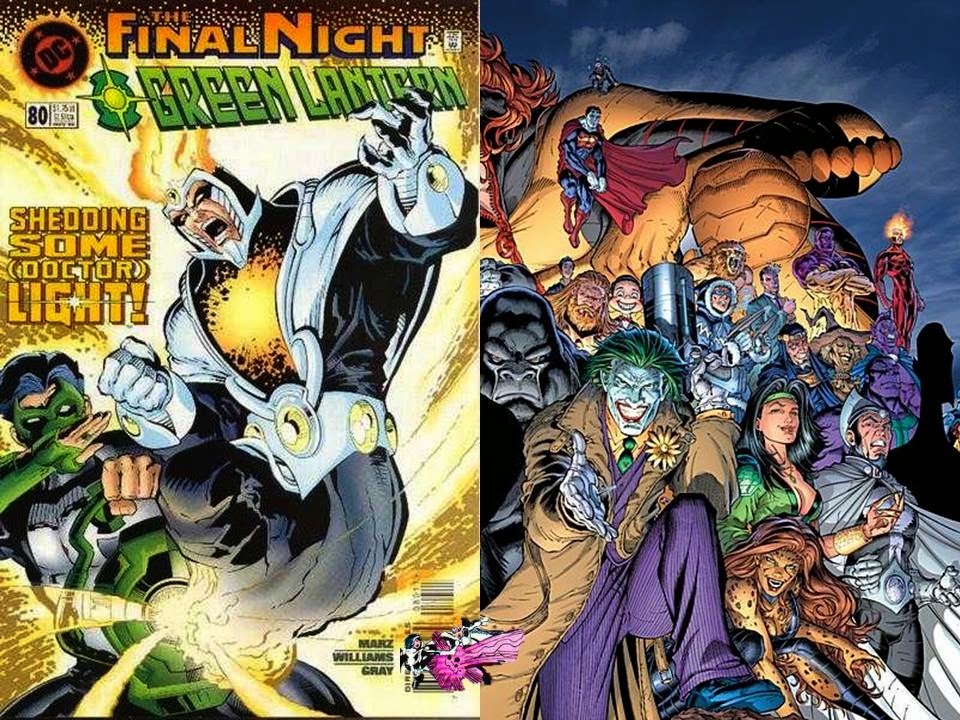
This also didn’t work out well for the doctor….he was in prison quite a bit, which didn’t turn out well for him either. Dr. Light got recruited to the Suicide Squad…and killed on Apokolips. Still, hell didn’t want this loser and sent him back to Earth…where he still had problems.
He got a new costume (which he later dumped), faced the new Green Lantern (Kyle Rayner), which got him recruited to play in Lex Luthor’s Injustice Gang (from JLA #10-15, as Green Lantern’s foe, with Luthor there for Superman, Joker for Batman, Ocean Master for Aquaman, Circe for Wonder Woman, Mirror Master for Flash…and a surprise for Martian Manhunter!). Still, Arthur ended up in jail, and even partnering with the Joker didn’t keep Dr. Light safe from the toxic Joker’s Last Laugh…but that was nothing compared to the Identity Crisis he’d later have. Seems Arthur was really villainious one day, so bad that the JLA had to wipe his mind…and that started a whole nasty chain of events, leading to tons of problems for the world’s heroes. And, it was after all this that Arthur faced Green Arrow alone (well, not so alone….as he brought help, including Killer Frost, Mirror Master, Deathstroke the Terminator and Merlyn, all in Green Arrow #54-59 in 2005/2006!).
Merlyn didn’t really use magic, but his skill with a bow was like magic. Arthur King first came on the scene in Justice League of America #94 (November, 1971, by Mike Friedrich and Dick Dillin); he was a member of the League of Assassins, and had been an archer idolized by young Oliver Queen, and even once able to beat Green Arrow early in his career before Arthur became an assassin. Merlyn was also a recruit in an “anti”-Justice League (composed of foes of the team, including Superman’s foe-Brainiac, Batman villain-Clayface, Aquaman’s opposite-the Ocean Master, Flash nemesis-Grodd, Green Lantern’s arch enemy-Sinestro, Atom’s foe-Chronos, Black Canary villain-the Harpy and the Queen Bee to face Elongated Man and Red Tornado) in Action Comics #443 (January, 1975) and faced Black Lightning (a future friend to Green Arrow with lightning powers) in that electric hero’s second issue.
Merlyn ended up facing other heroes for quite a time when Green Arrow went “urban hunter” in Seattle, even joining a group, the Killer Elite (with Bolt, Chiller, Deadline and Deadshot) to fight the Justice League America branch under the direction of Neron during the Underworld Unleashed, fighting Arrowette and the rest of the Young Justice kids as a member of the Zandian olympic team, and Merlyn was also involved in the Identity Crisis, mostly fighting the new female Manhunter, Kate Spencer. Still, he couldn’t stay away from Green Arrow, and faced him again, both before and after Ollie’s wedding to Black Canary, and Black Canary as well during her 2007 mini-series, and a quick reunion with some of the League of Assassins to face the Bat-family…after, Merlyn was faced with a female psychopathic admirer of Green Arrow’s named Cupid…who made him see stars.
Deadshot started off as a Batman villain in Batman #59 (June, 1950, by David Vern and Lew Schwartz), and then sat out for a while, all the way until Detective Comics #474, where Steve Englehart returned the character (and the late Marshall Rogers gave him his one-eyed fully-masked assassin look). Then, with the manipulations of Darkseid turning the world against its heroes in Legends, Deadshot joined the Suicide Squad, where he remained a member for most of its original 66 issue run (all under the talent of writer John Ostrander, fleshing out the character of Floyd Lawton, and why this rich kid went to the wrong side of the tracks, becoming a trickshot artist and assassin), even boasting a 4-issue mini-series all his own! Even after the Squad went away for a while, Floyd stayed in groups, joining the Killer Elite, and even coming back to other versions of the Suicide Squad, where this man could use his deadly talents to help people (because, even though Deadshot is a killer, somewhere with him, he wants to be an old style gunslinger, pulling into town to keep the law…like he did the first time he met Batman).
And, all of this…and no Green Arrow? Well…yes, that’s true. Green Arrow and Deadshot really didn’t cross paths until around the Identity Crisis and Deadshot’s 2005 6-issue mini-series, and the Villains United series…which led to the Secret Six mini-series and regular series (wherein Floyd worked with Cat-Man, another Batman villain that crossed paths with Green Arrow).
These two incredible marksmen…just kept missing each other. Seems something must have kept them off-balance…
Werner Vertigo started off fighting Green Arrow’s ladyfriend, the sonic-empowered Black Canary, in World’s Finest Comics #251 (June-July, 1978, by Gerry Conway and Trevor von Eeden), trying to take back jewels owned by his family, as he was part of the ruling class of the small Eastern European country of Vlatava that the Russians had taken over; and his genetic inner ear disorder, which he inherited as well, had been neutralized by mechanical means, by which he could affect the vertigo of anyone around him. Vertigo returned in the next issue of World’s Finest to face Green Arrow (switching with the Stinger in a “tag-team” style, where the Stinger faced Black Canary…but still ending in defeat for the villains). Green Arrow kept Vertigo as a villain for a few more battles…until Darkseid turned Earth against its heroes in Legends, and Count Vertigo faced Black Canary again. Count Vertigo was captured by Manhunter Mark Shaw, and went to work with the Suicide Squad, starting with issue #24, where he and Deadshot had a few confrontations over time. Still, Count Vertigo stayed with the team through issue #66, when the members left to pursue individual interests.
Count Vertigo returned home to Vlatava to help his people, but instead was there to watch as the Spectre killed them all (in Spectre #13, December, 1993, by John Ostrander and Tom Mandrake). Count Vertigo returned to the Suicide Squad briefly, then was recruited to join Johnny Sorrow’s Injustice Society as a foe of Black Canary’s. Still, after a chance encounter with Green Arrow (in Green Arrow #22, May, 2003 by Scott Beatty and Phil Hester) on Starfish Island (the place where Ollie learned the basic archery and survival skills and came to the realization he wanted to help people), Count Vertigo also realized the evil life wasn’t for him, and wanted to help people again (Count Vertigo was also a little bi-polar, which he also needed help with on occasion). So, after the Infinite Crisis, he joined Checkmate (with JSAers Green Lantern Alan Scott, Mr. Terrific and JLI member Fire)…but, was still attached to the Suicide Squad (which pit him against the Justice League once again…this time, with that team being led by Black Canary, and against Manhunters Mark Shaw and Kate Spencer…leading one in a dizzying circular path…why, it’s enough to give one…vertigo!).
All of which is a way to show how interconnected Green Arrow’s foes are, both with each other, the Manhunters, and the various villainous organizations of the DC Universe.
Even so, this is just a few of the people that Green Arrow has faced over the years…and there are many more as well…and we’ll explore that further, starting with Replikon, Deathstroke and all of the other of Batman’s foes Green Arrow has faced over the years.
Glad you asked, because here a few facts on Green Arrow’s most wanted bad guys!
Tick Tock
First up is the most timely of those foes, the Clock King.The Clock King first appeared in World’s Finest Comics #111 (August, 1960, by Ed Herron and Lee Elias – he’s not on the cover because Green Arrow was on few covers back in the early 1960s). William Tockman was a man out of time…he thought he was going to perish, and planned to rob a bank using his impeccable ability to schedule (and a clock costume…well, hey, it was the Silver Age!) to get money to support his sister, but he was stopped by Green Arrow and Speedy…and sent to prison. He worked with Dr. Destiny and the first gathering of foes of the Justice League of America…and later still, found out that he wasn’t really dying at all! The Clock King faced Green Arrow a few times in before the Crisis on Infinite Earths (and appeared in that book as well, issue #9 with all the villains), and then joined the Injustice League with Justice League International #23 (January, 1989) with Major Disaster, Multi-Man, Cluemaster and Big Sir. He worked with that team for a while (even when it changed to Justice League Antarctica), both helping and hindering the JLI. He even worked with other foes who had a time fascination, like Atom’s foe – Chronos, the Batman’s Calendar Man and Batman/Green Lantern/Animal Man foe the Time Commander in a group called the “Time Foes” in Team Titans #13 and 14 (in 1993) and in Showcase ’94 for Zero Hour.
He even tried forming his own group, the Clockwatchers (with members Acidia, Sharpe, Crackle and Radiant) and fought the Teen Titans, Firehawk and Booster Gold in Chase #4 (May, 1998). But, time finally ran out for William Tockman when he rejoined the Injustice League at the behest of the U.S. government in Suicide Squad #1 (November, 2001). Another man took the name of the Clock King, and he seemed to have some ability to manipulate time, and he faced the Teen Titans just before Flashpoint, when time ran out for all….
Dream A Little Dream
Clock King dreamed of a better life for his sister…and maybe that’s why he was recruited by Dr. Destiny, the next foe we’ll discuss.Making his first appearance in Justice League of America #5 (June-July, 1961, by Gardner Fox and Mike Sekowsky), John Dee was a criminal scientist who was the first foe Green Arrow faced as a member of the Justice League, having joined the issue before, and he was the first villain who recruited the foes of the members to battle the team together (in case you are wondering, those foes are Wonder Woman’s Professor Menace, Aquaman baddie – the Electric Man, Martian Manhunter nemesis – the Getaway Mastermind, Flash foe - Captain Cold and Green Lantern’s villain - the Puppet Master…who later took the name the Puppeteer…). After a few more battles with the JLA, Dr. Destiny invented the Materioptikon…which allowed him to manipulate dreams into reality. This made him much harder to defeat, and after stopping another gathering of villains (foes after the hero – Superman/Luthor, Batman/Penguin, Aquaman/Cutlass Charlie, Flash/Captain Boomerang, Green Lantern/Tattooed Man, Martian Manhunter/Dr. Light, Atom/Plant-Master and Hawkman/Mr. I.Q. in Justice League of America #61, March, 1968) where the JLAers all acted as Green Arrow, the team had Dr. Destiny hypnotized to be unable to dream.
He even returned to face the JLA a few times after before he was only a dream….
Turn on the Light
Dr. Light was another Justice League foe who also battled the amazing archer individual after facing him in the Justice League (starting with his first appearance, in Justice League of America #12, June, 1962, by Gardner Fox and Mike Sekowsky).Arthur Light was kind of a failure as a scientist, and he carried that on through the rest of his life. Arthur ended up facing the Justice League to make himself feel superior, and he’s been losing ground ever since. Using light based weapons, he was able to isolate the individual JLA members, and dispatch them to alien planets…and, but for a bit of luck and honorary JLAer Snapper Carr, the members would still be there.
Dr. Light went on to face members individually, then even attacking the gathered sidekicks of the group in the Teen Titans (first time, in Teen Titans #44, November, 1976, with Green Arrow’s own sidekick, Speedy, in attendance). Dr. Light even formed a group of villains to attack the teens (under the direction of the demon, Trigon), the Fearsome Five (other members included Gizmo, Mammoth, Shimmer and Psimon in New Teen Titans #3, January, 1981, by Marv Wolfman and George Perez).

This also didn’t work out well for the doctor….he was in prison quite a bit, which didn’t turn out well for him either. Dr. Light got recruited to the Suicide Squad…and killed on Apokolips. Still, hell didn’t want this loser and sent him back to Earth…where he still had problems.
He got a new costume (which he later dumped), faced the new Green Lantern (Kyle Rayner), which got him recruited to play in Lex Luthor’s Injustice Gang (from JLA #10-15, as Green Lantern’s foe, with Luthor there for Superman, Joker for Batman, Ocean Master for Aquaman, Circe for Wonder Woman, Mirror Master for Flash…and a surprise for Martian Manhunter!). Still, Arthur ended up in jail, and even partnering with the Joker didn’t keep Dr. Light safe from the toxic Joker’s Last Laugh…but that was nothing compared to the Identity Crisis he’d later have. Seems Arthur was really villainious one day, so bad that the JLA had to wipe his mind…and that started a whole nasty chain of events, leading to tons of problems for the world’s heroes. And, it was after all this that Arthur faced Green Arrow alone (well, not so alone….as he brought help, including Killer Frost, Mirror Master, Deathstroke the Terminator and Merlyn, all in Green Arrow #54-59 in 2005/2006!).
Archery is Black Magic
Dr. Light’s help against the emerald archer included one of his individual foes, the “magician” Merlyn.Merlyn didn’t really use magic, but his skill with a bow was like magic. Arthur King first came on the scene in Justice League of America #94 (November, 1971, by Mike Friedrich and Dick Dillin); he was a member of the League of Assassins, and had been an archer idolized by young Oliver Queen, and even once able to beat Green Arrow early in his career before Arthur became an assassin. Merlyn was also a recruit in an “anti”-Justice League (composed of foes of the team, including Superman’s foe-Brainiac, Batman villain-Clayface, Aquaman’s opposite-the Ocean Master, Flash nemesis-Grodd, Green Lantern’s arch enemy-Sinestro, Atom’s foe-Chronos, Black Canary villain-the Harpy and the Queen Bee to face Elongated Man and Red Tornado) in Action Comics #443 (January, 1975) and faced Black Lightning (a future friend to Green Arrow with lightning powers) in that electric hero’s second issue.
Merlyn ended up facing other heroes for quite a time when Green Arrow went “urban hunter” in Seattle, even joining a group, the Killer Elite (with Bolt, Chiller, Deadline and Deadshot) to fight the Justice League America branch under the direction of Neron during the Underworld Unleashed, fighting Arrowette and the rest of the Young Justice kids as a member of the Zandian olympic team, and Merlyn was also involved in the Identity Crisis, mostly fighting the new female Manhunter, Kate Spencer. Still, he couldn’t stay away from Green Arrow, and faced him again, both before and after Ollie’s wedding to Black Canary, and Black Canary as well during her 2007 mini-series, and a quick reunion with some of the League of Assassins to face the Bat-family…after, Merlyn was faced with a female psychopathic admirer of Green Arrow’s named Cupid…who made him see stars.
A Shot in the Dark
Deadshot is an odd case, and is here mostly because of his friends.Deadshot started off as a Batman villain in Batman #59 (June, 1950, by David Vern and Lew Schwartz), and then sat out for a while, all the way until Detective Comics #474, where Steve Englehart returned the character (and the late Marshall Rogers gave him his one-eyed fully-masked assassin look). Then, with the manipulations of Darkseid turning the world against its heroes in Legends, Deadshot joined the Suicide Squad, where he remained a member for most of its original 66 issue run (all under the talent of writer John Ostrander, fleshing out the character of Floyd Lawton, and why this rich kid went to the wrong side of the tracks, becoming a trickshot artist and assassin), even boasting a 4-issue mini-series all his own! Even after the Squad went away for a while, Floyd stayed in groups, joining the Killer Elite, and even coming back to other versions of the Suicide Squad, where this man could use his deadly talents to help people (because, even though Deadshot is a killer, somewhere with him, he wants to be an old style gunslinger, pulling into town to keep the law…like he did the first time he met Batman).
And, all of this…and no Green Arrow? Well…yes, that’s true. Green Arrow and Deadshot really didn’t cross paths until around the Identity Crisis and Deadshot’s 2005 6-issue mini-series, and the Villains United series…which led to the Secret Six mini-series and regular series (wherein Floyd worked with Cat-Man, another Batman villain that crossed paths with Green Arrow).
These two incredible marksmen…just kept missing each other. Seems something must have kept them off-balance…
Down With the Count
Keeping people off-balance is par for the course for Count Vertigo.Werner Vertigo started off fighting Green Arrow’s ladyfriend, the sonic-empowered Black Canary, in World’s Finest Comics #251 (June-July, 1978, by Gerry Conway and Trevor von Eeden), trying to take back jewels owned by his family, as he was part of the ruling class of the small Eastern European country of Vlatava that the Russians had taken over; and his genetic inner ear disorder, which he inherited as well, had been neutralized by mechanical means, by which he could affect the vertigo of anyone around him. Vertigo returned in the next issue of World’s Finest to face Green Arrow (switching with the Stinger in a “tag-team” style, where the Stinger faced Black Canary…but still ending in defeat for the villains). Green Arrow kept Vertigo as a villain for a few more battles…until Darkseid turned Earth against its heroes in Legends, and Count Vertigo faced Black Canary again. Count Vertigo was captured by Manhunter Mark Shaw, and went to work with the Suicide Squad, starting with issue #24, where he and Deadshot had a few confrontations over time. Still, Count Vertigo stayed with the team through issue #66, when the members left to pursue individual interests.
Count Vertigo returned home to Vlatava to help his people, but instead was there to watch as the Spectre killed them all (in Spectre #13, December, 1993, by John Ostrander and Tom Mandrake). Count Vertigo returned to the Suicide Squad briefly, then was recruited to join Johnny Sorrow’s Injustice Society as a foe of Black Canary’s. Still, after a chance encounter with Green Arrow (in Green Arrow #22, May, 2003 by Scott Beatty and Phil Hester) on Starfish Island (the place where Ollie learned the basic archery and survival skills and came to the realization he wanted to help people), Count Vertigo also realized the evil life wasn’t for him, and wanted to help people again (Count Vertigo was also a little bi-polar, which he also needed help with on occasion). So, after the Infinite Crisis, he joined Checkmate (with JSAers Green Lantern Alan Scott, Mr. Terrific and JLI member Fire)…but, was still attached to the Suicide Squad (which pit him against the Justice League once again…this time, with that team being led by Black Canary, and against Manhunters Mark Shaw and Kate Spencer…leading one in a dizzying circular path…why, it’s enough to give one…vertigo!).
All of which is a way to show how interconnected Green Arrow’s foes are, both with each other, the Manhunters, and the various villainous organizations of the DC Universe.
Even so, this is just a few of the people that Green Arrow has faced over the years…and there are many more as well…and we’ll explore that further, starting with Replikon, Deathstroke and all of the other of Batman’s foes Green Arrow has faced over the years.
Wednesday, May 7, 2014
DC Heroes That Should Be On CW's Arrow
With its second season ending, the CW's Arrow has done a great job of introducing TV fans to the heroes of the DC Universe, with appearances by Black Canary, Bronze Tiger, Amanda Waller (and the whole Suicide Squad), even returns for Deathstroke and the Huntress (who on the series fall into the villain category, but were heroes in the comics....) and a teaser for Barry Allen (who, with a burst of lightning, will be the Flash...).
Still, a few more heroes could always appear (as could villains, after all, Count Vertigo and the Clock King were major Green Arrow villains, who ended up as members of the Suicide Squad in the comics, but not yet on the show).
Here are a few (along with their relationship to "Team Arrow" and other fun facts) and why each of these comic book heroes would work well on the CW's Starling City!
The Question. Crusading TV reporter Vic Sage decided it wasn't enough to report on crime, but with the help of Professor Rodor and an artificial skin he invented, came up with his crimefighting alter-ego, the Question, just a faceless man on the street, fighting crime as hard as he could..since the days of being a back up feature in Blue Beetle #1 (June, 1967 by Steve Ditko, for five issues, as well as having a solo one-shot with Mysterious Suspense). If the trenchcoated hero looks familiar, his look and motive was the basis for Rorschach of the Watchmen though DC thought they had more potential with the Charlton characters....
When DC Comics acquired the Charlton characters, the Question ended up with his own title, and got trained by Richard Dragon (a martial artist, who had been friends with Ben Turner, aka the Bronze Tiger), and then ran into Green Arrow (and Black Canary) more than a few times (most notably in both Question Annuals, as well as in the first 3 Green Arrow Annuals).
The Question had also worked quite a bit with the next candidate....
Blue Beetle. Ted Kord was a student of Dan Garrett's (the first, gem-powered Blue Beetle), who was killed on an island owned by Ted's uncle, Jarvis Kord, who was using the island to make an army of androids to take over the Earth.
Ted assumed the mantle of the Blue Beetle, but had been unable to get the mystic scarab that powered the original, so, instead used technology (including his BB-gun and flying ship, the Bug) since Captain Atom #83 (November, 1963, by Steve Ditko).
DC Comics used the Blue Beetle heavily in their Crisis on Infinite Earths series, and was the first Charlton character to get his own book (and to join the Justice League, where he worked with Black Canary). Blue Beetle also worked with the Huntress, and even later, with the Birds of Prey.
The Arrow series has even mentioned Ted Kord himself, as well as his company, Kord Industries, so why not have the man swing into action himself?
Black Orchid. Pre-Crisis, the Black Orchid had no origin, she was just a woman who fought crime with her strength, speed, invulnerability and disguise ability. As of Adventure Comics #428 (July-August, 1973 by Sheldon Mayer and Tony DeZuniga), Black Orchid would infiltrate a criminal's operation (pretending to be a maid, secretary, waitress, etc) and get the information needed to bring them down. One of the great mysteries of the Black Orchid run was her origin, because, even though the cover promised it was an origin issue, her origin was never given during the early years (Neil Gaiman did it later when reviving the character for a mini-series....)
The Black Orchid did this in Adventure Comics #428-430, and some back-ups in Phantom Stranger from #31-41, and Blue Devil Annual #1 (as well as the Crisis on Infinite Earths) before joining the Suicide Squad with their original issue #2. She even worked with Speedy (Roy Harper, himself a government agent, before he got his Arsenal identity) for a few issues, so while all the super-powers she has might be more than the usual for the Arrow series, her basic operations might work well in the Arrow world.
Crimson Avenger. Lee Travis was the publisher of a newspaper, and a weary World War I veteran who was wandering the world trying to find a purpose...and found one in the far-East temple of Nanda Parbat (where he was granted a vision of a noble man with a red cape who would die saving us all from doomsday...this addition to Crimson Avenger's history was from John Ostrander). This gave him the clarity to become the Crimson Avenger (starting with Detective Comics #20, October, 1938, by Jim Chambers...making him a hero that existed before Batman! Crimson Avenger's first cover wasn't even until Detective Comics #22).
The Crimson Avenger was a pulp style hero (think of the Shadow, or Green Hornet....as the Crimson Avenger also had an oriental sidekick named Wing and a gas gun that made a crimson cloud, all ideas that were popular for heroes of the 1930s before the mystery men really started to appear...he even dealt with invading aliens...almost...thanks to Orson Welles and a story by Roy Thomas as another addition to his secret origin). Later, Lee Travis (and Wing) adopted a more traditional super-hero look, and even joined Green Arrow and Speedy as members of the Seven Soldiers of Victory (with Wing as the unofficial eighth member)...thus, seems seeing Crimson Avenger work with the Arrow would be a natural!
Vigilante. Greg Saunders was known as a country singer, the Prairie Troubadour, who lost his sheriff father to a gang of bandits and adopted the Western themed Vigilante identity to bring them in (starting with Action Comics #42, November, 1941, by Mort Weisinger and Mort Meskin, and first cover, non-team was on Action Comics #52) and continued to be a hero for quite some time!
The Vigilante was a old fashion cowboy type fighting modern criminals with his six-shooter, lasso and horse (well, actually a pretty nifty motorcycle) and sidekicks Billy Gunn and Stuff the Chinatown Kid. The Vigilante also joined Green Arrow and Speedy (as well as the Crimson Avenger, the Shining Knight, the Star-Spangled Kid and Stripsey) in the Seven Soldiers of Victory!
DC even had established the Vigilante as a separate hero, who teamed up with the JLA.
Vigilante. Adrian Chase was a lawyer who worked with Robin of the Teen Titans in bringing down crime families in New York...and he was too good at his job, provoking the mob to kill his family in New Teen Titans Annual #2 (1983, by Marv Wolfman and George Perez; you might remember the law firm of Wolfman and Perez on Arrow) where Adrian then became the Vigilante.
The Vigilante hunted down criminals with skills acquired with many weapons and a regenerative power over his 50 issues and 2 Annuals, as well getting assistance from a team of professionals (like J.J. Davis, who was his computer and weapons expert). In his earlier issues (written by Marv Wolfman), Adrian struggled with the idea of killing criminals, and battled heroes (like Nightwing, who would later call Bludhaven home...a city mentioned on Arrow), and later, became obsessed when the Peacemaker killed officer Dave Winston (who had taken over the identity of the Vigilante for a time), and felt he had to bring this unbalanced hero to justice (in stories written by Paul Kupperberg, and covers by Mike Grell...the artist who also worked on Green Arrow on and off for decades, and provided the sketch of the Hood on the Arrow series). The Vigilante also became more unbalanced himself, and this series lead to the foundation of Checkmate (an organization that Roy Harper worked for in his Arsenal identity).
All these characters have ties to Green Arrow (some only slightly), but any would work well in the world set up on Arrow...and would suggest other characters to bring in as well!
Still, a few more heroes could always appear (as could villains, after all, Count Vertigo and the Clock King were major Green Arrow villains, who ended up as members of the Suicide Squad in the comics, but not yet on the show).
Here are a few (along with their relationship to "Team Arrow" and other fun facts) and why each of these comic book heroes would work well on the CW's Starling City!
The Answer Is...
The Question. Crusading TV reporter Vic Sage decided it wasn't enough to report on crime, but with the help of Professor Rodor and an artificial skin he invented, came up with his crimefighting alter-ego, the Question, just a faceless man on the street, fighting crime as hard as he could..since the days of being a back up feature in Blue Beetle #1 (June, 1967 by Steve Ditko, for five issues, as well as having a solo one-shot with Mysterious Suspense). If the trenchcoated hero looks familiar, his look and motive was the basis for Rorschach of the Watchmen though DC thought they had more potential with the Charlton characters....
When DC Comics acquired the Charlton characters, the Question ended up with his own title, and got trained by Richard Dragon (a martial artist, who had been friends with Ben Turner, aka the Bronze Tiger), and then ran into Green Arrow (and Black Canary) more than a few times (most notably in both Question Annuals, as well as in the first 3 Green Arrow Annuals).
The Question had also worked quite a bit with the next candidate....
A Gem Hidden In Plan Sight
Blue Beetle. Ted Kord was a student of Dan Garrett's (the first, gem-powered Blue Beetle), who was killed on an island owned by Ted's uncle, Jarvis Kord, who was using the island to make an army of androids to take over the Earth.
Ted assumed the mantle of the Blue Beetle, but had been unable to get the mystic scarab that powered the original, so, instead used technology (including his BB-gun and flying ship, the Bug) since Captain Atom #83 (November, 1963, by Steve Ditko).
DC Comics used the Blue Beetle heavily in their Crisis on Infinite Earths series, and was the first Charlton character to get his own book (and to join the Justice League, where he worked with Black Canary). Blue Beetle also worked with the Huntress, and even later, with the Birds of Prey.
The Arrow series has even mentioned Ted Kord himself, as well as his company, Kord Industries, so why not have the man swing into action himself?
Flowers Are Pretty
Black Orchid. Pre-Crisis, the Black Orchid had no origin, she was just a woman who fought crime with her strength, speed, invulnerability and disguise ability. As of Adventure Comics #428 (July-August, 1973 by Sheldon Mayer and Tony DeZuniga), Black Orchid would infiltrate a criminal's operation (pretending to be a maid, secretary, waitress, etc) and get the information needed to bring them down. One of the great mysteries of the Black Orchid run was her origin, because, even though the cover promised it was an origin issue, her origin was never given during the early years (Neil Gaiman did it later when reviving the character for a mini-series....)
The Black Orchid did this in Adventure Comics #428-430, and some back-ups in Phantom Stranger from #31-41, and Blue Devil Annual #1 (as well as the Crisis on Infinite Earths) before joining the Suicide Squad with their original issue #2. She even worked with Speedy (Roy Harper, himself a government agent, before he got his Arsenal identity) for a few issues, so while all the super-powers she has might be more than the usual for the Arrow series, her basic operations might work well in the Arrow world.
Blood Red
Crimson Avenger. Lee Travis was the publisher of a newspaper, and a weary World War I veteran who was wandering the world trying to find a purpose...and found one in the far-East temple of Nanda Parbat (where he was granted a vision of a noble man with a red cape who would die saving us all from doomsday...this addition to Crimson Avenger's history was from John Ostrander). This gave him the clarity to become the Crimson Avenger (starting with Detective Comics #20, October, 1938, by Jim Chambers...making him a hero that existed before Batman! Crimson Avenger's first cover wasn't even until Detective Comics #22).
The Crimson Avenger was a pulp style hero (think of the Shadow, or Green Hornet....as the Crimson Avenger also had an oriental sidekick named Wing and a gas gun that made a crimson cloud, all ideas that were popular for heroes of the 1930s before the mystery men really started to appear...he even dealt with invading aliens...almost...thanks to Orson Welles and a story by Roy Thomas as another addition to his secret origin). Later, Lee Travis (and Wing) adopted a more traditional super-hero look, and even joined Green Arrow and Speedy as members of the Seven Soldiers of Victory (with Wing as the unofficial eighth member)...thus, seems seeing Crimson Avenger work with the Arrow would be a natural!
Cowboys and Indians
Vigilante. Greg Saunders was known as a country singer, the Prairie Troubadour, who lost his sheriff father to a gang of bandits and adopted the Western themed Vigilante identity to bring them in (starting with Action Comics #42, November, 1941, by Mort Weisinger and Mort Meskin, and first cover, non-team was on Action Comics #52) and continued to be a hero for quite some time!
The Vigilante was a old fashion cowboy type fighting modern criminals with his six-shooter, lasso and horse (well, actually a pretty nifty motorcycle) and sidekicks Billy Gunn and Stuff the Chinatown Kid. The Vigilante also joined Green Arrow and Speedy (as well as the Crimson Avenger, the Shining Knight, the Star-Spangled Kid and Stripsey) in the Seven Soldiers of Victory!
DC even had established the Vigilante as a separate hero, who teamed up with the JLA.
Punishing the Criminals
Vigilante. Adrian Chase was a lawyer who worked with Robin of the Teen Titans in bringing down crime families in New York...and he was too good at his job, provoking the mob to kill his family in New Teen Titans Annual #2 (1983, by Marv Wolfman and George Perez; you might remember the law firm of Wolfman and Perez on Arrow) where Adrian then became the Vigilante.
The Vigilante hunted down criminals with skills acquired with many weapons and a regenerative power over his 50 issues and 2 Annuals, as well getting assistance from a team of professionals (like J.J. Davis, who was his computer and weapons expert). In his earlier issues (written by Marv Wolfman), Adrian struggled with the idea of killing criminals, and battled heroes (like Nightwing, who would later call Bludhaven home...a city mentioned on Arrow), and later, became obsessed when the Peacemaker killed officer Dave Winston (who had taken over the identity of the Vigilante for a time), and felt he had to bring this unbalanced hero to justice (in stories written by Paul Kupperberg, and covers by Mike Grell...the artist who also worked on Green Arrow on and off for decades, and provided the sketch of the Hood on the Arrow series). The Vigilante also became more unbalanced himself, and this series lead to the foundation of Checkmate (an organization that Roy Harper worked for in his Arsenal identity).
All these characters have ties to Green Arrow (some only slightly), but any would work well in the world set up on Arrow...and would suggest other characters to bring in as well!
Friday, May 2, 2014
Spider-Man’s Amazing Movie Team-Ups!
Spidey’s kept up an amazing run over the years, meeting with various other Marvel heroes in Marvel Team-Up (and, well, just about any title Spider-Man has been in).
With his latest movie, the Amazing Spider-Man, Spidey’s all ready to take over the big screen again! But….it doesn’t seem likely he’ll be teaming up with the Dark Knight (sort of obvious, Batman’s DC and Spidey’s Marvel), or sadly, even with his fellow Avengers (Spidey had been a part of the team in the comics) as the Amazing Spider-Man is being produced by Columbia Pictures (and it was Paramount Pictures that brought us the Avengers, and its movies, Iron Man, the Incredible Hulk, Iron Man 2, Thor and Captain America: the First Avenger)…and Spidey’s fellow New Yorkers like the Fantastic Four, Daredevil, Elektra, the X-Men and the Punisher are spread out as well! (The less said about the travelling Ghost Rider….and, well, there’s Howard the Duck as well….and the approaching Guardians of the Galaxy).
Still, this doesn’t stop the comics from teaming them up, or even having your friendly neighborhood Spider-Man meet with other movie franchise stars, even as part of his regular comic book appearances. So, let’s take a look at a few of those! And, wouldn’t any of these be the blockbuster of the summer?
One of the earliest meetings of these type was when Spider-Man confronted Dracula in Giant-Size Spider-Man #1 (July 1974, by Len Wein and Ross Andru), where the characters cross…on a boat. It’s a little more serious than that (Peter was there to help Aunt May with an illness…), but still pretty basic (and though the cover implies differently, Spidey and Dracula never meet). Dracula had been added to the Marvel Universe with Tomb of Dracula back in April 1972 (by Gerry Conway, Roy Thomas and Gene Colan), and had been encountering the occasional Marvel character as time progressed (as well as having a few created there as well, such as Blade, who fronted his own movie franchise of the daywalking vampire with Wesley Snipes as the titular character). Not an actual tie-in to any specific Dracula, but I’ve always felt he looked a little like the Christopher Lee version from the Hammer Films (though with a bit of the classic Bela Lugosi thrown in)…Marvel’s version of Dracula was one of the stronger ones, and most of the better adaptations of Bram Stoker’s Gothic character had something of this look involved.
Dracula wasn’t the only classic Universal Monster Spidey ran into. Frankenstein Monster’s rose to meet the webslinger in Marvel Team-Up #36 (August 1975, by Gerry Conway and Sal Buscema). Frankenstein’s Monster was in an issue of Silver Surfer, but started in earnest with The Monster of Frankenstein #1 (January 1973, by Gary Friedrich and Mike Ploog), and lasted for 18 issue (with the title switching to The Frankenstein Monster with issue #6) until he ran into the Amazing Spider-Man. Or, more accurately, Spidey and the Monster were kidnapped by Baron Ludwig von Shtupf to help create a new breed of monsters (under the baron’s control, of course). The two worked together (as they also faced Spidey’s werewolf foe, the Man-Wolf, who had returned from the moon) and the Mary Shelley’s Universal Monster shambled off to pop up here and there (as a member of the undead Avengers foes, the Legion of the Unliving, or with Iron Man fighting the Dreadknight, a distant relation of the Black Knight), and this Frankenstein’s Monster looks like an amalgam of the earlier versions, having longer hair than and a thinner look than the classic version by Boris Karloff, Lon Chaney Jr., Bela Lugosi or even Glenn Strange. who met Bela Lugosi‘s Dracula (along with Bud Abbott & Lou Costello in Abbott & Costello Meet Frankenstein).
Spidey didn’t just encounter old monsters, but those that fought them as well. Spidey met another guy with big muscles, the old pulp hero, Doc Savage in Giant-Size Spider-Man #3 (January 1975, by Gerry Conway and Ross Andru). Lester Dent‘s Man of Bronze first appeared in Doc Savage Magazine in March 1933 and Clark Savage Jr was a “perfect human being”, at least in terms of strength, speed and mental abilities, and he and his band of compatriots fought criminals and spies. Marvel started comic book adaptations of his stories with Doc Savage #1 (October 1972, by Roy Thomas, Steve Englehart and Ross Andru) which lasted eight issues. Sadly, Spidey and Doc don’t actually meet in the Giant-Size either, but both spend their time working against blue alien babe named DeSinna in their own times (Marvel at least kept Doc set in the 1930s when they used him). Doc does meet a later Marvel star, the Fantastic Four’s Thing, in Marvel Two-In-One #21 (November 1976, by Bill Mantlo and Ron Wilson). Though the movie came out in June 1975, Andru‘s Doc Savage does have a “Ron Ely” quality (Ron Ely being the actor to portray Doc in Doc Savage: The Man of Bronze). And, Hollywood plans more with a new Doc Savage movie to come.
Keeping with the idea of the old pulps, Spidey met the female barbarian lead, the Red Sonja in Marvel Team-Up #79 (March 1979, by Chris Claremont and John Byrne). Red Sonja came from the pages of Conan the Barbarian (#23, February 1973, by Roy Thomas and Barry Windsor-Smith) and was based loosely on Red Sonya from Robert E. Howard‘s “The Shadow Of The Vulture” short story from January 1934 (not originally a Conan story, which led to an eventual separation in the rights between owning Red Sonja and Conan), ending up with 7 issues of Marvel Feature, and 3 series of her own at Marvel (lasting 15 issues, 2 issues and 13 issues). This story did have the two characters meet, more or less, using a bit of magical trickery (needed to fight Red Sonja’s old magical foe, Kulan Gath, who manifested in the here and now). A delightful story of Spidey fighting along side the metal-bikinied red-head, along with a surprise or two here and there (look for a mild mannered Daily Planet reporter to make a cameo). Red Sonja’s now a big franchise at Dynamite Comics, and they worked with Marvel to make a Spider-Man/Red Sonja mini-series (more or less following up on the idea in this story…running a bit too long, but still having some fun with the idea). Sadly, less fun was the 1985 Red Sonja movie with Brigette Nielsen as the main character (with Arnold Schwarzenegger playing a Conan-like character in the movie, but not Conan, as back then it was still rare for movie franchises to crossover).
Though not in a normal comic, but in a large Treasury edition, Spider-Man encountered Supeman in a historic Marvel and DC team-up! True, DC and Marvel worked together the year before to produce a treasury sized (that mean larger than normal comic) adaptation of “The Wizard of Oz“, but in January, 1976, we readers were treated to Superman Vs. The Amazing Spider-Man….”the Greatest Superhero Team-Up of All Time!” by Gerry Conway and Ross Andru (with help from Neal Adams, Dick Giordano, Terry Austin, Josef Rubinstein and Bob Wiacek….hey, something this big needed an army of artists! As well as words from Stan Lee and Carmine Infantino as well). In this story, Superman tosses Lex Luthor into prison, as Spider-Man does to his own foe, Doctor Octopus. Just so happens, for this story, the two end up in prison together, and are able to escape. Though the machinations of the villains, the two heroes fight each other (part of those plans included the kidnapping of Lois Lane and Mary Jane Watson, the paramours of the titular heroes), figure out that they were tricked, and then team-up to save the girls and defeat the bad guys. Oddly enough, it had been suggested to Lee and Infantino to do a movie detailing this battle, but it was Superman – the Movie (with the iconic Christopher Reeve as Superman, that eventually came out in December 1978) and a few Spider-Man TV movies (with lesser known Nicholas Hammond in the later 1970s). Reeve went on to play Superman three more times, and, Superman has been a regular presence in the movies and television for decades, even making it to Saturday Night Live on occasion…which is ironic!
Lastly, Spidey met up with one of his strangest team-ups ever….meeting the real life stars of Stripes, the Blues Brothers, Coneheads, Invaders From Mars, Haunted Honeymoon and Car Wash…or at least the actors who played characters in those movies when Spidey teamed up with the Not-Ready-For-Prime-Time Players in Marvel Team-Up #74 (October 1978, by Chris Claremont and Bob Hall). Taking the idea that Stan Lee would be able to host SNL (and, hey, why’s that so hard to believe…well, it’s easy now, but Stan hadn’t been guest-starring in Marvel movies back then…), and a little postal problem…the villainous Silver Samurai ends up trying to fight John Belushi for a ring mistakenly delivered to the comedy star…and Spidey ends up having to work with the cast to keep John safe (and the show on the air). It does sound like this is a really odd idea, but the story works (and leads to a multi-issue crossover a little later in the series, where Spider-Man works with Nick Fury and Black Widow (who have been a few movies together recently) as well as Shang-Chi (the son of Fu Manchu)….and Fu Manchu, there’s a fellow who has been in some old movies as well!
At least Saturday Night Live didn’t forget one Avenger that the big screen Avengers did…the Ant-Man!
(Hey, he retains the strength of a human…at ant-size! Just ask him! It’s poor Garrett Morris as Ant-Man, John Belushi as the Hulk…and Dan Aykroyd as the Flash…).
With his latest movie, the Amazing Spider-Man, Spidey’s all ready to take over the big screen again! But….it doesn’t seem likely he’ll be teaming up with the Dark Knight (sort of obvious, Batman’s DC and Spidey’s Marvel), or sadly, even with his fellow Avengers (Spidey had been a part of the team in the comics) as the Amazing Spider-Man is being produced by Columbia Pictures (and it was Paramount Pictures that brought us the Avengers, and its movies, Iron Man, the Incredible Hulk, Iron Man 2, Thor and Captain America: the First Avenger)…and Spidey’s fellow New Yorkers like the Fantastic Four, Daredevil, Elektra, the X-Men and the Punisher are spread out as well! (The less said about the travelling Ghost Rider….and, well, there’s Howard the Duck as well….and the approaching Guardians of the Galaxy).
Still, this doesn’t stop the comics from teaming them up, or even having your friendly neighborhood Spider-Man meet with other movie franchise stars, even as part of his regular comic book appearances. So, let’s take a look at a few of those! And, wouldn’t any of these be the blockbuster of the summer?
This Bites
One of the earliest meetings of these type was when Spider-Man confronted Dracula in Giant-Size Spider-Man #1 (July 1974, by Len Wein and Ross Andru), where the characters cross…on a boat. It’s a little more serious than that (Peter was there to help Aunt May with an illness…), but still pretty basic (and though the cover implies differently, Spidey and Dracula never meet). Dracula had been added to the Marvel Universe with Tomb of Dracula back in April 1972 (by Gerry Conway, Roy Thomas and Gene Colan), and had been encountering the occasional Marvel character as time progressed (as well as having a few created there as well, such as Blade, who fronted his own movie franchise of the daywalking vampire with Wesley Snipes as the titular character). Not an actual tie-in to any specific Dracula, but I’ve always felt he looked a little like the Christopher Lee version from the Hammer Films (though with a bit of the classic Bela Lugosi thrown in)…Marvel’s version of Dracula was one of the stronger ones, and most of the better adaptations of Bram Stoker’s Gothic character had something of this look involved.
Pieces Get Together
Dracula wasn’t the only classic Universal Monster Spidey ran into. Frankenstein Monster’s rose to meet the webslinger in Marvel Team-Up #36 (August 1975, by Gerry Conway and Sal Buscema). Frankenstein’s Monster was in an issue of Silver Surfer, but started in earnest with The Monster of Frankenstein #1 (January 1973, by Gary Friedrich and Mike Ploog), and lasted for 18 issue (with the title switching to The Frankenstein Monster with issue #6) until he ran into the Amazing Spider-Man. Or, more accurately, Spidey and the Monster were kidnapped by Baron Ludwig von Shtupf to help create a new breed of monsters (under the baron’s control, of course). The two worked together (as they also faced Spidey’s werewolf foe, the Man-Wolf, who had returned from the moon) and the Mary Shelley’s Universal Monster shambled off to pop up here and there (as a member of the undead Avengers foes, the Legion of the Unliving, or with Iron Man fighting the Dreadknight, a distant relation of the Black Knight), and this Frankenstein’s Monster looks like an amalgam of the earlier versions, having longer hair than and a thinner look than the classic version by Boris Karloff, Lon Chaney Jr., Bela Lugosi or even Glenn Strange. who met Bela Lugosi‘s Dracula (along with Bud Abbott & Lou Costello in Abbott & Costello Meet Frankenstein).
Pulp Muscles
Spidey didn’t just encounter old monsters, but those that fought them as well. Spidey met another guy with big muscles, the old pulp hero, Doc Savage in Giant-Size Spider-Man #3 (January 1975, by Gerry Conway and Ross Andru). Lester Dent‘s Man of Bronze first appeared in Doc Savage Magazine in March 1933 and Clark Savage Jr was a “perfect human being”, at least in terms of strength, speed and mental abilities, and he and his band of compatriots fought criminals and spies. Marvel started comic book adaptations of his stories with Doc Savage #1 (October 1972, by Roy Thomas, Steve Englehart and Ross Andru) which lasted eight issues. Sadly, Spidey and Doc don’t actually meet in the Giant-Size either, but both spend their time working against blue alien babe named DeSinna in their own times (Marvel at least kept Doc set in the 1930s when they used him). Doc does meet a later Marvel star, the Fantastic Four’s Thing, in Marvel Two-In-One #21 (November 1976, by Bill Mantlo and Ron Wilson). Though the movie came out in June 1975, Andru‘s Doc Savage does have a “Ron Ely” quality (Ron Ely being the actor to portray Doc in Doc Savage: The Man of Bronze). And, Hollywood plans more with a new Doc Savage movie to come.
Sexy Swordplay
Keeping with the idea of the old pulps, Spidey met the female barbarian lead, the Red Sonja in Marvel Team-Up #79 (March 1979, by Chris Claremont and John Byrne). Red Sonja came from the pages of Conan the Barbarian (#23, February 1973, by Roy Thomas and Barry Windsor-Smith) and was based loosely on Red Sonya from Robert E. Howard‘s “The Shadow Of The Vulture” short story from January 1934 (not originally a Conan story, which led to an eventual separation in the rights between owning Red Sonja and Conan), ending up with 7 issues of Marvel Feature, and 3 series of her own at Marvel (lasting 15 issues, 2 issues and 13 issues). This story did have the two characters meet, more or less, using a bit of magical trickery (needed to fight Red Sonja’s old magical foe, Kulan Gath, who manifested in the here and now). A delightful story of Spidey fighting along side the metal-bikinied red-head, along with a surprise or two here and there (look for a mild mannered Daily Planet reporter to make a cameo). Red Sonja’s now a big franchise at Dynamite Comics, and they worked with Marvel to make a Spider-Man/Red Sonja mini-series (more or less following up on the idea in this story…running a bit too long, but still having some fun with the idea). Sadly, less fun was the 1985 Red Sonja movie with Brigette Nielsen as the main character (with Arnold Schwarzenegger playing a Conan-like character in the movie, but not Conan, as back then it was still rare for movie franchises to crossover).
Look, Up In The Sky!
Though not in a normal comic, but in a large Treasury edition, Spider-Man encountered Supeman in a historic Marvel and DC team-up! True, DC and Marvel worked together the year before to produce a treasury sized (that mean larger than normal comic) adaptation of “The Wizard of Oz“, but in January, 1976, we readers were treated to Superman Vs. The Amazing Spider-Man….”the Greatest Superhero Team-Up of All Time!” by Gerry Conway and Ross Andru (with help from Neal Adams, Dick Giordano, Terry Austin, Josef Rubinstein and Bob Wiacek….hey, something this big needed an army of artists! As well as words from Stan Lee and Carmine Infantino as well). In this story, Superman tosses Lex Luthor into prison, as Spider-Man does to his own foe, Doctor Octopus. Just so happens, for this story, the two end up in prison together, and are able to escape. Though the machinations of the villains, the two heroes fight each other (part of those plans included the kidnapping of Lois Lane and Mary Jane Watson, the paramours of the titular heroes), figure out that they were tricked, and then team-up to save the girls and defeat the bad guys. Oddly enough, it had been suggested to Lee and Infantino to do a movie detailing this battle, but it was Superman – the Movie (with the iconic Christopher Reeve as Superman, that eventually came out in December 1978) and a few Spider-Man TV movies (with lesser known Nicholas Hammond in the later 1970s). Reeve went on to play Superman three more times, and, Superman has been a regular presence in the movies and television for decades, even making it to Saturday Night Live on occasion…which is ironic!
Live From New York
Lastly, Spidey met up with one of his strangest team-ups ever….meeting the real life stars of Stripes, the Blues Brothers, Coneheads, Invaders From Mars, Haunted Honeymoon and Car Wash…or at least the actors who played characters in those movies when Spidey teamed up with the Not-Ready-For-Prime-Time Players in Marvel Team-Up #74 (October 1978, by Chris Claremont and Bob Hall). Taking the idea that Stan Lee would be able to host SNL (and, hey, why’s that so hard to believe…well, it’s easy now, but Stan hadn’t been guest-starring in Marvel movies back then…), and a little postal problem…the villainous Silver Samurai ends up trying to fight John Belushi for a ring mistakenly delivered to the comedy star…and Spidey ends up having to work with the cast to keep John safe (and the show on the air). It does sound like this is a really odd idea, but the story works (and leads to a multi-issue crossover a little later in the series, where Spider-Man works with Nick Fury and Black Widow (who have been a few movies together recently) as well as Shang-Chi (the son of Fu Manchu)….and Fu Manchu, there’s a fellow who has been in some old movies as well!
At least Saturday Night Live didn’t forget one Avenger that the big screen Avengers did…the Ant-Man!
(Hey, he retains the strength of a human…at ant-size! Just ask him! It’s poor Garrett Morris as Ant-Man, John Belushi as the Hulk…and Dan Aykroyd as the Flash…).
Subscribe to:
Posts (Atom)


