Showing posts with label Ultron. Show all posts

Thursday, May 7, 2015

Marvel Super-Heroes Secret Wars

"Can the combined might of Earth's most powerful heroes defeat the ultimate menace?"


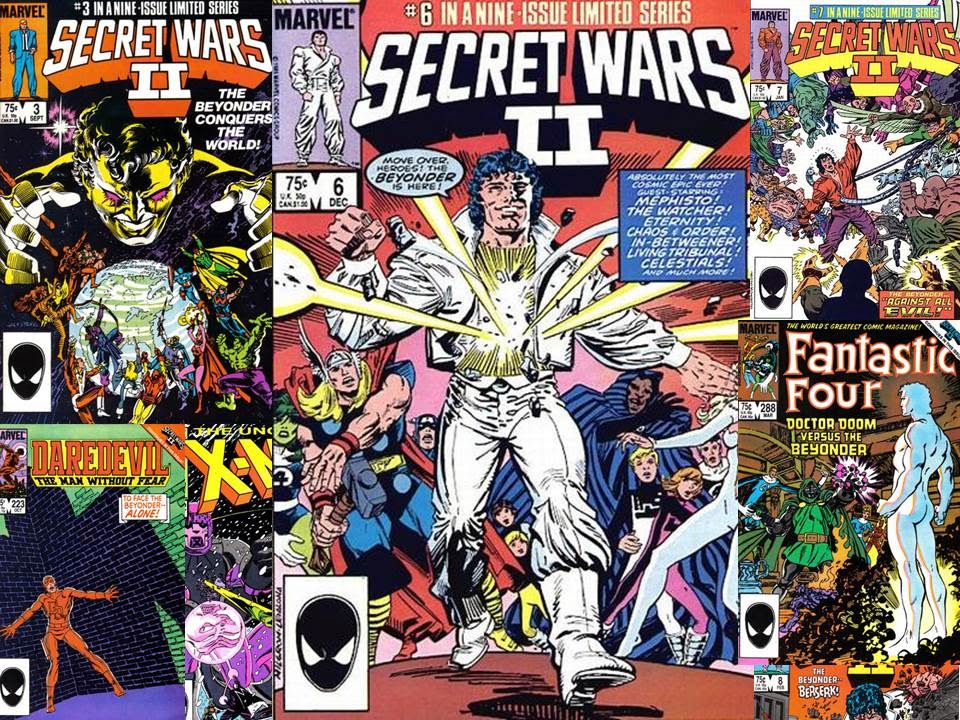
That was the question asked on the cover of Marvel Super Heroes Secret Wars #1 from May 1984 by Jim Shooter and Michael Zeck in the start of a twelve issue mini-series that would forever change Marvel Comics....

A Gathering


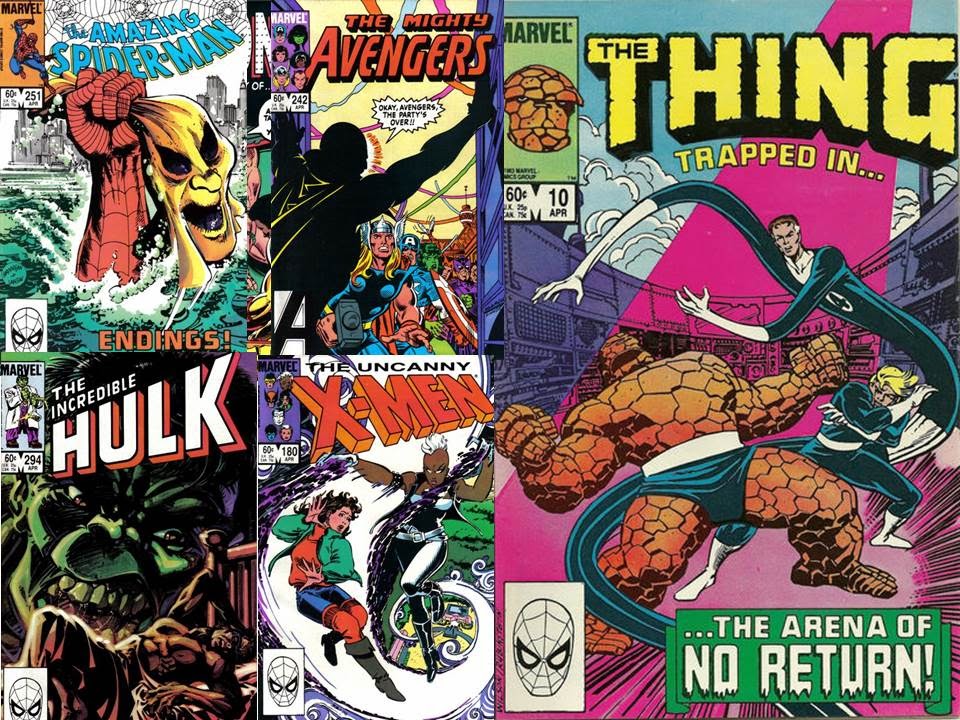
With the first issue (leading out from events of April, 1984's Amazing Spider-Man #251, Avengers #242, Captain America #292, Fantastic Four #264, Incredible Hulk #294, Iron Man #181, The Thing #10 and Uncanny X-Men #180), a representation of Earth's heroes found themselves on a satellite, listening to the Beyonder (an alien with supreme powers that had been observing the Earth for a time, and now brought a group to this place)....in order to form a Battleworld in which the opposing forces of good and evil would meet and determine which was more powerful.

The members of the Fantastic Four were the Thing, the Human Torch and Mr. Fantastic, the members of the Avengers were Captain America, Iron Man (James Rhodes, as Tony Stark had been having problems at the time), Thor, Wasp, Hawkeye, She-Hulk, Captain Marvel (Monica Rambeau, a lady with energy powers who had just recently joined the Avengers), and the X-Men (Professor X, Cyclops, Wolverine, Storm, Nightcrawler, Colossus and Rouge, with Spider-Man and the Hulk as single heroes...all set to battle against villains Dr. Doom, Magneto, Galactus, Dr. Octopus, Enchantress, Kang, the Lizard, Absorbing Man, the Wrecker and his Wrecking Crew (Thunderball, Piledriver, and Bulldozer), Ultron, Klaw and the Molecule Man.

A new hero came of out this with a new Spider-Woman (Julia Carpenter) in Marvel Super Heroes Secret Wars #7 (November, 1984), as well as a few new villains (Titania and Volcana from Marvel Super Heroes Secret Wars #3, July, 1984).  It also gave Spider-Man his "living suit" (which eventually became Venom, in Marvel Super Heroes Secret Wars #8, December, 1984).

The heroes and villains found other cities that the Beyonder had taken and combined to form his Battleworld (where the people they encountered came from), and all the while, Galactus planned to feed...and Dr. Doom schemed to come out on top of everyone.  Won't say how it all ended with Marvel Super Heroes Secret Wars #12 in April, 1985, but as we saw all the heroes return (more or less, other than the Thing, who stayed on the Battleworld for a time), but as there was still titles published at Marvel Comics (with changed heroes dealing what happened to themselves during the year long mini-series), the ending wasn't much of a spoiler to regular readers (and then there was another Secret Wars, Secret Wars II from July, 1985 to March, 1986 that brought the Beyonder to Earth, and directly crossed over with the Marvel titles of the time).

The Change


The change brought about by Marvel Super-Heroes Secret Wars involved an armor upgrade for Iron Man, a busted leg and badder attitude for the Hulk, roster changes for the Fantastic Four and the Avengers (as well as an eventual expansion of the Avengers, with Vision adding a west coast team), new costumes for the X-Men (and a new understanding of Magneto for a time), and the alien symbiote that would become Venom to menace Spider-Man (all mostly in their May, 1984 titles like Amazing Spider-Man #252, Avengers #243, Captain America #293, Fantastic Four #265, Incredible Hulk #295, Iron Man #182, The Thing #11 and Uncanny X-Men #181, and taking place between the pages of Thor #341).

But the biggest change of all was the loss of freedom that individual comics had to tell a story all their own, and a firmer editorial control and over-dependance of crossovers to drive sales of comics...taking away some of the innocence of those titles, as well as the ability to follow one comic by itself for any length of time.  This, going back to that battle of good vs. evil, and showing sadly that, in the end, it is greed and power that seems to win out, instead of the creative good.


Thursday, April 30, 2015

Avengers Ultron Unleashed

Back in August of 1999, Marvel Comics put out a collection of important Ultron stories under this beautiful cover by John Buscema and George Perez...

...who happened to do the art on the stories reprinted within....


...and here's a little on those stories all about the robotic foe of the Avengers!


The Early Days of Ultron


Ultron premiered in Avengers #54 (July, 1968), but wasn't seen as Ultron until Avengers #55 (August, 1968), working with the Masters of Evil, but this issue collects Avengers #57 (October, 1968) and Avengers #58 (November, 1968; all issues by Roy Thomas and John Buscema).  Within these pages,  the Vision is introduced, tries to join the Avengers, and kill them as well.  Vision revolts against Ultron's control, and along the way, we learn the origin of Ultron, how he was created by Hank Pym (Ant-Man/Giant-Man/Goliath...and more?).

Ultron Returns Again


Ultron did return multiple times, most notably in Avengers #162 (August, 1977), where he created Jocasta, who was meant to be his bride, and the second selection of stories in this collection are Avengers #170 (April, 1978) and Avengers #171 (May, 1978; all these stories by Jim Shooter and George Perez).  Ultron, like Frankenstein's Monster, just wanted someone to share his lonely existence with, and tried to create his own mate, Jocasta.  This didn't work out so well for Ultron, as he was stopped by the Scarlet Witch and her unpredictable mutant hex power.

Even More Than Ultron?


If you are unable to find the Avengers: Ultron Unleashed, and don't quite want to spend money on getting the actual issues, you can also find the earlier issues in Marvel Masterworks: The Avengers #6 (reprinting Avengers #51-58, Avengers Annual #2 and X-Men #45...a whole wonder of great stories, including Ultron's first appearance, the second Masters of Evil and a case of the Avengers vs. the X-Men!).

The second batch of issues are included in Avengers: The Korvac Saga, which includes Avengers #167, #168, and #170-177, which include folks like the original futuristic Guardians of the Galaxy, the Collector, the Kree Captain Marvel and more Avengers than you can shake a stick at as the team fights for universe against Korvac.

Avengers Assemble!


Thursday, April 9, 2015

Avengers History 202


Continuing our coverage of the Roy Thomas' years of Avengers chronicles, with Roy's biggest contributions to the team, the Vision and Ultron!


The Vision, a synthozoid (synthetic android) who can control his own density and fires a solar beam through a jewel on his forehead, meets the team in his first appearance of Avengers #57 (October 1968 art by John Buscema), and after a quick fight with the Avengers, reveals that Ultron built him to destroy them, but instead he helps the group to defeat Ultron.

Visions Of Things To Come


Vision joins the team in Avengers #58, (November 1968, drawn by John Buscema), where it is revealed that the Vision possesses the brain patterns of the supposedly dead Wonder Man (given to him by the evil Ultron), and that Hank Pym is the creator of Ultron! (Not the least of the secrets concerning the Vision, Wonder Man and Ultron, but the ones available to the Avengers at this time…).

The team plans to confront Goliath, but has to deal with Yellowjacket in Avengers #59, (December 1968, art by John Buscema) and Yellowjacket claims to have killed Goliath, and wants to be a member of the Avengers. Strangely, the team accepts this, and the Wasp even marries Yellowjacket in Avengers #60 (all the while fighting the Ringmaster and his Circus of Crime in January 1969 drawn by John Buscema)! Janet does this because she knows Yellowjacket is Hank Pym (aka Goliath)! Hank explains away his temporary insanity (and it is later revealed that the team was playing along with Hank to help him…still, when he returns to the team after a honeymoon with the Wasp, he keeps the identity of the Yellowjacket, which foreshadows the many identity problems that Hank Pym will have in the future. Some of the guests at the wedding who would be Avengers in the future made their first appearance in the Avengers title, including the Inhuman elemental Crystal, man without fear Daredevil and sorcerer supreme Dr. Strange (who also sticks around to help the newer Black Knight…but more on him in a bit).

New Big Man In Town


Change is afoot, as Hawkeye deals with a broken bowstring by adopting the identity of Goliath to save the Black Widow from the Puppet Master, Mad Thinker and old Ant-Man/Giant-Man foe, Egghead in Avengers #63, (April 1969, art by Gene Colan) where Clint Barton also keeps this new look and power as the new giant on the Avengers...


...but still has to deal with old problems (like the Swordsman, Ultron and Kang) as well as new (like the alien gaming Grandmaster and his distinguished creations, the Squadron Sinister – a team of villains composed of oddly familiar looking people – a strong flying alien Hyperion, speedster Whizzer and power-beam welding Dr. Spectrum and a dark knighted Nighthawk) who fight the Avengers over the period of Avengers #69-70, both drawn by Sal Buscema.

Enter A Dark Knight


With the problems of knights and swords, the Avengers take a new recruit as well, making the new Black Knight (Dane Whitman) an Avenger in Avengers #71. But, a little history on the Black Knight…Nathan Garrett was the Black Knight who was a Giant-Man foe in the Masters of Evil, and then, after a confrontation with Iron Man, had been fatally wounded. Garrett let his nephew know a little of the history of the Black Knight, and Dane tried to help the Avengers against Magneto, first as himself in Avengers #47, (December, 1967, art by John Buscema) then taking on the identity of the Black Knight in Avengers #48 (January 1968, art by George Tuska). Even if the Avengers knew Dane wasn’t a villain like his uncle, the world didn’t, and the Crimson Cowl tried to recruit him to his new Masters of Evil, which Dane helped to defeat as the Black Knight.

It is later revealed that the Black Knight is a long, noble tradition dating back through a lineage to the 12th century, defending the land against invaders, and after an encounter with the ghost of Sir Percy of Scandia (the original Black Knight, in Marvel Super-Heroes #17, November, 1968 by Roy Thomas and Howard Purcell), he proved worthy to draw the Ebony Blade (his own version of Excalibur) and gained that as a weapon, whose enchantments allowed him to help the Avengers (and Dr. Strange) in Avengers #61 (February 1969, art by John Buscema) against Asgardian villains Surtur and Ymir, and returned to aid the team in the battle of Kang and the Grandmaster, and led to the team taking him on in Avengers #71 (December, 1969, art by Sal Buscema, and, is it ironic that the team ends up in World War II again, and meets an early Captain America, the android Human Torch and Sub-Mariner, right when they are forming the Invaders? Cap deals with the Black Panther as they’ve met before though not yet, and Yellowjacket might be angry with Sub-Mariner since Namor took his Giant-Man spot in Tales To Astonish, but what is the relationship between Vision and the Human Torch?).


Still, the Avengers return home to more foes, facing the Zodiac (a team of technology enhanced mobsters based on astrological signs) finding out that Nick Fury hadn’t been killed by Scorpio, and meeting up with the Kree Captain Marvel for the first time, as well as reencountering Rick Jones in Avengers #72 (January 1970, art by Sal Buscema). The team then meet an alternate world barbarian named of Arkon from Polemachus (premiering in Avengers #75, drawn by John Buscema for April 1970) who was seduced by the Enchantress, and she also took an interest in the Black Knight – whose Ebony Blade was cursed, making him more violent and prone to rage). The eventual end of this encounter with Arkon (in Avengers #84, January, 1971, art by John Buscema) left Black Knight without his blade for a time, so he left the team for a time.


A new group of villains came into being to face the Avengers but its members were old foes.
They were called the Lethal Legion, and they first attacked the Avengers with Avengers #78 (July, 1970, with art by Sal Buscema), and their roster included the Swordsman, Power Man, the Living Laser, the Grim Reaper, and the Man-Ape (a foe of the Black Panther, who first appeared in Avengers #62, March, 1969, with art by John Buscema).

The Avengers stopped them in Avengers #79 (August 1970, drawn by John Buscema).

Plenty of Guests


The past comes alive again, as there is yet another legacy hero introduced, the current version of the Red Wolf, in Avengers #80. (September 1970, art by John Buscema).

With the help of Daredevil, they face the Zodiac again in Avengers #81-82.

The women get into the team-building act as the Valkyrie is introduced, and tries to form the Lady Liberators with the Wasp, the Scarlet Witch, the former Frightful Four member Inhuman Medusa, and still not Avenger Black Widow which all happens in Avengers #83 (December 1970, art by John Buscema). All this doesn’t happen as it’s a plot by the Enchantress, which leads to her fleeing to Arkon’s realm for a time.

With Avengers #85-86, we found out why the Squadron Sinister were so familiar…they were based on the Squadron Supreme…heroes from an alternate Earth that included the high-flying American Eagle, beam-welding Dr. Spectrum, their own archer named Hawkeye, his girl friend with a sonic cry Lady Lark, super-strong Hyperion, small scientist Tom Thumb, brooding dark crime-fighter Nighthawk and speedster the Whizzer. The team had to stop the evil Brain-Child from destroying their Earth. This sets the stage for a whole future of crisis between the Marvel Earth and the world of the Squadron Supreme, and also is where the Avengers will prepare for one of their larger battles…after a brief meeting with the Hulk in Avengers #88 (that also featured future Avenger and partner to Captain America, the high-flying Falcon, in his first Avengers appearance).

All this leading up to the most important battle in the lives of the Avengers (as well as everyone on Earth....coming soon!).

Wednesday, April 8, 2015

Avengers Opposite: More Masters of Evil

The Masters of Evil returned to face the Avengers with Avengers #54 (July, 1968) by Roy Thomas and John Buscema...

...and this cover by John Buscema.


What wonderful additional villains did they bring to face Earth's Mightiest Heroes?


A Speedy Foe


Whirlwind started out as the Human Top in Tales To Astonish #50 (December, 1963 by Stan Lee and Jack Kirby), fighting against Giant-Man and the Wasp!  David Cannon was a mutant with superhuman speed and a really bad attitude!


David returned to face the duo in Tales To Astonish #51, #55, #59, #68 and #69, and even was one of the many menaces at the wedding of Reed and Sue Richards in Fantastic Four Annual #3....soon after which, he upgraded his costume and became Whirlwind (starting in Avengers #46 in November, 1967 also by Thomas and Buscema)....continuing to mess with the Wasp and Hank Pym (in all his identities like Ant-Man, Goliath and Yellowjacket), as well as being a member of the Masters of Evil (and other villain groups, like the Lethal Legion).

Master of Sound


Klaw started out as a physicist who needed Vibranium to power his sound transducer, and the only place he could get it was in Black Panther's country of Wakanda.  So, in Fantastic Four #53 (November, 1966, by Stan Lee and Jack Kirby), Ulysses Klaw invaded the land a long time ago, but was held back...but, Klaw was wounded, losing his hand, and returned many years later, with a sonic blaster replacing his hand, and faced and lost to the Black Panther and the Fantastic Four (returning again in Fantastic Four #56, this time as a man made of sound...except for his sonic blaster hand).

Klaw joined the Masters of Evil right after that encounter, and returned again and again, facing the Avengers, the Fantastic Four, and even Ka-Zar and the Dazzler as well, before being recruited the Beyonder for the Marvel Super Heroes Secret Wars (working with other Masters of Evil like the Enchantress and later members like Absorbing Man, Titania and the Wrecking Crew), and returning to Earth, and fought the Black Panther again as well, and even joined the foes of the Fantastic Four in the Frightful Four.

Old Favorites


Radioactive Man and the Melter returned to the group as well...


...and they had been charter members of the team, returning to face off against the Avengers again...as they would do in the future!


A Spy In The Ranks


Black Knight was Dane Whitman, who took over from the original Masters of Evil's original Black Knight...


...but he was really a hero, and ended up helping out the Avengers against the villains, and their mysterious leader....


The New Leader


...would you believe it was the Avengers' butler, Jarvis?  You shouldn't, because it really wasn't (but it wasn't Baron Zemo either....).  Underneath the cowl of the Crimson Cowl was Jarvis, but he was really just a hypnotized pawn of the real villain, Ultron!

Ultron was created by Hank Pym, endowed with a copy of his brainwaves (which, as Hank's size-changing was making him more unstable meant that the robot was likewise mentally unbalanced), Ultron hypnotized Hank into forgetting he created the robot....and went about planning to attack the human race.  Ultron failed with his gathering of Avengers villains, but soon returned, creating the Vision to infiltrate the team (getting help from the Grim Reaper so he could give the Vision Wonder Man's brainwave patterns, and getting the body of the original android Human Torch from Fantastic Four foe, the Mad Thinker), Ultron continued his attack against the super-hero team (but was betrayed by the Vision).

Ultron has come back many times over the years, facing the Fantastic Four as well, and looking for a bride of his own (creating the android Jocasta).  Ultron was even a part of the Marvel Super Heroes Secret Wars, wherein he was used as a pawn by Dr. Doom...but he returned again as a villain in his own right, being a true menace to the Avengers and the entire human race every time he comes back!


Thursday, March 12, 2015

Avengers History 201

Welcome back to our continuing Avengers coverage!

Picking up where we left off, we start with Avengers #35 (December 1966, art by Don Heck) and, welcome aboard Roy Thomas, as the new writer of the team, taking over for Stan Lee. This is the beginning of a more advanced Avengers run, so we’ll be moving through a little more quickly, and taking advantage of the rich history of the team and how much more connected the Avengers universe becomes.

Carrying A Heavy Load


The team proceeded along as usual, finishing their battle against the Living Laser, and fighting the invading robots called the Ultroids (over the course of issues #36 and 37, until meeting up with a demi-god in Avengers #38 (March 1967) and this was a different demi-god than the mighty Thor, who had been a member!). Though, oddly enough, that’s where he got his start.


Yes, Hercules began his legendary journeys (for mighty Marvel) in Journey Into Mystery Annual #1 (1965, by Stan Lee and Jack Kirby), then the son of Zeus continued his battles with Thor in his own magazine for a time, as well as his own Olympian father, Zeus (himself no stranger to using lightning as a weapon, not unlike Thor), and the Olympian lord of the underworld, Pluto (as Hercules tried to take Hollywood and got into a bad contract that his friend Thor helped him out with…ironic, as Hercules wasn’t to be in the Thor movie, or the Avengers movie…), before becoming a guest of the Avengers after a battle with the Enchantress, who wasn’t above using strong men in attempts to defeat the team.


The Avengers kept this super-strong demi-god busy for a while (fighting the Hulk in Tales To Astonish #79, Fantastic Four foes like the Mad Thinker in #39, Sub-Mariner in #40, Diablo and the Dragon Man in #41 and 42, meeting Black Widow along the way, who was having commitment issues with Hawkeye and the Red Guardian – a Russian version of Captain America - and she didn’t join the Avengers at this time in #43 and 44.

The Avengers faced a team of Avengers villains including former Avenger, the Swordsman, and the Enchantress and her two other strong men, Power Man and the Executioner, in their first Annual) before finally letting him join the team in Avengers #45 (October 1967, drawn by Don Heck, while facing the Super-Adaptoid, who had previously only menaced Captain America in Tales of Suspense). The team deals with Magneto in Avengers #47 and 49, and a few other problems like the Black Knight in Avengers #48 as well.


Hercules didn’t stick around long, leaving soon after a confrontation with the titan Typhon in Avengers #50 (March 1968, drawn by John Buscema, and Typhon first appeared in Avengers #49, also by John, though not on the cover) …and disappeared for a while after that as well. Over the years, Hercules would wander back to the team (usually to fight an Olympian menace like Ares, Herc’s half-brother and the god of war) and leave the Avengers for a time, meet up with Thor and help the son of Odin, co-founded the Champions (with Black Widow, Ghost Rider, Angel and Iceman) to combat Pluto, and just be the great Greek almost-god that he was living the life in Hollywood, and even recently became strong enough to carry his own title, the Incredible Hercules! True, Hercules has had difficulties over the years, but he’s always fought back!

African Royalty


But, with Hercules leaving, the team needed a new member, and were lucky enough to find one in the acrobatic Black Panther. T’Challa started out in Fantastic Four #52 (July 1966, by Stan Lee and Jack Kirby), and he was the chieftain of the land of Wakanda, a technologically advanced nation in Africa that controls the world’s supply of vibranium (a metal which absorbs vibrations). After testing himself against the FF, they aid him in his battle with Ulysses Klaw, the man who killed T’Chaka, the Panther’s father. T’Challa defeats Klaw, who returns as a being of sound thanks to his mechanical hand in Fantastic Four #56. (November 1966, by Lee and Kirby). After aiding the Fantastic Four and the Inhumans in a battle with the emotion-manipulating Psycho Man in Fantastic Four Annual #5, (November 1967, by Lee and Kirby) Black Panther goes to meet Captain America in Tales of Suspense #97-99 (1968) and Captain America #100 (April 1968, all by Lee and Kirby), as together, they battle the forces of Baron Zemo.


When the king and the super-soldier defeat the faux Zemo, Cap suggests that the Avengers take Black Panther as a member in Avengers #51 (April 1968, art by John Buscema) and T’Challa joins the team in Avengers #52 (May 1968, drawn by John Buscema) where the team needs the help against the Grim Reaper – a foe just introduced, but with ties to the Avengers’ past, he’s the brother of Simon Williams/Wonder Man (whom the Avengers haven’t dealt with since his “death” at the hands of the Masters of Evil), who holds the Avengers responsible for Wonder Man’s death. The Grim Reaper is the first of many villains that are introduced at this time that will come back to be a constant menace to the Avengers, no matter what their membership.


After a quick battle with the X-Men in X-Men #45 and Avengers #53, the new Avengers face a new Masters of Evil in Avengers #54-55, that includes some of the original members like the Melter and Radioactive Man, plus Black Panther foe Klaw and Whirlwind (formerly the Giant-Man & Wasp foe, the Human Top, who changed his name to Whirlwind when he returned in Avengers #46 to combat Goliath), a new Black Knight (Dane Whitman, the nephew of Nathan Garrett of the original Masters of Evil, who died after sustaining injuries fighting Iron Man…and as the Avengers found out in Avengers #48, was not villainous) and mystery villain, the Crimson Cowl, who is really the robotic Ultron (making his first appearance in Avengers #54, July, 1968 drawn by John Buscema). Ultron is like the Energizer Bunny, he just keeps going!


The coming of Ultron…leads into the induction of the next two Avengers, and their creation as well, which the team deals with after getting a little more information on Cap’s past and how he came to be frozen in Avengers #56, (September 1968, art by John Buscema) and dealing with the time-traveling Scarlet Centurion (yes, he’s an alternate Kang too and comes back as a menace to another alternate world) and alternate versions the early Avengers in Avengers Annual #2 (1968). This is an early example of the Avengers traveling to alternate dimensions and through time…something they will continue to do, even recruiting from those places…and time is something that will reveal more about the next Avenger as well....and we'll have more on them soon!

Though Black Panther didn't leave the Avengers for a while, it take a little time for him to get his own series, first in Jungle Action (from issues #5 to #24), then his first own series that lasted 15 issues from January, 1977 to May, 1979 (finally ending in Marvel Premiere #51 to #53), and back to working with the Fantastic Four, and having a few mini-series, and then a 62 issue series from November, 1998 to September, 2003 and another regular series lasting 41 issues from April, 2005 to November, 2008 that involves him with the X-Men and Fantastic Four as well as the Avengers and the Civil War!