Showing posts with label Galactus. Show all posts

Friday, July 25, 2025

The Fantastic Four

A little difficult to sum up the Fantastic Four in any one volume, so, here, a reprint from Simon and Schuster from 1979, with a cover by Bob Larkin, and some extra interior words by Stan Lee, featuring stories from Fantastic Four #4 (cover by Jack Kirby and Sol Brodsky) with Sub-Mariner, #48-50 (covers by Jack Kirby and Joe Sinnott) with Silver Surfer and Galactus, and #86 (cover only) and #87 (covers by Jack Kirby and Joe Sinnott) featuring Doctor Doom.


Fantastic Four #4 and #48 (May, 1962 and March, 1966)

.


Fantastic Four #49 and #50 (April and May, 1966)

.

Fantastic Four #86 and #87 (May and June, 1969)

.


Thursday, April 26, 2018

Darkseid Meets Marvel

Jack Kirby created some of the most important concepts for Marvel Comics, such as the Fantastic Four, Silver Surfer and the X-Men, along with their friends and foes. 

"The King" also created Darkseid, one of the vilest villains of the DC Universe, the ruler of the planet of Apokolips, the evil side of the New Gods.

Seems like those heroes should protect us from that fearsome foe, but they weren't in the same universes....

...or, were they?

Two special comics show they could reach each other....


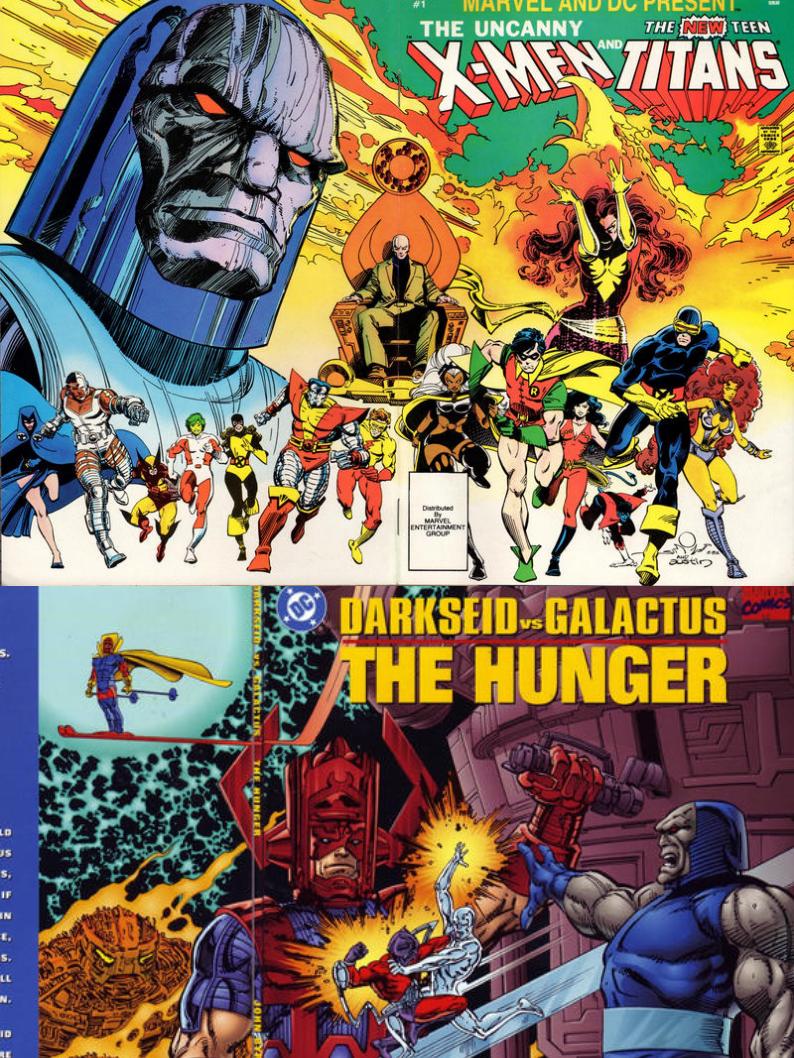
Marvel and DC Present #1

In Marvel and DC Present Featuring The Uncanny X-Men and The New Teen Titans #1  (1982), the two teams of heroes seem to exist on the same world, and face the menace of Darkseid as he tries to revive the power of the Dark Phoenix in "Apokolips...Now" by Chris Claremont, Walt Simonson and Terry Austin.

Darkseid plans to breach the Source Wall and to do that, tries to collect the memories of the Dark Phoenix from the X-Men, but while doing that, it also alerts the Titans' psychic, Raven, to have visions of a fiery bird, which her alien team mate of Starfire recognizes as the Dark Phoenix.  Deathstroke the Terminator is there to prevent trouble in case the X-Men retaliate, and has a battle with Wolverine (at the time, two of the greatest fighters of their respective universes, but in one universe here).  Professor X even makes use of Metron's Mobius Chair, and after the Dark Phoenix is  revived, the two teams work together (called collectively the X-Titans, showing a little favoritism to the Marvel heroes, as their regular writer did script this tale) to stop Darkseid's plan.

An ambitious story, made all the more enjoyable that it was all done in one issue, as were most of the team-ups between DC and Marvel characters in the day, such as the two Superman/Spider-Man tales and one Batman/Hulk tale, but this tale also signaled the end of the company crossovers for a time. 


Darkseid Vs. Galactus: The Hunger

Many years later, Darkseid faced off against the world-eater of Galactus in Darkseid Vs. Galactus: The Hunger (1995) by John Byrne, as DC and Marvel brought back their intercompany team-ups.

Here most of the battles are between the subordinates of the main villains, as Galactus plans to eat Apokolips, with Silver Surfer facing off against Darkseid's Para-Demons, as well as the New Genesis warrior of Orion, as well as covering the origins of Galactus, the Silver Surfer and the founding of the two worlds of New Genesis and Apokolips.  Galactus does indeed finally land on Apokolips, only to find the planet devoid of life, and thus useless to the eater of worlds, though Darkseid fought tooth and nail to keep this worthless garden, simply because it was his.

The Big Two Crossovers 

Darkseid had a small role in the DC Vs. Marvel mini-series of 1996, where he confronted the evil Thanos (worshiper of Death), and likely the result of that battle was shown in JLA Vs. Avengers (2003 and 2004), where Darkseid showed off a new accessory a bejeweled glove (the Infinity Gauntlet), which, the Lord of Apokolips was unable to use (likely due to the fact that its infinite power was only that in the Marvel Universe, not in the DC Universe).

Thursday, May 7, 2015

Marvel Super-Heroes Secret Wars

"Can the combined might of Earth's most powerful heroes defeat the ultimate menace?"


That was the question asked on the cover of Marvel Super Heroes Secret Wars #1 from May 1984 by Jim Shooter and Michael Zeck in the start of a twelve issue mini-series that would forever change Marvel Comics....

A Gathering


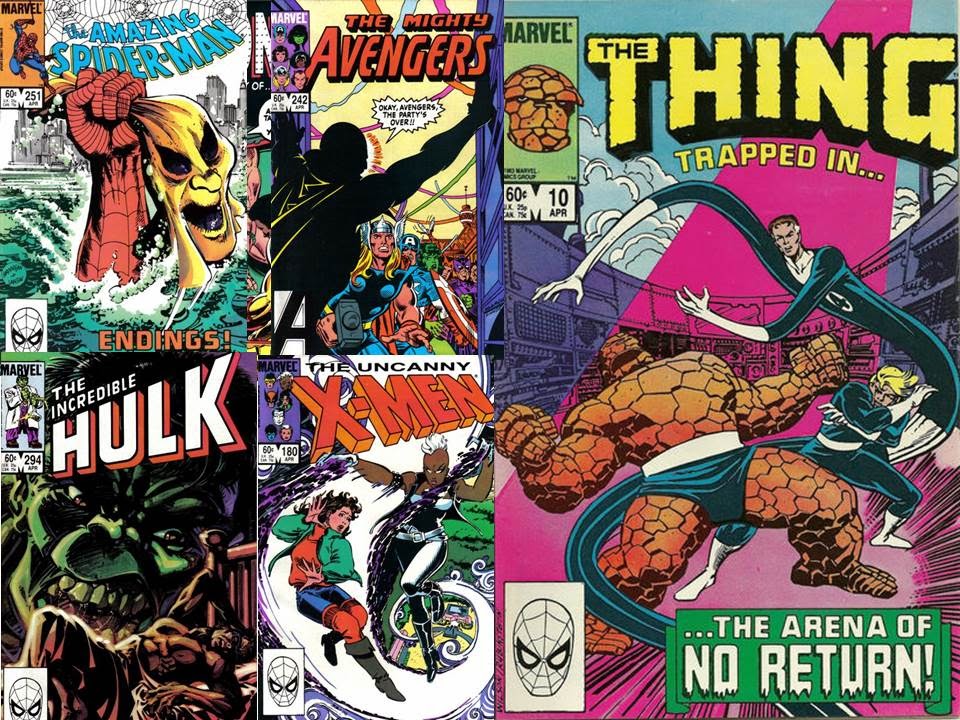
With the first issue (leading out from events of April, 1984's Amazing Spider-Man #251, Avengers #242, Captain America #292, Fantastic Four #264, Incredible Hulk #294, Iron Man #181, The Thing #10 and Uncanny X-Men #180), a representation of Earth's heroes found themselves on a satellite, listening to the Beyonder (an alien with supreme powers that had been observing the Earth for a time, and now brought a group to this place)....in order to form a Battleworld in which the opposing forces of good and evil would meet and determine which was more powerful.

The members of the Fantastic Four were the Thing, the Human Torch and Mr. Fantastic, the members of the Avengers were Captain America, Iron Man (James Rhodes, as Tony Stark had been having problems at the time), Thor, Wasp, Hawkeye, She-Hulk, Captain Marvel (Monica Rambeau, a lady with energy powers who had just recently joined the Avengers), and the X-Men (Professor X, Cyclops, Wolverine, Storm, Nightcrawler, Colossus and Rouge, with Spider-Man and the Hulk as single heroes...all set to battle against villains Dr. Doom, Magneto, Galactus, Dr. Octopus, Enchantress, Kang, the Lizard, Absorbing Man, the Wrecker and his Wrecking Crew (Thunderball, Piledriver, and Bulldozer), Ultron, Klaw and the Molecule Man.

A new hero came of out this with a new Spider-Woman (Julia Carpenter) in Marvel Super Heroes Secret Wars #7 (November, 1984), as well as a few new villains (Titania and Volcana from Marvel Super Heroes Secret Wars #3, July, 1984).  It also gave Spider-Man his "living suit" (which eventually became Venom, in Marvel Super Heroes Secret Wars #8, December, 1984).

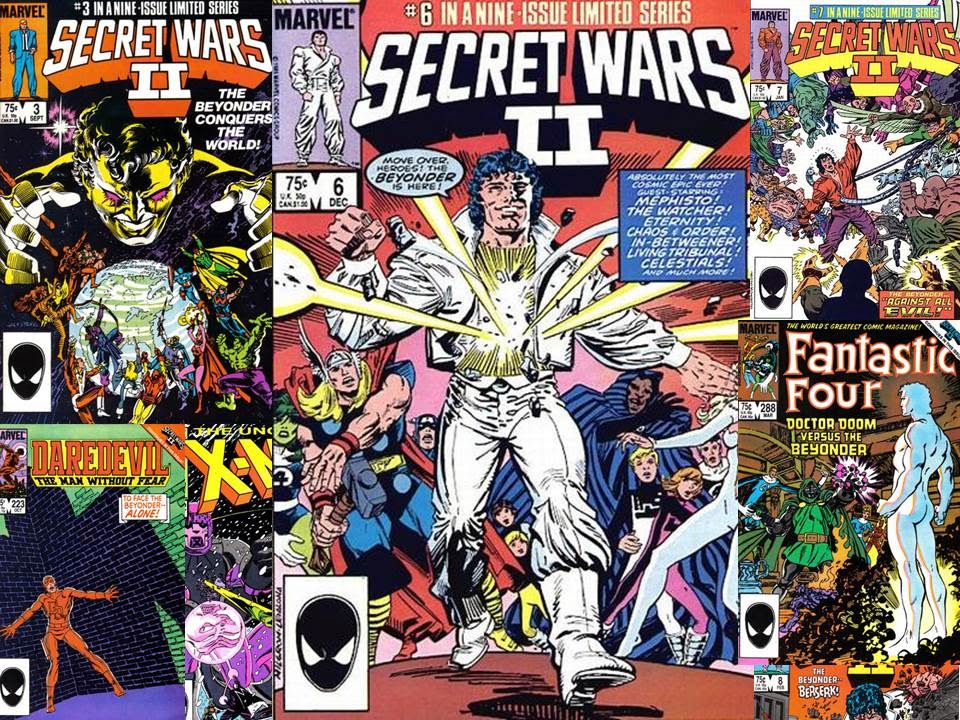
The heroes and villains found other cities that the Beyonder had taken and combined to form his Battleworld (where the people they encountered came from), and all the while, Galactus planned to feed...and Dr. Doom schemed to come out on top of everyone.  Won't say how it all ended with Marvel Super Heroes Secret Wars #12 in April, 1985, but as we saw all the heroes return (more or less, other than the Thing, who stayed on the Battleworld for a time), but as there was still titles published at Marvel Comics (with changed heroes dealing what happened to themselves during the year long mini-series), the ending wasn't much of a spoiler to regular readers (and then there was another Secret Wars, Secret Wars II from July, 1985 to March, 1986 that brought the Beyonder to Earth, and directly crossed over with the Marvel titles of the time).

The Change


The change brought about by Marvel Super-Heroes Secret Wars involved an armor upgrade for Iron Man, a busted leg and badder attitude for the Hulk, roster changes for the Fantastic Four and the Avengers (as well as an eventual expansion of the Avengers, with Vision adding a west coast team), new costumes for the X-Men (and a new understanding of Magneto for a time), and the alien symbiote that would become Venom to menace Spider-Man (all mostly in their May, 1984 titles like Amazing Spider-Man #252, Avengers #243, Captain America #293, Fantastic Four #265, Incredible Hulk #295, Iron Man #182, The Thing #11 and Uncanny X-Men #181, and taking place between the pages of Thor #341).

But the biggest change of all was the loss of freedom that individual comics had to tell a story all their own, and a firmer editorial control and over-dependance of crossovers to drive sales of comics...taking away some of the innocence of those titles, as well as the ability to follow one comic by itself for any length of time.  This, going back to that battle of good vs. evil, and showing sadly that, in the end, it is greed and power that seems to win out, instead of the creative good.