Showing posts with label Black Panther. Show all posts

Monday, June 27, 2016

Marvel Legends 2016 Wave 3 3 and 3 Quarters

Technically, it is more Marvel Legends 2016 Wave 2 and a half, as half this group we've seen before!


This wave includes Spider-Man foes of the living vampire, Morbius and water elemental, Hydro-Man, as well as a more modern look for the mutant X-Men, Rogue, as well as a later look of Avenger, Quasar...all in glorious 3 and 3/4 plastic, as only Hasbro and Marvel can do!


The fellows we've seen before include Black Panther, original armor Iron Man (both from Wave 1), and Spider-Man in two different costume variants (one from Wave 1 and one from Wave 2 of 2016).  At least you'll be able to find a Spider-Man and a Black Panther figure in the aisles when the Black Panther and Spider-Man movies come out!


Thursday, April 21, 2016

Spider-Man Teams With Black Panther and the Falcon

Spidey has met plenty of Avengers over the years, but some of them, he met when they were not part of the team.

Spider-Man met Black Panther when he was away from the Avengers for a time, and Falcon when he was just working with Captain America, before he joined the Avengers.

Let's take a look at these high-flying team-ups!

With Practice

How do dinosaurs end up on Broadway?  Well, that question is answered in Marvel Team-Up #20 (April, 1974) with "Dinosaurs On Broadway" by writer Len Wein, penciller Sal Buscema and inkers Frank Giacoia and Mike Esposito.

Picking up from the previous issue, where Spider-Man and Ka-Zar fought the new villain, Stergon the Dinosaur Man, Spidey hitched a ride from the Savage Land aboard Stergon's flying ship full of dinosaurs!  Black Panther gets involved thanks to the Avengers' butler, Jarvis, and has to help Spidey with this new menace to Manhattan.  Interesting that Marvel Team-Up could have stories over multiple issues, but not carry the guest star over (but Ka-Zar had his own new mag to get back to, with Shanna the She-Devil!).  Even more interesting is how Spider-Man and Black Panther handled all these dinosaurs on their own (and then T'Challa could spend his time in his book, Jungle Action!). 

Elements Change

"All That Glitters Is Not Gold" is the lesson of Marvel Team-Up #30 (February, 1975) by writer Gerry Conway, penciller Jim Mooney and inker Vince Colletta, with Spidey coming to the rescue of fellow Daily Bugle worker, Glory Grant, and her cousin, who has now joined a gang (but seems to be under mind control).  Spidey checks it out, while Glory calls on Sam Wilson (Falcon's alter ego) for help (Falcon had a little free time, as his usual partner, Steve Rogers, had briefly given up being Captain America and was in action as Nomad at this time).


The two heroes end up meeting, and then facing the menace of the man called Midas (it says so right on the cover blurb!).  Spider-Man and the Falcon were able to uncover his identity and put an end to his drug trafficking....


People Wither

Falcon comes to help Captain America when he calls, only to find his partner dying from a poison orchid in "Deathgarden" in Marvel Team-Up #71 (July, 1978) by writer Bill Kunkel, penciller Al Wenzel and inker Dan Green.  Nick Fury and the agents of S.H.I.E.L.D. were able to take Cap to a S.H.I.E.L.D. medical facility, but Falcon takes the lead to track down the poison and save Captain America!  Spider-Man happens to be stopping a robbery at a government facility that Falcon is checking out, and the two heroes end up battling for a bit, then team up, finding out that if it was a plant that was killing Cap, the likely villain behind it was the Plant-Man!


Falcon and Spider-Man work together to stop the villain (with Falcon using new moves like using his wings as a shield), and bring the cure to save Captain America (though Falcon and Captain America would soon give up their regular partnership, though Falcon meets up with the Defenders soon after this, then briefly joins the Avengers soon after that), with Nick Fury privately thanking Spidey for his help in this case.


Friends Change

Peter Parker is on assignment for the Daily Bugle, covering businessman Thomas Agar's preliminary hearing (for his company taking over half a million from the country of Wakanda), when Black Panther attacks in Marvel Team-Up #87 (November, 1979) in "The Razor's Edge!" by writer Steven Grant, penciller Gene Colan and inker Frank Springer.


Very quickly it is discovered that it wasn't Black Panther on the rampage, but a villain called Hellrazor, all a part of a plot to make T'Challa look evil and get access to the Wakandan vibranium (a special metal that is only found in the African country that Black Panther rules) for the evil Roxxon Corporation.  Spidey and Black Panther team-up to defeat Hellrazor, never quite getting a full hint of Roxxon's involvement in this case, with Spidey going back to his normal life, and Black Panther enjoying his visit with the Avengers after being reunited with them thanks to the Collector's plans to thwart Korvac.


It All Comes Together

Spidey tries to enjoy some time off as Peter Parker, but Aunt May ends up a victim of crime, pulled off by the Young Watchers, a vigilante group that supposedly protects people in Marvel Team-Up #114 (February, 1982) in "The Heat In Harlem!" by writer J.M. DeMatteis, penciller (and co-plotter) Herb Trimpe, and inker Mike Esposito.

Falcon had recently quit the Avengers, and was only occasionally working with Captain America at this point,  so this was a rare chance to see Falcon in action.  This time around, Spidey and Falcon faced off against Stone-Face, a foe Spidey, Cap and Falcon faced in Harlem (see Captain America issues in the mid-130s), then Falcon and Black Panther faced him again in Captain America #170 and #171.  Spidey and Falcon take care of business yet again here, with Falcon getting his own mini-series soon after!

That concludes our business of looking at Spider-Man's team-ups with these two Avengers, but there are more to come!

Saturday, January 16, 2016

Marvel Legends 2016 Wave 1 3 and 3 Quarters

Yes, the folks at Hasbro have changed the name of their 3 and 3/4 sized Marvel figures (making the name the same as their 6 inchers...no, this won't cause  any problems at retail), but you still get the same action figure goodness!


This time around, starting off the new year with a House of M Spider-Man, a Spider-Man Noir version, Captain Marvel (the former Ms. Marvel, Carol Danvers, version), Thor troll villain Ulik, Black Panther, Mark I Iron Man, aquatic Inhuman Triton, and bow-slinging member of the Guardians of the Galaxy....Yondu!

All but House of M Spidey and Black Panther are new, so plenty of new adventures your little guys can get into!

Wednesday, August 5, 2015

Why Marvel Needs the Fantastic Four

The Fantastic Four...

...the super-strong monster Thing (Benjamin J. Grimm), leader and elastic in mind and body Mr. Fantastic (Reed Richards), the fiery Human Torch (Johnny Storm) and the hard to see Invisible Girl (Sue Storm, later Sue Richards).  Four friends who premiered in Fantastic Four #1 (November, 1961 by Stan Lee and Jack Kirby).

At one point, this was considered to be the start of the Marvel Universe...

....the original X-Men were created "in the sensational Fantastic Four style" and the Avengers formed when Rick Jones' call for help with the Hulk to the FF was redirected to Iron Man, Ant-Man, Wasp and Thor!

The Fantastic Four had met the Hulk and Ant-Man before the Avengers even formed, and when Spider-Man was looking for money, he went to try to join the Fantastic Four!

Friends of the Fantastic Four


The Inhumans slowly worked their way into the life of the Fantastic Four...starting with Medusa (as a member of the Frightful Four, along with the Wizard, Paste-Pot Pete and the Sandman, in Fantastic Four #36 in March, 1965 by Stan Lee and Jack Kirby), then followed by Gorgon in Fantastic Four #44 (November, 1965, also by Stan and Jack), and the whole royal family of Inhumans (including leader Black Bolt, Karnak, Triton and Crystal) in Fantastic Four #45 (December, 1965 also by Lee and Kirby).

The Inhumans were a race of humans modified by exposure to the Terrigen Mists to have powers and abilities far beyond those of normal humans, and they lived apart from humanity in their city of Attilan.  The Inhumans saga slowly evolved over issues of the Fantastic Four, with the lovely Crystal being the object of affection of the Human Torch...(and Crystal becoming a member of the Fantastic Four for a time, when Sue had to take maternity leave after the birth of her and Reed's son, Franklin...starting in Fantastic Four #81 of December, 1968).

But, the Inhumans couldn't be contained to one book...having their history explored in Thor and elsewhere, and graduating to a few series of their own, like a 10 issue run in Amazing Adventures #1 to #10 from August, 1970 to January, 1972, to their first self-titled series with the Inhumans #1 to #12 from October, 1975, to August, 1977 and oh so many more!

The Inhumans worked with Black Panther as well, another friend of the FF, who premiered in Fantastic Four #52 (July, 1966 by Lee and Kirby again).  T'Challa was a prince of the African nation of Wakanda, the home of the unique metal of vibranium...and he wished to prove his meddle against the Fantastic Four, and did!  Black Panther became a quick ally of the team when Klaw killed T'Challa's father, T'Chaka (Fantastic Four #53, August, 1966).

Black Panther worked with the FF against a few foes quickly, ending with Psycho Man in Fantastic Four Annual #5 (November, 1967)...before moving on, meeting Captain America and soon joining the Avengers!

Black Panther worked with the Avengers for a time, but graduated to his own series as well, first in Jungle Action from issues #5 to #24 (July, 1973 to November, 1976), and then in the first of his own series, Black Panther, starting with issue #1 in January, 1977, lasting until issue #15, in May, 1979...

...oddly, with both those series ending elsewhere...and the Black Panther getting more series as well...

Foes of the Fantastic Four


An early foe of the Fantastic Four was the Sub-Mariner...and Namor was a foe of the whole human race!  Starting with Fantastic Four #4 (May, 1962), when Johnny Storm found a derelict in a homeless shelter...and cleaned him up to realize he was Namor, the Sub-Mariner!  Namor thought he lost his city of Atlantis, and vowed to take revenge on the human race (though being a threat to the family of the Fantastic Four as well, as he had intentions toward the Invisible Girl as well...much to the annoyance of her beau, Mr. Fantastic!).  Namor used his aquatic powers in a few early battles with the FF, culminating in Fantastic Four Annual #1 (September, 1963), when Namor found out that his people were still alive! 

But, that wasn't the end of Namor's tale...or the trouble he would cause the Fantastic Four, in more ways than one.  While battling the FF (and soon after, the Avengers, with the Hulk, no less), the Sub-Mariner also freed Captain America from his prison in ice (allowing Cap to join the Avengers!).

With Cap and Namor now active, it was realized that the Fantastic Four weren't the start of the Marvel Universe (and there was a whole history of Marvel characters from before, with Timely Comics, where Sub-Mariner and Captain America had comics, along with a different android Human Torch!).

All this didn't stop Namor from going on, taking the shared spot with the Hulk away from Giant-Man in Tales to Astonish (from issues #70, August, 1965 to #101, March, 1968, though Namor's last cover was Tales To Astonish #100 of February, 1968) and getting the first of his post meeting with the Fantastic Four starting with Sub-Mariner #1 in May, 1968, lasting until Sub-Mariner #72 September, 1974...

...with Namor's creator, Bill Everett coming back to do work on more than a few issues of Tales to Astonish (#85-91, #94-96) and Sub-Mariner (#50-55, and parts of #58-60), ending his association with Sub-Mariner #61 (May, 1973), which he died before completing more than 3 pages (with the rest of issue being finished by writer Steve Gerber, artist Win Mortiner and inker Jim Mooney).

But, Namor wasn't without a title for long, ending up in one with fellow Fantastic Four foe, Dr. Doom (that of Super-Villain Team-Up).
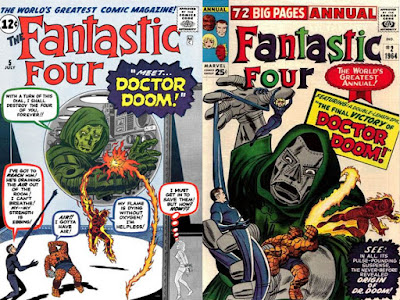
But, Dr. Doom existed before that series started...facing off against the Fantastic Four in Fantastic Four #5 (July, 1962, by Stan Lee and Jack Kirby), and had been a thorn in the lives of the Fantastic Four even before they went on their voyage to space and received their powers.

Victor von Doom was a college classmate of Reed Richards and Ben Grimm, who was annoyed by Reed's being a better scientist than Doom.  After an accident in the lab where he was working (which Reed tried to warn him about), Doom left the university, to head to Tibet, making his armor and then going to home to Latveria to take that country over (all from Fantastic Four Annual #2, September, 1964).

Dr. Doom also made the rounds, working with other villains like the Sub-Mariner (in Fantastic Four #6 in September, 1962), and even facing other members of the Marvel Universe, like Spider-Man (in Amazing Spider-Man #5 in October, 1963) and the Avengers (starting with Avengers #24-25, January-February, 1966 or earlier, as later reports came in)!

Dr. Doom's first solo tale came with Marvel Super-Heroes #20 (May, 1969), with Doom having to take on fellow Fantastic Four foe, El Diablo, who had tried to influence Doom by taking Valeria (the love of Doom's life)...

...but you can read more on this here, with the title becoming mostly reprints after his appearance, Dr. Doom DID defeat the Marvel super-heroes!

Still, Dr. Doom continued on, getting his own series (with Ka-Zar), which lasted for 8 issues in Astonishing Tales (#1 to #8, August, 1970 to October, 1971), where Doom faced Prince Rudolfo, the Doomsman,  the Faceless One (Astonishing Tales #1 to #3), Red Skull (Astonishing Tales #4 and #5), Black Panther (Astonishing Tales #6 and #7, trying to get at Wakanda's vibranium), and even "Satan" in Astonishing Tales #8 (where Doom tries to save the soul of his mother, Cynthia)!  

Doom tried another series as well, with Namor, the Sub-Mariner, starting with 2 issues of Giant-Size Super-Villain Team-Up (in  March and  June, 1975), and then continuing for 14 new issues with Super-Villain Team-Up starting in August, 1975 (though Namor took off with Super-Villain Team-Up #13, and X-Men foe Magneto and odd super-group the Champions were the guest of Super-Villain Team-Up #14 in October, 1977, and a reprint of the two Astonishing Tales battles with the Red Skull filled Super-Villain Team-Up #15 in November, 1978).

All this villainy, where can heroes turn?

Family


Everyone is a part of the Fantastic Four family, from Inhumans like Crystal and Medusa, to Heroes for Hire like Luke Cage, She-Hulk and Ant-Man...that was the charm of the Fantastic Four....it was a party, and everyone was invited!  

The family was the core of what made the Fantastic Four such an important part of the readers lives...and, by extension, made the whole of the Marvel Universe part of our family as well.

Wednesday, May 20, 2015

Goodbye David Letterman and Avengers Assemble

Did you know that late night talk show host David Letterman appeared in an issue of the Avengers?

Well, he did!

It was Avengers #239 in January, 1984!


Written by Roger Stern, with art and cover by Al Milgrom, Dave and Paul Shafer got to deal with a contingent of Avengers (including Hawkeye, Beast, Black Widow, Black Panther and sometime actor and stuntman Wonder Man).

This was a part of Marvel's Assistant Editor's Month, where weird and wacky things happened in all the Marvel titles, and Hawkeye was dealing with his new deafness (and new bride, Mockingbird aka Bobbi Morse!), and Dave had to take a hand in defeating the villain of the piece...the dreaded Fabian Stankowicz!

What's next, movie star Spider-Man on Saturday Night Live?  Well, that actually already happened....


Thursday, March 12, 2015

Avengers History 201

Welcome back to our continuing Avengers coverage!

Picking up where we left off, we start with Avengers #35 (December 1966, art by Don Heck) and, welcome aboard Roy Thomas, as the new writer of the team, taking over for Stan Lee. This is the beginning of a more advanced Avengers run, so we’ll be moving through a little more quickly, and taking advantage of the rich history of the team and how much more connected the Avengers universe becomes.

Carrying A Heavy Load


The team proceeded along as usual, finishing their battle against the Living Laser, and fighting the invading robots called the Ultroids (over the course of issues #36 and 37, until meeting up with a demi-god in Avengers #38 (March 1967) and this was a different demi-god than the mighty Thor, who had been a member!). Though, oddly enough, that’s where he got his start.


Yes, Hercules began his legendary journeys (for mighty Marvel) in Journey Into Mystery Annual #1 (1965, by Stan Lee and Jack Kirby), then the son of Zeus continued his battles with Thor in his own magazine for a time, as well as his own Olympian father, Zeus (himself no stranger to using lightning as a weapon, not unlike Thor), and the Olympian lord of the underworld, Pluto (as Hercules tried to take Hollywood and got into a bad contract that his friend Thor helped him out with…ironic, as Hercules wasn’t to be in the Thor movie, or the Avengers movie…), before becoming a guest of the Avengers after a battle with the Enchantress, who wasn’t above using strong men in attempts to defeat the team.


The Avengers kept this super-strong demi-god busy for a while (fighting the Hulk in Tales To Astonish #79, Fantastic Four foes like the Mad Thinker in #39, Sub-Mariner in #40, Diablo and the Dragon Man in #41 and 42, meeting Black Widow along the way, who was having commitment issues with Hawkeye and the Red Guardian – a Russian version of Captain America - and she didn’t join the Avengers at this time in #43 and 44.

The Avengers faced a team of Avengers villains including former Avenger, the Swordsman, and the Enchantress and her two other strong men, Power Man and the Executioner, in their first Annual) before finally letting him join the team in Avengers #45 (October 1967, drawn by Don Heck, while facing the Super-Adaptoid, who had previously only menaced Captain America in Tales of Suspense). The team deals with Magneto in Avengers #47 and 49, and a few other problems like the Black Knight in Avengers #48 as well.


Hercules didn’t stick around long, leaving soon after a confrontation with the titan Typhon in Avengers #50 (March 1968, drawn by John Buscema, and Typhon first appeared in Avengers #49, also by John, though not on the cover) …and disappeared for a while after that as well. Over the years, Hercules would wander back to the team (usually to fight an Olympian menace like Ares, Herc’s half-brother and the god of war) and leave the Avengers for a time, meet up with Thor and help the son of Odin, co-founded the Champions (with Black Widow, Ghost Rider, Angel and Iceman) to combat Pluto, and just be the great Greek almost-god that he was living the life in Hollywood, and even recently became strong enough to carry his own title, the Incredible Hercules! True, Hercules has had difficulties over the years, but he’s always fought back!

African Royalty


But, with Hercules leaving, the team needed a new member, and were lucky enough to find one in the acrobatic Black Panther. T’Challa started out in Fantastic Four #52 (July 1966, by Stan Lee and Jack Kirby), and he was the chieftain of the land of Wakanda, a technologically advanced nation in Africa that controls the world’s supply of vibranium (a metal which absorbs vibrations). After testing himself against the FF, they aid him in his battle with Ulysses Klaw, the man who killed T’Chaka, the Panther’s father. T’Challa defeats Klaw, who returns as a being of sound thanks to his mechanical hand in Fantastic Four #56. (November 1966, by Lee and Kirby). After aiding the Fantastic Four and the Inhumans in a battle with the emotion-manipulating Psycho Man in Fantastic Four Annual #5, (November 1967, by Lee and Kirby) Black Panther goes to meet Captain America in Tales of Suspense #97-99 (1968) and Captain America #100 (April 1968, all by Lee and Kirby), as together, they battle the forces of Baron Zemo.


When the king and the super-soldier defeat the faux Zemo, Cap suggests that the Avengers take Black Panther as a member in Avengers #51 (April 1968, art by John Buscema) and T’Challa joins the team in Avengers #52 (May 1968, drawn by John Buscema) where the team needs the help against the Grim Reaper – a foe just introduced, but with ties to the Avengers’ past, he’s the brother of Simon Williams/Wonder Man (whom the Avengers haven’t dealt with since his “death” at the hands of the Masters of Evil), who holds the Avengers responsible for Wonder Man’s death. The Grim Reaper is the first of many villains that are introduced at this time that will come back to be a constant menace to the Avengers, no matter what their membership.


After a quick battle with the X-Men in X-Men #45 and Avengers #53, the new Avengers face a new Masters of Evil in Avengers #54-55, that includes some of the original members like the Melter and Radioactive Man, plus Black Panther foe Klaw and Whirlwind (formerly the Giant-Man & Wasp foe, the Human Top, who changed his name to Whirlwind when he returned in Avengers #46 to combat Goliath), a new Black Knight (Dane Whitman, the nephew of Nathan Garrett of the original Masters of Evil, who died after sustaining injuries fighting Iron Man…and as the Avengers found out in Avengers #48, was not villainous) and mystery villain, the Crimson Cowl, who is really the robotic Ultron (making his first appearance in Avengers #54, July, 1968 drawn by John Buscema). Ultron is like the Energizer Bunny, he just keeps going!


The coming of Ultron…leads into the induction of the next two Avengers, and their creation as well, which the team deals with after getting a little more information on Cap’s past and how he came to be frozen in Avengers #56, (September 1968, art by John Buscema) and dealing with the time-traveling Scarlet Centurion (yes, he’s an alternate Kang too and comes back as a menace to another alternate world) and alternate versions the early Avengers in Avengers Annual #2 (1968). This is an early example of the Avengers traveling to alternate dimensions and through time…something they will continue to do, even recruiting from those places…and time is something that will reveal more about the next Avenger as well....and we'll have more on them soon!

Though Black Panther didn't leave the Avengers for a while, it take a little time for him to get his own series, first in Jungle Action (from issues #5 to #24), then his first own series that lasted 15 issues from January, 1977 to May, 1979 (finally ending in Marvel Premiere #51 to #53), and back to working with the Fantastic Four, and having a few mini-series, and then a 62 issue series from November, 1998 to September, 2003 and another regular series lasting 41 issues from April, 2005 to November, 2008 that involves him with the X-Men and Fantastic Four as well as the Avengers and the Civil War!