Wednesday, January 21, 2015

Justice Society Adds More Members


You'd think after adding four members (including Johnny Thunder, Dr. Mid-Nite, Starman and Wonder Woman), the Justice Society would be full...but, even more members came to sit at the table (like they did for the first meeting of the JSA in All-Star Comics #3, or for the Murphy Anderson cover of the All-Star Companion #1, one of four volumes on the JSA and all of the original Earth-2 by Roy Thomas...collect them all!).

Fair Play

Mr. Terrific seems like a good place to start....as he only appeared with the JSA once in the Golden Age, in All-Star Comics #24 (Spring, 1945), and that (along with the Big All-American Comic Book of December, 1944), are the only two covers he made it onto in the Golden Age.  Premiering in Sensation Comics #1 (January, 1942  by Charles Reizenstein and Hal Sharp), Terry Sloane was a genius, and college graduate by the age of 12...and an incredible socialite and athlete, so much a success that he was considering suicide at a bridge, until he met Wanda Wilson, also planning to kill herself as her brother was on his way to becoming a gangster.  Designing a costume and deciding to fight for "Fair Play", Terry became Mr. Terrific to show the boy Billie a new way, beating the leader of the gang, Big Shot, and finding a new purpose for his own life!

Mr. Terrific fought criminals for 63 issues of Sensation Comics #63 (March, 1947) before retiring for a time...and coming back to the JSA with Justice League of America #37 (August, 1965).  Terry made a few appearances with JLA/JSA tales over the years until his untimely passing (in one of those tales, no less!).   Still, that wasn't enough to totally take out Mr. Terrific, as he appeared with the JSA in two World War II set issues of Wonder Woman in 1977 (#231 and #232)...

...as well as being a member of the All-Star Squadron (though he only made it to their biggest meetings in All-Star Squadron #31 and #59-60, and post-Crisis in Young All-Stars #1, Annual #1 and #27), as well as being a ghost and visiting Starman (Jack Knight) in Starman #37 (December, 1997)...

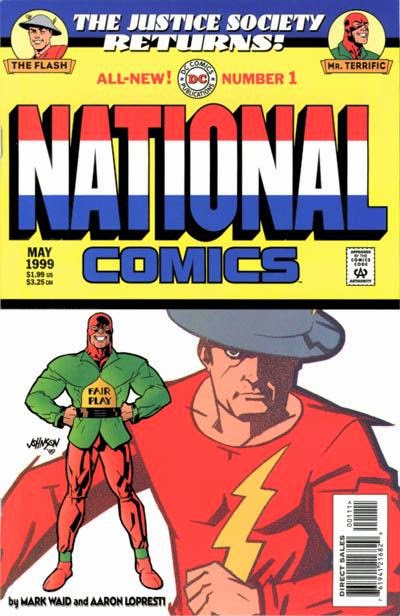
...and a World War II tale in National Comics #1 (May, 1999 by Mark Waid and Aaron Lopresti) with the Flash!  This tale, along with the other original JSA members' tales (and JSA #1-25 from the 1999 series, and the 2003 JSA: All-Stars #1-8 and more) are all in the JSA Omnibus #1 of 2014!

But, Terry did inspire the next generation and in Spectre #54 (June, 1997 by John Ostrander and Tom Mandrake), with Michael Holt taking over the mantle of Mr. Terrific to protect the next generation from gangstas as well as joining the JSA...and Michael even met Terry thanks to a few time travel tales in the JSA!  

Battlin' Boxer

While very similar to Mr. Terrific, Wildcat became the poster child for the JSA in later years.  Wildcat also began in Sensation Comics #1 (January, 1942, but by Bill Finger and Irwin Hasen), and boxer Ted Grant had been framed for the death of Socker Smith (Smith had trained Grant, and their managers wanted Grant to take a dive, Ted didn't, so they poisoned Smith, and Grant got the blame for his death).  Inspired by a kid recounting an adventure of Green Lantern, Ted decided to make his own costume, becoming Wildcat (and clearing his name as well!).

Wildcat also joined the JSA in All-Star Comics #24 (Spring, 1945), but he also came back for All-Star Comics #27 (Winter, 1945), as well as being in the first two issues of Comic Cavalcade of the 1940s, and the Big All-American Comic Book.  Wildcat just battled on, working with a private detective named Stretch Skinner and fighting foes such as the Yellow Wasp and the Huntress, until ending his Golden Age run with Sensation Comics #90 (June, 1949), though one unpublished battle of Wildcat and the Huntress came out in DC 100-Page Super Spectacular #6 (1971, which also reprinted the first JLA/JSA team up of Justice League of America #21-22 of 1963).  Wildcat himself didn't return in the Silver Age until Brave and the Bold #62 (October-November, 1965) fighting with the Sportsmaster and the Huntress alongside Starman and Black Canary, and even working with the Spectre once.

Wildcat was a frequent JSAer in JLA/JSA events, as well as being a major part of the 1970s revival of All-Star Comics (as well as getting his own Earth-1 counterpart that worked with Batman in 5 issues of Brave and the Bold, as well as the Creeper in one Super-Team Family).  Wildcat was injured during the Crisis on Infinite Earths, and taken out of time with them...and Yolanda Montez took over as Wildcat for a time with Infinity, Inc. until her unfortunate passing (but Ted returned with the rest of the JSA...and even helped train a new Wildcat to work in the JSA with him!).

Femme Fatale

Black Canary started off her career as a criminal, facing off against Johnny Thunder in Flash Comics #86 (August, 1947, by Robert Kanigher and Carmine Infantino).  Dinah Drake was the daughter of a police officer, and trained to join the police force...but didn't make it.  Dinah's dad died due to the disappointment, and she inherited enough to open a flower shop.  Still wanting to do more, Dinah donned a blond wig and distracting outfit, and decided to fight crime using her martial arts skills and training as the Black Canary!  At first, she appeared to be a criminal robbing other criminals, running afoul of Johnny, but her true heroic nature soon shown through, working with the JSA on a few cased, and taking over Johnny's feature in Flash Comics with Flash Comics #92 (February, 1948) and meeting private detective Larry Lance, and joining the JSA (also taking Johnny's place) with All-Star Comics #41 (June/July, 1948), which was also the second appearance of the Injustice Society of the World!

Black Canary continued on in Flash Comics until Flash Comics #104 (February, 1949), also having one Golden Age adventure in Comic Cavalcade #25, and two unpublished Golden Age Black Canary adventures ended up being presented after the Golden Age, in DC Special #3 (April/June, 1969) and in Adventure Comics #399 (November, 1970).  All of Black Canary's Golden Age solo adventures are in the Black Canary Archives #1.  Black Canary also continued as a member of the JSA until their original end in All-Star Comics #57 (February/March, 1951), and the story behind the story in Adventure Comics #466 (November/December, 1979), and returning to action with the JSA in Justice League of America #21 (August, 1963).

Between the last Golden Age adventure and the Silver Age Crisis, Black Canary married Larry Lance (as revealed in DC Special Series #10 of 1978), becoming Dinah Drake Lance, working with the JSA in the JLA/JSA team-ups, as well as two meeting with Starman in Brave & the Bold #61 (where Larry & Dinah's marriage was first revealed) and #62 (1965, tales also in the Black Canary Archives).  The JLA/JSA team-ups proved fatal for Larry, as at the end of the battle against Aquarius in Justice League of America #73 and #74 (August/September, 1969), he gave up his life to save Dinah and the worlds.  This prompted Dinah to leave Earth-2 and go to Earth-1 (and more of the story will be revealed under Black Canary's JLA entry....).


End of An Era


With All-Star Comics #57 (February/March 1951), the Golden Age JSA adventures ended (why that happened was revealed in Adventure Comics #466, but the JSA returned with the return of the Flash (Jay Garrick) in Flash #123, then the team in Flash #137, and with Justice League of America #21, an annual tradition of multi-Earth Crises started....

...but the JSA wasn't quite done with the Golden Age yet!


Ex-Boy Wonder

Robin (Dick Grayson) was a boy, working with Batman ever since Detective Comics #38 (April, 1940, by Bob Kane, Bill Finger and Jerry Robinson), but as time passed, the Boy Wonder got older (though it wasn't really reflected in the comics of the day).  The acrobatic youth even had his own solo run of stories in Star-Spangled Comics #65-#130 (1947-1952), even though Batman joined in the tales toward the end of the run, and gaining his own foes, like the Clock, the Fence, George Midas and a Boy Commandos' foe of Crazy-Quilt), and was a member of the wartime All-Star Squadron (also along side Batman).  

It was revealed in Justice League of America #55 (August, 1967), that Robin had indeed grown up, developing his own new costume (influenced by Batman), and he quickly became a member of the JSA as well!  Eventually, Robin adopted a new costume, and he continued to work with the JSA (and Infinity, Inc., as well as others, as detailed here) until the Crisis on Infinite Earths put an end to Earth-2 for a time.

The Mother of Them All


Well, not quite, but worth mentioning...the Red Tornado!  Abigail "Ma" Hunkel (first appearing in All-American Comics #3 of June, 1939 by Sheldon Mayer) was just a lady trying to take care of her kids (Huey and Amelia, also known as "Sisty") and her neighborhood (including "Dinky" Jibbet and his father, "Scribby" Jibbet)...until the mob kidnaps Sisty and Dinky!  The police are unable to help, and that's when Ma learns of Green Lantern...and comes up with a plan to free the kids (who are terrorizing the hoods who took them), by becoming the Red Tornado (all happening in All-American Comics #20, November, 1940 also by Sheldon Mayer, under a Green Lantern cover!).  Though possessing no powers other than two wild kids and some street smarts, she's able to defeat the hoods (who are unaware that she's a woman under her mystery man outfit).  Ma continues to do good in the neighborhood, soon aided by the Cyclone Kids (Sisty and Dinky, starting with All-American Comics #24, March, 1941).  Ma's adventures as the Red Tornado continued until All-American Comics #59 (July, 1944). 

The Red Tornado was there for the first meeting of the JSA, but couldn't stay due to ripping her costume!  Ma was well loved by the JSA, and even considered a member (but she wasn't).  Still, there was a Red Tornado to come into the JSA (and Ma even came back herself to help out here and there as well, like explaining being a hero to Liberty Belle, Phantom Lady and Wonder Woman in DCU Holiday Bash #2 of 1998!).  

More to come, as the JLA and JSA grew closer, and as you can see, there's another Red Tornado on the horizon!


Thursday, January 15, 2015

DC Comics Heroic Huntress

For those who don’t know...


...here’s a few facts on DC’s heroine...


...the Huntress!


In The Beginning


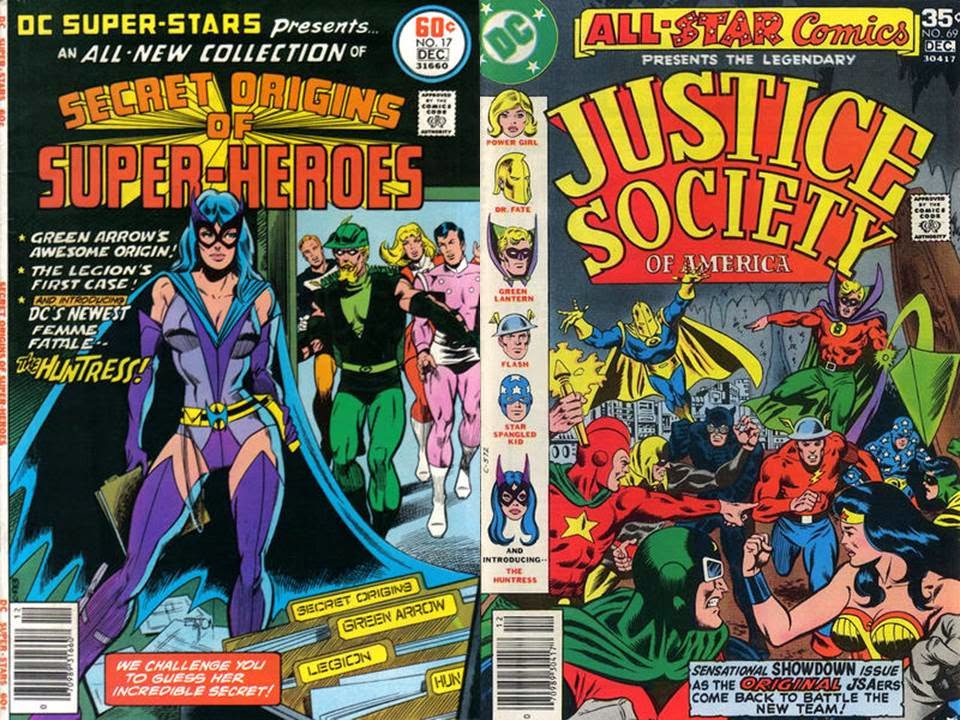
DC’s first heroic Huntress premiered in DC Super-Stars #17 (November-December 1977, created by Paul Levitz, Joe Staton and Bob Layton)….or at least that was where her origin was. All-Star Comics #69 came out at about the same time (and same date – August 24th, 1977, but the All-Star issue labels itself as introducing her), and teased the character in the final panel, but her story was in the Super-Stars issue. (DC Super-Stars had an origin of Green Arrow, written by Denny O’Neil, and drawn by the same man who has done the sketch of “the hood” in the Arrow TV series, Mike Grell!).

The Huntress was Helena Wayne, daughter of Batman and Catwoman. This happened on Earth-2, where Superman, Wonder Woman and Batman (along with Catwoman) had been around since the 1940s, with the heroes all being members of the Justice Society of America, and had aged together, with Bruce Wayne and Selina Kyle getting married along the way, and producing….Helena!

Her father trained her in criminology, and she also kept fit, but was headed more into a traditional legal career, until a thug killed her mother (and Bruce, as Batman, watched her die in his arms, mostly giving up his career as Batman after this). This event inspired Helena to become the Huntress, and capture her mother’s killer (Silky Chernak, for those keeping score at home).

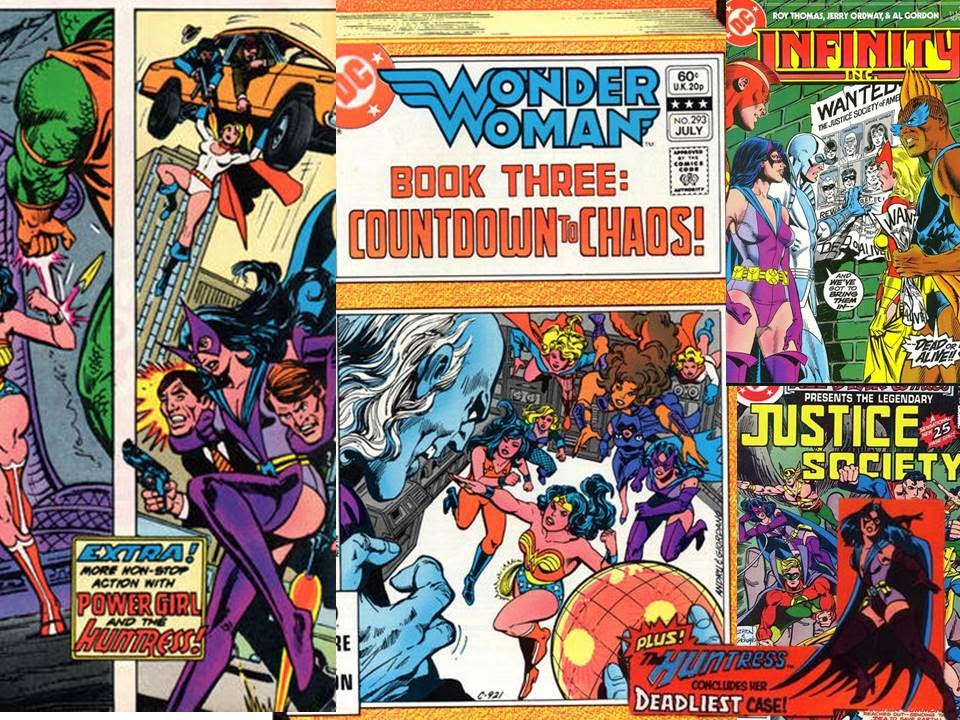
The Huntress soon joined the JSA (providing a nice counterpoint to new member, Superman’s cousin, Power Girl), and had a few adventures with them (and also met her father’s Earth-1 counterpart, who was a charter member of the Justice League of America, and she called him "Uncle Bruce"), as well as adventures of her own (and even fought the Wildcat foe, the Huntress, for the right to her name and dealing with her step-brother, Robin!). Her journey ended with the Crisis on Infinite Earths, when her world was wiped out…and she died as well.

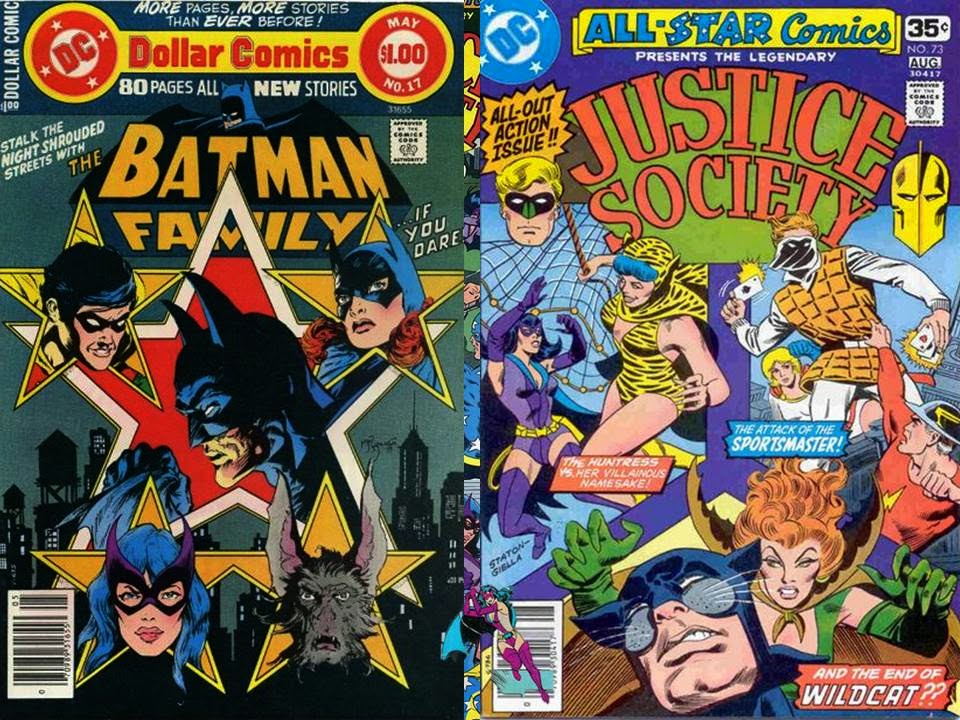
Still, her tales can be read for those who want to, in All-Star Comics #69-74, Adventure Comics #461-466, Batman Family #17-20, Wonder Woman #271-321 (missing a few in between), Brave and the Bold #184, America vs. the Justice Society #1-4, the first dozen issues of Infinity Inc., a few of the later JLA/JSA team-ups in Justice League of America, and in the Crisis on Infinite Earths.

New Huntress


But, the end of her world and existence couldn’t keep the Huntress down.


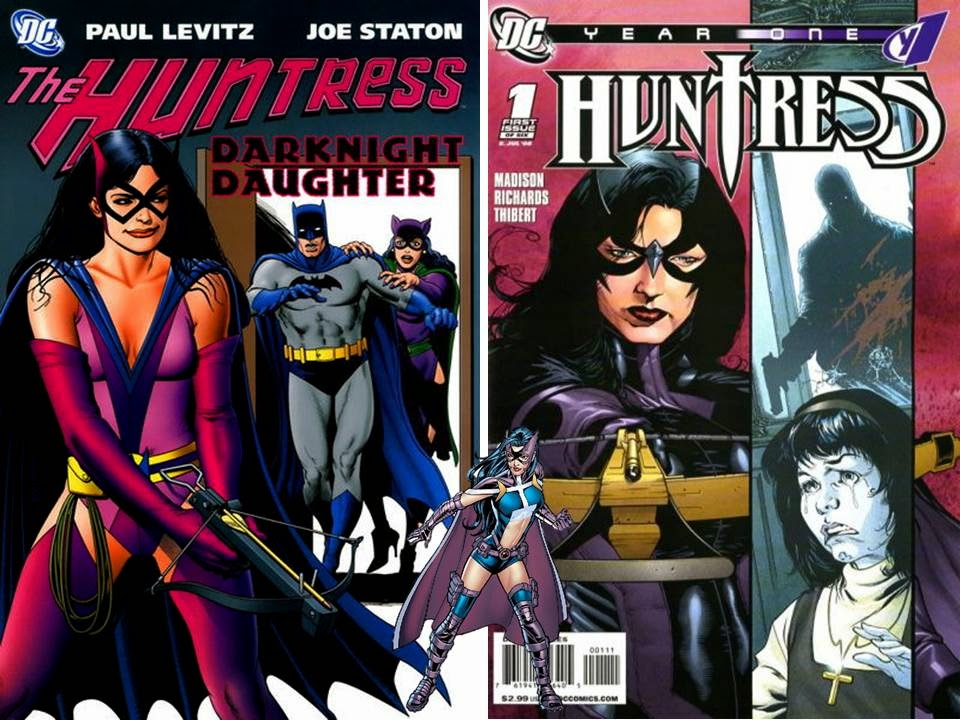
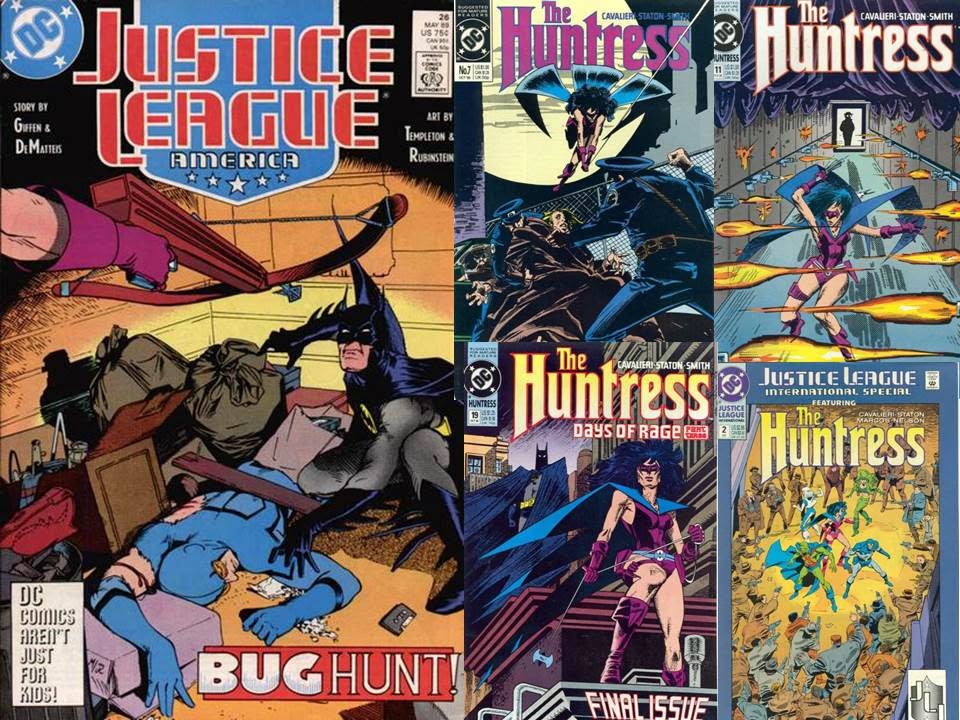
The Huntress returned as a new character, Helena Bertinelli, in the Huntress #1 (April 1989, by Joey Cavalieri and Joe Staton). Still a purple clad lady with a crossbow fighting crime (and the same purple and blue color scheme, reflecting a relationship to Batman and Catwoman, that wasn’t there this time out), this time out she was a mobster’s daughter, looking to set things straight.


She soon joined the Justice League America (with Justice League America #26, May, 1989), appeared there occasionally, and fought crime in her own title for 19 issues (with the same creative team), and a Justice League International Special (#2, 1991) to wrap up this particular run of the crossbow-welding crimefighter!


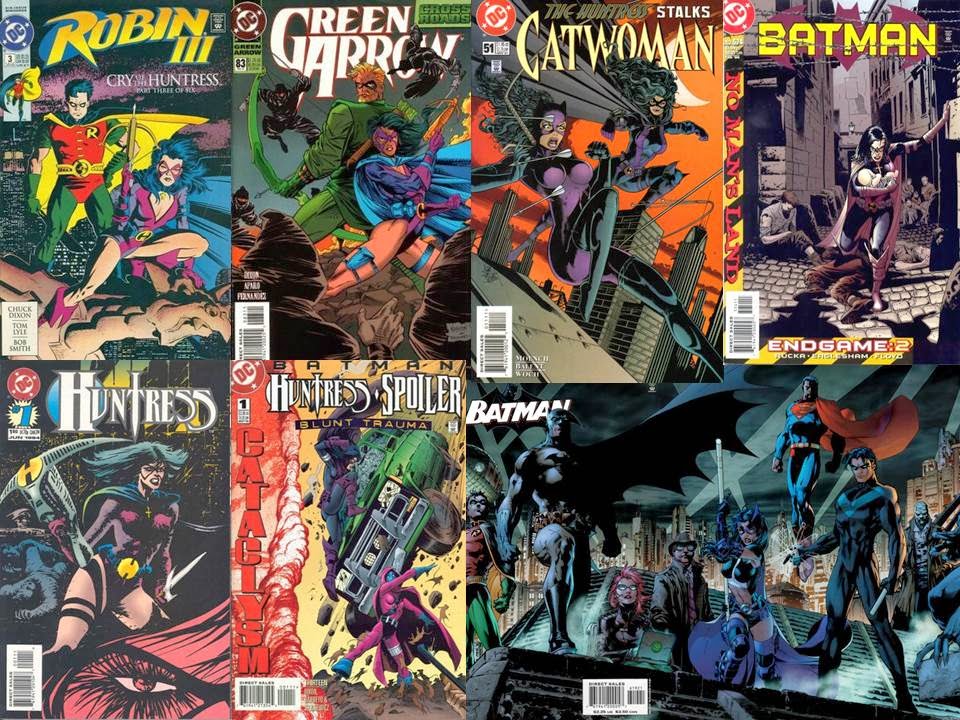
Thanks to Bat-writer, Chuck Dixon, the Huntress didn’t fade away, but instead returned, and kept fighting crime near Gotham. The Huntress was a little too violent for Batman’s tastes, but he encouraged her, and kept on eye on her as well to keep her from going too far.

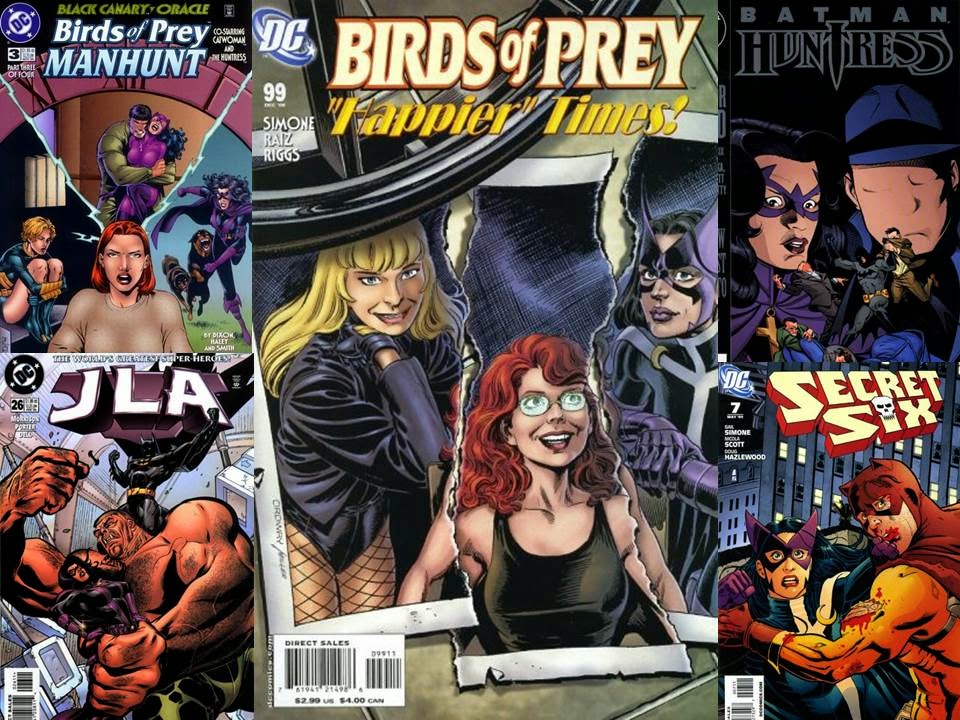
The Huntress also worked with Robin (Tim Drake), rejoined the Justice League for a time, had a relationship with Nightwing (Dick Grayson), fought in Gotham during No Man’s Land and while Hush stalked Batman, and worked with other heroes such as the Black Canary, Catwoman, the Question, Spoiler and Green Arrow, as well as playing a major role in the DC One Million event, and becoming a teacher, before becoming a regular in Birds of Prey (starting with issue #57, September 2003 with Black Canary and Oracle). She even had a little fling with Cat-Man (originally a Batman foe, but moved on to fight Green Arrow, and was a founder of the Secret Six, which also had Deadshot, another Batman foe co-opted by the Arrow…).  Helena even changed the look of her costume a few times along the way…

Same As The Old Huntress


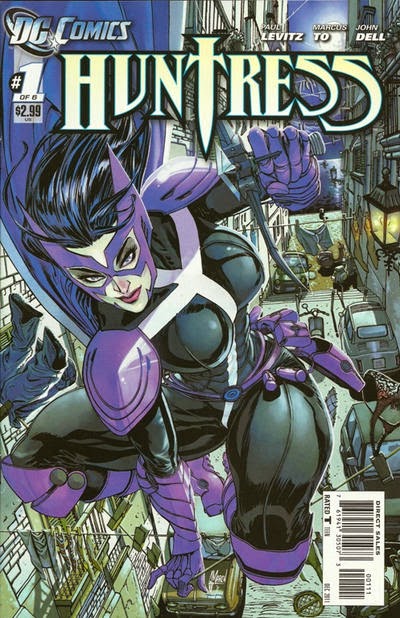
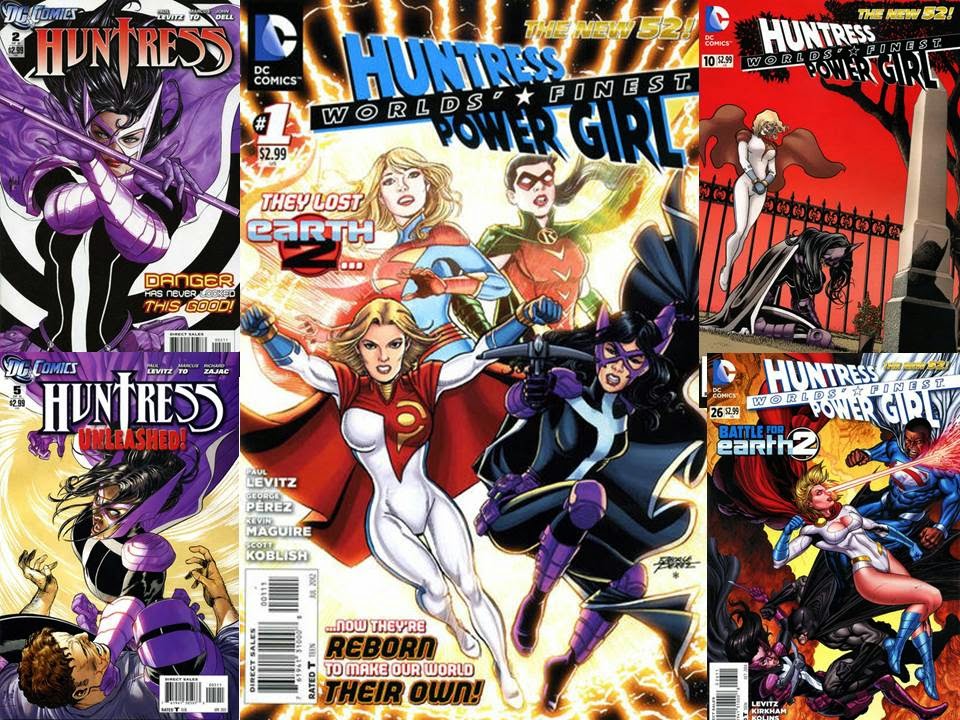
Still, something was off with the Huntress, and with the reset of the DC Universe, Paul Levitz and Marcus To returned Helena to being Helena Wayne with their 6-issue mini-series in 2011-2012.

The Huntress was the daughter of a Batman and Catwoman (from a different Earth-2), but she had been that world’s Robin (and worked with that world’s Supergirl).

The two of them ended up in the regular Earth, and adopted the identities of the Huntress and Power Girl, and are trying to figure out how to get home in the Worlds’ Finest title, also written by Paul Levitz, and with art by George Perez and Kevin Maguire (and even Jerry Ordway, who drew the original Huntress in Infinity Inc., inked her in the later days of her Wonder Woman back-ups, and a few of the mobster Huntress in Birds of Prey

...so, Worlds’ Finest just needs Joe Staton to return when he has time from his Dick Tracy newspaper series!).

Proving, the more things change, the more they stay the same!

Wednesday, January 14, 2015

Justice Society of America Adds Members

The Justice Society was the first gathering of DC's heroes.  

The first additions to their ranks happened very soon after they were formed...


Rolling Thunder


Johnny Thunder was born on July, 7th, 1917, and was quite lucky...being born on the 7th day of the 7th month...this gave him the ability to access a magical Badhnisian Thunderbolt (name later revealed to be Yz) that would do anything Johnny asked, so long as Johnny said the magic words of "Cei-U"...which sounds like "Say, You".  Say, you'd think that would make him all powerful and quite the menace....and it could have, if Johnny wasn't a good guy (and a little slow on the uptake as well).  Premiering in Flash Comics #1 (January, 1940, by John B. Wentworth and Stan Aschmeier) along with JSA charter members Flash and Hawkman, Johnny continued to adventures in Flash Comics (as well as in the New York World's Fair #2, World's Best Comics #1, World's Finest Comics #2 and #3, and later the Big All-American Comic Book, and even appearing in All-Star Comics #2, and guesting with the JSA in All-Star Comics #3 and #4 (and a solo text adventure in All-Star Comics #5) before officially joining the JSA with All-Star Comics #6 (August-September, 1941).  It's a good thing Johnny joined the JSA, or he'd barely be noticed...Johnny and his Thunderbolt didn't end up on many Flash Comics (or any other comics) covers, except for All-Star Comics.

For the most part, Johnny's adventures in the Golden Age were pretty simple, helping out his girlfriend, Daisy Darling and his adopted daughter, Peachy Pet, and foiling crooks...and it was in trying to stop one of those crooks, a femme fatale named Black Canary that he met in Flash Comics #86 (August, 1947), that changed Johnny's life.  Johnny started to work with her, and she started to appear more than Johnny's Thunderbolt, and eventually took over Johnny's spot in Flash Comics (with issue #92, after sharing billing with Johnny in Flash Comics #91, which was also the last Golden Age appearance of the Thunderbolt), and she took over his membership in the JSA in All-Star Comics #41, with Johnny's last Golden Age appearance being in All-Star Comics #39.

Johnny's absence was partially explained in Superman Family #204 (November-December, 1980 in the Mr. and Mrs. Superman feature), and Johnny returned with the JSA in Flash #137...though the Thunderbolt didn't return until Justice League of America #37, wherein it was revealed that Johnny had an evil Earth-1 duplicate, who also used the Thunderbolt for a time, and this evil Johnny also returned in Justice League of America #38, #219 and #220 (wherein more of Black Canary's history was revealed as well).

If not for the JSA and JLA, Johnny would likely have been forgotten....but, Johnny had a western hero who had the name...as well as a female Jonni Thunder who was a private investigator who worked with Infinity, Inc.....and later, a kid named J.J. Thunder took up the Thunderbolt as well. 

Man of the Stars


As much as Johnny counted on luck and magic, Starman worked with science.  Starting his adventures in Adventure Comics #61 (April, 1941, by Gardner Fox and Jack Burnley), Ted Knight used the Gravity Rod (which allowed Ted to fly and fire energy beams) to be a hero in the style of the original Green Lantern, and to fight menaces such as Dr. Doog, the Light, and the Mist while protecting his girlfriend, Doris Lee,  before joining the Justice Society with All-Star Comics #8 (December-January, 1941-1942).

A playboy as well as a scientist, Ted kept improving the Gravity Rod (eventually calling it a Cosmic Rod, and adding more energy manipulation abilities to his weapon), and continued to fight on with the Justice Society and on his own, through All-Star Comics #23 (Winter, 1944) and Adventure Comics #102 (February-March, 1946, the issue after being when Superboy, Green Arrow and Aquaman moved to Adventure Comics), which was Ted's last Golden Age appearance.

Ted Knight soldiered on, and returned with the JLA/JSA team-ups, having his first adventure with the team after their revival facing off against the Crime Syndicate of America in Justice League of America #29-30 (August-September, 1964).  Starman had also worked with the original Black Canary in two issues of Brave and the Bold (#61 and #62 in 1965, the first also reviving an old foe of Ted's, the Mist), and continued to work with the Justice Society on and off until just after the Crisis on Infinite Earths, which took most of the team away for a while...

But, Starman also had quite the legacy...having passed on his Cosmic Rod to the Star-Spangled Kid for a time (who had used it to join the JSA later, and using the basis of its technology to help him turn himself into Skyman in Infinity, Inc.), had an alien take over the name once on Earth-1 (a fellow name of Mikaal Tomas, in First Issue Special #12 of March, 1976), as well as a second alien, name of Prince Gavin, take the name starting with Adventure Comics #467 (January, 1980).  Prince Gavin didn't fair well in the Crisis on Infinite Earths either....

..later, a new Starman arose, that being Will Payton, who took up the mantle after being kid by a beam from the stars, and gaining super-strength, speed, flight and the ability to alter his appearance (all starting in Starman #1 from October, 1988), and that Starman met the first of the original Starman's sons, David Knight, who reminded the newcomer of the Starman legacy.

That Starman legacy was followed up on after Zero Hour: A Crisis In Time, and a new Starman, David's brother, Jack Knight, and his 83 issue series (that also contained 2 Annuals, an Eighty-Page Giant and a Secret Files, and even a special focusing on the Mist, no less), in which writer James Robinson wove together the history of all the Starmen, and a few other folks as well like Flash's foe of the Shade, Phantom Lady, Solomon Grundy, Batman foe Dr. Phosphorus, western hero Scalphunter and even Stargirl the legacy of Star-Spangled Kid, in Opal City (and truly a story for another day...and one that intimately involved the JSA as well as the JSA's next member...).


Doctor In The Dark


Dr. Mid-Nite...poor Dr. Charles Mcnider.  All the Doctor wanted to do is treat a witness against Killer Maroni (no relation known to Boss Maroni, who helped create Robin), in All-American Comics #25 (April, 1941 by Charles Reizenstein and Stan Aschmier), and yet, the Killer ended up blinding the Doctor...or so he thought, until the McNider's owl, Hooty, crashed through a window, and McNider realized he could see in the dark...and created a costume, blackout bombs (to blind his foes) and infrared goggles to allow him to see in the day, becoming Dr. Mid-Nite!

Dr. Mid-Nite joined the JSA with All-Star Comics #8 (December-January, 1941/1942), still having solo tales as well (but not getting any covers thanks to Green Lantern and the western Johnny Thunder) fighting crime and working with his assistant, Myra Mason, in All-American Comics until #102 in October, 1948 and stuck around with team until its Golden Age end in All-Star Comics #57 (February-March, 1951).  Dr. Mid-Nite also didn't get much solo appearances when he came back (starting with Flash #137), mostly hanging around with the JSA (though he was captured by the Secret Society of Super-Villains once, and rated one solo story in DC Comics Presents #29, but also didn't make that cover) until they disappeared soon after the Crisis On Infinite Earths with the Last Days of the Justice Society Special in 1986.

Infinity, Inc. gained a legacy member, with McNider's protege, Dr. Beth Chapel, who was blinded during the Crisis On Infinite Earths and took on a slightly more correct spelled super-hero identity inspired by Charles, becoming Dr. Midnight (created by Roy Thomas and Todd McFarlane).  The original Dr. Mid-Nite returned for a time, but was lost again during the Zero Hour: A Crisis In Time event that also aged the original Starman, and then later, a boy once rescued by McNider named Pieter Cross became a Doctor, and then the new Dr. Mid-Nite in a 3 issue mini-series from 1999 by Matt Wagner and John K. Snyder, keeping a Doctor in the JSA.


Amazing Amazon


Wonder Woman premiered as a back-up story in All-Star Comics #8 (December-January, 1941/1942) by William Moulton Marston and Harry G. Peter, wherein Princess Diana of Paradise Island had been made from clay by the gods as a gift to Hippolyte and granted some of the powers of the Olympian Gods.  Diana was raised by the Amazons, growing up a strong, gifted woman.  One day, Diana and her friend, Mala, found Steve Trevor, a wounded U.S. Army officer, and Diana vowed to return him to Man's World (after winning a contest among the Amazons, wherein Diana masked herself to enter), was gifted her Invisible Plane, Golden Lasso and began to fight in World War II!

Wonder Woman was the star of Sensation Comics (starting with #1 in January, 1942), and graduated to her own Wonder Woman title its first issue in the Summer of 1942, and working with the JSA in All-Star Comics #11 (June-July, 1942), and joining in All-Star Comics #12 (August-September, 1942).  Now, Wonder Woman didn't have to become an honorary member of the JSA just because she was promoted to her own title...though for a time she only acted as the JSA's secretary!  Wonder Woman spent her time fighting various alien invasions, gods, and villains like Dr. Poison, Cheetah, Giganta, Dr. Psycho, Baroness Von Gunther, Queen Clea and more, and even branched out into Comic Cavalcade, starting with #1 in Winter, 1942 (which had 29 covers of her having adventures with Flash and Green Lantern, though, sadly, no such team-ups within the book...though they each had solo stories in Comic Cavalcade until Comic Cavalcade #29, October, 1948).  Wonder Woman also made it into the Big All-American Comic Book of 1944!

The Golden Age Wonder Woman's adventures continued through the last case of the Justice Society in All-Star Comics #57 (February-March, 1951),  her last appearance in Sensation Comics (#106 in November-December, 1951), and through Wonder Woman #97 (April, 1958....the last story drawn by H. G. Peter, though some sources list Wonder Woman #77 as Wonder Woman's last Golden Age appearance due to it being the last appearance of Wonder Woman before the debut of Martian Manhunter in Detective Comics), and Wonder Woman was there for the revival of the JSA in Flash #137 (June, 1963), and the World War II Wonder Woman even had a revival in Wonder Woman (in Wonder Woman #228-243, DC Special Series #9, All-New Collector's Edition #C-54,  and World's Finest Comics #244-250 in the 1970s), due to the Wonder Woman TV show with Lynda Carter, taking the Wonder Woman comic over with Wonder Woman #228 (and meeting her Silver Age counterpart and fighting the first Red Panzer, Nazi Helmut Streicher who was there at the formation of the JSA in DC Special #29 and whose later incarnations would fight Wonder Girl Donna Troy), keeping the book until Wonder Woman #243 (May, 1978) with another team-up and switching back the title to the Silver Age Wonder Woman.  After these appearances, differences between the Wonder Woman were established, such as the Golden Age's Wonder Woman's mother, Hippolyte, being brunette (and the Silver Age Hippolyta being blond), and the Golden Age Wonder Woman had married Steve Trevor, and even had a daughter, Lyta Trevor (destined to become Fury of Infinity, Inc.).

Wonder Woman had more of her World War II history filled in with All-Star Squadron (a group of World War II DC heroes formed with the members of the Justice Society of America, Seven Soldiers of Victory, the Freedom Fighters and more) in tales set in the 1940s (but presented in the 1980s) as well as being a frequent guest in Infinity, Inc....at least until the Crisis On Infinite Earths ended her career (though the Golden Age Wonder Woman popped up a little to help the current Wonder Woman during Infinite Crisis).  All this history shows why Wonder Woman needed a Wonder Woman Encyclopedia!

Wonder Woman also had a major affect on the JSA...as Sensation Comics provided the next two members, Mr. Terrific and Wildcat (and more on them to come!).


Thursday, January 8, 2015

Avengers History 101

Yes, class is in session, and we’ll begin today by giving you a brief run down of the Avengers and its members!


The Avengers first assembled in Avengers #1 (September 1963) by Stan Lee and Jack Kirby, but the teammates didn’t start there…they had been living their lives for years before that, so, in this, the first of a few articles about the Avengers membership, let’s breakdown the charter members of the Avengers, which were Iron Man, the Hulk, Thor, Ant-Man and the Wasp, and how the team formed!


Thor!


Thor, he’s the oldest of the team members, so we’ll start with him. The version of Thor most Marvel fans are familiar with began in Journey Into Mystery #83 (August 1962, by Stan Lee and Jack Kirby).

In the story, “Thor the Mighty and the Stone Men From Saturn”, Dr. Donald Blake, attempting to escape invading aliens, discovers a hidden cave with the mighty Mjolnir, which grants him the power of the Norse god, Thor. A little different from the movie, and the Doctor discovers later that he really is the son of Odin, and this was all part of a test to teach the young god humility.


Still hasn’t gotten there, but ’tis true that he could!  Before Avengers #1, Thor faced the Kronans (the official name for the Stone Men from Saturn, in JIM #83), the Executioner from San Diablo (JIM #84), with Thor’s own brother Loki (a sorcerer from Asgard, and more on his mischief later, but he started to menace this version of Thor in JIM #85, but Thor and Loki had appeared before in the pre-Marvel Leading Comic Corporation, in Venus #12, February 1951, and would be a constant thorn in Thor’s side, as well as the Avengers…). Loki was a constant menace to Thor, and would also often use others to do his biding. Always amazing that their father, the all-father Odin, would come down so hard on Thor for minor problems, yet Loki get away with near murder…


Other pre-Avengers #1 foes include the time-traveller Zarrko the Tomorrow Man (JIM #86), Thug Thatcher (JIM #89), Carbon-Copy Man (shape-changing alien Zano, JIM #90), Sandu (a carnival magician Loki gave powers to in JIM #91), the Radioactive Man (Chen Lu, a Chinese scientist irradiated to fight Thor in JIM #93 who would also come back to menace the entire Avengers team time and time again), Professor Zaxton (a man with a duplicating machine, JIM #95), and Merlin the Mad (really the Maha Yogi, not the ancient wizard who helped Arthur find Excalibur, the real Merlin was busy elsewhere…) who started to appear in Marvel Comics with JIM #96, the last issue before Thor helped to found the Avengers!


A few later Thor villains really became Avengers menaces as well, to either the team or other Avengers, such as the Lava Men (JIM #97), Cobra (JIM #98), Mr. Hyde (JIM #99), the Enchantress and Executioner (both rogue Asgardians who started to menace this version of Thor with JIM #103), the Grey Gargoyle (JIM #107), the Absorbing Man (JIM #114), the Destroyer (JIM #118), and the Wrecker (Thor #148) and his Wrecking Crew (Defenders #17), but we can touch on them when needed.

Ant-Man and the Wasp!


Ant-Man, well, he’s a little bit of a lengthy tale, as his alter ego of Dr. Henry Pym first appeared in Tales To Astonish #27 (January 1962, by Stan Lee and Jack Kirby) as “The Man in the Ant Hill!”. This was good enough for Hank to return as the Ant-Man in the aptly titled “The Return of the Ant-Man” in Tales To Astonish #35 (September 1962, also by Stan Lee and Jack Kirby), and this time, biochemist Hank had a costume, was in control of his shrinking powers (given to him by a gas that contained “Pym particles”, and had a cybernetic helmet that allowed him to speak to the ants (and, he had the strength of a full-sized human at ant-sized…which, everyone should remember from an infamous sketch from the early days of Saturday Night Live!).


But, mostly Hank was stuck fighting communists, though a few had names like Comrade X (Nina Vladimirovna Tsiolkovsky, TTA #36, who came back as Madame X), the Protector (Gerald Marsh, TTA #37), Egghead (Elihas Starr, a scientific rival who became Hank’s most tenacious foe starting with TTA #38), the Scarlet Beetle (an irradiated, intelligent beetle, TTA #39), the Hijacker (Howard Mitchell, TTA #40), Kulla (an extra-dimensional alien tyrant, TTA #41), the Voice (Jason Cragg, who had a hypnotic voice of doom, TTA #42), and the Time-Master (Elias Weems, TTA #43, who could age people). Still, Hank had not even picked up a support cast at this point, other than his ants. But, that was due to change soon when scientist Vernon Van Dyne came looking for help….


Dr. Van Dyne needed the help, as he was being stalked by Pilai, an creature from Kosmos (who was a criminal that the scientist contacted while attempting to contact other dimensions, and Dr. Van Dyne was unable to get the help he needed from Dr. Pym). The alien criminal came to Earth and killed the elder scientist, leaving his debutante daughter, Janet Van Dyne, looking to Hank Pym for help. He did, exposing her to the “Pym particles”, as well as giving her insect wings which would manifest as she shrank which would allow her to fly, and devices that would to have a bio-electric sting. Ant-Man and the Wasp defeated the alien, and became partners in Tales To Astonish #44 (June 1963, by Stan Lee and Jack Kirby). The pair faced Hank’s foe Egghead in TTA #45, meeting the Fantastic Four in Fantastic Four #16, and a robotic alien scout called the Cyclops in TTA #46, (all the while slowly falling in love) before founding the Avengers.

Iron Man!


“Iron Man Is Born” was the title of Tales of Suspense #39 (March 1963, by Stan Lee and Don Heck), where scientist and industrialist Tony Stark was captured by guerrilla leader Wong-Chu. Tony must build the armor to save his own life from shrapnel lodged near his heart, and to escape his captivity and become the hero known as Iron Man (and return safely to his home...). 


There's more to the story than what's presented here, but this does have the basics, and additions to the origins will be added as need; nothing is ever as simple as it appears in the world of Iron Man!

Iron Man faces a wide variety of foes on his return to the United States (and a change to golden armor, being the first of many upgrades to the Iron Man armor), starting with Gargantus in TOS #40, scientist Dr. Carlo Strange in TOS #41, communist Red Barbarian in TOS #42, Kala the Queen of the Underworld in TOS #43, and Hatap the mad Pharaoh in TOS #44 in his last appearance before the armored Stark becomes an Avenger.

Later Iron Man foes that come to menace the Avengers (singly or together) include Jack Frost (at least in TOS #45, later to be called the Blizzard), the Crimson Dynamo (a set of armors worn by a different range of foes starting with TOS #46), the Mandarin (a foe with powerful alien rings, who would become the greatest menace to the Iron Man, starting with TOS #50), the uni-beamed Unicorn (TOS #56), and even more powerful armored foe, Titanium Man (TOS #69). Iron Man also faced more foes who became Avengers…but, we’ll talk about them later on.

Hulk!


We’ll end with the Hulk, who premiered in The Incredible Hulk #1 (May 1962, by Stan Lee and Jack Kirby, boy, these guys created all the good stuff, didn’t they?). Doc Bruce Banner was bolted by gamma rays while trying to save young Rick Jones….and unleashed his rage by turning into the Hulk.

The Hulk started as a grey monster, but then took on a familiar green hue, and was incredibly strong and resistant to harm.


During his short six issue run, Hulk faced the Gargoyle (a Russian scientist) in #1, the Toad Men in #2, the Ringmaster and his Circus of Crime in #3, Mongu (a supposed alien menace) in #4, underworld overlord Tyrannus and would-be conqueror General Fang in #5, and the alien Metal Master in #6 (as well as General Thunderbolt Ross in every issue)…and his own temper, which got the super-strong hero into trouble with his pal.


Rick Jones sent out a distress call to the Fantastic Four (with Mr. Fantastic, Invisible Girl and the Thing who would be future Avengers who made their first appearance in the title in #1, but not to join until later, and the Human Torch, who is the only charter FFer to not be an Avenger!), which Loki rerouted to lure Thor into battle with the Hulk.

(The Fantastic Four had previously fought the Hulk in Fantastic Four #12, which took place between Incredible Hulk #5 and 6!).

Iron Man, Ant-Man and the Wasp also got the call, gathered to fight the green behemoth, and learned he was not at fault. Thor went to catch Loki, who was only finally defeated with teamwork, and captured thanks to the Ant-Man. The group gathered, and Wasp provided their name….the Avengers. And, thus…it was history!


Avengers Assemble!


Oddly enough, a few modern creators have come back to insert some stories into Avengers history…such as back ups in the 12 issue Avengers Classic, an eight issue mini-series called Avengers: The Earth’s Mightiest Heroes, and a delightful little tale of Avengers #1.5 (or basically, one and one-half)! Great little stories, that are at least worth a quick mention here…as they filled in a few logical gaps along the way…it was also between Avengers #1 and 2, that Ant-Man and Wasp first faced the Porcupine (Tales To Astonish #48), and that led to a change in Avengers’ membership, that really started in Tales To Astonish #49….


The Avengers next new member was really just an old member renamed, as Ant-Man made his first appearance as Giant-Man in Avengers #2 (November 1963, by Lee/Kirby) against the Space Phantom (who, was a phantom from space…well, there’s more to his story, as he also travelled in time and banished Avengers to limbo, but it involves future Avengers villains, so we’ll talk about that later…).
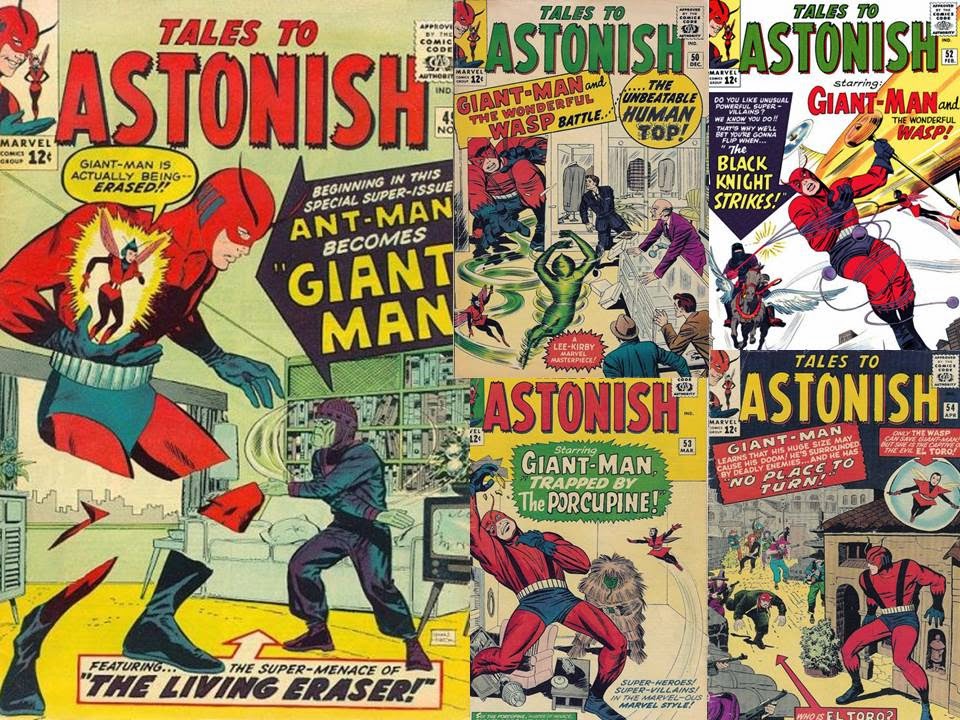
As Giant-Man, Hank faced even more villains, starting with his first appearance as Giant-Man in Tales To Astonish #49 (November 1963, by Lee/Kirby), and that foe was the Living Eraser.

That was followed by rogue speedster the Human Top (named David Cannon, in TTA #50, more on him later), the Black Knight (Nathan Garrett, in TTA #52), and El Toro (TTA #54).


Wasp and Giant-Man began to really become a couple after facing the Magician (TTA #56, who also later faced the Wasp alone), the Colossus (a robot not related to the X-Man, TTA #58), the Beasts of Berlin (communist gorillas…in TTA #60), Second-Story Sammy (who steals the Giant-Man costume and faces the Wasp in TTA #62), the Wrecker (not the one who faces Thor, this one is only in TTA #63), Madam Macabre (who has ties to the Mandarin, in TTA #66) and the Hidden Man (TTA #67), before losing his slot with Tales To Astonish #69, because starting in #70, Namor took the spot! But most of this happened after Avengers #3, so let’s mention that and follow up on Hank Pym later…

Avengers #3 (January 1964, by Lee/Kirby) has Iron Man’s first red and gold armor as the team battles former member the Hulk and future Avenger Namor the Sub-Mariner! During the course of this issue, Iron Man contacts a few other members of the Marvel Universe, including the Fantastic Four, the X-Men (including future Avenger, the Beast), and future Avenger, Spider-Man…so, the idea of a membership drive has really started. Seems the team is down a member, and, oddly enough, it was Namor that helped them find that member, who was an old teammate of his from earlier days…and we’ll discuss this later, so make sure to come back!