Showing posts with label Harlequin. Show all posts

Thursday, October 26, 2017

JSA Opposite: Injustice Society Additions Part 2

The Injustice Society of the World was the evil opposite of the Justice Society of America, made up of individual heroes Rogue's Galleries.  The first team formed to face the JSA back in All-Star Comics #37 (October-November, 1947), with only the Wizard escaping...

...allowing him to come back with new villains and a new ISW in All-Star Comics #41 (June-July, 1948) with "The Case Of The Patriotic Crimes" by writer John Broome, and artists including Alex Toth, Carmine Infantino, Arthur Peddy and Irwin Hasen, inked by Frank Giacoia and Bernard Sachs.

Here are the last two Golden Age members not covered earlier....

Fiddler

Isaac Bowin first appeared in All-Flash #32 (December-January, 1947/1948) by Robert Kanigher, Lee Elias and Moe Worthman, facing off against the Jay Garrick version of the Flash (who was the only Flash at that time) with a "Duet Of Danger".  Isaac was a thief who ended up in prison in India, then learned the skills of a fakir while there, but using a fiddle instead of a flute, and used the fiddle to kill the fakir.  Bowin returned home, intending to become a crime boss, but instead faced off against the Flash.  Fiddler seeming fell to his doom, but returned again in Flash Comics #93 (March, 1948 by Kanigher and Elias), facing off against Jay Garrick again, with his "Violin Of Villainy", before joining the Injustice Society...

...then fighting Jay Garrick's Flash one last time in the Golden Age, in Comic Cavalcade #28 (August-September, 1948 by Kanigher, Irwin Hasen and Bernard Sachs) in "The Flash Concerto", and popping up in a times past tale set in the early 1950s in Starman #46 (September, 1998), plotting to finish off Starman (Ted Knight).


The Fiddler returned, along with Thinker (Clifford DeVoe) and the Shade (Richard Swift), as the three villains had taken over Keystone City, and it took the "Flash Of Two Worlds" (both Jay Garrick and Barry Allen) to defeat the trio in Flash #123 (September, 1961).  After that, Fiddler worked with the Crime Champions in Justice League of America #21 and #22 (1963), faced Jay Garrick alone in Flash #201 (November, 1970), rejoined the ISW along with new member, Solomon Grundy, in All-Star Comics #63 (November-December, 1976)...

....faced off against the Teen Titans in Teen Titans #46 (February, 1977), worked with the Icicle and the Shade to revive Darkseid, and was opposed by Orion, Mr. Miracle, Big Barda, the JSA and the JLA in Justice League of America #183 to #185 (1980), reunited with the Crime Champions for Justice League of America #219 and #220 in 1983, was a part of the Crisis on Infinite Earths for a bit...


....joining the Wizard, the Shade and kids of the original ISW (including Artemis, Hazard and a new Icicle) in Injustice, Unlimited in Infinity, Inc. #34 to #36 in 1987, facing Wally West Flash and the new Thanagarian Hawkman and Hawkwoman (as well as a little time travelling to the past to face Jay Garrick), in Hawkworld Annual #1 of 1990...

...figuring out how much trouble the villains were in with Neron in Underworld Unleashed #1 (November, 1995), arriving for the funeral of the original Chronos, who was hastened to his grave by Neron (and his own lust for power) in Chronos #6 (August, 1998), being there as Wally West reclaimed the title of Flash in Flash #208 (April, 2004), all before dying as a member of the new Secret Six (along with surviving members Deadshot, Catman, a new Rag Doll, Mike the Parademon and Scandal Savage) in Villains United #1 (July, 2005)..

...with a legacy character, a female named Virtuoso picking up the fiddling villainy in Villains United #5 and #6 in 2005 (and a few issues of Secret Six), with Fiddler returning as an animated corpse (Black Lantern) in Suicide Squad #67 and Secret Six #17 and #18 in 2010 (where he also faced Virtuoso).

Harlequin

Molly Maynne first appeared in All-American Comics #89 (September, 1947) by Robert Kanigher and Irwin Hasen, where she was Alan Scott's secretary at WXYZ radio, which planned to have a Green Lantern radio show.  To face Green Lantern, they went to the comics, and picked "The Harlequin" (a character only in the comics) to be his first foe...Molly, who was in love with Alan Scott, took over the identity of Harlequin, getting hypno-spectacles and a mandolin, and trying to take over the gangs of Gotham.   She faced Green Lantern, but neither learned each other's identity.  Harlequin immediately returned in All-American Comics #91 (November, 1947) by Kanigher, Hasen and John Belfi, with a plan to marry Green Lantern (it took a while, but Molly eventually had that wedding).

Molly next faced Alan in a full-length issue in Green Lantern #29 (December-January, 1947/1948), all by Kanigher, Hasen and Belfi, with the first story pitting Green Lantern against the police (who think Alan is on Harlequin's side), then in the second part of that, having Harlequin face her own gang, who think she is in love with Green Lantern!  The third story was separate from the previous two, as Harlequin gives up, turning herself into the police....as long as Green Lantern defends her in court!  Next up, in All-American Comics #93 (January, 1948), Green Lantern comes up with the idea of taking Molly on a date, to lure out the Harlequin!   Coincidentally, Alan picks the stadium Molly was going to rob, so she goes along with it, to then change into Harlequin, to continue the robbery, but Green Lantern foils it, and captures Harlequin and her gang, but failed to take away her hypno-glasses, which she uses to escape.  

Picking up where the last issue left off, All-American Comics #94 (February, 1948) by Kanigher, Hasen and Belfi, finds Alan Scott planning a coop to capture Harlequin by sponsoring a beauty contest with an opal Harlequin ring to lure his foe there (and she does enter, but uses illusions to keep Green Lantern busy).  Green Lantern hid a camera in the opal, to at least find out her identity (as she does escape with the ring), but she returns it with the camera broken.    In her final cover of the series, All-American Comics #95 (March, 1948), Harlequin finds a way to trap Green Lantern, promising to reveal her identity to him, if he does the same for her.  They actually do remove their masks in front of each other, but....a little smoke gets in the way (Gotham is a dirty city, after all).

In her final Golden Age cover, Green Lantern #31 (March-April, 1948) by Kanigher, Irwin and Belfi, a gang leader gets a hold of Harlequin's spectacles and Green Lantern's ring, forcing the two to work together to stop him.  Green Lantern #32 (May-June, 1948) sees Harlequin do something odd...offer to return her ill-gotten gains to the government, so they can return the funds to her victims.  After this, Harlequin works with the  ISW (where she helps Black Canary fight the Injustice Society to save the JSA, especially Green Lantern). 

Harlequin is only in All-American Comics #99 (July, 1948) as Molly Maynne (and Green Lantern is barely there as well as Streak the Wonder Dog takes over the tale, in a story by John Broome and Alex Toth (the Green Lantern feature soon leaves All-American Comics).  With Green Lantern #33 (July-August, 1948) by Kanigher and Hasen, Harlequin takes advantage of Leap Year to ask Green Lantern to marry her (Molly's got a one track mind).  Molly (and only Molly) has a brief appearance in Green Lantern's story in Comic Cavalcade #28 (August-September, 1948).  Then, with Green Lantern #34 (September-October, 1948) by Kanigher, Hasen and Bob Oksner, it is revealed that Molly has been a government agent all this time, working to bring down the mob!  Oddly, Molly is still Alan's secretary for an appearance in Green Lantern #36 (January-February, 1949), then helps Green Lantern and Mr. and Mrs. Superman in Superman Family #206 (March-April, 1981) in a story set in the 1950s, where she helps the heroes capture the Sportsmaster.

Molly does return as Harlequin in Infinity, Inc. #9, #12 and #18 in the mid-1980s, as she tries to get close to Green Lantern, then helps Jade and Obsidian find out who there mother is in Infinity, Inc. Annual #1 of 1985 (slight spoiler, it is NOT Molly, but yet another Kanigher creation).  Molly and Alan also get married, with the JSA and Infinity, Inc. in attendance, then appears in most of the mid-20s issues of Infinity, Inc. as the JSA deals with the Crisis On Infinite Earths (even appearing in the later issues of that series), and with Infinity, Inc. #30 (September, 1986) more or less retires as Harlequin as the JSA (including Green Lantern) get stuck in a limbo dimension for a time.

Molly remains active with the Infinity, Inc. kids until their series ends (including when Manhunter agent Marcie Cooper takes over the Harlequin's spectacles and identity for a time, and Marcie even joins Injustice Unlimited, and Molly's name grows and is shortened, as she goes by Molly Mayne-Scott with one "n" more now), pops up for a Green Lantern issue (#19 of December, 1991, with GLs Hal Jordan, John Stewart and Guy Gardner), and even has a brief return as Harlequin as Alan gets much younger, taking on his Sentinel identity in Green Lantern Corps Quarterly #6 (Fall, 1993), then the evil part of Molly's soul takes a life of its own as Harlequin, starting with Underworld Unleashed: Abyss - Hell's Sentinel (December, 1995), before her body and soul are reunited with help from Kyle Rayner's Green Lantern (#71 of February, 1996).  Molly and Alan are still together to this day (somewhere....)...

Molly has no relationship to the current Harley Quinn, but was the last Golden Age villain to join the ISW in the Golden Age, but not the last that the Injustice Society recruited (although not until the Silver Age, with the Shade and Solomon Grundy....).  

Thursday, December 3, 2015

Teen Titans Tease

As the original Teen Titans series came to an end, the idea of a second group of Teen Titans came about, the Titans West in Teen Titans #50 to #52 (1978) by Bob Rozakis and Don Heck, with the two teams facing Captain Calamity and Mr. ESPer.  

The Titans West group was brought together by Lilith, and included the original Hawk & Dove....as well as two characters with previous histories (though not directly with the Teen Titans....).


Bat-Girl

Betty Kane first appeared in Batman #139 (April, 1961) by Bill Finger and Sheldon Moldoff, as the athletically inclined niece of Kathy Kane (who was the original Batwoman), who found out her identity and wanted to be like her aunt, and be the Robin to Kathy's Batman.


Kathy stalled for time, promising the girl she would train her, but Bat-Girl got into action as Batman, Robin and Batwoman were trapped by King Cobra and his gang...

...and this story was reprinted in Batman Annual #7 of 1964 as well as in the 1972 volume of Batman From the '30s to the 1970s.


Bat-Girl returned in Batman #141 (August, 1961) as "Batwoman's Junior Partner" by Bill Finger and Sheldon Moldoff, where Robin and Bat-Girl beat the Moth (no relation to the Killer Moth), returned again, with "Bat-Mite Meets Bat-Girl" in Batman #144 (December, 1961) by Bill Finger and Sheldon Moldoff, with Bat-Girl and Robin alone in Gotham, and Bat-Girl professing her love for Robin, and Bat-Mite getting in the middle of the problem (this story being reprinted in Batman From the '30s to the 1970s and the Batman in the Sixties tradepaperback of 1999.

Bat-Girl gets in her first full length story with the "Prisoners of Three Worlds" in Batman #153 (February, 1963, by Bill Finger and Sheldon Moldoff), where Robin and Bat-Girl face aliens, and are sent to the aliens' home dimension, and they have to save Batman and Batwoman (who are sent to another dimension as well, with this story making it into the  Batman From the '30s to the 1970s as well as into the Batman: Greatest Stories Ever Told Volume #2 of 2007.  Bat-Girl finally gets to face some major Batman foes in "The Great Clayface-Joker Feud" in Batman #159 (November, 1963, by Bill Finger and Sheldon Moldoff), helping to catch the Joker, and while getting the shape-changing Clayface, not getting his stash of transmutation chemicals.  This story made it into the Greatest Joker Stories Ever Told of 1989.

Bat-Girl made it into her only appearance in Detective Comics, Detective Comics #322 (December, 1963) with "The Bizarre Batman Genie" by Dave Wood and Sheldon Moldoff (an odd tale, to be sure, and one not reprinted).  Bat-Girl made an "imaginary appearance" as a grown up Batwoman in Batman #163 (May, 1964, by Bill Finger and Chic Stone) where Dick Grayson was Batman in stories written by Alfred (and these can be found in DC's Greatest Imaginary Stories Volume #2: Batman and Robin of 2010).  Batman comics had started to grow up, abandoning things like aliens, Bat-Mite, Ace the Bat-Hound, and Batwoman and Bat-Girl (though a new Batgirl, Barbara Gordon showed up in Detective Comics #359 of January, 1967, related to Com. Gordon instead of Batwoman), and Betty had faded away, popping up as a tennis player during Wonder Woman's trials in Wonder Woman #219 (August-September, 1975 by Martin Pasko and Curt Swan).

So, when Bob Rozakis needed new teens for a west coast expansion of the Teen Titans, Bette was there (playing tennis no less), getting a chance to reconnect with Robin (fighting for his affections with the Harlequin) in Teen Titans #50 to #52 of 1978, and even continuing that in Batman Family #16 (February-March, 1978, by Bob Rozakis and Don Heck, where Barbara Gordon was also around), before heading to limbo again (only briefly stopping by for Donna Troy's wedding in Tales of the Teen Titans #50 of February, 1985 by Marv Wolfman and George Perez), and her later change into Flamebird (as we'll detail in a later column....). 


Golden Eagle

Charley Parker was a slacker, and became the Golden Eagle by accident, as "The Kid Who Won Hawkman's Wings" in Justice League of America #116 (March-April, 1975, by Cary Bates and Dick Dillin), getting wings due to Hawkman foe, Matter Master, and his subconscious desire to defeat Hawkman (but being unable to, because, at the time, Hawkman was back on Thanagar with Hawkgirl due to a plague).


Charley was pretty much left to back to his regular life in Justice League of America #117 (April, 1975, by Elliot S! Maggin and Dick Dillin), as Hawkman returned....(and Charley didn't make either cover, the kid gets no respect!).


But it appears Hawkman took pity on the kid, giving him a pair of wings so he could continue to fight crime (while being chronically unemployed on the west coast), meeting up with the Teen Titans in Teen Titans #50 to #52 (1978) to briefly be a part of the Titans West, and even popping up for Donna Troy's wedding in Tales of the Teen Titans #50 (February, 1985 by Marv Wolfman and George Perez), before being forgotten in the Crisis On Infinite Earths (and later to get a few different histories, first in Secret Origins Annual #3, along with Bat-Girl/Flamebird, and then later, thanks to the Hawkworld history rewrite).

Joker's Daughter

Duela Dent appeared first in Batman Family #6 (July-August, 1976) in a tale by Bob Rozaiks and Irv Novick, wherein the mysterious Joker's Daughter appears, using Joker-like gimmicks to terrorize Robin (but causing no real harm...unlike the real Joker would have done), but her real identity remained a mystery...


....and it would even after the mystery was solved; but let's not get a head of our selves.


The Joker's Daughter would return again, but in a slightly different form....


...facing Robin again in Batman Family #8 (November-December, 1976, by Bob Rozaiks and Irv Novick), but this time as Catgirl (potentially a younger Catwoman), and then in Batman Family #9 (January-February, 1977 by Bob Rozaiks and Irv Novick), wherein Robin gets help, facing Scarecrone (the Scarecrow's daughter), the Riddler's Daughter, and the Penguin's Daughter, where Robin thinks he's solved the "Startling Secret of The Devilish Daughters",  all of whom Robin thinks is Duela Dent (who claims to really be Two-Face's daughter), and she wants to fight crime instead of heroes! 

(The Batman Family #9 story was reprinted in the Batgirl: Greatest Stories Ever Told tradepaperback of 2011).

Duela pops up next in Teen Titans #46 (February, 1977 by Bob Rozaiks and Irv Novick), where she joins the Teen Titans and helps fight Golden Age Flash foe, the Fiddler (as the Titans work on some conflicts of their own),  continues with the team and faces the Flamesplasher, Darklight and Sizematic twins in Teen Titans #47 (April, 1977, by Bob Rozaiks and Bob Brown), and finds out where there are twins, there is usually Two-Face...who attacks "Daddy's Little Crimefighter", and leads Duela to take on the new identity of the Harlequin in Teen Titans #48 (June, 1977, by Bob Rozakis and Jose Delbo).  As the Harlequin, Duela is there when the team faces the Rocket Rollers in Teen Titans #49 (August, 1977, by Bob Rozakis and Jose Delbo), and then the big meet of Teen Titans #50 to #52 of 1978 (though she only makes the cover in a vignette as the Harlequin).

Duela is there for the never before revealed origin of the Teen Titans in their last issue of Teen Titans #53 (February, 1978), follows Robin into Batman Family #16 (February-March, 1978), is one of the Titans present for the graduation of Wally West (Kid Flash) in DC Special Series #11 (1978), and helps Robin in Batman Family #19 (August-September, 1978), then keeps him busy as the Card Queen in Detective Comics #482 and #483 (1979) as the Card Queen, before disappearing for a time (and coming back for Donna Troy's wedding in Tales of the Teen Titans #50 (February, 1985 by Marv Wolfman and George Perez), wherein Dick Grayson confronts her with the fact that she's too old to be Two-Face's daughter!  Duela Dent's story doesn't continue again until well after the Crisis On Infinite Earths, and it is those multiple Earths that help her origin.... 


...and that covers the members of the original Teen Titans (Robin, Aqualad, Kid Flash, Wonder Girl, Speedy, Hawk, Dove, Lilith, Mal, Gnarrk, Harlequin, Bumblebee, Golden Eagle and Bat-Girl), except for one, little Beast Boy (who met the Teen Titans early in his career with the Doom Patrol), and joined the Titans finally during the Titans West time at the urging of Lilith, but little Garfield Logan is more associated with the Teen Titans in his identity of Changeling, with other Titans like Raven, Starfire and Cyborg, so we'll cover him then!

Wednesday, June 18, 2014

Robert Kanigher's Other Wonder Women

Some of you might remember writer Robert Kanigher as Sgt. Rock and Easy Company co-creator (with Joe Kubert), or as an editor (and then writer) of Wonder Woman (being the first writer to take over Wonder Woman from creator William Moulton Marston).  You might even know he co-created the Suicide Squad, the Metal Men, the Haunted Tank and the Sea Devils, as well as writing the first Barry Allen Flash story in Showcase #4...but he also created a little more as well!

Black Canary


Along with artist Carmine Infantino, Robert Kanigher created the original Black Canary (Dinah Drake) in the Thunderbolt feature in Flash Comics #86 in August, 1947 (with a dinosaur on the cover, not Black Canary, but hey, Kanigher later co-created the "War That Time Forgot" series, where dinosaurs fought soldiers), missing only Flash Comics #89, and she took over the feature from poor Johnny Thunder with Flash Comics #92 (February, 1948, which also introduced her boyfriend, and later husband, Larry Lance...and father of the second Black Canary who was in the Justice League and Birds of Prey).   

Kanigher and Infantino did all her individual features up until the last issue of Flash Comics #104 (February, 1949) and two unpublished stories as well (that got published in DC Special #3 in April-June, 1969, and Adventure Comics #399 in November, 1970, and all these tales plus her two Brave & the Bold #61 and 62 by Gardner Fox and Murphy Anderson, and two Adventure Comics back-ups from #418 and 419 by Denny O'Neil and Alex Toth are in the Black Canary Archives!). 

Harlequin


Black Canary also took over Johnny Thunder's spot in the Justice Society of America, and while there, she faced the Harlequin.  Not Batman's foe, but the foe of the original Green Lantern, a lady named Molly Mayne (still a little crazy, and in love with Alan Scott, the original Green Lantern!).  Harlequin first appeared in All-American Comics #89 (September, 1947 by Kanigher and artist Irwin Hasen).

Harlequin returned many times, in All-American Comics #91, 93, 94 and 95, as well as Green Lantern #29, 31, 32, 33, 34 and 36, and Comic Cavalcade #28, using hologram projecting glasses and a wooden mandolin as weapons, even working with the Injustice Society in All-Star Comics #41 (June-July, 1948) where she met Black Canary.  Molly still loved Alan, and finally did marry him later, during Roy Thomas' Infinity, Inc. run.  Sadly, most of her individual appearances have not been reprinted.


Mademoiselle Marie


Originally just a member of the French Resistance during World War II, Marie fought the Nazis starting with Star-Spangled War Stories #84 (August, 1959) by Kanigher and artist Jerry Grandenetti.  Mlle. Marie's appearances lasted through Star-Spangled War Stories #91 (wherein her feature was taken over by the dinosaurs of the War that Time Forgot), but Marie soldiered on, meeting Sgt. Rock, Johnny Cloud, the members of the Haunted Tank, the Hellcats and the Unknown Soldier (all World War II heroes, co-created by Kanigher).

Marie's final fate was hinted at in Detective Comics #501-502 in 1981, and her murder solved by Batman and Checkmate #21-22 made Mademoiselle Marie a "legacy" name, naming the World War II Marie...Anais Guillot.  DC Universe: Legacies #4 hints that Marie might have indeed survived World War II...and has a son that looks like Sgt. Rock!  Marie also had a World War II one-shot in November, 2010 by writer Billy Tucci and artists Justiniano and Tom Derenick, with a cover by Brian Bolland as well.

Rose and Thorn


There were two women with the Rose and Thorn name..and they were both created by Robert Kanigher!  The first as a foe of the Golden Age Flash in Flash Comics #89 (November, 1947 with art by Joe Kubert) who only had one other published golden age story in Flash Comics #96 (though parts of another unprinted story were reprinted in Superman's Girlfriend Lois Lane #113, among other places....).  The Thorn was a split personality (the good girl being Rose Canton), faced the Flash with poison darts, and she returned to face Black Canary (and the JLA) in JLA: Year One #2, as well as the JSA in All-Star Comics #72-73....and then more of her history was revealed in Infinity Inc. and especially in Infinity Inc. Annual #1...with the Harlequin as well!

The second Rose and Thorn started in Superman's Girlfriend Lois Lane #105 (October, 1970) in a story written by Kanigher, with art by Ross Andru (who had worked with Kanigher on Wonder Woman as well).  Rose Forrest was a police detective's daughter, traumatized by the death of her dad at the hands of the 100 (an evil crime syndicate based in Metropolis).  This caused Rose to develop the split personality of the Thorn (hiding her short blond hair with a brown wig)...and working to take the mobsters down, occasionally making a wild and wacky Lois Lane cover (and co-starring in the main feature).   

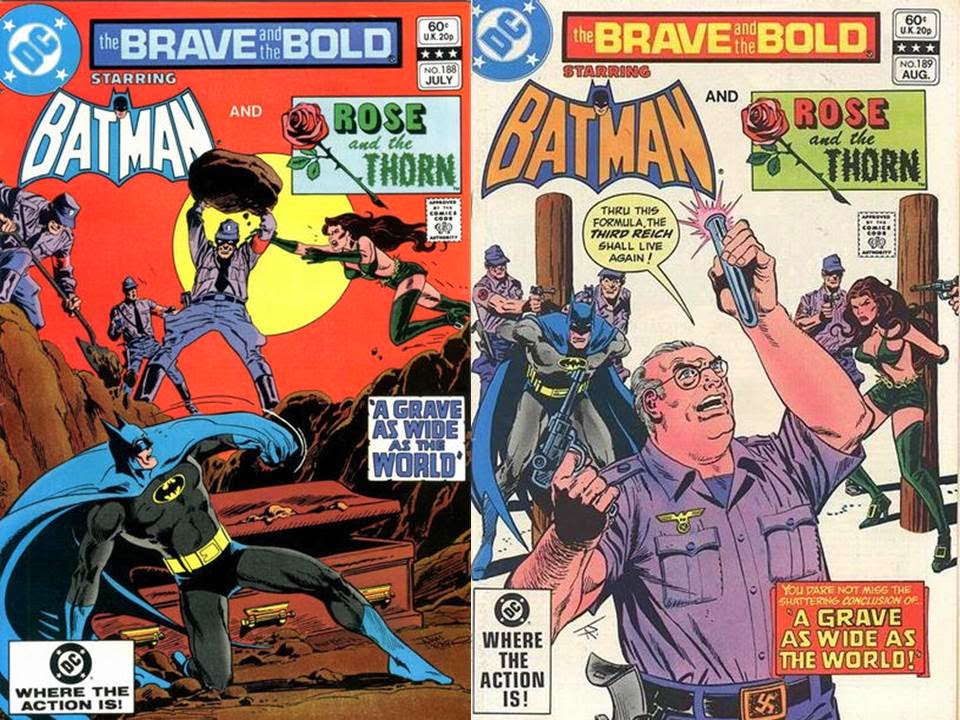
Kanigher wrote most of the back ups (with Cary Bates writing a few), and other artists on the series included Gray Morrow, Dick Giordano, Rich Buckler and Don Heck by the back-ups end in Superman's Girlfriend Lois Lane #130.  Rose and Thorn came back in Superman #336 (June, 1979, by Len Wein and Curt Swan), and in two issues of Brave and the Bold (#188 and #189, written by Kanigher, and art by Jim Aparo) with Batman.

After the Crisis on Infinite Earths, in Dan Jurgens' Booster Gold fighting a new, expanded 100 (now the 1000, in Booster's earliest issues as he settled into Metropolis) and even helped in the Superman title crossover Panic in the Sky, as well as working with the new Green Arrow (Connor Hawke) for a short time as well as having a few tales in the Showcase revival of the mid-1990s, as well as appearing in the early issues of Joker's gal pal, Harley Quinn (no relation to the earlier Harlequin...though Thorn didn't make the covers of #3 and #14 of Harley Quinn), unlike the next Kanigher creation!


Poison Ivy 


The character that brings most of them together!  Kanigher and Shelly Moldoff (ghosting for Batman co-creator Bob Kane) introduced Poison Ivy in Batman #181 (June, 1966) basing her look off popular pin-up girl Bettie Page!  (You can see it in Carmine Infantino's cover for the issue, and she was used as Catwoman was considered "too sexy" to use in the comics of the time).  Pamela Isley was just a seductive thief to start (and was back pretty quickly...in Batman #183) before disappearing again (though that first tale was reprinted in Batman #208, with cover art by noted good girl artist Nick Cardy).  Kanigher even brought her back to face the Thorn in  Superman's Girlfriend Lois Lane #116 (November, 1971, with art by Dick Giordano, who also drew Wonder Woman and Green Arrow/Black Canary back-ups for a time).   

Len Wein and Dick Dillin brought her back as a member of the Injustice Gang of the World (a team of villains including Scarecrow, Chronos, Mirror Master, Shadow-Thief and the Tattooed Man) to face the JLA in Justice League of America #111 (May-June, 1974) and Black Canary was there in the team's second appearance in Justice League of America #143. 

With DC Special Series #6 (November, 1977), Poison Ivy joined forces with Grodd, Sinestro, Bizarro and Kanigher created Wonder Woman foe, the Angle Man to fight the JLA with the Secret Society of Super-Villains!  Later still, she joined forces with all DC villains in the Crisis on Infinite Earths!


After the Crisis on Infinite Earths (where she faced Phantom Lady, a heroine who looked like a pin-up girl), Poison Ivy joined the Suicide Squad (another series originally co-created by Kanigher, though this version included DC villains (like Deadshot and Count Vertigo) thanks to an update by writer John Ostrander, and she was there on and off from issues #33 to #66), and that team faced Checkmate! (which later included a legacy of Mademoiselle Marie!).

Poison Ivy also grew...becoming a champion of the plant kingdom, and even getting a greener hue....and becoming friends with Joker's gal pal, Harley Quinn! 

In the Harley Quinn series, you can see more of the pin-up girl in the art of Terry and Rachel Dodson...and more so in her later appearances as well, like in Gotham City Sirens, and she was even part of the Birds of Prey with Black Canary to start of the New 52!

All of this shows us one thing...that if it wasn't for Robert Kanigher, there'd be a lot less complex female characters for women to cosplay at comic conventions or for writers and artists to explore in the pages of DC Comics!