Showing posts with label 1950s. Show all posts

Wednesday, January 18, 2017

Patriot Captain America of the late 1940s and early 1950s

Steve Rogers was the first Captain America, but he wasn't the only one.   Another man to be Cap was Jeff Mace.


Reporter.       Hero.


American.     Patriot.

Here's a little of the history of the man who was the Patriot, and gave up that identity to become Captain America!

Golden Age

Jeff Mace began life as the Patriot in Human Torch #4 (Spring, 1941 by Ray Gill and George Mandel, though the issue was #3 on the cover), appearing in the next issue (Human Torch #4/5), then moving over to Marvel Mystery Comics starting with #21 (July, 1941), where he was a regular feature until Marvel Mystery Comics #74 (July, 1946), using his athletic ability and reporter's skills to fight menaces.

Along the way, he even gained a partner, Miss Patriot (Jeff's friend, Mary Morgan), who gained powers of above normal hearing and super-vision in Marvel Mystery Comics #50 (December, 1943), getting him a little extra help on his cases.


All these appearances, and the Patriot never made a cover in the Golden Age, so settle for a few of his splash pages to show his original costume!


This was also the costume Rick Jones manifested him during the Kree-Skrull War (but that wasn't really Jeff Mace....).


1970s Revival

With the success of the Invaders in the 1970s (a team composed of the original Captain America, the original Human Torch and Sub-Mariner formed in an issue of the Avengers during a time travel adventure), more classic Timely characters were given new life, detailing their adventures during World War II, this time as the homefront heroes, the Liberty Legion, including the Whizzer, Miss America, the Thin Man, Jack Frost, Blue Diamond, Red Raven and the Patriot...

...starting in Invaders #5 (March, 1976 by Roy Thomas, Rich Buckler, Dick Ayers and Jim Mooney), continuing into Marvel Premiere #29 (April, 1976 by Roy Thomas, Don Heck and Vince Colletta), Invaders #6 (May, 1976 by Roy Thomas, Frank Robbins and Vince Colletta) and Marvel Premiere #30 (June, 1976 by Thomas, Heck and Colletta), with all the heroes gathering to battle the Red Skull (under Jack Kirby covers, no less!).  The Liberty Legion returned in Invaders #35 to #38 (December, 1978 to March, 1979), as well as alternate Earth versions of the team meeting the Thing in Marvel Two-In-One Annual #1 (1976) and Marvel Two-In-One #20 (October, 1976).

The big change for the Patriot happened in What If? #4 (August, 1977 by Roy Thomas and Frank Robbins), where he helped the former Invaders and their new Captain America and Bucky against the android, Adam II, who killed the second Captain America....resulting in Jeff Mace making the decision to take up the spirit of liberty, and become the newest Captain America, where he remained until he couldn't any more (with this history recognized in Captain America #215 in November, 1977), retiring to go back to reporting, and another man was assigned by the government to become the fourth Captain America.

End Of The Line

Jeff Mace got a little help from the Contemplator in Captain America Annual #6 (1982 by J. M. DeMatteis, Ron Wilson and Vince Colletta) to become Captain America once more, saving an alternate Earth from an alternate Adam II with help from Steve Rogers!  This was important to Jeff Mace, who needed a good last shot at being a hero, as he was dying of cancer, eventually passing away in Captain America #285 (September, 1983 by J. M. DeMatteis, Sal Buscema and Kim DeMulder).

Life Of The Legend

Patriot got some of his history filled in with later looks back at Timely's Golden Age...
 
...with the longest look back coming in Captain America: Patriot mini-series, with four issues from November 2010 to February, 2011, really getting into the mind of Jeffrey Mace and his added history! 
 

Karl Kesel and Mitch Breitweisser gave the Patriot a fuller origin, having reporter Jeffrey Solomon Mace be influenced by Captain America to become a hero, detailing how he took over as the third Captain America, working with the All-Winners Squad, FBI liaison Betsy Ross (who would become Golden Girl), Miss Patriot, the shooting of his Bucky, and how the FBI didn't want him as Captain America as the threat of Communism loomed over America, making Jeff lack trust in the USA, and retire from being Captain America.

Captain America History

Though the comics treated Captain America and Bucky as the originals, Jeff Mace and Fred Davis' versions of Captain America and Bucky had their Golden Age adventures, starting with Captain America Comics #59 (November, 1946), continuing into All-Winners Comics #21 (Winter, 1946-1947, facing Future Man and Madame Death with the All-Winners Squad), then from Captain America Comics #60 (January, 1947) to Captain America Comics #73 (July, 1949), and even titles like Blonde Phantom #16 (Winter, 1947-1948), Sub-Mariner #31 (April, 1949) and Captain America's Weird Tales #74 (October, 1949), and even to his home, Marvel Mystery Comics, for issues #80 to #84, #86 to #88, #91 and #92 in the 1940s (but this time as Captain America).
 

Captain America faced many new foes at this time, like the Human Fly, the Black Baron, Mr. Polly, King Lear, the Acrobat, the Chief, and even Lavender....who shot Bucky and was the villain that Betsy Ross first faced, in her new super-hero identity as the Golden Girl (in Captain America Comics #66 in April, 1948 by Bill Woolfolk and Syd Shores). 

Bucky (Fred Davis) stayed on the sidelines from this point onward (returning briefly to face the Trickster in Captain America Comics #71 of March, 1949), and Golden Girl gave up her costumed identity after Captain America Comics #73 (July, 1949). 

Jeff Mace's Captain America even faced his own Red Skull....

...facing off against the dead villain in the odd Captain America's Weird Tales #74 (October, 1949), as the Red Skull got the lord of the underworld to bring Cap to hell for one last battle....(and the rest of the tales of this and the next issue were supernatural ones, not relating to Captain America).  Through all this, Captain America triumphed....a Patriot (this time, represented by Jeff Mace).


Wednesday, February 4, 2015

3-D Man In Your Face

Looking back is good....and in the 1970s, comics looked back to the 1950s!

Let's look at the "startling NEW super-hero from the FABULOUS 1950's!"...3-D Man!  "Who in blazes?" you might ask...

One Dimension


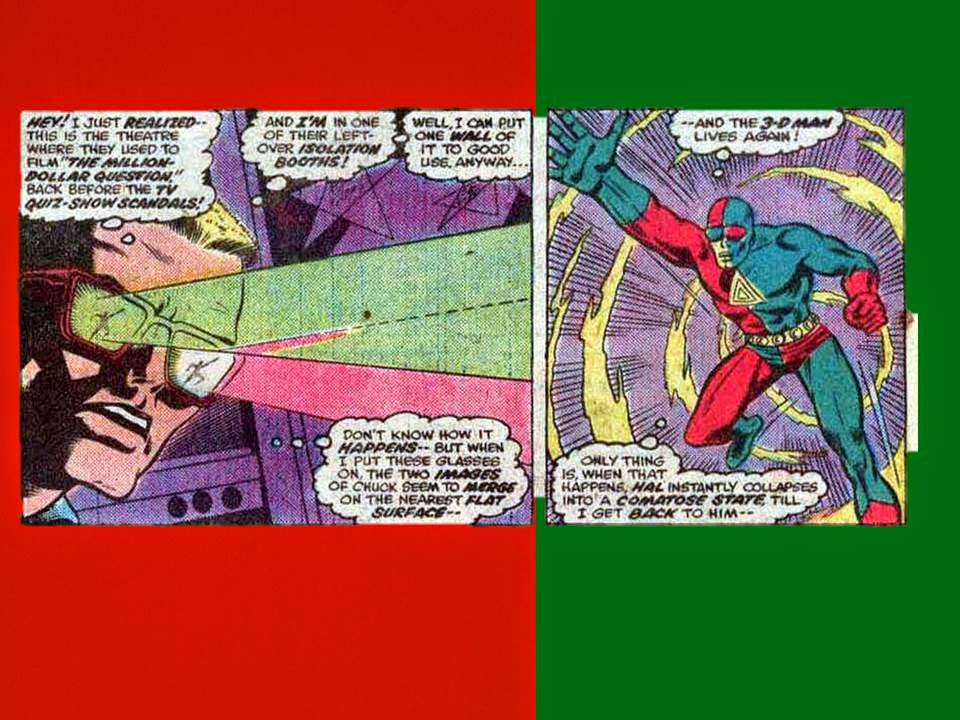
Premiering in Marvel Premiere #35 (April, 1977 by Roy Thomas and Jim Craig, and a cover by Jack Kirby), was the story of the Chandler brothers, Charles and Hal.  Chuck was a test pilot for NASA in 1958, taking out the experimental XF-13 when he had a real close encounter, with some Skrulls (a nasty shape-shifting alien race who would come to menace the Fantastic Four and the rest of Earth's heroes).  Chuck was able to escape, blowing up the Skrull ship, but it bathed him in an odd energy, and as he approached his brother Hal (as Chuck had landed at their "secret spot" in the desert), the XF-13 blew up, turning Chuck into red and green images on Hal's glasses.

For some reason, Hal later thought to put on those glasses and look at a wall, and thus came into being....the 3-D Man!  Blessed with 3 times the abilities of a normal man, Chuck Chandler materialized in a red and green hybrid of his flight suit (sending his brother into a coma), and could appear to fight crime (and sense Skrulls) for 3 hours at a time (and this was his first adventure out and about).    

Two Dimensions


With the second appearance of 3-D Man in Marvel Premiere #36 (June, 1977, by Roy Thomas and Jim Craig, with a plotting assist by Don Glut, and cover by Gil Kane and Joe Sinnott), the action kicked into high gear, with the second manifestation of 3-D Man (as well as Zirksu, the Skrull that he faces), manipulating new rock and roll sensation, Vince Rivers, into inciting the nation's youth into a violent frenzy!  During the course of this adventure, we learn that merging seems to have cured Hal's polio, that Chuck's dad wasn't dealing well with the supposed death of his test pilot son, with Hal and Chuck's girlfriend, Peggy, getting closer as she drove Hal to a Vince Rivers concern, where the 3-Man foiled the Skrull's plot (but was unable to find the Skrull).

3-D Man also mentioned the Invaders and All-Winners Squad (previous hero teams that existed in the 1940s, which included Captain America, the Sub-Mariner and the original Human Torch), and 3-D Man met Peggy, and in a letter's page column, Roy Thomas explained his fascination with the 1950s and how that let to him creating this hero of the 1950s in the 1970s!

Three Dimensions


In Marvel Premiere #37 (August, 1977, also by Roy Thomas and Jim Craig, and plot assist by Don Glut, and cover by Gil Kane and Joe Sinnott), Zirksu stepped up his plans against 3-D Man, having followed the hero (who found the device the Skrull used to incite the riots at the concert), and blasted 3-D Man and Hal as the multi-hued hero returned to Hal's body for the third time (though the Skrull was surprised there was not more of an affect of the blast).  Hal returned home with Peggy, and Zirksu (taking the guise of then Vice President Richard Nixon) helped a Commie hating professor named Sinkowitz transform himself into the Cold Warrior (using Skrull science to enhance the professor's own), making a foe for the 3-D Man (who was half-red after all).

When 3-D Man was next manifested by Hal, Hal's mind was in control...and he fought the Cold Warrior and beat him.  This was enough of a setback for the Skrull abandon his Nixon identity and to disappear...as did the 3-D Man for a time!

And Beyond!


But, the 3-D Man did come back, in the Incredible Hulk #251 (September, 1980, by Bill Mantlo and Sal Buscema, with a cover by Michael Golden), with quite some time having passed for Hal and family...

...Hal had married Peggy Clark, and they had two sons, Chuck Chandler and Hal Chandler Jr., and Hal had retired the 3D-Man, concentrating instead on his career and family.

When the family discovered Bruce Banner, Hal invited him into his home (but in reality, Hal recognized Bruce as the alter-ego of the Hulk, and called the military to bring him in).  At the same time, Rick Jones (a friend of the Hulk's) had encountered trouble and sent out a distress call via ham radio to the Teen Brigade and more (with the younger Chuck Chandler hearing the call on his dad's equipment).  The Hulk changed in the house, prompting Hal to call on 3-D Man again (who manifested with Chuck's mind) and the Hulk and 3-D Man battled for a bit, as 3-D Man also tried to process all the changes that had happened since he last appeared!  3-D Man eventually helped Hulk leave to go aid Rick and his friends, and Hal came clean with Peggy about the 3-D Man and how the original Chuck Chandler survived within him (and dealing with their destroyed house in Incredible Hulk #252).  3-D Man also appeared in the gathering of heroes in Marvel Super Hero Contest of Champions #1 in June, 1982, but he was just a face in the crowd at that point...  

Further Out


The 3-D Man stayed out of the limelight yet again, but there was a new hero, Triathlon (Delroy Garrett Jr.), who premiered in Avengers #8 (September, 1998, by Kurt Busiek and George Perez) who seemed awfully familiar...and the link between him and 3-D Man was explored in Avengers #50-56 (also known as Avengers #465-471, as suddenly finding your roots became popular) in 2002, and the Avengers dealt with their time-traveling foe, Kang, and Triathlon returning Hal and Charles Chandler to Peggy (the brothers being minus their powers, but Triathlon still having the abilities of 3 men).


Side Trip


But, what if the Avengers had formed during the 1950s instead of the 1960s?  Would 3-D Man have been a member?

It was exactly that question that led to the alternate world of What If? #9 (June, 1978 written by Don Glut, and art by Alan Kupperberg and Bill Black, taking the concept from Roy Thomas) and the formation of the 1950s Avengers, with 3-D Man joining forces with heroes of Marvel Comics of the 1950s (Venus the goddess, the Human Robot, the Gorilla Man, Marvel Boy and foe of the Yellow Claw...Jimmy Woo).  The team battled a gathering of their foes, but Eisenhower did not want them to stay together as a team.  This reality was developed further in Avengers Forever #4 and #5 (in 1999), wherein a Skrull posing as Nixon tried to take over America's space program in 1959...at least until Immortus (another time traveling Avengers villain) shut down this reality.... 


And Back Home


Thing is, minus 3-D Man (and including Namora, the Sub-Mariner's cousin), this group did form briefly in the regular Marvel Universe in the 1958 (as Department Zero and the G-Men)...as S.H.I.E.L.D. later learned, and Jimmy Woo (who had later joined S.H.I.E.L.D., and was even part of the S.H.I.E.L.D. team to face Godzilla), and this group reformed as the Agents of Atlas when Jimmy was injured (in Agents of Atlas #1, October, 2006, the beginning of a 6 issue limited series by Jeff Parker and Leonard Kirk, which let to the regular Agents of Atlas series which lasted 11 issues in 2009).

Finally In Focus


With the threat of Skrull Secret Invasion, Delroy joined the Avengers Initiative program, taking over the 3-D Man identity with Avengers: the Initiative #12 (June, 2008), fighting the Skrulls in Avengers: the Initiative #16-19, and eventually working with the Agents of Atlas in Atlas #1-5 (2010). 


Wednesday, January 7, 2015

Captain America of the 1950s

Steve Rogers was the first Captain America, but he wasn't always the Captain America of the 20th Century.  There was a man who took up the spirit of Cap, and another patriot who wore Captain America's suit...

...and then there was the Captain America of the 1950s book published by Atlas Comics (a precursor to Marvel Comics), at a time when monsters ruled the comics!

"The Real Captain America"


Though Captain America appeared in comics in the 1950s when there was a slight revival of super-heroes, Steve Rogers was at this time frozen in ice, awaiting to be found by the Sub-Mariner and the Avengers.

In comes William Burnside, a devoted Captain America fan, had surgery to look like Steve Rogers (and even legally adopted his name).  Burnside recruited Jack Monroe to be his Bucky, and the treated the two to a version of the super-soldier serum...and they fought the red menace of Communism...at least until the two went crazy and were locked away by the U.S. government for a time.

Steve Englehart and Sal Buscema introduced the readers (and the Falcon, Captain America's partner at the time) to the 1950s Captain America with Captain America #153 (September, 1972), wherein Falcon faced a Captain America and Bucky who were looking for the real America (that being the recently escaped Burnside and Monroe).  Over the course of Captain America #154-156, Burnside captures Falcon to get info on Captain America, Falcon escapes and goes to the Avengers, Burnside faces the real Captain America and explains his origins (in Captain America #155), and the real Captain America defeats Burnside in the end.

Captain America Returns


Burnside returns as a pawn of other villains under a different identity in Captain America #231-236 (1979).

Burnside then returned again proclaiming himself the real Captain America in Captain America #36-49, #600-605 (2008-2010), when the original Bucky served as Captain America for a time.


Jack Monroe was cured of his problems and took up the identity of Nomad (an identity Cap himself took on when he gave up being Captain America for a time) starting with Captain America #282 (June, 1983, by J.M. DeMatteis and Mike Zeck).

This Nomad even ended up with a four issue mini-series and a twenty five run in his own title for a time in the 1990s...

Captain America History


Here are the Atlas issues where Burnside and Monroe were Captain America and Bucky (though they are referred to as Steve Rogers and James Barnes in the issues), and the two face the various Communist menaces of the day (such as the Man with No Face and Electro, as well as his own version of the Red Skull, a fellow by the name of Albert Malik), though the original Human Torch monopolized the covers of the early stories.

Young Men #24-27 (December, 1953  thru April, 1954), Men's Adventures #27 (May, 1954)

Captain America Comics #76 (May, 1954), Young Men #28 (June, 1954), Men's Adventures #28 (July, 1954), Captain America Comics #77 (July, 1954), ending his reign of terror in Captain America Comics #78 (September,1954).

All this covers Captain America until he's found by the Avengers in Avengers #4 (March, 1964).